
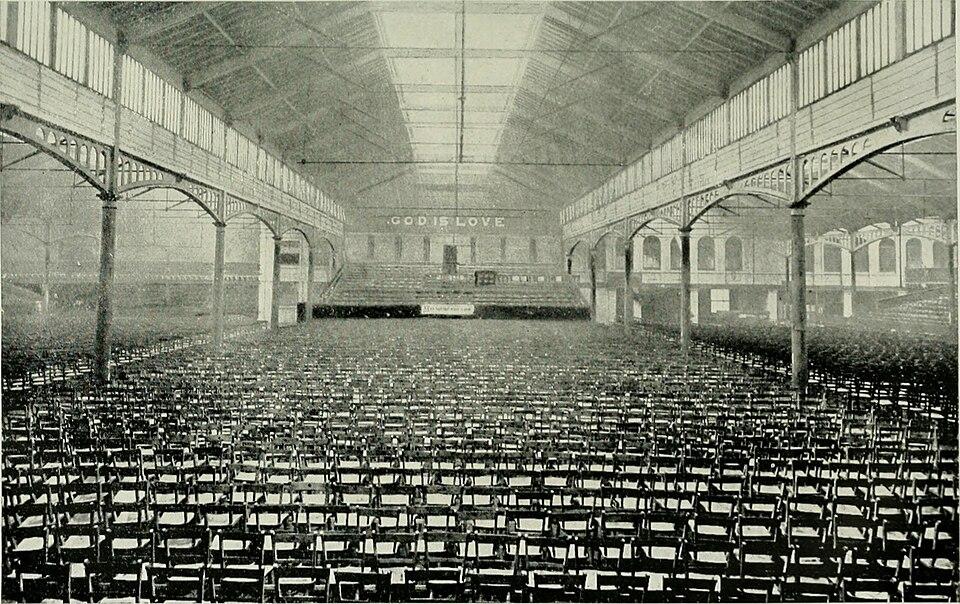
Ira D. Sankey, My Life and Sacred Songs, 1906. Public domain.
1736 to 1905 · Subject · Featured Study
Songs of the Revivals
The Wesleys' first hymn books, Sankey's hymn book, Fanny Crosby and the love song of Wales are each told from their writers' own records.
- Books
- Colossians, Ephesians, Acts, Psalms
- Hold in memory
- Colossians 3:16, Acts 16:25
Every one of the first 500 copies of Sankey's hymn book was bought on the day it was first used, at Sunderland.
Let the word of Christ richly dwell within you as you teach and admonish one another with all wisdom, and as you sing psalms, hymns, and spiritual songs with gratitude in your hearts to God.
Summary
Each awakening left songs that its own people wrote, printed and sang in the meetings. Their records survive for five of them: the Moravians, the Wesleys, Sankey, Fanny Crosby and the Welsh revival.
- John Wesley heard the Moravians sing on through a storm at sea on 25 January 1736.
- And Can It Be was first printed under the title Free Grace.
- Sankey's Sacred Songs and Solos began as 23 pieces cut from his scrapbook.
- Stead found that three-fourths of a Welsh meeting in 1904 was singing.
The Verses on Singing in the Church
Paul tells the churches to teach one another in song, and Acts shows two prisoners singing at midnight.
The hymn writers of the revivals wrote for congregations to sing, and these verses name what such singing does.
Singing that teaches
Do not get drunk on wine, which leads to reckless indiscretion. Instead, be filled with the Spirit. Speak to one another with psalms, hymns, and spiritual songs. Sing and make music in your hearts to the Lord,
Paul ties being filled with the Spirit to speaking to one another in song.
Singing in the night
About midnight Paul and Silas were praying and singing hymns to God, and the other prisoners were listening to them.
It shows a song sung under trial still reaching those who hear it, as Psalm 40 says of the new song.
Acts 16:25BSB
He put a new song in my mouth, a hymn of praise to our God. Many will see and fear and put their trust in the LORD.
The psalmist says God put a new song in his mouth, and many will see and trust.
Psalm 40:3BSB
Acts 16:25, Psalm 40:3
Five Songs and Their Records
Five hymns, in the order they were made.
The five songs run from the Wesleys' first hymn books to the Welsh revival, about 165 years.
| Song | Writer | Year | The record |
|---|---|---|---|
| And Can It Be, printed as Free Grace | Charles Wesley | 1739 | Hymns and Sacred Poems, 1739, page 117 |
| Jesu, Thy Blood and Righteousness | From Zinzendorf's German, in the Wesleys' English | 1740 | Hymns and Sacred Poems, 1740, page 177 |
| Blessed Assurance | Fanny Crosby, to a tune by Mrs. Joseph F. Knapp | 1873 | Crosby, Memories of Eighty Years, 1906 |
| The Ninety and Nine | Sung to a tune Sankey made as he sang | 1874 | Sankey, My Life, 1907 |
| Here Is Love, in Welsh | William Rees, Hiraethog | Sung in 1904 and 1905 | Elvet Lewis, With Christ among the Miners, 1907 |
The Moravians and the Wesleys
The Moravians sang through a storm, Charles Wesley began a hymn, and the brothers printed one from the German.
On 25 January 1736, on the ship Simmonds bound for Georgia, John Wesley joined the German Moravians at their evening service. In the middle of their psalm the sea broke over the ship and split the mainsail, and the English passengers began to scream.
Wesley wrote that the Germans calmly sang on. When he asked one of them afterward whether they had been afraid, the man answered that their women and children were not afraid to die.
Two years later Charles Wesley recorded in his journal for 23 May 1738 that he began a hymn on his conversion. He was persuaded to break off for fear of pride, then encouraged by Mr. Bray to finish it.
The next evening his brother John was brought to him by friends and declared that he believed. They sang the hymn together, though the journal does not name it.
The brothers printed Hymns and Sacred Poems in London in 1739, and among its hymns is And Can It Be, under the title Free Grace. Their book of 1740 carries a hymn of Zinzendorf's in English, headed From the German.
George Osborn's collected edition of their poems, printed in 1868, sets Count Zinzendorf's Christi Blut und Gerechtigkeit beside that hymn.
Sankey, Fanny Crosby and Wales
A scrapbook became a hymn book, a tune asked for words, and a nation sang one love song.
Ira D. Sankey sailed to England with Moody in June 1873. He tells how he cut 23 pieces from his scrapbook for R. C. Morgan, editor of The Christian in London, who printed them as Sacred Songs and Solos.
In 1874, at a noon meeting in the Free Assembly Hall at Edinburgh, Sankey sang The Ninety and Nine to the words of a poem found that year. He struck the key of A flat and made the tune as he went, and he says it was never changed.
Fanny Crosby wrote in 1906 that Blessed Assurance came in 1873 from a melody Mrs. Joseph F. Knapp played for her on the piano. Mrs. Knapp asked her what the tune said, and the words were her answer.
When Stead went to Wales during the revival of 1904, he found that three-fourths of each meeting was singing, with no hymn book and no one giving out a hymn.
Elvet Lewis, who wrote of the revival among the miners, called one hymn the mighty love song of the revival. It was Dyma gariad fel y moroedd, by Dr. William Rees, who wrote under the name Hiraethog, and it is sung in English as Here Is Love.
In Their Own Words
Charles Wesley (1707 to 1788)
The Journal of the Rev. Charles Wesley, volume 1, 23 May 1738, page 94
Charles Wesley nearly stopped his hymn.
“At nine I began an hymn upon my conversion, but was persuaded to break off, for fear of pride. Mr. Bray coming, encouraged me to proceed in spite of Satan. I prayed Christ to stand by me, and finished the hymn.”
Methodist
About this saying1 paragraph
This is the journal entry itself, from 1738.
Charles Wesley
Free Grace, in Hymns and Sacred Poems (1739), stanza 1; Osborn, volume 1, page 105
The Wesleys printed And Can It Be as Free Grace.
“And can it be, that I should gain An interest in the Saviour's blood? Died He for me?—who caused His pain! For me?—who Him to death pursued. Amazing love! how can it be That Thou, my God, shouldst die for me?”
Methodist
About this saying1 paragraph
The first stanza, as Osborn reprinted it in 1868, asks how God could die for the singer.
W. T. Stead (1849 to 1912)
The Revival in the West, in The Welsh Revival, page 45
Stead heard the meetings carried by song.
“Three-fourths of the meeting consist of singing. No one uses a hymn-book. No one gives out a hymn.”
Revival witness
About this saying1 paragraph
Stead wrote this of the Welsh meetings he attended, in a pamphlet of 1905.
How Much Did the Song Carry?
Stead gave the song the leading part in Wales, and a Welsh critic wrote a retrospect of the same revival.
Stead judged that in Wales the singing did more than the preaching to reach the hearts of the people, and that the revival followed the line of song.
J. Vyrnwy Morgan published his book on the revival in 1909 with the subtitle A Retrospect and a Criticism. He names Here Is Love as the hymn of the love of God among the themes the revival sang.
Both writers name the same hymn, and Morgan set out his book as a criticism of the revival as well as a retrospect.
Books to Read Next
Hymns and Sacred Poems
John and Charles Wesley · 1739
It is the first of the brothers' hymn books, printed in London.
Read the 1739 printingMy Life and the Story of the Gospel Hymns
Ira D. Sankey · 1907
Sankey tells how his hymn book began and how The Ninety and Nine was first sung.
Read Sankey's memoirWith Christ among the Miners
H. Elvet Lewis · 1907
Lewis records the hymns of the Welsh revival and names its love song.
Read Lewis's bookWhat the Songs Kept
The writers of these hymns left records of when and how each one was made. The churches still sing And Can It Be, Blessed Assurance and Here Is Love from the books those revivals printed.
Sources
Scripture is the Berean Standard Bible.
- The Holy Bible, Berean Standard Bible (read 2026)
- John Wesley, Journal, 25 January 1736, in N. Curnock, ed., The Journal of the Rev. John Wesley, Standard Edition, volume 1 (London: Robert Culley, 1909), pages 142 to 143.
- The Journal of the Rev. Charles Wesley, ed. Thomas Jackson, volume 1 (London: Wesleyan Methodist Book-Room, 1849), pages 94 to 95.
- John and Charles Wesley, Hymns and Sacred Poems (London: William Strahan, 1739), page 117.
- John and Charles Wesley, Hymns and Sacred Poems (London: W. Strahan, 1740), page 177.
- G. Osborn, ed., The Poetical Works of John and Charles Wesley, volume 1 (London: Wesleyan-Methodist Conference Office, 1868), pages 105 and 346 to 347.
- Ira D. Sankey, My Life and the Story of the Gospel Hymns and of Sacred Songs and Solos (New York: Harper and Brothers, 1906 and 1907), pages 47 to 48 and 268 to 271.
- Fanny Crosby, Memories of Eighty Years (Boston: James H. Earle, 1906), pages 168 and 180.
- W. T. Stead, The Revival in the West, in The Welsh Revival (Boston: The Pilgrim Press, 1905), pages 44 to 45.
- H. Elvet Lewis, With Christ among the Miners (London: Hodder and Stoughton, 1907), page 83.
- J. Vyrnwy Morgan, The Welsh Religious Revival 1904-5: A Retrospect and a Criticism (London: Chapman and Hall, 1909), page 83.
Keep Studying
Studies1
People and groups2