
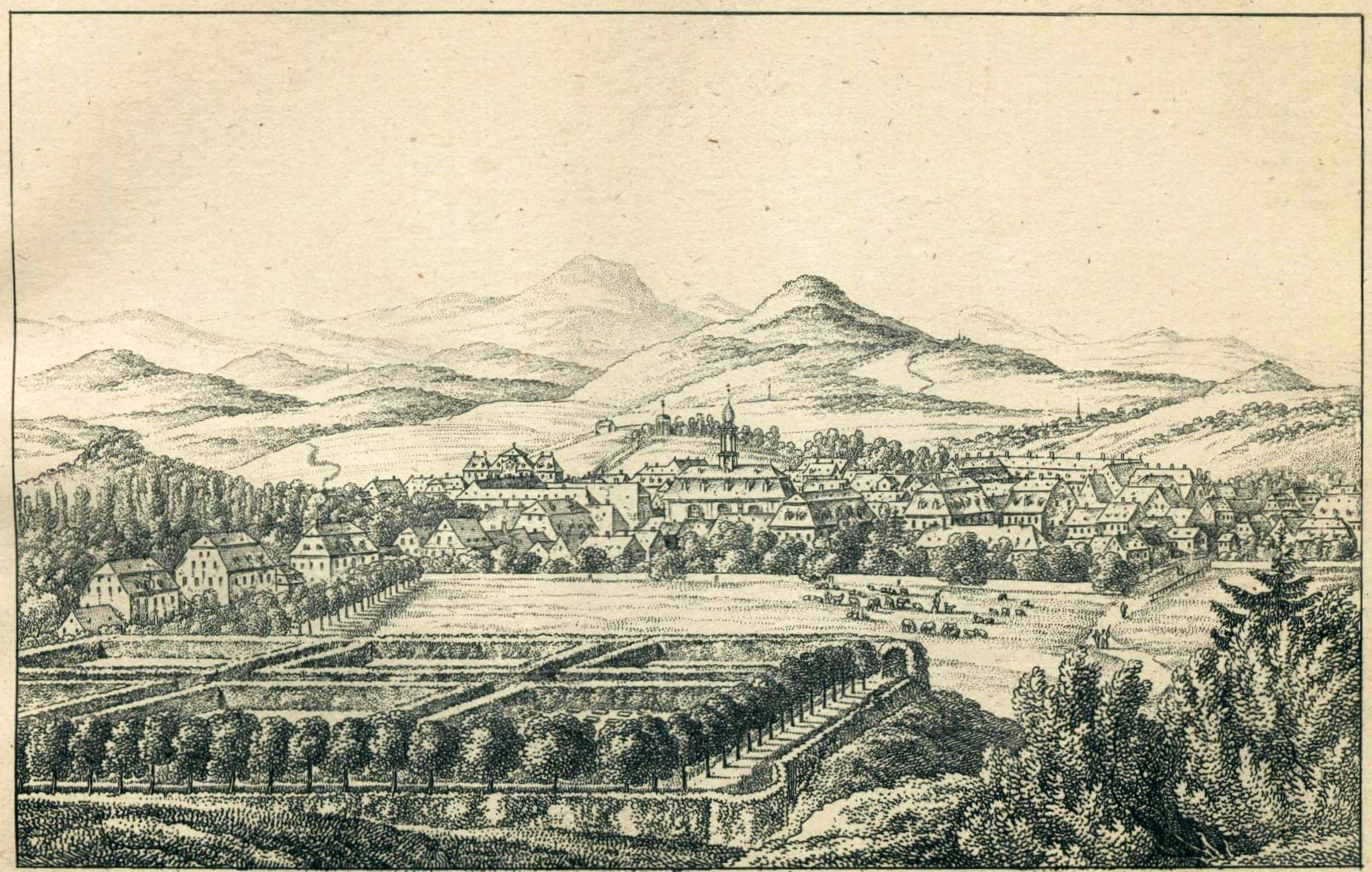
Herrnhut with the Lausche behind, Carl August and Ludwig Richter, 1820. Public domain.
AD 1728 to today · Story · Featured Study
The Daily Texts
A Saxon congregation's word for the day became a book the Brethren have issued every year since.
- When
- 1728 to today
Each evening at Herrnhut one of the elders put his hand into a box of texts and drew the word for the next day.
God is not a man, that He should lie, or a son of man, that He should change His mind. Does He speak and not act? Does He promise and not fulfill?
Summary
The daily texts, in German the Losungen, began at Herrnhut in Saxony under Count Zinzendorf, on whose land the Moravian refugees had begun to build in 1722.
- The Count held that Christ, who cared for each of His children, could be trusted to guide the hand of the elder who drew the text.
- The German words of the first watchword, as the Brethren give them today, begin Liebe hat ihn hergetrieben.
- Zinzendorf made the collection of texts for 1737 himself, before he went with Van Alphen to Utrecht.
The Texts a Watchword Gave
Two days of the first mission show the watchword at work, at Copenhagen and at sea.
At Copenhagen in 1732 the two missionaries took Numbers 23:19 from the congregation's watchword booklet, when they did not know how to go on. Oldendorp's history of the mission notes the day's watchword beside the day's events, as on 7 December 1732.
Without speech or language, without a sound to be heard,It was the congregation's watchword on the day the two missionaries sighted the first island of the Caribbean.
The Story From the Box to the Book
It moves from a word spoken at an evening meeting to a printed book for the whole year.
Hutton tells that the Count first gave a short address on a text or a verse of a hymn at the evening singing meeting, and next morning had the passage taken round by the elders to every house.
In 1728, Hutton writes, the elders chose a number of texts and verses in advance and put them in a box.
The lot is cast into the lap, but its every decision is from the LORD.MannaFest sets this verse here because the elders left the day's word to the drawing of a lot.
In 1731 the Count had the texts for the whole year printed. Hutton, who had a copy before him, writes that the first book has one text for each day, all from the New Testament.
Zinzendorf spent his last days, in 1760, revising the text-book.
For they are not idle words to you, because they are your life, and by them you will live long in the land that you are crossing the Jordan to possess.”Hutton says Dober found this verse in his text-book in the summer of 1731, where the Memorial Days say he opened the Bible.
From 1740 the book gave a second text for each day.
“We can plainly see that the LORD has been with you,” they replied. “We recommend that there should now be an oath between us and you. Let us make a covenant with youIt is the first text of the English Daily Words for 1766, given for New Year's Day with a line of a hymn under it.
Who Tells the Story
The Brethren's own historians tell it, and the publisher of the book today tells its reach.
Spangenberg's Life of Zinzendorf, Cranz's History of the Brethren in La Trobe's English of 1780 and Holmes's History of 1825 are the church's own histories.
The numbers of languages and readers today come from the Brethren's own pages, which speak for the book they publish.
What the Record Leaves Unsaid
Two facts of the book's history are not recorded.
The title of the book of 1731 is not known. Today's drawn text is from the Old Testament, and when the drawing came to take it from there is not recorded.
The Book Today
The book is still made at Herrnhut, three years ahead of its year.
The Brethren's page says the Old Testament Losung is drawn by lot and the other texts are chosen to fit it. The collection it is drawn from is 1,834 numbered cards, and the texts for 2029 were drawn on 22 April 2026.
One page of the Brethren says the book is translated into over 60 languages, and another says more than 55. The Moravian Church in America counts 1.5 million readers.
In January 2025 the Moravian Church in America wrote that Dietrich Bonhoeffer “grew up using the Moravian Daily Text (Die Losungen)” and read it daily until his imprisonment.
In Their Own Words
A carpenter of Herrnhut, the Count's biographer and a minister of the Brethren describe the daily word.
Christian David (1690 to 1751)
his letter to J. G. Heitz, in Memorial Days of the Renewed Church of the Brethren, appendix C, page 123
The daily word
“In the evening the Count holds a singing meeting, at which he explains the Daily Word.”
Moravian Brethren
About this saying1 paragraph
Christian David described an evening at Herrnhut about 1728.
August Gottlieb Spangenberg (1704 to 1792)
The Life of Nicholas Lewis Count Zinzendorf, translated by Samuel Jackson, page 95
A watch-word for the following day
“About this time he began to speak upon a passage of Scripture, or a verse of a hymn, in the singing-meetings, which were held every evening, and this gave occasion to the daily ‘watch-words;’ for when the singing-meeting was over, he gave the text, or verse of a hymn, on which he had spoken, to the brethren and sisters as a watch-word for the following day. He made the commencement on the 3d of May, and gave the following verse as a watchword:— ‘'Twas love that urged him from above; 'Twas love that forced him from his throne. Then let me give him love for love, And once more yield him up his own.’”
Moravian Brethren
About this saying1 paragraph
The first watchword, early in the eighteenth century, came from a hymn on the love of Christ.
August Gottlieb Spangenberg
The Life of Nicholas Lewis Count Zinzendorf, translated by Samuel Jackson, page 406
The watchwords verified
“The Count concluded the year, after addressing the children at Great Hennersdorf, in the customary manner with the church. He first of all spoke upon the watchword for the day, ‘Lo, I am with you always, even to the end of the world;’ and asserted that the watchwords in the beginning of the year had been verified.”
Moravian Brethren
About this saying1 paragraph
This was the Count's word at the turn of a year in the middle of the eighteenth century.
John Holmes (1767 to 1843)
History of the Protestant Church of the United Brethren, volume I, pages 295 to 296
Chosen by the elders
“The selection is made by the Elders' Conference of the Unity, in a full meeting of the Board, and sufficiently early in the year, to be forwarded in time to their several congregations and missionary stations. It consists of two parts, the former containing Texts from the Old Testament, and the latter from the New”
Moravian Brethren
About this saying1 paragraph
A minister of the Brethren set down in 1825 how the book was made.
August Gottlieb Spangenberg, John Holmes
Where Historians Disagree
The witnesses give two beginnings for the watchword, a year apart.
When did the watchword begin?2 paragraphs
Spangenberg dates the first watchword to May 1728, and Cranz says the text was carried from house to house in the year 1728.
Against that reading, Hutton tells the Count's evening practice first and then says the practice was better organized in the next year, 1728, which puts its start in 1727.
Books to Read Next
Three free books tell the story, from 1780 to 1909.
The Life of Nicholas Lewis Count Zinzendorf
A. G. Spangenberg, translated by Samuel Jackson · 1838
It gives the first watchword and the Count's year-end words on the texts.
Read it free onlineThe Ancient and Modern History of the Brethren
David Cranz, translated by Benjamin La Trobe · 1780
It is the Brethren's own history of their customs, the watchword among them.
Read it free onlineA History of the Moravian Church
J. E. Hutton · 1909
It tells the elders' box of 1728 and the first printing.
Read it free onlineWhat the Daily Texts Left
The daily texts left an unbroken series. The Moravian Archives at Bethlehem hold a complete collection of the Daily Texts back to 1728.
Sources
Scripture is the Berean Standard Bible.
- The Holy Bible, Berean Standard Bible (read 2026)
- J. E. Hutton, A History of the Moravian Church (London, 1909), Book Two, chapter IV, and footnote 80.
- A. G. Spangenberg, The Life of Nicholas Lewis Count Zinzendorf, translated by Samuel Jackson (London, 1838), page 95.
- Memorial Days of the Renewed Church of the Brethren (Ashton-under-Lyne: T. Cunningham, 1822), appendix C and chapter VI.
- C. G. A. Oldendorp, Geschichte der Mission der evangelischen Brüder auf den caraibischen Inseln, edited by J. J. Bossart, second part (Barby, 1777), pages 459 to 462.
- David Cranz, The Ancient and Modern History of the Brethren, translated by Benjamin La Trobe (London: W. and A. Strahan, 1780), page 124.
- John Holmes, History of the Protestant Church of the United Brethren, volume I (London, 1825), pages 295 to 296.
- The Daily Words of the Brethren's Congregation, for the year 1766 (London), New Year's Day.
- Evangelische Brüder-Unität, Herrnhuter Brüdergemeine, Die Losungen.
- Losungen.de, Jedes Jahr.
- The Moravian Church in America, 2026 Daily Texts now available (July 2025), and Bonhoeffer: Pastor, Spy, Assassin, a review (January 2025)
- Moravian Archives, Bethlehem, The Daily Text Collection.
Keep Studying
People and groups6
Doctrines1
Church history2