
AD 1727 and after · Story · Featured Study
The Hundred-Year Prayer Watch
The men and women of Herrnhut shared out every hour of the day and night so that someone was always praying.
A critic of 1753 mocked the praying people of Herrnhut, who knew their hour, he wrote, without call, clock or watch.
- When
- 22 August 1727 to 1855
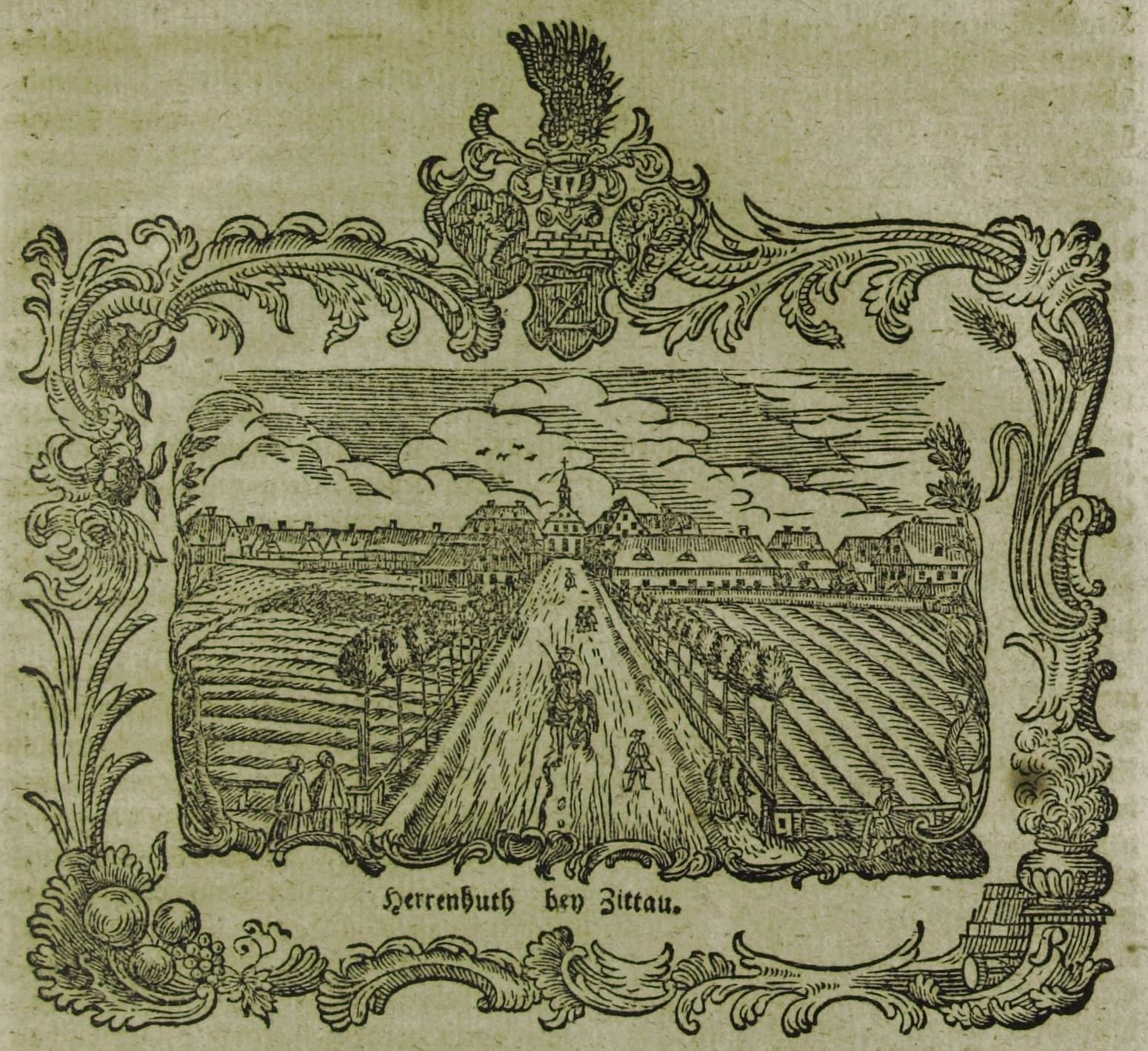
Herrnhut near Zittau, a woodcut of 1771, public domain
The fire shall be kept burning on the altar continually; it must not be extinguished.
Summary
Herrnhut, a village of Moravian refugees on Count Zinzendorf's land in Saxony, began its watch in the summer of 1727. The community's own records give the start, and the synods of later years record that it decayed and was reformed.
- The steward Heitz had written to the Count that he hoped no silence might be on the hill by day or night, as Hutton gives his letter.
- The awakened children of Herrnhut began a plan of their own like the watch.
- Hutton, the Moravian historian, called it one of the most remarkable prayer unions ever organized.
The Watchmen on the Walls
William Binnie wrote in 1883 that the Brethren's name for their watch alluded to these verses.
The steward Heitz preached on these verses at the dedication of the first house of Herrnhut, about Martinmas 1722.
On your walls, O Jerusalem, I have posted watchmen; they will never be silent day or night. You who call on the LORD shall take no rest for yourselves, nor give Him any rest until He establishes Jerusalem and makes her the praise of the earth.The synod of 1855 at Bethlehem said the founders had fulfilled these verses by the hourly intercession.
The Counts of the First Intercessors
Four witnesses count the first intercessors, and they disagree on the number and on how the hours were shared.
The diary counts forty-eight who drew their hours by lot, and Spangenberg counts twenty-four who chose them.
| Witness | How many began | How the hours were shared |
|---|---|---|
| The diary, in the Memorial Days | Twenty-four Brethren and as many Sisters covenanted on 26 August, and the number rose to seventy-seven. | They divided the twenty-four hours among themselves by lot. |
| Spangenberg, in his Life of Zinzendorf | Twenty-four brethren and sisters began, and the number soon rose to seventy-seven. | Each person picked his own hour. |
| Cranz, in his History of the Brethren of 1780 | Some Brethren and Sisters began, and he gives no number. | One or more of them prayed in each hour. |
| Holmes, in his History of 1825 | Upwards of seventy formed the plan. | Two or more prayed each hour, each choosing his own. |
The Story From the Resolve to the Memorial Day
It moves from a diary entry of August 1727 to the memorial day printed by 1766.
The diary of Herrnhut dates the resolve to 22 August 1727. On the 23rd fourteen Brethren offered themselves, and on 27 August the new rule was put into practice.
The intercessors kept their hours alone, each in his own place of retirement. One who could not spend the whole hour in prayer, from “indigence of spirit” or the business of his office, might sing hymns of praise in it instead, since nothing forced was to obtain at Herrnhut.
So Peter was kept in prison, but the church was fervently praying to God for him.The synod of 1855 set Herrnhut's watch beside the church's unceasing prayer for Peter in this verse.
A weekly meeting told the intercessors the special subjects for their prayers.
The Memorial Days give the distress of all who were known to them, in the congregation or out of it, as the matter of each hour.
Pray in the Spirit at all times, with every kind of prayer and petition. To this end, stay alert with all perseverance in your prayers for all the saints.The synod of 1855 named this verse when it described the praying church of Herrnhut.
Hutton writes that Zinzendorf brought the system of incessant hourly prayer to the converts of St Thomas when he visited the island.
By 1766 the Brethren's printed Daily Words named 27 August 1727 among their memorial days as the beginning of the hourly intercession.
Pray without ceasing.The synod of 1855 called the hourly intercession a demonstration of this command.
Who Tells the Story
The community's diary, its letters and its historians tell it.
The diary of Herrnhut survives for these days as the Memorial Days of 1822 quote it. Christian David's letter to Heitz is a second witness of the time, and the Herrnhut Constitution of 1733 is the community's own statement, laid before the theologians of Württemberg.
Spangenberg, a bishop of the Brethren, wrote the Life of Zinzendorf, which Samuel Jackson put into English in 1838. Henry Rimius, a hostile witness, attacked the Brethren in his Candid Narrative of 1753.
In Their Own Words
The diary gives the resolve, Christian David gives the name and the rule of the place, and Spangenberg gives the hours.
Christian David (1690 to 1751)
his letter to J. G. Heitz, in Memorial Days of the Renewed Church of the Brethren (Ashton-under-Lyne: T. Cunningham, 1822), appendix C, pages 123 to 124
The incense of our prayer
“We have a regulation for intercession and supplication among the Brethren, so that prayer is continually offered up during the successive twenty four hours of day and night; with a view, that as in the Old Testament, the fire on the altar was never suffered to go out, so the incense of our prayer may incessantly remain burning upon the altar of our hearts.”
Moravian Brethren
About this saying1 paragraph
Christian David listed the rules of Herrnhut about 1728, and this was the ninth.
Christian David
his prayer in the first house, from Heitz's letters, in Memorial Days of the Renewed Church of the Brethren (Ashton-under-Lyne: T. Cunningham, 1822), chapter I, page 33
The Watch of the Lord
“This place shall be called the Watch of the Lord, and they that dwell therein, are to watch day and night, lest the work of grace, here begun, should in any measure be impeded”
Moravian Brethren
About this saying1 paragraph
Christian David gave the place its name in a prayer early in the eighteenth century.
August Gottlieb Spangenberg (1704 to 1792)
The Life of Nicholas Lewis Count Zinzendorf, translated by Samuel Jackson, page 88
Silence kept neither day nor night
“Each of these individuals devoted one hour in the day or night, as best suited his convenience, to prayer before God, to filial converse with him, and to intercession for the church of Christ collectively, for the community, and, in the sequel, for all the churches of the Brethren and their choirs; for individuals, for the missionaries, the land in which they dwelt, the magistrates and teachers, the whole of Christendom, and the human race in general; so that by means of this arrangement, silence was kept neither day nor night before the Lord.”
Moravian Brethren
About this saying1 paragraph
Spangenberg tells what each intercessor's hour held, in the account printed in English in 1838.
The congregation at Herrnhut
the diary of Herrnhut, quoted in Memorial Days of the Renewed Church of the Brethren (Ashton-under-Lyne: T. Cunningham, 1822), chapter V, pages 132 to 133
A flame that should not cease
“In this view we resolved to kindle the flame of a free willing sacrifice of intercession in our place, which should not cease to burn day or night; yet we took care not to curtail or impede the effective operations of the Lord himself, in this respect, and were satisfied, merely to propose the subject to the Brethren for their consideration.”
Moravian Brethren
About this saying1 paragraph
The congregation gave its reason for the watch in August 1727.
August Gottlieb Spangenberg, The congregation at Herrnhut
Where Historians Disagree
Two questions of the watch stand here with the writers who answer them.
Did the watch run a hundred years without a break?3 paragraphs
The Herrnhut Constitution of 1733 says “this perpetual intercession has never ceased day or night since its first beginning”. Hutton wrote in 1909, “It is said to have lasted without interruption for over a hundred years”, and no earlier printing of the hundred years is known.
Against an unbroken century, Friedrich von Watteville wrote to the synod of 1769 that the Stundengebet had so decayed that hardly more than its name was left. The synod of 1818 drew up a new plan because the old one had met difficulties and objections.
At Salem in North Carolina a prayer meeting took its place in 1822. The synod of 1855 at Bethlehem asked where its American congregations still kept the practice.
Did the watch send out the missionaries?2 paragraphs
A. C. Thompson wrote in the Missionary Herald of October 1882 that from the revival came the hourly intercession and an impulse to carry the gospel to the heathen. Hence, he wrote, two missionaries set out from Herrnhut in 1732.
Against that reading, the Memorial Days tell the watch and the sending in two chapters and draw no line between them, and Thompson is the first writer known to draw it.
Books to Read Next
Three free books tell the watch, and all three are the Brethren's own.
Memorial Days of the Renewed Church of the Brethren
The Brethren's Church · 1822
It quotes the diary of August 1727 and Christian David's letter.
Read it free onlineThe Life of Nicholas Lewis Count Zinzendorf
A. G. Spangenberg, translated by Samuel Jackson · 1838
It gives the count of twenty-four and what they prayed for.
Read it free onlineJournal of the Provincial Synod of the United Brethren's Church
The Provincial Synod at Bethlehem · 1855
It is the American Brethren's own record of their synod.
Read it free onlineWhat the Watch Left
The watch left a day on the Brethren's calendar. On 27 August 1872, the memorial day of the hourly intercession, a Moravian Prayer Union was founded, as Thompson records.
Sources
Scripture is the Berean Standard Bible.
- The Holy Bible, Berean Standard Bible (read 2026)
- Memorial Days of the Renewed Church of the Brethren (Ashton-under-Lyne: T. Cunningham, 1822), chapter I page 33, chapter V pages 131 to 134 and appendix C pages 115 to 124.
- A. G. Spangenberg, The Life of Nicholas Lewis Count Zinzendorf, translated by Samuel Jackson (London, 1838), page 88.
- David Cranz, The Ancient and Modern History of the Brethren, translated by Benjamin La Trobe (London: W. and A. Strahan, 1780), pages 100 and 124 to 125.
- John Holmes, History of the Protestant Church of the United Brethren, volume I (London, 1825), pages 211 to 212.
- An Extract of the Constitution of the Church of the Moravian Brethren at Hernhuth (1733), item 10, in John Wesley, Journal, August 1738, The Works of the Reverend John Wesley (New York: J. Emory and B. Waugh, 1831), volume III, page 101.
- John Wesley, Journal, August 1738, The Works of the Reverend John Wesley (New York, 1831), volume III, pages 82 to 103.
- Henry Rimius, A Candid Narrative of the Rise and Progress of the Herrnhuters (London: A. Linde, 1753)
- Friedrich von Watteville, letter to the Synod of 1769, in E. W. Cröger, Geschichte der erneuerten Brüderkirche, part III (Gnadau, 1854), pages 119 to 120.
- Results of the Synod of 1818 and the Salem Diary of 1822, in A. L. Fries, editor, Records of the Moravians in North Carolina, volume VII (Raleigh, 1947), pages 3506 and 3562.
- Journal of the Provincial Synod of the United Brethren's Church, held at Bethlehem, May 1855 (Bethlehem, 1855), page 48.
- William Binnie, Zinzendorf, in The Evangelical Succession, second series (Edinburgh: Macniven and Wallace, 1883), page 267.
- J. E. Hutton, A History of the Moravian Church (London, 1909), Book Two, chapters III and VII.
- A. C. Thompson, A Century and a Half, Missionary Herald 78, number 10 (Boston, October 1882), page 373; and Moravian Missions: Twelve Lectures (New York, 1882)
- The Daily Words of the Brethren's Congregation, for the year 1766 (London), the list of memorial days.
Keep Studying
People and groups6