
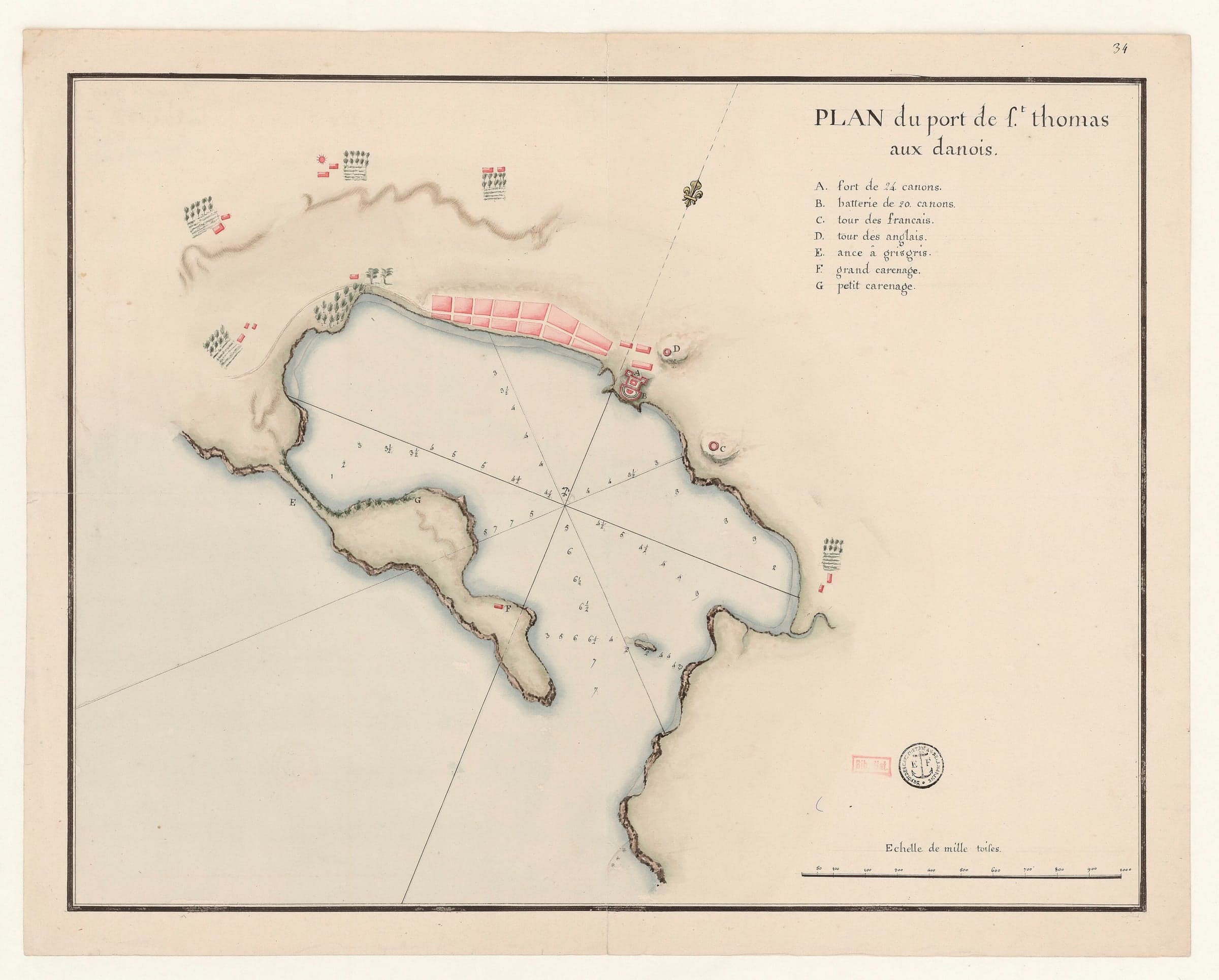
Plan of the harbour of St Thomas, public domain, File:Plan du port de St. Thomas aux Danois - btv1b53103810z.jpg
AD 1731 to 1736 · Story · Featured Study
The First Moravian Missionaries, 1732
The voyage from Copenhagen to St Thomas took the two men upwards of ten weeks.
- When
- 23 July 1731 to 30 September 1736
A man from St Thomas told the Brethren that he had often sat on its shore longing to know the truth of God.
For they are not idle words to you, because they are your life, and by them you will live long in the land that you are crossing the Jordan to possess.”
Summary
In August 1732 Leonhard Dober, a potter, and David Nitschmann, a carpenter, left Herrnhut to preach to the enslaved Africans of St Thomas in the Danish West Indies. They were the first missionaries the renewed Moravian church sent out, and their sending answered a plea made at Copenhagen the year before.
- Dober was twenty-six years old when he left Herrnhut.
- Countess Stolberg of Wernigerode was the only person on the road who favoured the plan, as the Memorial Days tell it.
- Princess Charlotte Amalie gave them money and a Dutch Bible at Copenhagen.
The Texts of the Road
The records name the verses of two days, one at sea and one on the island.
Given at sea
Without speech or language, without a sound to be heard,
It was the congregation's watchword on 7 December 1732, the day they sighted the first Caribbean island.
Psalm 19:3BSB
Read on St Thomas
Now this is eternal life, that they may know You, the only true God, and Jesus Christ, whom You have sent.
Anthony's letter to his sister quoted it, and it gave them their first word to the slaves.
John 17:3BSB
The blind receive sight, the lame walk, the lepers are cleansed, the deaf hear, the dead are raised, and the good news is preached to the poor.
It stands in the Gospel of the third Sunday in Advent, the day after they landed.
Matthew 11:5BSB
John 17:3, Matthew 11:5
The Road From Herrnhut to St Thomas
Seven stages took them from a Saxon village to a Danish island in less than four months.
They walked from Bautzen to Copenhagen and sailed from there.
| Stage | When | What happened there |
|---|---|---|
| Herrnhut | 21 August 1732, at three in the morning | The Count set out with the two men. |
| Bautzen | The same day | The Count laid his hands on Dober and blessed him. |
| Wernigerode | On the road | Countess Stolberg received them. |
| Brunswick and Hamburg | On the road | They went on by foot. |
| Copenhagen | 15 September | They reached the city and met the Company's refusal. |
| At sea | 8 October | They went on board a Dutch ship and sailed the same day. |
| St Thomas | 13 December | They came ashore on the island. |
The Story From a Plea to a Plantation
It moves from a word heard at Copenhagen to two men preaching in a slave quarter.
Zinzendorf went to Copenhagen in 1731 for the coronation of Christian VI. Some of his household met there a West Indian named Anthony, who served Count de Laurwig.
On 23 July the Count told the congregation at Herrnhut what he had heard. The next morning Dober opened his Bible and found Deuteronomy 32:47.
Dober and his friend Tobias Leupold wrote to the congregation on 25 July, four days before Anthony himself reached Herrnhut. There Anthony said a teacher could reach the slaves only by becoming a slave, which Oldendorp calls an unfounded claim.
How then can they call on the One in whom they have not believed? And how can they believe in the One of whom they have not heard? And how can they hear without someone to preach?MannaFest sets this verse beside the reason Dober gave the congregation in his memorial.
Most of the congregation thought the plan a “well meant, but impracticable intention of youths”, and a whole year went by.
Dober said he needed no lot to be sure of the Lord's mind, but left the congregation free to use one, and he drew it himself. It read, “Let the youth go, the Lord is with him!”
A lot kept Leupold back, so Dober asked for David Nitschmann, who had first met Anthony at Copenhagen. The Count sent them off with no instruction but to be led in all things by the Spirit of Jesus Christ.
Listen, O daughter! Consider and incline your ear: Forget your people and your father’s house,Dober drew this verse from Countess Stolberg's collection of texts at Wernigerode, on the road north.
At Copenhagen the directors of the West India Company would not further the plan, on the ground of the slave laws and the cost of provisions.
Chamberlain von Pless asked how they would live, and Nitschmann said he would work at his trade as a carpenter.
The court chaplains Reuss and Blum took their side, and Martens, the King's butler, found them a passage in a Dutch vessel bound for St Thomas.
God is not a man, that He should lie, or a son of man, that He should change His mind. Does He speak and not act? Does He promise and not fulfill?It came to them at Copenhagen from the congregation's watchword booklet, when they did not know how to go on.
On the island the planter Lorenzen took them into his house. The next day they found Anthony's sister Anna and his brother Abraham and read them his letter.
“For you also, said they, has Jesus procured salvation, and we are come hither for the purpose of preaching to you the Word of this Salvation.”
Listen, a tumult on the mountains, like that of a great multitude! Listen, an uproar among the kingdoms, like nations gathered together! The LORD of Hosts is mobilizing an army for war.It was the text for the day they landed.
Nitschmann earned their keep as a carpenter and sailed for home in April 1733. Dober stayed, and became tutor in the governor's family.
Leupold came out in June 1734 with a call for Dober to come home as Chief Elder of Herrnhut, and Dober sailed on 12 August.
Fight the good fight of the faith. Take hold of the eternal life to which you were called when you made the good confession before many witnesses.Dober's letter home of April 1733 borrows this verse's words when he asks for prayer.
Numbers 23:19, Isaiah 13:4, 1 Timothy 6:12
What They Offered, and What Is Often Said
The records give an offer to become slaves, and a later story turned it into a sale.
Dober's memorial to the congregation, as the Memorial Days give it in English, says he would “offer myself to be a slave” if another brother would go with him. Oldendorp's German of 1777 has the two willing to give themselves as slaves if they could win one soul for the Saviour.
The offer was never carried out, since von Pless told them no white man could be used as a slave on St Thomas. By 1797 an English heading in Rippon's Baptist Annual Register called them two missionaries “desirous of selling themselves as Slaves”.
Hutton wrote in 1909 that the statement that the first Moravian missionaries actually became slaves “is incorrect.”
The People of the Story
Seven people stand in the record, each with his calling.
The people of the sending had these callings and offices.
| Person | The part the record gives |
|---|---|
| Anthony, whom Oldendorp calls Anton | He had been taught the Christian faith and baptized at Copenhagen. |
| Leonhard Dober | He was a potter of Herrnhut, born at Münchsroth in Swabia. |
| David Nitschmann | He was a married carpenter, consecrated a bishop of the renewed church in 1735. |
| Count Zinzendorf | He was the lord of the land on which the refugees had built Herrnhut. |
| Chamberlain von Pless | He was the chief chamberlain at the Danish court. |
| Governor Gardelin | He was the newly appointed governor of St Thomas. |
| Friedrich Martin | He stood sponsor at the baptism of the boy Carmel and then went out to St Thomas. |
Who Tells the Story
The church's own books are the only accounts of the sending.
The Memorial Days of 1822 are the Brethren's own book of their remembered days, printed in English, and they quote Dober's letters. C. G. A. Oldendorp wrote the church's history of its Caribbean mission, printed at Barby in 1777 and edited by J. J. Bossart.
J. E. Hutton, a pastor whose History of the Moravian Church of 1909 the Moravian Governing Board read in manuscript, tells it a third time. Each of the three is the movement's account of itself, and the court's and the Company's side survives only as these books report it.
Where the Witnesses Differ
Three details stand in two forms, and the record does not settle them.
The landing, Nitschmann's leaving and Anthony's name each have two forms.
| The detail | One form | The other form |
|---|---|---|
| The day they landed | Oldendorp and the Memorial Days give 13 December. | Cranz gives 12 December. |
| Nitschmann's leaving | Oldendorp gives 17 April 1733. | The Memorial Days give 13 April. |
| Anthony's name | The books before 1909 call him Anthony or Anton. | Hutton alone gives him the surname Ulrich. |
The Mission and the Slave Order
The Brethren preached to the slaves and did not oppose their slavery.
The mission accepted the slave order of St Thomas. The Brethren bought the boy Carmel on the island, and Dober brought him home in 1734, as the Memorial Days record.
Hutton prints the speech Zinzendorf made to the converts of St Thomas in 1739. In it stand the words “God punished the first negroes by making them slaves,” and Hutton wrote that the Brethren “never pleaded for emancipation.”
They first preached on the island that Jesus had procured salvation for the slaves as for any man. Weighed by that word, their silence on the slave order was a failure, and their own historian records it.
In Their Own Words
Dober gives his reason and his shame, the Count names his messengers, and Carey looks back sixty years on.
Nicolaus Ludwig von Zinzendorf (1700 to 1760)
his words at Herrnhut, reported in Memorial Days of the Renewed Church of the Brethren (Ashton-under-Lyne: T. Cunningham, 1822), chapter VI, pages 138 to 139
Messengers to the heathen
“My dear Sir, there are among these Brethren, Messengers, that will go forth to the heathen in St. Thomas, Greenland, Lapland, &c.”
Moravian Brethren
About this saying1 paragraph
The Count said this to a visitor at his door in Herrnhut in July 1731, as the Memorial Days report it. The young men were walking past singing on the evening Dober and Leupold first shared their wish.
Leonhard Dober (1706 to 1766)
his memorial to the congregation, in Memorial Days of the Renewed Church of the Brethren (Ashton-under-Lyne: T. Cunningham, 1822), chapter VI, page 141
Souls who have never heard
“I leave my proposal to the decision of the Congregation, and have no other reason to urge it but this,—that I think there are yet souls on that island who cannot believe, because they have never heard.”
Moravian Brethren
About this saying1 paragraph
This was the one reason Dober gave for going, in the year of waiting, 1731 to 1732.
Leonhard Dober
his account of 1733, in Memorial Days of the Renewed Church of the Brethren (Ashton-under-Lyne: T. Cunningham, 1822), chapter VI, page 154
In the governor's house
“Yet I felt greatly ashamed, that my situation should be so different from my intended plan, which had been to be a slave in St. Thomas: and the whole manner of living was to me so strange and new, that I often felt much depression of spirits on that account.”
Moravian Brethren
About this saying1 paragraph
Dober looked back in 1733 on the plan he had brought from Herrnhut.
Leonhard Dober
his letter of April 1733, in Memorial Days of the Renewed Church of the Brethren (Ashton-under-Lyne: T. Cunningham, 1822), chapter VI, page 152
Think of me and pray for me
“I entreat you dearest Brethren to think of me, and to pray for me, that I may be enabled to continue to fight the good fight, to which I am called in the Gospel, and which I am engaged in, proving faithful unto death.”
Moravian Brethren
About this saying1 paragraph
Dober asked the congregation's prayers when Nitschmann left him alone on the island in April 1733.
William Carey (1761 to 1834)
An Enquiry into the Obligations of Christians to Use Means for the Conversion of the Heathens, section II, page 37
None of the moderns
“But none of the moderns have equalled the Moravian Brethren in this good work; they have sent missions to Greenland, Labrador, and several of the West-Indian Islands, which have been blessed for good.”
Particular Baptist
About this saying1 paragraph
Sixty years after the sending, William Carey ranked the missions of his century in 1792.
Leonhard Dober, Leonhard Dober, William Carey
What Historians Say of the Sending
Hutton weighs the sending's claim to be first, and Carey's list sets it among the missions before it.
The first Protestant missionaries?2 paragraphs
Hutton wrote that the Moravians were “the first Protestant Church in Christendom to undertake the conversion of the heathen”, and that only in that sense were they the pioneers of modern missions.
Carey's Enquiry of 1792, for its part, names Eliot of New England in 1632 and the king of Denmark's men at Tranquebar in 1706 before them.
Books to Read Next
Three free books tell the sending, and two of them come from the Brethren's own church.
Memorial Days of the Renewed Church of the Brethren
The Brethren's Church · 1822
It quotes Dober's memorial and his letters from the island.
Read it free onlineGeschichte der Mission der evangelischen Brüder auf den caraibischen Inseln
C. G. A. Oldendorp, edited by J. J. Bossart · 1777
Its second part gives the sending and the first baptisms from the mission's papers, in German.
Read it free onlineA History of the Moravian Church
J. E. Hutton · 1909
It weighs the claim to be first and the mission's part in slavery.
Read it free onlineWhat the Sending Left
On 30 September 1736 Spangenberg baptized three men on a plantation of St Thomas, after he and Friedrich Martin had judged them ready. Hutton calls Martin, who built there the strongest congregation of the mission field, the apostle to the negroes.
Sources
Scripture is the Berean Standard Bible.
- The Holy Bible, Berean Standard Bible (read 2026)
- Memorial Days of the Renewed Church of the Brethren (Ashton-under-Lyne: T. Cunningham, 1822), chapter VI, pages 135 to 157.
- C. G. A. Oldendorp, Geschichte der Mission der evangelischen Brüder auf den caraibischen Inseln S. Thomas, S. Croix und S. Jan, edited by J. J. Bossart, second part (Barby, 1777), pages 450 to 521.
- David Cranz, The Ancient and Modern History of the Brethren, translated by Benjamin La Trobe (London, 1780), pages 149 and 184.
- John Rippon, The Baptist Annual Register for 1794 to 1797 (London, 1797), An Account of Two Moravian Missionaries.
- A. G. Spangenberg, The Life of Nicholas Lewis Count Zinzendorf, translated by Samuel Jackson (London, 1838), pages 148 and 157.
- J. E. Hutton, A History of the Moravian Church (London, 1909), Book Two, chapter VI, and footnote 87.
- William Carey, An Enquiry into the Obligations of Christians to Use Means for the Conversion of the Heathens (Leicester: Ann Ireland, 1792), pages 36 and 37.
- Historical Sketch of the Church and Missions of the United Brethren, commonly called Moravians (Bethlehem, Pa.: J. and W. Held, 1848), the notice of Leonhard Dober.
Keep Studying
Studies4
People and groups5
Doctrines1