
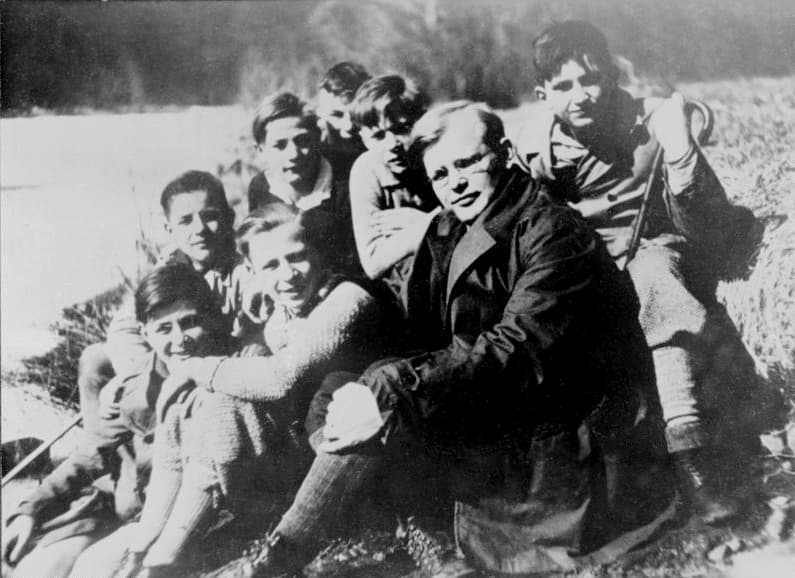
Dietrich Bonhoeffer with pupils, 1932. CC BY-SA 3.0.
AD 1728 to 1945 · Story · Featured Study
From Herrnhut to Bonhoeffer
Bonhoeffer's mother and his governess knew Herrnhut, and he read its daily texts in freedom and in prison.
- When
- 1728 to 8 April 1945
In his American diary Bonhoeffer wrote of one day's text from the Moravian book, “That follows me around all day.”
Make every effort to come to me before winter. Eubulus sends you greetings, as do Pudens, Linus, Claudia, and all the brothers.
Summary
Dietrich Bonhoeffer was a German theologian whose family and whose daily prayer both had ties to the Moravian community at Herrnhut.
- Paula von Hase, Bonhoeffer's mother, was born at Königsberg on 30 December 1876, a hundred and forty-nine years after the Herrnhut revival of 1727.
- Schlingensiepen writes that the governess Maria Horn was known in the family as Hörnchen.
- The first printed book of the Herrnhut texts, Hutton writes, had one text for each day, all of them from the New Testament.
The Texts of June 1939
Bonhoeffer read Scripture by the Brethren's calendar in New York.
He headed his entries there in June 1939 with the day's texts, among them 2 Timothy 4:21.
Your word is a lamp to my feet and a light to my path.Bonhoeffer named it with Matthew 13:8 in his diary.
The Line From the Watchwords to the Last Sunday
The daily texts ran from the Herrnhut congregation to Bonhoeffer's prison cell.
In 1728 Zinzendorf gave the Herrnhut congregation a watchword each evening for the day to come, beginning on 3 May, as Spangenberg records. Hutton writes that the elders put chosen texts into a box and drew one each evening for the next day.
In 1731 the texts for the whole year were printed.
The lot is cast into the lap, but its every decision is from the LORD.This verse is MannaFest's choice for a lot cast in trust.
Bethge writes that Paula von Hase, when she was young, spent months at Herrnhut and took up the ideals of the Moravian Brethren with youthful enthusiasm.
She married Karl Bonhoeffer on 5 March 1898. Christiane Tietz, in the publisher's extract of her Theologian of Resistance, writes that Paula always was responsible for her children's religious instruction.
I am reminded of your sincere faith, which first dwelt in your grandmother Lois and your mother Eunice, and I am convinced is in you as well.This verse is MannaFest's choice for a faith that passed from a mother to her son.
Maria Horn was the family's governess from 1906 to 1923, and Bethge calls her a real follower of the Moravian Brethren. Her sister Käthe Horn taught the twins.
And you shall teach them diligently to your children and speak of them when you sit at home and when you walk along the road, when you lie down and when you get up.This verse is MannaFest's choice for the teaching of children in a household.
In June 1939 Bonhoeffer was in New York.
From prison he later wrote that he had never regretted his decision of the summer of 1939 to go home to Germany.
“This is what the LORD of Hosts says: ‘Administer true justice. Show loving devotion and compassion to one another.It heads his diary entry of 8 June 1939.
In Tegel prison on 24 August 1943, after a night of air raids over the city, he wrote home about the Moravian text of that morning.
At Christmas 1943 he counted the exchange of the Losungen among his greatest joys, and on 21 August 1944 he wrote that he had taken up the Losungen once more.
And I will give peace to the land, and you will lie down with nothing to fear. I will rid the land of dangerous animals, and no sword will pass through your land.It is the text he wrote of, which he said struck him strangely.
On 8 April 1945, the Sunday after Easter, Bethge writes, Bonhoeffer expounded the Losung to his companions.
But He was pierced for our transgressions, He was crushed for our iniquities; the punishment that brought us peace was upon Him, and by His stripes we are healed.It is the text of that last service in Bethge's account.
Deuteronomy 6:7, Zechariah 7:9, Leviticus 26:6, Isaiah 53:5
Herrnhut and Zinzendorf in Bonhoeffer's Work
Bonhoeffer met Herrnhut in his work as well as at home.
Schlingensiepen writes that in America Bonhoeffer read, as he had done at Finkenwalde, the daily texts set in his Moravian devotional book. Bethge writes that at Finkenwalde he found a commentary by Zinzendorf on Jeremiah 15:19 to 21, and that the ordinands saw to it that it was passed round.
In 1933 an ecumenical conference at Herrnhut was called off after the invitations had gone out, for what Bethge calls obviously political reasons. Bishop Jensen of the Moravian Brethren wrote to Bonhoeffer on 6 October 1933.
Who Tells the Story
Most of the record is in Bonhoeffer's own hand.
Bonhoeffer's letters from Tegel were gathered by his friend Eberhard Bethge as Widerstand und Ergebung, and his diary of 1939 stands in English in The Way to Freedom (1966). Bethge also wrote his life, in English in 1970 and revised in 2000.
A Moravian review of January 2025 speaks for the church's own line to Bonhoeffer.
What the Record Leaves Unsaid
Some of Paula's youth has no record.
No house, year or teacher is recorded for her time at Herrnhut.
What the Line Carries
Bethge himself limits the Moravian part of Bonhoeffer's upbringing.
Bethge writes that after her marriage Paula's Moravian ideals remained below the surface, and that Maria Horn did not have much religious influence over the children.
What the record carries from Herrnhut to Bonhoeffer is a habit of reading Scripture day by day.
In Their Own Words
Bonhoeffer speaks of the daily texts in his diary, a book and a letter from prison.
Dietrich Bonhoeffer (1906 to 1945)
American diary, June 1939, in The Way to Freedom: Letters, Lectures and Notes 1935-1939, edited by Edwin H. Robertson, the diary of June 1939
Said to me
“It is not a misuse of Scripture if I take that to be said to me”
Confessing Church
About this saying1 paragraph
Bonhoeffer weighed in 1939 whether a daily text could speak to one man's choice.
Dietrich Bonhoeffer
American diary, 18 June 1939, in The Way to Freedom: Letters, Lectures and Notes 1935-1939, edited by Edwin H. Robertson, the entry of 18 June 1939
The readings of the day
“How good the readings are today!”
Confessing Church
About this saying1 paragraph
The entry of 18 June 1939 opens with this line.
Dietrich Bonhoeffer
Life Together (1939), translated by John W. Doberstein
A real blessing
“the daily Bible passages published by the Moravian Brethren, for example, are a real blessing to all who have ever used them”
Confessing Church
About this saying1 paragraph
In a book of 1939 he commended the Moravian texts to others.
Dietrich Bonhoeffer
Letter from Tegel, 21 July 1944, in Eberhard Bethge, Dietrich Bonhoeffer: Theologian, Christian, Contemporary
The day's Losungen
“At those times I simply take pleasure in the day's Losungen”
Confessing Church
About this saying1 paragraph
The day after the plot of 20 July 1944 failed, he wrote of where he found his joy.
Dietrich Bonhoeffer, Dietrich Bonhoeffer
Where Historians Disagree
Two questions of the line divide its writers.
Where did Paula learn the Moravian way?2 paragraphs
Bethge in 1970 and in 2000, and Pelikan after him in 1982, place the Moravian part of her youth at Herrnhut.
Against that place, a 2016 extract from James Clarke and Co., whose pages name no author, says she attended a Moravian boarding school at Gnadau.
Did he keep the texts in prison?2 paragraphs
A Moravian review of 2025 says he meditated on the Losungen daily until his imprisonment.
Against that limit, his letters from Tegel name the Losungen until August 1944.
Books to Read Next
Three books tell the line, the first of them Bethge's life of Bonhoeffer.
Dietrich Bonhoeffer: A Biography
Eberhard Bethge · 2000
It tells Paula's months at Herrnhut, the Horn sisters and the Losungen of 1939.
In print: find it wherever books are sold.
Life Together
Dietrich Bonhoeffer · 1939
It is Bonhoeffer's own book, in the English of 1954.
In print: find it wherever books are sold.
The Life of Nicholas Lewis Count Zinzendorf
August Gottlieb Spangenberg, translated by Samuel Jackson · 1838
It tells the first watchwords at Herrnhut in 1728.
Read it free onlineWhat the Line Left
The line from Herrnhut left Bonhoeffer the Brethren's daily texts, and his letters from Tegel left a record of one reader's use of them.
Sources
Scripture is the Berean Standard Bible.
- The Holy Bible, Berean Standard Bible (read 2026)
- Eberhard Bethge, Dietrich Bonhoeffer: Theologian, Christian, Contemporary (London: Collins, 1970)
- Eberhard Bethge, Dietrich Bonhoeffer: A Biography, revised edition (Minneapolis: Fortress, 2000)
- Dietrich Bonhoeffer, Widerstand und Ergebung: Briefe und Aufzeichnungen aus der Haft, edited by Eberhard Bethge, twelfth edition (Gütersloh: Gerd Mohn, 1983), pages 47 to 219.
- Dietrich Bonhoeffer, The Way to Freedom: Letters, Lectures and Notes 1935-1939, edited by Edwin H. Robertson (London: Collins, 1966), the American diary.
- Dietrich Bonhoeffer, Life Together, translated by John W. Doberstein (New York: Harper, 1954)
- Ferdinand Schlingensiepen, Dietrich Bonhoeffer 1906-1945: Martyr, Thinker, Man of Resistance (London: T and T Clark, 2010)
- Herbert Rainer Pelikan, Die Frömmigkeit Dietrich Bonhoeffers (Wien: Herder, 1982)
- International Bonhoeffer Society, Paula Bonhoeffer (no date given; read in 2026)
- James Clarke and Co., a Bonhoeffer life, chapter 1, Sacred Space (2016), the publisher's extract.
- Christiane Tietz, Theologian of Resistance (Minneapolis: Augsburg Fortress), chapter 1, the publisher's extract (ISBN 9781506408446)
- Moravian Church in America, a film review, Bonhoeffer: Pastor, Spy, Assassin (January 2025)
- August Gottlieb Spangenberg, The Life of Nicholas Lewis Count Zinzendorf, translated by Samuel Jackson (London: Samuel Holdsworth, 1838), page 95.
- J. E. Hutton, A History of the Moravian Church (1909)