
Matthew 17:7
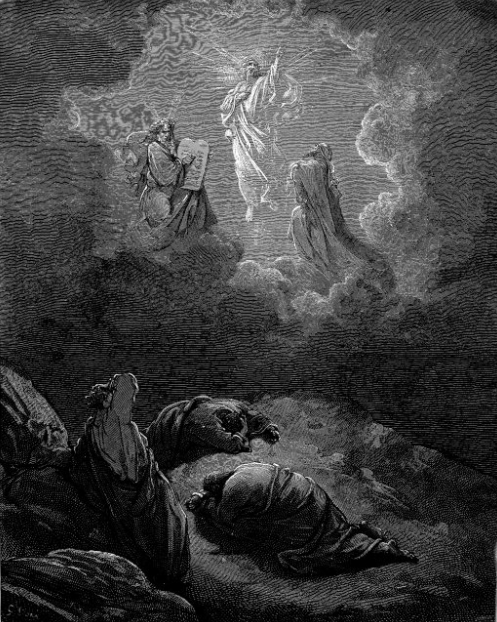
in Matthew 17Then Jesus came over and touched them. “Get up,” He said. “Do not be afraid.”
BSB
The same verse in ASV and KJV ▾
ASV
And Jesus came and touched them and said, Arise, and be not afraid.
KJV
And Jesus came and touched them, and said, Arise, and be not afraid.
⋯
This verse in Matthew 17
Commentary
12 notes on this verseAnd whereas they were laid down, and could not raise themselves again, He approaches them, touches them gently, that by His touch their fear might be banished, and their unnerved limbs gain strength; And Jesus drew near, and touched them. But He further added His word to His hand, And said unto them, Arise, fear not. He first banishes their fear, that He may after impart teaching.
This site's exposition
fell on their face, and were sore afraid
on Matthew 17:6-8
The disciples fall in terror at the voice, and Jesus comes to touch them himself, the same gesture he used on the leper of chapter 8, with the same reassurance, arise, and be not afraid. When they lift their eyes the vision has resolved to its center, they saw no man, save Jesus only, Moses and Elijah having withdrawn and left him standing alone. Chrysostom reads this closing image as the whole scene's real lesson, that every lesser glory, however great, gives way before Christ and leaves him occupying the field by himself.
The record, by era
The Church Fathers2 voices
(Verse 7) And Jesus came and touched them. Because they were lying down and unable to rise, he kindly approached and touched them, so that fear would flee with the touch and their weakened limbs would be strengthened. And he said to them: Rise up, and do not be afraid. He who healed with his hand, heals with his command. Do not be afraid. First, fear is expelled, so that later, knowledge may be given.
A commentator
John ChrysostomHomily on the Gospel of Matthew 56 · Written in the 5th century.
proposed
"And Jesus came and touched them, and said, Arise, and be not afraid. And when they lifted up their eyes, they saw no man, save Jesus only." But that the fear abiding so long might not drive out their recollection, presently He puts an end to their alarm, and is seen Himself alone, and commands them to tell no man this, until He is risen from the dead.
The Medieval Church2 voices
Then Christ's strengthening is presented. And he strengthens them by deed and by word: by deed, against fear and against falling; against fear, by his presence, because Jesus came. Psalm 22:4: I will fear no evils, for you are with me. And above at 14:27: …
And Jesus came and touched them, and said, Arise, and be not afraid. Lest the fear grip them for a long time and obliterate the memory of what they had seen, the Lord rouses them and reassures them.
The Puritans and the Awakening1 voice
And Jesus came and touched them,....
5 more voices on this verse
The Nineteenth Century5 voices
Jesus came and touched them - Exactly parallel to this account is Dan 8:18, I was in a deep sleep, i.e. (a trance) on my face towards the ground; but he Touched me, and set me upright. From Jesus alone are we to expect Divine communications, and by his power only are we able to bear and improve them.
These verses contain one of the most remarkable events in our Lord’s earthly ministry, the event commonly called the transfiguration. The order in which it is recorded is beautiful and instructive. The latter part of the last chapter showed us the cross; here we are graciously allowed to see something of the coming reward. The hearts which have just been saddened by a plain statement of Christ’s sufferings are at once gladdened by a vision of Christ’s glory. Let us mark this. We often lose much by not tracing the connection between chapter and chapter in the Word of God.
These verses contain one of the most remarkable events in our Lord’s earthly ministry, the event commonly called the transfiguration. The order in which it is recorded is beautiful and instructive. The latter part of the last chapter showed us the cross; here we are graciously allowed to see something of the coming reward. The hearts which have just been saddened by a plain statement of Christ’s sufferings are at once gladdened by a vision of Christ’s glory. Let us mark this. We often lose much by not tracing the connection between chapter and chapter in the Word of God. There are some mysterious things, no doubt, in the vision here described. It must needs be so. We are yet in the body. Our senses are conversant with gross and material things; our ideas and perceptions about glorified bodies and dead saints must necessarily be vague and imperfect. Let us content ourselves with endeavoring to mark out the practical lessons which the transfiguration is meant to teach us. In the first place we have in these verses a striking pattern of the glory in which Christ and his people will appear when he comes the second time. There can be little question that this was one main object of this wonderful vision. It was meant to encourage the disciples by giving them a glimpse of good things yet to come. That face “shining as the sun” and that raiment “white as the light” were intended to give the disciples some idea of the majesty in which Jesus will appear to the world when he comes the second time, and all his saints with him. The corner of the veil was lifted up to show them their Master’s true dignity. They were taught that if he did not yet appear to the world in the guise of a King, it was only because the time for putting on his royal apparel was not yet come. It is impossible to draw any other conclusion from St. Peter’s language when writing on the subject.
IT is exceedingly important to have clear evidences of the truth of our holy religion. Sometimes, I dare say, you have wished that God would speak out of Heaven in your hearing, or that He would work some extraordinary marvel before your eyes, that you might know beyond all question the truth of the Gospel of Jesus. This desire for signs and wonders is no new thing.
IT is exceedingly important to have clear evidences of the truth of our holy religion. Sometimes, I dare say, you have wished that God would speak out of Heaven in your hearing, or that He would work some extraordinary marvel before your eyes, that you might know beyond all question the truth of the Gospel of Jesus. This desire for signs and wonders is no new thing. Ah, my dear Friends, we know not what we ask, nor what we desire, for if such a voice were to come to us out of a bright cloud—we are made of the same flesh and blood as Peter, James and John, and it would, therefore, produce the same effect upon us as upon them—we would fall on our faces and be sorely afraid. Spirituals must grow out of spirituals—saving faith can never be produced by carnal sight and hearing. The Holy Spirit can work faith in us apart from any form of miracle and, miracle, alone, can never create a spiritual faith. Do we wish to receive a sign in order to confirm our belief in God? Suppose that we had it—we would soon need to have it repeated, for unbelief dies hard. I cannot tell how often we should need to hear the voice out of the cloud, but certainly life would soon become a misery to us, for we should be so frequently lying on our faces, so often cast into a swoon of fear, that we should be shattered, nervous and incapable of the ordinary duties of life! Like Israel at Sinai, we would begin to entreat that the Lord would not speak to us any more! The fact is that the voice of God, as absolute God, is too awful, too majestic for mortal ears—and the sight of overwhelming miracles would put such a strain upon the human mind that it is better for us to be without them.
The words behind it
12 Greek wordsEvery Greek word of this verse in the order it stands, with what it means and the door to its own study. The last column counts the times a word stands in the whole Bible: the rarer the word, the more the places it appears belong together.
| Greek | Sound | Meaning | Word study | In the Bible |
|---|---|---|---|---|
| καὶ | kai | And | G2532 → | 9120 times |
| προσῆλθεν | proselthen | he came | G4334 → | 86 times |
| ὁ | ho | <the> | G3588 → | 19766 times |
| Ἰησοῦς, | iesous | Jesus, | G2424 → | 908 times |
| καὶ | kai | and | G2532 → | 9120 times |
| ἁψάμενος | hapsamenos | having touched | G681 → | 39 times |
| αὐτῶν | auton | them | G846 → | 5565 times |
| εἶπεν· | eipen | He said; | G2036 → | 925 times |
| ἐγέρθητε | egerthete | do rise up | G1453 → | 142 times |
| καὶ | kai | and | G2532 → | 9120 times |
| μὴ | me | not | G3361 → | 1066 times |
| φοβεῖσθε. | phobeisthe | do be afraid. | G5399 → | 95 times |
καὶAnd
kaiG2532 →9120 times
προσῆλθενhe came
proselthenG4334 →86 times
ὁ<the>
hoG3588 →19766 times
Ἰησοῦς,Jesus,
iesousG2424 →908 times
καὶand
kaiG2532 →9120 times
ἁψάμενοςhaving touched
hapsamenosG681 →39 times
αὐτῶνthem
autonG846 →5565 times
εἶπεν·He said;
eipenG2036 →925 times
ἐγέρθητεdo rise up
egertheteG1453 →142 times
καὶand
kaiG2532 →9120 times
μὴnot
meG3361 →1066 times
φοβεῖσθε.do be afraid.
phobeistheG5399 →95 times
A shaded row is a word that stands 400 times or fewer in the Bible.
The walk
8 stopsEach card is a verse this one points to, and under it the verses that one points to in turn. Where several paths arrive at the same place, that place is listed first: the text keeps returning to it.
Through
Revelation 1:17When I saw Him, I fell at His feet like a dead man. But He placed His right hand on me and said, “Do not be afraid. I am the First and the Last,
it leads to
- Daniel 10:8–10
So I was left alone, gazing at this great vision. No strength remained in me; my face grew deathly pale, and I was powerless.
Reached by 2 separate paths from here.
- Isaiah 44:6
Thus says the LORD, the King and Redeemer of Israel, the LORD of Hosts: “I am the first and I am the last, and there is no God but Me.
- Revelation 22:13
I am the Alpha and the Omega, the First and the Last, the Beginning and the End.”
- Daniel 10:8–10
Through
Matthew 14:27But Jesus spoke up at once: “Take courage! It is I. Do not be afraid.”
it leads to
- John 16:33
I have told you these things so that in Me you may have peace. In the world you will have tribulation. But take courage; I have overcome the world!”
- Isaiah 41:10
Do not fear, for I am with you; do not be afraid, for I am your God. I will strengthen you; I will surely help you; I will uphold you with My right hand…
- Acts 23:11
The following night the Lord stood near Paul and said, “Take courage! As you have testified about Me in Jerusalem, so also you must testify in Rome.”
- Revelation 1:17–18
When I saw Him, I fell at His feet like a dead man. But He placed His right hand on me and said, “Do not be afraid. I am the First and the Last,
- John 16:33
Through
Daniel 10:18Again the one with the likeness of a man touched me and strengthened me.
it leads to
- Daniel 10:16
And suddenly one with the likeness of a man touched my lips, and I opened my mouth and said to the one standing before me, “My lord, because of the vision, I am overcome…
Reached by 3 separate paths from here.
- Daniel 10:16
Where this verse is studied
About Matthew
This page draws on 11 works. Open the list of works
This page draws on Adam Clarke, Commentary on the Bible; Charles Spurgeon, The Metropolitan Tabernacle Pulpit, Sermon No. 1727: “The Voice from the Cloud and the Voice of the Beloved” (lightly modernized text, CCEL edition); J.C. Ryle, Expository Thoughts on the Gospels: Matthew; Jerome, Catena Aurea by Aquinas; Jerome, Commentary on Matthew; John Chrysostom, Homilies on the Gospel of Matthew; John Chrysostom, Homily on the Gospel of Matthew 56; John Gill, Exposition of the New Testament (1746-1748); Matthew Henry, Commentary on the Whole Bible; Theophylact of Ohrid, Commentary on Matthew and Thomas Aquinas, Commentary on Matthew.