
Luke 15:22
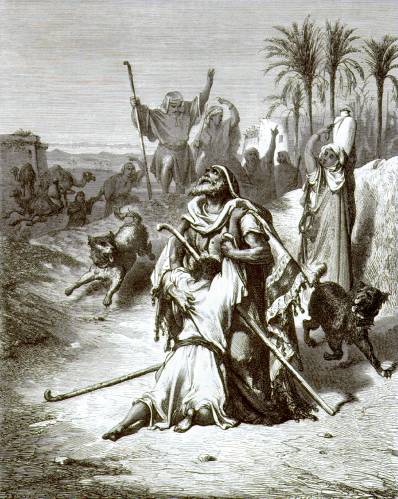
in Luke 15But the father said to his servants, ‘Quick! Bring the best robe and put it on him. Put a ring on his finger and sandals on his feet.
BSB
The same verse in ASV and KJV ▾
ASV
But the father said to his servants, Bring forth quickly the best robe, and put it on him; and put a ring on his hand, and shoes on his feet:
KJV
But the father said to his servants, Bring forth the best robe, and put it on him; and put a ring on his hand, and shoes on his feet:
⋯
This verse in Luke 15
Commentary
27 notes on this verseThen he shall get up, come to his father, and confess to him, "I have sinned against heaven and before you. I am no longer worthy to be called your son. Treat me like one of your hired servants."When he confesses like that, he will be considered worthy of more than that for which he prayed. His father neither takes him in like a hired servant nor treats him like a stranger. Oh no, he kisses him as a son. He accepts him as a dead man come back to life again.
This site's exposition
was filled with compassion
on Luke 15:20-24
His father saw him while he was still in the distance and was filled with compassion, splanchnizomai, the verb Luke keeps for the deepest mercy. He ran to his son, which no dignified householder did, and the confession stops short of the hired-servant clause as the father calls for the best robe, a ring, sandals, and the fattened calf. The father states the verdict as resurrection: this son of mine was dead and is alive again.
This site's exposition
Bring the best robe
The father answers the confession with orders to his servants. Albert Barnes notes that the son had likely come home in rags, and the robe was the best outer garment in the house. The ring and sandals complete a son's dress.
The record, by era
The Church Fathers5 voices
Or the robe is the cloke of wisdom, by which the Apostle covers the nakedness of the body. But he received the best wisdom; for there is one wisdom which knew not the mystery. The ring is the seal of our unfeigned faith, and the impression of truth; concerning which it follows, And put a ring on his hand.
(de Quæst. Ev. l. ii. q. 33.) Or the best robe is the dignity which Adam lost; the servants who bring it are the preachers of reconciliation.
Leaving those that have not strayed, the good Shepherd seeks you. If you will surrender yourself, he will not hold back. In his kindness, he will lift you up on his shoulders, rejoicing that he has found his sheep that was lost. The Father stands and awaits your return from your wandering. Only turn to him, and while you are still afar off, he will run and embrace your neck. With loving embraces, he will enfold you, now cleansed by your repentance.… He says, "Truly I say to you that there is joy in heaven before God over one sinner who repents." If any one of those who seem to stand will bring a charge that you have been quickly received, the good Father himself will answer for you. He will say, "It is fitting that we should celebrate and be glad, for this my daughter was dead and is come to life again. She was lost and is found."
What is the object of the parable? Let us examine the occasion that led to it so we will learn the truth. The blessed Luke had said a little before of Christ the Savior of us all.… The Pharisees and scribes made this outcry at his gentleness and love to people. They wickedly and impiously blamed him for receiving and teaching people whose lives were impure. Christ very necessarily set before them the present parable. He clearly shows them that the God of all requires even him who is thoroughly steadfast, firm, holy, and has attained to the highest praise for sobriety of conduct to be earnest in following his will. When any are called to repentance, even if they have a bad reputation, he must rejoice rather and not give way to an unloving irritation because of them.
It is the opinion of some that the two sons signify the holy angels and us earth dwellers. The elder one, who lived soberly, represents the company of the holy angels, while the younger and prodigal son is the human race. Some among us give it a different explanation, arguing that the older and well-behaved son signifies Israel after the flesh. The other son, who chose to live in the lust of pleasures and moved far away from his father, depicts the company of the Gentiles.
19 more voices on this verse
The Church Fathers6 voices
(Hom. de Patre et duobus Filiis.) Or he bids them put shoes on his feet, either for the sake of covering the soles of his feet that he may walk firm along the slippery path of the world, or for the mortification of his members. For the course of our life is called in the Scriptures a foot, and a kind of mortification takes place in shoes; inasmuch as they are made of the skins of dead animals. He adds also, that the fatted calf must be killed for the celebration of the feast. For it follows, And bring the fatted calf, that is, the Lord Jesus Christ, whom he calls a calf, because of the sacrifice of a body without spot; but he called it fatted, because it is rich and costly, inasmuch as it is sufficient for the salvation of the whole world. But the Father did not Himself sacrifice the calf, but gave it to be sacrificed to others. For the Father permitting, the Son consenting thereto by men was crucified.
(non occ.) The father does not direct his words to his son, but speaks to his steward, for he who repents, prays indeed, but receives no answer in word, yet beholds mercy effectual in operation. For it follows, But the father said unto his servants, Bring forth the best robe, and put it on him.
(ubi sup.) Or he orders the ring to be given, which is the symbol of the seal of salvation, or rather the badge of betrothment, and pledge of the nuptials with which Christ espouses His Church. Since the soul that recovers is united by this ring of faith to Christ.
"Give him a ring for his finger." The father's devotion is not content to restore only his innocence. It also brings back his former honor. "And give him sandals for his feet." He was rich when he departed, but how poor he has returned! Of …
Thus it was, too, that God formed man at the first, because of His munificence; but chose the patriarchs for the sake of their salvation; and prepared a people beforehand, teaching the headstrong to follow God; and raised up prophets upon earth, accustoming man to bear His Spirit [within him], and to hold communion with God: He Himself, indeed, having need of nothing, but granting communion with Himself to those who stood in need of it, and sketching out, like an architect, the plan of salvation to those that pleased Him.
"He gave the best robe," that which Adam lost, the everlasting glory of immortality. "He put a ring upon his finger." That is the ring of honor, the title of liberty, the outstanding pledge of the spirit, the seal of the faith, and the dowry …
The Medieval Church6 voices
By "servants" you can understand Angels, since they are ministering spirits sent forth to minister for those worthy of salvation (Heb. 1:14). For they clothe the one turning from wickedness in the "best robe," that is, either in the former robe of incorruption which we …
By the servants (or angels) you may understand administering spirits, or priests who by baptism and the word of teaching clothe the soul with Christ Himself. For as many of us as have been baptized in Christ have put on Christ. (Gal. 3:27.)
But the father said to his servants. After the father's mercy in receiving the unworthy one has been shown, there is here subjoined mercy in clothing the naked. And since the sinner is stripped of the garment of interior purity and the adornment of exterior …
And the father said to his servants: Quickly bring the first robe, and put it on him. The first robe is the garment of innocence, which man, well created, received but lost when poorly persuaded, when after the fault of transgression he recognized himself to …
And put a ring on his hand, and shoes on his feet. The ring is either the seal of sincere faith, by which all promises are inscribed with a certain impression in the hearts of believers, or the pledge of those nuptials by which the …
That is, his working, that by works faith may shine forth, and by faith his works be strengthened.
The Puritans and the Awakening2 voices
They are sometimes ranked with harlots ( Matt. xxi. 32 ); here and elsewhere with sinners, such as were openly vicious, that traded with harlots, known rakes. Some think that the sinners here meant were heathen, and that Christ was now on the other side Jordan, or in Galilee of the Gentiles.
But the father said to his servants,....
The Nineteenth Century5 voices
A commentator
Albert Barnes1798–1870
Notes, Explanatory and Practical, on the Old and New Testaments (1832-1869)
The best robe - The son was probably in rags. The joy of the father is expressed by clothing him in the best raiment, that he might appear well. The “robe” here mentioned is probably the outer garment; and the father told them to put on him the best one that was in the house - one reserved for festival occasions. See Gen 27:15. A ring on his hand - To wear a ring on the hand was one mark of wealth and dignity. The rich and those in office commonly wore them. Compare Jas 2:
A commentator
J.C. Ryle1816–1900
Expository Thoughts on the Gospels: Luke (lightly modernized text, Grace Gems edition) (1858)
proposed
The parable before us is commonly known as the parable of "the prodigal son." It may be truly called a mighty spiritual picture. Unlike some of our Lord's parables, it does not convey to us one great lesson only, but many. Every part of it is particularly rich in instruction. We see, firstly, in this parable — a man following the natural bent of his own heart. Our Lord shows us a "younger son" making haste to go far away from a kind father's house, and "wasting his substance in riotous living."
A commentator
J.C. Ryle1816–1900
Expository Thoughts on the Gospels: Luke (lightly modernized text, Grace Gems edition) (1858)
proposed
The parable before us is commonly known as the parable of "the prodigal son." It may be truly called a mighty spiritual picture. Unlike some of our Lord's parables, it does not convey to us one great lesson only, but many. Every part of it is particularly rich in instruction. We see, firstly, in this parable — a man following the natural bent of his own heart. Our Lord shows us a "younger son" making haste to go far away from a kind father's house, and "wasting his substance in riotous living." We have in these words, a faithful portrait of the mind with which we are all born. This is our likeness. We are all naturally proud and self-willed. We have no pleasure in fellowship with God. We long to depart, and go afar away from Him. We spend our time, and strength, and faculties, and affections — on things that cannot profit. The covetous man does it in one way; the slave of lusts and passions in another way; and the lover of pleasure in another way. In one point alone are all agreed. Like sheep, we all naturally "go astray, and turn every one to his own way." (Isaiah 53:6.) In the younger son's initial conduct, we see the natural heart of every man. He who knows nothing of these things, has yet much to learn. He is spiritually blind. The eyes of his understanding need to be opened. The worst ignorance in the world, is not to know ourselves. Happy is he who has been delivered from the kingdom of darkness — and been made acquainted with himself! Of too many it may be said, "They know not, neither will they understand. They walk on in darkness." (Psalm 82:5.) We see, secondly, in this parable — man finding out by bitter experience, that the ways of sin are hard.
LAST Lord's-Day we spoke upon the consecration of priests. That theme might seem too high for troubled hearts and trembling consciences who fear that they shall never be made priests and kings unto God. So glorious a privilege appears to them to hang in the dim, distant future, if, indeed, they reach it at all. Therefore, at this time, we will go down from the elevated regions to comfort those who are seeking the Lord—with the view of helping them, in their turn, to climb, also!
LAST Lord's-Day we spoke upon the consecration of priests. That theme might seem too high for troubled hearts and trembling consciences who fear that they shall never be made priests and kings unto God. So glorious a privilege appears to them to hang in the dim, distant future, if, indeed, they reach it at all. Therefore, at this time, we will go down from the elevated regions to comfort those who are seeking the Lord—with the view of helping them, in their turn, to climb, also! We speak this morning, not of the consecration of priests, but of the reception of sinners, and this, according to our text, is a very joyful business. It is even described as a merrymaking, accompanied with music and with dancing. We, very frequently, speak of the sorrow for sin which accompanies conversion, and I do not think we can speak of it too often. But yet there is a possibility of our overlooking the equally holy and remarkable joy which attends the return of a soul to God. It has been a very common error to suppose that a man must pass through a very considerable time of despondency, if not of horror of mind, before he can find peace with God. But in this parable the father seems determined to cut short that period. He stops his son in the very middle of his confession and, before he can ask to be made as one of the hired servants, his mournful style is changed to rejoicing, for the father has already fallen on his neck and kissed his trembling lips into a sweet silence! It is not the Lord's desire that sinners should tarry long in the state of unbelieving conviction of sin. It is something wrong in themselves which keeps them there—either they are ignorant of the freeness and fullness of Christ, they harbor self-righteous hopes—or they cling to their sins. Sin lies at the door but it is no work of God which blocks the way.
The words behind it
28 Greek wordsEvery Greek word of this verse in the order it stands, with what it means and the door to its own study. The last column counts the times a word stands in the whole Bible: the rarer the word, the more the places it appears belong together.
| Greek | Sound | Meaning | Word study | In the Bible |
|---|---|---|---|---|
| Εἶπεν | eipen | Said | G2036 → | 925 times |
| δὲ | de | then | G1161 → | 2765 times |
| ὁ | ho | the | G3588 → | 19766 times |
| πατὴρ | pater | father | G3962 → | 410 times |
| πρὸς | pros | to | G4314 → | 700 times |
| τοὺς | tous | the | G3588 → | 19766 times |
| δούλους | doulous | servants | G1401 → | 129 times |
| αὐτοῦ· | autou | of him; | G846 → | 5565 times |
| ταχὺ | tachu | Quickly | G5036 → | |
| ἐξενέγκατε | exenegkate | do bring out | G1627 → | |
| στολὴν | stolen | robe | G4749 → | |
| τὴν | ten | the | G3588 → | 19766 times |
| πρώτην | proten | best | G4413 → | 152 times |
| καὶ | kai | and | G2532 → | 9120 times |
| ἐνδύσατε | endusate | do clothe | G1746 → | 27 times |
| αὐτὸν | auton | him | G846 → | 5565 times |
| καὶ | kai | and | G2532 → | 9120 times |
| δότε | dote | do give | G1325 → | 412 times |
| δακτύλιον | daktulion | a ring | G1146 → | |
| εἰς | eis | for | G1519 → | 1755 times |
| τὴν | ten | the | G3588 → | 19766 times |
| χεῖρα | cheira | hand | G5495 → | 175 times |
| αὐτοῦ | autou | of him | G846 → | 5565 times |
| καὶ | kai | and | G2532 → | 9120 times |
| ὑποδήματα | hupodemata | sandals | G5266 → | 10 times |
| εἰς | eis | for | G1519 → | 1755 times |
| τοὺς | tous | <the> | G3588 → | 19766 times |
| πόδας, | podas | [his] feet, | G4228 → | 93 times |
ΕἶπενSaid
eipenG2036 →925 times
δὲthen
deG1161 →2765 times
ὁthe
hoG3588 →19766 times
πατὴρfather
paterG3962 →410 times
πρὸςto
prosG4314 →700 times
τοὺςthe
tousG3588 →19766 times
δούλουςservants
doulousG1401 →129 times
αὐτοῦ·of him;
autouG846 →5565 times
ταχὺQuickly
tachuG5036 →
ἐξενέγκατεdo bring out
exenegkateG1627 →
στολὴνrobe
stolenG4749 →
τὴνthe
tenG3588 →19766 times
πρώτηνbest
protenG4413 →152 times
καὶand
kaiG2532 →9120 times
ἐνδύσατεdo clothe
endusateG1746 →27 times
αὐτὸνhim
autonG846 →5565 times
καὶand
kaiG2532 →9120 times
δότεdo give
doteG1325 →412 times
δακτύλιονa ring
daktulionG1146 →
εἰςfor
eisG1519 →1755 times
τὴνthe
tenG3588 →19766 times
χεῖραhand
cheiraG5495 →175 times
αὐτοῦof him
autouG846 →5565 times
καὶand
kaiG2532 →9120 times
ὑποδήματαsandals
hupodemataG5266 →10 times
εἰςfor
eisG1519 →1755 times
τοὺς<the>
tousG3588 →19766 times
πόδας,[his] feet,
podasG4228 →93 times
A shaded row is a word that stands 400 times or fewer in the Bible.
The walk
8 stopsEach card is a verse this one points to, and under it the verses that one points to in turn. Where several paths arrive at the same place, that place is listed first: the text keeps returning to it.
Through
Isaiah 61:10I will rejoice greatly in the LORD, my soul will exult in my God; for He has clothed me with garments of salvation and wrapped me in a robe of righteousness, as a bridegroom…
it leads to
- Revelation 19:7–8
Let us rejoice and be glad and give Him the glory. For the marriage of the Lamb has come, and His bride has made herself ready.
- Philippians 3:9
and be found in Him, not having my own righteousness from the law, but that which is through faith in Christ, the righteousness from God on the basis of faith.
- Psalms 132:9
May Your priests be clothed with righteousness, and Your saints shout for joy.
- Psalms 132:16
I will clothe her priests with salvation, and her saints will sing out in joy.
- Revelation 21:2
I saw the holy city, the new Jerusalem, coming down out of heaven from God, prepared as a bride adorned for her husband.
- Revelation 19:7–8
Through
Esther 3:10So the king removed the signet ring from his finger and gave it to Haman son of Hammedatha, the Agagite, the enemy of the Jews.
it leads to
- Genesis 41:42
Then Pharaoh removed the signet ring from his finger, put it on Joseph’s finger, clothed him in garments of fine linen, and placed a gold chain around his neck.
Reached by 2 separate paths from here.
- Esther 8:2
The king removed the signet ring he had recovered from Haman and presented it to Mordecai. And Esther appointed Mordecai over the estate of Haman.
Reached by 2 separate paths from here.
- Genesis 41:42
Through
Genesis 41:42Then Pharaoh removed the signet ring from his finger, put it on Joseph’s finger, clothed him in garments of fine linen, and placed a gold chain around his neck.
it leads to
- Esther 3:10
So the king removed the signet ring from his finger and gave it to Haman son of Hammedatha, the Agagite, the enemy of the Jews.
Reached by 2 separate paths from here.
- Esther 3:10
Where this verse is studied
On this page
Studies5
On this verse
About Luke
This page draws on 21 works. Open the list of works
This page draws on Albert Barnes, Notes, Explanatory and Practical, on the Old and New Testaments (1832-1869); Alexander Maclaren, Expositions of Holy Scripture, Luke; Ambrose of Milan, Catena Aurea by Aquinas; Athanasius of Alexandria, FESTAL LETTER 7; Augustine of Hippo, Catena Aurea by Aquinas; Basil of Caesarea, LETTER 46; Bede, On the Gospel of Luke; Bede, Catena Aurea by Aquinas; Bonaventure, Commentary on Luke, Chapter 15; Charles Spurgeon, The Metropolitan Tabernacle Pulpit, Sermon No. 1204: “The Reception of Sinners” (lightly modernized text, CCEL edition); Cyril of Alexandria, COMMENTARY ON LUKE, HOMILY 107; Irenaeus, Against Heresies Book IV; J.C. Ryle, Expository Thoughts on the Gospels: Luke (lightly modernized text, Grace Gems edition); Jamieson, Fausset & Brown, Commentary Critical and Explanatory on the Whole Bible; John Chrysostom, Catena Aurea by Aquinas; John Gill, Exposition of the New Testament (1746-1748); Matthew Henry, Commentary on the Whole Bible; Peter Chrysologus, SERMON 3; Peter Chrysologus, SERMON 5; Theophylact of Ohrid, Commentary on Luke and Theophylact of Ohrid, Catena Aurea by Aquinas.