
The first thing God says
The Light
God's first recorded words make light, and He makes it three days before He makes anything to carry it. The last city in the Bible has no sun either. Between those two pages runs a thread you can follow by lamplight.
The chain
Walk the thread
Stop 1 of 9
Let there be light
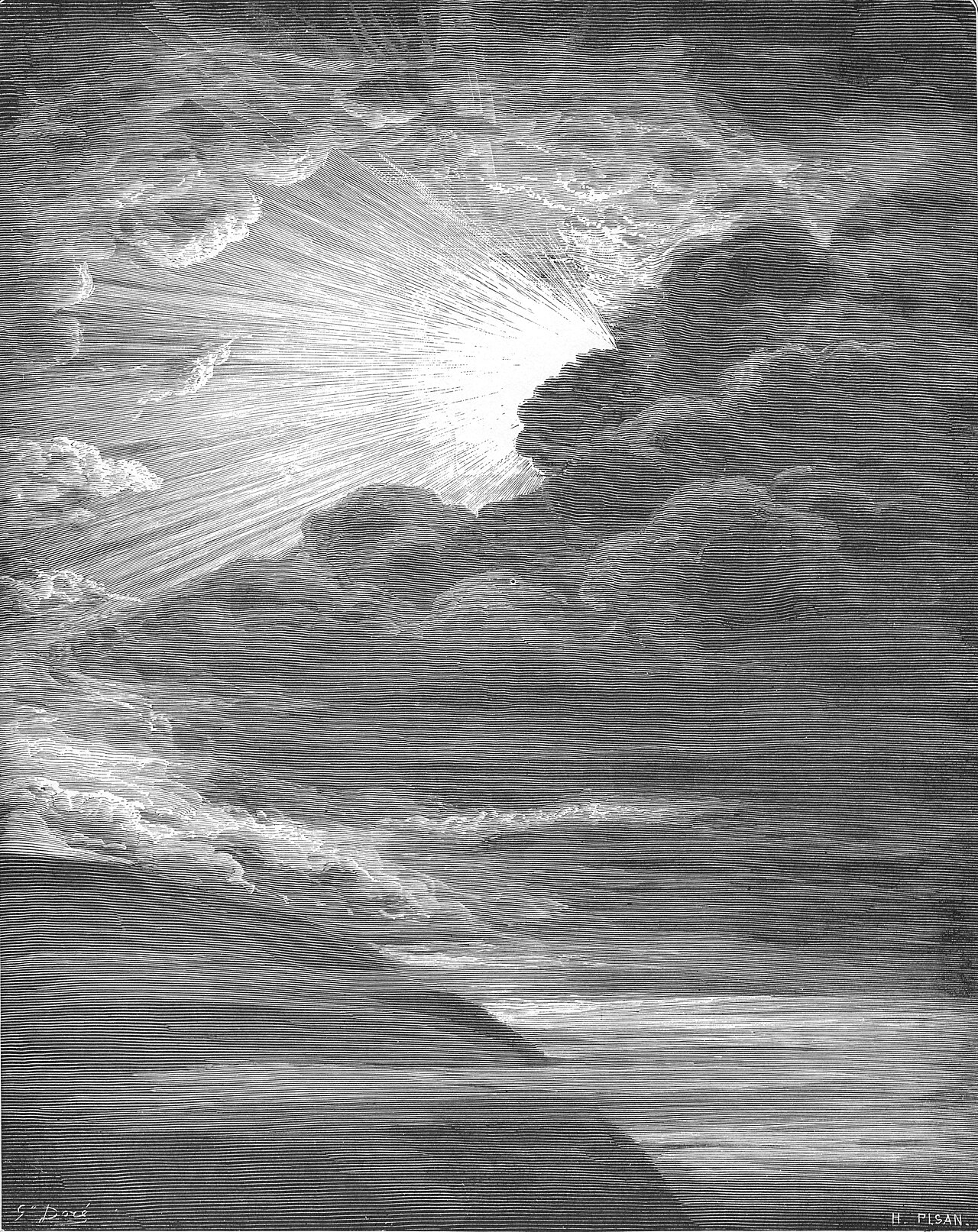
And God said, “Let there be light,” and there was light. And God saw that the light was good, and He separated the light from the darkness. God called the light “day,” and the darkness He called “night.” And there was evening, and there was morning—the first day.
Genesis 1:3–5BSB 'And God said, Let there be light: and there was light.' The noun is אוֹר (ʾor, H216). Light is spoken into being on day one; the sun, moon, and stars are not made until day four — so from the first page light is something God gives, not something a lamp produces.
Commentary on Genesis 1:3–52 voices
The first word of God created the nature of light; it made darkness vanish, dispelled gloom, illuminated the world, and gave to all beings at the same time a sweet and gracious aspect. The heavens, until then enveloped in darkness, appeared with that beauty which they still present to our eyes. The air was lighted up, or rather made the light circulate mixed with its substance, and, distributing its splendour rapidly in every direction, so dispersed itself to its extreme limits. Up it sprang to the very æther and heaven.
Basil of Caesarea· The Hexaemeron, Homily 2: The Earth Was Invisible and Unfinished, 379Patristic
How can we worthily praise light after the testimony given by the Creator to its goodness? The word, even among us, refers the judgment to the eyes, incapable of raising itself to the idea that the senses have already received. But, if beauty in bodies results from symmetry of parts, and the harmonious appearance of colours, how in a simple and homogeneous essence like light, can this idea of beauty be preserved? Would not the symmetry in light be less shown in its parts than in the pleasure and delight at the sight of it?
Basil of Caesarea· The Hexaemeron, Homily 2: The Earth Was Invisible and Unfinished, 379Patristic
Stop 2 of 9
A pillar of fire, to give them light
And the LORD went before them in a pillar of cloud to guide their way by day, and in a pillar of fire to give them light by night, so that they could travel by day or night.
Exodus 13:21BSB Light becomes a travelling companion: 'by night in a pillar of fire, to give them light; that they might go by day and by night.' The same presence that leads is the presence that illuminates — guidance and light are one object in the wilderness, not two.
Commentary on Exodus 13:211 voice
It was also fitting that a pillar of fire preceded the Israelites as they progressed through the desert during the night and a pillar of a cloud during the day. There is dread in fire but a gentle soothing quality in the sight of a cloud. "Day" is understood to point toward the life of the righteous and "night" that of the sinner. Hence Paul said to sinners who had been converted, "You were once darkness but are now light in the Lord."
Gregory the Dialogist· Forty Gospel Homilies, Homily 21, 604Patristic
Stop 3 of 9
Jehovah is my light
The LORD is my light and my salvation— whom shall I fear? The LORD is the stronghold of my life— whom shall I dread?
Psalms 27:1BSB The figure turns personal and possessive — 'Jehovah is my light and my salvation; Whom shall I fear?' — and the conclusion drawn from it is not comfort but courage. In the Hebrew Bible אוֹר (H216) is tagged in 110 verses; Job carries more of them than any other book, and Isaiah is next.
Commentary on Psalms 27:12 voices
Christians have nothing to fear, even if demons should not be well-disposed to them; for they are protected by the supreme God, who is well pleased with their piety and who sets his divine angels to watch over those who are worthy of such guardianship, so that they can suffer nothing from demons.
Origen of Alexandria· AGAINST CELSUS 8:27, 253Patristic
The Lord is my light and my salvation; whom shall I fear?....
John Gill· Exposition of the Old Testament (1748-1763)Reformed
Stop 4 of 9
The people that walked in darkness
The people walking in darkness have seen a great light; on those living in the land of the shadow of death, a light has dawned.
Isaiah 9:2BSB 'The people that walked in darkness have seen a great light.' Four verses later Isaiah names what the light turned out to be: 'For unto us a child is born, unto us a son is given' (9:6). The figure becomes a person inside a single paragraph.
Commentary on Isaiah 9:22 voices
Therefore, he had the pledge of immortality: but being placed in the shadow of life, he could not see and grasp the hidden life with Christ in God by some common touch and sight. And if not yet a sinner, certainly not of an incorruptible and inviolable nature; for he who has fallen into sin is not yet a sinner. Indeed, he was in the shadow of life; but those who are sinners are in the shadow of death.
Ambrose of Milan· On Paradise 5.29, 397Patristic
The people that walked in darkness,....
John Gill· Exposition of the Old Testament (1748-1763)Reformed
Stop 5 of 9
The true light
In Him was life, and that life was the light of men. The Light shines in the darkness, and the darkness has not overcome it. There came a man who was sent from God. His name was John. He came as a witness to testify about the Light, so that through him everyone might believe. He himself was not the Light, but he came to testify about the Light. The true Light who gives light to every man was coming into the world.
John 1:4–9BSB John's prologue puts life and light in apposition — 'In him was life; and the life was the light of men' — then reports what happened when the light arrived: 'the darkness apprehended it not.' φῶς (phōs, G5457) is tagged in 61 verses of the New Testament, and John's Gospel holds more of them than any other book.
Commentary on John 1:4–92 voices
Many read this inaccurately because they add without any punctuation, "that which has been made in him was life." The correct statement is "All things were made through him, and without him was made nothing that has been made," meaning that that which has been made without him has not been made. … Now, if all things were made through him, is the Father, on that account, excluded from creation, or Holy Spirit, and has the Son alone worked?
Jerome· HOMILY 87, ON JOHN 1.1-14, 420Patristic
And that we may not have to ask, Of what God was the Word made flesh? he does himself previously teach us, saying, "There was a man sent from God, whose name was John. The same came as a witness, that he might bear witness of that Light. He was not that Light, but [came] that he might testify of the Light." By what God, then, was John, the forerunner, who testifies of the Light, sent [into the world]?
Irenaeus· AGAINST HERESIES 3.11.4, 202Patristic
Stop 6 of 9
I am the light of the world
Once again, Jesus spoke to the people and said, “I am the light of the world. Whoever follows Me will never walk in the darkness, but will have the light of life.”
John 8:12BSB The claim is spoken in the first person and attached to a condition: 'he that followeth me shall not walk in the darkness, but shall have the light of life.' Following is what the verse asks; light is what it promises.
Stop 7 of 9
Ye are the light of the world
You are the light of the world. A city on a hill cannot be hidden.
Matthew 5:14BSB The identical phrase is handed to disciples: 'Ye are the light of the world. A city set on a hill cannot be hid.' The thread forks here — the same title, held by the source and by the borrowers, and the passage goes on to say what light is for.
Commentary on Matthew 5:141 voice
(Verset 14 et suiv.) You are the light of the world. A city set on a hill cannot be hidden. Nor do people light a lamp and put it under a basket, but on a stand, and it gives light to all in the house. In the same way, let your light shine before others, so that they may see your good works and give glory to your Father who is in heaven.
Jerome· Commentary on Matthew, 420Patristic
Stop 8 of 9
Shined in our hearts
For God, who said, “Let light shine out of darkness,” made His light shine in our hearts to give us the light of the knowledge of the glory of God in the face of Jesus Christ.
2 Corinthians 4:6BSB Paul quotes day one and applies it to conversion: 'God, that said, Light shall shine out of darkness, who shined in our hearts, to give the light of the knowledge of the glory of God in the face of Jesus Christ.' The word he uses for that illumination, φωτισμός (G5462), is tagged in only two verses of the New Testament — and both of them are this chapter, verses 4 and 6.
Commentary on 2 Corinthians 4:61 voice
But does anyone deny that the Godhead of the eternal Trinity is to be adored, when the Scriptures also set forth the inexplicable majesty of the divine Trinity, as the apostle says elsewhere: "For the God who commanded the light to shine out of darkness has shined in our hearts, to give the light of the knowledge of the glory of God, in the face of Christ Jesus?" … Who is it, then, who shined that we might know God in the face of Christ Jesus?
Ambrose of Milan· On the Holy Spirit 3.12.86. 88, 397Patristic
Stop 9 of 9
No need of the sun
And the city has no need of sun or moon to shine on it, because the glory of God illuminates the city, and the Lamb is its lamp.
Revelation 21:23BSB The city has no sun and no moon, 'for the glory of God did lighten it, and the lamp thereof is the Lamb.' Day one is undone in the best way: light without a luminary again, only now the source has a face. The Lamb thread ends on this same verse.
Commentary on Revelation 21:231 voice
And in that he says that the sun is not necessary in the city, he shows, evidently, that the Creator as the immaculate light shines in the midst of it, whose brightness no mind has been able to conceive, nor tongue to tell.
Victorinus of Pettau· Commentary on the Apocalypse of the Blessed John, 304Patristic