
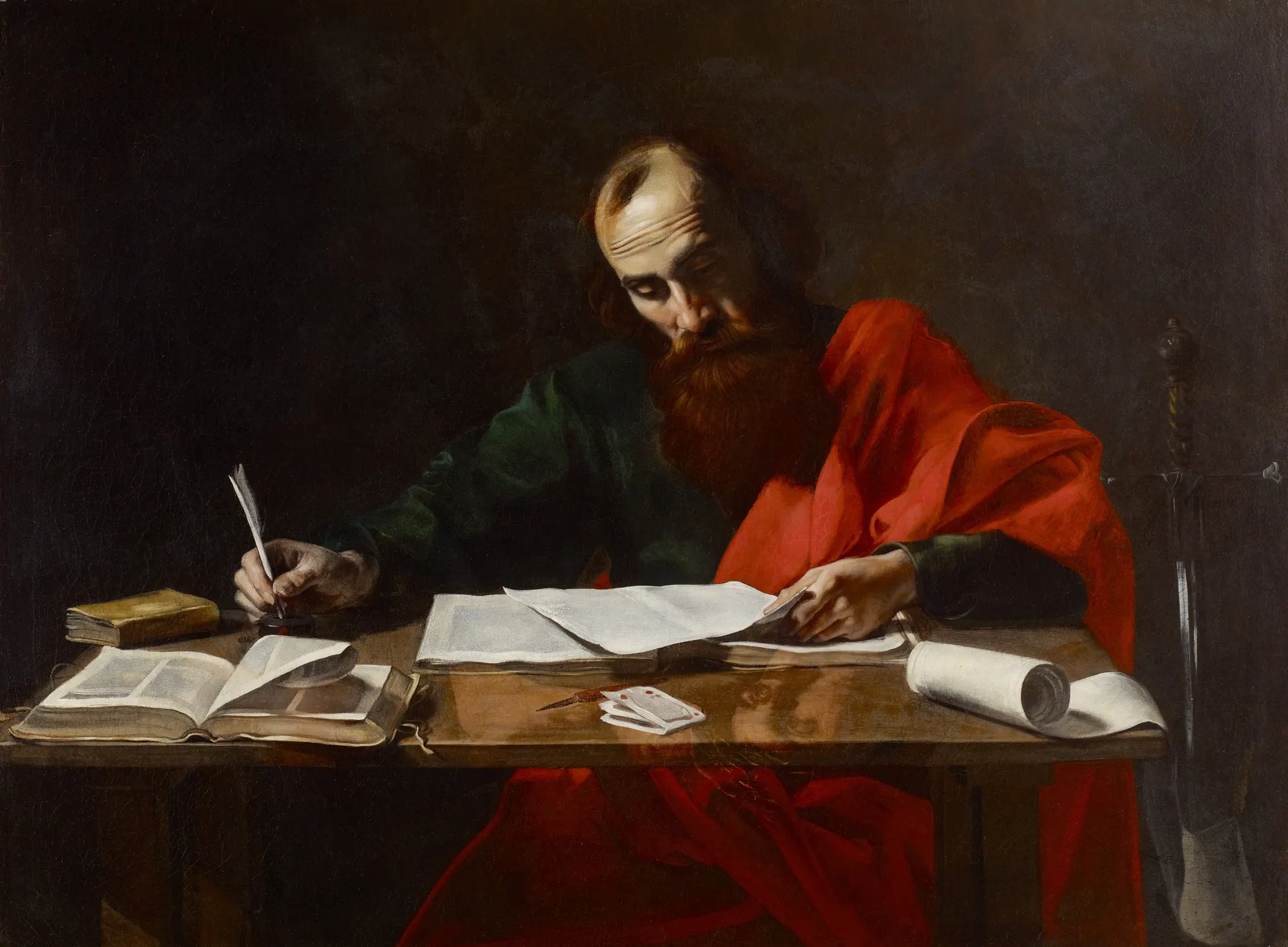
Romanschapter 4
25 verses · Paul · AD 56 or 57 · Paul's letters
What then shall we say that Abraham, our forefather, has discovered?
Introduction
Paul, Paul's letters, Romans Overview.
Paul wrote this letter from Corinth about AD 57 to house churches in Rome he had never visited, where Jewish and Gentile believers met side by side. He had been trained in the Law as a Pharisee and had become the apostle to the nations, and the question of who belongs to God's people had followed him everywhere. This chapter takes the argument of the letter back to the founder of Israel. Listen for the order of events, for the whole case turns on what came first. Listen also for the language of an account book, and ask what kind of entry faith makes.
Context
- Who
- Mixed house churches in Rome, where descent from Abraham was the proudest possible credential.
- What
- A chapter of argument from Genesis showing that Abraham was counted righteous through faith, before his circumcision and before the law.
- Where
- Written from Corinth to the house churches of Rome, drawing on the story of Abraham in Genesis.
- When
- Written about AD 57, early in the reign of Nero; the events it recalls fall in the life of Abraham, long before the law was given at Sinai.
- Why
- To prove from the Scriptures that justification through faith is God's old way, and that it makes Jew and Gentile one family under Abraham.
Historical context
Ancestry mattered enormously in the ancient world. Romans kept wax masks of their forefathers in the entrance hall; Jews traced descent from Abraham as the ground of covenant identity. Paul's move is to examine the credential itself rather than dispute it.
Show the rest of the historical context, 2 more paragraphs
His argument turns on the order of events in Genesis. Abraham was counted righteous before he was circumcised, and the promise came long before the Law was given at Sinai. In a culture where the older claim beat the newer one, that sequence was a strong argument, not a technicality.
The bookkeeping language, reckoned, counted, credited to his account, came from ordinary commercial life, where a sum was entered in a ledger. Paul sets it against wages: a labourer's pay is owed, not gifted, and what God does is the second kind.
Significance
For Gentile believers, this chapter made Abraham theirs. He is the father of all who believe without being circumcised, and the promise that he would be heir of the world runs through faith rather than bloodline.
Show the rest of the significance, 1 more paragraph
For Jewish believers, it did not take Abraham away, it kept him as father of the circumcised who also walk in his faith. The point was one family with one door, and the door was trust in the God who gives life to the dead.
The heads below are this chapter's scenes. The numbered points under each are its verses.
Abraham Believed God, and It Was Reckoned to Him
Romans 4:1-2
Abraham, our forefather: Paul puts Abraham forward as the test case for justification, God declaring a sinner righteous in His own court. Works would have given Abraham a boast among men, and that boast is worth nothing in front of God. The father of the nation is the first proof.
Romans 4:1
What shall we say then that Abraham, our father as pertaining to the flesh, hath found?--that is, (as the order in the original shows), "hath found, as pertaining to ('according to,' or 'through') the flesh"; meaning, "by all his natural efforts or legal obedience."
Jamieson, Fausset & Brown · Commentary Critical and Explanatory on the Whole Bible (1871)reformed
1 more voice on this verseWhat preachers and commentators have said about this verse, in their own words.
Romans 4:1
“These things having thus been explained according to our ability, it also seems by no means to be passed over that he named Abraham "our father according to the flesh." For Abraham is seen to be the father of the Gentiles according to faith, not according to the flesh.”
Origen of Alexandria · written before 253 · Commentary on the Epistle to the Romanspatristic
he had something to boast about: Calvin calls this an incomplete argument and supplies the conclusion. Works would give Abraham a boast, yet he has none before God, so works did not justify him. Ambrosiaster adds that Abraham does have glory before God, and it comes through the faith that justified him.
Romans 4:2
“What can we say to those who insist that Abraham was justified by works because he was ready to sacrifice his son Isaac on the altar? Abraham was already an old man when God promised him that he would have a son and that his descendants would be as countless as the stars of the sky. Abraham piously believed that all things are possible with God and so exercised this faith.”
Cyril of Alexandria · written before 444 · Explanation of the Letter to the Romanspatristic
2 more voices on this verse
Romans 4:2
“For if Abraham were justified by works - The Jew proceeds: - I conclude, therefore, that Abraham was justified by works, or by his obedience to this law of circumcision; and, consequently, he has cause for glorying, καυχημα, to exult in something which he has done to entitle him to these blessings. Now, it is evident that he has this glorying, and consequently that he was justified by works. Apostle.”
Adam Clarke · Commentary on the Bible (1810-1826)evangelical
Romans 4:2
“For if Abraham, etc. This is an incomplete argument, which may be made in this form -- "If Abraham was justified by works, he might justly glory: but he had nothing for which he could glory before God; then he was not justified by works." Thus the clause but not before God, is the minor proposition; and to this must be added the conclusion which I have stated, though it is not expressed by Paul.”
John Calvin · Commentaries (1554)reformed
The quotation is Genesis 15:6, and Abraham believed God centuries before the law came at Sinai. Credited renders an accounting word, logizomai, the entry of righteousness into an account that no work had earned. Faith receives what it did not produce.
Romans 4:3
And teaching this very thing, He said to the Jews: "Your father Abraham rejoiced that he should see my day; and he saw it, and was glad." What is intended? "Abraham believed God, and it was imputed unto him for righteousness." In the first place, [he believed] that He was the maker of heaven and earth, the only God; and in the next place, that He would make his seed as the stars of heaven. This is what is meant by Paul, [when he says,] "as lights in the world."
Irenaeus · written before 202 · Against Heresies Book IVpatristic
3 more voices on this verse
Romans 4:3
“For what saith the Scripture? - The inspired account of Abraham’s justification. This account was final, and was to settle the question. This account is found in Gen 15:6. Abraham believed God - In the Hebrew, “Abraham believed Yahweh.” The sense is substantially the same, as the argument turns on the act of believing. The faith which Abraham exercised was, that his posterity should be like the stars of heaven in number. This promise was made to him when he had no child, and of course when he had no prospect of such a posterity.”
Romans 4:3
“Abraham believed God - That promise of God concerning the numerousness of his seed, Gen. xv, 5, 7; but especially the promise concerning Christ, Gen. xii, 3, through whom all nations should be blessed. And it was imputed to him for righteousness - God accepted him as if he had been altogether righteous.”
John Wesley · Explanatory Notes upon the New Testament (1755)evangelical
Romans 4:3
“For what saith the Scripture?.... This answers to דכתיב מאי, "what is that which is written" (c)? or what does the Scripture say? which is a way of speaking used by the Jews, when anything is proposed, which seems contrary to Scripture, as here justification by works does.”
Cross references
Romans 4:3
- QuotingGenesis 15:6“Abram believed the LORD, and it was credited to him as righteousness.”
'Abraham believed God, and it was counted unto him for righteousness' ('what saith the scripture?')
ConnectionsGenesis 15:6
Romans 4:4-5
the wages of the worker: Wages are an obligation the employer owes, and no one calls a paycheck a gift. Verse 5 sets the opposite case: God justifies the wicked, and faith is credited to the man who brings no work. Justifies the wicked is the boldest phrase in the chapter.
Romans 4:4
“But as to what he says: "To him who works, the wage is not imputed according to grace but according to debt; but to him who believes in him who justifies the ungodly, faith is reckoned unto righteousness" — he seems to show that in faith there is, as it were, the grace of him who justifies, but in work the justice of him who repays.”
Origen of Alexandria · written before 253 · Commentary on the Epistle to the Romanspatristic
1 more voice on this verse
Romans 4:4
“Now to him that worketh is the reward not reckoned of grace, but of debt - Therefore, if Abraham had been justified by works, the blessings he received would have been given to him as a reward for those works, and consequently his believing could have had no part in his justification, and his faith would have been useless.”
Adam Clarke · Commentary on the Bible (1810-1826)evangelical
believes in Him who justifies the wicked: Chrysostom asks the reader to weigh what this faith believes, that God can make a man who lived in impiety just in a moment. Origen calls such faith the root of righteousness, and works grow from it as its fruit.
Romans 4:5
“Faith, which believes in the justifier, is the beginning of justification before God. And this faith, when it is justified, is like a root in the soil of the soul, which the rain has watered, so that as it begins to grow by the law of God, branches appear, which bring forth fruit. The root of righteousness does not spring from works; rather, the fruit of works grows from the root of righteousness, viz., by that root of righteousness by which God brings righteousness to the one whom he has accepted apart from works.”
Origen of Alexandria · written before 253 · Commentary on the Epistle to the Romanspatristic
2 more voices on this verse
Romans 4:5
“But to him that worketh not - Who does not rely on his conformity to the Law for his justification; who does not depend on his works; who seeks to be justified in some other way. The reference here is to the Christian plan of justification. But believeth - Note, Rom 3:26. On him - On God. Thus, the connection requires; for the discussion has immediate reference to Abraham, whose faith was in the promise of God. That justifieth the ungodly - This is a very important expression. It implies, (1) That people are sinners, or are ungodly.”
Romans 4:5
“But to him that worketh not - It being impossible he should without faith. But believeth, his faith is imputed to him for righteousness - Therefore God's affirming of Abraham, that faith was imputed to him for righteousness, plainly shows that he worked not; or, in other words, that he was not justified by works, but by faith only.”
John Wesley · Explanatory Notes upon the New Testament (1755)evangelical
Romans 4:6-8
credits righteousness apart from works: David is the second witness, quoted from Psalm 32:1-2. He calls a man blessed whose lawless acts are forgiven, and the Lord will never count his sin. The psalm ties pardon to a righteousness God supplies.
Romans 4:6
After these things, as if for the confirmation of his statement which he had made — "But to him who does not work, yet believes in him who justifies the ungodly, faith is reckoned unto righteousness" — he takes up a testimony from the Psalms and says: "As David also declares the blessedness of the man to whom God accounts righteousness without works: Blessed are they whose iniquities are forgiven, and whose sins are covered; blessed is the man to whom the Lord has not imputed sin."
Origen of Alexandria · written before 253 · Commentary on the Epistle to the Romanspatristic
2 more voices on this verse
Romans 4:6
“So David also - David is fitly introduced after Abraham, because be also received and delivered down the promise. Affirmeth - A man is justified by faith alone, and not by works. Without works-That is, without regard to any former good works supposed to have been done by him.”
John Wesley · Explanatory Notes upon the New Testament (1755)evangelical
Romans 4:6
“Saying, Blessed, &c.-- (Ps 32:1, 2). David here sings in express terms only of "transgression forgiven, sin covered, iniquity not imputed"; but as the negative blessing necessarily includes the positive, the passage is strictly in point.”
Jamieson, Fausset & Brown · Commentary Critical and Explanatory on the Whole Bible (1871)reformed
whose lawless acts are forgiven: Chrysostom notices that the psalm says nothing of faith. He holds that Paul cites it on purpose: if pardon by grace makes a man blessed, the man made righteous is more blessed still.
Romans 4:7
“Blessed - Happy are they: they are highly favored; see the note at Mat 5:3. Whose sins are covered - Are concealed; or hidden from the view. On which God will no more look, and which he will no more remember. “By these words,” says Calvin (in loco), “we are taught that justification with Paul is nothing else but pardon of sin.” The word “cover” here has no reference to the atonement, but is expressive of hiding, or concealing that is, of forgiving sin.”
1 more voice on this verse
Romans 4:7
“Whence I think that David too, in the thirty-first psalm, which he entitled "Of the understanding of David," gave this beginning, admonishing by the very superscription that a deeper understanding must be sought in the things he was about to say, namely that "blessed are they whose iniquities are forgiven": concerning which we have spoken, as far as we were able, when we dictated on the Psalms in order.”
Origen of Alexandria · written before 253 · Commentary on the Epistle to the Romanspatristic
Cross references
Romans 4:7
- QuotingPsalms 32:1“Blessed is he whose transgressions are forgiven, whose sins are covered.”
'Blessed are they whose iniquities are forgiven' (David on imputed righteousness)
whose sin the Lord will never count: Ambrosiaster reads the three verbs of verses 7 and 8, forgiven, covered and never counted, as one act said three ways. Barnes draws out the last. The Lord treats the ungodly man of verse 5 as though the sin had never been charged, the same crediting Paul described in Abraham.
Righteousness Before Circumcision, Promise Before Law
Romans 4:9-10
this blessing only on the circumcised: The question is whether the blessing reaches the uncircumcised as well. Genesis 15 credits the righteousness to Abraham, and Genesis 17 gives him circumcision fourteen chapters later. Abraham was uncircumcised when God credited it.
Romans 4:9
“Cometh this blessedness then upon the circumcision only?.... That is, upon the circumcised Jews; are they the only persons that partake of this happiness? the word "only" is rightly supplied, and is in the Claromontane exemplar used by Beza, and in the Vulgate Latin and Ethiopic versions: or upon the uncircumcision also? upon the uncircumcised Gentiles; do not they likewise share in this blessedness? for we say, that faith was reckoned to Abraham for righteousness.”
1 more voice on this verse
Romans 4:9
“Abraham was pardoned and accepted in uncircumcision, a circumstance which, as it might silence the fears of the poor uncircumcised Gentiles, so it might lower the pride and conceitedness of the Jews, who gloried in their circumcision, as if they had the monopoly of all happiness. Here are two reasons why Abraham was justified by faith in uncircumcision:-- 1.”
Matthew Henry · Commentary on the Whole Bible (1707-1721)puritan
In what context was it credited?: Wesley dates the gap by Ishmael, unborn when Abraham was declared righteous and thirteen years old at the circumcision. Barnes names what hung on the order: had the crediting come after, a Jew could claim circumcision had earned it.
Romans 4:10
“Not in circumcision - Not after he was circumcised; for he was justified before Ishmael was born, Gen. xv, 1-21; but he was not circumcised till Ishmael was thirteen years old, Gen. xvii, 25.”
John Wesley · Explanatory Notes upon the New Testament (1755)evangelical
1 more voice on this verse
Romans 4:10
“What did Abraham believe? He believed that he would have a descendant, a son, in whom all the nations would be justified by faith while they were still uncircumcised, as Abraham then was.”
Ambrosiaster · written before 384 · Commentary on Paul's Epistlespatristic
Romans 4:11-12
the sign of circumcision as a seal: Circumcision came as a seal, the stamp that confirms a righteousness already given. Abraham is therefore father of believers who were never circumcised, and father of the circumcised who walk in the footsteps of his faith. Faith makes the family in both directions.
Romans 4:11
“And he received the sign ... - A sign is that by which any thing is shown, or represented. And circumcision thus showed that there was a covenant between Abraham and God; Gen 17:1-10. It became the public mark or token of the relation which he sustained to God. A seal - See the note at Joh 3:33. A seal is that mark of wax or other substance, which is attached to an instrument of writing, as a deed, etc., to confirm, ratify it, or to make it binding.”
1 more voice on this verse
Romans 4:11
“The gospel way of justification is by an imputed righteousness, mellei logizesthai -- it shall be imputed; he uses a future verb, to signify the continuation of this mercy in the church, that as it is the same now so it will be while God has a church in the world, and there are any of the children of men to be justified; for there is a fountain opened that is inexhaustible.”
Matthew Henry · Commentary on the Whole Bible (1707-1721)puritan
ConnectionsGenesis 17:11
walk in the footsteps of the faith: The verse sets a condition on the circumcised as well. Wesley states it flatly: to those who share none of his faith, Abraham is no father, whatever their descent.
Romans 4:12
“And the father of circumcision - He is also the head and representative of all the circumcision of all the Jews who walk in the steps of that faith; who seek for justification by faith only, and not by the works of the law; for this was the faith that Abraham had before he received circumcision.”
Adam Clarke · Commentary on the Bible (1810-1826)evangelical
1 more voice on this verse
Romans 4:12
“Now, this Jesus did by drawing us off from the religion of stones, and bringing us over from hard and fruitless cogitations, and establishing in us a faith like to Abraham. As Paul does also testify, saying that we are children of Abraham because of the similarity of our faith, and the promise of inheritance.”
Irenaeus · written before 202 · Against Heresies Book IVpatristic
Romans 4:13-15
heir of the world: The promise that Abraham would inherit the world came through the righteousness that comes by faith. If the law made the heirs, faith is useless and the promise worthless, since law brings wrath. Without law there is no transgression to count.
Romans 4:13
“For the promise ... - To show that the faith of Abraham, on which his justification depended, was not by the Law, the apostle proceeds to show that the promise concerning which his faith was so remarkably evinced was before the Law was given. If this was so, then it was an additional important consideration in opposition to the Jew, showing that acceptance with God depended on faith, and not on works. That he should be heir of the world - An heir is one who succeeds, or is to succeed to an estate.”
1 more voice on this verse
Romans 4:13
“Or, rather, it points at Christ, the seed here mentioned; compare Gal. iii. 16 , To thy seed, which is Christ. Now Christ is the heir of the world, the ends of the earth are his possession, and it is in him that Abraham was so.”
Matthew Henry · Commentary on the Whole Bible (1707-1721)puritan
ConnectionsGenesis 15:18
faith is useless and the promise is worthless: Theophylact follows the logic through. If the law handed out the inheritance, no one would trouble with faith. A promise tied to a condition no one keeps could never be paid.
Romans 4:14
"For if those who are of the law are heirs, faith has been made void, and the promise has been annulled. For the law works wrath. But where there is no law, neither is there transgression." If, he says, the promise was given to Abraham that he should be heir of the world not from the law, but through the faith which was reckoned to him unto righteousness, it will follow without doubt that all who hope that righteousness will be reckoned to them by God should hope for it not through the law, but through faith.
Origen of Alexandria · written before 253 · Commentary on the Epistle to the Romanspatristic
1 more voice on this verse
Romans 4:14
“For if they which are of the law be heirs--If the blessing is to be earned by obedience to the law. faith is made void--the whole divine method is subverted.”
Jamieson, Fausset & Brown · Commentary Critical and Explanatory on the Whole Bible (1871)reformed
the law brings wrath: Matthew Henry calls the second clause an acknowledged maxim and turns it round: where there is law there is transgression, and transgression provokes wrath. Augustine adds that the anger falls heavier on a man who knew the command and broke it anyway.
Romans 4:15
But now, in this place where he says, "For the law works wrath," it must be considered more carefully to which law this saying seems to look; and likewise that which follows, "For where there is no law, neither is there transgression." But before a fuller explanation is required of us, let us reply briefly to those objections which the heretics are accustomed to raise against us from this passage. For they say: "See how the Apostle says that the law of Moses works wrath, and that where that law has not been, there neither will there be transgression."
Origen of Alexandria · written before 253 · Commentary on the Epistle to the Romanspatristic
2 more voices on this verse
Romans 4:15
“Because the law - Considered apart from that grace, which though it was in fact mingled with it, yet is no part of the legal dispensation, is so difficult, and we so weak and sinful, that, instead of bringing us a blessing, it only worketh wrath; it becomes to us an occasion of wrath, and exposes us to punishment as transgressors.”
John Wesley · Explanatory Notes upon the New Testament (1755)evangelical
Romans 4:15
“Because the law - All law. It is the tendency of law. Worketh wrath - Produces or causes wrath. While man is fallen, and a sinner, its tendency, so far from justifying him, and producing peace, is just the reverse. It condemns, denounces wrath, and produces suffering. The word “wrath” here is to be taken in the sense of punishment. Rom 2:8. And the meaning is, that the Law of God, demanding perfect purity, and denouncing every sin condemns the sinner, and consigns him to punishment.”
the promise comes by faith: Faith is the means because grace is the source. A promise resting on grace is guaranteed to all Abraham's offspring, the Jew who has the law and the Gentile who has his faith.
Romans 4:16
“Therefore it is of faith, that it might be by grace - On this account the promise is mercifully grounded, not on obedience to a law, but on the infinite goodness of God: and thus the promise is sure to all the seed - to all, both Jews and Gentiles, who, believing in Christ Jesus, have a right to all the blessings contained in the Abrahamic covenant. All the seed necessarily comprehends all mankind.”
Adam Clarke · Commentary on the Bible (1810-1826)evangelical
2 more voices on this verse
Romans 4:16
“Therefore it - The blessing. Is of faith, that it might be of grace - That it might appear to flow from the free love of God, and that the promise might be firm, sure, and effectual, to all the spiritual seed of Abraham; not only Jews, but gentiles also, if they follow his faith.”
John Wesley · Explanatory Notes upon the New Testament (1755)evangelical
Romans 4:16
Therefore, &c.--A general summary: "Thus justification is by faith, in order that its purely gracious character may be seen, and that all who follow in the steps of Abraham's faith--whether of his natural seed or no--may be assured of the like justification with the parent believer."
Jamieson, Fausset & Brown · Commentary Critical and Explanatory on the Whole Bible (1871)reformed
gives life to the dead: Genesis 17:5 stands behind the verse, where God had already named Abraham a father of many nations. The God Abraham believed raises the dead, and He calls into being what does not exist. Both descriptions answer the impossibility Abraham faced.
Romans 4:17
“What he was required to believe being above nature, his faith had to fasten upon God's power to surmount physical incapacity, and call into being what did not then exist. But God having made the promise, Abraham believed Him in spite of those obstacles. This is still further illustrated in what follows.”
Jamieson, Fausset & Brown · Commentary Critical and Explanatory on the Whole Bible (1871)reformed
3 more voices on this verse
Romans 4:17
And he added in what follows: "Who quickens the dead, and calls those things which are not as those which are." Here we understand the dead according to the sin of the soul, since he says, "the soul which sins shall die."
Origen of Alexandria · written before 253 · Commentary on the Epistle to the Romanspatristic
Romans 4:17
“The Apostle shows the power and excellence of that faith to which he ascribes justification. Who against hope - Against all probability, believed and hoped in the promise. The same thing is apprehended both by faith and hope; by faith, as a thing which God has spoken; by hope, as a good thing which God has promised to us.”
John Wesley · Explanatory Notes upon the New Testament (1755)evangelical
Romans 4:17
“As it is written - Gen 17:5. I have made thee - The word used here in the Hebrew Gen 17:5 means literally, to give, to grant; and also, to set, or constitute. This is also the meaning of the Greek word used both by the Septuagint and the apostle. The quotation is taken literally from the Septuagint. The argument of the apostle is founded in part on the fact that the past tense is used - I have made thee - and that God spoke of a thing as already done, which he had promised or purposed to do.”
Cross references
Romans 4:17
- QuotingGenesis 17:5“No longer will you be called Abram, but your name will be Abraham, for I have made you a father of many nations.”
'I have made thee a father of many nations' ('as it is written')
In Hope Against Hope, Strong in Faith
Romans 4:18-19
Against all hope: Abraham held the promise with nothing in sight to support it. Verse 19 gives the facts he faced without flinching, a body near a hundred years old and Sarah's womb long dead. Faith looked straight at the evidence against the promise.
Romans 4:18
Therefore Abraham "against hope believed in hope, that he might become the father of many nations," which were to be as the stars of heaven, not only in multitude but also in brightness; and he, faithfully believing him who promised, "was not," he says, "weakened in faith." What he says, "he was not weakened in faith," seems to me to show that there is a certain weakness in faith. But if there is weakness, there is without doubt also health, as he shows in other places when he says: "Rebuke them sharply, that they may be sound in the faith."
Origen of Alexandria · written before 253 · Commentary on the Epistle to the Romanspatristic
2 more voices on this verse
Romans 4:18
“Who against hope believed in hope,.... Abraham believed the promise of God, that he might become the father of many nations, being assisted by a supernatural aid: "in hope"; of the fulfilment of it by the grace and power of God: "against hope": against all visible, rational grounds of hope; Sarah's womb and his own body being dead, but inasmuch as God had said it, he believed: according to that which is spoken, so shall thy seed be; his faith rested upon the word of God, which showed the nature of it, and that it was of the right kind.”
Romans 4:18
“Who against hope--when no ground for hope appeared. believed in hope--that is, cherished the believing expectation. that he might become the father of many nations, according to that which was spoken, So shall thy seed be--that is, Such "as the stars of heaven," Ge 15:5.”
Jamieson, Fausset & Brown · Commentary Critical and Explanatory on the Whole Bible (1871)reformed
Cross references
Romans 4:18
- QuotingGenesis 15:5And the LORD took him outside and said, “Now look to the heavens and count the stars, if you are able.” Then He told him, “So shall your offspring be.”
'So shall thy seed be' (Abraham's hope against hope)
the decrepitness of his body: Oecumenius notes the care of the word about, since Genesis 17 gives Abraham's age as ninety-nine. Matthew Henry reads his question there, whether a man of a hundred could father a child, as wonder and a wish to hear more. Abraham weighed the facts and held the promise.
Romans 4:19
“He said indeed, Shall a child be born to him that is a hundred years old? But that was the language of his admiration and his desire to be further satisfied, not of his doubting and distrust; his faith passed by that consideration, and thought of nothing but the faithfulness of the promise, with the contemplation whereof he was swallowed up, and this kept up his faith.”
Matthew Henry · Commentary on the Whole Bible (1707-1721)puritan
1 more voice on this verse
Romans 4:19
“And being not weak in faith - That is, having strong faith. He considered not - He did not regard the fact that his body was now dead, as any obstacle to the fulfillment of the promise. He did not suffer that fact to influence him, or to produce any doubt about the fulfillment. Faith looks to the strength of God, not to second causes, or to difficulties that may appear formidable to man.”
Romans 4:20-21
strengthened in his faith: Abraham gave glory to God while the promise was still unfulfilled. He was fully persuaded of God's power to do what He promised. Faith that holds is itself worship.
Romans 4:20
“Unbelief is at the bottom of all our staggerings at God's promises. It is not the promise that fails, but our faith that fails when we stagger. He was strong in faith, giving glory to God, enedynamothe -- he was strengthened in faith, his faith got ground by exercise--crescit eundo.”
Matthew Henry · Commentary on the Whole Bible (1707-1721)puritan
1 more voice on this verse
Romans 4:20
“He staggered not - He was not moved, or agitated; he steadily and firmly believed the promise. Giving glory to God - Giving honor to God by the firmness with which he believed his promises. His conduct was Such as to honor God; that is, to show Abraham’s conviction that he was worthy of implicit confidence and trust. In this way all who believe in the promises of God do honor to him. They bear testimony to him that he is worthy of confidence.”
being fully persuaded: Abraham trusted God's power while the promise looked impossible. Matthew Henry hears in the Greek verb a ship coming into harbour under full sail. Barnes finds the same faith later at Moriah, where Abraham believed God was able to bring Isaac back from the dead.
Romans 4:21
“And being fully persuaded,.... He had not only faith, a strong faith, but full assurance of faith: that what he God had promised; though it was so long ago, and there were so many difficulties in the way; he was able, being the Lord God Almighty, to perform; so his faith rested upon the power of God, with whom nothing is impossible.”
1 more voice on this verse
Romans 4:21
“And being fully persuaded - Thoroughly or entirely convinced; Luk 1:1; Rom 14:5; 2Ti 4:5, 2Ti 4:17. He was able - Compare Gen 18:14. This was not the only time in which Abraham evinced this confidence. His faith was equally implicit and strong when he was commanded to sacrifice his promised son; Heb 11:19.”
Credited to him as righteousness closes the chapter on the same words that opened it at verse 3. The faith described across verses 18 to 21 is exactly the faith Genesis 15:6 counted. Abraham's whole life confirms the one line.
Romans 4:22
“And therefore it was imputed to him for righteousness - The verse is thus paraphrased by Dr. Taylor: “For which reason God was graciously pleased to place his faith to his account; and to allow his fiducial reliance upon the Divine goodness, power, and faithfulness, for a title to the Divine blessing, which, otherwise, having been an idolater, he had no right to.””
Adam Clarke · Commentary on the Bible (1810-1826)evangelical
1 more voice on this verse
Romans 4:22
And therefore it was imputed, &c.--"Let all then take notice that this was not because of anything meritorious in Abraham, but merely because he so believed."
Jamieson, Fausset & Brown · Commentary Critical and Explanatory on the Whole Bible (1871)reformed
Romans 4:23-25
Genesis 15:6 was written with later readers in view. The same crediting falls on everyone who believes in Him who raised Jesus from the dead. Verse 25 names the ground: He was delivered over for trespasses and raised for justification, His death answering sin and His resurrection sealing the verdict.
Romans 4:23
“But I should like to inquire into this: whether it is only for this reason that the Apostle says that "it was not written for the sake of" Abraham "alone, but for our sake also," namely, because he said, "Abraham believed God, and it was reckoned to him for righteousness." Do you suppose that this saying alone, out of all the things that are said about Abraham, was written not for his sake only, but for ours as well? Or will certain other things also appear to have been written not for his sake only, but for ours too?”
Origen of Alexandria · written before 253 · Commentary on the Epistle to the Romanspatristic
2 more voices on this verse
Romans 4:23
“Now it was not written - The record of this extraordinary faith was not made on his account only; but it was made to show the way in which men may be regarded and treated as righteous by God. If Abraham was so regarded and treated, then, on the same principle, all others may be. God has but one mode of justifying people. Imputed - Reckoned; accounted. He was regarded and treated as the friend of God.”
Romans 4:23
“Now, &c.--Here is the application of this whole argument about Abraham: These things were not recorded as mere historical facts, but as illustrations for all time of God's method of justification by faith.”
Jamieson, Fausset & Brown · Commentary Critical and Explanatory on the Whole Bible (1871)reformed
Origen asks why Paul names God here by the resurrection of Jesus, when he could have named Him maker of heaven and earth. Wesley supplies the link with Abraham. The God who raised Jesus had already brought life, in a manner, out of the bodies of Abraham and Sarah.
Romans 4:24
“I should indeed like to inquire why it is that in this place the Apostle, when naming God, in whom we believe and in whom Abraham believed, did not say "believing" in God most high, or "believing in him" who made heaven and earth, or "in him" who made the angels and the other powers of the heavenly glory; but says: "who raised the Lord Jesus from the dead." Let us therefore inquire for what cause this title of the Lord's resurrection is taken up for the comparison of Abraham's faith.”
Origen of Alexandria · written before 253 · Commentary on the Epistle to the Romanspatristic
3 more voices on this verse
Romans 4:24
“Who raised up Jesus from the dead - As he did in a manner both Abraham and Sarah. If we believe on him who raised up Jesus - God the Father therefore is the proper object of justifying faith. It is observable, that St. Paul here, in speaking both of our faith and of the faith of Abraham, puts a part for the whole.”
John Wesley · Explanatory Notes upon the New Testament (1755)evangelical
Romans 4:24
“But for us also - The mention of this circumstance has a much more extensive design than merely to honor Abraham. It is recorded as the model, according to which God will save both Jews and Gentiles: indeed there can be no other way of salvation; as all have sinned, all must either be saved by faith through Christ Jesus, or finally perish. If God, therefore, will our salvation, it must be by faith; and faith contemplates his promise, and his promise comprehends the Son of his love.”
Adam Clarke · Commentary on the Bible (1810-1826)evangelical
Romans 4:24
“FAITH—true, saving faith—is in all ages the same. It may exercise itself upon different things, but the faith of Abraham is the same faith as that which was in the heart of Paul—and the faith of Paul was precisely the same faith as that which is in the heart of every Believer at the present moment! We have "like precious faith" with the godly of all the ages. It is always the same faith as it is always the same God and the same Savior.”
Charles Spurgeon · written before 1892 · The Metropolitan Tabernacle Pulpit, Sermon No. 2357: “The Two Pillars Of Salvation” (lightly modernized text, CCEL edition)Particular Baptist
He was delivered over to death: Matthew Henry calls His death and His being raised to life the two hinges on which the door of salvation turns. Chrysostom reasons from the raising back to the death. A sinner would have stayed dead, so the one God raised was delivered over for the trespasses of others.
Romans 4:25
“Who was delivered - To death; compare the notes at Act 2:23. For our offences - On account of our crimes. He was delivered up to death in order to make expiation for our sins. And was raised again - From the dead. For our justification - On account of our justification. In order that we may be justified.”
2 more voices on this verse
Romans 4:25
“Who was delivered - To death. For our offenses - As an atonement for them. And raised for our justification - To empower us to receive that atonement by faith.”
John Wesley · Explanatory Notes upon the New Testament (1755)evangelical
Romans 4:25
“For this reason also in what follows he adds and says of the Lord Jesus: "Who was delivered up," he says, "for our sins, and rose again for our justification" — that he may show that those things for which Christ was delivered up we too ought to abhor and cast away. For if we believe that he was delivered up for our sins, how is not every sin to be counted by us as foreign and hostile, for which our Redeemer is recorded to have been delivered up to death?”
Origen of Alexandria · written before 253 · Commentary on the Epistle to the Romanspatristic
How this psalm is built
The form: A proof from Abraham's own story that faith is older than circumcision and stronger than the law, as Chrysostom classes it.
The patterns in this chapter
| Device | What it does | Where to see it |
|---|---|---|
| The word credited, ten times | Forms of the verb credit stand ten times in the Berean text of the chapter, in verses 3, 4, 5, 6, 9, 10, 11, 22, 23 and 24. It is the language of an account book, and verses 4 and 5 set it against wages owed. Barnes reads the crediting of verses 6 to 8 as pardon, the Lord treating the ungodly as though the sin had never been charged.Albert Barnes, Notes, Explanatory and Practical, on the Old and New Testaments (1832-1869), on Romans 4:8. | Romans 4:3, Romans 4:4, Romans 4:8, Romans 4:22, Romans 4:24 |
| The argument from the order of events | Verses 9 to 12 ask when the crediting happened and answer from Genesis, where Abraham is declared righteous in chapter 15 and circumcised in chapter 17. Wesley dates the gap by Ishmael, unborn at the first and thirteen years old at the second. Circumcision then stands as a seal on a righteousness Abraham already held.John Wesley, Explanatory Notes upon the New Testament, 1755, on Romans 4:10. | Romans 4:9, Romans 4:10, Romans 4:11 |
| Two witnesses from the Scriptures | Paul brings Abraham from the Law, quoting Genesis 15:6 at verse 3, and David from the Psalms, quoting Psalm 32:1 and 2 at verses 7 and 8. Gill notes that the psalm is cited as proof of the happiness of those God justifies. Genesis 17:5 follows at verse 17 and Genesis 15:5 at verse 18.John Gill, Exposition of the New Testament (1746-1748), on Romans 4:7. | Romans 4:3, Romans 4:7, Romans 4:17, Romans 4:18 |
How this chapter is built
6 more paragraphs on the patterns
The chapter opens on the question of what Abraham found and answers from one verse, Genesis 15:6, quoted at verse 3. Verses 4 to 8 set wages against a gift and call David as a second witness from Psalm 32. Verses 9 to 12 ask when the crediting happened, before circumcision or after. Verses 13 to 17 set the promise against the law, and verses 18 to 22 show Abraham's faith facing his own age and Sarah's. Verses 23 to 25 apply the same crediting to everyone who believes in the God who raised Jesus.
Where it stands in the letter
Chapter 3 ended by saying that boasting is excluded and that faith upholds the law. Chapter 4 proves both from the first book of the law. It hands chapter 5 the ground of its first sentence, justification through faith, and the resurrection named in its last verse.
Where to go deeper
The doctrine the chapter proves has its own pages at /featured/justification-by-faith and /featured/imputation. The covenant behind Genesis 15 stands at /featured/abrahamic-covenant, and the question the chapter raises about works has a page at /featured/faith-and-works.
Sources: John Chrysostom, Homily on Romans VIII, 407, on Romans 4:14. John Wesley, Explanatory Notes upon the New Testament, 1755, on Romans 4:10. John Gill, Exposition of the New Testament (1746-1748), on Romans 4:7. Albert Barnes, Notes, Explanatory and Practical, on the Old and New Testaments (1832-1869), on Romans 4:8.
Keep studying
Studies16
People and groups1
Words12
Subjects4
Sources for this chapter
The summary
Jamieson, Fausset & Brown, Commentary Critical and Explanatory; John Calvin, Commentaries; John Wesley, Explanatory Notes Upon the New Testament and Matthew Henry, Complete Commentary.
The form and classifications
John Calvin, Commentaries, 1554, on Romans 4:2; John Chrysostom, Homily on Romans VIII, 407, on Romans 4:14 and Origen of Alexandria, COMMENTARY ON THE EPISTLE TO THE ROMANS, 253, on Romans 4:2.
The exposition
Adam Clarke, Commentary on the Bible; Albert Barnes; Alexander Maclaren, Expositions of Holy Scripture: Romans; Ambrosiaster, COMMENTARY ON PAUL'S EPISTLES; Augustine of Hippo, GRACE AND FREE WILL 10.22; Charles Hodge, Commentary on the Epistle to the Romans; Frederic Godet, Commentary on St. Paul’s Epistle to the Romans; Jamieson, Fausset & Brown, Commentary Critical and Explanatory on the Whole Bible; John Calvin; John Chrysostom; John Gill, Exposition of the New Testament; John Wesley, Explanatory Notes upon the New Testament; Matthew Henry, Commentary on the Whole Bible; Oecumenius, PAULINE COMMENTARY FROM THE GREEK CHURCH; Origen of Alexandria, COMMENTARY ON THE EPISTLE TO THE ROMANS; Robert Haldane, Exposition of the Epistle to the Romans; Theodoret of Cyrus, INTERPRETATION OF THE LETTER TO THE ROMANS and Theophylact of Ohrid, Commentary on Romans.