
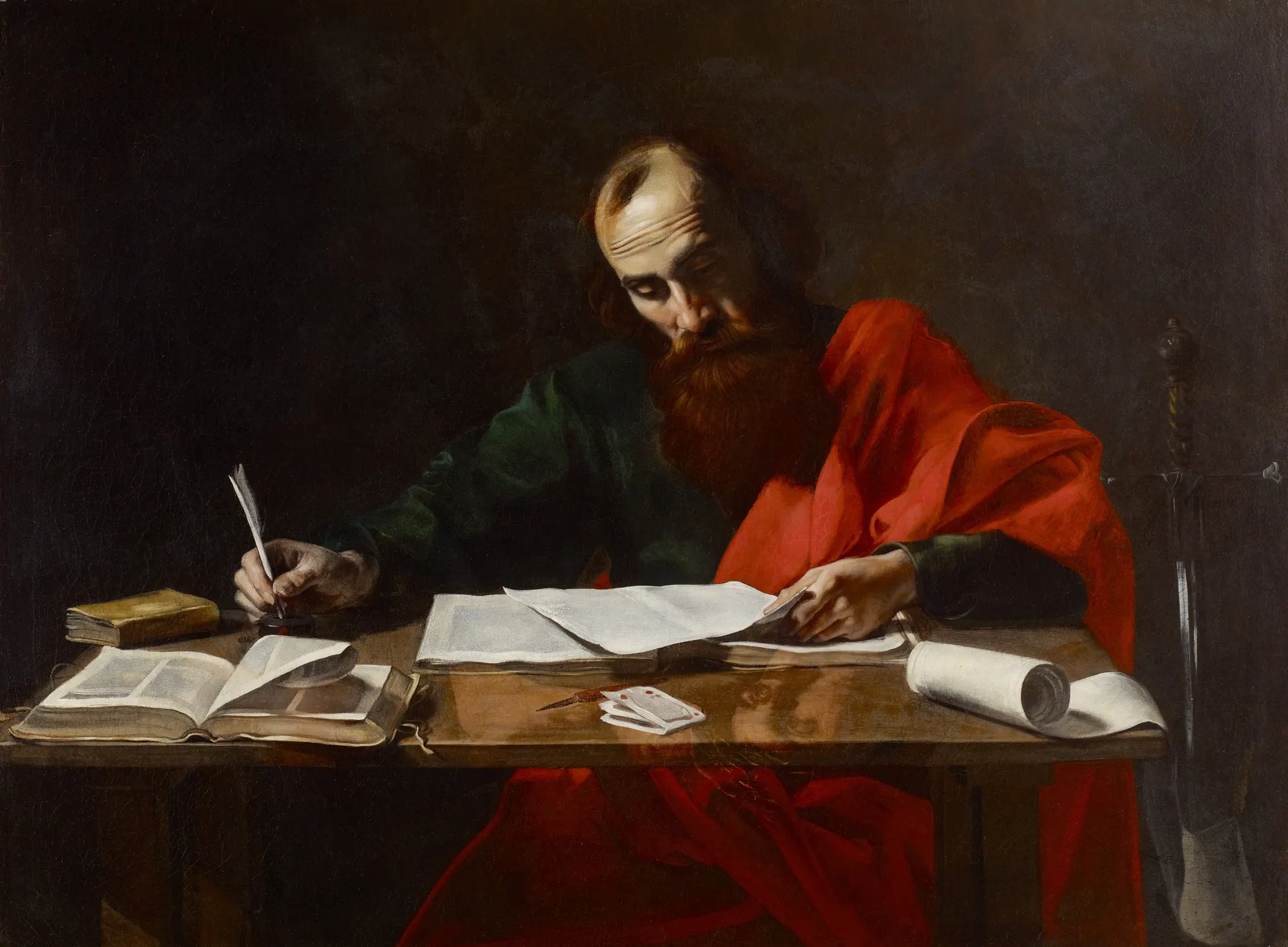
Romanschapter 1
32 verses · Paul · AD 56 or 57 · Paul's letters
Paul, a servant of Christ Jesus, called to be an apostle, and set apart for the gospel of God—
Introduction
Paul, Paul's letters, Romans Overview.
Paul wrote this letter from Corinth about AD 57 to house churches in Rome he had never visited. Jews and Gentiles met together in those churches, and he hoped they would help him travel further west. This first chapter is how he introduces himself and his message to strangers. Listen for how long he takes over his own greeting, and for the one sentence that states the theme of the whole letter. Then listen for the change of tone, as courtesy gives way to a charge. Read it as the opening of an argument the next chapters carry forward.
Context
- Who
- House churches in Rome, Gentile believers in the majority, with Jewish believers returning after years of exile, who had never met the man writing to them.
- What
- The opening of Paul's letter to the Romans: his greeting, his thanks and plans, the statement of his theme, and the first count of the charge against a world that turned from God to idols.
- Where
- Written from Corinth to the house churches in Rome, the capital of the empire.
- When
- About AD 57, early in the reign of Nero, while Paul was at Corinth.
- Why
- To introduce Paul and his gospel to a church he had not founded, and to begin showing why every person needs that gospel.
Historical context
Ancient letters opened with a fixed formula: sender, recipient, greeting. Paul takes that one-line convention and stretches it over seven verses, packing his credentials and his gospel into the space where a normal letter said "Paul to the Romans, greetings." A first hearer would notice the swelling immediately.
Show the rest of the historical context, 2 more paragraphs
He had never been to Rome, which changes the tone of everything. He is introducing himself to a church he did not found, hoping for their backing on a journey further west, and he is careful to say he wants to be encouraged by them as well as to strengthen them.
The moral picture he draws in the second half was not exaggeration to anyone living there. Roman writers themselves, satirists and moralists alike, complained about the same excesses, and the city's religion filled temples with images of gods in human and animal form. Paul's argument is that the problem is worship pointed at the wrong object, and everything else follows from that.
Significance
For Gentile believers in the capital of the world, being told they were included in a gospel promised beforehand through the prophets in the Holy Scriptures placed them inside a story far older than Rome.
Show the rest of the significance, 1 more paragraph
And the claim that this message was the power of God for salvation to everyone who believes, to the Jew first and also to the Greek, set the agenda of the whole letter. Both groups were in the room, and Paul was going to address both without letting either one feel superior.
The heads below are this chapter's scenes. The numbered points under each are its verses.
Paul, a Servant Called to the Gospel of God
Romans 1:1-2
set apart for the gospel of God—: Paul names himself a servant before he names his office. The Greek word is doulos, a slave owned by another. His apostleship sets him apart for the gospel God promised beforehand through His prophets.
Romans 1:1
Paul, when writing to the Romans, has explained this very point: "Paul, an apostle of Jesus Christ, predestinated unto the Gospel of God, which He had promised by His prophets in the holy Scriptures, concerning His Son, who was made to Him of the seed of David according to the flesh, who was predestinated the Son of God with power through the Spirit of holiness, by the resurrection from the dead of our Lord Jesus Christ."
Irenaeus · written before 202 · Irenaeus Against Heresies Book 3patristic
1 more voice on this verseWhat preachers and commentators have said about this verse, in their own words.
Romans 1:1
“He was called at one and the same time to the faith and the apostleship of Christ (Ac 26:16-18). of God--that is, the Gospel of which God is the glorious Author.”
Jamieson, Fausset & Brown · Commentary Critical and Explanatory on the Whole Bible (1871)reformed
promised beforehand through His prophets: Henry and Gill answer a charge the first hearers met, that this gospel was new. God had promised it long before through His prophets, and the Holy Scriptures held the promise. Theodoret sees the word holy marking those Scriptures as divine.
Romans 1:2
"Which he had promised before by his prophets in the holy Scriptures." Whether the Gospel promised by God through the prophetic Scriptures ought to be taken simply, or by way of distinction from that other Gospel which John in the Apocalypse calls eternal — which is then to be revealed when the shadow has passed away and the truth has come, and when death has been swallowed up and eternity restored — consider you also, you who read.
Origen of Alexandria · written before 253 · Commentary on the Epistle to the Romanspatristic
2 more voices on this verse
Romans 1:2
“Which he had promised afore . . . in the holy scriptures--Though the Roman Church was Gentile by nation (see on Ro 1:13), yet as it consisted mostly of proselytes to the Jewish faith (see on Introduction to this Epistle), they are here reminded that in embracing Christ they had not cast off, but only the more profoundly yielded themselves to, Moses and the prophets (Ac 13:32, 33).”
Jamieson, Fausset & Brown · Commentary Critical and Explanatory on the Whole Bible (1871)reformed
Romans 1:2
“Which he had promised afore - Both in the law and in the prophets God showed his purpose to introduce into the world a more perfect and glorious state of things; which state was to take place by and under the influence of the Messiah, who should bring life and immortality to light by his Gospel.”
Adam Clarke · Commentary on the Bible (1810-1826)evangelical
Romans 1:3-4
a descendant of David according to the flesh: Paul's subject is the Son, David's descendant according to the flesh. Through the Spirit of holiness He was declared with power to be God's Son by His resurrection from the dead. The Greek horisthentos means marked out, so the resurrection showed the world what the Son already was.
Romans 1:3
“Who was of the seed of David according to the flesh - That is, with regard to his human nature. Both the natures of our saviour are here mentioned; but the human is mentioned first, because the divine was not manifested in its full evidence till after his resurrection.”
John Wesley · Explanatory Notes upon the New Testament (1755)evangelical
2 more voices on this verse
Romans 1:3
“Those, therefore, who allege that He took nothing from the Virgin do greatly err, [since,] in order that they may cast away the inheritance of the flesh, they also reject the analogy [between Him and Adam].”
Irenaeus · written before 202 · Against Heresies Book IIIpatristic
Romans 1:3
“Concerning his Son - This is connected with the first verse, with the word “gospel.” The gospel of God concerning his Son. The design of the gospel was to make a communication relative to his Son Jesus Christ. This is the whole of it. There is no “good news” to man respecting salvation except what comes by Jesus Christ. Which was made - The word translated “was made” means usually “to be,” or “to become.” It is used, however, in the sense of being born.”
declared with power: The Latin copies read predestined where the Greek reads declared, and Origen already weighs the two words. Augustine sets weakness beside power: the Son of David in weakness according to the flesh, the Son of God in power through the Spirit. The resurrection is where the power shows.
Romans 1:4
“But powerfully declared to be the Son of God, according to the Spirit of Holiness - That is, according to his divine nature. By the resurrection from the dead - For this is both the fountain and the object of our faith; and the preaching of the apostles was the consequence of Christ's resurrection.”
John Wesley · Explanatory Notes upon the New Testament (1755)evangelical
3 more voices on this verse
Romans 1:4
“As Christ was predestined to be the Son of God in power, so we too have been predestined to be sons of God, not however in power but by grace, having been made worthy of such a calling and having received it only by the will of God the Father. There is a big difference here between Emmanuel and us.”
Cyril of Alexandria · written before 444 · Commentary on Romanspatristic
Romans 1:4
“And declared to be the Son of God - See the note on Act 13:33, where this subject is considered at large. The word ορισθεντος, which we render declared, comes from οριζω, to bound, define, determine, or limit, and hence our word horizon, the line that determines the farthest visible part of the earth, in reference to the heavens. In this place the word signifies such a manifest and complete exhibition of the subject as to render it indubitable.”
Adam Clarke · Commentary on the Bible (1810-1826)evangelical
Romans 1:4
“This is here styled the "spirit," as an impalpable and immaterial nature (Joh 4:24), and "the spirit of holiness," probably in absolute contrast with that "likeness, of sinful flesh" which He assumed. One is apt to wonder that if this be the meaning, it was not expressed more simply.”
Jamieson, Fausset & Brown · Commentary Critical and Explanatory on the Whole Bible (1871)reformed
Romans 1:5-6
grace and apostleship: came to Paul through Christ. Godet reads one grace in both words, the grace that saved Paul and sent him on behalf of Christ's name. The purpose is the obedience that comes from faith among the Gentiles, and verse 6 places the Roman believers inside that call.
Romans 1:5
“He says that through Christ he received grace and apostleship, inasmuch as Christ is the "mediator of God and men". "Grace and apostleship": grace is to be referred to endurance in labors; apostleship to the authority of preaching, since Christ himself is called an "apostle", that is, one sent by the Father, seeing that he says he was sent "to preach the gospel to the poor". Because, therefore, what is his own he gives also to his disciples. "Grace" is said to be "poured out upon his lips".”
Origen of Alexandria · written before 253 · Commentary on the Epistle to the Romanspatristic
ConnectionsRomans 16:26
called to belong to Jesus Christ: Chrysostom marks the order of the phrase: the Romans are called along with the other nations, and the capital receives no rank of its own. Jamieson, Fausset and Brown agree that Paul ascribes nothing special to the church at Rome. Its members belong to Christ by His call.
Romans 1:6
“Paul is said to be called to be an apostle, and the Romans are also called, though not to be apostles. Rather they are called to be holy in the obedience of faith. We have already spoken above about the different callings.”
Origen of Alexandria · written before 253 · Commentary on the Epistle to the Romans.116patristic
called to be saints: The letter is addressed to everyone in Rome whom God loves and has called to be saints. Saint means set apart, a standing the call itself gives. The greeting joins Greek charis to Hebrew shalom, both from the Father and the Lord Jesus Christ.
Romans 1:7
You see, then, that we are told that the grace of the Father and the Son is one, and the peace of the Father and the Son is one, but this grace and peace is the fruit of the Spirit, as the Apostle taught us himself, saying: "But the fruit of the Spirit is love, joy, peace, patience."
Ambrose of Milan · written before 397 · On the Holy Spirit, Book 1, Chapter 12patristic
2 more voices on this verse
Romans 1:7
“To all that be in Rome - That is, to all who bear the Christian name. Perhaps he here included not only the church at Rome, but all who might have been there from abroad. Rome was a place of vast concourse for foreigners; and Paul probably addressed all who happened to be there. Beloved of God - Whom God loves. This is the privilege of all Christians. And this proves that the persons whom Paul addressed were “not” those merely who had been invited to the external privileges of the gospel.”
Romans 1:7
“The favours desired: Grace and peace. The Old-Testament salutation was, Peace be to you; but now grace is prefixed-- grace, that is, the favour of God towards us or the work of God in us; both are previously requisite to true peace. All gospel blessings are included in these two: grace and peace.”
Matthew Henry · Commentary on the Whole Bible (1707-1721)puritan
I Am Not Ashamed of the Gospel
Romans 1:8-10
your faith is being proclaimed all over the world: Paul opens with thanks before any correction. He thanks God for the Roman church's faith, proclaimed all over the world, in a congregation he had never seen. He calls God as his witness that he prays for them constantly, asking God to open the way for him to come.
Romans 1:8
“First, I thank my God - From this to the end of Rom 1:17 belongs to the preface, in which the apostle endeavors to conciliate the good opinion of the Christians at Rome, and to prepare their minds for his reproofs and exhortations. Your faith is spoken - καταγγελλεται, is celebrated, throughout the whole world - in every place where the Christian religion is professed, through all parts of the Roman dominions; for in this sense we should understand the words, the whole world.”
Adam Clarke · Commentary on the Bible (1810-1826)evangelical
2 more voices on this verse
Romans 1:8
“He here particularly thanks God, that what otherwise himself should have done, was done at Rome already. My God - This very word expresses faith, hope, love, and consequently all true religion. Through Jesus Christ - The gifts of God all pass through Christ to us; and all our petitions and thanksgivings pass through Christ to God.”
John Wesley · Explanatory Notes upon the New Testament (1755)evangelical
Romans 1:8
" Paul, in like manner, everywhere speaks of "God the Father, and our Lord Jesus Christ." When writing to the Romans, he gives thanks to God through our Lord Jesus Christ. To the Galatians he declares himself to be "an apostle not of men, neither by man, but through Jesus Christ and God the Father.
Tertullian · written before 220 · Against Praxeaspatristic
God, whom I serve with my spirit: Paul takes an oath here. Gill and Chrysostom give the reason: the Romans had never seen him, so only the God who reads hearts could vouch for his love.
Romans 1:9
God is a witness to his saints, because they too are witnesses of God, according to what the prophet says: "You shall be my witnesses, and I am a witness, says the Lord." But the Savior also says to the disciples: "You shall be my witnesses in Jerusalem, and in Samaria, and in all the ends of the earth", according to that which is written: "He who shall confess in me, I also will confess in him before my Father." But let us see what it is that he says, "whom I serve in my spirit."
Origen of Alexandria · written before 253 · Commentary on the Epistle to the Romanspatristic
1 more voice on this verse
Romans 1:9
“For God is my witness, whom I serve,.... These words are an appeal to God, and carry in them the nature and form of an oath; the reason of the apostle's using it was, because he was personally unknown to the Romans, and they to him, and so might doubt of his affectionate regard unto them; and therefore for the confirmation thereof he uses it: this was a case which was only known to God and himself, and hence he appeals to him for the truth of it.”
succeed in coming to you: Paul asks to come to Rome only by God's will, and Chrysostom sees his longing held in check by the fear of God. Jamieson, Fausset and Brown note how the prayer was answered, some years later and in chains. He reached the city as a prisoner.
Romans 1:10
“Making request, if by any means now at length,.... A principal thing, which be incessantly and importunately requested at the throne of grace, was, that he might have an opportunity of coming to them; that God in his providence would open a way for him; and that he might have a safe and comfortable journey in a very little time; all which he submits to the will of God, as a good man ought to do; and which he thus expresses, I might have a prosperous journey by the will of God, to come unto you; see Jas 4:13.”
Romans 1:11-12
impart to you some spiritual gift: Paul wants to impart some spiritual gift to strengthen the church, and charisma covers any grace God hands through one person to another. Verse 12 corrects the picture at once: the encouragement runs both ways, through the faith each has. An apostle expects to receive as much as he gives.
Romans 1:11
“First of all we ought to learn that it is an apostolic work to long for the brethren, yet for no other cause than either that we may confer upon them something of a spiritual gift if we are able, or, if we are not able, that we ourselves may receive from them. For without this, the desire of going about among the brethren is not commendable. But in that he says, "that I may impart to you some spiritual gift", he seems to indicate that there is something which is indeed a gift, yet not spiritual.”
Origen of Alexandria · written before 253 · Commentary on the Epistle to the Romanspatristic
1 more voice on this verse
Romans 1:11
“That I may impart to you - Face to face, by laying on of hands, prayer, preaching the gospel, private conversation. Some spiritual gift - With such gifts the Corinthians, who had enjoyed the presence of St. Paul, abounded, 1 Cor. i, 7; xii, 1; xiv, 1.”
John Wesley · Explanatory Notes upon the New Testament (1755)evangelical
The gift Paul hoped to impart could suggest a church weak in faith, and Chrysostom sees Paul removing that thought at once. Wesley adds that he places the Romans first.
Romans 1:12
“That is, that I may be comforted together with you by the mutual faith both of you and me--"Not wishing to "lord it over their faith," but rather to be a "helper of their joy," the apostle corrects his former expressions: my desire is to instruct you and do you good, that is, for us to instruct and do one another good: in giving I shall also receive" [JOWETT].”
Jamieson, Fausset & Brown · Commentary Critical and Explanatory on the Whole Bible (1871)reformed
2 more voices on this verse
Romans 1:12
“That is, I long to be comforted by the mutual faith both of you and me - He not only associates the Roman with, but even prefers them before, himself. How different is this style of the apostle from that of the modern court of Rome!”
John Wesley · Explanatory Notes upon the New Testament (1755)evangelical
Romans 1:12
“Blessed therefore are those to whom the Apostle wishes to impart spiritual grace for the confirming of their faith, that they may no longer be little ones, nor be carried about with every wind of doctrine. And when this is done by Paul, he himself also receives consolation, seeing his own work firm and stable; and those are consoled who are made partakers of the apostolic grace.”
Origen of Alexandria · written before 253 · Commentary on the Epistle to the Romanspatristic
Romans 1:13-15
how often I planned to come to you: Paul had often planned to come to Rome and had been prevented each time. His obligation runs to Greeks and non-Greeks, to the wise and the foolish, the whole world as a Greek reckoned it. That debt is why Rome stands next on his road.
Romans 1:13
“There is indeed a hyperbaton in this passage; there is also a defect of expression. But the hyperbaton we may render in this way: "But I would not have you ignorant, brethren, that I have often purposed to come to you, that I might have some fruit among you also, even as among the other nations, Greeks and barbarians, wise and unwise, and have been hindered until now." The defect of expression, however, will be supplied in this manner.”
Origen of Alexandria · written before 253 · Commentary on the Epistle to the Romanspatristic
1 more voice on this verse
Romans 1:13
“He was hindered by other business that took him off, by his care of other churches, whose affairs were pressing; and Paul was for doing that first, not which was most pleasant (then he would have gone to Rome), but which was most needful--a good example to ministers, who must not consult their own inclinations so much as the necessity of their people's souls.”
Matthew Henry · Commentary on the Whole Bible (1707-1721)puritan
I am obligated both to Greeks: Origen asks what Greeks and barbarians had given Paul to make him their debtor. Barnes answers that the debt arose from the favor God had shown him in appointing him to preach, so he owed the gospel to all. Wesley counts the Romans among the Greeks, covering every nation.
Romans 1:14
Now we must inquire how the Apostle is a debtor to Greeks and barbarians, to the wise and the unwise. For what had he received from them, whereby he should become their debtor? I think that he was made a debtor to the various nations for this reason, that he received through the grace of the Holy Spirit to speak in the tongues of all nations, as he himself also says: "I speak with tongues more than you all."
Origen of Alexandria · written before 253 · Commentary on the Epistle to the Romanspatristic
1 more voice on this verse
Romans 1:14
“I am a debtor both to the Greeks, and to the barbarians - It has been remarked before that all the nations of the earth, themselves excepted, were termed barbarians by the Greeks. See the origin of the word barbarous in the note on Act 28:2 (note).”
Adam Clarke · Commentary on the Bible (1810-1826)evangelical
so eager to preach the gospel: Rome was the capital and seat of the empire, and Ambrosiaster sees Paul's eagerness to preach the gospel there. Chrysostom counts the cost: a voyage by sea, plots, and a city given over to godlessness. The debt Paul owed made the apostle willing to pay it.
Romans 1:15
“So, as much as in me is, I am ready,.... This explains what he was a debtor to one and another for, namely, to preach the Gospel; expresses the readiness of his mind to that work, whatever difficulties lay in his way; and declares what a willing mind he had to preach it also to the Romans, as elsewhere: to you that are at Rome also; the metropolis of the Roman empire, a very public place, the seat of Satan, and where was the heat of persecution.”
2 more voices on this verse
Romans 1:15
“So, as much as in me is, I am ready to preach the gospel to you that are at Rome also--He feels himself under an all-subduing obligation to carry the gospel to all classes of mankind, as adapted to and ordained equally for all (1Co 9:16).”
Jamieson, Fausset & Brown · Commentary Critical and Explanatory on the Whole Bible (1871)reformed
Romans 1:15
“I am ready to preach - προθυμον; I have a ready mind. I was only prevented by the providence of God from visiting you long ago. His time is best: in the mean time I write, by his direction, to comfort and instruct you.”
Adam Clarke · Commentary on the Bible (1810-1826)evangelical
Romans 1:16-17
the power of God for salvation: The gospel is God's power for salvation to everyone who believes, first to the Jew and then to the Greek. Verse 17 names what it reveals, God's righteousness by faith from start to finish. Luther read it as the righteousness God puts on a man through faith.
Romans 1:16
“For I am not ashamed of the Gospel. For it is the power of God unto salvation to everyone who believes. Many reproaches indeed arose against the Gospel at the beginning of its preaching; but Paul had learned patience from the prophets, who say: Do not be overcome by their reproaches, and do not give way before their revilings; and he knew that he preached the Gospel not in the persuasive words of human wisdom, but in the power of the Spirit.”
Origen of Alexandria · written before 253 · Commentary on the Epistle to the Romanspatristic
4 more voices on this verse
Romans 1:16
“But Paul is not ashamed, knowing it is the power of God unto salvation to every one that believeth - The great and gloriously powerful means of saving all who accept salvation in God's own way. As St. Paul comprises the sum of the gospel in this epistle, so he does the sum of the epistle in this and the following verse.”
John Wesley · Explanatory Notes upon the New Testament (1755)evangelical
Romans 1:16
“I am not ashamed of the Gospel of Christ - This text is best illustrated by Isa 28:16; Isa 49:23, quoted by the apostle, Rom 10:11: For the Scripture saith, Whosoever believeth on him, shall not be ashamed; i.e. they shall neither be confounded, nor disappointed of their hope. The Jews, by not believing on Jesus Christ, by not receiving him as the promised Messiah, but trusting in others, have been disappointed, ashamed, and confounded, from that time to the present day.”
Adam Clarke · Commentary on the Bible (1810-1826)evangelical
Romans 1:16
“The salvation of believers as the end: It is the power of God unto salvation. Paul is not ashamed of the gospel, how mean and contemptible soever it may appear to a carnal eye; for the power of God works by it the salvation of all that believe; it shows us the way of salvation ( Acts xvi. 17 ), and is the great charter by which salvation is conveyed and made over to us.”
Matthew Henry · Commentary on the Whole Bible (1707-1721)puritan
Romans 1:16
“For I am not ashamed of the gospel--(The words, "of Christ," which follow here, are not found in the oldest and best manuscripts). This language implies that it required some courage to bring to "the mistress of the world" what "to the Jews was a stumbling-block and to the Greeks foolishness" (1Co 1:23).”
Jamieson, Fausset & Brown · Commentary Critical and Explanatory on the Whole Bible (1871)reformed
The line comes from Habakkuk 2:4, where the prophet waits for a vision that seems slow in coming. Augustine reads the living as a faith that lasts until believers see God face to face.
Romans 1:17
“Sometimes it means that righteousness by which a man, through the gift of God, is made and is righteous; and that, both by receiving Christ through faith, and by a conformity to the essential righteousness of God.”
John Wesley · Explanatory Notes upon the New Testament (1755)evangelical
1 more voice on this verse
Romans 1:17
“For - This word implies that he is now about to give a “reason” for what he had just said, a reason why he was not ashamed of the gospel of Christ. That reason is stated in this verse. It embodies the substance of all that is contained in the Epistle. It is the doctrine which he seeks to establish; and there is not perhaps a more important passage in the Bible than this verse; or one more difficult to be understood. Therein - In it, ἐν οὕτῳ en houtō, that is, in the gospel.”
Cross references
Romans 1:17
- QuotingHabakkuk 2:4“Look at the proud one; his soul is not upright—but the righteous will live by faith—”
'The just shall live by faith', thesis of Romans ('as it is written')
Truth Held Down: They Traded the Glory of God
The wrath of God is being revealed from heaven: now, in the present tense. Suppress translates katecho, to press something down and keep it there. What men suppress is a truth they already know, and verse 19 says who gave it.
Romans 1:18
“For the wrath of God is revealed - The apostle has now finished his preface, and comes to the grand subject of the epistle; namely, to show the absolute need of the Gospel of Christ, because of the universal corruption of mankind; which was so great as to incense the justice of God, and call aloud for the punishment of the world 1. He shows that all the heathen nations were utterly corrupt, and deserved this threatened punishment. And this is the subject of the first chapter, from Rom 1:18 to the end (Rom 1:18-32).”
Adam Clarke · Commentary on the Bible (1810-1826)evangelical
1 more voice on this verse
Romans 1:18
“His first argument is, The law condemns all men, as being under sin. None therefore is justified by the works of the law. This is treated of chap. iii, 20.”
John Wesley · Explanatory Notes upon the New Testament (1755)evangelical
Romans 1:19-20
what may be known about God is plain to them: God has made what may be known about Him plain. Creation has shown His eternal power and divine nature, invisible qualities understood from His workmanship. The word for without excuse is anapologetos, with no defense to offer, and that is where the chapter leaves the nations.
Romans 1:19
“Because what is known of God is manifest in them; for God has manifested it to them. We have already said above that what is known of God is that which they can attain from the order and reasons of this world, as the Apostle himself indicates from what follows, saying that his invisible things are contemplated through the things that have been made.”
Origen of Alexandria · written before 253 · Commentary on the Epistle to the Romanspatristic
3 more voices on this verse
Romans 1:19
“Because that which may be known of God,.... There are some things which could not be known of God by the light of nature; as a trinity of persons in the Godhead; the knowledge of God in Christ as Mediator; the God-man and Mediator Jesus Christ; his incarnation, sufferings, death, and resurrection; the will of God to save sinners by a crucified Jesus; the several peculiar doctrines of the Gospel, particularly the resurrection of the dead, and the manner of worshipping of God with acceptance: but then there are some things which may be known of God, without a revelation.”
Romans 1:19
“Because - The apostle proceeds to show how it was that the pagan hindered the truth by their iniquity. This he does by showing that the truth might be known by the works of creation; and that nothing but their iniquity prevented it. That which may be known of God - That which is “knowable” concerning God. The expression implies that there may be many things concerning God which cannot be known. But there are also many things which may be ascertained.”
Romans 1:19
“For what is to be known of God - Those great principles which are indispensably necessary to be known. Is manifest in them; for God hath showed it to them - By the light which enlightens every man that cometh into the world.”
John Wesley · Explanatory Notes upon the New Testament (1755)evangelical
so that men are without excuse: Chrysostom joins this verse to Psalm 19:1, where the heavens declare the glory of God to every nation. Augustine names the excuse Paul removes, the plea that a man would have acted otherwise had he only known. Wesley adds that these qualities are seen by the mind.
Romans 1:20
“For the invisible things of him from--or "since" the creation of the world are clearly seen--the mind brightly beholding what the eye cannot discern. being understood by the things that are made--Thus, the outward creation is not the parent but the interpreter of our faith in God.”
Jamieson, Fausset & Brown · Commentary Critical and Explanatory on the Whole Bible (1871)reformed
2 more voices on this verse
Romans 1:20
“The invisible things of him - His invisible perfections are manifested by his visible works, and may be apprehended by what he has made; their immensity showing his omnipotence, their vast variety and contrivance, his omniscience; and their adaptation to the most beneficent purposes, his infinite goodness and philanthropy. His eternal power - αιδιος αυτου δυναμις, That all-powerful energy that ever was, and ever will exist; so that, ever since there was a creation to be surveyed, there have been intelligent beings to make that survey.”
Adam Clarke · Commentary on the Bible (1810-1826)evangelical
Romans 1:20
“‘So that they are without excuse: because that, when they knew God, they glorified him not as God, neither were thankful.’Romans 1:20, 21 THOSE who boast of their knowledge betray their ignorance. Knowledge is not a possession to be proud of, since it brings with it so great a responsibility that a nurse might as well be proud of watching over a life in peril. Knowledge may become good or ill according to the use which is made of it.”
ConnectionsPsalms 19:1
Romans 1:21-23
although they knew God: They knew God and withheld worship and thanks, the root failure before a single idol is carved. Claiming wisdom, they became fools and traded the glory of the immortal God for images of man, birds, animals and reptiles. The list descends from man to reptiles, reversing Genesis 1.
Romans 1:21
“Because, knowing God - For the wiser heathens did know that there was one supreme God; yet from low and base considerations they conformed to the idolatry of the vulgar. They did not glorify him as God, neither were thankful - They neither thanked him for his benefits, nor glorified him for his divine perfection. But became vain - Like the idols they worshipped.”
John Wesley · Explanatory Notes upon the New Testament (1755)evangelical
2 more voices on this verse
Romans 1:21
“Because that - The apostle here is showing that it was right to condemn people for their sins. To do this it was needful to show them that they had the knowledge of God, and the means of knowing what was right; and that the true source of their sins and idolatries was a corrupt and evil heart. When they knew God - Greek, “knowing God.” That is, they had an acquaintance with the existence and many of the perfections of one God.”
Romans 1:21
“To glorify him as God is to worship him with spiritual worship; but they made images of him. Not to glorify God as God is in effect not to glorify him at all; to respect him as a creature is not to glorify him, but to dishonour him.”
Matthew Henry · Commentary on the Whole Bible (1707-1721)puritan
they became fools: The wise of the Greek world claimed wisdom as their boast, and Barnes notes that philosopher means a lover of wisdom. Theodoret sees the claim itself exposing them as fools. Augustine names the root as pride.
Romans 1:22
“Professing themselves to be wise - This is most strikingly true of all the ancient philosophers, whether Greeks or Romans, as their works, which remain, sufficiently testify. The word φασκοντες signifies not merely the professing but the assumption of the philosophic character. In this sense the word φασκειν is used by the best Greek writers. See Kypke. A dispassionate examination of the doctrine and lives of the most famed philosophers of antiquity, of every nation, will show that they were darkened in their mind and irregular in their conduct.”
Adam Clarke · Commentary on the Bible (1810-1826)evangelical
1 more voice on this verse
Romans 1:22
“Thus the world by wisdom knew not God, 1 Cor. i. As a profession of wisdom is an aggravation of folly, so a proud conceit of wisdom is the cause of a great deal of folly. Hence we read of few philosophers who were converted to Christianity; and Paul's preaching was no where so laughed at and ridiculed as among the learned Athenians, Acts xvii.”
Matthew Henry · Commentary on the Whole Bible (1707-1721)puritan
exchanged the glory of the immortal God: Augustine sees the Romans, the Greeks and the Egyptians in this exchange, all proud of their wisdom. Clarke adds that Greek sculptors gave their finest skill to images of the gods in the form of mortal man. The glory of the immortal God was traded for a statue.
Romans 1:23
“And changed the glory of the incorruptible God,.... God is incorruptible and immortal in his nature, and so is opposed to all corruptible creatures and things: he has a glory which is essential to him, and a manifestative one in the creatures, and which is relative, and of right belongs to him: his absolute essential glory cannot be changed, cannot be taken away from him, nor given to another; but his relative glory may be said to be changed, when another is worshipped in his stead, and called by his name.”
2 more voices on this verse
Romans 1:23
“And changed - This does not mean that they literally “transmuted” God himself; but that in their views they exchanged him; or they changed him “as an object of worship” for idols. They produced, of course, no real change in the glory of the infinite God, but the change was in themselves. They forsook him of whom they had knowledge Rom 1:21, and offered the homage which was due to him, to idols.”
Romans 1:23
“People like this make it hard to tell which was the more contemptible, the worshipers or the worshiped. Perhaps the worshipers by far, since as rational beings and recipients of God's grace, they chose their inferior for patron and better.”
Gregory of Nazianzus · written before 390 · Oration 28: on God 28.15patristic
God Gave Them Up: The Long Slide Downward
Romans 1:24-25
God gave them over: to what they already wanted, the first of three times the chapter says it. Paradidomi means to hand a person across to another's keeping. Verse 25 names the exchange: the truth of God traded for a lie.
Romans 1:24
“God - gave them up, etc. - They had filled up the measure of their iniquities, and God, by permitting them to plunge into all manner of irregularities, thus, by one species of sin, inflicted punishment on another. Dishonour their own bodies - Probably alluding here to what is more openly expressed, Rom 1:26, Rom 1:27. Between themselves - εν εαυτοις, Of themselves, of their own free accord; none inciting, none impelling.”
Adam Clarke · Commentary on the Bible (1810-1826)evangelical
2 more voices on this verse
Romans 1:24
“By whom they were given up. God gave them up, in a way of righteous judgment, as the just punishment of their idolatry--taking off the bridle of restraining grace--leaving them to themselves--letting them alone; for his grace is his own, he is debtor to no man, he may give or withhold his grace at pleasure.”
Matthew Henry · Commentary on the Whole Bible (1707-1721)puritan
Romans 1:24
“Wherefore God also--in righteous retribution. gave them up--This divine abandonment of men is here strikingly traced in three successive stages, at each of which the same word is used (Ro 1:24, 26; and Ro 1:28, where the word is rendered "gave over").”
Jamieson, Fausset & Brown · Commentary Critical and Explanatory on the Whole Bible (1871)reformed
exchanged the truth of God for a lie: Barnes reads the truth of God as a Hebrew way of saying the true God. Clarke notes that Scripture often calls an idol a lie, as at Isaiah 44:20 and Jeremiah 10:14.
Romans 1:25
“Who changed the truth of God into a lie--that is, the truth concerning God into idol falsehood. and worshipped and served the creature more than the Creator--Professing merely to worship the Creator by means of the creature, they soon came to lose sight of the Creator in the creature.”
Jamieson, Fausset & Brown · Commentary Critical and Explanatory on the Whole Bible (1871)reformed
2 more voices on this verse
Romans 1:25
“Or, above the Creator, paying more devout respect to their inferior deities, stars, heroes, demons, thinking the supreme God inaccessible, or above their worship. The sin itself was their worshipping the creature at all; but this is mentioned as an aggravation of the sin, that they worshipped the creature more than the Creator.”
Matthew Henry · Commentary on the Whole Bible (1707-1721)puritan
Romans 1:25
“Who changed the truth of God - This is a repetition of the declaration in Rom 1:23, in another form. The phrase, “the truth of God” is a Hebrew phrase, meaning “the true God.” In such a case, where two nouns come together, one is employed as an adjective to qualify the other. Most commonly the latter of two nouns is used as the adjective, but sometimes it is the former, as in this case. God is called “the true God” in opposition to idols, which are called false gods.”
Romans 1:26-27
God gave them over to dishonorable passions: This is the second handing over in the chapter. The exchange of verse 25 now shows in the body, as women and men exchanged natural relations for unnatural ones. The due penalty for their error came back in themselves.
Romans 1:26
“Would those so condemned not have remained in the lusts of their hearts, even if they had not been given up to them by God? Would they not have fallen into dishonorable passions, even if they had not been given up to them by God? Would they not have fallen into an unfit mind quite apart from being given up to it by God?”
Origen of Alexandria · written before 253 · On Prayer 29.12patristic
1 more voice on this verse
Romans 1:26
“For this cause God gave them up, etc. - Their system of idolatry necessarily produced all kinds of impurity. How could it be otherwise, when the highest objects of their worship were adulterers, fornicators, and prostitutes of the most infamous kind, such as Jupiter, Apollo, Mars, Venus, etc.? Of the abominable evils with which the apostle charges the Gentiles in this and the following verse I could produce a multitude of proofs from their own writings; but it is needless to make the subject plainer than the apostle has left it.”
Adam Clarke · Commentary on the Bible (1810-1826)evangelical
the due penalty for their error: Chrysostom traces the penalty back to its source, the exchange of God's truth for a lie. Wesley sees the dishonoring of their bodies as the fit reward of an idolatry that dishonored God. Vice brings its own penalty.
Romans 1:27
“Receiving the just recompense of their error - Their idolatry being punished with that unnatural lust, which was as horrible a dishonour to the body, as their idolatry was to God.”
John Wesley · Explanatory Notes upon the New Testament (1755)evangelical
1 more voice on this verse
Romans 1:27
“And likewise the men ... - The sin which is here specified is what was the shameful sin of Sodom, and which from that has been called sodomy. It would scarcely be credible that man had been guilty of a crime so base and so degrading, unless there was ample and full testimony to it.”
Romans 1:28-29
He gave them up to a depraved mind: The third handing over closes the sequence. They did not approve of keeping God in view, so God gave them up to a mind He does not approve. The Greek plays on one word, dokimazo and adokimos.
Romans 1:28
“They did not like to retain God - It would, perhaps, be more literal to translate ουκ εδοκιμασαν, They Did Not Search to retain God in their knowledge. They did not examine the evidences before them (Rom 1:19, Rom 1:20) of his being and attributes; therefore God gave them over to a Reprobate mind, εις αδοκιμον νουν, to an Unsearching or undiscerning mind; for it is the same word in both places. They did not reflect on the proofs they had of the Divine nature, and God abandoned them to the operations of a mind incapable of reflection.”
Adam Clarke · Commentary on the Bible (1810-1826)evangelical
2 more voices on this verse
Romans 1:28
“For one and the same God [that blesses others] inflicts blindness upon those who do not believe, but who set Him at naught; just as the sun, which is a creature of His, [acts with regard] to those who, by reason of any weakness of the eyes cannot behold his light; but to those who believe in Him and follow Him, He grants a fuller and greater illumination of mind.”
Irenaeus · written before 202 · Against Heresies Book IVpatristic
Romans 1:28
“Eyes full of adultery cannot cease from sin, 2 Pet. ii. This reprobate mind was a blind scared conscience, past feeling, Eph. iv. When the judgment is once reconciled to sin, the man is in the suburbs of hell.”
Matthew Henry · Commentary on the Whole Bible (1707-1721)puritan
filled with every kind of wickedness: Chrysostom finds every word intensive: filled, every kind, full. Ambrosiaster sees wickedness set at the head of the list, with greed and malice flowing from it. Clarke reports that some of the best manuscripts omit fornication here, as the Berean text does.
Romans 1:29
“Being filled - That is, the things which he specifies were common or abounded among them. This is a strong phrase, denoting that these things were so often practiced as that it might be said they were full of them. We have a phrase like this still, when we say of one that he is full of mischief, etc. Unrighteousness - ἀδικία adikia. This is a word denoting injustice, or iniquity in general. The particular specifications of the iniquity follow. Fornication - This was a common and almost universal sin among the ancients, as it is among the moderns.”
1 more voice on this verse
Romans 1:29
“Filled with all injustice - This stands in the first place; unmercifulness, in the last. Fornication - Includes here every species of uncleanness. Maliciousness - The Greek word properly implies a temper which delights in hurting another, even without any advantage to itself.”
John Wesley · Explanatory Notes upon the New Testament (1755)evangelical
Romans 1:30-32
God-haters, insolent, arrogant, and boastful: The list closes on broken relationship, naming every bond that should hold a family or a city. Verse 32 lands the sharpest charge in the chapter. They know God's righteous decree, they do these things, and they applaud the people who do them.
Romans 1:30
“Backbiters - Καταλαλους, from κατα, against, and λαλεω, I speak; those who speak against others; false accusers, slanderers. Haters of God - Θεοστυγεις, atheists, contemners of sacred things, maligners of providence, scorners, etc. All profligate deists are of this class; and it seems to be the finishing part of a diabolic character. Despiteful - Ὑβριστας, from ὑβριζω, to treat with injurious insolence; stormy, boisterous; abusing both the characters and persons of those over whom they can have any power. Proud - Ὑπερηφανους, from ὑπερ, above or over, and φαινω, I show or shine.”
Adam Clarke · Commentary on the Bible (1810-1826)evangelical
1 more voice on this verse
Romans 1:30
“Whisperers - Such as secretly defame others. Backbiters - Such as speak against others behind their back. Haters of God - That is, rebels against him, deniers of his providence, or accusers of his justice in their adversities; yea, having an inward heart- enmity to his justice and holiness.”
John Wesley · Explanatory Notes upon the New Testament (1755)evangelical
senseless, faithless, heartless, merciless: In Greek senseless, faithless, heartless and merciless all open with the same negative. Clarke takes faithless as covenant breaking. Chrysostom joins heartless to Matthew 24:12, where wickedness spreads and love grows cold in men.
Romans 1:31
“Without understanding - Inconsiderate, or foolish; see Rom 1:21-22. Covenant breakers - Perfidious; false to their contracts. Without natural affections - This expression denotes the lack of affectionate regard toward their children. The attachment of parents to children is one of the strongest in nature, and nothing can overcome it but the most confirmed and established wickedness. And yet the apostle charges on the pagan generally the lack of this affection. He doubtless refers here to the practice so common among pagans of exposing their children, or putting them to death.”
1 more voice on this verse
Romans 1:31
“Covenant-breakers - It is well known, the Romans, as a nation, from the very beginning of their commonwealth, never made any scruple of vacating altogether the most solemn engagement, if they did not like it, though made by their supreme magistrate, in the name of the whole people.”
John Wesley · Explanatory Notes upon the New Testament (1755)evangelical
approve of those who practice them: Wesley calls approval the highest degree of wickedness. Passion can hurry a man into a sin he hates, and applause loves the sin for its own sake. Augustine adds that consent shares in deeds never done.
Romans 1:32
“Who, knowing the judgment of God - Δικαιωμα, the grand rule of right which God has revealed to every man, the knowledge of which he has, less or more, given to every nation of the world, relative to honouring parents, taking care of their own offspring, keeping their engagements, etc., etc.”
Adam Clarke · Commentary on the Bible (1810-1826)evangelical
2 more voices on this verse
Romans 1:32
“Not only do the same, but have pleasure in those that practice them - This is the highest degree of wickedness. A man may be hurried by his passions to do the thing he hates; but he that has pleasure in those that do evil, loves wickedness for wickedness' sake. And hereby he encourages them in sin, and heaps the guilt of others upon his own head.”
John Wesley · Explanatory Notes upon the New Testament (1755)evangelical
Romans 1:32
“Perverted human tradition is the source of great evil for us, in that some sins are denounced while others are viewed with indifference. Crimes like homicide and adultery are the object of a violent but feigned indignation while others, like anger, reviling, drunkenness or avarice, are not considered deserving of even a simple admonition.”
Basil of Caesarea · written before 379 · On the Judgment of Godpatristic
How this psalm is built
The form: A preface through verse 17 that greets, gives thanks and states the theme, then the grand subject of the letter, the need of the gospel shown from the corruption of mankind, as Clarke classes it.
The patterns in this chapter
| Device | What it does | Where to see it |
|---|---|---|
| God gave them over, three times | The same verb comes three times in five verses: God gave them over at verse 24, gave them over at verse 26 and gave them up at verse 28. Jamieson, Fausset and Brown read these as three successive stages of one abandonment, each marked by the same Greek word. Each handing over follows an exchange, and each leaves the people to what they had already chosen.Jamieson, Fausset & Brown, Commentary Critical and Explanatory on the Whole Bible, 1871, on Romans 1:24. | Romans 1:24, Romans 1:26, Romans 1:28 |
| The three exchanges | The word exchanged comes at verses 23, 25 and 26. The glory of God is exchanged for images, the truth of God for a lie, and natural relations for unnatural ones. Albert Barnes reads verse 25 as the declaration of verse 23 said again in another form, so the second exchange names what the first one was.Albert Barnes, Notes, Explanatory and Practical, on the Old and New Testaments (1832-1869), on Romans 1:25. | Romans 1:23, Romans 1:25, Romans 1:26 |
| The list of vices | Verses 29 to 31 set out the list that follows the third handing over. Ambrosiaster reads it as ordered, with wickedness set first and the other vices flowing from it, and Chrysostom marks that every term is intensive. The last four words close the list on the loss of feeling for God and for other people.Ambrosiaster, COMMENTARY ON PAUL'S EPISTLES, 384, on Romans 1:29. | Romans 1:29, Romans 1:30, Romans 1:31 |
How this chapter is built
6 more paragraphs on the patterns
The chapter falls into two parts. Adam Clarke counts everything to the end of verse 17 as the preface, the greeting, the thanksgiving and the statement of theme. From verse 18 the letter turns to what Clarke calls its grand subject, the need of the gospel shown by the corruption of mankind. That second part turns on one verb said three times, at verses 24, 26 and 28, which Jamieson, Fausset and Brown read as three successive stages and John Wesley as three degrees of ungodliness and of punishment. The word exchanged also comes three times, at verses 23, 25 and 26, and the chapter closes on a list of vices in verses 29 to 31.
Where it stands in the letter
Verses 16 and 17 give the thesis the whole letter unfolds, and verse 18 opens a charge that Jamieson, Fausset and Brown carry to 3:20, where they place the turn to the grace of the gospel. Chapter 1 leaves the Gentile world without excuse, and chapter 2 turns the same charge on the reader who agreed with it.
Where to go deeper
The city has its own page at /featured/rome. The line quoted in verse 17 is traced at /featured/the-just-shall-live-by-faith, and the charge that begins at verse 18 at /featured/the-universal-indictment.
Sources: Adam Clarke, Commentary on the Bible, 1832, on Romans 1:8 and 1:18; Jamieson, Fausset and Brown, Commentary Critical and Explanatory on the Whole Bible, 1871, on Romans 1:24 and 3:20, with John Wesley, Explanatory Notes upon the New Testament, 1755, on Romans 1:23.
Keep studying
Studies6
People and groups1
Places1
Words12
Sources for this chapter
The summary
Jamieson, Fausset & Brown, Commentary Critical and Explanatory; John Calvin, Commentaries; John Wesley, Explanatory Notes Upon the New Testament and Matthew Henry, Complete Commentary.
The context
E. B. Pusey, The Minor Prophets: A Commentary and John Calvin, Commentaries on the Twelve Minor Prophets.
The form and classifications
Adam Clarke, Commentary on the Bible, 1832, on Romans 1:8 and 1:18; John Gill, Exposition of the New Testament (1746-1748), on Romans 1:8 and John Wesley, Explanatory Notes upon the New Testament, 1755, on Romans 1:23.
The exposition
Adam Clarke, Commentary on the Bible; Albert Barnes; Ambrosiaster, COMMENTARY ON PAUL'S EPISTLES; Augustine of Hippo; Charles Hodge, Commentary on the Epistle to the Romans; Frederic Godet, Commentary on St. Paul's Epistle to the Romans; Jamieson, Fausset & Brown, Commentary Critical and Explanatory on the Whole Bible; John Calvin, Commentary on the Epistle to the Romans; John Chrysostom; John Gill; John Wesley, Explanatory Notes upon the New Testament; Martin Luther, Preface to the Epistle to the Romans; Matthew Henry, Commentary on the Whole Bible; Origen of Alexandria, COMMENTARY ON THE EPISTLE TO THE ROMANS; Robert Haldane, Exposition of the Epistle to the Romans and Theodoret of Cyrus, INTERPRETATION OF THE LETTER TO THE ROMANS.