
Psalm 77
20 verses · Individual lament
Your path led through the sea, Your way through the mighty waters, but Your footprints were not to be found.
Introduction
Asaph, the Sleepless Night, Book 3: The crisis of the throne, Poetry, Psalms Overview.
This psalm is headed for Asaph and set for the choir of Jeduthun, and it is the record of a sleepless night. A man in deep distress lies awake asking whether God has changed, and he asks it six ways without receiving an answer. Nothing in his situation moves. What moves is his mind, when he decides to remember what God did long ago at the sea. Listen for the turn in the middle, where the questions give way to memory, and for the storm at the sea told in quick strokes at the close.
Context
- Who
- Worshippers whose present evidence pointed the wrong way
- What
- A lament of a sleepless night that turns from unanswered questions to the memory of the Exodus.
- Where
- Israel's worship, in the voice of a man lying awake through the night watches.
- When
- The date is unstated; the psalm is set for the Jeduthun choir of the temple singers.
- Why
- To show a troubled believer how remembering God's past deeds steadies faith in a dark present.
Historical context
The heading names Asaph and assigns the psalm to Jeduthun, one of the three men set over the music of the sanctuary, so it is a prayer written for public use. No date and no event is named, and the psalm gives an hour instead. The night in Israel was divided into watches with the guard changing at set times, so a man lying awake could measure how long he had been awake. The middle of the psalm is six questions in a row with no answers attached. The crossing of the sea at the close is told in storm language, thunder, lightning and a trembling earth, the vocabulary the whole region used for a god arriving, and Israel used it for one night at one shoreline.
Significance
For hearers whose situation gave them no reason for hope, the psalm offered old evidence sung back at a new fear. It ends with a whole nation led the way a flock moves, by two men and a staff, and it turns on a decision to remember while nothing in the circumstances has changed.
This chapter in Jewish lifeWhat this chapter is in Jewish life and reading.
How it is read
Rashi reads this psalm as the voice of Israel in exile, and he says so at the heading. The word Jeduthun he takes, as he took it at Psalm 62, of "the decrees and the laws that pass over Israel" (Rashi on Psalms 77:1:1). The running wound of verse 3 is then a wound of exile, which he calls a night (Rashi on Psalms 77:3:2). Verse 5, where God holds the eyes open, he reads as sleeplessness of a particular kind. A man who wakes from sleep has his mind settled again. This man's eyes are held shut in the night of exile while his spirit throbs and he has no speech (Rashi on Psalms 77:5:1). The remembering that follows is then a remembering of the sanctuary. The music of verse 7 is the music the singer used to play in the Temple in the days of old (Rashi on Psalms 77:7:1). The thought that all this is meant to frighten him back to God he puts in the man's own mouth at verse 11 (Rashi on Psalms 77:11:1). From verse 17 the psalm turns to the sea, and Rashi keeps it at the Red Sea. The thunder rolled there like a wheel to confuse the camp of the Egyptians, and the footprints left no mark on the water (Rashi on Psalms 77:19:1 and 77:20:1). Ibn Ezra and Radak stand in the corpus here by reference alone. Rashi is quoted here from the Judaica Press complete Tanach with Rashi, translated by A. J. Rosenberg, under CC-BY.
What the rabbis say
The corpus records forty places where the Midrash and the Talmud draw on this psalm, cited here by reference. Midrash Tehillim treats it at 77:1 and 77:2, and cites its verses again at 1:4, 42:4 and 113:1. Verse 19, on the thunder and the lightning, is drawn into the Babylonian Talmud at Berakhot 59a:7. Verse 14, on the way of God in holiness, stands in the Jerusalem Talmud at Berakhot 9:1:12. The sea of verses 17 to 21 draws the midrashim of the crossing. They stand at the Mekhilta DeRabbi Yishmael, Tractate Vayehi Beshalach 5:19 and 1:2, the Mekhilta DeRabbi Shimon Ben Yochai 14:19 and 14:23, Pirkei DeRabbi Eliezer 4:5 and Bamidbar Rabbah 23:2. Verse 10, asking whether God has forgotten to be gracious, is read at Eikhah Rabbah 1:23.
Sources: Rashi, Rashi on Psalms 77:1 to 77:20, the Judaica Press complete Tanach with Rashi, translated by A. J. Rosenberg, CC-BY, 1040 to 1105; Midrash Tehillim, 77:1, 77:2, 42:4 and 113:1, cited by reference; Babylonian Talmud, Berakhot 59a:7, cited by reference; Jerusalem Talmud, Berakhot 9:1:12, cited by reference; Mekhilta DeRabbi Yishmael, Tractate Vayehi Beshalach 1:2 and 5:19, cited by reference; The Sefaria corpus, scripts/data/sources/sefaria/psalms/77.json, fetched 2026-09-19, 2026.
Psalms 77:1-3
I cried out to God: The psalmist cries aloud to God and keeps his hands stretched out through the night. His soul refused to be comforted, and remembering God made him groan. The trouble itself is never named.
Psalms 77:1
“With my voice I cried out to the Lord: with my voice to God, and he gave heed to me. In the day of my tribulation I sought out God. See how he is in tribulation, and he beseeches God, God, God — and yet God is one. With my voice I cried out to the Lord. A cry is necessary at that time when he who cries is far off. So what this man says is this: since on account of my sins I am far from you, therefore I cry, that you may hear me.”
Jerome · written before 420 · Homily 10, on Psalm 76patristic
1 more voice on this verseWhat preachers and commentators have said about this verse, in their own words.
Psalms 77:1
“I cried unto God with my voice. This Psalm has much sadness in it, but we may be sure it will end well, for it begins with prayer, and prayer never has an ill issue. Asaph did not run to man but to the Lord, and to him he went, not with studied, stately, stilted words, but with a cry, the natural, unaffected, unfeigned expression of pain. He used his voice also, for though vocal utterance is not necessary to the life of prayer, it often seems forced upon us by the energy of our desires.”
Charles Spurgeon · The Treasury of David, Vol. 3 (1872)Particular Baptist
my outstretched hands did not grow weary: Jamieson, Fausset and Brown gave the Hebrew as a hand spread out that did not grow numb. Charles Spurgeon observed that he sought the Lord before any relief, since God hiding his face was the root of the trouble. The search ran from day into night.
Psalms 77:2
“In the day of my trouble I sought the Lord. All day long his distress drove him to his God, so that when night came he continued still in the same search. God had hidden his face from his servant, therefore the first care of the troubled saint was to seek his Lord again. This was going to the root of the matter and removing the main impediment first. Diseases and tribulations are easily enough endured when God is found of us, but without him they crush us to the earth. My sore ran in the night, and ceased not.”
Charles Spurgeon · The Treasury of David, Vol. 3 (1872)Particular Baptist
1 more voice on this verse
Psalms 77:2
“There is, however, some ambiguity in the words. The Hebrew word yd, yad, which I have translated hand, is sometimes taken metaphorically for a wound; and, therefore, many interpreters elicit this sense, My wound ran in the night, and ceased not, that is to say, My wound was not so purified from ulcerous matter as that the running from it was made to stop.”
John Calvin · Commentaries (1554)reformed
I remembered You, O God, and I groaned: Spurgeon noted the strangeness here. The God who delights faith became a dread when the psalmist remembered Him, and every attribute looked dark to a troubled heart. Clarke read the faint spirit as grief for his suffering people.
Psalms 77:3
“My soul refused to be comforted. Insofar as it depended on my sins, I could not comfort myself with having no hope. I remembered God, and I was delighted. Insofar as it lay in my sins, I could find no comfort; again I thought of God, and in his mercy I was delighted. In the Hebrew it reads otherwise: "I remembered God, and I was troubled." I considered his gentleness, I considered his tenderness, I considered his purity; and seeing myself unclean, I was vehemently troubled. And I was exercised, and my spirit failed.”
Jerome · written before 420 · Homily 10, on Psalm 76patristic
1 more voice on this verse
Psalms 77:3
“I remembered God, and was troubled. He who is the wellspring of delight to faith becomes an object of dread to the psalmist's distracted heart. The justice, holiness, power, and truth of God have all a dark side, and indeed all the attributed may be made to look black upon us if our eye be evil; even the brightness of divine love blinds us, and fills us with a horrible suspicion that we have neither part nor lot in it.”
Charles Spurgeon · The Treasury of David, Vol. 3 (1872)Particular Baptist
Psalms 77:4-6
kept my eyes from closing: God Himself keeps his eyes from closing, and the trouble runs too deep for speech. He turns on purpose, to the days of old and the song he remembered, and the last verb of verse 6 is chaphas, to search. Barnes reads a man at work to remember.
Psalms 77:4
“Thou holdest mine eyes waking. The fears which thy strokes excite in me forbid my eyelids to fall, my eyes continue to watch as sentinels forbidden to rest. Sleep is a great comforter, but it forsakes the sorrowful, and then their sorrow deepens and eats into the soul. If God holds the eyes waking, what anodyne shall give us rest? How much we owe to him who giveth his beloved sleep! I am so troubled that I cannot speak. Great griefs are dumb. Deep streams brawl not among the pebbles like the shallow brooklets which live on passing showers.”
Charles Spurgeon · The Treasury of David, Vol. 3 (1872)Particular Baptist
2 more voices on this verse
Psalms 77:4
“My eyes anticipated the watches. In the Hebrew it reads otherwise: "I held in check the gaze of my eyes, I was struck dumb and did not speak." What he means is this: considering my sins, I did not dare to lift my eyes to heaven. "For to the sinner God has said: Why do you declare my statutes?" Therefore I was struck dumb, I was afraid, I could not speak. This is according to the Hebrew. My eyes anticipated the watches. Before anyone else was awake, I was awake.”
Jerome · written before 420 · Homily 10, on Psalm 76patristic
Psalms 77:4
“Thou holdest mine eyes waking,.... Or, "the watches", or rather "keepers of the eyes" (m); the eyebrows, which protect the eyes; these were held, so that he could not shut them, and get any sleep; so R.”
I considered the days of old: When the present held no good, Spurgeon said, the soul considered the days of old and the years long past. He counted that search a duty against despair. Augustine pictured a man driven inward, who mused and pondered in the secret place of his heart.
Psalms 77:5
“I thought upon the days of old, and I had the eternal years in mind. Insofar as it lay in my sins, I was despairing, and my soul had refused to be comforted. I began to think from the beginning of the world, when God made man, all the way to my own year, from Adam down to my own time.”
Jerome · written before 420 · Homily 10, on Psalm 76patristic
At night I remembered my song: Matthew Henry took the song as one he had sung in better days. He tried to sing it again and found himself out of tune for it. The memory only poured out his soul in grief.
Psalms 77:6
“I call to remembrance my song in the night. At other times his spirit had a song for the darkest hour, but now he could only recall the strain as a departed memory. Where is the harp which once thrilled sympathetically to the touch of those joyful fingers? My tongue, hast thou forgotten to praise? Hast thou no skill except in mournful ditties? Ah me, how sadly fallen am I! How lamentable that I, who like the nightingale could charm the night, am now fit comrade for the hooting owl. I commune with mine own heart.”
Charles Spurgeon · The Treasury of David, Vol. 3 (1872)Particular Baptist
1 more voice on this verse
Psalms 77:6
“I meditated by night with my heart, and I dug over my spirit. I was not thinking of my anger, I was not thinking of my enemy; but my whole thought was of God. The night, which is wont to be either for rest or for lust, was for me a thinking upon the virtues. I meditated with my heart, and I dug over my spirit: that is, I dug like a field, that there I might cast the seed of the Lord's teachings.”
Jerome · written before 420 · Homily 10, on Psalm 76patristic
Psalms 77:7-9
Five questions stand here, and none is answered. They ask whether the Lord will spurn His people forever, whether His loving devotion is gone, and whether His anger has shut off His compassion. The turn comes at verse 11.
Psalms 77:7
“Wilt the Lord cast off forever? This was one of the matters he enquired into. He painfully knew that the Lord might leave his people for a season, but his fear was that the time might be prolonged and have no close; eagerly, therefore, he asked, will the Lord utterly and finally reject those who are his own, and suffer them to be the objects of his contemptuous reprobation, his everlasting cast offs? This he was persuaded could not be. No instance in the years of ancient times led him to fear that such could be the case.”
Charles Spurgeon · The Treasury of David, Vol. 3 (1872)Particular Baptist
2 more voices on this verse
Psalms 77:7
“Will the Lord cast off for ever?.... The Syriac version of this, and the two following verses, is not by way of interrogation, but affirmation: "the Lord hath forgotten me for ever, nor will he", &c. and so expresses the language of unbelief; but the Arabic version, in connection with the last words, with which it begins this verse, is, "and I weighed in my spirit whether the Lord", &c. and so makes it a subject of inquiry, and at most of questioning or doubting.”
Psalms 77:7
“Is his mercy clean gone for ever? No; his mercy endures for ever; as it is from everlasting, it is to everlasting, Ps. ciii. Doth his promise fail for evermore?”
Matthew Henry · Commentary on the Whole Bible (1707-1721)puritan
Has His promise failed for all time?: The questions move from God's loving devotion to His promise. Spurgeon heard the psalmist asking whether a promise God had kept to every generation had now failed. Henry answered from Psalm 103, where His mercy runs from everlasting to everlasting.
Psalms 77:8
“Is his mercy clean gone for ever? If he has no love for his elect, has he not still his mercy left? Has that dried up? Has he no pity for the sorrowful? Doth his promise fail for evermore? His word is pledged to those who plead with him; is that become of none effect? Shall it be said that from one generation to another the Lord's word has fallen to the ground; whereas aforetime he kept his covenant to all generations of them that fear him? It is a wise thing thus to put unbelief through the catechism.”
Charles Spurgeon · The Treasury of David, Vol. 3 (1872)Particular Baptist
Has God forgotten to be gracious?: Augustine answered the question with a picture. All compassion shown between people flows from God like a stream, so the spring cannot run dry. God shuts off His anger more readily than His compassion, he said.
Psalms 77:9
“Hath God forgotten to be gracious? Has El, the Mighty One, become great in everything but grace? Does he know how to afflict, but not how to uphold? Can he forget anything? Above all, can he forget to exercise that attribute which lies nearest to his essence, for he is love? Hath he in anger shut up his tender mercies? Are the pipes of goodness choked up so that love can no more flow through them? Do the bowels of Jehovah no longer yearn towards his own beloved children?”
Charles Spurgeon · The Treasury of David, Vol. 3 (1872)Particular Baptist
Psalms 77:10-12
the right hand of the Most High: What grieves him is that the Most High's right hand has changed. Against that he sets a decision, said twice, that he will remember the works of the LORD and His wonders of old. Verse 12 is the same work, reflecting and pondering.
Psalms 77:10
“And I said, Now I have begun. In the Hebrew it reads otherwise: "And I said, It is my weakness" — that is, what I suffer is not from the cruelty of God, but from my sins. This is the change of the right hand of the Most High. That the Lord should have mercy, that he should give his grace to the whole world, that he should not hold back his mercies in his anger — this is the change of the right hand of the Most High.”
Jerome · written before 420 · Homily 10, on Psalm 76patristic
2 more voices on this verse
Psalms 77:10
“And I said, This is my infirmity. He has won the day, he talks reasonably now, and surveys the field with a cooler mind. He confesses that unbelief is an infirmity, a weakness, a folly, a sin. He may also be understood to mean, "this is my appointed sorrow, "I will bear it without complaint. When we perceive that our affliction is meted out by the Lord, and is the ordained portion of our cup, we become reconciled to it, and no longer rebel against the inevitable. Why should we not be content if it be the Lord's will?”
Charles Spurgeon · The Treasury of David, Vol. 3 (1872)Particular Baptist
Psalms 77:10
“He finds relief in contrasting God's former deliverances. Shall we receive good at His hands, and not evil? Both are orderings of unerring mercy and unfailing love.”
Jamieson, Fausset & Brown · Commentary Critical and Explanatory on the Whole Bible (1871)reformed
I will remember Your wonders of old: The psalmist now resolves to remember. Barnes said he looked to the works of the LORD to learn His true character and whether He could be trusted. Spurgeon added that God stands ready to show His strength for His servants now, as in the days of old.
Psalms 77:11
“I will remember the works of the Lord. Fly back my soul, away from present turmoil, to the grandeurs of history, the sublime deeds of Jehovah, the Lord of Hosts; for he is the same and is ready even now to defend his servants as in days of yore. Surely I will remember thy wonders of old. Whatever else may glide into oblivion, the marvellous works of the Lord in the ancient days must not be suffered to be forgotten. Memory is a fit handmaid for faith.”
Charles Spurgeon · The Treasury of David, Vol. 3 (1872)Particular Baptist
1 more voice on this verse
Psalms 77:11
“I was mindful of the works of the Lord: which he had done for Moses, which he had done for the saints. For I will be mindful of your wonders from the beginning: and I will meditate on all your works, and I will be exercised in your devices. My whole thought is of your virtues. I consider how you had mercy on those men, and about myself I do not despair.”
Jerome · written before 420 · Homily 10, on Psalm 76patristic
ponder Your mighty deeds: Henry said the one who remembers the works of the LORD must go on to reflect on all He has done and speak to others. He called that a cure for distrust. God stays the same, he said.
Psalms 77:12
“I will meditate also of all thy work. Sweet work to enter into Jehovah's work of grace, and there to lie down and ruminate, every thought being absorbed in the one precious subject. And talk of thy doings. It is well that the overflow of the mouth should indicate the good matter which fills the heart. Meditation makes rich talking; it is to be lamented that so much of the conversation of professors is utterly barren, because they take no time for contemplation.”
Charles Spurgeon · The Treasury of David, Vol. 3 (1872)Particular Baptist
Psalms 77:13-15
Your way, O God, is holy: God's way is holy, set apart from every other way, and no god is as great as He is. He works wonders and displays His strength among the peoples, and with power He redeemed His people. Jacob and Joseph together stand for the whole covenant family.
Psalms 77:13
“God, your way is in the holy place. Whoever, then, is not holy, the way of God is not in him. What is the way of God? "I am the way, and the life, and the truth." This the Savior says. The way of God, then, is the Son. But the way of God is only in the holy one. If we wish that Christ should dwell in us, let us be holy: for the way of God is in the holy one. What God is great like our God?”
Jerome · written before 420 · Homily 10, on Psalm 76patristic
2 more voices on this verse
Psalms 77:13
“Thy way, O God, is in the sanctuary,.... Or "in holiness" (y); that is, is holy, so the Syriac version, and to which the Targum agrees.”
Psalms 77:13
“Thy way, O God, is in the sanctuary, or in holiness. In the holy place we understand our God, and rest assured that all his ways are just and right. When we cannot trace his way, because it is "in the sea, "it is a rich consolation that we can trust it, for it is in holiness. We must have fellowship with holiness if we would understand "the ways of God to man." He who would be wise must worship. The pure in heart shall see God, and pure worship is the way to the philosophy of providence.”
Charles Spurgeon · The Treasury of David, Vol. 3 (1872)Particular Baptist
You are the God who works wonders: Spurgeon set this God against the false gods, who only pretend to work wonders. Gill heard the Exodus behind the line, when the peoples saw the strength the LORD displayed for Israel. Verse 15 names that redemption.
Psalms 77:14
“Thou art the God that doest wonders. Thou alone art Almighty. The false gods are surrounded with the pretence of wonders, but you really work them. It is thy peculiar prerogative to work marvels; it is no new or strange thing with thee, it is according to thy wont and use. Herein is renewed reason for holy confidence. It would be a great wonder if we did not trust the wonder working God. Thou hast declared thy strength among the people. Not only Israel, but Egypt, Bashan, Edom, Philistia, and all the nations have seen Jehovah's power.”
Charles Spurgeon · The Treasury of David, Vol. 3 (1872)Particular Baptist
1 more voice on this verse
Psalms 77:14
“Thou art the God that doest wonders,.... In nature, providence, and grace; it seems chiefly to regard what was done for the Israelites in Egypt, and in the wilderness, see Psa 78:12, thou hast declared thy strength among the people; the nations of the world, who heard what the Lord did for Israel by his mighty power, and with an outstretched arm, as follows.”
the sons of Jacob and Joseph: The Hebrew reads with Your arm, and Barnes took the arm as the sign of strength, as at Exodus 6:6. Spurgeon said the arm, more than the hand, stands for the fulness of His power. The sons of Joseph are counted with the sons of Jacob.
Psalms 77:15
“Thou hast with thine arm redeemed thy people,.... The people of Israel out of Egypt, which was typical of the redemption of the Lord's people by Christ, the arm and power of God: the sons of Jacob and Joseph. Joseph is particularly mentioned for honour's sake, and because he was the means of supporting Jacob and his family in Egypt; and had special faith in their deliverance from thence; the Targum is, "the sons whom Jacob begot, and Joseph nourished.'' Selah. See Gill on Psa 3:2.”
2 more voices on this verse
Psalms 77:15
“You have made known your power among the peoples. "Christ the power of God and the wisdom of God": "the mystery which had been hidden from the ages"; now you have made known your power among the peoples. You have redeemed with your arm your people. "Lord, who has believed our report? and to whom has the arm of the Lord been revealed?" You have redeemed with your arm your people: that is, in Christ. The sons of Jacob and of Joseph.”
Jerome · written before 420 · Homily 10, on Psalm 76patristic
Psalms 77:15
“Thou hast with thine arm redeemed thy people, the sons of Jacob and Joseph. All Israel, the two tribes of Joseph as well as those which sprang from the other sons of Jacob, were brought out of Egypt by a display of divine power, which is here ascribed not to the hand but to the arm of the Lord, because it was the fulness of his might.”
Charles Spurgeon · The Treasury of David, Vol. 3 (1872)Particular Baptist
Psalms 77:16-18
The waters saw You: The clouds poured down water, the skies thundered, and His arrows flashed back and forth. The waters saw God and swirled, the depths were shaken, and the earth quaked. Only sea and sky move here, and God moves them.
Psalms 77:16
“The waters saw you, O God, the waters saw you, and they feared. For the moment let us speak according to the letter; let us cling to the earth for the sake of the simpler folk. When the people passed through the Red Sea and through the Jordan, the waters understood their Creator, and the people did not understand. And the depths were troubled. "The sea saw, and fled: the Jordan was turned back." The great sound of the waters. "The clouds shook out the waters," it has in the Hebrew. The clouds gave forth their voice.”
Jerome · written before 420 · Homily 10, on Psalm 76patristic
1 more voice on this verse
Psalms 77:16
“The waters saw thee, O God, the waters saw thee; they were afraid. As if conscious of its Maker's presence, the sea was ready to flee from before his face. The conception is highly poetical, the psalmist has the scene before his mind's eye, and describes it gloriously. The water saw its God, but man refuses to discern him; it was afraid, but proud sinners are rebellious and fear not the Lord. The depths also were troubled. To their heart the floods were made afraid.”
Charles Spurgeon · The Treasury of David, Vol. 3 (1872)Particular Baptist
Your arrows flashed back and forth: Spurgeon placed this storm at the Red Sea, where the clouds and skies joined the waters against Egypt. Henry pictured the pillar of fire over Israel while the water poured down on the rebels. The arrows are lightning.
Psalms 77:17
“The clouds poured out water. Obedient to the Lord, the lower region of the atmosphere yielded its aid to overthrow the Egyptian host. The cloudy chariots of heaven hurried forward to discharge their floods. The skies sent out a sound. From the loftier aerial regions thundered the dread artillery of the Lord of Hosts. Peal on peal the skies sounded over the heads of the routed enemies, confusing their minds and adding to their horror. Thine arrows also went abroad. Lightnings flew like bolts from the bow of God.”
Charles Spurgeon · The Treasury of David, Vol. 3 (1872)Particular Baptist
Your thunder resounded in the whirlwind: Barnes explained the Hebrew word for whirlwind as a wheel that rolls along. Spurgeon heard a war chariot in the thunder, with the voice of the LORD resounding from it. The whole earth trembled and quaked.
Psalms 77:18
“The voice of thy thunder was in the heaven, or in the whirlwind. Rushing on with terrific swiftness and bearing all before it, the storm was as a chariot driven furiously, and a voice was heard (even thy voice, O Lord!) out of the fiery car, even as when a mighty man in battle urges forward his charger, and shouts to it aloud. All heaven resounded with the voice of the Lord. The lightnings lightened the world. The entire globe shone in the blaze of Jehovah's lightnings.”
Charles Spurgeon · The Treasury of David, Vol. 3 (1872)Particular Baptist
Psalms 77:19-20
Your path led through the sea: His way ran through the mighty waters. The sea gave no footprints to follow, and the psalm ends with the flock led by the hand of Moses and Aaron. Delitzsch reads that flock as the answer to the trouble the psalm opened with.
Psalms 77:19
“Your way is in the sea: where the waves are, where the bitter water is, where the dragon dwells, where the little tiny fishes cling. Your way is in the sea. You who were in heaven came down to earth. According to the letter we can say: At the time when Moses led the people out, it was you who led them out. Your way is in the sea. Then we can also, according to the history, say it otherwise: The seas were a way for you.”
Jerome · written before 420 · Homily 10, on Psalm 76patristic
1 more voice on this verse
Psalms 77:19
“God's ways are like the deep waters which cannot be fathomed ( Ps. xxxvi. 6 ), like the way of a ship in the sea, which cannot be tracked, Prov. xxx. God's proceedings are always to be acquiesced in, but cannot always be accounted for.”
Matthew Henry · Commentary on the Whole Bible (1707-1721)puritan
by the hand of Moses and Aaron: The psalm passes from storm to a quiet flock. Charles Spurgeon observed that the smiter of Egypt was the shepherd of Israel. Matthew Henry saw in Moses the governor and in Aaron the high priest, the two offices through which God led his people.
Psalms 77:20
“And your footsteps shall not be known: you led out your people like sheep. The good shepherd led out his people like sheep. By the hand of Moses and Aaron. This he did according to the letter: for the rest, daily he does it in us. By the hand of Moses, that is, in the law (and we know that the law is spiritual): in the spiritual law. And of Aaron: that is, in the priesthood. In your spiritual law, and in your spiritual priesthood, you led out your people.”
Jerome · written before 420 · Homily 10, on Psalm 76patristic
2 more voices on this verse
Psalms 77:20
“Thou leddest thy people like a flock by the hand of Moses and Aaron. What a transition from tempest to peace, from wrath to love. Quietly as a flock Israel was guided on, by human agency which veiled the excessive glory of the divine presence. The smiter of Egypt was the shepherd of Israel. He drove his foes before him, but went before his people. Heaven and earth fought on his side against the sons of Ham, but they were equally subservient to the interests of the sons of Jacob.”
Charles Spurgeon · The Treasury of David, Vol. 3 (1872)Particular Baptist
Psalms 77:20
“Moses was their governor, Aaron their high priest; they were guides, overseers, and rulers to Israel, and by them God led them. The right and happy administration of the two great ordinances of magistracy and ministry is, though not so great a miracle, yet as great a mercy to any people as the pillar of cloud and fire was to Israel in the wilderness.”
Matthew Henry · Commentary on the Whole Bible (1707-1721)puritan
How this psalm is built
The form: A psalm with much sadness in it that begins with prayer and must therefore end well, as Spurgeon classes it.
The patterns in this chapter
| Device | What it does | Where to see it |
|---|---|---|
| The six questions at the low point | Verses 7 to 9 ask six questions and give no answer to any of them. They are laid end to end: will the Lord spurn forever, will He never show favour, is His loving devotion gone, has His promise failed, has God forgotten to be gracious, has His anger shut off His compassion. Spurgeon reads the run as the mark of a spirit attacked with doubts down to the foundations of things.Charles Spurgeon, The Metropolitan Tabernacle Pulpit, Sermon No. 1843, "A Question for a Questioner", 1885. | Psalm 77:7, Psalm 77:8, Psalm 77:9 |
| The one word that turns the psalm | The verb to remember carries the psalm across its hinge. In verse 3 the writer remembers God and groans, in verse 6 he remembers his song at night, and in verse 11 he says twice that he will remember the works of the LORD. The same act that made him faint is the act that carries him out. | Psalm 77:3, Psalm 77:6, Psalm 77:11 |
| The three Selahs that mark the stages | Selah stands at verse 3, verse 9 and verse 15. The first closes the account of the sleepless night, the second closes the six questions, and the third closes the naming of the redemption, after which the psalm turns to the sea and never returns to the first person singular. | Psalm 77:3, Psalm 77:9, Psalm 77:15 |
| The storm at the sea told in short strokes | Verses 16 to 19 pair their lines two and three at a time: the waters saw and swirled, the clouds poured and the skies resounded, the thunder resounded and the lightning lit the world. The paired lines build the crossing of the sea without naming it, and verse 20 names it in one plain sentence at the end. | Psalm 77:16, Psalm 77:17, Psalm 77:18, Psalm 77:19 |
The psalm belongs to the group headed for Asaph, Psalms 73 to 83, and it shares their habit of setting a present trouble against the nation's past. Psalm 74 asks how long in the same voice, and Psalm 78, which follows immediately, takes up the same history at far greater length and teaches it to the next generation. Psalm 77 does in ten verses what Psalm 78 does in seventy-two.
8 more paragraphs on the patterns
Inside the psalm the pattern is a reversal of direction. The first half looks inward and downward, at the soul, the spirit, the eyes, the days of old as a loss. The second half looks outward and backward at the same days of old as a deposit. The words are nearly the same in both halves, and what changes is whose works are being considered.
The last verse is the pattern stated in one image. The people are led like a flock, and the hand is the hand of Moses and Aaron. A man who began the psalm with his own outstretched hands ends it by naming other hands and a shepherd behind them.
The New Testament's use
No verse of Psalm 77 is quoted in the New Testament. Its last two verses, the path through the sea whose footprints could not be found and the flock led by the hand of Moses and Aaron, stand behind the shepherd language of the Gospels, and the church has preached them that way, but the psalm itself is not cited.
The debated point
Verse 10 is the psalm's disputed line. The sentence is that the right hand of the Most High has changed, and the question is whether the psalmist is stating a conclusion or reporting one he is about to abandon. Spurgeon takes it as the speaker's own bad conclusion, offered and then left behind at verse 11, which is why he could preach the psalm as a comfort. Matthew Henry reads the same verse as the point where the man turns deliberately from his feelings to his memory, so that the change named is his own and the recalling is the cure (Commentary on the Whole Bible, 1710, on Psalm 77:10). Both are readings of one Hebrew sentence and the psalm does not adjudicate between them.
Where to go deeper
The crossing the psalm remembers is set out at the Red Sea crossing. The shepherd figure of the last verse is set out at the shepherd.
Keep studying
Studies5
Sources for this chapter
The summary
Jamieson, Fausset & Brown, Commentary Critical and Explanatory; John Calvin, Commentaries; John Wesley, Notes on the Old Testament and Matthew Henry, Complete Commentary.
The form and classifications
Charles Spurgeon and Matthew Henry, Commentary on the Whole Bible, 1710, on Psalm 77:10.
The exposition
Adam Clarke, Commentary on the Bible; Albert Barnes; Augustine of Hippo, Exposition on Psalm 77; Charles Spurgeon; Franz Delitzsch, Biblical Commentary on the Psalms; Jamieson, Fausset & Brown, Commentary Critical and Explanatory on the Whole Bible; John Gill, Exposition of the Old Testament and Matthew Henry, Commentary on the Whole Bible.
The painting
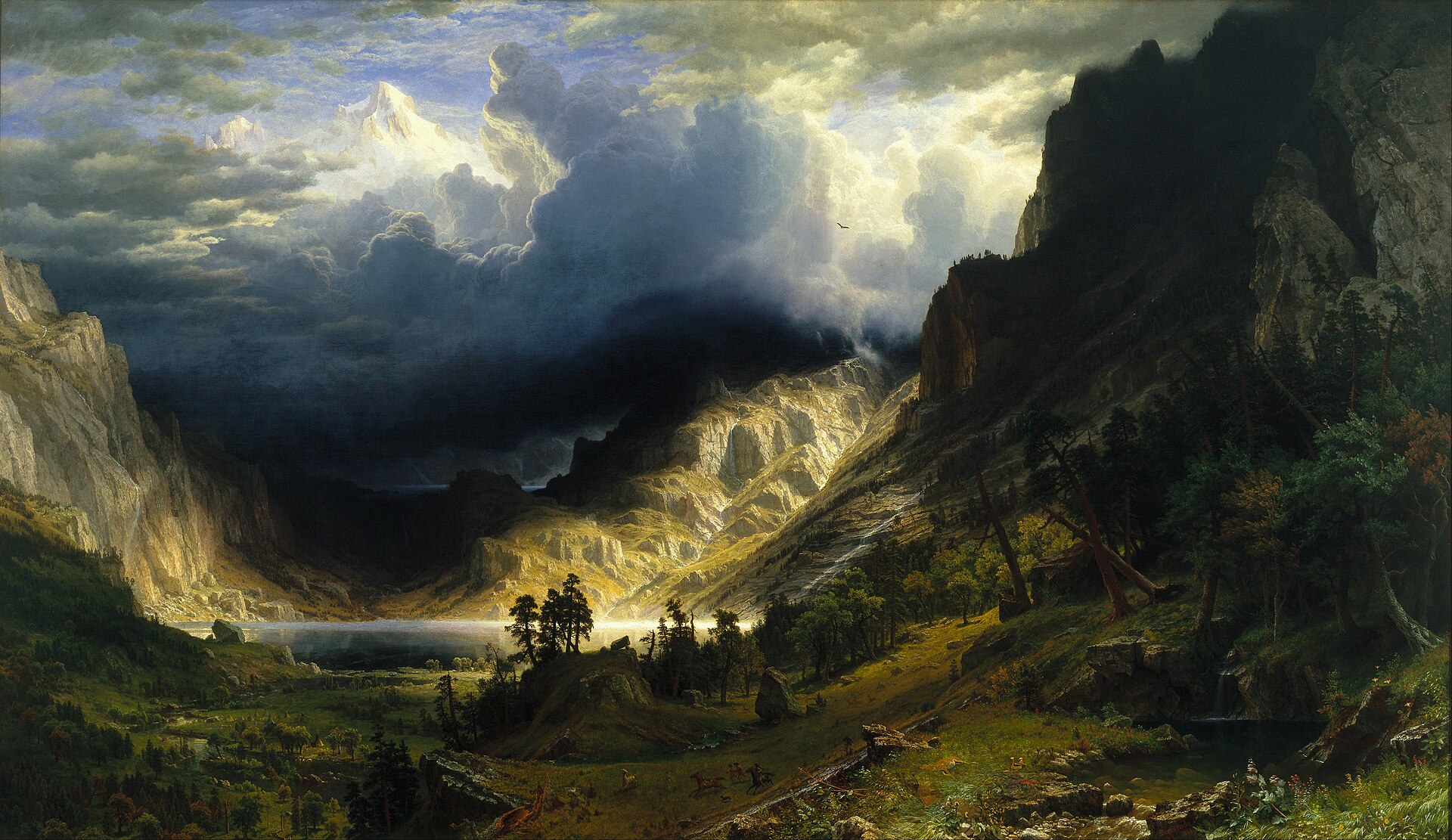
A Storm in the Rocky Mountains, Mt. Rosalie. Albert Bierstadt, 1866. Wikimedia Commons. Public domain.