
Psalm 42
11 verses · Psalm of lament
Why are you downcast, O my soul? Why the unease within me? Put your hope in God, for I will yet praise Him for the salvation of His presence.
Introduction
The sons of Korah, the Thirsting Soul, Book 2: The Elohistic Psalter, Poetry, Psalms Overview.
The sons of Korah, a family of temple singers, gave this psalm to a man who once led the crowds up to the festivals and now cannot go. He writes from the far north, near the sources of the Jordan, days away from the sanctuary, while his neighbours ask where his God has gone. It opens the second book of the Psalter. Listen for the question he puts to his own soul and the answer he gives it, said twice here and a third time in the psalm that follows. It teaches a person how to speak to himself when worship is out of reach.
Context
- Who
- Israelites kept away from the sanctuary and taunted for it by the people around them
- What
- A lament of a temple singer cut off from the sanctuary, who argues with his own downcast soul.
- Where
- The far north of Israel, at the headwaters of the Jordan under Mount Hermon
- When
- The monarchy, with the date unstated; the superscription names the sons of Korah and no event.
- Why
- To give words to the grief of being kept from worship and to teach the soul to hope in God.
Historical context
The psalm is ascribed to the sons of Korah, the guild of Levitical singers descended from the Korah of Numbers 16, whose family was kept in the temple service. It opens Book Two of the Psalter and the Korahite collection, and it is titled a maskil, an instruction. The land of the Jordan and the peaks of Hermon at verse 6 are the far north, at the river's headwaters, and from there the sanctuary at Jerusalem is several days away. The Jordan comes off Hermon in a series of falls, which are the waters the writer could see and hear at verse 7. The pilgrim festivals brought crowds up to Jerusalem three times a year, and a Levitical singer would have walked at the head of one, which is the office the writer has lost. The taunt of verses 3 and 10, Where is your God, was the standard question put to a displaced worshipper by neighbours whose gods appeared to be doing better.
Significance
For the first hearers, the psalm gave words to the particular grief of being cut off from public worship, which in Israel was the place God had put His name. Its refrain asks the soul a question and then gives it an order, put your hope in God. The psalm says that twice and hands the third saying to Psalm 43 without any change in the circumstances.
This chapter in Jewish lifeWhat this chapter is in Jewish life and reading.
What is done
The psalm's own subject is the pilgrimage to the Temple, and Rashi reads its longing as the longing of a people who can no longer make it. On the question of when the psalmist will appear before God he writes:
to make the pilgrimages on the festivals. Here he prophesied concerning the destruction of the Temple. (Rashi on Psalms 42:3:1)
He reads the memory of the fifth line as the memory of walking up with the crowd to the House of God, at Rashi on Psalms 42:5:1, and the thirst of the third line as the words of Israel in Babylon, at Rashi on Psalms 42:3:2.
How it is read
The heading names the sons of Korah, and Rashi begins by saying who they were and how they came to write. He names Assir, Elkanah and Abiasaf, takes them as the sons who stood apart from their father's rebellion, and has them singing in the mouth of the earth that swallowed the rest, at Rashi on Psalms 42:1:1, which cites Numbers 26:11 for the sons of Korah who did not die. This site names the same guild of temple singers on its Psalms page. The famous opening image he explains at length, first as a matter of the sound a hart makes, then as a teaching of the Sages:
Our Sages said: The hind is the most pious of the beasts. (Rashi on Psalms 42:2:1)
The rest of that comment tells what the hind does when the other beasts gather to her for water:
And what does she do? She digs a pit and thrusts her antlers into it and lows. Thereupon, the Holy One, blessed be He, has compassion on her and the deep brings up water for her. (Rashi on Psalms 42:2:1)
On the deep calling to deep he gives one short sentence:
Deep calls to deep One trouble calls the next one. (Rashi on Psalms 42:8:1)
He reads the whole psalm as the speech of Israel in exile, remembering the Jordan and Sinai and the forgiveness after the golden calf, at Rashi on Psalms 42:7:1 and Rashi on Psalms 42:7:2. A Christian reader is taught this psalm as the thirst of one soul for God. The Jewish reading keeps the thirst and makes the exile of a people its subject. Ibn Ezra stands on this chapter at Ibn Ezra on Psalms 42:1:1, 42:4:1, 42:10:1, 42:11:1 and 42:12:1, and Sefaria holds no English version of those references, so this card cites them without quotation.
What the rabbis say
The corpus records 40 places where the rabbinic literature takes up a line of this psalm, 34 of them in the Midrash. Rashi carries one of the best known of them at Rashi on Psalms 42:3:1, where the three times the psalm asks why the soul is downcast are counted against three kingdoms that would cut off the Temple service, named there as Babylon, Greece and Edom. The Midrash on the Psalms treats the psalm at Midrash Tehillim 1:2, 42:1, 22:10, 119:16, 42:2, 80:4, 42:3, 42:4 and 42:5, Bereshit Rabbah at Bereshit Rabbah 16:4, 13:13, 13:4, 32:7, 6:7 and 13:6 and Eikhah Rabbah, the midrash on Lamentations, at Eikhah Rabbah 1:22, 1:52 and Petichta 24. The Talmud takes up lines of the psalm at Sanhedrin 43a:22, Jerusalem Talmud Berakhot 9:2:22, Avodah Zarah 3b:13, Avodah Zarah 3b:14, Chagigah 12b:7 and Chagigah 12b:8.
Sources: Rashi, Rashi on Psalms, in The Judaica Press complete Tanach with Rashi, translated by A. J. Rosenberg, under a CC-BY licence; Ibn Ezra, Ibn Ezra on Psalms, cited at Ibn Ezra on Psalms 42:1:1, 42:4:1, 42:10:1, 42:11:1 and 42:12:1; Midrash Tehillim, the Midrash on the Psalms, cited at Midrash Tehillim 1:2, 42:1, 22:10, 119:16, 42:2, 80:4, 42:3, 42:4 and 42:5; Eikhah Rabbah, the midrash on Lamentations, cited at Eikhah Rabbah 1:22, 1:52 and Petichta 24; The Talmud, cited at Sanhedrin 43a:22, Jerusalem Talmud Berakhot 9:2:22, Avodah Zarah 3b:13, Avodah Zarah 3b:14, Chagigah 12b:7 and Chagigah 12b:8; MannaFest, the sons of Korah among the named voices of the Psalter, at /book/psalms, 2026; MannaFest, the Sefaria corpus at scripts/data/sources/sefaria/psalms/42.json, fetched 2026-09-19, 2026.
Psalms 42:1-2
deer pants for streams: A deer pants for streams of water, and the soul's thirst is for God, the living God. Spurgeon reads a hunted animal's need in it, pressed and desperate for water. He asks when he will appear in God's presence.
Psalms 42:1
“As the hart panteth after the water brooks, so panteth my soul after the, O God. As after a long drought the poor fainting hind longs for the streams, or rather as the hunted hart instinctively seeks after the river to lave its smoking flanks and to escape the dogs, even so my weary, persecuted soul pants after the Lord my God. Debarred from public worship, David was heartsick.”
Charles Spurgeon · The Treasury of David, Vol. 2 (1870)Particular Baptist
1 more voice on this verseWhat preachers and commentators have said about this verse, in their own words.
Psalms 42:1
“As the hart panteth after the water brooks,.... Either through a natural thirst that creature is said to have; or through the heat of the summer season; and especially when hunted by dogs, it betakes itself to rivers of water, partly to make its escape, and partly to extinguish its thirst, and refresh itself.”
the living God: Barnes read the soul that thirsts here as one that longs to come back to the house of God and praise Him with His people. Spurgeon pressed further, to God himself beyond the temple. Thirst, he said, is worse than hunger.
Psalms 42:2
First, therefore, he is sought without being found, so that afterward, when found, he may be held more tightly. For holy desires, as we have said, grow by delay. But if they fail by delay, they were not desires. With this love burned whoever was able to reach the truth. Hence David says: "My soul has thirsted for the living God; when shall I come and appear before the face of God?" Hence he admonishes us, saying: "Seek his face always."
Gregory the Dialogist · written before 604 · Forty Gospel Homilies, Homily 25patristic
Psalms 42:3-4
My tears have been my food: Tears are the food, day and night, while men ask all day long where his God is. The memory that comes is a procession to God's house. Henry reads that memory as sharpening the grief, the shouts of joy now out of reach.
Psalms 42:3
“There is a weeping that springs from contemplating eternal good and longing for future light, and tears of joy and desire cannot help but break out as the soul is athirst for the mighty living God.”
John Cassian · written before 435 · CONFERENCES 9:29patristic
1 more voice on this verse
Psalms 42:3
“My tears have been my meat day and night. Salt meats, but healthful to the soul. When a man comes to tears, constant tears, plenteous tears, tears that fill his cup and trencher, he is in earnest indeed. As the big tears stand in the stag's eyes in her distress, so did the salt drops glitter in the eyes of David. His appetite was gone, his tears not only seasoned his meat, but became his only meat, he had no mind for other diet.”
Charles Spurgeon · The Treasury of David, Vol. 2 (1870)Particular Baptist
as I pour out my soul: Barnes and Jamieson, Fausset and Brown read the Hebrew verbs as future: these things the soul will remember. Barnes saw a resolve to keep these sorrows in mind. Spurgeon judged it useless for the soul to pour itself out within, and he urged pouring it out before the LORD.
Psalms 42:4
“When I remember these things, I pour out my soul in me. When he harped upon his woes his heart melted into water and was poured out upon itself. God hidden, and foes raging, a pair of evils enough to bring down the stoutest heart! Yet why let reflections so gloomy engross us, since the result is of no value: merely to turn the soul on itself, to empty it from itself into itself is useless, how much better to pour out the heart before the Lord!”
Charles Spurgeon · The Treasury of David, Vol. 2 (1870)Particular Baptist
1 more voice on this verse
Psalms 42:4
“The verbs are properly rendered as futures, "I will remember," &c.,--that is, the recollection of this season of distress will give greater zest to the privileges of God's worship, when obtained.”
Jamieson, Fausset & Brown · Commentary Critical and Explanatory on the Whole Bible (1871)reformed
Why are you downcast: The man asks his own soul why it is downcast and tells it to hope in God. His own answer is praise for the salvation of God's presence. Delitzsch reads the refrain, repeated at 42:11 and 43:5, as the key to one poem in three movements.
Psalms 42:5
Troubled by the hazardous turnings of this world, David says, "Why are you sad, O soul, why do you trouble me? Hope in God, for I will give praise to him, the salvation of my countenance and my God." Therefore, when we are distressed and apprehensive, let hope strengthen us with the expectation of things that are to come. Look to each phrase individually. "Hope, for I will give praise," he says; not "I give praise," but "I will give praise."
Ambrose of Milan · written before 397 · The Prayer of Job and David 4:3.12-13patristic
1 more voice on this verse
Psalms 42:5
“Why art thou cast down, O my soul? As though he were two men, the psalmist talks to himself. His faith reasons with his fears, his hope argues with his sorrows. These present troubles, are they to last forever? The rejoicings of my foes, are they more than empty talk? My absence from the solemn feasts, is that a perpetual exile? Why this deep depression, this faithless fainting, this chicken hearted melancholy? As Trapp says, "David chides David out of the dumps; "and herein he is an example for all desponding ones.”
Charles Spurgeon · The Treasury of David, Vol. 2 (1870)Particular Baptist
Psalms 42:6-7
from the land of Jordan: He remembers God from the land of Jordan, the peaks of Hermon and Mount Mizar, the far north of Israel. Deep calls to deep in the waterfalls' roar, and the breakers have rolled over him. Barnes reads the waves as the northern waters he could see.
Psalms 42:6
“Therefore - Therefore that I may revive my drooping spirits. Remember - I will consider thy infinite mercy and power, and faithfulness. Mizar - From all the parts of the land, to which I shall be driven; whether from the parts beyond Jordan on the east: or mount Hermon, which was in the northern parts.”
John Wesley · Explanatory Notes upon the Old Testament (1765)evangelical
1 more voice on this verse
Psalms 42:6
“O my God, my soul is cast down within me. Here the song begins again upon the bass. So sweet an ending deserves that for the sake of a second hopeful close the Psalm should even begin again. Perhaps the psalmist's dejection continued, the spasm of despondency returned; well, then, he will down with his harp again, and try again its power upon himself, as in his younger days, he saw its influence upon Saul when the evil spirit came upon him. With God the song begins a second time more nearly than at first.”
Charles Spurgeon · The Treasury of David, Vol. 2 (1870)Particular Baptist
Deep calls to deep: Henry notes that Jonah used the words about breakers and waves from inside the fish, the same in the Hebrew. Gill read Deep calls to deep as one sorrow after another, as with Job. The waterfalls and waves belong to God.
Psalms 42:7
“Deep calleth unto deep at the noise of the water spouts,.... By which are meant afflictions, comparable to the deep waters of the sea, for their multitude and overwhelming nature; see Psa 69:1; these came pouring down, one after another, upon the psalmist: as soon as one affliction over, another came, as in the case of Job; which is signified by one calling to another, and were clamorous, troublesome, and very grievous and distressing; all thy waves and thy billows are gone over me: with which he seemed to be covered and overwhelmed, as a ship is at sea.”
3 more voices on this verse
Psalms 42:7
“Listen to this: "Deep calls on deep at the voice of your floodgates." Scripture of the Old Testament calls on Scripture of the New Testament for the consummation of holiness and the fullness of grace; it calls with the voice of grace and the outflowing of spiritual abundance.”
Ambrose of Milan · written before 397 · Commentary on Twelve Psalms 36:18patristic
Psalms 42:7
“IN the grandeur of Nature there are awful harmonies. When the storm agitates the ocean below, the heavens above hear the tumult and answer to the clamor. Down comes a deluge of sonorous hail or swift-descending rain, attended with peals of thunder and flashes of flame. Frequently the waterspout, of which David speaks in the next sentence, evidences the sympathy of the two great waters above and beneath the firmament—the great deep above stretches out its hands to the great deep below and in voice of thunder their old relationship is recognized.”
Psalms 42:7
“God knows what he does, and so shall they shortly. Jonah, in the whale's belly, made use of these words of David, Jonah ii. 3 (they are exactly the same in the original), and of him they were literally true, All thy waves and thy billows have gone over me; for the book of psalms is contrived so as to reach every one's case.”
Matthew Henry · Commentary on the Whole Bible (1707-1721)puritan
Psalms 42:8-9
decrees His loving devotion: Day and night are both claimed for God, loving devotion by day and a song at night. The next breath asks God my Rock why He has forgotten, with the enemy's oppression still pressing. Henry notes that the prayer goes on through the questioning.
Psalms 42:8
“Yet the Lord will command his lovingkindness in the daytime. Come what may there shall be "a certain secret something" to sweeten all. Lovingkindness is a noble life belt in a rough sea. The day may darken into a strange and untimely midnight, but the love of God ordained of old to be the portion of the elect, shall be by sovereign decree meted out to them.”
Charles Spurgeon · The Treasury of David, Vol. 2 (1870)Particular Baptist
1 more voice on this verse
Psalms 42:8
“Still he relies on as constant a flow of divine mercy which will elicit his praise and encourage his prayer to God. 9, 10. in view of which [Ps 42:8], he dictates to himself a prayer based on his distress, aggravated as it was by the cruel taunts and infidel suggestions of his foes.”
Jamieson, Fausset & Brown · Commentary Critical and Explanatory on the Whole Bible (1871)reformed
God my Rock: Spurgeon notes that the one who asks why he must walk in sorrow still calls God his Rock. Faith, he said, may ask God why His promises seem unfulfilled. Augustine heard the same cry in Christ's words from the cross.
Psalms 42:9
“I will say unto God my rock,.... A name frequently given to the eternal God, Father, Son, and Spirit, Deu 32:4; See Gill on Psa 18:2; why hast thou forgotten me? See Gill on Psa 13:1; why go I mourning because of the oppression of the enemy? meaning perhaps Saul; though it may be applied to any spiritual enemy, sin, Satan, and the world; who are very oppressive and afflicting, and occasion continual mourning to the children of God.”
1 more voice on this verse
Psalms 42:9
I will say unto God my rock, Why hast thou forgotten me? Faith is allowed to enquire of her God the causes of his displeasure, and she is even permitted to expostulate with him and put him in mind of his promises, and ask why apparently they are not fulfilled. If the Lord be indeed our refuge, when we find no refuge, it is time to be raising the question, "Why is this?"
Charles Spurgeon · The Treasury of David, Vol. 2 (1870)Particular Baptist
Psalms 42:10-11
the crushing of my bones: The same question of verse 3, where is your God, now lands like the crushing of bones. The taunt has reached the body. Verse 11 brings the refrain back a second time, and the poem carries it to 43:5, where it closes.
Psalms 42:10
“As with a sword in my bones, mine enemies reproach me. Cruel mockeries cut deeper than the flesh, they reach the soul as though a rapier were introduced between the ribs to prick the heart. If reproaches kill not, yet they are killing, the pain caused is excruciating. The tongue cuts to the bone, and its wounds are hard to cure. While they say daily unto me, Where is thy God? This is the most unkind cut of all, reflecting as it does both upon the Lord's faithfulness and his servant's character.”
Charles Spurgeon · The Treasury of David, Vol. 2 (1870)Particular Baptist
1 more voice on this verse
Psalms 42:10
“He had mentioned before what the reproach was that touched him thus to the quick, and here he repeats it: They say daily unto me, Where is thy God? --a reproach which was very grievous to him, both because it reflected dishonour upon God and was intended to discourage his hope in God, which he had enough to do to keep up in any measure, and which was but too apt to fail of itself.”
Matthew Henry · Commentary on the Whole Bible (1707-1721)puritan
my Savior and my God: Barnes notes the refrain of verse 5 returns to the downcast soul with a change at its end: praise Him, my Savior and my God. Spurgeon read the added words as growing confidence. They answer the taunt of verse 10, where is your God.
Psalms 42:11
“When the inner person shows signs for a time of wavering between vice and virtue, say, "Why are you cast down, O my soul, and why are you disquieted within me? Hope thou in God, for I shall yet praise him who is the health of my countenance and my God." You must never let suggestions of evil grow on you or a babel of disorder win strength in your breast. Kill the enemy while he is small, and, that you may not have a crop of tares, nip the evil in the bud.”
Jerome · written before 420 · LETTER 22.6patristic
2 more voices on this verse
Psalms 42:11
“ANOTHER verse in this Psalm so attracts me that, though it is not my text, I cannot pass it by without a moment's notice. In the 5th verse the Psalmist says, "I shall yet praise Him for the help of His Countenance," and then follows the expression of the text, "who is the health of my countenance and my God." God's Countenance is our help and He, Himself is the health of our countenance! The best help a man can have in time of trouble is the Countenance of God!”
Psalms 42:11
“This brings on a renewed self-chiding, and excites hopes of relief. health--or help. of my countenance--(compare Ps 42:5) who cheers me, driving away clouds of sorrow from my face. my God--It is He of whose existence and favor my foes would have me doubt.”
Jamieson, Fausset & Brown · Commentary Critical and Explanatory on the Whole Bible (1871)reformed
Connectionstopics/loss
How this psalm is built
The form: A maskil of the sons of Korah, the first half of one poem in three movements with Psalm 43, as Delitzsch classes it.
The patterns in this chapter
| Device | What it does | Where to see it |
|---|---|---|
| The refrain, said twice here and once more in Psalm 43 | Why are you downcast, O my soul, stands at 42:5, at 42:11 and again at 43:5. Franz Delitzsch reads it as the key that makes the two psalms one poem in three movements. The refrain is a question followed by an order, hope in God, so the man does not talk himself out of the grief but tells himself where to put it.Franz Delitzsch, Biblical Commentary on the Psalms, on Psalm 42:5. | Psalm 42:5, Psalm 42:11, Psalm 43:5 |
| Where is your God, thrown twice | The taunt stands at verse 3 while tears are his food, and comes back at verse 10 where it lands like the crushing of his bones. The second time is worse because nothing has changed, and the psalm measures the damage by the repetition rather than by describing it.Matthew Henry, Commentary on the Whole Bible, 1710, on Psalm 42:9 to 11. | Psalm 42:3, Psalm 42:10 |
| Water, in three different states | The psalm opens on streams of water a deer cannot reach at verse 1, turns them into tears that are his food at verse 3, and ends with waterfalls and breakers rolling over him at verse 7. The one element is first what he needs, then what he produces, then what is drowning him.Charles Spurgeon, The Treasury of David, Vol. 2, 1870, on Psalm 42:7. | Psalm 42:1, Psalm 42:3, Psalm 42:7 |
| The remembered procession | Verse 4 is the psalm's only picture of the past: the writer leading the multitude to the house of God with shouts of joy and praise. Matthew Henry reads the memory as sharpening the grief rather than easing it, since the shouts are now out of reach.Matthew Henry, Commentary on the Whole Bible, 1710, on Psalm 42:1 to 5. | Psalm 42:4 |
| Day and night, claimed for God and for the trouble alike | Tears are his food day and night at verse 3, and at verse 8 the LORD commands His loving devotion by day and His song is with him in the night. The same two words carry the grief and the mercy, and the psalm sets them one against the other without resolving which holds.Albert Barnes, Notes on the Book of Psalms, 1832 to 1869, on Psalm 42:8. | Psalm 42:3, Psalm 42:8 |
The pattern inside the psalm
6 more paragraphs on the patterns
The deer of verse 1 is a picture of need rather than of gentleness. Charles Spurgeon reads a hunted animal in it, pressed and desperate for water, and the verb behind pants is the same in both halves of the verse so the animal's thirst and the soul's are given the same word.
Deep calls to deep at verse 7 is the psalm's most quoted line and its hardest. The waters are the trouble, and the psalm calls them Your waterfalls and Your breakers, so the thing rolling over him is named as God's before the complaint of verse 9 is made.
The psalm and Psalm 43 share the refrain, and Psalm 43 also shares the phrase God my Rock at 42:9 with its own appeal to God my refuge at 43:2. The overlap in vocabulary is part of the evidence that the two belong together.
The longing of verses 1 and 2 is for a place, the presence of God in the sanctuary, and the psalm never spiritualises it. What is wanted is to come and appear before God, and the answer at 43:3 and 4 is a route to the holy mountain and the altar.
The debated concept
Whether Psalms 42 and 43 are one psalm or two is the standing question, and it has consequences for how both are read. Franz Delitzsch and Charles Spurgeon hold that they are one composition, and the evidence is the shared refrain at 42:5, 42:11 and 43:5, the shared vocabulary of God my Rock and God my refuge, the repeated question at 42:9 and 43:2, and the absence of any title over Psalm 43. Albert Barnes records that many Hebrew manuscripts join them. The counter-case is the Masoretic division itself, which the tradition has kept, and the fact that Psalm 43 reads coherently alone. A student is best served by reading them together and noting where the printed Bible divides them.
Keep studying
Sources for this chapter
The summary
Jamieson, Fausset & Brown, Commentary Critical and Explanatory; John Calvin, Commentaries; John Wesley, Notes on the Old Testament and Matthew Henry, Complete Commentary.
The form and classifications
Albert Barnes, Notes on the Book of Psalms, 1832 to 1869, on Psalm 42, title; Charles Spurgeon, The Treasury of David, Vol. 2, 1870, on Psalm 42:1; Franz Delitzsch, Biblical Commentary on the Psalms, on Psalm 42 and Matthew Henry, Commentary on the Whole Bible, 1710, on Psalm 42.
The exposition
Albert Barnes; Augustine of Hippo, On the Psalms; Charles Spurgeon, The Treasury of David; Franz Delitzsch, Biblical Commentary on the Psalms; Jamieson, Fausset & Brown, Commentary Critical and Explanatory on the Whole Bible; John Gill, Exposition of the Old Testament and Matthew Henry, Commentary on the Whole Bible.
The painting
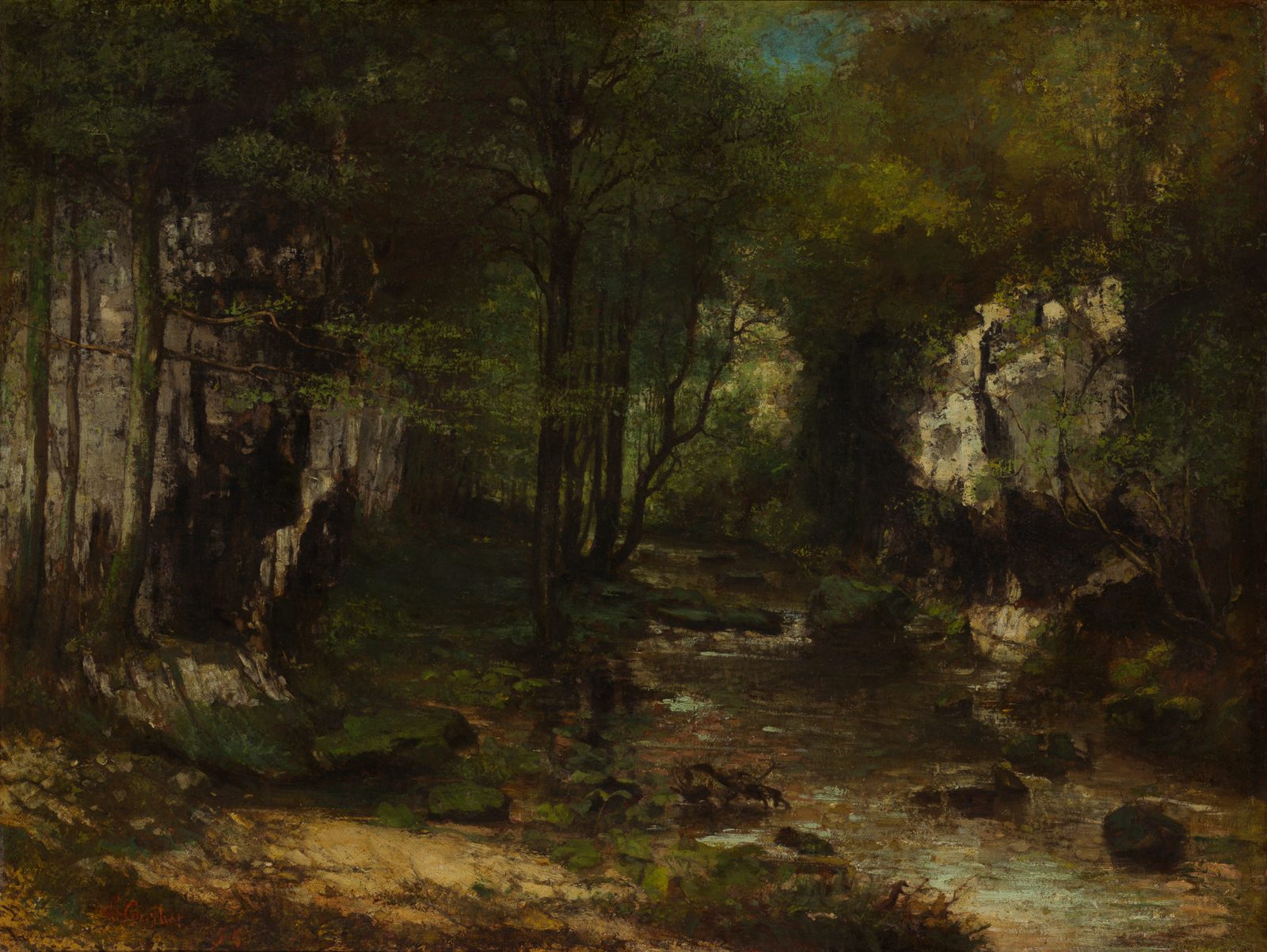
The Stream. Gustave Courbet, 1855. Wikimedia Commons. Public domain.