
Psalm 132
18 verses · Royal psalm and Song of Ascents
The LORD swore an oath to David, a promise He will not revoke: “One of your descendants I will place on your throne.
Introduction
Author unstated, the Oath to David, Book 5: The return and the great Hallelujah, Poetry, Psalms Overview.
This is the longest of the pilgrim songs, and its heading names no writer. It is about David rather than by him, and it remembers the years he spent finding a home for the ark and the promise God made to his family in return. Pilgrims sang it on the way to a temple that stood because of that promise. Listen for the two oaths, one sworn by the king and one sworn by God, and for how the second answers the first with more than was asked. Solomon prayed three of its lines when he dedicated the temple.
Context
- Who
- Israelites whose whole national hope rested on a promise made to one family
- Where
- A procession retracing the day the ark of the covenant was carried up to Jerusalem
- When
- The Songs of Ascents, the ark, the king and the promise. The superscription names no writer. The events it remembers are David's, c. 1000 BC, and the psalm was used at the temple afterward, since Solomon prays its closing petition at 2 Chronicles 6:41 and 42
Historical context
No name stands in the heading, and the psalm is about David rather than by him. It retells a specific day. The ark of the covenant had been captured by the Philistines, returned, and then left for decades in a village, and the psalm names the places it was tracked down, Ephrathah, the old name for the Bethlehem district, and the fields of Jaar, which is Kiriath-jearim where it actually sat. David's oath is quoted, that he would not go home or lie down until he found a place for it. Building a permanent house for a god was standard royal duty in the ancient world. What is unusual is God's reply, which promises to build the king a house instead. The horn that will grow for David and the lamp prepared for him are two royal images a first hearer read at once, a ruling line and a household that had not gone dark.
Significance
Pilgrims sang this while climbing to a temple that stood because of a promise older than the building. God had chosen Zion as his resting place, and he had sworn an oath to David that he would not take back. When the throne was empty and the province small, both halves were still on the books.
This chapter in Jewish lifeWhat this chapter is in Jewish life and reading.
What is done
Psalm 132 is the thirteenth of the fifteen Songs of Ascents and the longest of them, and its subject is the bringing of the Ark to the place God chose. It is sung within the collection, whose setting this site records at /featured/psalms-of-ascent from Mishnah Middot 2:5 and Mishnah Sukkah 5:4. The commentary in the corpus reads it as the history of how the Temple site came to be known, so the psalm carries in Jewish reading the memory of a search rather than of a settled possession.
How it is read
Rashi opens on David's affliction and reads it as the affliction of his soul, "how he worked and toiled to find a place for You" (Rashi on Psalms 132:1:1, the Judaica Press complete Tanach with Rashi, translated by A. J. Rosenberg, CC-BY). He reads the oath about finding a place as an oath held until it should be known where the sanctuary would stand, and the anointed one of the tenth verse as Solomon coming to set the Ark in it. On the sixth verse he gives two readings of hearing the news in Ephrath, the second of them an argument from the boundary lines in the book of Joshua that Jerusalem is higher than all the land and therefore fit for the Temple, which he says is expounded in tractate Zevahim 54b. Ibn Ezra reads the search for a place against the honour of places: all the land belongs to the LORD, and there are honoured places that are more honoured (Ibn Ezra on Psalms 132:5:1, translated by Rabbi Mike Feuer, Jerusalem Anthology, CC-BY). On the thirteenth verse he explains why Zion is named, since it is called the city of David and David rejoiced when the mountain of the House was shown to him. Radak comments on three verses and stands here as a citation, at Radak on Psalms 132:2:1.
What the rabbis say
Rashi hands on one saying with its locator, that the Temple stands higher than the whole land of Israel, which he takes from Zevahim 54b. The corpus records forty locators of its own on this chapter, thirty-eight Midrash and two Talmud, each without text. David's oath about sleep is taken up at Bereshit Rabbah 70:1 and Midrash Lekach Tov, Genesis 28:20:2. The hearing in Ephrath is taken up at Bereshit Rabbah 99:1 and Midrash Tannaim on Deuteronomy 33:12:44. The oath to David about his throne is taken up at Ruth Rabbah 2:2 and Midrash Mishlei 15:1, the choice of Zion for a dwelling at Bereshit Rabbah 56:2, Aggadat Bereshit 53:3 and Ein Yaakov, Menakhot 9:5, and the lamp prepared for the anointed at Bereshit Rabbah 71:5, Pesikta Rabbati 34:1 and Pirkei DeRabbi Eliezer 28:9.
Sources: Rashi, Rashi on Psalms 132:1:1, 132:5:1, 132:6:2, 132:10:1 and 132:18:1, the Judaica Press complete Tanach with Rashi, translated by A. J. Rosenberg, CC-BY; Ibn Ezra, Ibn Ezra on Psalms 132:5:1 and 132:13:1, translated by Rabbi Mike Feuer, Jerusalem Anthology, CC-BY; Radak, Radak on Psalms 132:2:1, cited only, no English version in the corpus; Babylonian Talmud, Zevahim 54b, as Rashi cites it; Midrash, Bereshit Rabbah 70:1, 99:1, 56:2 and 71:5, Ruth Rabbah 2:2, Midrash Mishlei 15:1, Aggadat Bereshit 53:3, Pesikta Rabbati 34:1, Pirkei DeRabbi Eliezer 28:9, Bamidbar Rabbah 12:9; Jerusalem Talmud, Peah 3:6:2; Mishnah, Middot 2:5 and Sukkah 5:4, as /featured/psalms-of-ascent records them; MannaFest, the Songs of Ascents, at /featured/psalms-of-ascent, 2026.
Psalms 132:1-2
remember on behalf of David: The prayer asks the LORD to remember the hardships David endured. Verse 2 gives what those hardships were about, an oath sworn to the LORD and a vow made to the Mighty One of Jacob. Jacob himself uses that title of God at Genesis 49:24.
Psalms 132:1
“Lord, remember David, and all his afflictions. With David the covenant was made, and therefore his name is pleaded on behalf of his descendants, and the people who would be blessed by his dynasty. Jehovah, who changes not, will never forget one of his servants, or fail to keep his covenant; yet for this thing he is to be entreated. That which we are assured the Lord will do must, nevertheless, be made a matter of prayer. The request is that the Lord would remember, and this is a word full of meaning.”
Charles Spurgeon · The Treasury of David, Vol. 7 (1885)Particular Baptist
3 more voices on this verseWhat preachers and commentators have said about this verse, in their own words.
Psalms 132:1
“Remember, O Lord, David and all his meekness. Many suppose, from what is written in the Gospel — "Have mercy on us, Son of David," which the blind men who were sitting in Jericho said — that this David, whose name means "strong of hand," is referred to the Lord Savior. But if in this psalm we should choose to interpret it, as they judge, it does great harm to our understanding.”
Jerome · written before 420 · Homily 44, on Psalm 131patristic
Psalms 132:1
“The name of David is prominently mentioned, because it was to him that the continuance of the kingdom and Temple was promised, and though dead, this could not affect the truthfulness of God's word.”
John Calvin · Commentaries (1554)reformed
Psalms 132:1
“This vow is not elsewhere recorded. It expresses, in strong language, David's intense desire to see the establishment of God's worship as well as of His kingdom. remember David--literally, "remember for David," that is, all his troubles and anxieties on the matter.”
Jamieson, Fausset & Brown · Commentary Critical and Explanatory on the Whole Bible (1871)reformed
vowed to the Mighty One of Jacob: The Hebrew title is Abir Yaakov, and abir carries the sense of strength, so the Mighty One is the strong one of Jacob. Isaiah 49:26 and 60:16 use the same title. The history in 2 Samuel records no such oath, and verses 3 to 5 alone give its words.
Psalms 132:2
“How he sware unto the Lord, and vowed unto the mighty God of Jacob. Moved by intense devotion, David expressed his resolve in the form of a solemn vow, which was sealed with an oath. The fewer of such vows the better under a dispensation whose great Representative has said, "swear not at all." Perhaps even in this case it had been wiser to have left the pious resolve in the hands of God in the form of a prayer; for the vow was not actually fulfilled as intended, since the Lord forbade David to build him a temple.”
Charles Spurgeon · The Treasury of David, Vol. 7 (1885)Particular Baptist
1 more voice on this verse
Psalms 132:2
“As he swore to the Lord, he vowed a vow to the God of Jacob. In the Hebrew it does not have cos, that is, "as," nor is that the sense; but it has os, that is, "who," and the sense is: Remember, O Lord, David and all his meekness, who swore to the Lord, vowed a vow to the God of Jacob. And this I think was done not so much by a fault of the seventy translators as by an error of the copyists.”
Jerome · written before 420 · Homily 44, on Psalm 131patristic
Psalms 132:3-5
The vow puts off house, bed, sleep and slumber until a place is found for the LORD. David's words at 2 Samuel 7:2 give the occasion, the ark still in a tent while he lives in a house of cedar. John Gill read it as hyperbole for a restless mind.
Psalms 132:3
“If I shall enter into the tabernacle of my house. David says this: I seek no other rest but Christ, who is to be born of my seed, that is, whom you promised would be born of my loins.”
Jerome · written before 420 · Homily 44, on Psalm 131patristic
2 more voices on this verse
Psalms 132:3
“Surely I will not come into the tabernacle of my house,.... The new house and palace David built for himself after he came to the throne, made of cedar, 2Sa 5:11; not that he should never enter into it till he had found a dwelling for God, but that he should not go into it with pleasure till that was done; for this and what follows are hyperboles, as Kimchi observes, and signify that he should have no peace nor satisfaction of mind till this was accomplished.”
Psalms 132:3
“Surely I will not come into the tabernacle of my house, nor go up into my bed. Our translators give the meaning, though not the literal form, of David's vow, which ran thus, "If I go"—"If I go up", etc. This was an elliptical form of imprecation, implying more than it expressed, and having therefore about it a mystery which made it all the more solemn. David would not take his ease in his house, nor his rest in his bed, till he had determined upon a place for the worship of Jehovah.”
Charles Spurgeon · The Treasury of David, Vol. 7 (1885)Particular Baptist
give sleep to my eyes: Verse 4 pairs sleep with slumber and eyes with eyelids. Proverbs 6:4 uses the same four words for a man who has pledged himself for a neighbour and must be released before he rests.
Psalms 132:4
“I will not give sleep to mine eyes, or slumber to wine eyelids. He could not enjoy sleep till he had done his best to provide a place for the ark. It is a strong expression, and it is not to be coolly discussed by us. Remember that the man was all on fire, and he was writing poetry also, and therefore his language is not that which we should employ in cold blood. Everybody can see what he means, and how intensely he means it.”
Charles Spurgeon · The Treasury of David, Vol. 7 (1885)Particular Baptist
until I find a place: Dwelling translates mishkenot, a plural of mishkan, the word Exodus 25:9 uses for the tabernacle. Verse 7 takes up the same word in His dwelling place. The vow is answered when the LORD has chosen Zion for His home at verse 13.
Psalms 132:6-7
the ark was in Ephrathah: Jaar is the Hebrew for a wood. The ark was heard of at Ephrathah and found in those fields, where it stood twenty years at Kiriath-jearim. Verse 7 answers with worship at His footstool, the word David uses of the house he planned for the ark at 1 Chronicles 28:2.
Psalms 132:6
“These may be the "words of David" and his pious friends, who, at Ephratah--or Beth-lehem (Ge 48:7), where he once lived, may have heard of the ark, which he found for the first time in the fields of the wood--or, Jair, or Kirjath-jearim ("City of woods") (1Sa 7:1; 2Sa 6:3, 4), whence it was brought to Zion.”
Jamieson, Fausset & Brown · Commentary Critical and Explanatory on the Whole Bible (1871)reformed
2 more voices on this verse
Psalms 132:6
“Behold, we heard of it in Ephrata. In the Hebrew it does not have "it," but has "him": that is, that one who is to be born of the seed of David. We heard of him in Ephrata: which the sense is about Mary. But we can also understand it simply, since Ephrata is called Bethlehem, and Christ was born in Bethlehem. Happy therefore the place, which so long a time before was sung by the voice of the prophets.”
Jerome · written before 420 · Homily 44, on Psalm 131patristic
Psalms 132:6
“LONG before David's time, the Ark of the Lord had been almost forgotten by the children of Israel. It formed a most important part of the Ceremonial Law which God had ordained. I may almost call it the central portion of that pattern which was shown to Moses in the mountain. But the Ark had been carried into captivity by the Philistines and, afterwards, the terrible judgment worked upon the men of Beth-Shemesh may have made many afraid to go near it. So it remained a long time in Kirjath-Jearim and there David found it.”
Charles Spurgeon · written before 1892 · The Metropolitan Tabernacle Pulpit, Sermon No. 2590: “Hearing, Seeking, Finding” (lightly modernized text, CCEL edition)Particular Baptist
let us worship at His footstool: The Hebrew verb behind worship is shachah, to bow down low. Psalm 99:5 gives the same call to worship at His footstool, and Psalm 99:1 sets the LORD enthroned above the cherubim. Those who heard of the ark in verse 6 now go to it.
Psalms 132:7
“We will go into his tabernacles. Having found the place where he dwells we will hasten thereto. He has many dwellings in one in the various courts of his house, and each of these shall receive the reverence due: in each the priest shall offer for us the appointed service; and our hearts shall go where our bodies may not enter.”
Charles Spurgeon · The Treasury of David, Vol. 7 (1885)Particular Baptist
1 more voice on this verse
Psalms 132:7
“The purpose of engaging in God's worship is avowed. The solemn entry of the ark, symbolical of God's presence and power, with the attending priests, into the sanctuary, is proclaimed in the words used by Solomon (2Ch 6:41).”
Jamieson, Fausset & Brown · Commentary Critical and Explanatory on the Whole Bible (1871)reformed
Psalms 132:8-9
Arise, O LORD, to Your resting place: The prayer asks the LORD to rise to His resting place with the ark of His strength. Solomon prays these words almost exactly at the temple's dedication, at 2 Chronicles 6:41. Righteousness is asked for the priests, and joy for the saints.
Psalms 132:8
“Rest - Into thy resting place, the temple so called, Isaiah lxvi, 1, where thou hast now a fixed habitation. The ark - The seat of thy powerful and glorious presence.”
John Wesley · Explanatory Notes upon the Old Testament (1765)evangelical
1 more voice on this verse
Psalms 132:8
“Note, Righteousness is the best ornament of a minister. Holiness towards God, and goodness towards all men, are habits for ministers of the necessity of which there is no dispute. "They are thy priests, and will therefore discredit their relation to thee if they be not clothed with righteousness. " 3.”
Matthew Henry · Commentary on the Whole Bible (1707-1721)puritan
Your priests be clothed with righteousness: Saints translates chasidim, from chesed, loving devotion. Solomon's form of this prayer at 2 Chronicles 6:41 asks salvation for the priests in place of righteousness. The garments of the priests at Exodus 28:2 were made for glory and for beauty.
the sake of Your servant David: The plea is made on David's account, for the anointed one who then sat on his throne. Solomon prays the petition at 2 Chronicles 6:42, asking that the anointed not be rejected and that the LORD remember His loving devotion to David. The name pleaded is David's.
Psalms 132:10
“For thy servant David’s sake - Because of the promise made to him; because of the zeal which he has shown in securing a place for the ark. Let it not be in vain that he has shown such a regard to the honor of God; let not the promises made to him fail. Such a prayer is proper now.”
Psalms 132:11-12
swore an oath to David: The oath sets one of David's descendants on his throne. Peter takes up this verse at Acts 2:30 and carries it to the resurrection of Jesus, at Acts 2:31 and 32. Verse 12 hangs the sons' own place on that throne upon keeping the covenant and the testimony.
Psalms 132:11
That the Lord was to be born of a virgin we know clearly; now we must show of what stock the virgin was. "The Lord swore to David a firm promise from which he will not withdraw: 'Your own offspring I will set on your throne.' " Again, "I will make his posterity endure forever and his throne as the days of heaven."
Cyril of Jerusalem · written before 386 · Catechetical Lecture 12:23patristic
1 more voice on this verse
Psalms 132:11
“Here we come to a grand covenant pleading of the kind which is always prevalent with the Lord. The Lord hath sworn in truth unto, David. We cannot urge anything with God which is equal to his own word and oath. Jehovah swears that our faith may have strong confidence in it: he cannot forswear himself. He swears in truth, for he means every word that he utters; men may be perjured, but none will be so profane as to imagine this of the God of truth.”
Charles Spurgeon · The Treasury of David, Vol. 7 (1885)Particular Baptist
Cross references
Psalms 132:11
- Quoted inActs 2:30“But he was a prophet and knew that God had promised him on oath that He would place one of his descendants on his throne.”
'of the fruit of his loins... he would raise up Christ' (Davidic oath)
ConnectionsActs 2:30
If your sons keep My covenant: The same condition stands in David's charge to Solomon at 1 Kings 2:4 and in the LORD's word at 1 Kings 9:4 and 5. The Hebrew for testimony belongs with edut, the name Exodus 25:16 gives the tablets placed in the ark. The ark of verse 8 held them.
Psalms 132:12
“If thy children will keep my covenant, and my testimony that I shall teach them,.... The former part of the promise and oath is absolute, respecting the Messiah; but this is conditional, and relates to the seed of David, both immediate, and in succeeding generations; proposing their observance of the law of God, as the condition of their enjoying the kingdom after him.”
1 more voice on this verse
Psalms 132:12
“He did fulfill the condition of the promise; he kept God's covenant and his testimony, did his Father's will, and in all things pleased him; and therefore to him, and his spiritual seed, the promise shall be made good.”
Matthew Henry · Commentary on the Whole Bible (1707-1721)puritan
Psalms 132:13-14
the LORD has chosen Zion: The search of verses 6 to 8 is answered by the LORD's own choice of Zion for His home. The word desired stands twice, in verse 13 and in the LORD's speech at verse 14, where Zion is His resting place forever. Spurgeon marks that God Himself speaks here.
Psalms 132:13
“For the Lord hath chosen Zion. It was no more than any other Canaanite town till God chose it, David captured it, Solomon built it, and the Lord dwelt in it. So was the church a mere Jebusite stronghold till grace chose it, conquered it, rebuilt it, and dwelt in it. Jehovah has chosen his people, and hence they are his people. He has chosen the church, and hence it is what it is. Thus in the covenant David and Zion, Christ and his people, go together.”
Charles Spurgeon · The Treasury of David, Vol. 7 (1885)Particular Baptist
Resting place translates menuchah, the word of verse 8, where the prayer asked the LORD to arise with the ark. At Numbers 10:33 the ark went ahead of Israel to find a resting place. Zion is where that search ends.
Psalms 132:14
“This is my rest for ever. Oh, glorious words! It is God himself who here speaks. Think of rest for God! A Sabbath for the Eternal and a place of abiding for the Infinite. He calls Zion my rest. Here his love remains and displays itself with delight. "He shall rest in his love." And this forever. He will not seek another place of repose, nor grow weary of his saints. In Christ the heart of Deity is filled with content, and for his sake he is satisfied with his people, and will be so world without end.”
Charles Spurgeon · The Treasury of David, Vol. 7 (1885)Particular Baptist
Psalms 132:15-16
bless her with abundant provisions: Zion's provisions are blessed and her poor are satisfied with bread. Matthew Henry marks that Zion has her own poor to keep, and the promise takes in even them. Verse 9 asked righteousness for the priests, and verse 16 gives them salvation.
Psalms 132:15
“Nay, the promise goes further: I will satisfy her poor with bread. Zion has her own poor to keep; and it is promised that God will take care even of them. [1.] By his providence they shall be kept from wanting; they shall have provision enough. If there be scarcity, the poor are the first that feel it, so that it is a sure sign of plenty if they have sufficient.”
Matthew Henry · Commentary on the Whole Bible (1707-1721)puritan
1 more voice on this verse
Psalms 132:15
“I will abundantly bless her provision. It must be so. How can we be without a blessing when the Lord is among us? We live upon his word, we are clothed by his charity, we are armed by his power: all sorts of provision are in him, and how can they be otherwise than blessed? The provision is to be abundantly blessed; then it will be abundant and blessed.”
Charles Spurgeon · The Treasury of David, Vol. 7 (1885)Particular Baptist
her saints will sing out in joy: The Hebrew doubles the verb behind sing out in joy, ranen yerannenu, where verse 9 asked once for the saints to shout for joy. The LORD gives more than was asked. Each request of verses 8 to 10 has its answer in verses 14 to 17.
Psalms 132:16
“More is promised than was prayed for. See how the ninth verse asks for the priests to be clad in righteousness, and the answer is, I will also clothe her priests with salvation. God is wont to do exceeding abundantly, above all that we ask or even think. Righteousness is but one feature of blessing, salvation is the whole of it. What cloth of gold is this! What more than regal array! Garments of salvation! we know who has woven them, who has dyed them, and who has given them to his people.”
Charles Spurgeon · The Treasury of David, Vol. 7 (1885)Particular Baptist
Psalms 132:17-18
make a horn grow for David: The horn is strength and a ruling house, the figure Hannah uses of the horn of His anointed at 1 Samuel 2:10. The lamp is what the books of Kings keep for David's line, a lamp at 1 Kings 11:36. His enemies are clothed with shame, and his crown gleams.
Psalms 132:17
“There will I make the horn of David to bud. In Zion David's dynasty shall develop power and glory. In our notes from other authors we have included a description of the growth of the horns of stags, which is the natural fact from which we conceive the expression in the text to be borrowed. As the stag is made noble and strong by the development of his horns, so the house of David shall advance from strength to strength.”
Charles Spurgeon · The Treasury of David, Vol. 7 (1885)Particular Baptist
1 more voice on this verse
Psalms 132:17
“To bud - His power and glory to flourish. A lamp - A successor to continue forever in his family, as this phrase is expounded 1 Kings xi, 36; xv, 4, and particularly one eminent and glorious light, namely, the Messiah.”
John Wesley · Explanatory Notes upon the Old Testament (1765)evangelical
Crown translates nezer, the word for the holy crown on the high priest's turban at Exodus 29:6. Gleam is yatsits, from the verb to blossom or shine. Clothe here is the verb of verses 9 and 16.
Psalms 132:18
“His enemies will I clothe with shame. They shall be utterly defeated, they shall loathe their evil design, they shall be despised for having hated the Ever Blessed One. Their shame they will be unable to hide, it shall cover them: God will array them in it for ever, and it shall be their convict dress to all eternity. But upon himself shall his crown flourish. Green shall be his laurels of victory. He shall win and wear the crown of honour, and his inherited diadem shall increase in splendour. Is it not so to this hour with Jesus?”
Charles Spurgeon · The Treasury of David, Vol. 7 (1885)Particular Baptist
How this psalm is built
The form: A song of the ascents on the bringing up of the ark, and the one royal psalm of the collection, as Delitzsch classes it.
A David's hardships remembered and his oath to the Mighty One of Jacob
Psalm 132:1-5
B The ark sought, found in the fields of Jaar, and carried to its dwelling place
Psalm 132:6-8
C Priests to be clothed with righteousness and saints to shout for joy
Psalm 132:9
D The plea made for the sake of David, that the anointed one not be rejected
Psalm 132:10
C′ Priests clothed with salvation and saints singing out in joy
Psalm 132:16
B′ Zion chosen, and named by the LORD as His resting place forever
Psalm 132:13-14
A′ The LORD's oath to David, a promise He will not revoke
Psalm 132:11-12
The patterns in this chapter
| Device | What it does | Where to see it |
|---|---|---|
| Two oaths facing each other | David swears in verses 2 to 5 that he will not rest until he finds a place for the LORD. The LORD swears in verses 11 and 12 that He will set one of David's descendants on his throne. The psalm is built so that the human vow is answered by the divine one.Franz Delitzsch, Biblical Commentary on the Psalms, on Psalm 132:11. | Psalm 132:2, Psalm 132:11 |
| The vow that refuses four things | Verses 3 and 4 put off house, bed, sleep and slumber, one after another, before verse 5 gives the reason. John Gill read the list as hyperbole for a mind that would not settle, and 2 Samuel 7:2 gives the occasion, the ark in a tent while David lived in a house of cedar.John Gill, Exposition of the Old Testament (1748 to 1763), on Psalm 132:3. | Psalm 132:3, Psalm 132:4, Psalm 132:5 |
| The priests clothed twice | Verse 9 asks that the priests be clothed with righteousness and the saints shout for joy. Verse 16 answers with the LORD clothing them with salvation and the saints singing out in joy. The request is granted in the same words, with salvation put where righteousness had been.Albert Barnes, Notes, Explanatory and Practical, on the Old and New Testaments (1832 to 1869), on Psalm 132:16. | Psalm 132:9, Psalm 132:16 |
| The horn and the lamp | Verse 17 promises a horn made to grow for David and a lamp prepared for His anointed. The horn is strength and a ruling house, the figure Hannah uses at 1 Samuel 2:10. The lamp is what the books of Kings keep for David's line, a lamp in Jerusalem at 1 Kings 11:36.Franz Delitzsch, Biblical Commentary on the Psalms, on Psalm 132:17. | Psalm 132:17 |
The structure
13 more paragraphs on the patterns
Eighteen verses in two halves that mirror one another. Verses 1 to 10 are a prayer built on David's vow, and verses 11 to 18 are the LORD's answer built on His own oath. The petition of verse 10 stands at the turn.
The mirror is exact in three places. David's hardships and oath in verses 1 to 5 are answered by the LORD's oath in verses 11 and 12. The ark sought and carried to its dwelling place in verses 6 to 8 is answered by Zion chosen and named His resting place in verses 13 and 14. The priests asked to be clothed with righteousness and the saints to shout for joy in verse 9 are answered in verse 16, with salvation put where righteousness had been.
The vow itself is a list of four refusals, house, bed, sleep and slumber, before verse 5 gives the reason. John Gill read the list as hyperbole for a mind that would not settle.
Across the canon
Solomon prays this psalm at the dedication of the temple. The petition of verses 8 to 10 stands almost word for word at 2 Chronicles 6:41 and 42.
The thrones of the house of David at Psalm 122:5 are the same throne this psalm swears about, so the collection's arrival psalm and its royal psalm hold the city's two claims between them.
In the New Testament
Peter quotes verse 11 at Pentecost. At Acts 2:30 he names David as a prophet who knew that God had promised him on oath that He would place one of his descendants on his throne. At Acts 2:31 and 32 he applies that oath to the resurrection of Jesus. This psalm therefore stands among the texts behind the first Christian sermon.
Stephen takes up the vow of verses 3 to 5 at Acts 7:46. There David is the man who found favor in the sight of God and asked to provide a dwelling place for the God of Jacob. Acts 7:47 answers that it was Solomon who built the house.
Ephrathah in verse 6 is the district of Bethlehem, which Luke 2:4 names as the city of David. The psalm's search for a dwelling therefore begins in the town where the New Testament places the birth.
What is debated
How far the promise of verses 11 and 12 is conditional is argued, and the psalm states both sides in consecutive verses. Verse 11 calls it a promise the LORD will not revoke, which reads as unconditional. Verse 12 hangs the sons' own place on the throne upon keeping the covenant and the testimony, which reads as conditional.
One position holds the line itself unbreakable and the individual king's enjoyment of it conditional. Another holds the whole oath conditional and read as fulfilled in the one descendant who kept the covenant, which is how Peter takes it at Acts 2. The psalm sets the two verses side by side and reconciles them nowhere.
Keep studying
Places1
Sources for this chapter
The summary
Jamieson, Fausset & Brown, Commentary Critical and Explanatory; John Calvin, Commentaries; John Wesley, Notes on the Old Testament and Matthew Henry, Complete Commentary.
The form and classifications
Charles Spurgeon, The Treasury of David, Vol. 7, 1885, on Psalm 132:14; Franz Delitzsch, Biblical Commentary on the Psalms, on Psalm 132:1 and Matthew Henry, Commentary on the Whole Bible, 1710, on Psalm 132:10.
The exposition
Albert Barnes, Notes on the Book of Psalms; Charles Spurgeon, The Treasury of David; Franz Delitzsch, Biblical Commentary on the Psalms; John Gill, Exposition of the Old Testament; Keil and Delitzsch, Biblical Commentary on the Old Testament and Matthew Henry, Commentary on the Whole Bible.
The painting
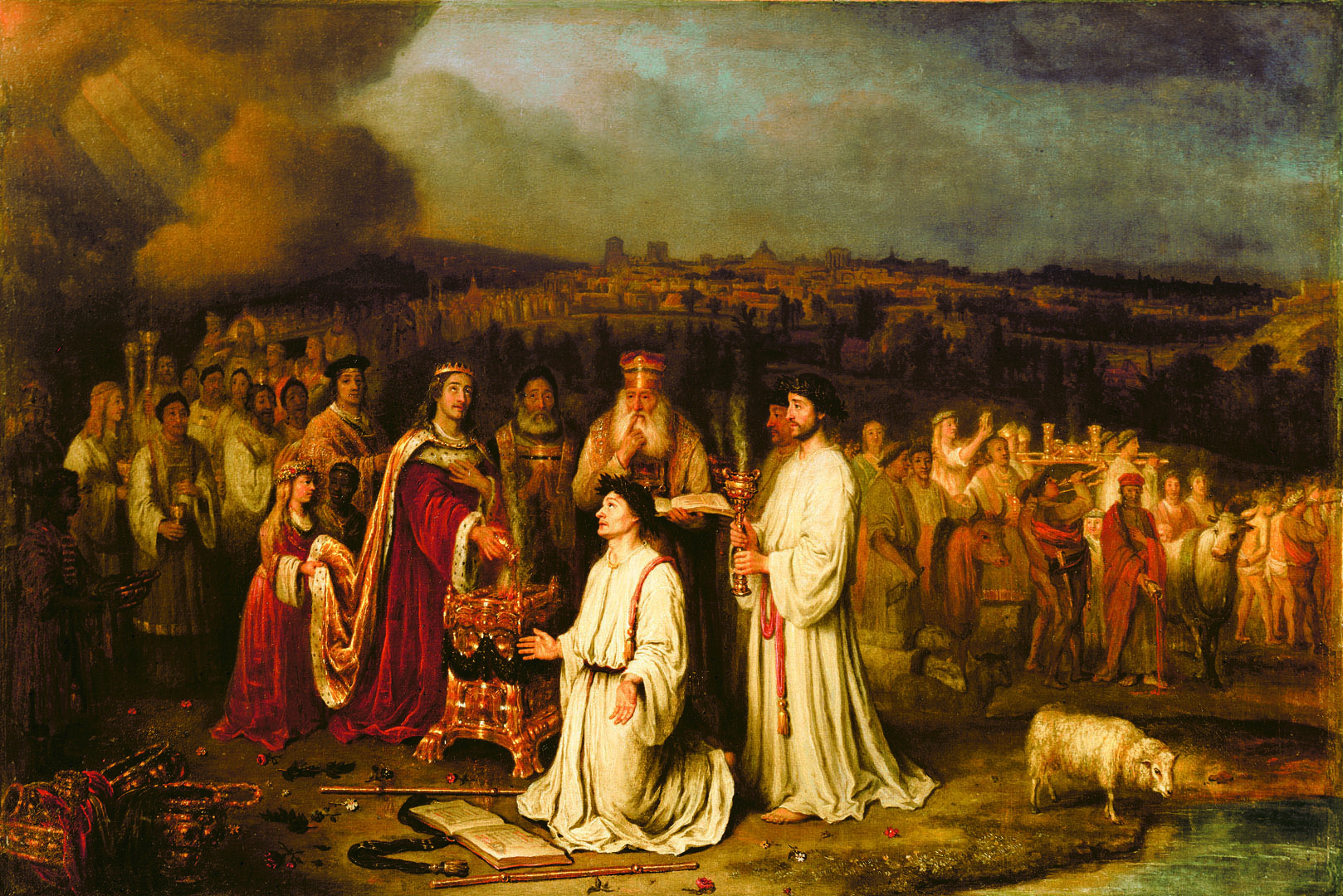
Solomon Dedicating the Temple outside Jerusalem. Philips Koninck, 1664. Wikimedia Commons. Public domain.