
Psalms 132:3
in Psalms 132“I will not enter my house or get into my bed,
BSB
The same verse in ASV and KJV ▾
ASV
Surely I will not come into the tabernacle of my house, Nor go up into my bed;
KJV
Surely I will not come into the tabernacle of my house, nor go up into my bed;
⋯
This verse in Psalms 132
Commentary
12 notes on this verseIf I shall enter into the tabernacle of my house. David says this: I seek no other rest but Christ, who is to be born of my seed, that is, whom you promised would be born of my loins.
This site's exposition
I will not enter my house
on Psalms 132:3-5
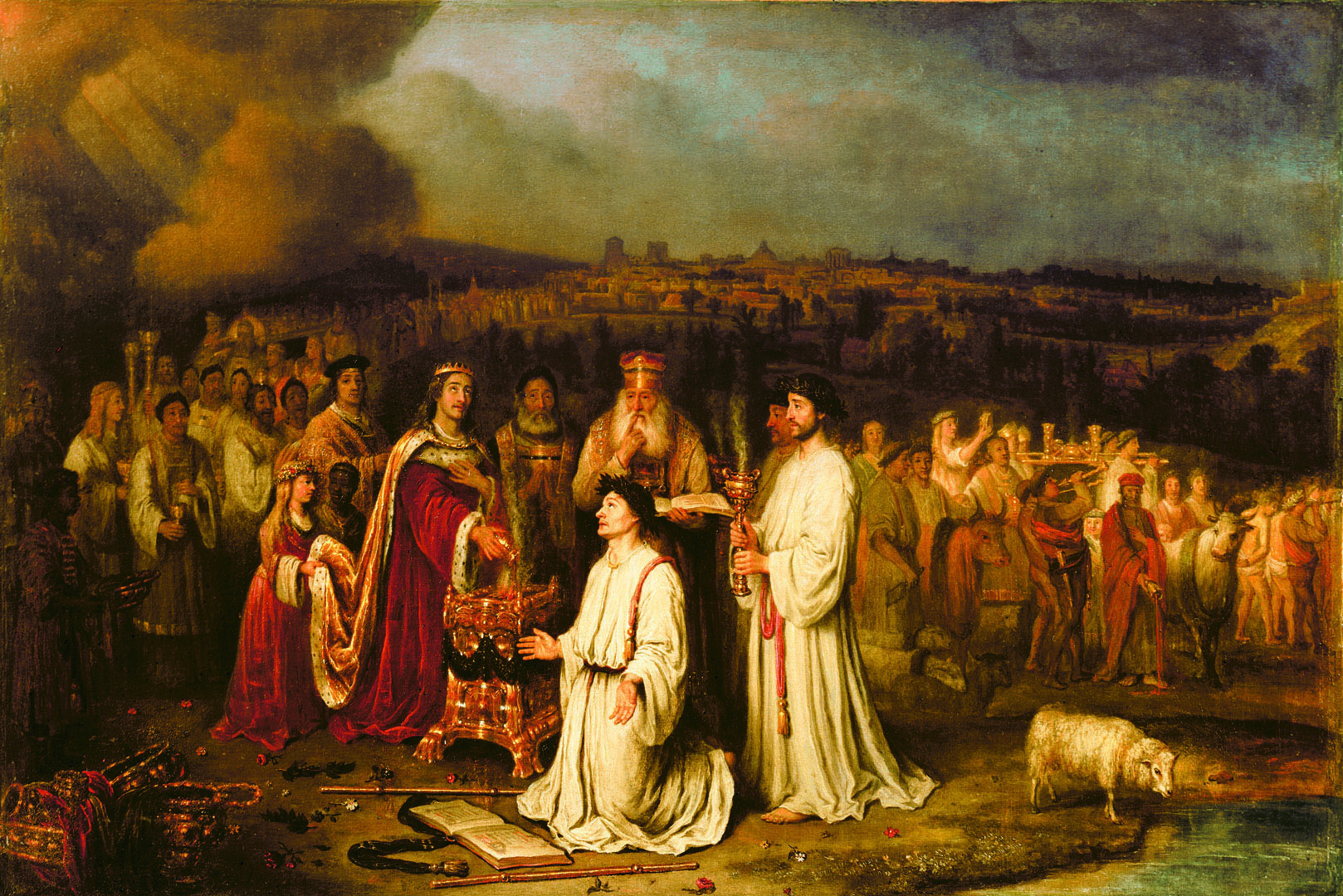
The vow puts off house, bed, sleep and slumber until a place is found for the LORD. David's words at 2 Samuel 7:2 give the occasion, the ark still in a tent while he lives in a house of cedar. John Gill read it as hyperbole for a restless mind.
The record, by era
The Church Fathers2 voices
The more I meditate on the mind of the saints, the more I am reminded of something that is high and hard and beyond the powers of human nature. Call to mind what the same psalmist [David] has said: "If I shall go up into …
What then doth he mean, "How he sware," etc.? Let us see what vow is this. We can offer God nothing more pleasing than to swear. Now to swear is to promise firmly. Consider this vow, that is, with what ardour he vowed what he vowed, with what love, with what longing; nevertheless, he prayeth the Lord to fulfil it in these words, "O Lord, remember David, and all his meekness." In this temper he vowed his vow, and there should be a house of God: "I will not come within the tabernacle of mine house, nor climb up into my bed" (ver. 3). "I will not suffer mine eyes to sleep, nor mine eyelids to slumber" (ver. 4). This seemeth not enough; he adds, "Neither the temples of my head to take any rest, until I find out a place for the Lord; an habitation for the God of Jacob" (ver. 5). Where did he seek a place for the Lord? If he was meek, he sought it in himself. For how is one a place for the Lord? Hear the Prophet: "Upon whom shall My Spirit rest? Even upon him that is poor and of a contrite spirit, and trembleth at My words." Dost thou wish to be a place for the Lord? Be thou poor in spirit, and contrite, and trembling at the word of God, and thou wilt thyself be made what thou seekest. For if what thou seekest be not realized in thyself, what doth it profit thee in another. ...
The Medieval Church1 voice
Girded with such things to serve as invincible armor, let us take our stand against the evil one, being wakeful and well prepared, as though it was day. Let us pierce him with the mighty arrows of the Spirit's words and cut off all his …
The Puritans and the Awakening2 voices
Surely I will not come into the tabernacle of my house,.... The new house and palace David built for himself after he came to the throne, made of cedar, 2Sa 5:11; not that he should never enter into it till he had found a dwelling for God, but that he should not go into it with pleasure till that was done; for this and what follows are hyperboles, as Kimchi observes, and signify that he should have no peace nor satisfaction of mind till this was accomplished.
1 , Then David said, This is the house of the Lord ); and perhaps it was upon occasion of that judgment that he made this vow, being apprehensive that one of God's controversies with him was for his dilatoriness in this matter.
quarantine:debris (2026-07-29) — unbalanced-parens
5 more voices on this verse
The Nineteenth Century5 voices
Surely I will not come into the tabernacle of my house, nor go up into my bed. Our translators give the meaning, though not the literal form, of David's vow, which ran thus, "If I go"—"If I go up", etc. This was an elliptical form of imprecation, implying more than it expressed, and having therefore about it a mystery which made it all the more solemn. David would not take his ease in his house, nor his rest in his bed, till he had determined upon a place for the worship of Jehovah.
A commentator
Jamieson, Fausset & Brown1802–1910
Commentary Critical and Explanatory on the Whole Bible (1871)
This vow is not elsewhere recorded. It expresses, in strong language, David's intense desire to see the establishment of God's worship as well as of His kingdom. remember David--literally, "remember for David," that is, all his troubles and anxieties on the matter.
Surely I will not come into the tabernacle of my house, nor go up into my bed. Our translators give the meaning, though not the literal form, of David's vow, which ran thus, "If I go"—"If I go up", etc. This was an elliptical form of imprecation, implying more than it expressed, and having therefore about it a mystery which made it all the more solemn. David would not take his ease in his house, nor his rest in his bed, till he had determined upon a place for the worship of Jehovah. The ark had been neglected, the Tabernacle had fallen into disrespect; he would find the ark, and build for it a suitable house; he felt that he could not take pleasure in his own palace till this was done. David meant well, but he spake more than he could carry out. His language was hyperbolical, and the Lord knew what he meant: zeal does not always measure its terms, for it is not thoughtful of the criticisms of men, but is carried away with love to the Lord, who reads the hearts of his people. David would not think himself housed till he had built a house for the Lord, nor would he reckon himself rested till he had said, "Arise, O Lord, into thy rest." Alas, we have many around us who will never carry their care for the Lord's worship too far! No fear of their being indiscreet? They are housed and bedded, and as for the Lord, his people may meet in a barn, or never meet at all, it will be all the same to them. Observe that Jacob in his vow spoke of the stone being God's house, and David's vow also deals with a house for God.
Surely I will not come - This must refer to the situation of the temple; or, as we would express it, he would not pass another day till he had found out the ground on which to build the temple, and projected the plan, and devised ways and means to execute it. And we find that he would have acted in all things according to his oath and vow, had God permitted him. But even after the Lord told him that Solomon, not he, should build the house he still continued to show his good will by collecting treasure and materials for the building, all the rest of his life.
A commentator
Albert Barnes1798–1870
Notes, Explanatory and Practical, on the Old and New Testaments (1832-1869)
proposed
Surely I will not come into the tabernacle of my house - The tent of my dwelling; the place where I abide. Nor go up into my bed The couch of my bed, or where I sleep. I will make it my first business to find a dwelling-place for the Lord; a place where the ark may repose.
The words behind it
9 Hebrew wordsEvery Hebrew word of this verse in the order it stands, with what it means and the door to its own study. The last column counts the times a word stands in the whole Bible: the rarer the word, the more the places it appears belong together.
| Hebrew | Sound | Meaning | Word study | In the Bible |
|---|---|---|---|---|
| אִם־ | ʾim- | if | H518 → | 1069 times |
| אָ֭בֹא | ʾavo' | I will go | H935 → | 2568 times |
| בְּאֹ֣הֶל | beohel | in [the] tent of | H168 → | 345 times |
| בֵּיתִ֑י | beiti | house my | H1004 → | 2046 times |
| אִם־ | ʾim- | if | H518 → | 1069 times |
| אֶ֝עֱלֶ֗ה | ʾeeleh | I will go up | H5927 → | 890 times |
| עַל־ | ʾal- | on | H5921 → | 5755 times |
| עֶ֥רֶשׂ | ʾeres | [the] couch of | H6210 → | 10 times |
| יְצוּעָֽי׃ | yetzuai | beds my | H3326 → |
אִם־if
ʾim-H518 →1069 times
אָ֭בֹאI will go
ʾavo'H935 →2568 times
בְּאֹ֣הֶלin [the] tent of
beohelH168 →345 times
בֵּיתִ֑יhouse my
beitiH1004 →2046 times
אִם־if
ʾim-H518 →1069 times
אֶ֝עֱלֶ֗הI will go up
ʾeelehH5927 →890 times
עַל־on
ʾal-H5921 →5755 times
עֶ֥רֶשׂ[the] couch of
ʾeresH6210 →10 times
יְצוּעָֽי׃beds my
yetzuaiH3326 →
A shaded row is a word that stands 400 times or fewer in the Bible.
The walk
8 stopsEach card is a verse this one points to, and under it the verses that one points to in turn. Where several paths arrive at the same place, that place is listed first: the text keeps returning to it.
Through
Matthew 6:33But seek first the kingdom of God and His righteousness, and all these things will be added unto you.
it leads to
- Luke 12:31
But seek His kingdom, and these things will be added unto you.
- Matthew 5:6
Blessed are those who hunger and thirst for righteousness, for they will be filled.
- John 6:27
Do not work for food that perishes, but for food that endures to eternal life, which the Son of Man will give you. For on Him God the Father has placed His seal of…
- Psalms 34:9–10
Fear the LORD, you His saints, for those who fear Him lack nothing.
- Psalms 84:11–12
For the LORD God is a sun and a shield; the LORD gives grace and glory; He withholds no good thing from those who walk with integrity.
- Luke 12:31
Through
Ecclesiastes 9:10Whatever you find to do with your hands, do it with all your might, for in Sheol, where you are going, there is no work or planning or knowledge or wisdom.
it leads to
- Colossians 3:23
Whatever you do, work at it with your whole being, for the Lord and not for men,
- Ephesians 5:16
redeeming the time, because the days are evil.
- Romans 12:11
Do not let your zeal subside; keep your spiritual fervor, serving the Lord.
- Colossians 3:23
Where this verse is studied
On this page
About Psalms
This page draws on 11 works. Open the list of works
This page draws on Adam Clarke, Commentary on the Bible; Albert Barnes, Notes, Explanatory and Practical, on the Old and New Testaments (1832-1869); Augustine of Hippo, Exposition on Psalm 132; Charles Spurgeon, The Treasury of David, Vol. 7; Jamieson, Fausset & Brown, Commentary Critical and Explanatory on the Whole Bible; Jerome, Homily 44, on Psalm 131; John Gill, Exposition of the Old Testament; John Gill, Exposition of the Old Testament (1748-1763); Matthew Henry, Commentary on the Whole Bible; Nicetas of Remesiana, VIGILS OF THE SAINTS 5 and Sahdona the Syrian, BOOK OF PERFECTION 72.