
Psalms 132:7
in Psalms 132Let us go to His dwelling place; let us worship at His footstool.
BSB
The same verse in ASV and KJV ▾
ASV
We will go into his tabernacles; We will worship at his footstool.
KJV
We will go into his tabernacles: we will worship at his footstool.
⋯
This verse in Psalms 132
Commentary
10 notes on this verseA commentator
Charles Spurgeon1834–1892
The Metropolitan Tabernacle Pulpit, Sermon No. 2590: “Hearing, Seeking, Finding” (lightly modernized text, CCEL edition) · Written before 1892.
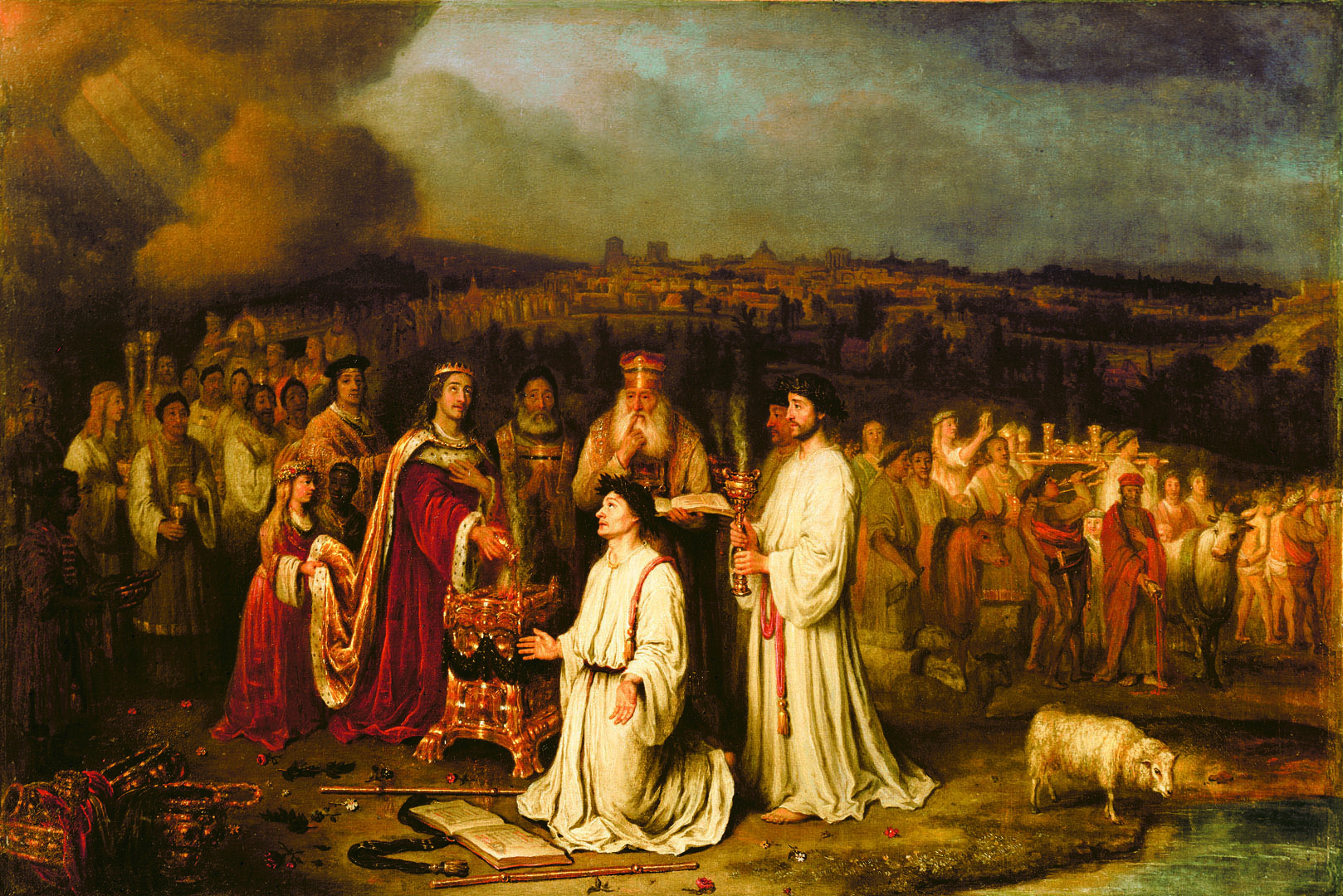
LONG before David's time, the Ark of the Lord had been almost forgotten by the children of Israel. It formed a most important part of the Ceremonial Law which God had ordained. I may almost call it the central portion of that pattern which was shown to Moses in the mountain. But the Ark had been carried into captivity by the Philistines and, afterwards, the terrible judgment worked upon the men of Beth-Shemesh may have made many afraid to go near it. So it remained a long time in Kirjath-Jearim and there David found it.
This site's exposition
the ark was in Ephrathah
on Psalms 132:6-7
Jaar is the Hebrew word for a wood. The ark was heard of at Ephrathah and found in those fields, where it stood twenty years at Kiriath-jearim, by 1 Samuel 7:1 and 2. Verse 7 answers with worship at His footstool, the word David uses of the house he planned for the ark at 1 Chronicles 28:2.
The record, by era
The Church Fathers1 voice
"We will go into His tabernacles" (ver. 7). Whose? Those of the Lord God of Jacob. They who enter to dwell therein, are the very same who enter that they may be dwelt in. Thou enterest into thy house, that thou mayest dwell therein; into the house of God, that thou mayest be dwelt in. For the Lord is better, and when He hath begun to dwell in thee, He will make thee happy. For if thou be not dwelt in by Him, thou wilt be miserable. That son who said, "Father, give me the portion of the goods," etc., wished to be his own master. It was well kept in his father's hands, that it might not be wasted with harlots. He received it, it was given into his own power; going to a far country, he squandered it all with harlots. At length he suffered hunger, he remembered his father; he returned, that he might be satisfied with bread. Enter therefore, that thou mayest be dwelt in; and mayest be not thine own, so to speak, but His: "We will go into His tabernacles. We will worship on the spot where His feet stood." Whose feet? The Lord's, or those of the house of the Lord itself? For that is the Lord's house, wherein he saith He ought to be worshipped. Beside His house, the Lord heareth not unto eternal life; for he belongeth to God's house, who hath in charity been built in with living stones. But he who hath not charity, falleth; and while he falls, the house stands. ...
The Puritans and the Awakening2 voices
(1.) They were inquisitive after the ark; for they lamented its obscurity, 1 Sam. vii. They heard of it at Ephratah (that is, at Shiloh, in the tribe of Ephraim); there they were told it had been, but it was gone. They found it, at last, in the fields of the wood, that is, in Kirjath-jearim, which signifies the city of woods.
We will go into his tabernacles,....
The Nineteenth Century2 voices
We will go into his tabernacles. Having found the place where he dwells we will hasten thereto. He has many dwellings in one in the various courts of his house, and each of these shall receive the reverence due: in each the priest shall offer for us the appointed service; and our hearts shall go where our bodies may not enter.
A commentator
Jamieson, Fausset & Brown1802–1910
Commentary Critical and Explanatory on the Whole Bible (1871)
The purpose of engaging in God's worship is avowed. The solemn entry of the ark, symbolical of God's presence and power, with the attending priests, into the sanctuary, is proclaimed in the words used by Solomon (2Ch 6:41).
3 more voices on this verse
The Nineteenth Century3 voices
A commentator
Charles Spurgeon1834–1892
The Metropolitan Tabernacle Pulpit, Sermon No. 2590: “Hearing, Seeking, Finding” (lightly modernized text, CCEL edition) · Written before 1892.
proposed
LONG before David's time, the Ark of the Lord had been almost forgotten by the children of Israel. It formed a most important part of the Ceremonial Law which God had ordained. I may almost call it the central portion of that pattern which was shown to Moses in the mountain. But the Ark had been carried into captivity by the Philistines and, afterwards, the terrible judgment worked upon the men of Beth-Shemesh may have made many afraid to go near it. So it remained a long time in Kirjath-Jearim and there David found it. And, after leaving it for a while at the house of Obed-Edom, brought it up to Jerusalem with great rejoicing. David's heart was so full of zeal for God that he desired that every part of the Lord's worship should be carried out with due order and proper solemnity. He wished to see a sanctuary built in which the Ark of the Lord should rest in its place and the worship of God should be carried out as He judged was meet and fit. The first thing, therefore, for David to do was to find the Ark, for, as I have already said, it was a central portion of the Divinely-ordained Ceremonial Law. The Ark was put away in the Most Holy Place and it was an express and notable symbol of the Presence of God among the people. It was there, from above the Mercy Seat, that God met with man and communed with him in the person of the High Priest. It was there that the Shekinah glory, denoting the special Presence of God, shone forth between the cherubim. It is clear, therefore, that if David meant to restore the worship of God to its due and proper order, his first business was to find the Ark. Yet, without forgetting that fact, I am not going to talk so much about David finding the Ark as to think of some who are in the condition in which I once was.
We will go into his tabernacles. Having found the place where he dwells we will hasten thereto. He has many dwellings in one in the various courts of his house, and each of these shall receive the reverence due: in each the priest shall offer for us the appointed service; and our hearts shall go where our bodies may not enter. David is not alone, he is represented as having sought for the ark with others, for so the word "we" implies; and now they are glad to attend him in his pilgrimage to the chosen shrine, saying, " We found it, we will go." Because these are the Lord's courts we will resort to them. We will worship at his footstool. The best ordered earthly house can be no more than the footstool of so great a King. His ark can only reveal the glories of his feet, according to his promise that he will make the place of his feet glorious: yet thither will we hasten with joy, in glad companionship, and there will we adorn him. Where Jehovah is, there shall he be worshipped. It is well not only to go to the Lord's house, but to worship there: we do but profane his tabernacles if we enter them for any other purpose. Before leaving this verse let us note the ascent of this Psalm of degrees—"We heard— we found— we will go— we will worship."
A commentator
Albert Barnes1798–1870
Notes, Explanatory and Practical, on the Old and New Testaments (1832-1869)
proposed
We will go into his tabernacles - His tents, or the fixed resting place prepared for the ark. This is evidently language supposed to have been used on bringing up the ark into its place in Jerusalem: language such as they may be supposed to have sung or recited on that occasion. We will worship at his footstool - See the notes at Psa 99:5. The meaning is, the footstool of God: let us bow humbly at his feet. The language denotes profound adoration. It expresses the feelings of those who bare the ark to its assigned place.
The words behind it
5 Hebrew wordsEvery Hebrew word of this verse in the order it stands, with what it means and the door to its own study. The last column counts the times a word stands in the whole Bible: the rarer the word, the more the places it appears belong together.
| Hebrew | Sound | Meaning | Word study | In the Bible |
|---|---|---|---|---|
| נָב֥וֹאָה | navoah | let us go | H935 → | 2568 times |
| לְמִשְׁכְּנוֹתָ֑יו | lemishkenotav | to dwelling place<s> his | H4908 → | 139 times |
| נִ֝שְׁתַּחֲוֶ֗ה | nishtachaveh | let us bow down | H7812 → | 172 times |
| לַהֲדֹ֥ם | lahadom | to [the] footstool of | H1916 → | 6 times |
| רַגְלָֽיו׃ | raglav | feet his | H7272 → | 247 times |
נָב֥וֹאָהlet us go
navoahH935 →2568 times
לְמִשְׁכְּנוֹתָ֑יוto dwelling place<s> his
lemishkenotavH4908 →139 times
נִ֝שְׁתַּחֲוֶ֗הlet us bow down
nishtachavehH7812 →172 times
לַהֲדֹ֥םto [the] footstool of
lahadomH1916 →6 times
רַגְלָֽיו׃feet his
raglavH7272 →247 times
A shaded row is a word that stands 400 times or fewer in the Bible.
The walk
8 stopsEach card is a verse this one points to, and under it the verses that one points to in turn. Where several paths arrive at the same place, that place is listed first: the text keeps returning to it.
Through
Psalms 122:1I was glad when they said to me, “Let us go to the house of the LORD.”
it leads to
- Psalms 84:10
For better is one day in Your courts than a thousand elsewhere. I would rather be a doorkeeper in the house of my God than dwell in the tents of the wicked.
- Micah 4:2
And many nations will come and say: “Come, let us go up to the mountain of the LORD, to the house of the God of Jacob. He will teach us His ways, so that…
- Isaiah 2:3
And many peoples will come and say: “Come, let us go up to the mountain of the LORD, to the house of the God of Jacob. He will teach us His ways so that…
- Psalms 84:1–2
How lovely is Your dwelling place, O LORD of Hosts!
- Psalms 128:1
Blessed are all who fear the LORD, who walk in His ways!
- Psalms 84:10
Through
Psalms 118:19Open to me the gates of righteousness, that I may enter and give thanks to the LORD.
it leads to
- Isaiah 26:2
Open the gates so a righteous nation may enter—one that remains faithful.
- Isaiah 26:2
Through
Psalms 5:7But I will enter Your house by the abundance of Your loving devotion; in reverence I will bow down toward Your holy temple.
it leads to
- Psalms 138:2
I bow down toward Your holy temple and give thanks to Your name for Your loving devotion and Your faithfulness; You have exalted Your name and Your word above all else.
- Hebrews 4:16
Let us then approach the throne of grace with confidence, so that we may receive mercy and find grace to help us in our time of need.
- Psalms 138:2
Where this verse is studied
On this page
About Psalms
This page draws on 9 works. Open the list of works
This page draws on Albert Barnes, Notes on the Book of Psalms; Albert Barnes, Notes, Explanatory and Practical, on the Old and New Testaments (1832-1869); Augustine of Hippo, Exposition on Psalm 132; Charles Spurgeon, The Metropolitan Tabernacle Pulpit, Sermon No. 2590: “Hearing, Seeking, Finding” (lightly modernized text, CCEL edition); Charles Spurgeon, The Treasury of David, Vol. 7; Franz Delitzsch, Biblical Commentary on the Psalms; Jamieson, Fausset & Brown, Commentary Critical and Explanatory on the Whole Bible; John Gill, Exposition of the Old Testament (1748-1763) and Matthew Henry, Commentary on the Whole Bible.