
Psalm 109
31 verses · Imprecatory psalm
O God of my praise, be not silent.
Introduction
David, the Accused Man's Appeal, Book 5: The return and the great Hallelujah, Poetry, Psalms Overview.
The heading gives this psalm to David and hands it to the choir leader. It is the prayer of a man repaid with hatred for his kindness and pursued with false charges, in a world where testimony at the city gate decided a man's fate. Its long middle section asks God to bring on the accuser the ruin he planned for others, and it leaves that judgment with God. These are hard words, and readers have weighed them for centuries. Listen for the change when the singer turns from his enemy to his own weakness, and for where the psalm places God at its close.
Context
- Who
- Israelites who knew that in a society without police or prisons a man's standing was his whole protection
- What
- The prayer of a falsely accused man who asks God to judge his accuser and to save him.
- Where
- Israel, where cases were heard by the elders at the city gate.
- When
- The reign of David, about 1010 to 970 BC by the superscription.
- Why
- To give a wronged person a place to bring the whole case to God and leave the sentence with Him.
Historical context
The danger in this psalm is speech used as a weapon in court. The accuser in an Israelite hearing stood at the right hand of the one he charged, which is why Zechariah 3:1 puts Satan at the right hand of Joshua the high priest. A case was decided by the elders at the city gate on the testimony of men who came forward, and a false witness could ruin a household in a morning. Deuteronomy 19:16 to 21 gives the false witness the penalty he sought for his victim, the principle behind the prayer that the cursing come back on the man who loved it. The ruin the curses ask for, a widowed wife, begging children and a creditor seizing the property, is what happened to a household whose head was condemned. The thin body, the weak knees and the fasting of verses 23 and 24 were the public signs of a man fighting a case in disgrace.
Significance
A man destroyed by testimony had no appeal beyond the elders already hearing the lies, and this psalm gave him somewhere else to take the case. Its hearers read the curses as a man handing the sentence to God and asking that the law's own rule, the false witness bearing what he intended, be applied by the one judge who could not be lied to.
This chapter in Jewish lifeWhat this chapter is in Jewish life and reading.
How it is read
Rashi reads this psalm as the prayer of the whole people rather than of one man with one enemy. On the first verse he writes that it "was said regarding all Israel", and the curses that follow are then read as Israel's complaint against the nations that oppress it (Rashi on Psalms 109:1:1, Rashi on Psalms, The Judaica Press complete Tanach with Rashi, translated by A. J. Rosenberg, CC-BY).
He names two of those nations by their fathers. The wicked mouth of verse 2 he glosses with one word, Ishmael, and from verse 14 to verse 18 he reads the cursed man as Esau (Rashi on Psalms 109:2:1, 109:14:1 and 109:17:1, same edition). A Christian reader should see the setting of that reading. Rashi wrote in eleventh century France, where Esau stood for Christendom and Ishmael for Islam in the Jewish commentaries of the day, and the psalm's curses are aimed there.
The charges he brings against Esau come from the Genesis narratives rather than from this psalm. Esau shortened Abraham's life by five years and caused his father's blindness, and he failed to do the kindness of mourning, where Jacob made the pottage of lentils to console Isaac on the day Abraham died (Rashi on Psalms 109:14:1 and 109:16:1, same edition).
Rashi also cites the midrash Shocher Tov by name on verse 5, where Israel says that it sacrifices seventy bulls every year for the seventy nations and asks for rain for them, and is harmed in return (Rashi on Psalms 109:5:1, citing Shocher Tov 109:4). Ibn Ezra carries eight comments for which Sefaria holds no English version, and they are cited by reference (Ibn Ezra on Psalms 109:3:1 and the seven references beside it).
What the rabbis say
The corpus records forty places where the Midrash and the Talmud cite this psalm, thirty one under Midrash and nine under Talmud, and it carries the locator for each one with no text. The Babylonian Talmud cites verse 18 at Moed Katan 15b:5, and verse 22 three times at Avodah Zarah 4b:18, Bava Batra 17a:2 and Avot DeRabbi Natan 32:3.
The Jerusalem Talmud reads verse 7 at Shabbat 2:6:6, verse 10 at Ketubot 13:3:5, verse 12 at Chagigah 2:1:10 and verse 18 at Shabbat 9:4:1. Midrash Tehillim treats the psalm at 109:1 and 109:2 and reads verse 24 at 31:6, and Ruth Rabbah takes up verse 12 at 6:4 and verse 31 at 5:9. The site reports where the rabbis cite the verse and reports no saying, because the locator carries none.
Sources: Rashi, Rashi on Psalms 109, in The Judaica Press complete Tanach with Rashi, translated by A. J. Rosenberg, CC-BY; Shocher Tov, Shocher Tov 109:4, as Rashi cites it at Rashi on Psalms 109:5:1; Ibn Ezra, Ibn Ezra on Psalms 109, cited by reference; Sefaria holds no English version; The Midrash and the Talmud, the forty locators on Psalms 109 in scripts/data/sources/sefaria/psalms/109.json.
Psalms 109:1-3
O God of my praise: The psalm opens by naming God the object of praise and asking Him not to stay silent. The attack is spoken, wicked and deceitful mouths, lying tongues, hateful words on every side. Verse 3 says the attack came without cause.
Psalms 109:1
“To the end, a psalm of David. When it says "to the end," let us understand that it is spoken not of the present, but of the future. And if it is spoken of the future, then the prophecy is about Christ. O God, do not keep silent about my praise. That is: Judas betrayed me, the Jews persecuted me and crucified me, and they thought that they would destroy me utterly, to the end. But you, O God, do not keep silent about my praise.”
Jerome · written before 420 · Homily 35, on Psalm 108patristic
1 more voice on this verseWhat preachers and commentators have said about this verse, in their own words.
Psalms 109:1
“Hold not thy peace. Mine enemies speak, be thou pleased to speak too. Break thy solemn silence, and silence those who slander me. It is the cry of a man whose confidence in God is deep, and whose communion with him is very close and bold. Note, that he only asks the Lord to speak: a word from God is all a believer needs. O God of my praise. Thou whom my whole soul praises, be pleased to protect my honour and guard my praise.”
Charles Spurgeon · The Treasury of David, Vol. 5 (1878)Particular Baptist
wicked and deceitful mouths: The enemies are plural in verses 2 to 5 and again from verse 20. In verses 6 to 19 the one cursed is a single man. Some readers take that man as their leader, and others hear the accusers' own words against the psalmist quoted there.
Psalms 109:2
“For the mouth . . . opened--or, "They have opened a wicked mouth" against me--literally, "with me," that is, Their intercourse is lying, or, they slander me to my face (Mt 26:59).”
Jamieson, Fausset & Brown · Commentary Critical and Explanatory on the Whole Bible (1871)reformed
1 more voice on this verse
Psalms 109:2
“For the mouth of the sinner and the mouth of the deceitful man has been opened against me. Let us see how the mouth of Judas the betrayer was opened against the Lord. He comes to the Lord in order to betray him, and he says: Rabbi — that is, master. Behold, the mouth of the sinner and the mouth of the deceitful man. I in my clemency wish to save him, and I offer him a kiss, and I wish to overcome his malice; yet he persists in doing evil, so as to betray me.”
Jerome · written before 420 · Homily 35, on Psalm 108patristic
attack me without cause: Without cause is chinnam, freely or for nothing. Jesus applies the word from Psalm 35:19 and 69:4 to Himself at John 15:25, hated without cause. They surround him as the bulls surround the sufferer of Psalm 22:12.
Psalms 109:3
“And they have surrounded me with words of hatred. Not that they might believe, but that they might war against me. And they have warred against me without cause. "Without cause" is understood in two ways. That is, without reason: for I had not sinned, and I did not deserve that they should make war upon me. And what worthy cause was there that they should war against me? Because I had healed their sick? because I had raised their dead? because I had done other signs? See therefore that they warred against him without cause.”
Jerome · written before 420 · Homily 35, on Psalm 108patristic
1 more voice on this verse
Psalms 109:3
“They were notorious liars; and lying comprehends two of the seven things which the Lord hates. "They are deceitful in their protestations and professions of kindness, while at the same time they speak against me behind my back, with a lying tongue. " They were equally false in their flatteries and in their calumnies.”
Matthew Henry · Commentary on the Whole Bible (1707-1721)puritan
Psalms 109:4-5
In return for my love: Love is answered by those who accuse. Verse 5 states the reversal, evil repaid for good and hatred for love. The Hebrew of verse 4 ends in two words, a pronoun and tefillah, prayer, which the Berean reads as a man of prayer.
Psalms 109:4
“Instead of loving me, they disparaged me: but I kept praying. In return for the benefits which I had conferred upon them, they were doing me insults. But what was I doing? I kept praying. These are the weapons of the Lord: and these are our weapons too, prayer. So then, whenever anyone persecutes us, and hates us, let us say: Instead of loving me, they disparaged me. But what was I doing? I kept praying. That I might overcome them? Far from it: for whom did the Lord pray that he might overcome?”
Jerome · written before 420 · Homily 35, on Psalm 108patristic
2 more voices on this verse
Psalms 109:4
“For my love they are my adversaries. They hate me because I love them. One of our poets says of the Lord Jesus—"Found guilty of excess of love." Surely it was his only fault. Our Lord might have used all the language of this complaint most emphatically—they hated him without a cause and returned him hatred for love. What a smart this is to the soul, to be hated in proportion to the gratitude which it deserved, hated by those it loved, and hated because of its love.”
Charles Spurgeon · The Treasury of David, Vol. 5 (1878)Particular Baptist
Psalms 109:4
“For my love they are my adversaries,.... For the love that Christ showed to the Jews; to their bodies, in going about and healing all manner of diseases among them; to their souls, in preaching, the Gospel to them in each of their cities; and for the love he showed to mankind in coming into the world to save them, which should have commanded love again; but instead of this they became his implacable adversaries: they acted the part of Satan; they were as so many Satans to him, as the word signifies.”
They repay me evil for good: Psalm 35:12 makes the same complaint. Proverbs 17:13 says evil will never leave the house of one who repays evil for good. The curses on the man's household in verses 9 to 13 follow that line.
Psalms 109:5
“And they set against me evils in return for goods. And set upon the cross, I kept praying for those who were crucifying me, while they were saying: "Aha, you who destroy the temple, and in three days build it up. Let him save himself. Let the Father who loves you come now and set you free." I rose again from the dead for their sakes, and they say: "His disciples came by night, and stole him away." And hatred in return for my love.”
Jerome · written before 420 · Homily 35, on Psalm 108patristic
1 more voice on this verse
Psalms 109:5
“And they have rewarded me evil for good,.... For the good words and sound doctrine he delivered to them; for the good works and miracles he wrought among them, to the healing of them; see Joh 10:32. And hatred for my love; he came to seek and save that which was lost, and yet they hated him, and would not have him to rule over them, Luk 19:10.”
Psalms 109:6-7
Set over him a wicked man: The curses begin here, asked by the man of verses 1 to 5. He asks that a wicked man be set over his accuser and that an accuser stand at that man's right hand. The last request is that his prayer be counted as sin.
Psalms 109:6
“Set thou a wicked man over him. What worse punishment could a man have? The proud man cannot endure the proud, nor the oppressor brook the rule of another like himself. The righteous in their patience find the rule of the wicked a sore bondage; but those who are full of resentful passions, and haughty aspirations, are slaves indeed when men of their own class have the whip hand of them. For Herod to be ruled by another Herod would be wretchedness enough, and yet what retribution could be more just?”
Charles Spurgeon · The Treasury of David, Vol. 5 (1878)Particular Baptist
1 more voice on this verse
Psalms 109:6
“Set a sinner over him. Since I prayed for them upon the cross, and they saw my wounds — I gave them room for repentance and they do not repent, and they refuse to have me as king — let them have the devil as king. They will not have Jesus as king: let them have Barabbas as king, Barabbas, which is interpreted "son of the father," that is, of the devil. This Barabbas, who was he? A seditious man and a robber.”
Jerome · written before 420 · Homily 35, on Psalm 108patristic
When he is tried: The scene is a law court. At Zechariah 3:1 the accuser stands at the high priest's right hand, the place named in verse 6. Proverbs 28:9 says the prayer of one who turns from the law is detestable.
Psalms 109:7
“When he shall be judged, let him be condemned. He judged and condemned others in the vilest manner, he suffered not the innocent to escape; and it would be a great shame if in his time of trial, being really guilty, he should be allowed to go free. Who would wish Judge Jeffries to be acquitted if he were tried for perverting justice? Who would desire Nero or Caligula to be cleared if set at the bar for cruelty? When Shylock goes into court, who wishes him to win his suit? And let his prayer become sin.”
Charles Spurgeon · The Treasury of David, Vol. 5 (1878)Particular Baptist
2 more voices on this verse
Psalms 109:7
“When he is judged, let him come forth condemned. Let him come not into judgment, but into condemnation. For where there is judgment, there is doubt: but where there is condemnation, the sentence is already plain. And let his prayer be turned into sin. The repentance of Judas was made a worse sin. How was the repentance of Judas made a worse sin? He went and perished by hanging; and he who became the betrayer of the Lord, this same man came to be his own slayer.”
Jerome · written before 420 · Homily 35, on Psalm 108patristic
Psalms 109:7
“Let his prayer become sin, as the clamours of a condemned malefactor not only find no acceptance, but are looked upon as an affront to the court. The prayers of the wicked now become sin, because soured with the leaven of hypocrisy and malice; and so they will in the great day, because then it will be too late to cry, Lord, Lord, open to us.”
Matthew Henry · Commentary on the Whole Bible (1707-1721)puritan
Psalms 109:8-9
May his days be few: The request is for few days. Peter quotes the rest of verse 8 at Acts 1:20 of Judas, where the Berean reads, May another take his position. The request then reaches his household, his children fatherless and his wife a widow.
Psalms 109:8
“Let his days be few. His days were made few, but his nights increased: for he was cut off in the middle of his days. The sun withdrew from him, and behold, darkness was multiplied for him. And let another receive his episcopate. This too is interpreted more plainly in the Acts of the Apostles. But it was not only spoken of Judas in that time, it is spoken even to this day. If Judas lost his apostleship, let priests and bishops guard themselves, lest they too lose their own priesthood.”
Jerome · written before 420 · Homily 35, on Psalm 108patristic
1 more voice on this verse
Psalms 109:8
“The last clause is quoted as to Judas by Peter (Ac 1:20). office--literally, "charge," Septuagint, and Peter, "oversight" [1Pe 5:2].”
Jamieson, Fausset & Brown · Commentary Critical and Explanatory on the Whole Bible (1871)reformed
Cross references
Psalms 109:8
- Quoted inActs 1:20“For it is written in the book of Psalms: ‘May his place be deserted; let there be no one to dwell in it,’ and, ‘May another take his position.’
'his bishoprick let another take' (replacing Judas)
ConnectionsActs 1:20
his wife a widow: The wording follows Exodus 22:24, the penalty on anyone who afflicts the widow and the fatherless. Verse 16 charges this man with hunting down the poor and needy. The curse repays him in kind.
Psalms 109:9
“Let his children be fatherless, and his wife a widow. This would inevitably be the case when the man died, but the psalmist uses the words in an emphatic sense, he would have his widow "a widow indeed", and his children so friendless as to be orphaned in the bitterest sense. He sees the result of the bad man's decease, and includes it in the punishment. The tyrant's sword makes many children fatherless, and who can lament when his barbarities come home to his own family, and they too, weep and lament.”
Charles Spurgeon · The Treasury of David, Vol. 5 (1878)Particular Baptist
Psalms 109:10-13
May his children wander as beggars: The children wander as beggars, and the creditor takes everything the man owns. Strangers plunder what his labor made, and no kindness is to reach him or his fatherless children. The descendants are cut off and the name blotted out.
Psalms 109:10
“Let his children be continually vagabonds, and beg. May they have neither house nor home, settlement nor substance; and while they thus wander and beg may it ever be on their memory that their father's house lies in ruins, —let them seek their bread also out of their desolate places. It has often been so: a race of tyrants has become a generation of beggars. Misused power and abused wealth have earned the family name universal detestation, and secured to the family character an entail of baseness.”
Charles Spurgeon · The Treasury of David, Vol. 5 (1878)Particular Baptist
May the creditor seize all he owns: Seize is a hunter's verb, to lay a snare. At 2 Kings 4:1 a creditor comes to take a widow's two sons as slaves. Deuteronomy 28:33 names strangers eating the fruit of a man's labor among the curses of the covenant.
Psalms 109:11
“Let the moneylender search out all his substance. You gave him money, O Lord, you gave to him as also to the others. But what did he do? He did not bind it up in a napkin, nor bury it in the earth, nor was he negligent: but when he had the Lord's talent and money, he took a price from the enemies of the Lord, and sold his own Lord. Therefore I say to you, O Lord, exact from him the interest of your money. And let strangers plunder his labors.”
Jerome · written before 420 · Homily 35, on Psalm 108patristic
no one to extend kindness to him: Kindness is chesed, loyal love. Verse 16 says this man never thought to show it, and verses 21 and 26 ask God's loving devotion, the same word, for the speaker. The measure he gave is the measure asked for him.
Psalms 109:12
“Let there be none to extend mercy unto him. He had no mercy, but on the contrary, he crushed down all who appealed to him. Loath to smite him with his own weapon, stern justice can do no otherwise, she lifts her scales and sees that this, too, must be in the sentence. Neither let there be any to favour his fatherless children.”
Charles Spurgeon · The Treasury of David, Vol. 5 (1878)Particular Baptist
1 more voice on this verse
Psalms 109:12
“The children of wicked parents often fare the worse for their parents' wickedness in this way that the bowels of men's compassion are shut up from them, which yet ought not to be, for why should children suffer for that which was not their fault, but their infelicity?”
Matthew Henry · Commentary on the Whole Bible (1707-1721)puritan
May his descendants be cut off: Deuteronomy 25:6 sets the brother's duty to a widow so that a dead man's name is kept in Israel. This line asks for the opposite. Psalm 9:5 speaks of the name of the wicked blotted out forever.
Psalms 109:13
“Let his posterity be cut off; and in the generation following let their name be blotted out. Both from existence and from memory let them pass away till none shall know that such a vile brood ever existed. Who wishes to see the family of Domitian or Julian continued upon earth? Who would mourn if the race of Tom Paine or of Voltaire should come to an utter end? It would be undesirable that the sons of the utterly villainous and bloodthirsty should rise to honour, and if they did they would only revive the memory of their father's sins.”
Charles Spurgeon · The Treasury of David, Vol. 5 (1878)Particular Baptist
Psalms 109:14-16
the iniquity of his fathers: The request reaches back a generation, the iniquity of his fathers remembered and the sin of his mother never blotted out. Verse 15 asks that their sins stay before the LORD, and verse 16 names the ground, a man who hunted the poor to death. He had never shown kindness.
Psalms 109:14
“This verse is, perhaps, the most terrible of all, but yet as a matter of fact children do procure punishment upon their parents' sins, and are often themselves the means of such punishment. A bad son brings to mind his father's bad points of character; people say, "Ah, he is like the old man. He takes after his father." A mother's sins also will be sure to be called to mind if her daughter becomes grossly wicked. "Ah", they will say, "there is little wonder, when you consider what her mother was." These are matters of everyday occurrence.”
Charles Spurgeon · The Treasury of David, Vol. 5 (1878)Particular Baptist
May their sins always remain before the LORD: Nehemiah 4:5 prays the same way against the enemies of the builders. Isaiah 43:25 shows the reverse, the LORD blotting out transgressions and remembering sins no more. Memory cut off answers the name blotted out in verse 13.
Psalms 109:15
“Again, he wishes that his father's sins may follow up the transgressor and assist to fill the measure of his own iniquities, so that for the whole accumulated load the family may be smitten with utter extinction. A king might justly wish for such an end to fall upon an incorrigible brood of rebels; and of persecutors, continuing in the same mind, the saints might well pray for their extinction; but the passage is dark; and we must leave it so. It must be right or it would not be here, but how we cannot see.”
Charles Spurgeon · The Treasury of David, Vol. 5 (1878)Particular Baptist
he never thought to show kindness: The verse gives the ground of every request in verses 6 to 15. The brokenhearted he pursued are the ones the LORD is near to at Psalm 34:18. Verse 31 sets the LORD at the needy one's right hand.
Psalms 109:16
Because that he remembered not to show mercy,.... As Judas did not; neither to the poor, whom he cared not for, Joh 12:6 nor to Christ, whom he betrayed with a kiss to his enemies: nor had these words of Christ any effect upon him, to move his pity and compassion, "Friend, wherefore art thou come?"
1 more voice on this verse
Psalms 109:16
“Because he did not remember to show mercy. See how great the clemency of the Lord is. He sees him coming with the officers, he sees him coming with clubs, and he offers him a kiss. That man comes to betray, and the Lord gives a kiss; so that he who did not fear his master might at least be overcome by clemency.”
Jerome · written before 420 · Homily 35, on Psalm 108patristic
Psalms 109:17-19
The cursing that he loved: He asks that the cursing this man loved fall on him, and that the blessing he refused stay far off. The cursing was worn like a coat, and the request is that it soak into him like water and reach his bones like oil. It wraps him like a robe.
Psalms 109:17
“As he loved cursing, so let it come unto him. Deep down in every man's soul the justice of the lex talionis is established. Retaliation, not for private revenge, but as a measure of public justice, is demanded by the psalmist and deserved by the crime. Surely the malicious man cannot complain if he is judged by his own rule, and has his corn measured with his own bushel. Let him have what he loved. They are his own chickens, and they ought to come home to roost. He made the bed, let him lie on it himself.”
Charles Spurgeon · The Treasury of David, Vol. 5 (1878)Particular Baptist
soak into his body like water: Numbers 5:22 pictures a curse carried in water into the body of the accused. Here the cursing he wore outside like a coat passes inward, into body and bones. Oil was rubbed into the skin and soaked deep.
Psalms 109:18
“Garment - Which a man wears constantly. Like water - Water in the cavity of the belly, between the bowels, is almost certain death. And oil soaking into any of the bones, will soon utterly destroy it.”
John Wesley · Explanatory Notes upon the Old Testament (1765)evangelical
like a belt tied forever around him: A belt was worn every day, tied close to the body. Isaiah 11:5 gives the Messiah a belt of righteousness and faithfulness, the reverse picture. The curse stays with him.
Psalms 109:19
“Let it be unto him as the garment which covereth him - He has chosen to put it on, to wear it, to appear in it; so let him constantly feel its consequences. As he is always obliged to wear clothing, so let this be as constantly with him and upon him as his mantle and his sash. And for a girdle wherewith he is girded continually - The belt or girdle which he constantly wears. See the notes at Mat 5:38.”
the LORD’s reward to my accusers: One line closes the curses of verses 6 to 19. Verse 20 calls them a reward from the LORD, asked against the accusers, those who speak evil against him. They are the wicked and deceitful mouths of verse 2.
Psalms 109:20
“This is the summing up of the entire imprecation, and fixes it upon the persons who had so maliciously assailed the inoffensive man of God. David was a man of gentle mould, and remarkably free from the spirit of revenge, and therefore we may here conceive him to be speaking as a judge or as a representative man, in whose person great principles needed to be vindicated and great injuries redressed.”
Charles Spurgeon · The Treasury of David, Vol. 5 (1878)Particular Baptist
Psalms 109:21-22
deal kindly with me: The psalm turns to the speaker himself. He asks God to deal kindly with him for the sake of His name and to deliver him by His loving devotion. He is poor and needy with a wounded heart, the same words verse 16 used of the ones he pursued.
Psalms 109:21
“But do thou for me, O God the Lord, for thy name's sake. How eagerly he turns from his enemies to his God! He sets the great thou in opposition to all his adversaries, and you see at once that his heart is at rest. The words are very indistinct and though our version may not precisely translate them, yet it in a remarkable manner hits upon the sense and upon the obscurity which hangs over it. "Do thou for me"—what shall he do? Why, do whatever he thinks fit.”
Charles Spurgeon · The Treasury of David, Vol. 5 (1878)Particular Baptist
my heart is wounded within me: Wounded is chalal, to pierce, the root of the word for the servant pierced for transgressions at Isaiah 53:5. Verse 16 spoke of the brokenhearted hunted to death, and here the heart that is struck is his own. Psalm 40:17 makes the same confession.
Psalms 109:22
“For I am poor and needy. When he does plead anything about himself he urges not his riches or his merits, but his poverty and his necessities: this is gospel supplication, such as only the Spirit of God can indite upon the heart. This lowliness does not comport with the supposed vengeful spirit of the preceding verses: there must therefore be some interpretation of them which would make them suitable in the lips of a lowly minded man of God. And my heart is wounded within me.”
Charles Spurgeon · The Treasury of David, Vol. 5 (1878)Particular Baptist
Psalms 109:23-25
like a lengthening shadow: Three pictures stand together, a lengthening shadow, a locust shaken off, and knees weak from fasting. The body grows lean and gaunt. The accusers see him and shake their heads, the gesture the mockers make at Psalm 22:7.
Psalms 109:23
“I am shaken off like locusts. I indeed had come to protect my people, and I said: "Jerusalem, Jerusalem, who kill the prophets and stone those who are sent to you, how often did I wish to gather your children as a hen gathers her chicks under her wings." I had come like a hen to protect them: but they received me with a most hostile mind. I had come as a mother: and they slew me as if I were their murderer. I am shaken off. What is this? They persecuted me, they cast me out.”
Jerome · written before 420 · Homily 35, on Psalm 108patristic
1 more voice on this verse
Psalms 109:23
“I am gone like the shadow when it declineth. I am a mere shadow, a shadow at the vanishing point, when it stretches far, but is almost lost in the universal gloom of evening which settles over all, and so obliterates the shadows cast by the setting sun. Lord, there is next to nothing left of me, wilt thou not come in before I am quite gone? I am tossed up and down as the locust, which is the sport of the winds, and must go up or down as the breeze carries it.”
Charles Spurgeon · The Treasury of David, Vol. 5 (1878)Particular Baptist
My knees are weak from fasting: Psalm 35:13 speaks of fasting for the very men who later became his accusers. The Hebrew of the second line reads that his body has lost its fat. The knees give way under the fasting and the grief.
Psalms 109:24
“My knees are weak through fasting,..... Either voluntary or forced, through want of food or refreshment; this was verified in Christ, when he kneeled and prayed, and his sweat was as it were great drops of blood falling to the ground; see Psa 69:10. And my flesh faileth of fatness; or "for want of oil" (k); the radical moisture of his flesh being dried up like a potsherd, Psa 22:15. (k) משמן δι' ελαιον, Sept. "propter oleum", V. L. "propter defectum olei", Eth. Arab.”
1 more voice on this verse
Psalms 109:24
My knees are weak through fasting; either religious fasting, to which he resorted in the dire extremity of his grief, or else through loss of appetite occasioned by distress of mind. Who can eat when every morsel is soured by envy? This is the advantage of the slanderer, that he feels nothing himself, while his sensitive victim can scarcely eat a morsel of bread because of his sensitiveness. However, the good God knoweth all this, and will succour his afflicted. The Lord who bids us confirm the feeble knees will assuredly do it himself. "And my flesh faileth of fatness."
Charles Spurgeon · The Treasury of David, Vol. 5 (1878)Particular Baptist
they shake their heads: Matthew 27:39 shows those who passed the cross shaking their heads at Jesus. Lamentations 2:15 has all who pass by shaking their heads at Jerusalem. Scorn is cherpah, open reproach from his accusers.
Psalms 109:25
“I became also a reproach unto them,.... Or they reproached him; not only in life, traducing his conversation, blaspheming his miracles, calling him a Samaritan, saying he had a devil, and charging him with sedition; but at the time of his death they reviled him, and treated him in the most opprobrious manner. When they looked upon me, they shaked their heads; which was verified in the Jews as they passed by the cross of Christ, whither they came to stare upon him and scoff at him, Mat 27:39.”
1 more voice on this verse
Psalms 109:25
“In all this David was a type of Christ, who in his humiliation was thus wounded, thus weakened, thus reproached; he was also a type of the church, which is often afflicted, tossed with tempests, and not comforted. He prays for mercy for himself.”
Matthew Henry · Commentary on the Whole Bible (1707-1721)puritan
Psalms 109:26-29
Help me, O LORD my God: He asks for help by God's loving devotion. He asks that they know whose hand it is, and though they curse, God will bless; they will be put to shame. Verse 29 asks that the accusers wear shame like a robe, the garment of verse 18 turned on them.
Psalms 109:26
“Help me, O Lord my God. Laying hold of Jehovah by the appropriating word my, he implores his aid both to help him to bear his heavy load and to enable him to rise superior to it. He has described his own weakness, and the strength and fury of his foes, and by these two arguments he urges his appeal with double force. This is a very rich, short, and suitable prayer for believers in any situation of peril, difficulty, or sorrow. O save me according to thy mercy. As thy mercy is, so let thy salvation be.”
Charles Spurgeon · The Treasury of David, Vol. 5 (1878)Particular Baptist
1 more voice on this verse
Psalms 109:26
“Save me according to your mercy. He says also in the Gospel: "I have power to lay down my soul and to take it up again." And again: "No one takes it from me." And how does he ask for mercy? He himself asks for mercy, and he himself bestows it; he himself as man asks, and as God bestows.”
Jerome · written before 420 · Homily 35, on Psalm 108patristic
Let them know that this is Your hand: The request looks past the rescue to the accusers' knowing. Isaiah 41:20 gives the same purpose, that all may know the hand of the LORD has done this. The LORD will be seen to have done it.
Psalms 109:27
“And let them know that this is your hand, and you, O Lord, have made it. What is it that he says, And let them know that this is your hand, and you, O Lord, have made it? Let the Jews understand that they did not prevail against me by their own strength: but my will and your will was done, that I should suffer. And I willed to suffer; therefore I say, according to what I am as man: "My God, I willed to do your will." And your will was also mine, that I should suffer.”
Jerome · written before 420 · Homily 35, on Psalm 108patristic
Though they curse, You will bless: David says the same when Shimei curses him at 2 Samuel 16:12, hoping the LORD will repay good for the cursing. Deuteronomy 23:5 records the LORD turning Balaam's curse into a blessing. Readers who hear verses 6 to 19 as the enemies' words find those curses answered here.
Psalms 109:28
“Let them curse, but bless thou,.... Let them curse me, as Shimei did David, the type of Christ; let them curse themselves, as they did; or my people: or "let them be cursed", as the Syriac version; cursed in life and at death, and to all eternity: but "bless thou me", the Messiah; as he did, when he raised him front the dead, set him at his right hand, and gave him a name above everyone, and made him most blessed for evermore; and bless my people with all spiritual blessings of grace, and with eternal glory and happiness.”
1 more voice on this verse
Psalms 109:28
“Men's curses are impotent; God's blessings are omnipotent; and those whom we unjustly curse may in faith expect and pray for God's blessing, his special blessing. When the Pharisees cast out the poor man for his confessing Christ, Christ found him, John ix.”
Matthew Henry · Commentary on the Whole Bible (1707-1721)puritan
wear their shame like a robe: Psalm 35:26 prays the same, that those who gloat over him wear shame and disgrace. Bildad promises it to Job at Job 8:22 against those who hate him. The accusers are the plural enemies of verses 2 to 5 and 20.
Psalms 109:29
“Let those who disparage me be clothed with shame. It profits us greatly to understand what we say. The clemency of God appears in this, in his saying "let them be clothed." He does not say, let them perish; he does not say, let them be blotted out forever: but what does he say? let them be confounded, that is, let them understand their error, and be confounded, and stand in repentance. He who is clothed with shame is near to salvation: for if anyone is truly confounded, he begins to repent.”
Jerome · written before 420 · Homily 35, on Psalm 108patristic
1 more voice on this verse
Psalms 109:29
“Let mine adversaries be clothed with shame,.... This is only explanative of what is said before, And let them cover themselves with their own confusion as with a mantle: the Arabic version is, "as with a breastplate." Some understand it as a petition of Christ, that they might be brought to repentance for their sins, and so to shame for them; which is an instance of his wondrous grace and goodness; and it is certain he prayed for the forgiveness of his enemies when on the cross, Luk 23:34.”
Psalms 109:30-31
thank the LORD profusely: The psalm closes in praise, where verse 1 began. The thanks are spoken out loud, in the presence of many. The LORD stands at the needy man's right hand to save him from his condemners, where verse 6 asked an accuser to stand.
Psalms 109:30
“I will confess to the Lord exceedingly with my mouth. This is said after the resurrection, and it is sung of the future church. And in the midst of many I will praise him. For not in Judea alone, but in the whole world, in the church I will praise you.”
Jerome · written before 420 · Homily 35, on Psalm 108patristic
1 more voice on this verse
Psalms 109:30
“In singing this psalm we must comfort ourselves with the believing foresight of the certain destruction of all the enemies of Christ and his church, and the certain salvation of all those that trust in God and keep close to him.”
Matthew Henry · Commentary on the Whole Bible (1707-1721)puritan
the condemners of his soul: Condemners is literally those who judge his soul, the court of verse 7 seen from the other side. At Psalm 16:8 the LORD stands at the right hand as well. The next psalm names the right hand twice, at Psalm 110:1 and 5.
Psalms 109:31
“For he shall stand at the right hand of the poor. God will not be absent when his people are on their trial; he will hold a brief for them and stand in court as their advocate, prepared to plead on their behalf. How different is this from the doom of the ungodly who has Satan at his right hand (Ps 109:6). To save him from those that condemn his soul.”
Charles Spurgeon · The Treasury of David, Vol. 5 (1878)Particular Baptist
How this psalm is built
The form: An imprecatory psalm, whose curses are asked of God rather than carried out by the man who asks, as Calvin classes it.
A An accuser is asked to stand at the wicked man's right hand
Psalm 109:6
B He hunted a man poor and needy and brokenhearted to death
Psalm 109:16
C Cursing was the coat he wore and the water he drank
Psalm 109:18-19
D One line closes the curses and names them a reward from the LORD to the accusers
Psalm 109:20
C′ The accusers are asked to be clothed with shame and wrapped in disgrace
Psalm 109:29
B′ The speaker is poor and needy, his heart wounded within him
Psalm 109:22
A′ The LORD stands at the needy man's right hand to save him
Psalm 109:31
The patterns in this chapter
| Device | What it does | Where to see it |
|---|---|---|
| The garment that comes back | The accuser wore cursing like a coat at verse 18, and verse 29 asks that the accusers wear shame like a robe. What the man put on is what he is asked to be clothed in, and the psalm turns the same image round on the same person.Franz Delitzsch, Biblical Commentary on the Psalms, 1871, on Psalm 109:18. | Psalm 109:18, Psalm 109:19, Psalm 109:29 |
| Evil for good, hatred for love | Verse 5 states the whole injury in one balanced line, evil repaid for good and hatred for love. Everything the psalm asks for afterwards is measured against that sentence.Albert Barnes, Notes, Explanatory and Practical, on the Old and New Testaments, 1832 to 1869, on Psalm 109:5. | Psalm 109:4, Psalm 109:5 |
| The curse worked down the generations | Verses 6 to 15 move outward in order: the man himself, his office, his days, his wife and children, his property, his descendants, and then back to his father and mother. The list is built to leave nothing of him standing.Matthew Henry, Commentary on the Whole Bible, 1710, on Psalm 109:8. | Psalm 109:6, Psalm 109:8, Psalm 109:9, Psalm 109:13, Psalm 109:14 |
| I am poor and needy | Verse 16 accuses the enemy of hunting the poor and needy and brokenhearted, and verse 22 says the speaker himself is poor and needy with a wounded heart. The same three words describe the victim in both places.Albert Barnes, Notes, Explanatory and Practical, on the Old and New Testaments, 1832 to 1869, on Psalm 109:22. | Psalm 109:16, Psalm 109:22 |
| The God of my praise | The psalm opens by calling God the God of his praise at verse 1, and closes at verses 30 and 31 with thanks given out loud in the presence of many. The curses sit inside a frame of praise.John Calvin, Commentary on the Book of Psalms, 1557, on Psalm 109:30. | Psalm 109:1, Psalm 109:30, Psalm 109:31 |
The debated concept
7 more paragraphs on the patterns
This psalm is the Psalter's main test case for the imprecations, and the question is live. How much of verses 6 to 19 is the psalmist's own speech and how much is his accusers' words quoted back is argued in the commentaries, because the Hebrew moves from plural enemies in verses 2 to 5 to a single man through the curses and back to the plural at verse 20. The reading that takes the curses as quotation makes verse 20 the psalmist's summary of what they said, and it relieves the reader of attributing them to a man of prayer. The reading that takes them as his own, which the Berean prints, holds that the psalm is doing exactly what it appears to do, handing the whole of a wound to God. The first reading has the pronoun shift in its favour; the second has the plain sense of verse 20, which calls the list a reward from the LORD. Neither should be flattened, and the psalm's own structure supports arguing it.
Where the requests are addressed
Every request is made to God and none to a court or a crowd. That is what separates this psalm from a private curse, and it is why verse 20 names the list a reward from the LORD. The psalm also states its ground before it asks: verse 16 says the accuser hunted a man poor and needy and brokenhearted to death and had never shown kindness.
The prophecy and the New Testament's use
Verse 8 is quoted by Peter at Acts 1:20 over Judas, and the Berean gives it there as may another take his position. The apostles used the line to authorize the choosing of Matthias, which makes this psalm the ground of one of the earliest recorded acts of the church. Whether the psalm anticipates Judas or supplies apt language for him is a question the passage in Acts does not settle, and the church has held both.
The reversal that shapes it
The psalm turns its own images round. The accuser wore cursing like a coat at verse 18 and the accusers are asked to wear shame like a robe at verse 29. An accuser was asked to stand at the wicked man's right hand at verse 6, and the LORD stands at the needy man's right hand at verse 31. The curses and the prayer answer each other across verse 20.
Keep studying
Sources for this chapter
The summary
Jamieson, Fausset & Brown, Commentary Critical and Explanatory; John Calvin, Commentaries; John Wesley, Notes on the Old Testament and Matthew Henry, Complete Commentary.
The form and classifications
Adam Clarke, Commentary on the Bible, 1832, on Psalm 109:1; John Calvin, Commentary on the Book of Psalms, 1557, on Psalm 109:1 and Matthew Henry, Commentary on the Whole Bible, 1710, on Psalm 109:1.
The exposition
Albert Barnes, Notes on the Book of Psalms; Charles Spurgeon, The Treasury of David; Franz Delitzsch, Biblical Commentary on the Psalms; Jamieson, Fausset and Brown, Commentary Critical and Explanatory on the Whole Bible; John Calvin, Commentary on the Book of Psalms; John Gill, Exposition of the Old Testament and Matthew Henry, Commentary on the Whole Bible.
The painting
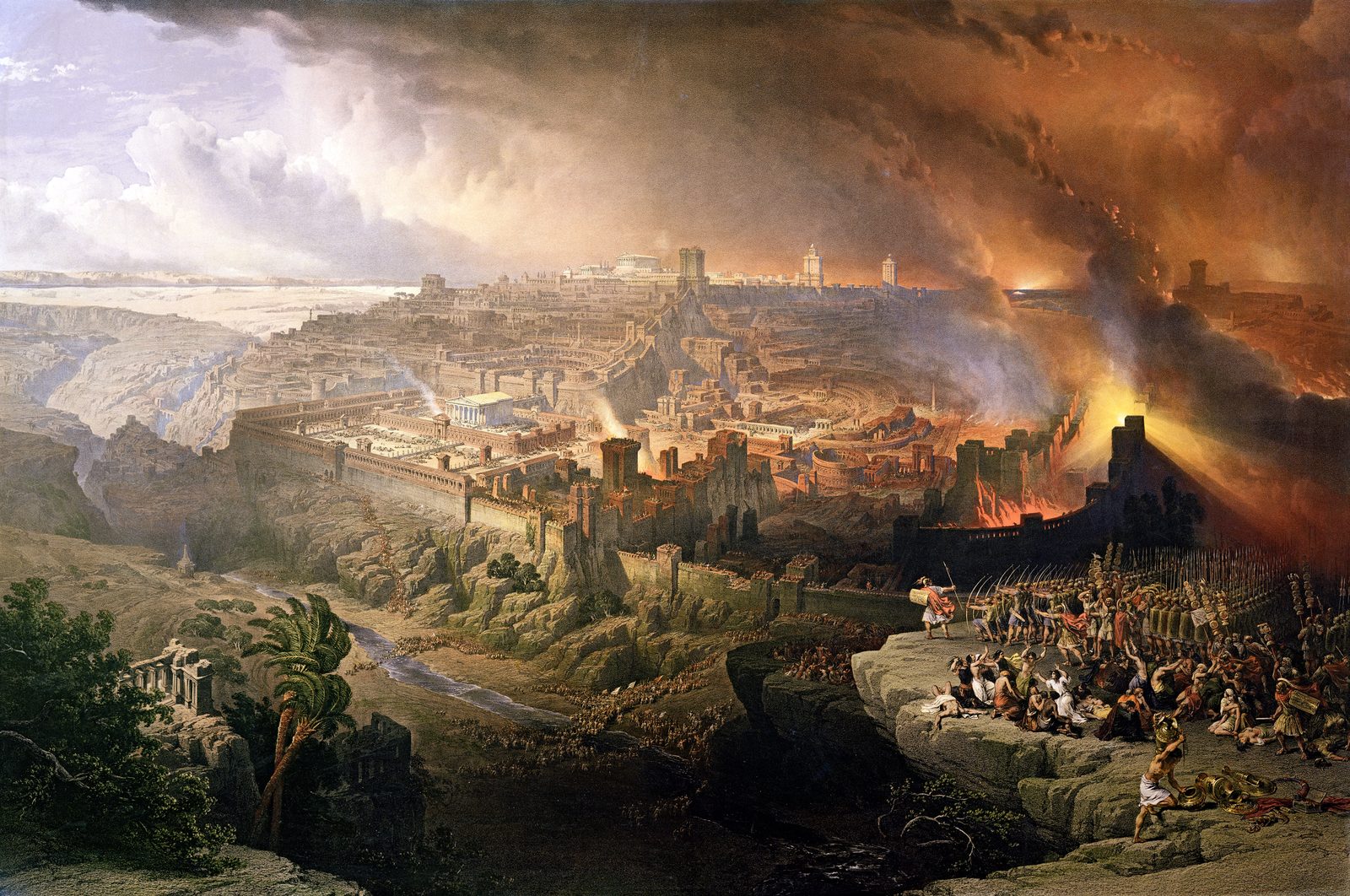
The Siege and Destruction of Jerusalem by the Romans Under the Command of Titus, A.D. 70. David Roberts, 1850. Wikimedia Commons. Public domain.