
Nehemiahchapter 8
18 verses · KJVNehemiah book hub →
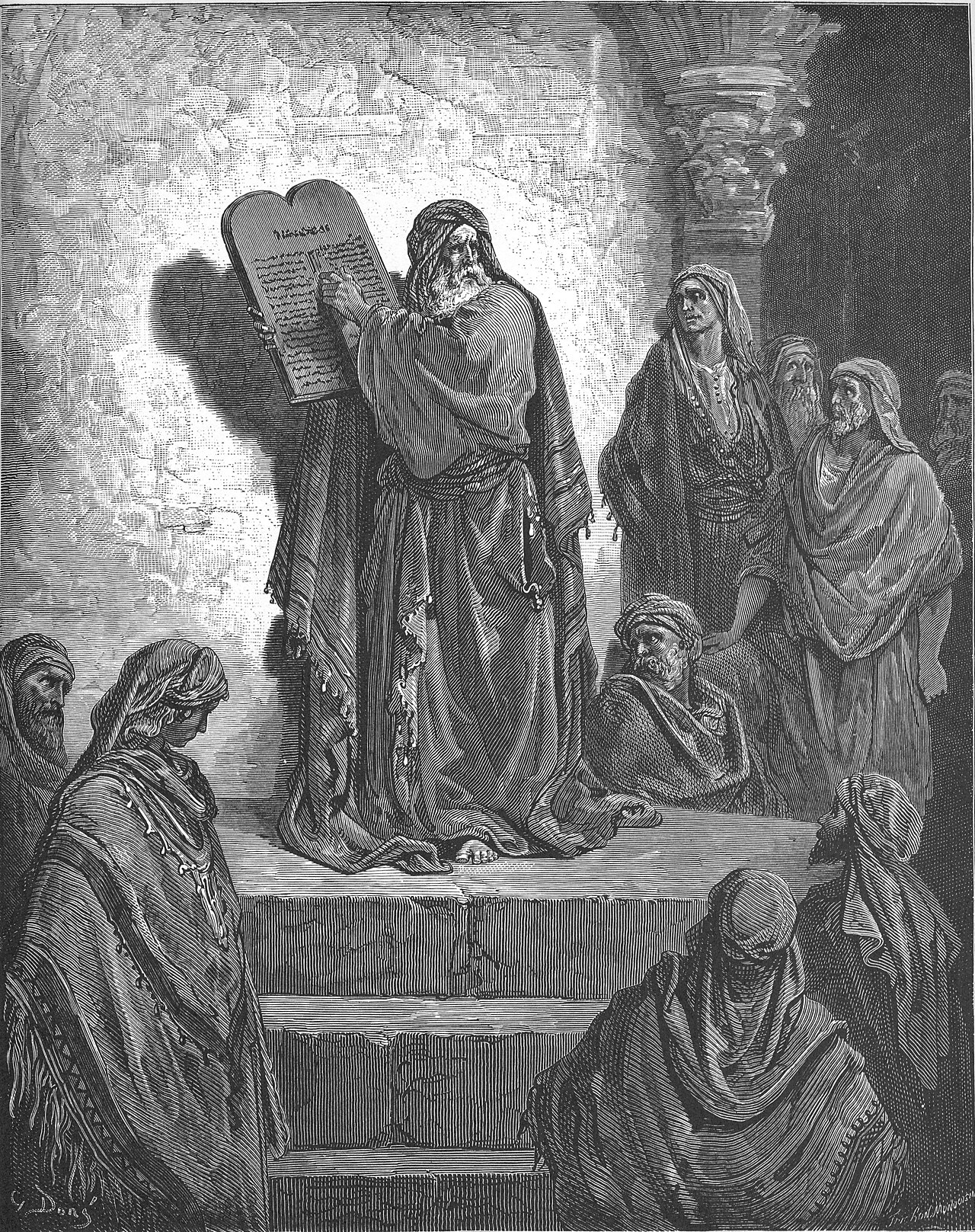
Ezra Reads the Law to the People, Gustave Doré, Doré's English Bible (1866), public domain
Key verse
And all the people gathered themselves together as one man into the street that was before the water gate; and they spake unto Ezra the scribe to bring the book of the law of Moses, which the Lord had commanded to Israel.
It stands in scene A of the chapter, verses 1 to 8.
The chapter
Chapter summary
The book comes out in public. All the people gather as one man into the broad place before the water gate and ask Ezra for the book of the law of Moses; he reads from early morning until midday before men, women, 'and all that could hear with understanding,' and the ears of all the people were attentive. He stands on a pulpit of wood; when he opens the book the people stand, answer 'Amen, Amen' with lifted hands, and bow their faces to the ground. The Levites 'gave the sense, so that they understood the reading.' The people weep, and are told, 'the joy of Jehovah is your strength.' They find the feast of booths written, and keep it with very great gladness.
Context
History · Nehemiah · Nehemiah overview
Where the chapter sits
Nehemiah 8 falls in Covenant renewal under Ezra's teaching (chapters 8–10). Ezra reads the Law at the Water Gate; ‘so they read … distinctly, and gave the sense’ (8:8); the Feast of Tabernacles kept; covenant formally renewed and signed.
The Law read at the Water Gate. Ezra reads; the Levites interpret; the people weep and then rejoice.
Before it: Rebuilding the walls, chapters 1–7. After it: Organizing the restored community; second reform, chapters 11–13.
The whole shape of Nehemiah→The world behind this chapter
Nehemiah 8The history
The people asked for this. They told Ezra to bring the book of the law of Moses, and he read from morning until midday to a congregation that stood the whole time. A purpose-built wooden pulpit was set up with named men on either side, this is the earliest clear picture in Scripture of a public reading with a platform, and it is the ancestor of the synagogue service.
The rest of the history, and what it meant to them
The Levites' role is the interesting part: they "read in the book… distinctly, and gave the sense, and caused them to understand the reading." After generations in Babylonia, everyday speech was Aramaic, and the Hebrew Scriptures needed rendering and explaining as they were read. That practice grew into the Aramaic paraphrases later written down as the Targums.
Then they find, in the reading, that Israel should live in booths during the seventh-month feast, and they go out for olive, myrtle and palm branches and build shelters on their roofs and in the courts and squares. The text says it had not been kept like that since the days of Joshua.
What it meant to them
The people wept when they heard the law, and were told not to. "This day is holy unto the Lord your God; mourn not, nor weep… neither be ye sorry; for the joy of the Lord is your strength." They were sent home to eat the fat and drink the sweet and send portions to those who had nothing prepared.
That is the shape of the whole chapter: understanding first, then grief, then feasting. And the joy was ordered, a community that had just heard how far short it fell was commanded to celebrate.
Sources cited
- Alfred Edersheim, The Temple: Its Ministry and Services (public domain)
- Alfred Edersheim, Bible History: Old Testament (public domain)
- K. A. Kitchen, On the Reliability of the Old Testament
A. From morning until midday, and the people gave attentive ear
1. (vv. 1-3)
Nehemiah 8:1, 1 voiceWhat preachers and commentators have said about this verse, in their own words.
Nehemiah 8:1
“The street - Rather, “the square” or “court.” So in Neh 8:16 (compare Ezr 10:9). The court seems to have been one between the eastern gate of the temple and the watergate in the city-wall. It would thus lie within the modern Haram area. Ezra the scribe - This is the first mention of Ezra in the present book, and the first proof we have had that he was contemporary with Nehemiah.”
Nehemiah 8:2, 1 voice
Nehemiah 8:2
“First day - This was the feast of trumpets, which is called a sabbath, and on which they were to have an holy convocation, Lev. xxiii, 24. And it was on this day, the altar was set up, after their return from captivity; in remembrance of which they had probably kept it ever since, with more than ordinary solemnity.”
John Wesley· Explanatory Notes upon the Old Testament (1765)evangelical
a.to bring the book of the law of Moses: The demand comes from below: the people gather as one man and ask Ezra to bring the book, and he reads from morning until midday to men, women and all that could hear with understanding, and the ears of all the people were attentive. The date is the first day of the seventh month, the feast of trumpets of Lev 23:24, so the reading itself is the day's trumpet. The wall was finished six days earlier at 6:15; the first public act inside it is Scripture read aloud.
2. (vv. 4-6)
Nehemiah 8:4, 3 voices
Nehemiah 8:4
“Ezra the scribe stood upon a wooden platform, etc. This place seems to be remembered in the Scripture of Chronicles, where it is said: Solomon stood before the altar of the Lord, facing the multitude of Israel, and stretched out his hands. For Solomon had …”
Bede· written before 735· Commentary on Ezra and Nehemiahpatristic
Nehemiah 8:4
“Stood upon a pulpit of wood - מגדל migdal, a tower, a platform, raised up for the purpose, to elevate him sufficiently for the people both to see and hear him; for it is said, Neh 8:5, that he was above all the people. This is the first intimation we have of a pulpit, or structure of this kind.”
Adam Clarke· Commentary on the Bible (1810-1826)evangelical
Nehemiah 8:4
“Ezra . . . stood upon a pulpit of wood--Not made in the form known to us, but only a raised scaffold or platform, broad enough to allow fourteen persons to stand with ease upon it. Ezra's duty was very laborious, as he continued reading aloud from morning until midday, but his labor was lightened by the aid of the other priests present.”
Jamieson, Fausset & Brown· Commentary Critical and Explanatory on the Whole Bible (1871)reformed
Nehemiah 8:5, 1 voice
Nehemiah 8:5
“Stood up - The attitude of attention and respect. Compare the existing practice of the Christian Church at the reading of the Gospel for the day.”
Nehemiah 8:6, 1 voice
Nehemiah 8:6
“Ezra blessed the Lord - In imitation of this, we say, when the gospel for the day is commenced, Glory be to God for his holy Gospel! and conclude this thanksgiving with, Amen.”
Adam Clarke· Commentary on the Bible (1810-1826)evangelical
a.a pulpit of wood: The pulpit of wood, made for the purpose, is the first in Scripture, built so that the book could be seen and heard by a street full of people. When Ezra opens the book all the people stand up, and the blessing is answered with Amen, Amen, lifted hands, and faces to the ground: a whole liturgy of the word in two verses, reverence bracketing reading. Thirteen named men stand beside him, the ministry of the book already a shared office.
3. (vv. 7-8)
Nehemiah 8:7, 3 voices
Nehemiah 8:7
“The names here (and in Neh 9:4, Neh 9:5; Neh 10:9) seem not to be the personal appellations of individuals, but rather designations of Levitical families, the descendants respectively of Jeshua, etc., who lived not later than the time of Zerubbabel Neh 7:43; Neh 12:8.”
Nehemiah 8:7
“Understand - As well the words, which being Hebrew, now needed to be translated into the Chaldee or Syriack language, now, the common language of that people, who together with their religion, had also in a great part lost their language; as also the meaning of them: they expounded the mind and will of God in what they read, and applied it to the peoples present condition.”
John Wesley· Explanatory Notes upon the Old Testament (1765)evangelical
Nehemiah 8:7
“Of these also there were thirteen priests, whose lips were to keep knowledge, Mal. ii. It is a great mercy to a people thus to be furnished with ministers that are apt to teach. Happy was Ezra in having such assistants as these, and happy were they in having such a guide as Ezra.”
Matthew Henry· Commentary on the Whole Bible (1707-1721)puritan
Nehemiah 8:8, 2 voices
Nehemiah 8:8
“They - Ezra and his companions successively. Sense - The meaning of the Hebrew words, which they expounded in the common language. Thy gave - So they gave them both a translation of the Hebrew words into the Chaldee, and an exposition of the things contained in them.”
John Wesley· Explanatory Notes upon the Old Testament (1765)evangelical
Nehemiah 8:8
“Let those that read and preach the word learn also to deliver themselves distinctly, as those who understand what they say and are affected with it themselves, and who desire that those they speak to may understand it, retain it, and be affected with it likewise. It is a snare for a man to devour that which is holy.”
Matthew Henry· Commentary on the Whole Bible (1707-1721)puritan
a.caused the people to understand the law: The Levites move among the standing people, and 8:8 states the method in the sentence that occurs nowhere else in Scripture: they read distinctly, and GAVE THE SENSE, and caused them to understand the reading. The readings on what giving the sense meant are named: rabbinic tradition, dated to the Talmudic era, places the origin of the Aramaic Targum in this verse, translation for a people whose tongue had shifted in Babylon, while the bench reads exposition, explanation added to reading; both may be true at once and neither is settled here. Reading plus explanation to the assembly is the shape the synagogue service and the expository sermon descend from, a legacy the commentators draw and name as theirs.
B. This day is holy: the joy of the LORD is your strength
1. (vv. 9-10)
Nehemiah 8:9, 3 voices
Nehemiah 8:9
"But all the people wept when they heard the words of the law." For the same holy teachers, who stir the minds of their hearers to tears with sacred readings and devout exhortations, also console those tears by promising them the eternal joys to come. …
Bede· written before 735· Commentary on Ezra and Nehemiahpatristic
Nehemiah 8:9
“Nehemiah, which is the Tirshatha - Hereto, Nehemiah has called himself פחה pechâh Neh 5:14-15, Neh 5:18, which is the ordinary word for “governor.” Now for the first time he is called ‘the Tirshatha’” (see Ezr 2:63 note.) The people wept ... - Because the Law brought vividly before them their sins of omission and commission. In Neh 8:10 the Jews were not forbidden to be sorry for their sins, but they were only prohibited from marring a festive occasion with the expression of their sorrow.”
Nehemiah 8:9
“The masters of the assembly endeavoured to pacify them and encourage them. Now Nehemiah is brought in, and not before, in this chapter; he took notice of the people's weeping. Ezra was pleased to see them so affected with the word, but Nehemiah observed to him, and Ezra concurred in the thought, that it was now unseasonable.”
Matthew Henry· Commentary on the Whole Bible (1707-1721)puritan
Nehemiah 8:10, 1 voice
Nehemiah 8:10
“Eat the fat, and drink the sweet - Eat and drink the best that you have; and while ye are feeding yourselves in the fear of the Lord, remember those who cannot feast; and send portions to them, that the joy and the thanksgiving may be general. Let the poor have reason to rejoice as well as you.”
Adam Clarke· Commentary on the Bible (1810-1826)evangelical
a.mourn not, nor weep: The people weep at hearing the law, the first honest response of a generation measuring itself against the book, and the leaders forbid the grief: this day is holy, and holiness here commands a feast. The instruction has a social half, send portions unto them for whom nothing is prepared, so the joy is distributed before it is enjoyed. Then the sentence that occurs nowhere else in Scripture: THE JOY OF THE LORD IS YOUR STRENGTH, joy not as the reward of strength but as its source, and Spurgeon preached the text by that name.
2. (vv. 11-12)
Nehemiah 8:11, 2 voices
Nehemiah 8:11
“So the Levites stilled all the people,.... Made them quiet and easy, being backed by the governor: saying, hold your peace; refrain from weeping and mourning: for the day is holy; a festival, set apart for joy and gladness: neither be ye grieved; inwardly; as they were not to show any signs of sorrow outwardly, so they were not to cherish grief inwardly.”
Nehemiah 8:11
“Every thing is beautiful in its season; as we must not be merry when God calls to mourning, so we must not frighten and afflict ourselves when God gives us occasion to rejoice. Even sorrow for sin must not grow so excessive as to hinder our joy in God and our cheerfulness in his service.”
Matthew Henry· Commentary on the Whole Bible (1707-1721)puritan
a.Hold your peace: The Levites still the people as one quiets mourners, and the day turns to eating, drinking, sending portions and great mirth. The narrator gives the reason in the last clause: BECAUSE THEY HAD UNDERSTOOD the words that were declared unto them. Understanding is the ground of the joy, which is the whole chapter's argument in one subordinate clause.
C. Booths of olive and myrtle, a gladness unknown since Joshua
1. (vv. 13-15)
Nehemiah 8:14, 2 voices
Nehemiah 8:14
“And they found written in the law which the Lord had commanded by Moses,.... The children of Israel, to be observed by them; either by hearing it read the day before, or by conversation with Ezra, they perceived it was enjoined in the law, particularly in Lev 23:39 that the children of Israel should dwell in booths, in the feast of the seventh month: which was the same month, and this the second day of it, and therefore the time drew near for keeping it; for it was to begin the fifteenth.”
Nehemiah 8:14
“In the feast of the seventh month - That is, the feast of tabernacles, which was held in commemoration of the sojourning of their fathers in the wilderness after they had been delivered from the Egyptian bondage. Now, having been delivered from the Babylonish captivity, and the proper time of the year occurring, it was their especial duty to keep the same feast.”
Adam Clarke· Commentary on the Bible (1810-1826)evangelical
Nehemiah 8:15, 1 voice
Nehemiah 8:15
“The mount - The “mount of Olives” is probably intended. Pine branches - Rather, “branches of the wild olive.” The actual trees named by the Law may have become scarce. It was probably considered that the spirit of the command was kept if branches of trees similar in general character to those named in Leviticus were employed.”
a.on the second day: the leaders come back for more: the chief of the fathers, the priests and the Levites gather to Ezra, even to understand the words of the law, the teachers putting themselves under the book before they teach it. What they find written is the feast of booths, commanded by Moses and waiting in the text, and the proclamation goes out to fetch branches from the mount. Obedience here is discovered by reading, the pattern of Josiah's book repeated without a king.
2. (vv. 16-17)
Nehemiah 8:16, 1 voice
Nehemiah 8:16
“Upon the roof of his house - It need scarcely be repeated, that the houses in the East are generally built with flat roofs. On these they reposed; on these they took the air in the heats of summer; and on these they oftentimes slept.”
Adam Clarke· Commentary on the Bible (1810-1826)evangelical
Nehemiah 8:17, 1 voice
Nehemiah 8:17
“It is not the intention of the writer to state that the Feast of tabernacles had not been kept from the time of Joshua until this occasion (see 1Ki 8:2, 1Ki 8:65; Ezr 3:4); but that there had been no such celebration as this since Joshua’s time. Compare 2Ki 23:22; 2Ch 35:18.”
a.made themselves booths: Booths rise on roofs, in courts, in the courts of the house of God, in the street of the water gate: the city that just rebuilt its wall camps inside it in shelters of branches, acting out the wilderness in the middle of its achievement. The narrator's measure is verified against the floor: SINCE THE DAYS OF JESHUA THE SON OF NUN unto that day had not the children of Israel done so, a feast recovered across nine hundred years by reading the book, and there was very great gladness. The name is its own quiet echo, for the Jeshua of the return stands where Jeshua the son of Nun once stood.
3. (v. 18)
Nehemiah 8:18, 2 voices
Nehemiah 8:18
“Also day by day, from the first day unto the last day, he read in the book of the law of God,.... That is, Ezra; this was done by him every day during the feast, whereas only the first and last days were the holy convocations on which it seems to have been read: and they kept the feast seven days, and on the eighth day was a solemn assembly, according to the manner; prescribed in Lev 23:39.”
Nehemiah 8:18
“Also day by day . . . he read in the book of the law of God--This was more than was enjoined (De 31:10-12), and arose from the exuberant zeal of the time. on the eighth day was a solemn assembly--This was the last and great day of the feast (see on Nu 29:35).”
Jamieson, Fausset & Brown· Commentary Critical and Explanatory on the Whole Bible (1871)reformed
a.a solemn assembly: Day by day, from the first day unto the last, he read in the book of the law of God: the feast's seven days each carry their reading, and the eighth day closes with the solemn assembly according unto the manner, which is Lev 23:36 kept to the letter. The week that began with one morning's reading ends as a rhythm of daily Scripture, the recovered practice already becoming a habit.
The text of this chapter
This page carries no textual note on Nehemiah 8. Where this site has examined a place the manuscripts differ, the examination is in the manuscripts room. Every place this site examines →
This page draws on 11 works. Open for the list.
This page draws on Adam Clarke, Commentary on the Bible (1810-1826); Albert Barnes, Notes, Explanatory and Practical, on the Old and New Testaments (1832-1869); Alfred Edersheim, Bible History: Old Testament; Bede, Commentary on Ezra and Nehemiah; Charles Spurgeon, The Joy of the Lord, the Strength of His People (Metropolitan Tabernacle Pulpit, No. 1027); Jamieson, Fausset & Brown, Commentary Critical and Explanatory on the Whole Bible (1871); John Gill; John Wesley, Explanatory Notes upon the Old Testament (1765); Keil, The Books of Ezra, Nehemiah, and Esther; Matthew Henry and W. F. Adeney, Ezra, Nehemiah and Esther (Expositor's Bible).
Keep studying
On this page
Studies4
On this verse
On this chapter
On this book