
Nehemiahchapter 2
20 verses · Nehemiah · 5th century BC · History
Now in the month of Nisan, in the twentieth year of King Artaxerxes, when wine was set before him, I took the wine and gave it to the king. I had never been sad in his presence,
Introduction
Nehemiah, History, Nehemiah Overview.
Nehemiah tells this part of his story himself, four months after the prayer of the first chapter. He was a courtier who could lose his place, or his life, by a wrong expression in front of the king. His hearers were a community that had seen every earlier building effort in Jerusalem stopped by its neighbours. The chapter moves from a royal palace to a ruined city in the dark. Listen for how he prays and plans at the same moment, and for the names of the men who oppose him from the first day. Those three names return through the rest of the book.
Context
- Who
- A community that had learned to expect its building projects to be stopped
- What
- Nehemiah's request to the king, his travel to Jerusalem with royal letters, his night survey of the walls, and his call to the people to build.
- Where
- The king's table at Susa, the province Beyond the River, and the ruined walls and gates of Jerusalem.
- When
- The month of Nisan in the twentieth year of Artaxerxes I, about April 445 BC, with the travel to Jerusalem in the months after.
- Why
- To show that the work was authorised by the king, carried out by God's gracious hand, and opposed from the start.
Historical context
A cupbearer was not a waiter. He tasted the king's wine against poison, which meant the king trusted him with his life and saw him daily, a position of real access held by trusted courtiers. Persian court protocol also required a serene face before the king; showing grief in the royal presence was a serious breach, which is why Nehemiah says he was very sore afraid.
Show the rest of the historical context, 2 more paragraphs
What he asks for is a package: leave, safe-conduct letters to the governors of Beyond the River, and timber from the keeper of the king's forest, named as Asaph. Royal estates and managed woodland were a normal part of Persian provincial holdings. He is also given army officers and horsemen, the escort Ezra had been ashamed to request.
The opponents appear immediately and by name: Sanballat the Horonite, Tobiah the Ammonite official, and later Geshem the Arabian. All three are more than literary figures. A Jewish letter from the garrison at Elephantine in Egypt refers to the sons of Sanballat, governor of Samaria, and an inscribed silver bowl from Egypt names a king of Qedar called Geshem.
Significance
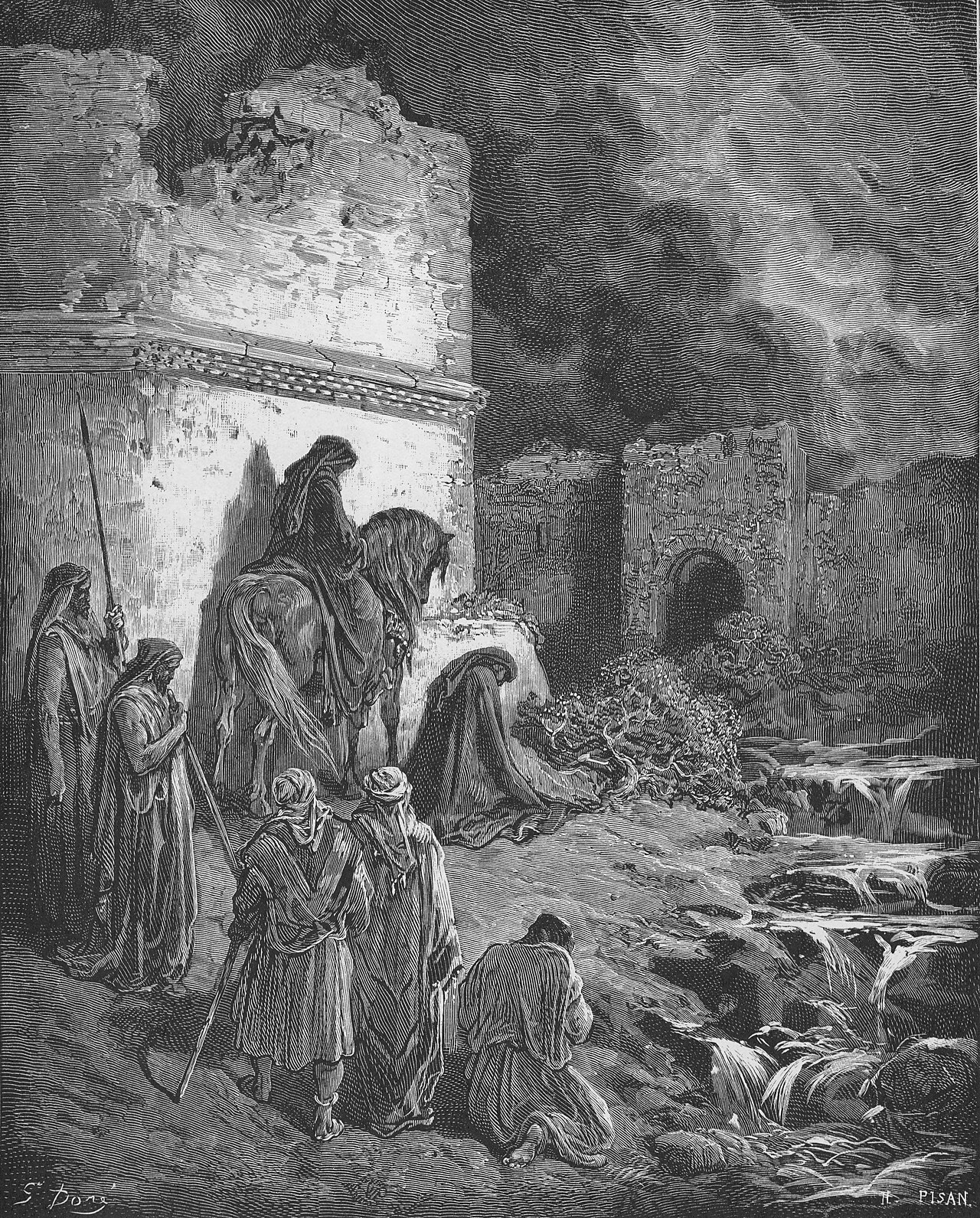
Nehemiah's first act in Jerusalem is to tell nobody. He rides out at night with a few men, inspects the broken walls and burned gates, and in places the rubble is too deep for the animal to pass. Then he speaks.
Show the rest of the significance, 1 more paragraph
His pitch is short and includes himself: "Ye see the distress that we are in… come, and let us build up the wall of Jerusalem, that we be no more a reproach." The reproach was the point. A city without walls was a city anyone could enter and nobody respected.
This chapter in Jewish lifeWhat this chapter is in Jewish life and reading.
What is done
This chapter has no place in the synagogue year. The site's own table in src/lib/hebraic/readings.ts printed parashot total 0 and haftarah uses total 0 for Nehemiah, and no festival reading.
Its first verse is met with the first verse of the book, in the discussion of the new year for kings. The corpus sets under it Rosh Hashanah 3a:3, 3a:14, 3b:1, 3b:4 and 3b:5, with the Jerusalem Talmud at Rosh Hashanah 1:1:3 and 1:2:2. Under the sixth verse, where Rashi reads Nehemiah as giving the king a time of return (Rashi on Nehemiah 2:6:6), it sets Rosh Hashanah 4a:1 and 4a:6 with Ein Yaakov, Rosh Hashanah 1:3. The month of Nisan in this verse and the month of Kislev in the first chapter are the two dates that discussion weighs.
How it is read
Rashi is the one commentator on this chapter whose English the corpus carries, quoted here from The Judaica Press complete Tanach with Rashi, translated by A. J. Rosenberg, which Sefaria reports as CC-BY. He names the king at once. Artaxerxes is Darius, called so because of his kingship (Rashi on Nehemiah 2:1:1). The king's question about Nehemiah's face Rashi reads as suspicion of the cupbearer. "This incident is only wickedness of heart, that you have in your heart to put me to death by poisoning this cup." (Rashi on Nehemiah 2:2:2). Nehemiah's answer names Jerusalem as the place of the graves of his fathers (Rashi on Nehemiah 2:3:2).
The prayer between the king's question and Nehemiah's reply Rashi takes as a prayer said before the king. He gives it words, asking the God of heaven to fulfil the petition (Rashi on Nehemiah 2:4:2). The letters from the king were given to the governors so that they would escort him in peace (Rashi on Nehemiah 2:9:1).
The night ride around the walls carries the one reading in the chapter a reader is unlikely to meet elsewhere. Rashi says the men with Nehemiah went on foot so that they could leave the city in secret. He then reports what he takes them to have done. "They went to break and cast down the walls of the city at night and to increase their breaches in order that on the morrow, the people of the city would be eager and agree unanimously with Nehemiah to build the walls of the city." He marks it as his reading of the text rather than a tradition he received, closing with the words so it appears from the text (Rashi on Nehemiah 2:12:1). He carries the same reading through the next three verses, where the burned wall was easily cast down (Rashi on Nehemiah 2:13:1, 2:14:1 and 2:15:1).
The opposition is read plainly. Sanballat and his companions were displeased because they were the adversaries of Judah and Benjamin (Rashi on Nehemiah 2:10:1). Nehemiah's last word to them Rashi paraphrases as a refusal of any part in the building, since they had no share in the city (Rashi on Nehemiah 2:20:1).
What the rabbis say
The corpus carries twenty-four rabbinic locators on this chapter and the text of none, so each is cited and linked here rather than quoted. On the first verse it holds Ein Yaakov, Rosh Hashanah 1:2, Jerusalem Talmud Rosh Hashanah 1:1:3, Jerusalem Talmud Rosh Hashanah 1:2:2, Rosh Hashanah 3a:14, Rosh Hashanah 3a:3, Rosh Hashanah 3b:1, Rosh Hashanah 3b:4, Rosh Hashanah 3b:4-5 and Rosh Hashanah 3b:5. On the second it holds Midrash Lekach Tov, Genesis 40:7:1 and Pirkei DeRabbi Eliezer 38:3. On the third it holds Otzar Midrashim, Midrash on the Ten Kings 1:11.
On the fourth verse the corpus holds Rosh Hashanah 3b:6. On the sixth it holds Ein Yaakov, Rosh Hashanah 1:3, Rosh Hashanah 4a:1 and Rosh Hashanah 4a:6. On the eighth it holds Arakhin 6a:4. On the tenth it holds Kiddushin 70a:3.
On the thirteenth verse the corpus holds Tractate Soferim 7:3. On the fifteenth it holds Introductions to Amoraic Literature, Part II (Notes and Interpretations for Chapters of the Talmud), Baba Batra, Chapter III 33. On the nineteenth it holds Ein Yaakov, Kiddushin 4:2. On the twentieth it holds Jerusalem Talmud Shekalim 1:4:5, Midrash Tanchuma, Vayeshev 2:15 and Pirkei DeRabbi Eliezer 38:25. What each of them teaches is a saying of the rabbis, and is reported as theirs wherever this site quotes one. The quotations wait on a fetch that carries the text.
Sources: Rashi, Rashi on Nehemiah 2:1:1 to 2:20:1, The Judaica Press complete Tanach with Rashi, translated by A. J. Rosenberg, reported CC-BY; The Sefaria corpus, scripts/data/sources/sefaria/nehemiah/2.json, the 24 Talmud and Midrash locators of this chapter; The site's own files, src/lib/hebraic/readings.ts, printing no portion, no Haftarah and no festival reading for this book.
The heads below are this chapter's scenes. The numbered points under each are its verses.
A sad face before the king, and a prayer between two sentences
Nehemiah 2:1-2
in the twentieth year of King Artaxerxes: Four months pass between the news in Chislev and the wine Nehemiah sets before the king in Nisan. The king reads the change: "This could only be sadness of the heart" (2:2). Nehemiah is "overwhelmed with fear," since a sad face before a Persian king was itself a danger.
Nehemiah 2:1
“Nisan was the name given by the Persian Jews to the month previously called “Abib,” the first month of the Jewish year, or that which followed the vernal equinox. It fell four months after Chisleu Neh 1:1. The twentieth year - As Artaxerxes ascended the throne in 465 B.C., his 20th year would correspond to 445-444 B.C.”
1 more voice on this verseWhat preachers and commentators have said about this verse, in their own words.
Nehemiah 2:1
“The reasons for so long a delay cannot be ascertained. I took up the wine, and gave it unto the king--XENOPHON has particularly remarked about the polished and graceful manner in which the cupbearers of the Median, and consequently the Persian, monarchs performed their duty of presenting the wine to their royal master.”
Jamieson, Fausset & Brown · Commentary Critical and Explanatory on the Whole Bible (1871)reformed
Wesley traces the sad face to fasting and grief, and adds a second fear, that the request was great and would offend his officials. Clarke reads the king's question as a hint of suspicion. A sad servant before the king could look like a man hiding a plot.
Nehemiah 2:2
“Sad - His fasting joined with inward grief had made a sensible change in his countenance. Afraid - It was an unusual and ungrateful thing to come into the king of Persia's presence with any token of sorrow. And he feared a disappointment, because his request was great and invidious, and odious to most of the Persian courtiers.”
John Wesley · Explanatory Notes upon the Old Testament (1765)evangelical
1 more voice on this verse
Nehemiah 2:2
“Then I was very sore afraid - Probably the king spoke as if he had some suspicion that Nehemiah harboured some bad design, and that his face indicated some conceived treachery or remorse.”
Adam Clarke · Commentary on the Bible (1810-1826)evangelical
the city where my fathers are buried: Nehemiah answers with a courtier's blessing, "May the king live forever!" He names the cause, "the city where my fathers are buried lies in ruins, and its gates have been destroyed by fire" (2:3). Ancient peoples treated tombs as sacred ground, so naming the graves reached the king.
I prayed to the God of heaven: Between the king's question and Nehemiah's answer falls the shortest prayer in Scripture: "So I prayed to the God of heaven" (2:4). The prayer is made while the king still waits for an answer. The title "the God of heaven" was the Persian court's own name for God.
Nehemiah 2:4
“So I prayed to the God of heaven - Before he dared to prefer his request to the king, he made his prayer to God, that his suit might be acceptable: and this he does by mental prayer. To the spirit of prayer every place is a praying place.”
Adam Clarke · Commentary on the Bible (1810-1826)evangelical
1 more voice on this verse
Nehemiah 2:4
“Nehemiah had made inquiry as to the state of the city of Jerusalem and the tidings he heard caused him bitter grief. "Why should not my countenance be sad," he said, "when the city, the place of my fathers' sepulchers, lies waste and the gates thereof are consumed with fire?" He could not endure that it should be a mere ruinous heap—that city which was once beautiful and the joy of the whole earth!”
Nehemiah 2:5-6
if your servant has found favor in your sight: Nehemiah asks that the king send him to Judah, and he frames the whole request as a matter of the king's favor. The king asks when Nehemiah will return, so what is granted is leave with a term attached. The queen sits beside him.
Nehemiah 2:5
“The city of my fathers’ sepulchres - The tombs of the dead were sacred among the ancients, and nothing could appear to them more detestable than disturbing the ashes or remains of the dead. Nehemiah knew that in mentioning this circumstance he should strongly interest the feelings of the Persian king.”
Adam Clarke · Commentary on the Bible (1810-1826)evangelical
1 more voice on this verse
Nehemiah 2:5
“He asked for a commission to go as governor to Judah, to build the wall of Jerusalem, and to stay there for a certain time, so many months, we may suppose; and then either he had his commission renewed or went back and was sent again, so that he presided there twelve years at least, ch.”
Matthew Henry · Commentary on the Whole Bible (1707-1721)puritan
with the queen seated beside him: Wesley notes that Persian kings ate alone, so the queen seated beside the king marks an unusual occasion, and she may have helped the request. Clarke denies that she was Esther. The time set was short, though Nehemiah 5:14 later counts twelve years as governor.
Nehemiah 2:6
“I set him a time--Considering the great despatch made in raising the walls, it is probable that this leave of absence was limited at first to a year or six months, after which he returned to his duties in Shushan.”
Jamieson, Fausset & Brown · Commentary Critical and Explanatory on the Whole Bible (1871)reformed
2 more voices on this verse
Nehemiah 2:6
“The queen - Which is here noted, as an unusual thing; for commonly the kings of Persia dined alone, and perhaps because the queen expressed some kindness to him, and promoted his request. How long - This question shewed the king's affection to him, and that he was not willing to want his attendance longer than was necessary.”
John Wesley · Explanatory Notes upon the Old Testament (1765)evangelical
Nehemiah 2:6
“The queen also sitting by him - Who probably forwarded his suit. This was not Esther, as Dean Prideaux supposes, nor perhaps the same Artaxerxes who had taken her to be queen; nor does שגל shegal signify queen, but rather harlot or concubine, she who was chief favourite. The Septuagint translate it παλλακη, harlot; and properly too. See the introduction.”
Adam Clarke · Commentary on the Bible (1810-1826)evangelical
Nehemiah 2:7-9
may letters be given to me: Nehemiah asks for two kinds of paper. Letters "for the governors west of the Euphrates" grant safe passage, and a letter to Asaph, "keeper of the king’s forest," secures timber. The king grants it all, and Nehemiah names the reason: "the gracious hand of my God was upon me" (2:8).
Nehemiah 2:7
“Moreover, I said unto the king, let letters be given me to the governors beyond the river,.... The river of Euphrates, on that side of it towards the land of Judea: that they may convey me over till I come into Judah; furnish him with provisions, and a guard to protect him.”
Asaph, keeper of the king’s forest: The word for forest is pardes, which Clarke traces to a Persian term for a pleasure garden, the source of the Greek word paradise. Wesley places the king's forest in Lebanon. The timber would make beams for the citadel gates, the city wall, and the house Nehemiah would occupy.
Nehemiah 2:8
“Asaph the keeper of the king’s forest - הפרדס hapardes of the paradise of the king. This I believe is originally a Persian word; it frequently occurs in Arabic, ferdoos, and in Greek, παραδεισος, and in both signifies a pleasant garden, vineyard, pleasure garden, and what we call a paradise.”
Adam Clarke · Commentary on the Bible (1810-1826)evangelical
2 more voices on this verse
Nehemiah 2:8
“King's forest - Of the forest of Lebanon, famous for choice trees. Palace - Of the king's palace, which was adjoining to the house of God. Enter - That I shall build to dwell in while I am there.”
John Wesley · Explanatory Notes upon the Old Testament (1765)evangelical
Nehemiah 2:8
“Here was an immediate answer to his prayer; for the seed of Jacob never sought the God of Jacob in vain. In the account he gives of the success of his petition he takes notice, 1.”
Matthew Henry · Commentary on the Whole Bible (1707-1721)puritan
Riding the ruins by night and telling no one
gave them the king’s letters: Gill leaves open whether these governors west of the Euphrates were Tattenai and Shethar-bozenai of Ezra 5. The letters opened their provinces to the king's servant. In Gill's reading the officers and cavalry served his honour as well as his safety, and handed him on to the governors.
Nehemiah 2:9
“Then I came to the governors beyond the river,.... Who these governors were, whether the same who were in the second year of this king's reign eighteen years ago, Tatnai and Shetharboznai, is not certain: now the king had sent captains of the army and horsemen with me; both to do him honour, and for his safety; and coming thus attended, must serve to recommend him to the governor, who received him from them at the river Euphrates, and conducted him to Judah.”
they were deeply disturbed: Sanballat the Horonite and Tobiah the Ammonite enter the story here, "deeply disturbed that someone had come to seek the well-being of the Israelites" (2:10). Both men held standing under Persia, Sanballat likely governing Samaria and Tobiah risen to office in Ammon, so the opposition starts from seated power.
Nehemiah 2:10
“When Sanballat the Horonite,.... Who either presided at Horonaim, or sprung from thence, a city of Moab, Isa 15:5 and Tobiah the servant, the Ammonite; who was formerly a slave, but now raised, from a low mean estate, to be governor in the land of Ammon, though still a vassal of the king of Persia: heard of it, it grieved them exceedingly that there came a man to seek the welfare of the children of Israel; to which the Moabites and Ammonites were always averse, and ever bore an hatred to Israel, and envied everything that tended to their happiness.”
1 more voice on this verse
Nehemiah 2:10
“Sanballat the Horonite - Probably a native of Horonaim, a Moabite by birth, and at this time governor of the Samaritans under the king of Persia. Tobiah the servant - He was an Ammonite; and here, under the Persian king, joint governor with Sanballat. Some suppose that the Sanballat here mentioned was the same who persuaded Alexander to build a temple on Mount Gerizim in favor of the Samaritans. Pelagius thinks there were two governors of this name.”
Adam Clarke · Commentary on the Bible (1810-1826)evangelical
Nehemiah 2:11-12
had been there three days: Nehemiah rests three days before he moves, the same pause Ezra took on arrival at Jerusalem (Ezra 8:32). Then he sets out "at night with a few men" and tells no one. He surveys the field before any building begins, the counting of the cost the Lord would later teach.
Nehemiah 2:11
“So I came to Jerusalem, and was there three days. Before he entered on any business, resting himself from the fatigue of the journey, and receiving the visits of his friends, as Ezra before him did, Ezr 8:32.”
I set out at night: Only one animal went, and Nehemiah rode it. Matthew Henry observes that men who bring the greatest good often come without show or noise. The plan was God's gift to Nehemiah's heart, and he kept it there until the survey of the wall was done.
Nehemiah 2:12
“Wise men, and those who are worthy of double honour, yet covet not to come with observation, to make a show, or make a noise, no, not when they come with the greatest blessings. Those that shortly are to have the dominion in the morning the world now knows not, but they lie hid, 1 John iii.”
Matthew Henry · Commentary on the Whole Bible (1707-1721)puritan
1 more voice on this verse
Nehemiah 2:12
“NEHEMIAH, it seems, prepared himself for action by taking a survey of the necessities of the case. Although he lived before our Savior's day, he certainly acted upon one of our Savior's maxims about counting the cost, lest, after having begun to build, we should not be able to finish.”
Charles Spurgeon · written before 1892 · The Metropolitan Tabernacle Pulpit, Sermon No. 3364: “Surveying the Field” (lightly modernized text, CCEL edition)Particular Baptist
Nehemiah 2:13-16
toward the Well of the Serpent: The night ride runs the city's edge by name, out through "the Valley Gate toward the Well of the Serpent and the Dung Gate" (2:13). He goes up the valley, inspects the wall and reenters by the Valley Gate. He tells the officials, priests and nobles nothing yet.
Nehemiah 2:13
“I went out by night by the gate of the valley--that is, the Jaffa gate, near the tower of Hippicus. even before the dragon well--that is, fountain on the opposite side of the valley. and to the dung port--the gate on the east of the city, through which there ran a common sewer to the brook Kedron and the valley of Hinnom.”
Jamieson, Fausset & Brown · Commentary Critical and Explanatory on the Whole Bible (1871)reformed
1 more voice on this verse
Nehemiah 2:13
“The gate of the valley - A gate opening on the valley of Hinnom, which skirted Jerusalem to the west and south. The exact position is uncertain; as is also that of “the dragon well.” The dung port - The gate by which offal and excrements were conveyed out of the city, and placed eastward of the valley-gate.”
the Fountain Gate and the King’s Pool: Clarke places the Fountain Gate at Siloam and takes the King's Pool as the work of King Hezekiah, who brought the waters into the city. Jamieson, Fausset and Brown picture water in the pool and rubble around it. The way was closed to the animal.
Nehemiah 2:14
“I went on to the gate of the fountain--that is, Siloah, from which turning round the fount of Ophel. to the king's pool: but there was no place for the beast that was under me to pass--that is, by the sides of this pool (Solomon's) there being water in the pool, and too much rubbish about it to permit the passage of the beast.”
Jamieson, Fausset & Brown · Commentary Critical and Explanatory on the Whole Bible (1871)reformed
2 more voices on this verse
Nehemiah 2:14
“Then I went on to the pool of the fountain, and to the king's pool..... That led to the fountain Siloah or Gihon, so called; it was the way to the potter's field, to Bethlehem, Hebron, Gaza, and Egypt.”
Nehemiah 2:14
“The gate of the fountain - Of Siloah. The king’s pool - Probably the aqueduct made by Hezekiah, to bring the waters of Gihon to the city of David. See 2Ch 32:30.”
Adam Clarke · Commentary on the Bible (1810-1826)evangelical
so I went up the valley by night: The valley is the Kidron on the east of the city, as Barnes explains. Barnes has Nehemiah go on around the wall and come back, while Gill thinks the ruined wall forced him back the way he went out. Both readings end where the night began.
Nehemiah 2:15
“Then went I up in the night by the brook,.... The brook Kidron: and viewed the wall; that was on that side: and turned back; did not go quite round the wall, the way perhaps being obstructed with rubbish, and was unpassable or he had not time to do it: and entered by the gate of the valley, and so returned; into the city, the same way he went out of it, Neh 2:13.”
1 more voice on this verse
Nehemiah 2:15
“The brook - The Kidron watercourse, which skirted the city on the east. Turned back - i. e. he turned westward, and having made the circuit of the city, re-entered by the valley-gate.”
The officials did not know where: Clarke explains the silence as a guard against the enemies of verse 10, who would have moved to stop the work. The list of those who had not been told runs from Jews and priests to nobles and officials. Chapter 3 names priests and officials among the workers.
Nehemiah 2:16
“The rulers knew not whither I went - He made no person privy to his design, that he might hide every thing as much as possible from their enemies till he had all things in readiness; lest they should take measures to defeat the work.”
Adam Clarke · Commentary on the Bible (1810-1826)evangelical
Let us rise and build: the God of heaven will prosper us
Nehemiah 2:17-18
let us rebuild the wall of Jerusalem: Nehemiah names the distress before the plan: "Come, let us rebuild the wall of Jerusalem, so that we will no longer be a disgrace" (2:17). He gives the grounds after the ask, "the gracious hand of my God upon me" and what the king had said.
Nehemiah 2:17
“Then said I unto them,.... The priests and princes of the Jews: you see the distress that we are in; lie open to our enemies, and exposed to their insults: how Jerusalem lieth waste, and the gates thereof are burnt with fire, Neh 1:3, come, and let us build up the wall of Jerusalem that we be no more a reproach; to their neighbours about them, who scoffed at them as a defenceless people and frequently came in upon them, and spoiled and plundered them of their goods and substance.”
they set their hands to this good work: John Wesley reads the people's reply as resolve to see the work through, and the strengthened hands as their own and one another's. They had two grounds, God's hand and the king's word.
Nehemiah 2:18
“Rise up - Let us do it with vigour, and diligence, and resolution, as those that are determined to go through with it. Their hands - Their own and one anothers.”
John Wesley · Explanatory Notes upon the Old Testament (1765)evangelical
Nehemiah 2:19-20
they mocked us and ridiculed us: Geshem the Arab stands with Sanballat and Tobiah. Nehemiah answers, "The God of heaven is the One who will grant us success," and denies them any "portion, right, or claim in Jerusalem" (2:20). Wesley reads the three words as no claim by birth, religion or kindness done.
Nehemiah 2:19
“Geshem the Arabian - The discovery that Sargon populated Samaria in part with an Arab colony explains why Arabs should have opposed the fortification of Jerusalem.”
1 more voice on this verse
Nehemiah 2:19
“They represented the undertaking also as a wicked thing, no better than treason: Will you rebel against the king? Because this was the old invidious charge, though now they had a commission from the king and were taken under his protection, yet still they must be called rebels. [2.] See also with what good reason the Jews slighted these discouragements.”
Matthew Henry · Commentary on the Whole Bible (1707-1721)puritan
Nehemiah answers the charge of rebelling against the king by naming the God of heaven. Clarke notes that to be a citizen of Jerusalem was a high honour kept for the tribes, and the three denials shut these officials out. The builders are His servants.
Nehemiah 2:20
“Ye have no portion, nor right - To be a citizen of Jerusalem was a high honor; and they would not permit those who did not belong to the tribes of Israel to dwell there. Zerubbabel gave the same answer to the Samaritans, Ezr 4:3.”
Adam Clarke · Commentary on the Bible (1810-1826)evangelical
1 more voice on this verse
Nehemiah 2:20
“No portion - You have no authority over us, nor interest in our church and state, but are aliens from the common-wealth of Israel. Memorial - No testimony, or monument, either of your relation to us by birth or religion, or of your kindness to us, or to this place.”
John Wesley · Explanatory Notes upon the Old Testament (1765)evangelical
Keep studying
Places1
Sources for this chapter
The summary
Jamieson, Fausset & Brown, Commentary Critical and Explanatory; John Wesley, Notes on the Old Testament and Matthew Henry, Complete Commentary.
The context
C. F. Keil, The Books of Ezra, Nehemiah, and Esther and Matthew Henry, Commentary on the Whole Bible.
The exposition
Adam Clarke, Commentary on the Bible; Albert Barnes, Notes, Explanatory and Practical, on the Old and New Testaments (1832-1869); Charles Spurgeon; Jamieson Fausset and Brown, Commentary Critical and Explanatory on the Whole Bible; Jamieson, Fausset & Brown, Commentary Critical and Explanatory on the Whole Bible; John Gill; John Wesley, Explanatory Notes upon the Old Testament; Keil, The Books of Ezra, Nehemiah, and Esther and Matthew Henry, Commentary on the Whole Bible.