
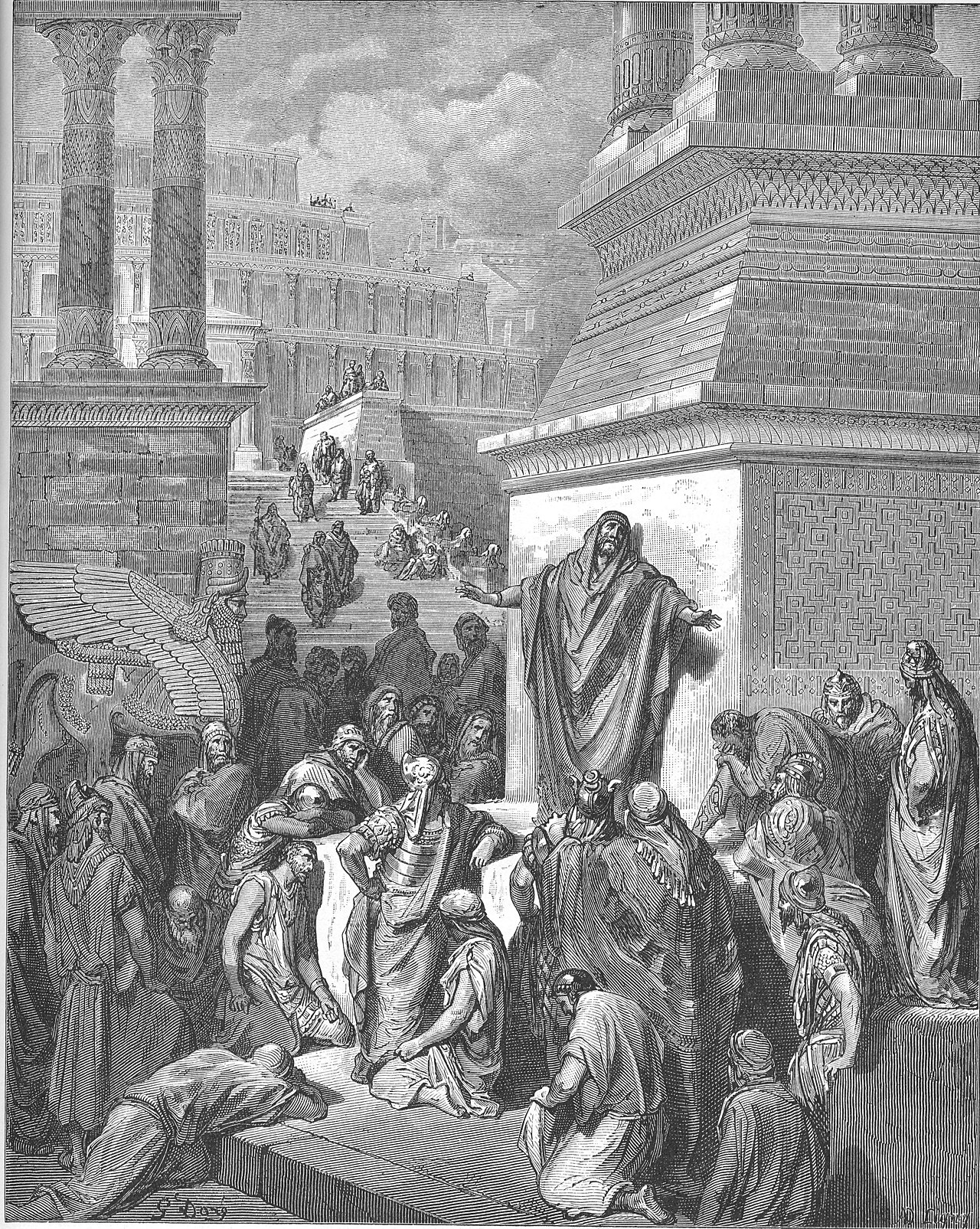
Jonahchapter 4
11 verses · Jonah, by tradition · 8th century BC · The Twelve
So he prayed to the LORD, saying, “O LORD, is this not what I said while I was still in my own country? This is why I was so quick to flee toward Tarshish. I knew that You are a gracious and compassionate God, slow to anger, abounding in loving devotion—One who relents from sending disaster.
Introduction
Jonah, by tradition, The Twelve, Jonah Overview.
This chapter closes the book, and it closes it on a question from God. The prophet has done what he was sent to do, and he is not glad of it. Here at last he gives his reason for running, and he gives it in words Israel had used in worship since Sinai. Listen for the small things God appoints in this chapter, and for the comparison God draws between a single plant and a great city. The book gives no reply from Jonah. Each hearer is left to answer the question for himself.
Context
- Who
- A nation being asked whether it wanted God's mercy to have limits
- What
- A narrative of Jonah's anger at God's mercy to Nineveh and the lesson God teaches him with a plant, a worm and a scorching east wind.
- Where
- A shelter Jonah made for himself on the east side of Nineveh, outside the city.
- When
- The days after Nineveh's repentance, in the first half of the eighth century BC.
- Why
- To show that God's compassion reaches a Gentile city, its children and its cattle, and to ask whether His servant will share that compassion.
Historical context
Jonah finally explains why he ran, and it is not fear. He says he knew all along that God is gracious and merciful, slow to anger and of great kindness, and repents of the evil, which is a direct quotation of how God described Himself to Moses at Sinai. Jonah ran because he believed the creed and did not want it applied to Assyria.
Show the rest of the historical context, 4 more paragraphs
He builds a booth on the east side of the city and sits in it. The shelter would be branches over a frame, the same kind of temporary hut used at harvest and at the Feast of Tabernacles, enough for shade, not enough for a hot wind.
The plant that grows over him is called a qiqayon, often identified with the castor-oil plant, which grows fast, has broad leaves, and can wilt overnight if the stem is damaged. A worm at the stem would do it.
The east wind that follows is the sirocco off the desert: dry, dust-laden, and brutally hot, a wind that regularly makes people ill in that region. Jonah, with no shade and that wind, asks to die.
God's closing question includes a number: more than 120,000 people who cannot discern between their right hand and their left, most naturally read as young children, which would put the wider population much higher, "and also much cattle." God's last recorded words in the book mention the livestock.
Significance
The book ends on a question, unanswered. That is deliberate; the reader has to answer it.
Show the rest of the significance, 1 more paragraph
For Israel, the point was that they had a God whose compassion ran past their borders and past their enemies' record, and that this was not a flaw in Him. Jonah cared more about a plant he did not grow than about a city of people. The prophet's anger, not Nineveh's wickedness, is the last thing the book examines.
This chapter in Jewish lifeWhat this chapter is in Jewish life and reading.
What is done
This chapter closes the reading of the Day of Atonement afternoon. The site's table in src/lib/hebraic/readings.ts records that the book is read whole at that service and is followed by the closing verses of Micah on God pardoning iniquity, and it cites Babylonian Talmud Megillah 31a. The congregation therefore does not end on God's last question to Jonah, which the book leaves unanswered. It ends on the prophet Micah. Probed for this lane, the table printed parashot 0 and haftarah 0 for this chapter, so it is heard on no Sabbath.
How it is read
The commentators read Jonah's anger in two ways, and the first chapter's disagreement returns here. Rashi, from Pirké d'Rabbi Eliezer ch. 10, gives the fear for his name. "Now the nations will say that I am a false prophet" (Rashi on Jonah 4:1:1, The Judaica Press complete Tanach with Rashi, translated by A. J. Rosenberg, CC-BY). His note on the second verse carries it on. "I know that, if they repent, You will not destroy them, and I will appear to them as a liar" (Rashi on Jonah 4:2:1). Ibn Ezra and Radak give the fear for Israel. Ibn Ezra writes that Jonah saw Israel had not repented. He "feared that harm would come to them" and prayed to die, as Moses asked to be erased from God's book (Ibn Ezra on Jonah 4:3:1, the Sefaria Community Translation, CC0). Radak reads the prayer the same way, "so that I do not see the harm to Israel", and gives the same comparison with Moses (Radak on Jonah 4:3:1, the same translation). At the first chapter Ibn Ezra had called the false prophet reading incorrect.
Radak asks how Jonah knew the city was spared at all. "How did Jonah know? The forty days had not yet passed." His answer is that God told him in the spirit of prophecy that the decree was turned because they had repented (Radak on Jonah 4:1:1, the same translation). Jonah's booth east of the city he reads as a watch, to see whether they would keep their repentance and the decree return (Radak on Jonah 4:5:1).
Rashi's notes on the plant are plain. The appointing verb means preparation, after Jonathan's Targum (Rashi on Jonah 4:6:1). The plant saved Jonah from the heat of the sun (Rashi on Jonah 4:6:2). Jonah did not toil for it "with plowing, sowing, or watering", and it grew in one night (Rashi on Jonah 4:10:1 and 4:10:2). The east wind of the eighth verse is a wind that silences all the other winds, which he takes from the Sages and from Gittin 31b (Rashi on Jonah 4:8:1). The two groups of God's last question he reads as the children and the adults "who do not recognize who created them" (Rashi on Jonah 4:11:1 and 4:11:2). Word notes stand at 4:7:1 and 4:8:2.
Eight notes on this chapter stand without an English text. Ibn Ezra on Jonah 4:2:1, 4:4:1, 4:7:1 and 4:9:1 and Radak on Jonah 4:4:1 and 4:9:1 are marked linked because Sefaria holds no English version of the ref. Malbim on Jonah 4:2:1 and 4:5:2 are in the translation of Betzalel Avraham Feinstein of 2026, and they are marked linked because the licence Sefaria reports for it is unknown.
What the rabbis say
The corpus carries thirty-one rabbinic locators on this chapter and the text of none, so each is cited here and none is quoted. On the second verse, Jonah's prayer that quotes God's mercy back to him, it holds Avot DeRabbi Natan 17:8, Pirkei DeRabbi Eliezer 10:1 and Yalkut Shimoni on Torah 873:4. On the third, the prayer to die, it holds Midrash Tehillim 116:8 and Otzar Midrashim, Midrashim on Missing and Extra Letters 1:28. On the sixth, the plant, it holds Ein Yaakov, Shabbat 1:1, Vayikra Rabbah 24:7 and Yalkut Shimoni on Torah 603:1. On the seventh, the worm, it holds Midrash Sekhel Tov, Shemot 16:15:1.
On the eighth verse, the east wind, the corpus holds Ein Yaakov (Glick Edition), Gittin 3:1, Ein Yaakov, Gittin 3:2, and Gittin 31b:8 and 31b:9, the folio Rashi names. It holds Midrash Lekach Tov, Genesis 41:6:1, Midrash Sekhel Tov, Bereshit 41:6:2 and Midrash Sekhel Tov, Shemot 10:13:2 there too.
The last verse draws the most. On the eleventh, the great city with its children and its animals, the corpus holds Bekhorot 4b:8 and 4b:9, Keritot 6b:22 and Kohelet Rabbah 3:18:1. It holds Midrash Tanchuma Buber, V'Zot HaBerachah 5:1 and Midrash Tanchuma, V'Zot HaBerachah 6:1 there too. It holds Pirkei DeRabbi Eliezer 43:8, Sifra, Bechukotai, Chapter 9 6, Tanna DeBei Eliyahu Rabbah 19:1, Temurah 9a:16 and Yevamot 61a:3. It holds Yalkut Shimoni on Torah 388:1, 689:1, 762:1 and 786:5 as well. What each of them teaches is a saying of the rabbis, and is reported as theirs wherever this site quotes one.
Sources: Rashi, Rashi on Jonah 4:1:1 to 4:11:2, The Judaica Press complete Tanach with Rashi, translated by A. J. Rosenberg, reported CC-BY; Ibn Ezra, Ibn Ezra on Jonah 4:3:1, the Sefaria Community Translation, reported CC0; Ibn Ezra on Jonah 4:2:1, 4:4:1, 4:7:1 and 4:9:1, cited by ref because the corpus carries no English text; Radak, Radak on Jonah 4:1:1, 4:3:1 and 4:5:1, the Sefaria Community Translation, reported CC0; Radak on Jonah 4:4:1 and 4:9:1, cited by ref because the corpus carries no English text; Malbim, Malbim on Jonah 4:2:1 and 4:5:2, Trans. Betzalel Avraham Feinstein, 2026, cited by ref because the licence Sefaria reports is unknown; The Sefaria corpus, scripts/data/sources/sefaria/jonah/4.json, the 31 Talmud and Midrash locators of this chapter; The site's own files, src/lib/hebraic/readings.ts, the festival reading for Jonah citing Babylonian Talmud Megillah 31a, probed for this chapter and printing parashot 0 and haftarah 0.
The heads below are this chapter's scenes. The numbered points under each are its verses.
Angry enough to die: I knew you were a gracious God
Jonah 4:1-3
Jonah, however, was greatly displeased: Nineveh spared leaves Jonah "greatly displeased," and he asks the LORD to take his life. He names why he fled, "I knew that You are a gracious and compassionate God, slow to anger," the words at Sinai in Exodus 34:6. The truth about God's character becomes Jonah's complaint.
Jonah 4:1
"But it displeased Jonah exceedingly and he was very angry. [And he prayed unto the LORD, and said]" LXX: 'Jonah was saddened by a great sadness, and he was confounded. And he prayed to the Lord, and he said'. Seeing the crowd of gentiles enter [Rom. 11:25], and that fulfils what is written in Deuteronomy: "they annoyed me with these gods who are not gods, so I will annoy them with a people that is not one; I shall anger them like a foolish nation" [Deut. 32:21].
Jerome · written before 420 · Commentary on Jonah, Chapter 4patristic
2 more voices on this verseWhat preachers and commentators have said about this verse, in their own words.
Jonah 4:1
“And Jonah was displeased exceedingly - It was an untempered zeal. The prophet himself records it as such, and how he was reproved for it. He would, like many of us, govern God’s world better than God Himself. Short-sighted and presumptuous! Yet not more short-sighted than those who, in fact, quarrel with God’s Providence, the existence of evil, the baffling of good, “the prison walls of obstacles and trials,” in what we would do for God’s glory. What is all discontent, but anger with God?”
Jonah 4:1
“Jonah was grieved because Nineveh's preservation, after his denunciation, made him seem a false prophet [CALVIN]. But it would make Jonah a demon, not a man, to have preferred the destruction of six hundred thousand men rather than that his prophecy should be set aside through God's mercy triumphing over judgment.”
Jamieson, Fausset & Brown · Commentary Critical and Explanatory on the Whole Bible (1871)reformed
I knew that You are a gracious and compassionate God: Jonah finally gives his reason for running, and it is a creed. He repeats the words the LORD spoke of Himself at Exodus 34:6, which Joel 2:13 also uses, as Jamieson, Fausset and Brown note. The prophet knew God well and resented what he knew.
Jonah 4:2
“And he prayed unto the Lord - Jonah, at least, did not murmur or complain of God. He complained to God of Himself. He expostulates with Him. Shortsighted indeed and too wedded to his own will! Yet his will was the well-being of the people whose prophet God had made him. He tells God, that this it was, which he had all along dreaded. He softens it, as well as he can, by his word, “I pray Thee,” which expresses deprecation anti-submissiveness. Still he does not hesitate to tell God that this was the cause of his first rebellion!”
1 more voice on this verse
Jonah 4:2
“Being in discontent, he applied to the duty of prayer, as he used to do in his troubles, but his corruptions got head of his graces, and, when he should have been praying for benefit by the mercy of God himself, he was complaining of the benefit others had by that mercy.”
Matthew Henry · Commentary on the Whole Bible (1707-1721)puritan
ConnectionsExodus 34:6
Jonah asks to die, as Elijah did under the broom tree at 1 Kings 19:4, and Jamieson, Fausset and Brown draw the comparison. Albert Barnes notes that even in his impatience Jonah still cast himself on God. His words return at verse 8.
Jonah 4:3
“Such a word as this may be the language of grace, as it was in Paul, who desired to depart and be with Christ, which is far better; but here it was the language of folly, and passion, and strong corruption; and so much the worse, [1.] Jonah being now in the midst of his usefulness, and therefore fit to live.”
Matthew Henry · Commentary on the Whole Bible (1707-1721)puritan
1 more voice on this verse
Jonah 4:3
“Jonah's impatience of life under disappointed hopes of Israel's reformation through the destruction of Nineveh, is like that of Elijah at his plan for reforming Israel (1Ki 18:1-46) failing through Jezebel (1Ki 19:4).”
Jamieson, Fausset & Brown · Commentary Critical and Explanatory on the Whole Bible (1871)reformed
Jonah 4:4-6
Jonah gives the LORD's question no answer and sits "to see what would happen to the city," still hoping for the judgment he preached. The LORD God appoints a vine, the Hebrew qiqayon. Jonah's gladness over its shade sets up the argument from the small mercy to the great one.
Jonah 4:4
"Then said the LORD, Do you well to be angry?" LXX: 'The Lord replied to Jonah, are you so much afflicted?' The Hebrew word hara lach can be translated as 'are you annoyed?' and are you afflicted?'. And each one pertains to the prophet and to the Lord: either he is annoyed and fears appearing a liar to the inhabitants of Nineveh, or he is afflicted, knowing that Israel is going to be destroyed.
Jerome · written before 420 · Commentary on Jonah, Chapter 4patristic
3 more voices on this verse
Jonah 4:4
“Then said the Lord, dost thou well to be angry? A mild and gentle reproof this; which shows him to be a God gracious and merciful, and slow to anger; he might have answered Jonah's passionate wish, and struck him dead at once, as Ananias and Sapphira were; but he only puts this question, and leaves it with him to consider of. Some render it, "is doing good displeasing to thee?" (y) art thou angry at that, because I do good to whom I will? so R.”
Jonah 4:4
“Doest thou well to be angry? - ההיטב הרה לך haheitib harah lac, “Is anger good for thee?” No, anger is good for no man; but an angry preacher, minister, bishop, or prophet, is an abominable man. He who, in denouncing the word of God against sinners, joins his own passions with the Divine threatenings, is a cruel and bad man, and should not be an overseer in God’s house. A surly bishop, a peevish, passionate preacher, will bring neither glory to God, nor good to man.”
Adam Clarke · Commentary on the Bible (1810-1826)evangelical
Jonah 4:4
“Doest thou well to be angry?--or grieved; rather as the Margin, "Art thou much angry," or "grieved?" [FAIRBAIRN with the Septuagint and Syriac]. But English Version suits the spirit of the passage, and is quite tenable in the Hebrew [GESENIUS].”
Jamieson, Fausset & Brown · Commentary Critical and Explanatory on the Whole Bible (1871)reformed
A gourd, a worm, and a scorching east wind
sat down east of it: Jonah leaves the city and waits to watch it. Matthew Henry takes it that he still hoped some judgment would fall and save his credit. Cyril of Alexandria reads him as thinking the city had only been granted a delay.
Jonah 4:5
“So Jonah went out of the city - o, The form of the words implies (as in the English Version), that this took place after Jonah was convinced that God would spare Nineveh; and since there is no intimation that he knew it by revelation, then it was probably after the 40 days . “The days being now past, after which it was time that the things foretold should be accomplished, and His anger as yet taking no effect, Jonah understood that God had pity on Nineveh.”
2 more voices on this verse
Jonah 4:5
“The forty days were now expiring, or had expired, and Jonah hoped that, if Nineveh was not overthrown, yet some judgement or other would come upon it, sufficient to save his credit; however, it was with great uneasiness that he waited the issue.”
Matthew Henry · Commentary on the Whole Bible (1707-1721)puritan
Jonah 4:5
“Therefore, not from sullennesss, but in order to watch the event from a neighboring station, he lodged in the booth. As a stranger, he did not know the depth of Nineveh's repentance; besides, from the Old Testament standpoint he knew that chastening judgments often followed, as in David's case (2Sa 12:10-12, 14), even where sin had been repented of.”
Jamieson, Fausset & Brown · Commentary Critical and Explanatory on the Whole Bible (1871)reformed
appointed a vine: The LORD God appoints the vine as He appointed the fish, and Jamieson, Fausset and Brown identify it as the castor oil plant. It is Jonah's first gladness in the book. Augustine's letters record a congregation in uproar over how Jerome translated its name.
Jonah 4:6
“And the Lord God prepared a gourd - I believe this should be rendered in the preterpluperfect tense. The Lord Had prepared this plant, קיקיון kikayon. It had in the course of God’s providence been planted and grown up in that place, though perhaps not yet in full leaf; and Jonah made that his tent. And its thick branches and large leaves made it an ample shelter for him, and because it was such, he rejoiced greatly on the account. But what was the kikayon?”
Adam Clarke · Commentary on the Bible (1810-1826)evangelical
1 more voice on this verse
Jonah 4:6
“It was a shadow over his head, to deliver him from his grief, that, being refreshed in body, he might the better guard against the uneasiness of his mind, which outward crosses and troubles are often the occasion and increase of. See how tender God is of his people in their afflictions, yea, though they are foolish and froward, nor is he extreme to mark what they do amiss.”
Matthew Henry · Commentary on the Whole Bible (1707-1721)puritan
Jonah 4:7-8
God appointed a worm: The verb that appointed the fish at 1:17 appoints a worm to strike the plant and "a scorching east wind" to beat on Jonah's head. Jonah grows faint and repeats the words of verse 3, and Wesley identifies the wind as the hot desert wind known across the region.
Jonah 4:7
“A small worm at the root destroys a large gourd. So it takes but little to make our creature comforts wither. It should silence discontent to remember, that when our gourd is gone, our God is not gone. the next day--after Jonah was so "exceeding glad" (compare Ps 80:7).”
Jamieson, Fausset & Brown · Commentary Critical and Explanatory on the Whole Bible (1871)reformed
1 more voice on this verse
Jonah 4:7
“When the morning rose - , i. e., in the earliest dawn, before the actual sunrise. For one day Jonah enjoyed the refreshment of the palm-christ. In early dawn, it still promised the shadow; just ere it was most needed, at God’s command, it withered.”
a scorching east wind: God appoints a third thing, the hot wind off the desert, which Matthew Henry says worked as bellows. Adam Clarke describes such winds as scorching and suffocating, blowing in from the burning sands. Jonah repeats his wish to die, now over a plant.
Jonah 4:8
“And it came to pass when the sun did arise,.... After that the gourd was smitten and withered; when it was not only risen, but shone out with great force and heat: that God prepared a vehement east wind; or, "a deafening east wind" (u); which blew so strong, and so loud, as R.”
2 more voices on this verse
Jonah 4:8
“A vehement east wind - Which was of itself of a parching, withering nature; and the sun, in addition, made it intolerable. These winds are both scorching and suffocating in the East, for deserts of burning sand lay to the east or south-east; and the easterly winds often brought such a multitude of minute particles of sand on their wings, as to add greatly to the mischief. I believe these, and the sands they carry, are the cause of the ophthalmia which prevails so much both in Egypt and India.”
Adam Clarke · Commentary on the Bible (1810-1826)evangelical
Jonah 4:8
“Jonah had said, I do well to be angry, but he could not prove it. God says and proves it, I do well to be merciful; and it is a great encouragement to poor sinners to hope that they shall find mercy with him, that he is so ready to justify himself in showing mercy and to triumph in those whom he makes the monuments of it, against those whose eye is evil because his is good.”
Matthew Henry · Commentary on the Whole Bible (1707-1721)puritan
Should I not spare a city of 120,000 and much cattle?
God repeats His question, narrowed now to the plant, and Jonah's answer, "I am angry enough to die!", defends his anger over a dead plant. He grieves a plant that cost him no labor, as Pusey notes, while he begrudges mercy to a city of more than 120,000 people.
Jonah 4:9
"And God said to Jonah, Do you well to be angry for the gourd? And he said, I do well to be angry, even unto death." LXX: 'and the Lord God said to Jonah, are you so afflicted for a gourd? He replied, 'I am very afflicted even to the point of death'. When he was asked about the repentance of the inhabitants of Nineveh and the safety of the city of the gentiles, 'do you well to be angry?', the prophet replied nothing, yet justified God's question by his silence.
Jerome · written before 420 · Commentary on Jonah, Chapter 4patristic
4 more voices on this verse
Jonah 4:9
“And God said to Jonah, dost thou well to be angry for the gourd?.... Or, "art thou very angry for it?" as the Targum: no mention is made of the blustering wind and scorching sun, because the gourd or plant raised up over him would have protected him from the injuries of both, had it continued; and it was for the loss of that that Jonah was so displeased, and in such a passion.”
Jonah 4:9
“Doest thou well to be angry? - o “See again how Almighty God, out of His boundless lovingkindness, with the yearning tenderness of a father, almost disporteth with the guileless souls of the saints! The palm-christ shades him: the prophet rejoices in it exceedingly. Then, in God’s Providence, the caterpillar attacks it, the burning East wind smites it, showing at the same time how very necessary the relief of its shade, that the prophet might be the more grieved, when deprived of such a good. He asketh him skillfully, was he very grieved? and that for a shrub?”
Jonah 4:9
“But even this was not an unmitigated evil. Jonah was a type, as of Christ, so also of Israel. Jonah, though an outcast, was highly honored of God in Nineveh; so Israel's outcast condition would prove no impediment to her serving God's cause still, if only she was faithful to God.”
Jamieson, Fausset & Brown · Commentary Critical and Explanatory on the Whole Bible (1871)reformed
Jonah 4:9
“Sin and death are two very dreadful things, yet Jonah, in his heat, makes light of them both. He has so little regard for God as to fly in the face of his authority, and to say that he did well in that which God said was ill done. Passion often over-rules conscience, and forces it, when it is appealed to, to give a false judgment, as Jonah here did.”
Matthew Henry · Commentary on the Whole Bible (1707-1721)puritan
Jonah 4:10-11
The book ends on the LORD's question, which argues from a plant to a great city, and no reply from Jonah is recorded. The city holds "more than 120,000 people who cannot tell their right hand from their left," read as the people lacking discernment or as infants.
Jonah 4:10
"Then said the LORD, You have had pity on the gourd, for the which you have not laboured, neither made it grow; which came up in a night, and perished in a night: and should not I spare Nineveh, that great city, wherein are more than sixscore thousand persons that cannot discern between their right hand and their left hand; and also much cattle?" LXX: 'and the Lord said, 'you wanted to keep safe a gourd which has done you no wickedness, that you have not cared for, which was born in one night and died in one night.
Jerome · written before 420 · Commentary on Jonah, Chapter 4patristic
1 more voice on this verse
Jonah 4:10
“Which came up in a night - St. Jerome, speaking of this plant, the kikayon, assigns to it an extraordinary rapidity of growth. It delights in a sandy soil, and in a few days what was a plant grows into a large shrub. But he does not appear to have meant the ricinus; this however is the most likely.”
Adam Clarke · Commentary on the Bible (1810-1826)evangelical
So should I not care about the great city of Nineveh: The book ends on God's question, reasoning from the lesser to the greater. John Wesley reads the 120,000 as infants and asks whether God should be less merciful to a great city than Jonah was to a weed. The cattle count too.
Jonah 4:11
“That great city - Wouldest thou have me less merciful to such a goodly city, than thou art to a weed? Who cannot discern - Here are more than six-score innocents who are infants. Much cattle - Beside men, women and children who are in Nineveh, there are many other of my creatures that are not sinful, and my tender mercies are and shall be over all my works.”
John Wesley · Explanatory Notes upon the Old Testament (1765)evangelical
2 more voices on this verse
Jonah 4:11
“Should I not spare? - literally “have pity” and so “spare.” God waives for the time the fact of the repentance of Nineveh, and speaks of those on whom man must have pity, those who never had any share in its guilt, the 120,000 children of Nineveh, “I who, in the weakness of infancy, knew not which hand, “the right” or “the left,” is the stronger and fitter for every use.””
Jonah 4:11
“On the following day the Book of Jonah was read according to custom, after the completion of which I began this discourse. A book has been read, brethren, in which it is foretold that sinners shall be converted. Their acceptance takes place because that which is to happen is looked forward to at present. I added that the just man had been willing even to incur blame, in order not to see or denounce the destruction of the city.”
Ambrose of Milan · written before 397 · Letters, Epistle 20patristic
Keep studying
Studies9
People and groups1
Places1
Words12
Sources for this chapter
The summary
Jamieson, Fausset & Brown, Commentary Critical and Explanatory; John Calvin, Commentaries; John Wesley, Notes on the Old Testament and Matthew Henry, Complete Commentary.
The exposition
Adam Clarke, Commentary on the Bible; Albert Barnes; Augustine of Hippo, Letter 71 (To Jerome), Chapter 3, Section 5; Carl Friedrich Keil, The Twelve Minor Prophets; Cyril of Alexandria, Commentary on Jonah 4:5; Edward Bouverie Pusey, The Minor Prophets: A Commentary; Jamieson, Fausset & Brown, Commentary Critical and Explanatory on the Whole Bible; Jamieson, Fausset, and Brown, Commentary Critical and Explanatory on the Whole Bible; John Calvin, Commentaries on the Twelve Minor Prophets; John Gill, Exposition of the Old Testament; John Wesley, Explanatory Notes upon the Old Testament and Matthew Henry, Commentary on the Whole Bible.