
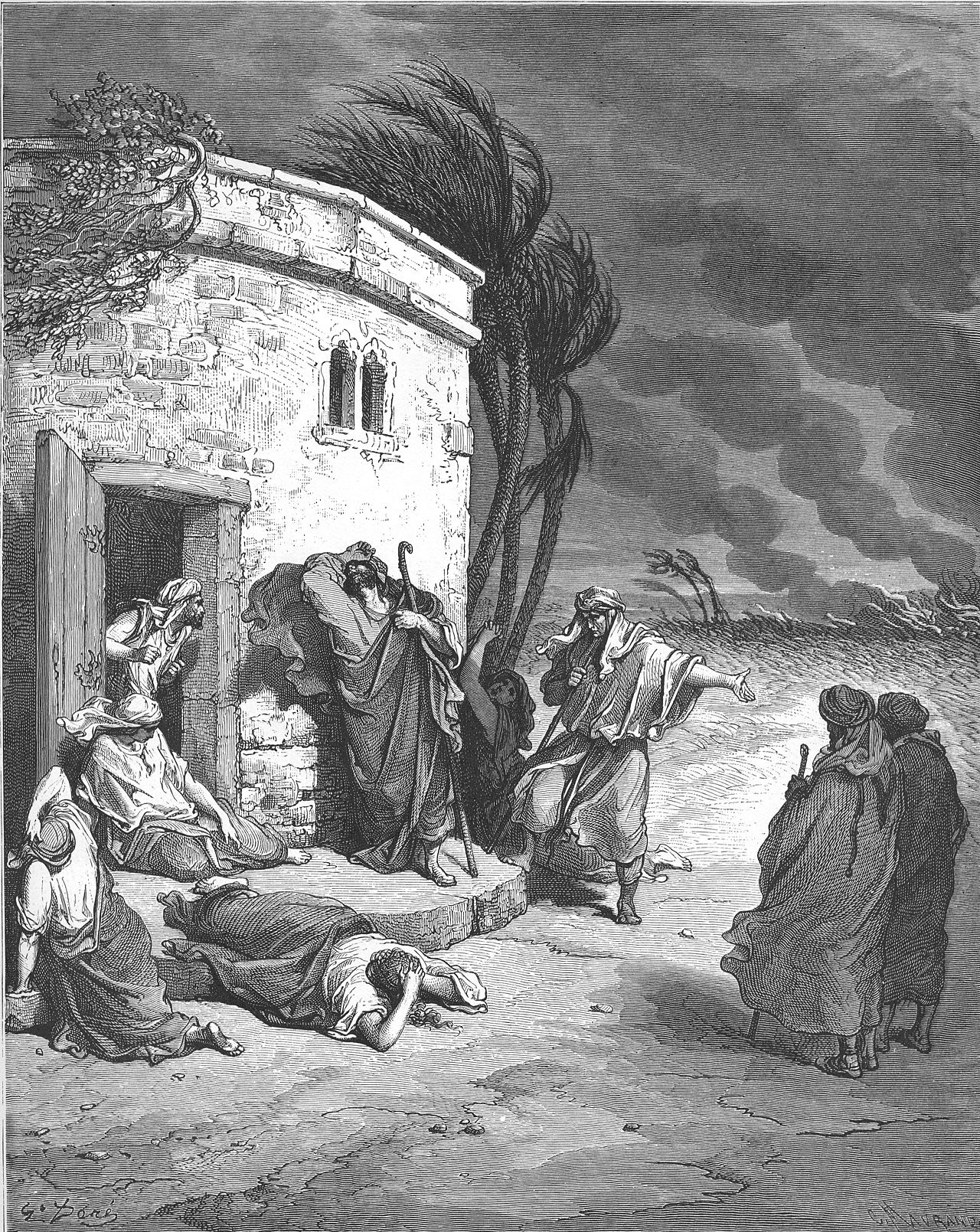
Jobchapter 19
29 verses · unknown · 10th century BC · Wisdom and poetry
But I know that my Redeemer lives, and in the end He will stand upon the earth.
Introduction
unknown, Wisdom and poetry, Job Overview.
Job answers Bildad, and this chapter holds the best-known confession in the book. He speaks as a man cut off from brothers, servants, wife and friends. His hearers lived by kinship, and their law named a near relative bound to buy back, protect and avenge a member of his family. They also knew kings who had their words cut into rock to last. Listen for the list of those who have turned away. Then listen for the one Job names when every human helper has gone.
Context
- Who
- Hearers for whom the family redeemer was a real legal figure, not a figure of speech
- What
- Job's reply to Bildad, a lament that God has walled him in and his family has forsaken him, and his confession of a living Redeemer.
- Where
- The ash heap outside Job's town, where his household and kin have abandoned him.
- When
- The second round of speeches, Job's reply to Bildad's second speech.
- Why
- To show Job's faith reaching past his ruin to a Redeemer who will stand on the earth and whom Job will see.
Historical context
The first half is a catalogue of social death, listed by relationship. Brothers put far away; acquaintances estranged; kinsfolk failed; the guests of his house counting him a stranger; his servant not answering when called; his breath strange to his wife; young children despising him; his close friends abhorring him. In a society where a man was his household and his clan, this is what total ruin actually meant.
Show the rest of the historical context, 3 more paragraphs
Then he asks for his words to be permanently recorded: printed in a book, or better, graven with an iron pen and lead in the rock for ever. That describes real monumental practice, letters cut into stone with an iron chisel and the grooves filled with molten lead so they stood out and lasted. Rulers across the ancient Near East recorded their claims that way, and Job wants his testimony to have the same permanence as a king's inscription.
The word he uses next is a legal one every hearer knew: goel, the redeemer. The goel was the nearest male relative, and his duties were specific, buy back land the family had lost, buy a relative out of slavery, marry a childless widow to preserve the line, and pursue the killer of a murdered kinsman. Job has just finished saying every human kinsman has abandoned him. So he names a different one: 'I know that my redeemer liveth, and that he shall stand at the latter day upon the earth.'
The following verse is famously hard in the Hebrew, and translations differ over whether Job expects to see God in his flesh or after his flesh is destroyed. What is not in doubt is the direction: he expects to see God himself, with his own eyes, and not as a stranger.
Significance
This is the summit of Job's faith and it comes from the bottom of his ruin. He does not withdraw a single complaint. He simply asserts that there is a living kinsman-redeemer who will stand up on the dust and settle his case, and that Job will be there to see it.
Show the rest of the significance, 1 more paragraph
For the first hearers this was the answer to the arbiter he asked for in chapter 9 and the witness in chapter 16, the same hand reaching, now with a name from family law. He closes by warning the friends to be afraid of the sword themselves, because there is a judgment.
This chapter in Jewish lifeWhat this chapter is in Jewish life and reading.
What is done
The site's table gives this chapter no public reading. Probed for this lane, src/lib/hebraic/readings.ts printed parashot total 0, haftarah uses total 0 and no festival reading for Job.
The corpus ties it to Midrash on three Torah portions. Midrash Tanchuma stands at Kedoshim 15:1 and Vaetchanan 2:1 under the twenty-first verse, with Midrash Tanchuma Buber, Kedoshim 15:1 beside them, and at Mishpatim 4:2 under the twenty-ninth. Its Talmud locators sit in Bava Batra under the twenty-first and twenty-third verses and in Shabbat under the twenty-seventh, with Tractate Semachot 1:4 on the same verse.
How it is read
Malbim, in Malbim's Job, translated by Jeremy I. Pfeffer (Ktav, 2003), which Sefaria reports as CC-BY, heads the chapter "The Eleventh Oration - Job’s Reply To Bildad’s Second Speech" (Malbim on Job 19:1:1).
Rashi, quoted here from The Judaica Press complete Tanach with Rashi, translated by A. J. Rosenberg, which Sefaria reports as CC-BY, reads the opening as a protest against the grief the friends give Job (Rashi on Job 19:2:1). At the third verse he reads the number as a count of the book's own speeches so far. "There are ten chapters until here" (Rashi on Job 19:3:1).
Job then owns his error and its blows as his alone. "I am the one who receives blows for my error" (Rashi on Job 19:4:1). The friends add to his trouble and prove his reproach to his face (Rashi on Job 19:5:1). He cries out about violence and is not answered (Rashi on Job 19:7:1).
Rashi's glosses in the middle verses are short. The tenth has a word of uprooting, the twelfth a word for a highway, and the thirteenth a word of cruelty (Rashi on Job 19:10:1, 19:12:1 and 19:13:1). The children of his body at the seventeenth verse are those he raised in his house as though they were his own (Rashi on Job 19:17:1). At the eighteenth he is despised by children, "all the more so in the eyes of princes" (Rashi on Job 19:18:1). At the twentieth his bones cleave because he is emaciated (Rashi on Job 19:20:1).
Malbim marks two turns in the second half of the chapter. "Job calls upon his companions to show him the pity that God has not shown." They gain nothing, he adds, from the withering of Job's flesh (Malbim on Job 19:21:1). At the twenty-third verse Job asks that his story not be forgotten, and Malbim reads hope in the request. "He will yet be vindicated before the end of time" (Malbim on Job 19:23:2).
Rashi's last note weighs two readings of the iron pen. He takes it as a pen that cuts the letters into rock, after which lead is run over them to blacken them and make them plain. "This is the practice of those who inscribe on stone." He then sets aside the other reading. "It cannot be explained to mean a lead pen because lead is soft in comparison with stone" (Rashi on Job 19:24:1). The difference is whether the lead is the tool or the filling, and Rashi decides it by the hardness of the stone.
The corpus carries no commentator's note on this chapter past the twenty-fourth verse. It carries nine further notes without an English text, each marked linked because Sefaria holds no English version of the ref. They stand cited and unquoted at Ibn Ezra on Job 19:6:1, 19:19:1 and 19:22:1, and at Metzudat David on Job 19:8:1, 19:9:1, 19:11:1, 19:14:1, 19:15:1 and 19:16:1.
What the rabbis say
The corpus carries thirty rabbinic locators on this chapter and the text of none, so each is cited and linked here by ref alone. On the fourth verse it holds Midrash Tehillim 7:2, Shemot Rabbah 30:11 and Vayikra Rabbah 4:6. On the tenth it holds Aggadat Bereshit 20:3, Introductions to Amoraic Literature, Part II (Notes and Interpretations for Chapters of the Talmud), Baba Batra, Chapter I 290, and Midrash Sekhel Tov, Shemot 15:22:1. On the fourteenth it holds Midrash Lekach Tov on Ruth 2:1:1 and Shemot Rabbah 31:13.
On the eighteenth it holds Aggadat Bereshit 28:2 and Midrash Lekach Tov on Lamentations, Introduction 1, and on the twentieth Midrash Tehillim 26:2.
The twenty-first verse, where Malbim hears Job ask his friends for pity, draws eight. The corpus holds Bava Batra 116a:14, Ein Yaakov, Bava Batra 8:7, Kohelet Rabbah 9:11:1 and Shemot Rabbah 23:9. Midrash Tanchuma Buber, Kedoshim 15:1, Midrash Tanchuma at Kedoshim 15:1 and Vaetchanan 2:1, and Pesikta DeRav Kahana 16:6 stand with them.
On the twenty-third verse it holds Bava Batra 15a:11 and 15a:13, Ein Yaakov, Bava Batra 1:32 and Midrash Sekhel Tov, Bereshit 27:33:3. On the twenty-sixth it holds Bereshit Rabbah 48:2 and Yalkut Shimoni on Torah 82:11. On the twenty-seventh it holds Shabbat 145a:9 and Tractate Semachot 1:4. On the twenty-ninth it holds Midrash Tanchuma, Mishpatim 4:2, Shemot Rabbah 30:24 and Tanna DeBei Eliyahu Rabbah 31:1. What each of them teaches is a saying of the rabbis, and is reported as theirs wherever this site quotes one. The quotations wait on a fetch that carries the text.
Sources: Rashi, Rashi on Job 19:2:1 to 19:24:1, The Judaica Press complete Tanach with Rashi, translated by A. J. Rosenberg, reported CC-BY; Malbim, Malbim on Job 19:1:1 to 19:23:2, Malbim's Job, trans. Jeremy I. Pfeffer, Ktav, 2003, reported CC-BY; Ibn Ezra, Ibn Ezra on Job 19:6:1, 19:19:1 and 19:22:1, cited by ref because the corpus carries no English text; Metzudat David, Metzudat David on Job 19:8:1, 19:9:1, 19:11:1, 19:14:1, 19:15:1 and 19:16:1, cited by ref because the corpus carries no English text; The Sefaria corpus, scripts/data/sources/sefaria/job/19.json, the 30 Talmud and Midrash locators of this chapter; The site's own files, src/lib/hebraic/readings.ts, printing no portion, no Haftarah and no festival reading for this book.
The heads below are this chapter's scenes. The numbered points under each are its verses.
Job: God Hath Overthrown Me and Fenced Up My Way
Job 19:1-5
Then Job answered: Gill notes that "Ten times now you have reproached me" is a round number of completeness. His answer to their exalting themselves is "my error concerns me alone": a hidden fault, if there were one, would be God's business alone. Henry sets their treatment against the better silence of 2:13.
Job 19:1
“Then Job answered and said. Having heard Bildad out, without giving him any interruption; and when he had finished his oration, he rose up in his own defence, and put in his answer as follows.”
crush me with your words?: Job answers Bildad's question at Job 18:2 with his own how long. Bildad asked when Job's words would end; Job asks when the friends' words will stop crushing him. Barnes hears a reply to Bildad's taunt.
Job 19:2
“How long, &c.--retorting Bildad's words (Job 18:2). Admitting the punishment to be deserved, is it kind thus ever to be harping on this to the sufferer?”
Jamieson, Fausset & Brown · Commentary Critical and Explanatory on the Whole Bible (1871)reformed
1 more voice on this verse
Job 19:2
"I see you will magnify yourselves against me, notwithstanding all I have said in my own justification." Those that speak too much seldom think they have said enough; and, when the mouth is opened in passion, the ear is shut to reason.
Matthew Henry · Commentary on the Whole Bible (1707-1721)puritan
Ten times now you have reproached me: Ten times is a round number for very often, as Henry reads it, like Jacob's complaint against Laban in Genesis 31. The friends have spoken five times, and Henry counts each speech as reproaching Job twice. They mistreat him shamelessly.
Job 19:3
“Lo, these ten times ye confound me. On enumerating the successive times of the speeches of Job's friends, we learn that as yet they had spoken but five times. But for this reason, that he had five times heard rebukes from them, and five times himself replied to their rebukes, he says that he had been ten times confounded; because both herein, viz. that he had been causelessly reproached, he suffered deeply, and in this, that he uttered words of instruction to those that gave no ear, he underwent confusion.”
Gregory the Dialogist · written before 604 · Morals on the Book of Job, Book XIVpatristic
my error concerns me alone: Chrysostom reads the line as a concession: grant that Job has gone astray, and the error still harms no one else. Henry sets it against the friends, who press their own errors on others. Barnes calls their reproach a meddlesome interference.
Job 19:4
“And be it indeed that I have erred - Suppose indeed that I have been mistaken in any thing, that in the simplicity of my heart I have gone astray, and that this matter remains with myself, (for most certainly there is no public stain on my life), you must grant that this error, whatsoever it is, has hurt no person except myself. Why then do ye treat me as a person whose life has been a general blot, and whose example must be a public curse?”
Adam Clarke · Commentary on the Bible (1810-1826)evangelical
1 more voice on this verse
Job 19:4
"And if I—let us suppose—had done things that should not have been done, even if I had been in such a condition, was it not necessary just the same that you felt ashamed while seeing my afflictions, disease, worms and loss of goods? But you approach me without commiserating with me and without feeling any sympathy for my adversities."
Origen of Alexandria · written before 253 · Fragments on Job 13.15, 29patristic
use my disgrace against me: The sentence runs on into verse 6, as Barnes notes: if the friends exalt themselves, they should understand that God has wronged Job. Henry calls it a base thing to trample on a man already down. Disgrace became their argument.
Job 19:6-9
drawn His net around me: Job answers Bildad's doctrine at 18:8 by naming the net's owner: "it is God who has wronged me and drawn His net around me". Barnes notes that Job's error is honest and profound. Job reads suffering as God's hostility because he cannot see the court of chapters 1 and 2.
Job 19:6
“Know now that God hath overthrown me - The matter is between him and me, and he has not commissioned you to add reproaches to his chastisements. And hath compassed me with his net - There may be an allusion here to the different modes of hunting which have been already referred to in the preceding chapter.”
Adam Clarke · Commentary on the Bible (1810-1826)evangelical
1 more voice on this verse
Job 19:6
“Know now at least that God hath afflicted me with no just judgment. O, how hard does the voice of the righteous man sound, suffering under the infliction of the rod! Which same, however, not pride, but grief gave vent to! Now he is not righteous, who gives up righteousness under sorrow; and blessed Job, because he had a meek spirit, did not sin even by a hard word.”
Gregory the Dialogist · written before 604 · Morals on the Book of Job, Book XIVpatristic
I get no response: Job cries out against violence and calls for help, and no answer comes from God or from his friends. Jamieson, Fausset and Brown read the missing justice both ways. Gregory holds that God delays His answer to purify the one who suffers.
Job 19:7
“Behold, I cry out of wrong - Margin, or “violence.” The Hebrew word (חמס châmâs) means properly violence. The violence referred to is that which was brought upon him by God. It is, indeed, harsh language; but it is not quite sure that he means to complain of God for doing him injustice. God had dealt with him in a severe or violent manner, is the meaning, and he had cried unto him for relief, but had cried in vain. No judgment - No justice.”
1 more voice on this verse
Job 19:7
"I will cry out, and there is nowhere judgment; I still contend." This is as if Job had said, "I cried out like an athlete in the stadium, but my judgment is nowhere there. Indeed, I still fight. But if I do not bring my fight to a close, I will not get my crown." We actually say these things lest we accuse God of the fact that Job suffered such misfortunes and there was judgment for him nowhere.
Origen of Alexandria · written before 253 · Fragments on Job 13.15, 29patristic
He has blocked my way so I cannot pass: Barnes takes the figure from a traveller whose road is suddenly shut by rocks or fences. Henry adds that the darkness hides even the hope of a later deliverance from Job's sight. God blocks the way and darkens it.
Job 19:8
“He hath fenced up my way, that I cannot pass: and He hath set darkness in my paths. He saw his 'way fenced up' with strokes, when anxiously desiring to pass into a state of security, he was not able to escape the scourges, and whereas he saw himself smitten, and yet did not find in himself a life worthy of such smiting, as it were 'in the paths' of the heart he met with 'the darkness' of his own ignorance, in that he could not fathom the cause wherefore he was so scourged.”
Gregory the Dialogist · written before 604 · Morals on the Book of Job, Book XIVpatristic
1 more voice on this verse
Job 19:8
“He hath fenced up my way - This may allude to the mode of hunting the elephant, described at the conclusion of the preceding chapter; or to the operations of an invading army. See under Job 19:11 (note).”
Adam Clarke · Commentary on the Bible (1810-1826)evangelical
removed the crown from my head: The crown stands for the honor and dignity Job held among his people, as Barnes explains. Henry counts his children as part of that glory, and Barnes adds his property, health and the esteem of friends. All of it is gone.
Job 19:9
“He hath stripped me of my glory - Everything which I had that contributed to my respectability and honor, he has taken away. My property, my health, my family, the esteem of my friend - all is gone. And taken the crown from my head - The crown is an emblem of honor and dignity - and Job says that God had removed all that contributed to his - and Job says that God had removed all that contributed to his former dignity; compare Pro 4:9; Pro 17:6; Eze 16:12; Lam 5:16.”
1 more voice on this verse
Job 19:9
“He hath stripped me of my glory, and taken the crown from my head. ALLEGORICAL INTERPRETATION That all this suits the person of the blessed man set in the midst of tribulation, there can be no doubt; but, since the words of the historical account are plain, they do not require explaining after the letter, therefore they have to be traced out in their mystical senses. Thus he says, He hath stripped me of my glory. For the glory of each individual is his righteousness.”
Gregory the Dialogist · written before 604 · Morals on the Book of Job, Book XIVpatristic
Job 19:10-12
He uproots my hope like a tree: In "He uproots my hope like a tree" Job answers his image at 14:7, where a cut tree had a hope a man lacked. With "His troops advance together" one tent becomes a city under siege. Delitzsch reads it as the language of the Chaldean and Sabean raids.
Job 19:10
“Mine hope hath he removed like a tree - There is no more hope of my restoration to affluence, authority, and respect, than there is that a tree shall grow and flourish, whose roots are extracted from the earth. I am pulled up by the roots, withered, and gone.”
Adam Clarke · Commentary on the Bible (1810-1826)evangelical
He counts me among His enemies: Job repeats the complaint of Job 13:24, as Barnes notes. Henry calls it a mistake to think God treats those He afflicts as enemies, since God loved Job and gloried in him as a friend. Job speaks without the prologue's knowledge.
Job 19:11
“He hath also kindled his wrath - He is angry. Wrath in the Scriptures is usually represented as burning or inflamed - because like fire it destroys everything before it. And he counteth me unto him as one of his enemies - He treats me as he would an enemy. The same complaint he elsewhere makes; see Job 13:24; perhaps also in Job 16:9. We are not to understand Job here as admitting that “he” was an enemy of God.”
1 more voice on this verse
Job 19:11
“Job's present apprehension was that God counted him as one of his enemies; and yet, at the same time, God loved him, and gloried in him, as his faithful friend. It is a gross mistake, but a very common one, to think that whom God afflicts he treats as his enemies; whereas, on the contrary, as many as he loves he rebukes and chastens; it is the discipline of his sons.”
Matthew Henry · Commentary on the Whole Bible (1707-1721)puritan
they construct a ramp against me: The picture is a siege: troops, a ramp and a camp around a single tent. Henry recalls the hedge God once set around Job, so the besieging army now stands where the guard once stood. Barnes takes the troops as the calamities themselves.
Job 19:12
“God's troops encamped around his tabernacle, as soldiers lay siege to a strong city, cutting off all provisions from being brought into it and battering it continually; thus was Job's tabernacle besieged. Time was when God's hosts encamped round him for safety: Hast thou not made a hedge about him?”
Matthew Henry · Commentary on the Whole Bible (1707-1721)puritan
1 more voice on this verse
Job 19:12
“His troops - The calamities which he had sent, and which are here represented as “armies” or “soldiers” to accomplish his work. It is not probable that he refers here to the bands of the Chaldeans and the Sabeans, that had robbed him of his property, but to the calamities that had come upon him, “as if” they were bands of robbers.”
Job: My Kinsfolk Have Failed: Have Pity, O Ye My Friends
Job 19:13-16
He has removed my brothers from me: The catalogue of estrangement descends by rank through a patriarchal household. Henry marks the inversion of the last pair, a lord begging his own servant and refused, as the depth of the humiliation. Gill notes that every relation the restoration of 42:11 names again is lost here first.
Job 19:13
“He hath put my brethren - This is a new source of afflication that he had not adverted to before, that God had caused all his children to be estranged from him - a calamity which he regarded as the crown of all his woes. The word rendered “my brethren” (אחי 'âchāy) means means properly “my brothers” - but whether he means literally his brothers, or whether he designs it to be taken in a figuratie sense as denoting his intimate friends, or those of the same rank in life or calling, it is impossible now to determine.”
1 more voice on this verse
Job 19:13
“Nay, his inward friends, the men of his secret, whom he was most intimate with and laid in his bosom, not only forgot him, but abhorred him, kept as far off from him as they could, because he was poor and could not entertain them as he used to do, and because he was sore and a loathsome spectacle.”
Matthew Henry · Commentary on the Whole Bible (1707-1721)puritan
My kinsmen have failed me: Barnes explains that the word for kinsmen means those near to Job, by blood, love or residence. Clarke reads failed as departed: they left his tent once there was no gain in staying. Kinsmen and friends go together.
Job 19:14
“My kinsfolk have failed - My neighbors (קרובי qârôbāy), those who were near to me. It may refer to “nearness” of affinity, friendship, or residence. The essential idea is that of “nearness” - whether by blood, affection, or vicinity. In Psa 38:11, it denotes near friends. And my familiar friends - Those who knew me - מידעי myudā‛ay. The allusion is to those who were “intimately” acquainted with him, or who were his bosom friends.”
count me as a stranger: Barnes explains the guests as sojourners who stay in the tent for a time. To the guests and maidservants of his own tent, Job is now a stranger and a foreigner. Clarke notes how rarely the fallen are shown pity.
Job 19:15
“They that dwell in mine house - The trials came to his very dwelling, and produced a sad estrangement there. The word used here גרי gārēy from גוּר gûr means properly those who “sojourn” in a house for a little time. It may refer to guests, strangers, servants, clients, or tenants. The essential idea is, that they were not “permanent” residents, though for a time they were inmates of the family. Jerome renders the place, “Inquilini domus meoe - the tenants of my house.” The Septuagint, Γείτονες οἰχιάς Geitones oikias - neighbors.”
I implore him with my own mouth: Jamieson, Fausset and Brown take the servant as one born in the family, the most bound to answer. Once a nod was enough; now Job must implore him aloud with his own mouth. Barnes says Job has ceased to be master.
Job 19:16
“I called my servant, and he gave me no answer. For what was the Jewish people but a 'servant,' which never obeyed the Lord with the love of a son, but the fear of a slave? Contrariwise it is said to us by Paul, For ye have not received the spirit of bondage again; but ye have received the spirit of adoption, whereby we cry Abba, Father.”
Gregory the Dialogist · written before 604 · Morals on the Book of Job, Book XIVpatristic
1 more voice on this verse
Job 19:16
“I called my servant - He lost all respect for me, and paid me no attention. I entreated him - I ceased to expect “obedience,” and tried to see what “persuasion” would do. I ceased to be master in my own house.”
Job 19:17-19
repulsive to my wife: The readings on "my own family" divide, whether the Hebrew means his dead children or the sons of his mother. Barnes and Gill set out both. The three friends before him are inside the sentence about those who have "turned against me", the charge of verse 2 restated as grief.
Job 19:17
“My breath is strange to my wife - Schultens renders this, “my breath is loathsome to my wife,” and so also Noyes.”
1 more voice on this verse
Job 19:17
“Some read it, "Though I lamented, or bemoaned myself, for the children," that is, "for the death of the children of my own body," an affliction in which she was equally concerned with him.”
Matthew Henry · Commentary on the Whole Bible (1707-1721)puritan
Even little boys scorn me: Barnes notes that the Hebrew word for little boys can also mean the wicked, as in Job 16:11. Reverence for age was a chief duty in the East, as Jamieson, Fausset and Brown observe. Even little boys scorn Job now.
Job 19:18
“The foolish too despised me. The wise falling away from faith in the truth, there is an addition rightly made concerning 'fools' as well; in that when the Pharisees and the Lawyers despised the Lord, the rabble of the people too followed the example of their incredulousness, which herein, that it saw Him a man, slighted the announcements of the Redeemer of the world.”
Gregory the Dialogist · written before 604 · Morals on the Book of Job, Book XIVpatristic
1 more voice on this verse
Job 19:18
“Yea, young children - Margin, or “the wicked.” This difference between the text and the margin arises from the ambiguity of the original word - עוילים ‛ăvı̂ylı̂ym. The word עויל ‛ăvı̂yl (whence our word “evil”) means sometimes the wicked, or the ungodly, as in Job 16:11. It may also mean a child, or suckling, (from עוּל ‛ûl - to give milk, to suckle, 1Sa 7:7-10; Gen 22:13: Ps. 77:71; Isa 40:11; compare Isa 49:15; Isa 65:20,) and is doubtless used in this sense here.”
All my best friends despise me: Barnes explains the Hebrew as the men of Job's secret, the best friends who shared his counsel. Those Job loves have now turned against him, closing the circle that began with his brothers in verse 13. Henry calls adversity the proof of friendship.
Job 19:19
“All my inward friends - Margin, “the men of my secret.” The meaning is those, who were admitted to the intimacy of friendship or who were permitted to be acquainted with his secret thoughts, purposes, and plans. The word uses here (סוד sôd) denotes properly “a couch, cushions, pillow,” on which one reclines; then a “divan,” a circle of persons sitting together for consultation or conversation; and hence, it refers to those who are sitting together in intimate counsel, (see Job 15:8, note; Job 29:4, note) and then familiar conversation, intimacy.”
1 more voice on this verse
Job 19:19
“So uncertain is the friendship of men; but, if God be our friend, he will not fail us in a time of need. But let none that pretend either to humanity or Christianity ever use their friends as Job's friends used him: adversity is the proof of friendship.”
Matthew Henry · Commentary on the Whole Bible (1707-1721)puritan
Job 19:20-22
the skin of my teeth: "I have escaped by the skin of my teeth" gave the proverb. Clarke and Delitzsch give two readings: escape with nothing, or the bare gums the disease has left. The cry "Have pity on me, my friends, have pity" asks what he believes God withholds.
Job 19:20
“My bone cleaveth to my skin - My flesh is entirely wasted away, and nothing but skin and bone left. I am escaped with the skin of my teeth - I have had the most narrow escape. If I still live, it is a thing to be wondered at, my sufferings and privations have been so great. To escape with the skin of the teeth seems to have been a proverbial expression, signifying great difficulty. I had as narrow an escape from death, as the thickness of the enamel on the teeth.”
Adam Clarke · Commentary on the Bible (1810-1826)evangelical
1 more voice on this verse
Job 19:20
“Skin - Immediately, the fat and flesh next to the skin being consumed. As - As closely as it doth to these remainders of flesh which are left in my inward parts.”
John Wesley · Explanatory Notes upon the Old Testament (1765)evangelical
Have pity on me, my friends: The doubled plea shows how far suffering has worn Job down, as Clarke reads it. He turns from accusing the friends to begging them, and his reason is the hand of God that struck him. Henry adds that friends in trouble owe each other pity.
Job 19:21
“Have pity on me - A tender, pathetic cry for sympathy. “God has afflicted me, and stripped me of all my comforts, and I am left a poor, distressed, forsaken man. I make my appeal to you, my friends, and entreat you to have pity; to sympathize with me, and to sustain me by the words of consolation.” One would have supposed that these words would have gone to the heart, and that we should hear no more of their bitter reproofs. But far otherwise was the fact.”
1 more voice on this verse
Job 19:21
“The noble Job in his harsh adversity cried out in blame not misery. That is to say, 'You're meant to be merciful not unjustly reproach me! Instead you assail me and overwhelm a man with whose sufferings you ought to show sympathy for friendship's sake.”
Basil of Caesarea · written before 379 · Commentary (church-history corpus)patristic
never get enough of my flesh?: Jamieson, Fausset and Brown observe that God's hand on a man gives no one leave to add to it, citing Zechariah 1:15. Wesley hears the friends persecute Job as if they had God's knowledge of his heart. To eat his flesh is to slander him.
Job 19:22
“Why do ye persecute me as God - Are not the afflictions which God sends enough? Do ye not see that I have as much as I can bear? When the papists were burning Dr. Taylor at Oxford, while wrapped in the flames, one of the true sons of the Church took a stick out of the faggots, and threw it at his head, and split open his face. To whom he calmly said, Man, why this wrong? Do not I suffer enough?”
Adam Clarke · Commentary on the Bible (1810-1826)evangelical
1 more voice on this verse
Job 19:22
“As God - As if you had the same infinite knowledge which God hath, whereby you can search my heart and know my hypocrisy, and the same sovereign authority to say and do what you please with me. Not satisfied - Are like wolves or lions that are not contented with devouring the flesh of their prey, but also break their bones.”
John Wesley · Explanatory Notes upon the Old Testament (1765)evangelical
Job: I Know That My Redeemer Liveth
Job 19:23-24
inscribed in a book: Job wishes his protest made permanent in rising degrees: "recorded", "inscribed in a book", "by an iron stylus on lead, or chiseled in stone forever". Clarke notes that the Hebrew asks for engraving, the lead run into letters cut in rock. Henry observes the wish was granted beyond its asking.
Job 19:23
“Oh that my words were now written! - Margin, as in Hebrew, “Who will give;” a common mode of expressing desire among the Hebrews. This expression of desire introduces one of the most important passages in the book of Job. It is the language of a man who felt that injustice was done by his friends, and that he was not likely to have justice done him by that generation.”
1 more voice on this verse
Job 19:23
“Despairing of justice from his friends in his lifetime, he wishes his words could be preserved imperishably to posterity, attesting his hope of vindication at the resurrection. printed--not our modern printing, but engraven.”
Jamieson, Fausset & Brown · Commentary Critical and Explanatory on the Whole Bible (1871)reformed
by an iron stylus on lead: Barnes describes the iron stylus as a sharp tool for cutting letters into stone. Jamieson, Fausset and Brown take the lead as poured into the chiseled letters. Job wishes his words recorded forever.
Job 19:24
“Iron pen and lead - Some suppose that the meaning of this place is this: the iron pen is the chisel by which the letters were to be deeply cut in the stone or rock; and the lead was melted into those cavities in order to preserve the engraving distinct. But this is not so natural a supposition as what is stated above; that Job refers to the different kinds of writing or perpetuating public events, used in his time: and the quotations from Pliny and Pausanias confirm the opinion already expressed.”
Adam Clarke · Commentary on the Bible (1810-1826)evangelical
my Redeemer lives: Redeemer here is the Hebrew goel, the kinsman who buys back a relative's land (Leviticus 25:25). After the arbiter of 9:33 and the witness of 16:19 comes a living Redeemer who "will stand upon the earth". Gregory and older writers read the goel as Christ, a reading theirs by name.
Job 19:25
“Latter day - At the day of the general resurrection and judgment, which, as those holy patriarchs well knew and firmly believed, was to be at the end of the world. The earth - The place upon which Christ shall appear and stand at the last day. Hebrew. upon the dust; in which his saints and members lie or sleep, whom he will raise out of it.”
John Wesley · Explanatory Notes upon the Old Testament (1765)evangelical
2 more voices on this verse
Job 19:25
“For I know that my Redeemer liveth. LITERAL INTERPRETATION For he who does not say, 'Creator,' but 'Redeemer,' expressly tells of Him, Who after He created all things, appeared Incarnate amongst us, that He might redeem us from a state of bondage, and by His Passion set us free from death everlasting; and mark with what sure faith he makes himself secure in the power of His Divine Nature, of Whom it is said by Paul, For though He was crucified through weakness, yet He liveth by the power of God.”
Gregory the Dialogist · written before 604 · Morals on the Book of Job, Book XIVpatristic
Job 19:25
“For I know that my Redeemer liveth - There are few passages in the Bible which have excited more attention than this, or in respect to which the opinions of expositors have been more divided. The importance of the passage Job 19:25-27 has contributed much to the anxiety to understand its meaning - since, if it refers to the Messiah, it is one of the most valuable of all the testimonials now remaining of the early faith on that subject.”
Job 19:26-27
yet in my flesh: The Hebrew is among the hardest in the book, for "in my flesh I will see God" can be rendered from or without my flesh. Henry, Gill and most older writers read a resurrection hope, while Delitzsch renders without my flesh and hears a vision beyond the body's ruin.
Job 19:26
“Rather, though after my skin (is no more) this (body) is destroyed ("body" being omitted, because it was so wasted as not to deserve the name), yet from my flesh (from my renewed body, as the starting-point of vision, So 2:9, "looking out from the windows") "shall I see God." Next clause [Job 19:27] proves bodily vision is meant, for it specifies "mine eyes" [ROSENMULLER, 2d ed.].”
Jamieson, Fausset & Brown · Commentary Critical and Explanatory on the Whole Bible (1871)reformed
3 more voices on this verse
Job 19:26
“God - The same whom he called his Redeemer, ver. 25, who having taken flesh, and appearing in his flesh or body with and for Job upon the earth, might well be seen with his bodily eyes. Nor is this understood of a simple seeing of him; but of that glorious and beatifying vision of God, which is promised to all God's people.”
John Wesley · Explanatory Notes upon the Old Testament (1765)evangelical
Job 19:26
“And I shall be again encompassed with my skin. But see, I hear of the resurrection, but it is the effect of the resurrection that I am searching out. For I believe that I shall rise again, but I wish that I might hear what kind of person; since it is a thing I ought to know, whether I shall rise again perhaps in some other subtle or ethereal body, or in that body wherein I shall die. But if I shall rise again in an ethereal body, it will no longer be myself, who rise again.”
Gregory the Dialogist · written before 604 · Morals on the Book of Job, Book XIVpatristic
Job 19:26
“And though after my skin worms destroy this body - My skin, which is now almost all that remains of my former self, except the bones; see Job 19:20. They destroy this - not body. נקפו זאת nikkephu zoth, they - diseases and affliction, destroy This wretched composition of misery and corruption.”
Adam Clarke · Commentary on the Bible (1810-1826)evangelical
my eyes will behold Him: Gregory and Henry hold that Job will see God with his own eyes in the flesh, raised from the dead. Jamieson, Fausset and Brown, following Bengel, read the words to mean God will no longer be a stranger to Job. Barnes hears Job expecting to behold God decide his cause.
Job 19:27
“Whom I shall see for myself, and mine eyes shall behold, and not another. For if, as certain votaries of false opinions believe, after the resurrection there shall be no palpable body, but the subtle quality of an invisible body shall be called the flesh, though there be no substance of flesh, then surely he that dies is one person, and he that rises again is another. But blessed Job destroys this assertion for them by a truthtelling voice, in that he says, Whom I shall see for myself; and mine eyes shall behold, and not another.”
Gregory the Dialogist · written before 604 · Morals on the Book of Job, Book XIVpatristic
2 more voices on this verse
Job 19:27
“Whom I shall see for myself - It will not come to be by mere report. I shall not merely hear of the decision of God in my favor, but I shall myself behold him. He will at length come forth, and I shall be permitted to see him, and shall have the delightful assurance that he settles this controversy in my favor, and declares that I am his friend. Job was thus permitted to see God Job 42:5, and hear his voice in his favor.”
Job 19:27
“My eyes shall behold him, and not another. First, "He, and not another for him, shall be seen, not a type or figure of him, but he himself." Glorified saints are perfectly sure that they are not imposed upon; it is no deceptio visus--illusion of the senses.”
Matthew Henry · Commentary on the Whole Bible (1707-1721)puritan
Job 19:28-29
the root of the matter: Job warns the friends that "wrath brings punishment by the sword". The words "so that you may know there is a judgment" turn their doctrine back on them. As Henry notes, the book keeps the warning: at 42:7 the wrath of the Lord burns against Eliphaz and his two friends.
Job 19:28
“But ye should say - Or, Then ye shall say. Why persecute we him - Or, as Mr. Good, How did we persecute him! Alas! we are now convinced that we did wrong. Seeing the root of the matter - A pure practice, and a sound hope, resting on the solid ground of sound faith, received from God himself. Instead of בי bi, in Me, בי bo, in Him, is the reading of more than one hundred of Kennicott’s and De Rossi’s MSS., and in several of the versions. Seeing the root of the matter is found in Him.”
Adam Clarke · Commentary on the Bible (1810-1826)evangelical
2 more voices on this verse
Job 19:28
“A living, quickening, commanding, principle of grace in the heart, is the root of the matter, as necessary to our religion as the root to the tree, to which it owes both its fixedness and its fruitfulness. Love to God and our brethren, faith in Christ, hatred of sin--these are the root of the matter; other things are but leaves in comparison with these.”
Matthew Henry · Commentary on the Whole Bible (1707-1721)puritan
Job 19:28
“Rather, "ye will then (when the Vindicator cometh) say, Why," &c. root . . . in me--The root of pious integrity, which was the matter at issue, whether it could be in one so afflicted, is found in me.”
Jamieson, Fausset & Brown · Commentary Critical and Explanatory on the Whole Bible (1871)reformed
you should fear the sword yourselves: Job turns the friends' doctrine of retribution back on them: Jamieson, Fausset and Brown read their anger at him as a sin the sword punishes. Wesley and Clarke take the sword as God's judgment, and Henry hears a future judgment where hard speeches must be answered. The accusers stand accused.
Job 19:29
“Be ye afraid of the sword - Of the sword of justice, of the wrath of God. In taking such views, and using such language, you ought to dread the vengeance of God, for he will punish the guilty. For wrath bringeth the punishments of the sword - The word “bringeth” is supplied by the translators, and as it seems to me improperly. The idea is, that wrath or anger such as they had manifested, was proper for punishment; that such malice as they had shown was a crime that God would not suffer to escape unpunished.”
2 more voices on this verse
Job 19:29
“Sword - Of some considerable judgment to be inflicted on you which is called the sword, as Deut. xxxii, 41, and elsewhere. That - This admonition I give you, that you may know it in time, and prevent it. A judgment - God sees and observes, and will judge all your words and actions.”
John Wesley · Explanatory Notes upon the Old Testament (1765)evangelical
Job 19:29
“God himself often takes vengeance for it, and those that showed no mercy shall find no mercy. (2.) If they repent not, that will be an earnest of worse. By these you may know there is a judgment, not only a present government, but a future judgment, in which hard speeches must be accounted for.”
Matthew Henry · Commentary on the Whole Bible (1707-1721)puritan
Keep studying
Studies5
People and groups1
Words12
Subjects4
Sources for this chapter
The summary
Jamieson, Fausset & Brown, Commentary Critical and Explanatory; John Wesley, Notes on the Old Testament and Matthew Henry, Complete Commentary.
The context
Gregory the Great, Morals on the Book of Job and Matthew Henry, Commentary on the Whole Bible.
The exposition
Adam Clarke, Commentary on the Bible; Albert Barnes; Franz Delitzsch, Biblical Commentary on the Book of Job; Gregory the Dialogist, Morals on the Book of Job; Gregory the Great, Morals on the Book of Job; Jamieson, Fausset & Brown, Commentary Critical and Explanatory on the Whole Bible; John Chrysostom, Commentary on Job; John Gill, Exposition of the Old Testament; John Wesley, Explanatory Notes upon the Old Testament and Matthew Henry, Commentary on the Whole Bible.