
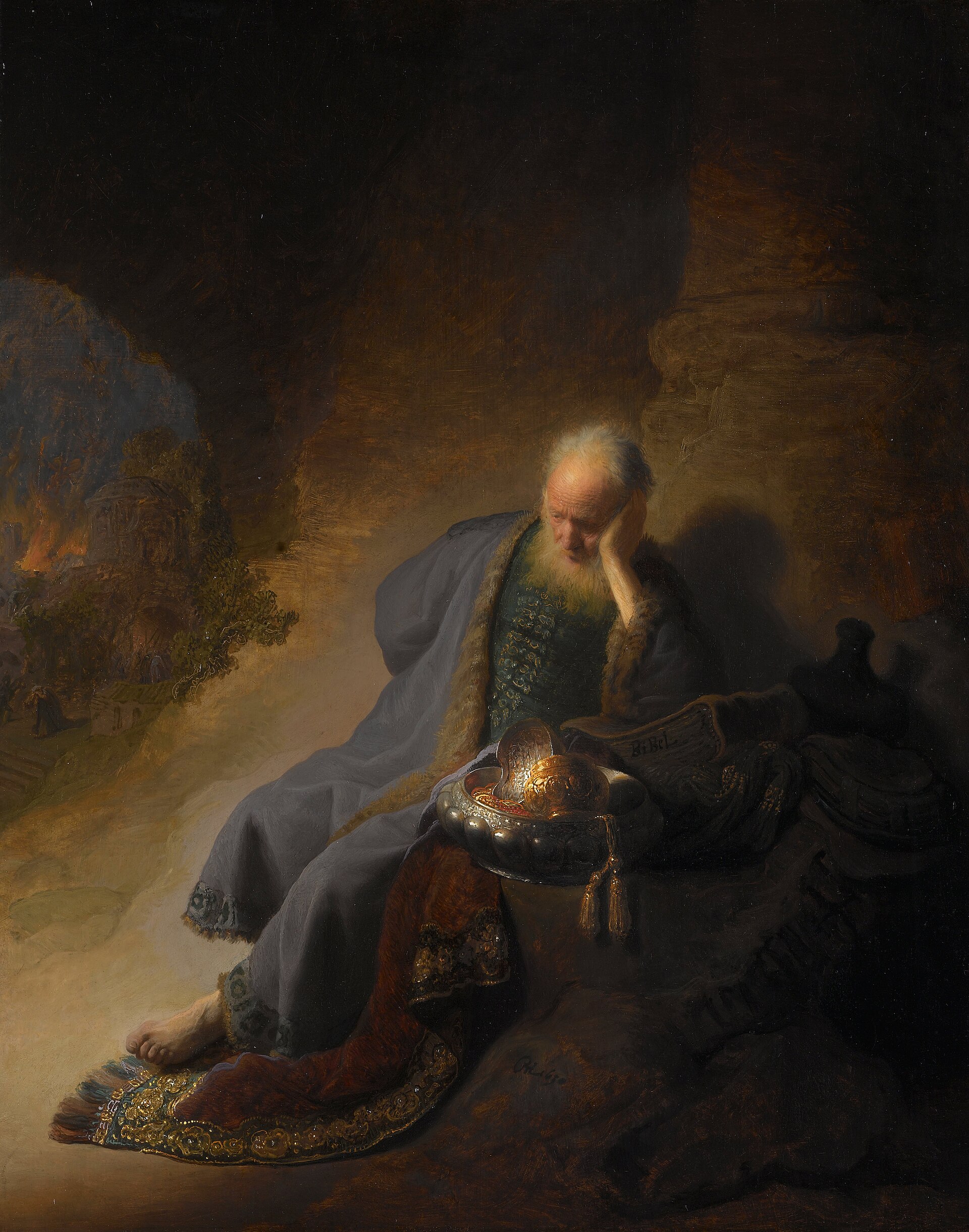
Jeremiahchapter 13
27 verses · Jeremiah, written by Baruch · 7th to 6th century BC · The Prophets
“Take the loincloth that you bought and are wearing, and go at once to Perath and hide it there in a crevice of the rocks.”
Introduction
Jeremiah, written by Baruch, The Prophets, Jeremiah Overview.
Jeremiah acted out this message before he spoke it, in the last years before Babylon took King Jehoiachin into exile. Linen was the fabric of priests, and a loincloth was worn tight against the body, so every hearer understood the picture he chose. The chapter moves from a sign done in silence to sayings spoken at court and in the street. Listen for the words pride and shame, and for the change from a garment to a wine jar to a flock. Its hardest saying is about habit. A reader should ask whether it describes Judah alone.
Context
- Who
- Judeans watching the prophet act out a message instead of speaking it
- What
- A sign act with a linen loincloth, followed by sayings about a wine jar, a coming exile and the shame of Jerusalem.
- Where
- A place called Perath, read either as the Euphrates or as Parah near Anathoth, and then Jerusalem and its royal court.
- When
- The reign of Jehoiakim or the short reign of Jehoiachin, about 605 to 597 BC.
- Why
- To show Judah that the pride which had spoiled its bond with God would end in captivity.
Historical context
Linen was the priestly fabric and the fine fabric, cool, white, expensive, and worn next to the skin. A sash wrapped tight at the waist was the most intimate garment a man owned, which is exactly the point of the picture: God had bound Israel to himself like a belt on a man's body.
Show the rest of the historical context, 3 more paragraphs
Where he buried it is argued over. The word used is the ordinary Hebrew name for the Euphrates, which would mean a journey of several hundred miles each way, twice; but a village called Parah lay only a few miles from Anathoth, with a spring and rock clefts, and the name is spelled almost identically. Readers have taken it both ways for centuries, and both readings land on the same message, the belt rots where Babylon is.
The wine-jar saying uses a household object. Wine was stored in large clay jars sealed with clay stoppers, and the proverb every jar shall be filled with wine sounds like a truism until it is turned: God will fill everyone in the land, kings, priests, prophets, citizens, with drunkenness, and then smash them against each other.
The chapter also names a punishment reserved for captured cities: the skirts of a woman lifted, her shame exposed. Ancient armies humiliated the defeated exactly this way, and the image is being applied to the capital.
Significance
The first hearers watched a man walk out with a good belt and come back with a rotted rag. Nobody forgets an object lesson like that, which is why prophets used them.
Show the rest of the significance, 1 more paragraph
The line about the Ethiopian's skin and the leopard's spots is not a comment about race; it is a comment about habit. A people practised in doing evil can no more change themselves than a leopard can rearrange its coat. That is why the chapter ends in a plea rather than a plan.
This chapter in Jewish lifeWhat this chapter is in Jewish life and reading.
What is done
No part of this chapter is read in the synagogue. Probed for this lane, the site's own table in src/lib/hebraic/readings.ts printed parashot 0 and haftarah uses 0 for Jeremiah 13, and no festival reading for the book. Across chapters 1 to 26 of Jeremiah the same probe found a Haftarah only in chapters 1, 2, 3, 4, 7, 8, 9, 16 and 17.
How it is read
Rashi is the one commentator on this chapter whose English the corpus carries, quoted here from The Judaica Press complete Tanach with Rashi, translated by A. J. Rosenberg, which Sefaria reports as CC-BY.
Rashi reads the ruined girdle as the people's pride: "Their pride shall be like this rotten girdle" (Rashi on Jeremiah 13:10:1). The king and the queen mother are "Jehoiachin and his mother" (Rashi on Jeremiah 13:18:1).
On the weeping of the seventeenth verse he gives two readings. The prophet weeps for the people's greatness cut down, or for the glory of Heaven given over to the idols of Babylon (Rashi on Jeremiah 13:17:1). The closing measure he reads as "a measure for a measure" (Rashi on Jeremiah 13:25:1).
The corpus carries ten further notes on this chapter without an English text, each marked linked because Sefaria holds no English version of the ref. They stand cited and unquoted at Malbim on Jeremiah 13:2:1 and 13:6:1. The same holds for Metzudat David on Jeremiah 13:3:1, 13:4:1, 13:5:1, 13:9:1, 13:11:1 and 13:13:1. The same holds for Radak on Jeremiah 13:15:1 and 13:24:1.
What the rabbis say
The corpus carries 40 rabbinic locators on the verses of this chapter, 4 in the Talmud and 36 in the Midrash. It carries the text of none, so each is cited by ref here and never quoted or paraphrased. The verse numbers are the Hebrew ones the corpus prints.
On verse 1 it holds Aggadat Bereshit 17:1. On verse 10 it holds Eikhah Rabbah, Petichta 31, Midrash Lekach Tov, Numbers 11:1:1, Sifrei Bamidbar 85:1 and Yalkut Shimoni on Torah 731:1. On verse 11 it holds Aggadat Bereshit 66:1, Midrash Tanchuma Buber, Kedoshim 5:1, Midrash Tanchuma, Kedoshim 5:1, Midrash Tanchuma, Ki Tisa 8:1, Pesikta DeRav Kahana 2:7 and Vayikra Rabbah 2:4. It also holds Yalkut Shimoni on Torah 376:1 there. On verse 12 it holds Midrash Tehillim 136:3.
On verse 15 it holds Bamidbar Rabbah 8:3, Devarim Rabbah 4:2, Ein Yaakov (Glick Edition), Sotah 1:9, Ein Yaakov, Sotah 1:11, Sotah 5a:2 and Yalkut Shimoni on Torah 851:2. On verse 16 it holds Aggadat Bereshit 55:2, Eikhah Rabbah 1:57, Eikhah Rabbah, Petichta 25, Eikhah Rabbah, Petichta 34, Midrash Aggadah, Deuteronomy 1:1:11, Midrash Aggadah, Deuteronomy 1:1:5 and Pesikta DeRav Kahana 13:9. On verse 17 it holds Chagigah 5b:10, Chagigah 5b:13, Eikhah Rabbah, Petichta 24, Ein Yaakov (Glick Edition), Khagigah 1:13, Ein Yaakov, Khagigah 1:9 and Midrash Sekhel Tov, Bereshit 33:17:25.
On verse 18 it holds Bereshit Rabbah 68:13 and Yalkut Shimoni on Torah 119:5. On verse 19 it holds Otzar Midrashim, Baraita of Rabbi Pinchas Ben Yair 1:23. On verse 21 it holds Bereshit Rabbah 75:3, Bereshit Rabbati, Parashat Vayishlach 2 and Midrash Tanchuma Buber, Vayishlach 5:1. On verse 23 it holds Midrash Sekhel Tov, Bereshit 30:32:5 and Shabbat 107b:4.
Sources: Rashi, Rashi on Jeremiah 13:1:1 to 13:25:1, The Judaica Press complete Tanach with Rashi, translated by A. J. Rosenberg, reported CC-BY; Malbim, Malbim on Jeremiah 13:2:1 and 13:6:1, cited by ref because the corpus carries no English text; Metzudat David, Metzudat David on Jeremiah 13:3:1, 13:4:1, 13:5:1, 13:9:1, 13:11:1 and 13:13:1, cited by ref because the corpus carries no English text; Radak, Radak on Jeremiah 13:15:1 and 13:24:1, cited by ref because the corpus carries no English text; The Sefaria corpus, scripts/data/sources/sefaria/jeremiah/13.json, the 40 Talmud and Midrash locators on the verses of this chapter; The site's own files, src/lib/hebraic/readings.ts, probed for Jeremiah 13: parashot 0, haftarah uses 0, and no festival reading for the book.
The heads below are this chapter's scenes. The numbered points under each are its verses.
The Linen Girdle Hidden in a Cleft by the River
Jeremiah 13:1-5
The command starts ordinary, a linen loincloth, then turns strange as Jeremiah must hide it “in a crevice of the rocks” at Perath. Jeremiah obeys before any reason is given, “So I went and hid it at Perath”. The cloth worn close to the body prepares for verse 11.
Jeremiah 13:1
“We are the robe of Christ. When we have clothed him with our confession of faith, we, in turn, have put on Christ. It is the apostle who says that Christ is our robe, for when we are baptized, we put on Christ. We both clothe and are clothed. Would you like to know in what manner we clothe the Lord? We read in Jeremiah: "Go buy yourself a linen loincloth. Wear it on your loins, and go to the Euphrates. There hide it in a cleft of the rock.”
Jerome · written before 420 · Homilies on the Psalms 45 (Ps 132)patristic
1 more voice on this verseWhat preachers and commentators have said about this verse, in their own words.
Jeremiah 13:1
“A linen girdle - The appointed dress of the priestly order (Lev 16:4, ...). Put it not in water - i. e., do not wash it, and so let it represent the deep-grained pollution of the people.”
So I bought a loincloth: John Gill notes that Jeremiah wore it unwashed, in public. Jerome reads the plain linen as Israel, taken from the earth with no beauty of its own and bound to the LORD by mercy.
Jeremiah 13:2
“So I got a girdle,.... Or, bought (n) a linen one, as directed: according to the word of the Lord; his express order and command; the prophet was not disobedient to the heavenly vision: and I put it on my loins; without washing it before or after, and wore it publicly for some time. (n) ואקנה Pagninus, Montanus, Piscator, Cocceius, Schmidt.”
Then the word of the LORD came: John Gill notes that the Targum calls this the word of prophecy from before the LORD. Gill adds that the time between the first word and the second is unknown. The second word sends the loincloth far from home.
Jeremiah 13:3
“And the word of the Lord,.... The Targum is, "the word of prophecy from before the Lord:'' came unto me the second time, saying; what distance of time there was between this order and the former is not known.”
Perath is the Hebrew name for the Euphrates. Henderson, cited by Jamieson, Fausset and Brown, reads it as Ephratha near Bethlehem, a short walk from Jerusalem. Albert Barnes keeps the river and puts the crevice on its upper course, and Adam Clarke sees in it the land of the exile.
Jeremiah 13:4
“Go to Euphrates, and hide it there - Intending to point out, by this distant place, the country into which they were to be carried away captive.”
Adam Clarke · Commentary on the Bible (1810-1826)evangelical
1 more voice on this verse
Jeremiah 13:4
“Euphrates--In order to support the view that Jeremiah's act was outward, HENDERSON considers that the Hebrew Phrath here is Ephratha, the original name of Beth-lehem, six miles south of Jerusalem, a journey easy to be made by Jeremiah. The non-addition of the word "river," which usually precedes Phrath, when meaning Euphrates, favors this view.”
Jamieson, Fausset & Brown · Commentary Critical and Explanatory on the Whole Bible (1871)reformed
So I went and hid it at Perath: Jerome sets the trip beside the other hard signs the prophets bore, Isaiah walking naked and Ezekiel eating his bread. The loincloth was hidden in the land of the Chaldeans, the enemies of Judah. The place pointed to the exile.
Jeremiah 13:6-7
Many days later the LORD said to me: Many days later Jeremiah is sent back to Perath for the loincloth. He digs it up from the place where he hid it, and “now it was ruined”. The cloth ruins because it lay buried in foreign soil, which is the fate the next verses name for Judah.
Jeremiah 13:6
“Many days - The seventy years’ captivity.”
So I went to Perath and dug up: Matthew Henry reports that most readers take the trips as done in a vision, like the travels of Ezekiel between Babylon and Jerusalem. Adam Clarke reads the ruined loincloth as the state of the people, corrupt, and marred by the LORD through the exile. Verse 9 names the ruin.
Jeremiah 13:7
“And behold, the girdle was marred; it was profitable for nothing - This symbolically represented the state of the Jews: they were corrupt and abominable; and God, by sending them into captivity, “marred the pride of Judah, and the great pride of Jerusalem,” Jer 13:9.”
Adam Clarke · Commentary on the Bible (1810-1826)evangelical
Jeremiah 13:8-11
Then the word of the LORD came to me: The interpretation names what the ruin stands for, “the pride of Judah and the great pride of Jerusalem”. Verse 11 gives the picture, “just as a loincloth clings to a man’s waist”, so the LORD made Israel and Judah cling to him. The verse closes, “But they did not listen”.
Jeremiah 13:8
“Then the word of the Lord came unto me, saying. Or the word of prophecy from before the Lord, as the Targum; and now follows the application of this sign to the thing signified, and the whole intention of it is opened.”
I will ruin the pride of Judah: The sign turns on pride. Matthew Henry answers it with the call of verse 16: give glory to the LORD by confessing sin, owning the guilt and accepting the punishment. Pride keeps the glory that belongs to the LORD, and so the LORD will ruin it.
These evil people, who refuse to listen: Albert Barnes reads this verse as a limit on the sign. The ruined loincloth stands for the evil people who go after other gods, and they rotted in exile. The faithful part of Judah came out of the exile stronger, as the good figs of 24:5-7 show.
Jeremiah 13:10
“This verse limits the application of the symbol. Only the ungodly and the idolatrous part of the people decayed at Babylon. The religious portion was strengthened and invigorated by the exile Jer 24:5-7.”
For just as a loincloth clings: Matthew Henry pictures the loincloth as a fine sash worn over the clothes for glory and beauty, like the sash of the high priest. Albert Barnes reads the clinging as the calling of Israel and Judah, set apart as the people of the LORD to bring salvation to mankind.
Jeremiah 13:11
“The reversed order, however, furnishes a clue for our exegesis. "The Lord is king, in splendor robed." The Lord is king, and he is robed in the splendor of patriarchs and prophets and a people that believes. He is robed in splendor. The patriarchs and prophets have been as the garment of Christ. They are the loincloth mentioned in Jeremiah—the girdle that he wore about his loins. Do you know that the saints are like a girdle and the vestment of God?”
Jerome · written before 420 · Homilies on the Psalms 26 (Ps 98)patristic
1 more voice on this verse
Jeremiah 13:11
“It should rather seem to be worn upon his clothes, for it was worn for a name and a praise, and probably was a fine sash, such as officers wear and such as are commonly worn at this day in the eastern nations.”
Matthew Henry · Commentary on the Whole Bible (1707-1721)puritan
Every Jar Filled with Wine; Give Glory Before Darkness Falls
Jeremiah 13:12-14
The proverb “Every wineskin shall be filled with wine” is a truism the people accept, and Jeremiah turns it into a sentence of judgment. The LORD will fill with drunkenness all who live in this land. The wine picture runs to its violent end, the vessels smashed against one another.
Jeremiah 13:12
“Do we not . . . know . . . wine--The "bottles" are those used in the East, made of skins; our word "hogshead," originally "oxhide," alludes to the same custom. As they were used to hold water, milk, and other liquids, what the prophet said (namely, that they should be all filled with wine) was not, as the Jews' taunting reply implied, a truism even literally.”
Jamieson, Fausset & Brown · Commentary Critical and Explanatory on the Whole Bible (1871)reformed
then you are to tell them: Albert Barnes notes that four kings fell in turn with Jerusalem, the kings who sit on David's throne. Wesley names the wine as the wine of astonishment of Psalm 60:3. Every rank of the land drinks the same cup.
Jeremiah 13:13
Then he teaches, on account of those who had sinned — as far as the literal sense goes — in Jerusalem at that time and in Judea, with what sort of wine God is about to fill these wineskins, the sinners. For it is written: "If they say to you: Do we not surely know that every wineskin shall be filled with wine? then you shall say to them: Thus says the Lord: Behold, I fill all the inhabitants of this land, and the kings who sit as sons of David upon his throne, and the priests."
Origen of Alexandria · written before 253 · Homilies on Jeremiah 12patristic
2 more voices on this verse
Jeremiah 13:13
“Behold, I will fill all the inhabitants of this land - with drunkenness - You pretend to take this literally, but it is a symbol. You, and your kings, and priests, and prophets, are represented by these bottles.”
Adam Clarke · Commentary on the Bible (1810-1826)evangelical
Jeremiah 13:13
“Behold - There is a wine of astonishment and confusion, Psalm lx, 3. With that wine, saith God, I will fill all orders of persons, kings, priests, prophets, and all the inhabitants of Jerusalem.”
John Wesley · Explanatory Notes upon the Old Testament (1765)evangelical
I will smash them against one another: Matthew Henry reads the sentence as measure for measure: those who showed no pity to one another receive no pity from the LORD. Origen adds that the LORD gathers the righteous and scatters sinners. Fathers and sons fall together.
Jeremiah 13:14
"And the priests," then, "and the prophets and Judah and all the inhabitants of Jerusalem" God says he will fill "with drunkenness" and will scatter "them, a man and his brother, and their fathers and their sons." And let us understand these things also thus: the righteous God gathers together, but the sinners he scatters.
Origen of Alexandria · written before 253 · Homilies on Jeremiah 12patristic
Jeremiah 13:15-17
Do not be arrogant, for the LORD has spoken: The call to “Give glory to the LORD your God before He brings darkness” offers one more chance to turn. The people wait for light, and the LORD turns it into thick darkness. Jeremiah’s own grief breaks into the sermon, “I will weep in secret because of your pride”.
Jeremiah 13:15
“IN this chapter Jeremiah had proclaimed the judgment of God against His sinful people under two very striking figures. Israel had been to God what a sash is to a man—the people had been bound closely about Him in His great love and favor. But on account of their sin, the Lord would put them away and they should be hidden by the Euphrates till their beauty was marred—until, in fact, like a rotten sash, their whole state had become decayed.”
2 more voices on this verse
Jeremiah 13:15
“Hear ye, and give ear,.... Both to what goes before, and what follows after.”
Jeremiah 13:15
“Be not proud - Both the symbols were of a nature very humiliating to the national self-respect.”
Give glory to the LORD your God: Jamieson, Fausset and Brown recall Joshua telling Achan to give glory to God by confessing his sin. Albert Barnes renders the dusky mountains as mountains of twilight, a dangerous path with the dark closing in. The time to turn is while the light lasts.
Jeremiah 13:16
“Give glory to - God - Confess your sins and turn to him, that these sore evils may be averted. While ye look for light - While ye expect prosperity, he turned it into the shadow of death - sent you adversity of the most distressing and ruinous kind. Stumble upon the dark mountains - Before you meet with those great obstacles, which, having no light - no proper understanding in the matter, ye shall be utterly unable to surmount.”
Adam Clarke · Commentary on the Bible (1810-1826)evangelical
3 more voices on this verse
Jeremiah 13:16
“Give him glory by a sincere repentance and reformation." The and not till then, we begin to live as we should, and to some good purpose, when we begin to give glory to the Lord our God, to make his honour our chief end and to seek it accordingly.”
Matthew Henry · Commentary on the Whole Bible (1707-1721)puritan
Jeremiah 13:16
The dark mountains - Rather, “the mountains of twilight.” Judah is not walking upon the safe highway, but upon dangerous mountains: and the dusk is closing round her. While then the light still serves let her return unto her God. And, while ye look ... - Translate, “and ye wait for light, and He turn it (the light) into the shadow of death, yea change it into clouded darkness.”
Jeremiah 13:16
“Give glory - Glorify God, by an humble confession of your sins, by submitting yourselves to God, humbling yourselves under his word, and under his mighty hand, before God brings upon you, his great and heavy judgments.”
John Wesley · Explanatory Notes upon the Old Testament (1765)evangelical
But if you do not listen: Jamieson, Fausset and Brown read weeping in secret as mourning for their sin, free of self-righteous blame. Albert Barnes takes the flock of the LORD as the exiles carried off with Jeconiah, the true core of the Jewish Church. Barnes counts the seventy years from that captivity.
Jeremiah 13:17
“The Lord’s flock - The people carried away captive with Jeconiah formed the Jewish Church, as we are expressly told, whereas Zedekiah and the people of Jerusalem possessed only the externals of the Church and not its reality. It is for this reason that the seventy years’ exile counts from Jeconiah’s captivity.”
Can the Ethiopian Change His Skin, or the Leopard His Spots?
Jeremiah 13:18-19
Say to the king and to the queen mother: The king and the queen mother told to “Take a lowly seat” are Jehoiachin and his mother Nehushta. Their “glorious crowns have fallen” a few years after this word was spoken. The shut cities of the Negev are the southern towns cut off as the enemy closes on Judah.
Jeremiah 13:18
“Say unto the king and to the queen - Probably Jeconiah and his mother, under whose tutelage, being young when he began to reign, he was left, as is very likely. Sit down - Show that ye have humbled yourselves; for your state will be destroyed, and your glorious crown taken from your heads.”
Adam Clarke · Commentary on the Bible (1810-1826)evangelical
The cities of the Negev have been shut: The Negev lay farthest from an enemy coming from the north, as Jamieson, Fausset and Brown note. Adam Clarke reads its fall as the invader sweeping from one end of the land to the other. Henderson takes shut to mean deserted.
Jeremiah 13:19
Shall be shut up - Rather, “are shut up, and no man openeth them.” The cities of the Negeb, the southern district of Judah, are blockaded, with no one to raise the siege. The captivity was the inevitable result of the capture of the fortified towns. An army entering from the north would march along the Shefelah, or fertile plain near the seacoast, and would capture the outlying cities, before it attacked Jerusalem, almost inaccessible among the mountains. Judah shall be ... - Translate, “Judah is ...”
Jeremiah 13:20-22
see those coming from the north: Verse 21 sets over Jerusalem the nations she courted for protection, “close allies whom you yourself trained”. The pain that follows is likened to “a woman in labor”. Verse 22 names the cause plainly, “the magnitude of your iniquity”, as the reason her skirts are stripped off.
Jeremiah 13:20
“Lift up your eyes, and behold them that come from the north,.... There are a Keri and a Cetib of the words "lift up" and "behold"; they are written in the singular number, and may be considered as directed to the king, as the words following are; and they are read in the plural number, the state and whole body of the people being called upon to observe the Chaldean army, which came from the north; and is represented as on the march, just at hand to invade, besiege, take, and carry them captive.”
What will you say when He sets: Adam Clarke traces it to Ahaz, who bowed to Assyria, after which the kings of Judah never ruled free again. Jamieson, Fausset and Brown add Josiah's league with Babylon. The allies Judah trained became her masters, and anguish came like a woman in labor.
Jeremiah 13:21
“Translate, “What wilt thou say, O Jerusalem, when He, Yahweh, shall set over thee for head those whom thou hast taught to be thy bosom friends?” The foreign powers, whose friendship she has been courting, will become her tyrants.”
And if you ask yourself: Wesley and Matthew Henry take the image from captors who stripped prisoners of war and drove them off barefoot. Albert Barnes pictures women of rank, used to long skirts, forced to walk like slaves. The cause is the magnitude of her iniquity.
Jeremiah 13:22
“Thy skirts - Probably these phrases are fetched from the usual practice of soldiers when they have conquered a place and taken prisoners, to strip them. By skirts is meant the lower part of their bodies covered with the lower part of their garments.”
John Wesley · Explanatory Notes upon the Old Testament (1765)evangelical
Jeremiah 13:23-25
Can the Ethiopian change his skin, or the leopard his spots?: The question “Can the Ethiopian change his skin, or the leopard his spots” describes evil grown into habit. Their sin has become as fixed as color to skin. Verse 25 gives the sentence that habit has earned, “This is your lot, the portion I have measured to you”.
Jeremiah 13:23
“For as the prophet speaks," If the Ethiopian changes his skin, or the leopard his spots," then will they be willing to think religiously who have been instructed in irreligion. You, however, beloved, on receiving this, read it by yourself.”
Athanasius of Alexandria · written before 373 · Defense of the Nicene Definition 7:32patristic
3 more voices on this verse
Jeremiah 13:23
“Can the Ethiopian change his skin?.... Or, "the Cushite"; either, as the Arabic version, the "Abyssine", the inhabitant of the eastern Ethiopia; properly an Ethiopian, as the Septuagint and Vulgate Latin versions render it; or, the "Chusean Arabian"; the inhabitant of Arabia Chusea, which was nearer Judea than the other Ethiopia, and better known, and which were of a dark complexion. The Targum renders it, the Indian; and so does the Syriac version.”
Jeremiah 13:23
“This verse answers the question, May not Judah avert this calamity by repentance? No: because her sins are too inveterate. By the Ethiopian (Hebrew: Cushite) is meant not the Cushite of Arabia but of Africa, i. e., the negro.”
Jeremiah 13:23
“Jeremiah had a friend who was a black man. Ebedmelech, the Ethiopian eunuch, had a great and tender concern for Jeremiah when he was shut up in the miry prison. He took ropes and covered them with rags that they might not cut the poor Prophet's armpits, and drew him up out of that filthy well into which he had been cast for the Truth of God's sake. I suppose, from the way Ebedmelech afterwards treated the Prophet Jeremiah, that they were great friends.”
Charles Spurgeon · written before 1892 · The Metropolitan Tabernacle Pulpit, Sermon No. 2536: “The Ethiopian” (lightly modernized text, CCEL edition)Particular Baptist
Chaff is the broken straw left when oxen tread out the grain, and Albert Barnes notes it was burned or left to the wind. Adam Clarke names the desert wind as a fierce storm from the south of Judah. The LORD will scatter his people the same way.
Jeremiah 13:24
“The wind of the wilderness - Some strong tempestuous wind, proverbially severe, coming from the desert to the south of Judea.”
Adam Clarke · Commentary on the Bible (1810-1826)evangelical
This is your lot: Albert Barnes gives two readings of the portion: a share measured out, or the portion of your lap, held in the fold of a garment. The falsehood is the idols, and Adam Clarke adds the lying prophets. The portion fits the sin.
Jeremiah 13:25
“The portion of thy measures - i. e., “thy measured portion” Job 11:9. Others render it: “the portion of thy lap,” the upper garment being constantly used for holding things Rth 3:15. In falsehood i. e - in idols (see the marginal reference).”
Jeremiah 13:26-27
I will pull your skirts up over your face: The exposure carries the chapter’s clothing pictures from the loincloth at verse 11 to skirts pulled up “that your shame may be seen”. The adulteries and “lustful neighings” name the fertility worship done in the open country. The chapter ends on a question, “How long will you remain unclean”.
Jeremiah 13:26
“Therefore will I discover thy skirts upon thy face - It was the custom to punish lewd women by stripping them naked, and exposing them to public view; or by throwing their clothes over their heads, as here intimated. Was this the way to correct the evil?”
Adam Clarke · Commentary on the Bible (1810-1826)evangelical
Your adulteries and lustful neighings: Jamieson, Fausset and Brown hear the lust of horses in the neighings, the worship of idols brought down to the beast. The hills were thought nearer heaven. Adam Clarke reads the question as an open door: the change of verse 23 was hard and still possible.
Jeremiah 13:27
“And thine abominations - “Even thy abominations.” The prophet sums up the three charges against Judah, namely, spiritual adultery, inordinate eagerness after idolatry (see the note at Jer 5:7 note), and shameless participation in pagan orgies. In the fields - “in the field,” the open, unenclosed country (see Jer 6:25; Jer 12:4). Wilt thou not ... once be? - “Or, how long yet ere thou be made clean!” These words explain the teaching of Jer 13:23. Repentance was not an actual, but a moral impossibility, and after a long time Judah was to be cleansed.”
1 more voice on this verse
Jeremiah 13:27
“I have seen thine adulteries,.... Not literally such, though they were greatly guilty of that sin; but figuratively, their idolatries: thy neighings; expressive of their strong desires after other gods, like that of adulterers and adulteresses after one another; and both which are like the neighing of horses.”
Keep studying
People and groups1
Places1
Sources for this chapter
The summary
Jamieson, Fausset & Brown, Commentary Critical and Explanatory; John Calvin, Commentaries; John Wesley, Notes on the Old Testament and Matthew Henry, Complete Commentary.
The exposition
Adam Clarke, Commentary on the Bible; Albert Barnes; Carl Friedrich Keil, The Prophecies of Jeremiah; Jamieson, Fausset & Brown, Commentary Critical and Explanatory on the Whole Bible; Jamieson, Fausset, and Brown, Commentary Critical and Explanatory on the Whole Bible; Jerome; John Calvin, Commentary on Jeremiah and Lamentations; John Gill; John Wesley, Explanatory Notes upon the Old Testament; Matthew Henry, Commentary on the Whole Bible and Origen of Alexandria, HOMILIES ON JEREMIAH 12.