
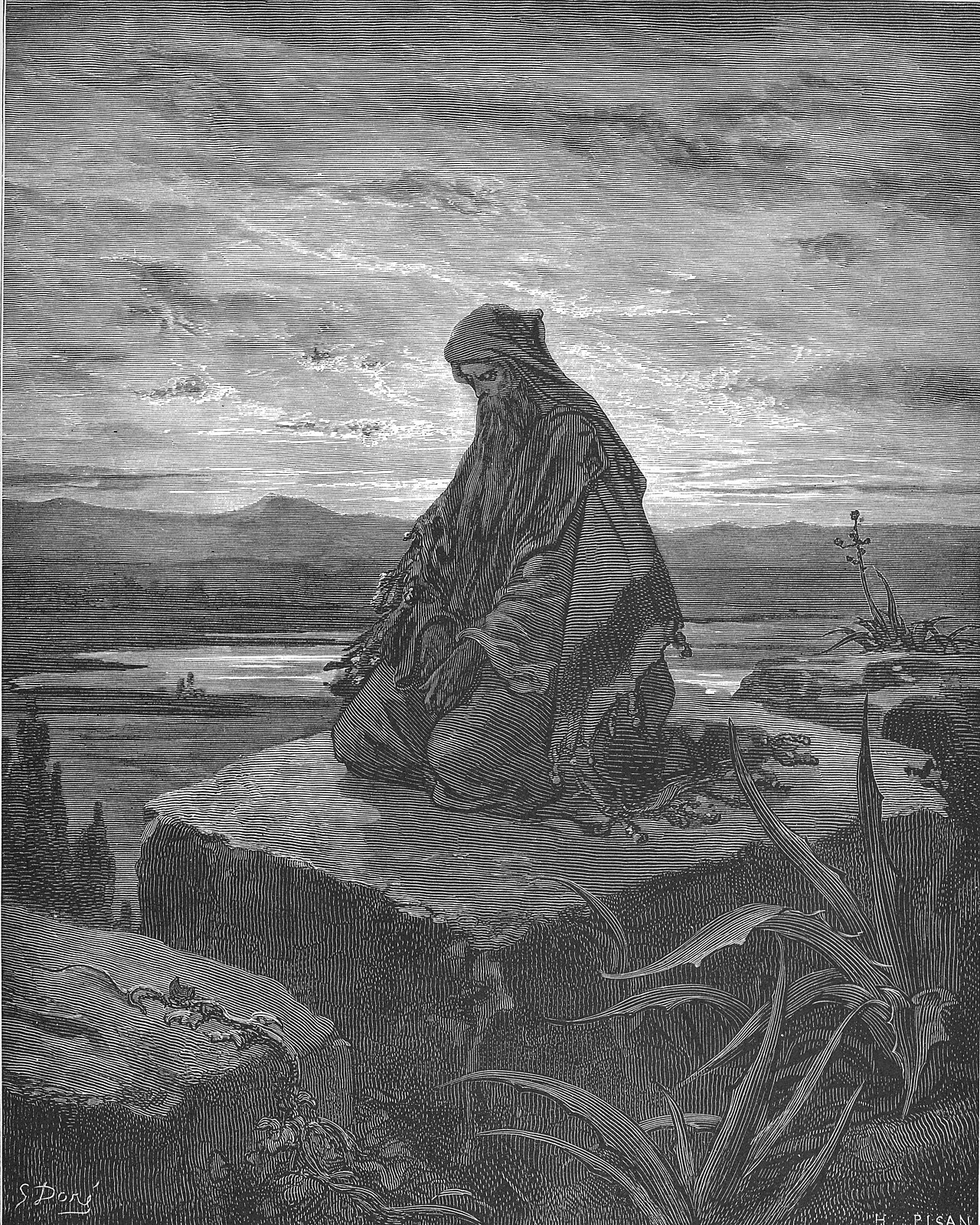
Isaiahchapter 8
22 verses · Isaiah · 8th century BC · The Prophets
And He will be a sanctuary—but to both houses of Israel a stone of stumbling and a rock of offense, to the dwellers of Jerusalem a trap and a snare.
Introduction
Isaiah, The Prophets, Isaiah Overview.
Isaiah wrote this chapter in his own voice during the months after his meeting with Ahaz, while the war with Damascus and Samaria still hung over Judah. Its first hearers were deciding whether to trust Assyria, the rebel alliance or the God who had spoken. It moves from a public sign to warnings and then to instruction for the prophet's own circle. Listen for the child whose name carries the message, and for the two kinds of water set against each other. Notice what the people are told to fear. The chapter teaches how a small faithful group waits in a dark time.
Context
- Who
- Judeans deciding whether to trust Assyria, the coalition, or the God who had just spoken
- What
- The sign of Maher-shalal-hash-baz, the flood of Assyria over a people who refused Shiloah's waters, and the call to fear God and wait for Him.
- Where
- Jerusalem, at a public tablet, in the prophet's household and by the waters of Shiloah on the city's east slope.
- When
- The Syro-Ephraimite crisis, about 734 to 732 BC.
- Why
- To confirm that Damascus and Samaria would fall to Assyria, to warn Judah, and to set the faithful apart around God's word.
Historical context
Isaiah is told to take a large tablet and write on it in ordinary script with a common stylus, before named witnesses. That is a legal act, not an art project. Public notices and contracts were written large, witnessed, and displayed, and using the everyday hand rather than a scribal flourish meant any literate passerby could read it. The message was four words long, roughly: quick to the spoil, swift to the plunder. Then a child was born and given the same name, so the prophecy walked around the city on two legs.
Show the rest of the historical context, 3 more paragraphs
The waters of Shiloah that go softly were a specific stream. Jerusalem's spring water ran down the eastern slope in an open, gently sloping channel, no rush, no roar, easy to overlook. Against it Isaiah sets the Euphrates in flood, which is what an empire looks like: it fills the channel, overflows the banks, and reaches up to the neck.
Consulting the dead was a live business. People went to mediums who whispered and chirped, the sound described is the thin, birdlike voice a practitioner produced for the spirit, and paid for a word about the future. Israel's law made it a capital offense, precisely because a nation that had a living God speaking had no business questioning corpses.
The instruction to bind up the testimony and seal the teaching among his disciples is the language of a sealed document entrusted to witnesses. If nobody will hear it now, seal it, it will be opened later, and it will still be true.
Significance
The generation being addressed was building a policy on rumor. Everyone was crying conspiracy, and Isaiah's counter was blunt: do not fear what they fear; fear God, and he becomes your sanctuary.
Show the rest of the significance, 1 more paragraph
The same stone is described two ways in one breath, a sanctuary, and a stone men trip over. What decides which is not the stone. That line was preached to a city about to trip.
This chapter in Jewish lifeWhat this chapter is in Jewish life and reading.
What is done
No part of this chapter is read in the synagogue. Probed for this lane, the site's own table in src/lib/hebraic/readings.ts printed parashot 0 and haftarah uses 0 for Isaiah 8, and no festival reading for the book. Across chapters 1 to 22 of Isaiah the same probe found a Haftarah only in chapters 1, 6, 7 and 9.
How it is read
Rashi is the main commentator on this chapter in the corpus, quoted here from The Judaica Press complete Tanach with Rashi, translated by A. J. Rosenberg, which Sefaria reports as CC-BY. Ibn Ezra is quoted from the Commentary of Ibn Ezra on Isaiah, translated by M. Friedlander in 1873, which Sefaria reports as Public Domain.
Rashi reads the son born to the prophetess as the child of the sign in chapter 7. "He is the very son whom the prophetess called Immanuel" (Rashi on Isaiah 8:3:1). He reads the two names as two signs. Maher-shalal-hash-baz is the disaster in store for Pekah and Immanuel is the salvation of the House of David (Rashi on Isaiah 8:18:1). The waters of Shiloah that flow gently are the kingdom of the House of David, "which leads them gently" (Rashi on Isaiah 8:6:1).
The conspiracy of the twelfth verse is read through the court of Hezekiah, where Shebna's company outnumbered Hezekiah's. Rashi has the prophet tell Hezekiah's men not to say, "We decide according to the majority" (Rashi on Isaiah 8:12:1). The prophet's waiting in the seventeenth verse is his hope that God will "save the House of David" (Rashi on Isaiah 8:17:1).
On the nineteenth verse Rashi reports Rabbi Simon's tradition that Beeri, the father of Hosea, prophesied two verses which were attached to Isaiah "since they were not enough for a Book" (Rashi on Isaiah 8:19:1). The corpus numbers the chapter by the Hebrew text, so its last verse, 8:23, is the verse an English Bible numbers 9:1 (Rashi on Isaiah 8:23:1).
What the rabbis say
The corpus carries 40 rabbinic locators on the verses of this chapter, 7 in the Talmud and 33 in the Midrash. It carries the text of none, so each is cited by ref here and never quoted or paraphrased. The verse numbers are the Hebrew ones the corpus prints.
On verse 2 it holds Bereshit Rabbati, Parashat Vayishlach 26, Eikhah Rabbah 5:18 and Ein Yaakov (Glick Edition), Makkot 3:9. On verse 3 it holds Shemot Rabbah 18:5. On verse 5 it holds Bereshit Rabbah 61:4, Midrash Lekach Tov, Genesis 25:1:1 and Midrash Sekhel Tov, Bereshit 25:1:1. On verse 6 it holds Bamidbar Rabbah 18:21, Bereshit Rabbah 78:14 and Bereshit Rabbati, Parashat Lech Lecha 31. On verse 7 it holds Bamidbar Rabbah 2:16, Ein Yaakov, Sanhedrin 11:27 and Midrash Tannaim on Deuteronomy 33:2:32.
On verse 8 it holds Ein Yaakov (Glick Edition), Sanhedrin 11:33, Midrash Tanchuma Buber, Tazria 10:3 and Midrash Tanchuma, Tazria 8:1. On verse 10 it holds Esther Rabbah 7:13, Midrash Lekach Tov on Esther 4:1:1 and Midrash Sekhel Tov, Shemot 2:8:2. On verse 12 it holds Ein Yaakov (Glick Edition), Sanhedrin 3:4, Ein Yaakov, Sanhedrin 3:7 and Sanhedrin 26a:23. On verse 14 it holds Ein Yaakov (Glick Edition), Sanhedrin 4:11, Ein Yaakov, Sanhedrin 4:18 and Sanhedrin 38a:2. On verse 16 it holds Bereshit Rabbah 42:3, Esther Rabbah, Petichta 10 and Esther Rabbah, Petichta 11.
On verse 17 it holds Jerusalem Talmud Sanhedrin 10:2:6, Megillah 24b:11 and Shir HaShirim Rabbah 5:11:2. On verse 18 it holds Midrash Tehillim 90:2 and Sukkah 52a:5. On verse 19 it holds Ein Yaakov (Glick Edition), Sotah 1:43 and Ein Yaakov, Sotah 1:50. On verse 21 it holds Avodah Zarah 53a:6 and Jerusalem Talmud Avodah Zarah 4:5:2. On verse 22 it holds Mekhilta DeRabbi Shimon Ben Yochai, Additions 8:2.
On verse 23 it holds Bamidbar Rabbah 23:14 and Eikhah Rabbah, Petichta 5.
What each of them teaches is a saying of the rabbis, and is reported as theirs wherever this site quotes one. The quotations wait on a fetch that carries the text.
Sources: Rashi, Rashi on Isaiah 8:1:1 to 8:23:1, The Judaica Press complete Tanach with Rashi, translated by A. J. Rosenberg, reported CC-BY; Ibn Ezra, Ibn Ezra on Isaiah 8:5:1, Commentary of Ibn Ezra on Isaiah - trans. by M. Friedlander, 1873, reported Public Domain; The Sefaria corpus, scripts/data/sources/sefaria/isaiah/8.json, the 40 Talmud and Midrash locators on the verses of this chapter; The site's own files, src/lib/hebraic/readings.ts, probed for Isaiah 8: parashot 0, haftarah uses 0, and no festival reading for the book.
The heads below are this chapter's scenes. The numbered points under each are its verses.
Maher-shalal-hash-baz: Swift Spoil, Speedy Prey
Isaiah 8:1-2
Isaiah is told to write Maher-shalal-hash-baz, hasten the spoil, hurry to the prey, "with an ordinary stylus," in script any passerby could read. Two "trustworthy witnesses," Uriah the priest and Zechariah, certify the writing before the child is conceived. No one can claim the prophecy was written after the fact.
Isaiah 8:1
“Take thee a great roll - The word which is here translated ‘roll’ more properly signifies tablet. So the Chaldee renders it. Those tablets were made of wood, metal, or stone, for the purpose of writing on; see Isa 30:8; Hab 2:2. On these tablets, or smooth plates, writing was performed by cutting the letters with an iron stylus, or small chisel. The process was slow, but the writing was permanent.”
Two trustworthy witnesses meet the law of Deuteronomy 19:15, as Aquinas says. Henry says Uriah the priest is the one who built an altar for King Ahaz in 2 Kings 16:10 and 11. At this time nothing stood against him as a witness.
Isaiah 8:2
“They were two in number (for out of the mouth of two witnesses shall every word be established ); one was Uriah the priest; he is mentioned in the story of Ahaz, but for none of his good deeds, for he humoured Ahaz with an idolatrous altar ( 2 Kings xvi. 10, 11 ); however, at this time, no exception lay against him, being a faithful witness.”
Matthew Henry · Commentary on the Whole Bible (1707-1721)puritan
1 more voice on this verse
Isaiah 8:2
“Uriah--an accomplice of Ahaz in idolatry, and therefore a witness not likely to assist the prophet of God in getting up a prophecy after the event (2Ki 16:10). The witnesses were in order that when the event should come, they might testify that the tablet containing the prophecy had been inscribed with it at the time that it professed.”
Jamieson, Fausset & Brown · Commentary Critical and Explanatory on the Whole Bible (1871)reformed
Isaiah 8:3-4
she conceived and gave birth: The prophetess bears a son the Lord names Maher-shalal-hash-baz. Before the boy can cry Father or Mother, "the wealth of Damascus and the plunder of Samaria will be carried off." Gill and Clarke set this beside the child of chapter 7 as a second dated clock toward the Assyrian invasion.
Isaiah 8:3
“And I went unto the prophetess,.... His wife, so called; not because she prophesied, but because she was the wife of a prophet; and besides, the birth of her son later mentioned, and his name, had in them the nature of a prophecy.”
before the boy knows how to cry: The boy of 8:3 sets the time, as the boy of 7:16 did. Clarke and Barnes put the fulfillment within three years, when the king of Assyria took Damascus and killed Rezin. 2 Kings 16:9 records it.
Isaiah 8:4
“For before the child - For my father and my mother, one MS. and the Vulgate have his father and his mother. The prophecy was accordingly accomplished within three years; when Tiglath-pileser, king of Assyria, went up against Damascus and took it, and carried the people of it captive to Kir, and slew Rezin, and also took the Reubenites and the Gadites, and the half-tribe of Manasseh, and carried them captive to Assyria, 2Ki 15:29; 2Ki 16:9; 1Ch 5:26.”
Adam Clarke · Commentary on the Bible (1810-1826)evangelical
1 more voice on this verse
Isaiah 8:4
“And his agrees with the other prophecy, chap. vii, 16. Before the child shall know to refuse the evil and chuse the good, which requires a longer time than to distinguish his parents, and suits well to Shear-Jashub, who, being born some years before, was capable of that farther degree of knowledge, as soon as this was capable of the lower degree.”
John Wesley · Explanatory Notes upon the Old Testament (1765)evangelical
The Quiet Waters of Shiloah and the River in Flood
Isaiah 8:5-6
the LORD spoke to me further: Judah has "rejected the gently flowing waters of Shiloah," the quiet spring inside Jerusalem's walls, and rejoices in Rezin and the son of Remaliah. The gentle waters despised here stand against the flood of the Euphrates summoned in the next verse.
the gently flowing waters of Shiloah: Shiloah was a small stream outside Jerusalem feeding a pool in the city, and Clarke takes its quiet flow as a picture of David's house. Gill identifies it with the pool of Siloam in John 9:7, whose name means sent. Its gentle water stands against the flood of verse 7.
Isaiah 8:6
“Forasmuch as this people refuseth “Because this people have rejected” - The gentle waters of Shiloah, a small fountain and brook just without Jerusalem, which supplied a pool within the city for the use of the inhabitants, is an apt emblem of the state of the kingdom and house of David, much reduced in its apparent strength, yet supported by the blessing of God; and is finely contrasted with the waters of the Euphrates, great, rapid, and impetuous; the image of the Babylonian empire, which God threatens to bring down like a mighty flood upon all these apostates of both…”
Adam Clarke · Commentary on the Bible (1810-1826)evangelical
2 more voices on this verse
Isaiah 8:6
“Forasmuch as this people refuseth the waters of Shiloah, that go softly,.... The same with Siloam, Joh 9:7 and so it is called in the Septuagint version here; and the word here used signifies "sent", as it is there interpreted.”
Isaiah 8:6
Obviously the only way to preserve the understanding of this passage is to explain its spiritual meaning. By the softly proceeding water of Siloam it means the gospel teaching of the word of salvation, because Siloam means "sent with a message." This would be God the Word, who was sent by the Father, of whom Moses says, "A ruler will not fail from Judah, nor a prince from his loins, until the one for whom it is stored up comes, and he is the expectation of the nations."
Eusebius of Caesarea · written before 339 · Proof of the Gospel 7:1patristic
Isaiah 8:7-8
the Lord will surely bring: The Lord brings "the mighty floodwaters of the Euphrates," the king of Assyria. The Hebrew speaks of outstretched wings, rendered "spreading streams," a bird of prey over the land. The prophet addresses "your entire land, O Immanuel," the name from chapter 7 returning to claim the threatened ground as his.
Isaiah 8:7
“The waters of the river - By the river, in the Scripture, is commonly meant the river Euphrates, as being, by way of eminence, the largest river with which they were acquainted; and also as being that distinguished by the fact that Abraham had lived beyond it, and crossed it; see the note at Isa 7:20. In this verse the image is kept up which was commenced in Isa 8:6. The Jews rejected the gentle waters of Siloah, and sought the alliance of a foreign king, whose kingdom stretched along, and extended beyond the Euphrates.”
1 more voice on this verse
Isaiah 8:7
“And here is another comfortable intimation that though the stretching out of the wings of the Assyrian, that bird of prey, though the right and left wing of his army, should fill the breadth of the land of Judah, yet still it was Immanuel's land. It is thy land, O Immanuel! It was to be Christ's land; for there he was to be born, and live, and preach, and work miracles.”
Matthew Henry · Commentary on the Whole Bible (1707-1721)puritan
O Immanuel!: Clarke and Barnes take the neck as Jerusalem, the head the flood reaches without covering. Henry notes that the land is still called Immanuel's land, tying it to the sign of 7:14. Verse 10 gives the meaning of the name.
Isaiah 8:8
“Such was the danger of Judah's land, when Sennacherib took all the fenced cities of Judah, 2 Kings xviii, 13, and sent his army against Jerusalem. Wings - Of his forces, or of the wings of his army, as they still are called. My land - Of the land of Judah, so called because the Messiah, who is called Immanuel, should be born there.”
John Wesley · Explanatory Notes upon the Old Testament (1765)evangelical
1 more voice on this verse
Isaiah 8:8
“He shall reach even to the neck - He compares Jerusalem, says Kimchi, to the head of the human body. As when the waters come up to a man’s neck, he is very near drowning, (for a little increase of them would go over his head), so the king of Assyria coming up to Jerusalem was like a flood reaching to the neck - the whole country was overflowed, and the capital was in imminent danger. Accordingly the Chaldee renders reaching to the neck by reaching to Jerusalem.”
Adam Clarke · Commentary on the Bible (1810-1826)evangelical
Isaiah 8:9-10
Huddle together, O peoples: The prophet addresses the nations directly, and the verdict "be shattered" comes three times like a drumbeat mocking every alliance formed against Judah. The refrain closes on the meaning of the child's name from chapter 7, "For God is with us," Immanuel confessed as the reason for confidence.
Isaiah 8:9
“The succession of the house of David cannot be set aside in Judah, for Immanuel Messiah is to be born in it as heir of David, of whom Isaiah's son is but a type (Isa 9:4, 6). give ear . . . far countries--witness the discomfiture of Judah's enemies.”
Jamieson, Fausset & Brown · Commentary Critical and Explanatory on the Whole Bible (1871)reformed
1 more voice on this verse
Isaiah 8:9
“For God is with us " (this refers to the name of Immanuel--God with us ); "the Messiah is to be born among us, and a people designed for such an honour cannot be given up to utter ruin. We have now the special presence of God with us in his temple, his oracles, his promises, and these are our defence.”
Matthew Henry · Commentary on the Whole Bible (1707-1721)puritan
The closing words translate the name Immanuel from 7:14 and 8:8. Henry reads the verse that way, and Barnes takes the whole address as a challenge to the nations that plotted against Judah. Their plans fail as the plot of 7:5 failed.
Isaiah 8:10
“Take counsel together - This is an address to the same foreign nations. It refers to the designs which they would form to destroy the Jewish state. Speak the word - That is, give the command - to overturn the nation of the Jews. It shall not stand - It shall not be accomplished. For God is with us - Hebrew ‘For Immanuel.’ It indicates the confidence of the prophet in view of the promise and the pledge. His reliance was there.”
A Sanctuary, and a Stone of Stumbling
Isaiah 8:11-13
the LORD has spoken to me: The Lord speaks to Isaiah, instructing him "not to walk in the way of this people," whose fear of conspiracy had gripped Ahaz. Isaiah must "not fear what they fear" and must regard the LORD of Hosts alone as holy. The instruction sets the prophet apart from the people.
Isaiah 8:11
“For the Lord spake thus - Spake that which immediately follows in the next verse. Warned him not to Unite in the alliance with foreign kingdoms which the nation was about forming. With a strong hand - Margin, ‘With strength of hand.’ That is, when the hand of God urged me.”
The Hebrew word for conspiracy is qesher, and Clarke says the Septuagint read a word meaning hard. Barnes takes the command as a call to refuse the fear of Ahaz's people and their alliance with Assyria. 1 Peter 3:14 draws on these words.
Isaiah 8:12
“Say ye not, A confederacy “Say ye not, It is holy” - קשר kesher. Both the reading and the sense of this word are doubtful. The Septuagint manifestly read קשה kashah; for they render it by σκληρον, hard. The Syriac and Chaldee render it מרדא merda, and מרוד dn merod, rebellion. How they came by this sense of the word, or what they read in their copies, is not so clear. But the worst of it is, that neither of these readings or renderings gives any clear sense in this place.”
Adam Clarke · Commentary on the Bible (1810-1826)evangelical
Cross references
Isaiah 8:12
- Quoted in1 Peter 3:14But even if you should suffer for what is right, you are blessed. “Do not fear what they fear; do not be shaken.”
'Be not afraid of their terror, neither be troubled'
The LORD of Hosts is the One you shall regard as holy: Barnes says to regard the LORD of Hosts as holy is to trust Him to defend Judah, when Ahaz trusted Assyria. Bonaventure joins the verse to Matthew 6:9. 1 Peter 3:15 says the same of Christ.
Isaiah 8:13
“Sanctify--Honor His holy name by regarding Him as your only hope of safety (Isa 29:23; Nu 20:12). him . . . fear--"fear" lest you provoke His wrath by your fear of man and distrust of Him.”
Jamieson, Fausset & Brown · Commentary Critical and Explanatory on the Whole Bible (1871)reformed
Isaiah 8:14-15
The Lord will be "a sanctuary," and "a stone of stumbling," one object with opposite effects as it is trusted or resisted. Paul joins it to Isaiah 28:16 at Romans 9:33, and Peter cites it at 1 Peter 2:8 of those who stumble by disobeying the word.
Isaiah 8:14
“MANY of the Rabbis, and I think with good reason, refer this to the Messiah. We refer it to Jesus Christ, the Man of Nazareth, the Son of God, who is the Messiah of God to our souls. We are, no doubt, justified in referring it to our Lord Jesus Christ, because Peter, speaking by the Holy Spirit, uses the next part of the verse in reference to Him. He declares that it was written that Jesus should be a stone of stumbling, and a rock of offense.”
Charles Spurgeon · written before 1892 · The Metropolitan Tabernacle Pulpit, Sermon No. 3522: “Christ a Sanctuary” (lightly modernized text, CCEL edition)Particular Baptist
2 more voices on this verse
Isaiah 8:14
“Jerusalem - Which are distinctly mentioned, as a wonderful thing, because Jerusalem was the seat of the temple, and of God's solemn worship, where all the means of knowledge and grace were in greatest plenty, where the thrones of civil and ecclesiastical judicature were established, where the most wise and learned doctors had their constant abode.”
John Wesley · Explanatory Notes upon the Old Testament (1765)evangelical
Isaiah 8:14
“And he shall be for a sanctuary “And he shall be unto you a sanctuary” - The word לכם lachem, unto you, absolutely necessary, as I conceive, to the sense, is lost in this place: it is preserved by the Vulgate, “et erit vobis in sanctificationem.” The Septuagint have it in the singular number: εσται σοι εις ἁγιασμον, it shall be to Thee. Or else, instead of מקדש mikdash, a sanctuary, we must read מוקש mokesh, a snare, which would then be repeated without any propriety or elegance, at the end of the verse.”
Adam Clarke · Commentary on the Bible (1810-1826)evangelical
Cross references
Isaiah 8:14
- Quoted in1 Peter 2:8“and, “A stone of stumbling and a rock of offense.” They stumble because they disobey the word—and to this they were appointed.”
'A stone of stumbling, and a rock of offence'
Many will stumble over these: Barnes takes the stumbling as the Assyrian invasion, when many fell and were captured. Gill takes it of Christ, set for the falling and rising of many in Luke 2:34. Romans 9:33 joins this stone to Isaiah 28:16.
Isaiah 8:15
“And many among them,.... Not all, though the greater part; for Christ was set for the falling and rising of many in Israel, Luk 2:34, shall stumble, and fall, and be broken: stumble at Christ, the stumbling stone; fall by unbelief into other sins and punishment, and be broken in pieces by this stone, Mat 21:44, and be snared, and be taken; and so die in their sins, and perish eternally. The allusion is to birds being taken in a snare or trap, or with bird lime, and therein or thereby held and detained.”
2 more voices on this verse
Isaiah 8:15
“And many among them - Many by the invasion under the Assyrian. Many were taken captive; many killed. and many were carried to Babylon. The repetition here of so many expressions so nearly synonymous is emphatic, and shows that it would be certainly done.”
Isaiah 8:15
“Many - Not all; for there shall be a remnant, as was foretold, chap. iv, 2; vi, 13. Stumble - At that stone or rock, mentioned, ver. viii, 14. This was accomplished at the coming of the Messiah, whom the Jews rejected to their own destruction.”
John Wesley · Explanatory Notes upon the Old Testament (1765)evangelical
To the Law and the Testimony, Not the Mediums
Isaiah 8:16-18
Bind up the testimony and seal: The command to "seal the law among my disciples" means kept safe and certified for a later day. Isaiah's posture is patient trust, "I will wait for the LORD," set against Ahaz's refusal of a sign. Isaiah and his children, Shear-jashub and Maher-shalal-hash-baz, stand as "signs and symbols in Israel."
Isaiah 8:16
“Among my disciples - בלמדי belimmudai. The Septuagint render it του μη μαθειν. Bishop Chandler, Defence of Christianity, p. 308, thinks they read מלמד, that it be not understood, and approves of this reading. - Abp. Secker.”
Adam Clarke · Commentary on the Bible (1810-1826)evangelical
I will wait for the LORD: Isaiah has sealed the law among his disciples in 8:16, and now he will wait for the LORD. Barnes takes the waiting as the prophet's trust after Israel refused his word, and Gill as waiting for Christ. Hebrews 2:13 quotes the words.
Isaiah 8:17
“And I will wait upon the Lord,.... Or "for the Lord" (x); for the coming of Christ, the Immanuel, who would be a sanctuary to some, and a stone of stumbling to others, and whose doctrine in the meanwhile would be bound up and sealed; faith in, and expectation of the Messiah's coming, are often signified by waiting for him, Isa 25:9, that hideth his face from the house of Jacob; to whom the promise of him was made, from whom he should descend, to whom he should be sent, and whom he would redeem.”
2 more voices on this verse
Isaiah 8:17
“And I will wait upon the Lord - This is the commencement of a new subject. The prophet had closed his former message; but had seen that in regard to the great mass of the nation, his exhortation had been in vain. He now says, that having delivered his message, he would patiently look to God alone. His hope was in him, though the nation looked elsewhere; and though calamities were coming, yet he would still trust in God only. That hideth his face - This is a figurative expression, denoting the withdrawing of his favor and protection.”
Isaiah 8:17
“Second, the awaiting of what is hidden, and I will wait: but I will look towards the Lord, I will wait for God (Mic 7:7).”
Thomas Aquinas · written before 1274 · Commentary on Isaiahpatristic
Cross references
Isaiah 8:17
- Quoted inHebrews 2:13And again: “I will put My trust in Him.” And once again: “Here am I, and the children God has given Me.”
'I will put my trust in him' (w/ Isa 8:18, 'the children which God hath given me')
the children the LORD has given me as signs and symbols: The names of Isaiah's children, Shear-jashub in 7:3 and Maher-shalal-hash-baz in 8:3, are the signs. Barnes says the LORD gave them to Israel to teach that He dwells with His people. Spurgeon follows Hebrews 2:13, which gives these words to Christ.
Isaiah 8:18
“Behold - These words are literally spoken by Isaiah concerning himself, but mystically concerning Christ; and therefore they are fitly ascribed to Christ, Heb. ii, 13. The children - His spiritual children, whom he had either begotten or brought up by his ministry. Wonders - Are a gazing flock, for our folly in believing God's promises.”
John Wesley · Explanatory Notes upon the Old Testament (1765)evangelical
Isaiah 8:19-20
When men tell you to consult: When the people are urged to consult mediums, the prophet asks why they would "consult the dead on behalf of the living." The test is "To the law and to the testimony." Whoever does not speak by this word has "no light of dawn," the sealed testimony as the measure.
Isaiah 8:19
“And when they shall say - When the people, instead of putting confidence in God, shall propose to apply to necromancers. In the time of Ahaz the people were, as they were often, much inclined to idolatry; 2Ki 16:10. In their troubles and embarrassments, instead of looking to Yahweh, they imitated the example of surrounding nations, and applied for relief to those who professed to be able to hold converse with spirits.”
1 more voice on this verse
Isaiah 8:19
“Hence the Septuagint renders the Hebrew for "necromancers" here "ventriloquists" (compare Isa 29:4). mutter--moan. should not, &c.--The answer which Isaiah recommends to be given to those advising to have recourse to necromancers. for the living, &c.--"should one, for the safety of the living, seek unto (consult) the dead?" [GESENIUS].”
Jamieson, Fausset & Brown · Commentary Critical and Explanatory on the Whole Bible (1871)reformed
To the law and to the testimony!: Against the mediums of verse 19 Isaiah sets the written word. Barnes reads the call as a test of every voice by what God has revealed. Clarke ties the testimony to the witnessed writing of 8:1 to 4 and the law to the command of verses 11 to 15.
Isaiah 8:20
“To the law - Let this dispute between you and them be determined by God's word, which is here and in many other places called the law, to signify their obligation to believe and obey it; and the testimony, because it is a witness between God and man, of God's will, and of man's duty. No light - This proceeds from the darkness of their minds, they are blind, and cannot see.”
John Wesley · Explanatory Notes upon the Old Testament (1765)evangelical
1 more voice on this verse
Isaiah 8:20
“To the law and to the testimony “Unto the command, and unto the testimony” - “Is not תעודה teudah here the attested prophecy, Isa 8:1-4? and perhaps תורה torah the command, Isa 8:11-15? for it means sometimes a particular, and even a human, command; see Pro 6:20, and Pro 7:1, Pro 7:2, where it is ordered to be hid, that is, secretly kept.” - Abp. Secker.”
Adam Clarke · Commentary on the Bible (1810-1826)evangelical
Isaiah 8:21-22
They will roam the land: Those who reject the testimony "roam the land, dejected and hungry," and hunger turns to rage instead of repentance. Looking to the earth they find "only distress and darkness and the gloom of anguish." The chapter closes in gloom, the darkness chapter 9 names and answers with a great light.
Isaiah 8:21
“And they shall pass through it,.... The land, as the Targum and Kimchi supply it; that is, the land of Judea, as Aben Ezra interprets it.”
2 more voices on this verse
Isaiah 8:21
“And they shall pass - The people who have been consulting necromancers. This represents the condition of these who have sought for counsel and direction, and who have not found it. They shall be conscious of disappointment, and shall wander perplexed and alarmed through the land. Through it - Through the land. They shall wander in it from one place to another, seeking direction and relief. Hardly bestead - Oppressed, borne down, agitated.”
Isaiah 8:21
“The foolishness of man perverts his way, and then his heart frets against the Lord, Prov. xix. See what need we have to keep our mouth as with a bridle when our heart is hot within us; for the language of fretfulness is commonly very offensive. [4.] They shall abandon themselves to despair, and, which way soever they look, shall see no probability of relief.”
Matthew Henry · Commentary on the Whole Bible (1707-1721)puritan
they will be driven into utter darkness: Verse 21 has them look upward, and here they look to the earth, and neither way gives relief. Barnes reads the anguish as the price of leaving the true God as counselor, and he points back to 5:30. Isaiah 9:1 and 2 answer this gloom with a great light.
Isaiah 8:22
“And they shall look unto the earth - They would look upward and find no relief, and then in despair cast their eyes to the earth to obtain help there. Yet equally in vain. The whole image is one of intense anguish brought on the nation for leaving the counselor the true God. And behold ... - see the note at Isa 5:30. Trouble - Anguish, oppression, צרה tsârâh, from צור tsûr, to oppress, to straiten, to afflict. This is a remarkable instance of the prophet Isaiah’s manner - of a rapid, impetuous, and bold style of utterance.”
Keep studying
Studies10
Sources for this chapter
The summary
Jamieson, Fausset & Brown, Commentary Critical and Explanatory; John Calvin, Commentaries; John Wesley, Notes on the Old Testament and Matthew Henry, Complete Commentary.
The exposition
Adam Clarke, Commentary on the Bible; Albert Barnes; Bonaventure, Collationes de Septem Donis, Collation 2; Charles Spurgeon, The Metropolitan Tabernacle Pulpit, Sermon No. 1194: “"I and the Children"” (lightly modernized text, CCEL edition); Franz Delitzsch, Biblical Commentary on the Prophecies of Isaiah; John Gill; Matthew Henry, Commentary on the Whole Bible and Thomas Aquinas, Commentary on Isaiah.