
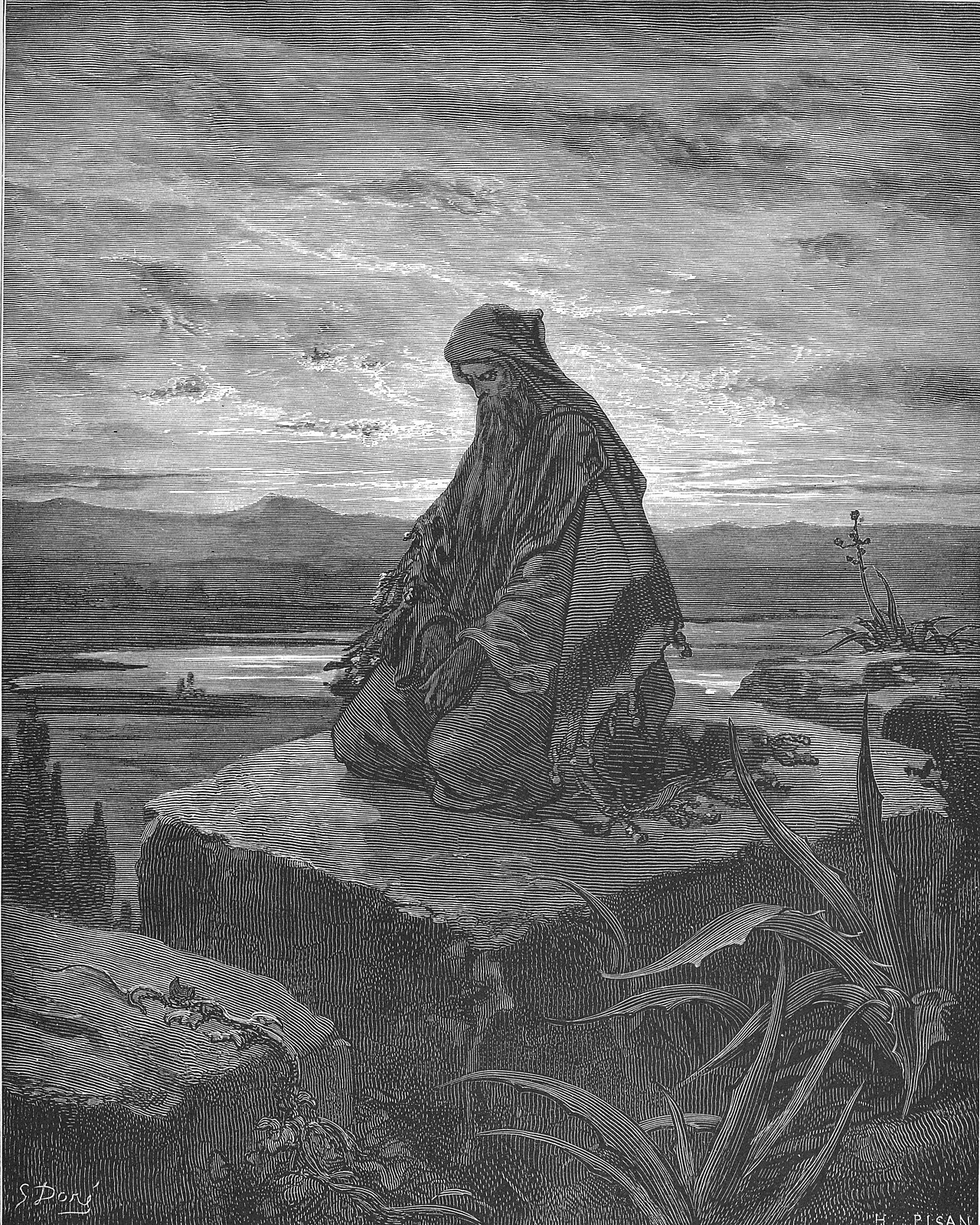
Isaiahchapter 52
15 verses · Isaiah · 8th century BC · The Prophets
Depart, depart, go out from there! Touch no unclean thing; come out from it, purify yourselves, you who carry the vessels of the LORD.
The last three verses of this chapter open the fourth song about the Servant, which runs on through Isaiah 53. Read Isaiah 53→
Introduction
Isaiah, The Prophets, Isaiah Overview.
Isaiah wrote this chapter for exiles waiting for news from a battle they could not see. It calls Jerusalem to wake, rise from the dust and put on her strength. The chapter then turns to a messenger bringing word across the mountains and to watchmen who see the LORD return to Zion. The last three verses begin the fourth song of the Servant, which runs on through chapter 53. Listen for the call to depart, and how it differs from the hurried night of the first exodus. Paul uses this chapter's messenger to speak of those who preach the gospel.
Context
- Who
- Exiles waiting for word from a battlefield they could not see
- What
- A call for Zion to awake, the good news of God's reign, the command to leave Babylon, and the opening of the fourth Servant Song.
- Where
- Jerusalem and the mountains around it, and the road out of Babylon.
- When
- Spoken about 700 to 690 BC by the book's own reading.
- Why
- To announce that the LORD reigns and is bringing His people home, and to introduce the Servant who will be exalted after suffering.
Historical context
The picture of the captive is exact. Shake yourself from the dust, arise, sit down; loose yourself from the bonds around your neck. Prisoners sat on the ground in the dirt, and captives were moved with neck ropes or wooden collars linking a column of men together, Assyrian reliefs show it. Getting up off the ground and off the rope is the whole command.
Show the rest of the historical context, 4 more paragraphs
The runner on the mountains is how war news arrived. A city under threat posted watchmen who scanned the ridgelines, and when a messenger appeared they read the outcome from how he ran before he could speak. So the line about beautiful feet on the mountains is not sentiment: those are the feet of the man whose arrival ends the waiting. What he shouts is a battle result, your God reigns.
The redemption terms come with a note about price. You were sold for nothing, and you shall be redeemed without money. God buys nothing back from Babylon; he was never paid for them in the first place.
The departure instructions distinguish this exodus from the first. Depart, go out from there, touch no unclean thing, be clean, you who carry the vessels of the LORD, the temple utensils being carried home. But you shall not go out in haste, nor go by flight, for the LORD will go before you, and the God of Israel will be your rear guard. The first exodus was a night run with bread that had no time to rise. This one is an orderly march with an escort front and back.
The last three verses begin the fourth Servant song, and they begin with disfigurement. His appearance was marred more than any man, and his form more than the sons of men. A prisoner beaten past recognition is a specific sight, and the ancient world had seen it.
Significance
The complaint the chapter answers is that God's name was being dragged through the mud by Israel's condition: my name is blasphemed continually every day. The rescue is about his reputation as much as their comfort.
Show the rest of the significance, 1 more paragraph
And for hearers among the nations, the last line of the chapter set up everything that follows: what had not been told them they will see, and what they had not heard they will consider. The kings of the earth shut their mouths.
This chapter in Jewish lifeWhat this chapter is in Jewish life and reading.
What is done
The site's own table in src/lib/hebraic/readings.ts sets this chapter in one prophetic reading of the annual cycle. It is read as the Haftarah of Shoftim, Isaiah 51:12 to 52:12, in both rites, on the Sabbath of the portion Deuteronomy 16:18 to 21:9. A congregation keeping that cycle hears the verses of each reference read aloud after the Torah portion of its Sabbath.
The corpus joins the chapter to the weeks of the Torah portions through the works arranged by portion. Under the second verse it carries Bereshit Rabbati, Parashat Vayetze 50. Under the fifth verse it carries Midrash Tanchuma, Pekudei 1:2 and Midrash Tanchuma, Pekudei 2:1. Under the sixth verse it carries Midrash Tanchuma Buber, Vaera 5:1. Under the tenth verse it carries Midrash Tanchuma Buber, Bereshit 7:1 and Midrash Tanchuma Buber, Kedoshim 4:1. Under the twelfth verse it carries Midrash Tanchuma Buber, Devarim 1:1 and Midrash Tanchuma, Devarim 1:1. Under the thirteenth verse it carries Midrash Tanchuma Buber, Toldot 20:1 and Midrash Tanchuma, Toldot 14:1.
How it is read
Two commentators on this chapter carry English in the corpus. Rashi is quoted from The Judaica Press complete Tanach with Rashi, translated by A. J. Rosenberg, which Sefaria reports as CC-BY, and every quotation of it is held to fifty words or fewer because the translation is modern. Ibn Ezra is quoted from the version Sefaria titles Commentary of Ibn Ezra on Isaiah - trans. by M. Friedlander, 1873, which it reports as Public Domain.
Ibn Ezra opens the chapter by fixing its time, and he argues against another reader to do it. "All agree that this prophecy has reference to the time yet to come", he writes, and he names R. Moses Hakkohen as holding the return from Babylon in error. The uncircumcised no longer entering Zion, and the oath like the waters of Noah, are to him the words of an irrevocable decree (Ibn Ezra on Isaiah 52:1:1).
Rashi reads the sale of the third verse as a moral account. Israel was sold for worthless matters, the evil inclination, and will be redeemed "but with repentance" rather than with money (Rashi on Isaiah 52:3:1 and 52:3:2). At the fourth verse he weighs two oppressors. Egypt had a claim on Israel as host, while Assyria oppressed them for nothing (Rashi on Isaiah 52:4:1). The going out without haste of the twelfth verse he explains from its own end: the Lord goes before as guide and behind as rear guard (Rashi on Isaiah 52:12:1). Ibn Ezra reads the reign of God in the seventh verse as the meaning of the Behold, it is I of the verse before (Ibn Ezra on Isaiah 52:7:2).
The thirteenth verse begins the passage on the servant who shall prosper, and Rashi names the servant at once: "at the end of days, My servant, Jacob, [i.e.,] the righteous among him, shall prosper". The marred appearance of the fourteenth verse is Israel's humble state as the nations saw it (Rashi on Isaiah 52:13:1 and 52:14:1). The next chapter carries the rest of that reading.
The corpus carries one further note on this chapter without an English text, marked linked because Sefaria holds no English version of the ref. It stands cited and unquoted at Radak on Isaiah 52:9:1.
What the rabbis say
The corpus carries forty rabbinic locators on this chapter and the text of none, so each is cited and linked here rather than quoted. On the first verse it holds Aggadat Bereshit 68:2, Mekhilta DeRabbi Shimon Ben Yochai 14:14, Mekhilta DeRabbi Shimon Ben Yochai 15:19 and Mekhilta DeRabbi Yishmael, Tractate Vayehi Beshalach 4:4. On the second verse it holds Aggadat Bereshit 39:1, Bereshit Rabbah 75:1, Bereshit Rabbati, Parashat Vayetze 50 and Eikhah Rabbah 1:23. On the third verse it holds Ein Yaakov (Glick Edition), Sanhedrin 11:46, Jerusalem Talmud Taanit 1:1:13, Megillah 24a:4 and Midrash Aggadah, Leviticus 25:48:1.
On the fifth verse it holds Ein Yaakov, Sukkah 5:13, Midrash Tanchuma, Pekudei 1:2, Midrash Tanchuma, Pekudei 2:1 and Midrash Tehillim 20:1. On the sixth verse it holds Midrash Tanchuma Buber, Vaera 5:1, Midrash Tehillim 91:6, Pesikta Rabbati 22:1 and Pirkei DeRabbi Eliezer 40:10. On the seventh verse it holds Berakhot 56b:10, Devarim Rabbah 5:15, Eikhah Rabbah 1:57 and Eikhah Rabbah 5:18. On the eighth verse it holds Aggadat Bereshit 23:2, Ein Yaakov (Glick Edition), Sanhedrin 11:13, Ein Yaakov, Sanhedrin 11:10 and Midrash Aggadah, Leviticus 26:12:1.
On the tenth verse it holds Aggadat Bereshit 47:2, Jerusalem Talmud Berakhot 9:1:12, Midrash Tanchuma Buber, Bereshit 7:1 and Midrash Tanchuma Buber, Kedoshim 4:1. On the twelfth verse it holds Mekhilta DeRabbi Yishmael, Tractate Pischa 7:4, Midrash Tanchuma Buber, Devarim 1:1, Midrash Tanchuma, Devarim 1:1 and Midrash Tannaim on Deuteronomy 16:3:12. On the thirteenth verse it holds Aggadat Bereshit 45:1, Midrash Tanchuma Buber, Toldot 20:1, Midrash Tanchuma, Toldot 14:1 and Midrash Tehillim 2:9. What each of them teaches is a saying of the rabbis, and is reported as theirs wherever this site quotes one. The quotations wait on a fetch that carries the text.
Sources: Rashi, Rashi on Isaiah 52:2:1 to 52:15:1, The Judaica Press complete Tanach with Rashi, translated by A. J. Rosenberg, reported CC-BY; Ibn Ezra, Ibn Ezra on Isaiah 52:1:1 to 52:9:1, Commentary of Ibn Ezra on Isaiah - trans. by M. Friedlander, 1873, reported Public Domain; Radak, Radak on Isaiah 52:9:1, cited by ref because the corpus carries no English text; The Sefaria corpus, scripts/data/sources/sefaria/isaiah/52.json, the 40 Talmud and Midrash locators of this chapter; The site's own files, src/lib/hebraic/readings.ts, the Haftarah entries for Shoftim (Isaiah 51:12 to 52:12).
The heads below are this chapter's scenes. The numbered points under each are its verses.
Awake, Put On Thy Strength, O Zion
Isaiah 52:1-3
clothe yourself with strength: The double summons “Awake, awake” answers the cup of chapter 51, and Zion is told to put on her “garments of splendor” again. Verse 3 states the terms: “You were sold for nothing, and without money you will be redeemed”, the free grace that 55:1 opens to all.
Isaiah 52:1
“Awake, awake - (See the notes at Isa 51:9). This address to Jerusalem is intimately connected with the closing verses of the preceding chapter. Jerusalem is there represented as down-trodden in the dust before her enemies. Here she is described under the image of a female that had been clad in the habiliments of mourning, and she is now called on to arise from this condition, and to put on the garments that would be indicative of gladness and of joy.”
Rise up and sit on your throne: The Hebrew reads rise up, sit, and a critic Clarke quotes found the pair at odds, since sitting in the dust marks mourning. Clarke answers from eastern custom. Jerusalem shakes off the dust of grief and takes a throne, and the captive Daughter of Zion loses her chains.
Isaiah 52:2
“Sit down, O Jerusalem “Ascend thy lofty seat, O Jerusalem” - The literal rendering here is, according to our English translation, “arise, sit;” on which a very learned person remarks: “So the old versions. But sitting is an expression of mourning in Scripture and the ancients; and doth not well agree with the rising just before.” It does not indeed agree, according to our ideas; but, considered in an oriental light, it is perfectly consistent. The common manner of sitting in the eastern countries is upon the ground or the floor with the legs crossed.”
Adam Clarke · Commentary on the Bible (1810-1826)evangelical
Barnes reads the verse as plain equity. The captors paid no money when Israel was sold, so none would be paid when the LORD redeemed her. Jamieson, Fausset and Brown point to Cyrus in Isaiah 45:13, who let the captives go without price or reward.
Isaiah 52:3
“Ye have sold yourselves for nought - You became captives and prisoners without any price being paid for you. You cost nothing to those who made you prisoners. The idea is, that as they who had made them prisoners had done so without paying any price for them, it was equitable that they should be released in the same manner. When their captors had paid nothing for them, God would suffer nothing to be paid for them in turn; and they should be released, as they had been sold, without a price paid for them.”
1 more voice on this verse
Isaiah 52:3
“As you became your foes' servants, without their paying any price for you (Jer 15:13), so they shall release you without demanding any price or reward (Isa 45:13), (where Cyrus is represented as doing so: a type of their final restoration gratuitously in like manner).”
Jamieson, Fausset & Brown · Commentary Critical and Explanatory on the Whole Bible (1871)reformed
Isaiah 52:4-6
went down to Egypt to live: Verse 4 recalls two oppressions, Egypt at first and Assyria after, both “without cause” on Israel's part. Verse 5 sets the present exile beside them. Verse 6 answers they “will know on that day that I am He who speaks”, the “I am He” of this half of the book.
Isaiah 52:4
“And yet when he oppressed them, I punished him severely, and delivered them out of his hands. The Assyrian - The king of Babylon, who is called the king of Assyria, 2 Kings xxiii, 29, as also the Persian emperor is called, Ezra vi, 22, because it was one and the same empire which was possessed, first by the Assyrians, then by the Babylonians, and afterwards by the Persians.”
John Wesley · Explanatory Notes upon the Old Testament (1765)evangelical
1 more voice on this verse
Isaiah 52:4
Thus saith the Lord God - אדני יהוה Adonai Jehovah; but Adonai is wanting in twelve of Kennicott’s, five of De Rossi’s, and two of my own MSS.; and by the Septuagint and Arabic. Some MSS. have יהוה צבאות Jehovah tsebaoth, “Lord of hosts;” and others have יהוה אלהים Yehovah Elohim, “Lord God.”
Adam Clarke · Commentary on the Bible (1810-1826)evangelical
those who rule them taunt: Barnes takes here to mean Babylon, where the people taken without cause needed the LORD to act as in Egypt and against Assyria. Jerome's text has the rulers acting unjustly where the Berean has them taunt. The blasphemy falls on the LORD's own name.
Isaiah 52:5
“Now, therefore, what have I here? - In Babylon, referring to the captivity of the Jews there. The idea is, that a state of things existed there which demanded his interposition as really as it did when his people had been oppressed by the Egyptians, or by the Assyrian. His people had been taken away for nought; they were subject to cruel oppressions; and his own name was continually blasphemed.”
Cross references
Isaiah 52:5
- Quoted inRomans 2:24As it is written: “God’s name is blasphemed among the Gentiles because of you.”
'The name of God is blasphemed among the Gentiles through you' ('as it is written')
that I am He who speaks: Clarke holds that the second therefore in the verse entered by mistake, absent from the Septuagint. Wesley reads that day as the day His people know His name through His power, at the return from Babylon and fully in the Messiah. Ambrose hears the LORD speak in person.
Isaiah 52:6
“Therefore my people shall know - The word לכן lachen, occurring the second time in this verse, seems to be repeated by mistake. It has no force nor emphasis as a repetition; it only embarrasses the construction and the sense. It was not in the copies from which the Septuagint, Syriac, and Vulgate were translated; it was not in the copy of the Septuagint from which the Arabic was translated; but in the Aldine and Complutensian editions δια τουτο is repeated; probably so corrected, in order to make it conformable with the Hebrew text.”
Adam Clarke · Commentary on the Bible (1810-1826)evangelical
2 more voices on this verse
Isaiah 52:6
“Shall know - They shall experience my power and goodness in fighting for them. In that day - When I shall redeem my people: which work was begun by the return of the Jews from Babylon, and perfected by the coming of the Messiah. Behold - That all these promises are the words of the omnipotent, unchangeable God.”
John Wesley · Explanatory Notes upon the Old Testament (1765)evangelical
Isaiah 52:6
“That is, he extended his hands to a people who did not believe and contradicted: not seeking an ambassador or messenger, but desiring to save his own people, the Lord himself: 'I, who spoke, behold I am here,' he said. And so, openly, I appear to those who do not seek me, and I am visible to those who do not ask me.”
Ambrose of Milan · written before 397 · On Joseph the Patriarch, 12.67patristic
How Beautiful the Feet That Bring Good Tidings
Isaiah 52:7-8
How beautiful on the mountains: The feet of the herald are beautiful for the message they carry, the word to Zion that her God reigns. Paul quotes the verse at Romans 10:15 of preachers sent with the gospel. In verse 8 the watchmen shout, “For every eye will see when the LORD returns to Zion”.
Isaiah 52:7
“How beautiful upon the mountains - This passage is applied by Paul to the ministers of the gospel (see Rom 10:15). The meaning here seems to be this: Isaiah was describing the certain return of the Jews to their own land. He sees in vision the heralds announcing their return to Jerusalem running on the distant hills. A herald bearing good news is a beautiful object; and he says that his feet are beautiful; that is, his running is beautiful.”
1 more voice on this verse
Isaiah 52:7
“Fully, and antitypically, the Gospel (Lu 2:10, 11), "beginning at Jerusalem" (Lu 24:47), "the city of the great King" (Mt 5:35), where Messiah shall, at the final restoration of Israel, "reign" as peculiarly Zion's God ("Thy God reigneth"; compare Ps 2:6).”
Jamieson, Fausset & Brown · Commentary Critical and Explanatory on the Whole Bible (1871)reformed
Cross references
Isaiah 52:7
- Quoted inRomans 10:15And how can they preach unless they are sent? As it is written: “How beautiful are the feet of those who bring good news!”
'How beautiful are the feet of them that preach the gospel' ('as it is written')
ConnectionsRomans 10:15
Your watchmen lift up their voices: The Hebrew opens with the words the voice of your watchmen, and Clarke finds no interpreter who has cleared the construction. The Berean text reads it as a cry, Listen. Wesley takes every eye that will see the LORD return to Zion as the eyewitnesses of Christ.
Isaiah 52:8
“Thy watchmen lift up the voice “All thy watchmen lift up their voice” - There is a difficulty in the construction of this place which, I think, none of the ancient versions or modern interpreters have cleared up satisfactorily. Rendered word for word it stands thus: “The voice of thy watchmen: they lift up their voice.” The sense of the first member, considered as elliptical, is variously supplied by various expositors; by none, as it seems to me, in any way that is easy and natural.”
Adam Clarke · Commentary on the Bible (1810-1826)evangelical
1 more voice on this verse
Isaiah 52:8
“Lift up thy voice - To give notice to all people of these glad tidings; and by way of exultation, to sing forth the praises of God for this glorious day. Eye - Distinctly and familiarly, their eyes beholding the eyes of this king of glory. They shall be eye and ear-witnesses of the words and works of Christ, and therefore their testimony shall be more certain and valuable.”
John Wesley · Explanatory Notes upon the Old Testament (1765)evangelical
Isaiah 52:9-10
Break forth in joy: The ruins of Jerusalem are told to sing, “for the LORD has comforted His people; He has redeemed Jerusalem”, the redemption promised in verse 3. “The LORD has bared His holy arm in the sight of all the nations”, the figure of a warrior throwing back his sleeve to strike.
Isaiah 52:9
“Break forth into joy - Jerusalem, at the time here referred to, was lying waste and in ruins. This call on the waste places of Jerusalem to break out into expressions of praise, is in accordance with a style which frequently occurs in Isaiah, and in other sacred writers, by which inanimate objects are called on to manifest their joy (see the notes at Isa 14:7-8; Isa 42:11). For the Lord hath comforted his people - That is, he does comfort his people, and redeem them.”
bared His holy arm: Heroes put on armor for battle, Spurgeon notes. God bares His holy arm before the nations, without armor, and looks only to the overthrow of His foe. Jerome's Latin has the LORD prepare His arm, and the Septuagint has Him reveal it.
Isaiah 52:10
“The Lord hath made bare his holy arm - That is, in delivering his people from bondage. This metaphor is taken from warriors, who made bare the arm for battle; and the sense is, that God had come to the rescue of his people as a warrior, and that his interpositions would be seen and recognized and acknowledged by all the nations. The metaphor is derived from the manner in which the Orientals dressed.”
1 more voice on this verse
Isaiah 52:10
“WHEN THE HEROES of old prepared for the fight they put on their armour; but when God prepares for battle he makes bare his arm. Man has to look two ways—to his own defence, as well as to the offence of his enemy; God hath but one direction in which to cast his eye—the overthrow of his foeman, and he disregards all measures of defence, and scorns all armour. He makes bare his arm in the sight of all the people.”
Isaiah 52:11-12
Depart, depart, go out from there!: The double “Depart, depart” echoes the double call of verse 1, and Paul applies “Touch no unclean thing” at 2 Corinthians 6:17. Those who “carry the vessels of the LORD” must be clean for the road. Unlike the hurried exodus from Egypt, “you will not leave in a hurry”.
Isaiah 52:11
“Long residence in Babylon made many loath to leave it: so as to mystical Babylon (Re 18:4). ye . . . that bear . . . vessels of the Lord--the priests and Levites, whose office it was to carry the vessels of the temple (Jer 27:18).”
Jamieson, Fausset & Brown · Commentary Critical and Explanatory on the Whole Bible (1871)reformed
Cross references
Isaiah 52:11
- Quoted in2 Corinthians 6:17“Therefore come out from among them and be separate, says the Lord. Touch no unclean thing, and I will receive you.”
'Come out from among them, and be ye separate'
Israel is your rear guard: Barnes sets the verse against the haste of Deuteronomy 16:3, and notes that the exiles left Babylon with time to prepare to carry the vessels. Gill adds that they would leave openly, unafraid. Jerome's Latin has the God of Israel gather them where the Berean has rear guard.
Isaiah 52:12
“For ye shall not go out with haste - As if driven out, or compelled to flee. You shall not go from Babylon as your fathers went from Egypt, in a rapid flight, and in a confused and tumultuous manner (see Deu 16:3). The idea here is, that they should have time to prepare themselves to go out, and to become fit to bear the vessels of the Lord. It was a fact that when they left Babylon they did it with the utmost deliberation, and had ample time to make any preparation that was necessary.”
1 more voice on this verse
Isaiah 52:12
“For ye shall not go out with haste, nor go by flight,.... As persons afraid of their enemies, of being pursued, overtaken, and detained by them; privily or by stealth, like fugitives, as the Oriental versions render it; in like manner as the Israelites went out of Egypt: but it signifies, that they should go out openly, boldly, quietly, and safely, and without fear of their enemies; yea, their enemies rather being afraid of them.”
My Servant Exalted, His Visage Marred More Than Any Man
Isaiah 52:13-15
My Servant will prosper: The fourth servant song opens, and its first word is exaltation: “He will be raised and lifted up and highly exalted”. Against that height verse 14 sets a form “marred beyond human likeness”. Paul quotes verse 15 at Romans 15:21, and the Targum of Jonathan names this servant the Messiah.
Isaiah 52:13
“My servant - That it is Christ who is here spoken of, is so evident, that the Chaldee paraphrast, and other ancient, and some later Hebrew doctors, understand it directly of him, and that divers Jews have been convinced and converted to the Christian faith, by the evidence of this prophecy.”
John Wesley · Explanatory Notes upon the Old Testament (1765)evangelical
2 more voices on this verse
Isaiah 52:13
“Notes on Isa 52:13-15 and Isa 53:1-12 The most important portion of Isaiah, and of the Old Testament, commences here, and here should have been the beginning of a new chapter. It is the description of the suffering Messiah, and is continued to the close of the next chapter. As the closing verses of this chapter are connected with the following chapter, and as it is of great importance to have just views of the design of this portion of Isaiah, it is proper in this place to give an analysis of this part of the prophecy.”
Isaiah 52:13
“The genuineness of the passage is certain; for the Jews would not have forged it, since it is opposed to their notion of Messiah, as a triumphant temporal prince. The Christians could not have forged it; for the Jews, the enemies of Christianity, are "our librarians" [PALEY].”
Jamieson, Fausset & Brown · Commentary Critical and Explanatory on the Whole Bible (1871)reformed
His form was marred beyond human likeness—: Clarke reads appalled at Him for at you, with the Syriac and Chaldee, as the Berean does. Jerome takes the marred form and appearance as the humility and poverty of His coming. Wesley finds the disfigured man worn by watchings, fastings and blows.
Isaiah 52:14
“As many were astonished at thee “As many were astonished at him” - For עליך aleicha read עליו alaiv. So the Syriac, Chaldee, and Vulgate in a MS.; and so likewise two ancient MSS.”
Adam Clarke · Commentary on the Bible (1810-1826)evangelical
1 more voice on this verse
Isaiah 52:14
“His countenance also was so marred with frequent watchings, and fastings, and troubles, that he was thought to be near fifty years old when he was but about thirty, John viii, 57, and was farther spoiled with buffetings, and crowning with thorns, and other cruel and despiteful usages.”
John Wesley · Explanatory Notes upon the Old Testament (1765)evangelical
so He will sprinkle many nations: Clarke keeps sprinkle while doubting it, and Secker, whom he quotes, preferred the Septuagint's reading, many nations will marvel at Him. Jamieson, Fausset and Brown keep sprinkle. Jerome sees in it the blood of Christ and baptism, before which kings shut their mouths.
Isaiah 52:15
“So shall he sprinkle many nations - I retain the common rendering, though I am by no means satisfied with it. “יזה yazzeh, frequent in the law, means only to sprinkle: but the water sprinkled is the accusative case; the thing on which has על al or אל el. Θαυμασονται, ό, makes the best apodosis. ינהג yenahag would do. ינהרו yinharu is used Isa 2:2; Jer 31:12; Jer 51:14, but is unlike. ‘Kings shall shut,’ etc., is good, but seems to want a first part.” - Secker.”
Adam Clarke · Commentary on the Bible (1810-1826)evangelical
1 more voice on this verse
Isaiah 52:15
“The antithesis is sufficient without any forced rendering. Many were astonished; so many (not merely men, but) nations shall be sprinkled. They were amazed at such an abject person claiming to be Messiah; yet it is He who shall justify and purify.”
Jamieson, Fausset & Brown · Commentary Critical and Explanatory on the Whole Bible (1871)reformed
Cross references
Isaiah 52:15
- Quoted inRomans 15:21Rather, as it is written: “Those who were not told about Him will see, and those who have not heard will understand.”
'To whom he was not spoken of, they shall see' (Paul's ambition to preach where unnamed)
ConnectionsRomans 15:21
Keep studying
Studies8
Sources for this chapter
The summary
Jamieson, Fausset & Brown, Commentary Critical and Explanatory; John Calvin, Commentaries; John Wesley, Notes on the Old Testament and Matthew Henry, Complete Commentary.
The exposition
Adam Clarke, Commentary on the Bible; Albert Barnes; Ambrose of Milan, On Joseph the Patriarch, 12.67; Charles Spurgeon, The New Park Street Pulpit, Sermon No. 185: “The Great Revival” (lightly modernized text, CCEL edition); Franz Delitzsch, Biblical Commentary on the Prophecies of Isaiah; Jamieson, Fausset & Brown, Commentary Critical and Explanatory on the Whole Bible; Jerome, Commentary on Isaiah; John Gill; John Wesley, Explanatory Notes upon the Old Testament and Matthew Henry, Commentary on the Whole Bible.