
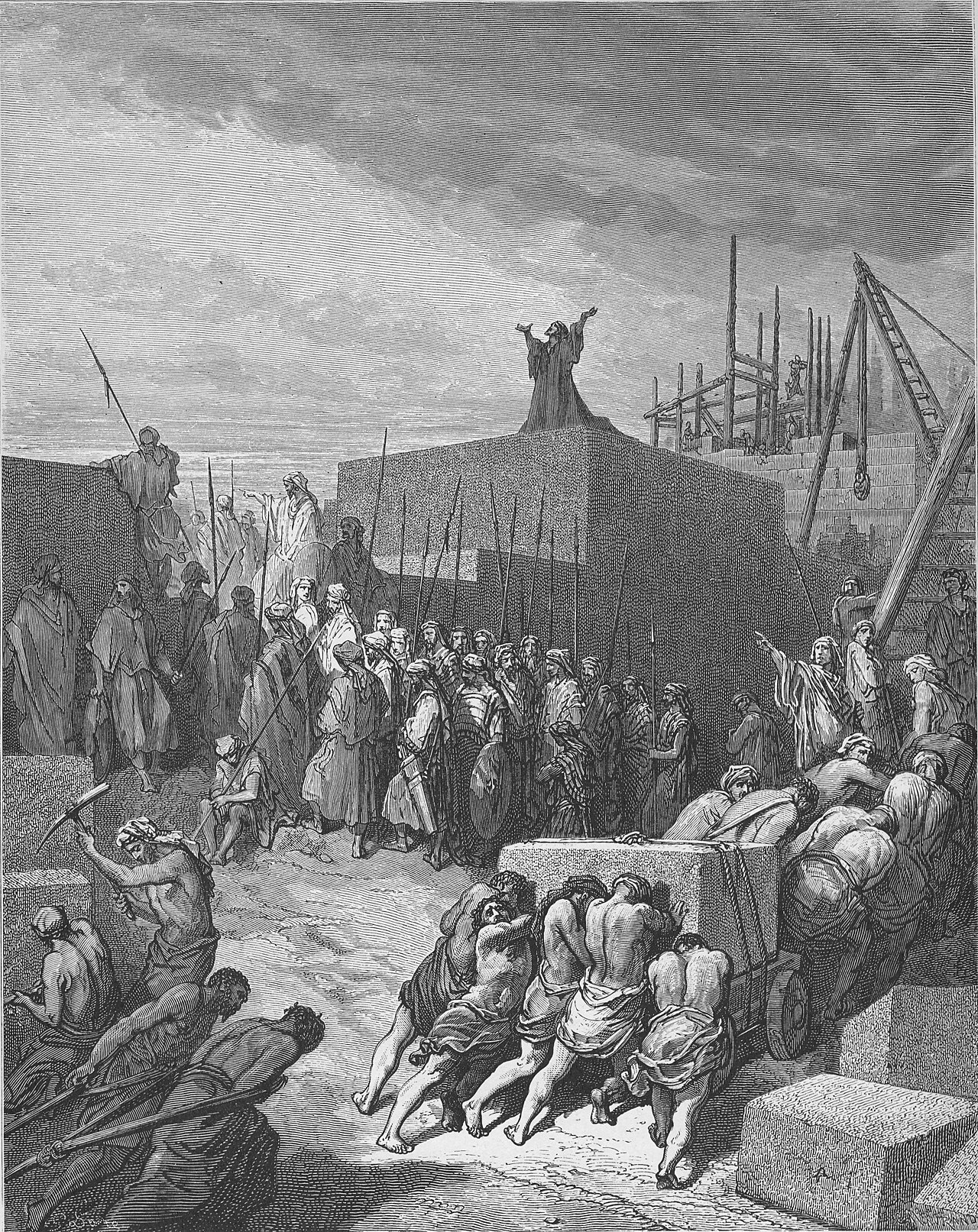
Haggaichapter 2
23 verses · Haggai · 520 BC · The Twelve
On that day, declares the LORD of Hosts, I will take you, My servant, Zerubbabel son of Shealtiel, declares the LORD, and I will make you like My signet ring, for I have chosen you, declares the LORD of Hosts.”
Introduction
Haggai, The Twelve, Haggai Overview.
Haggai spoke these three messages in the autumn and early winter of the year the building began again, to people who could now see how modest their temple would be. Some in the crowd were old enough to remember the one Babylon burned. The chapter moves from comfort, to a lesson drawn from the priests' own law, to a private promise for the governor. Listen for the dates, which tie each message to a feast, a season or a day of the work. Listen too for the promise to shake heaven and earth, which the letter to the Hebrews takes up again.
Context
- Who
- Builders who could see that what they were making was smaller than what had been lost
- What
- Three dated messages from the LORD through Haggai: encouragement over the new temple, a ruling on holiness and defilement, and a promise to Zerubbabel.
- Where
- Jerusalem, at the temple site where the work had begun again, in the Persian province of Judah.
- When
- The seventh and ninth months of the second year of Darius I, from October to December of 520 BC; the dates are stated in the text.
- Why
- To steady builders who were disheartened by the small new house, and to show them that blessing would run from the day of their obedience.
Historical context
The first message lands on the last day of the Feast of Tabernacles, the great harvest festival, a week of living in booths and remembering the wilderness, and the same feast at which Solomon had dedicated the first temple. That timing is not an accident.
Show the rest of the historical context, 4 more paragraphs
The problem addressed is grief, not laziness. "Who is left among you that saw this house in her first glory? and how do ye see it now? is it not in your eyes in comparison of it as nothing?" A few very old men in that crowd had seen Solomon's temple before 586 BC and were now looking at a modest replacement. Ezra records the same scene: old men weeping while younger ones shouted for joy.
The answer is a command repeated three times, be strong, be strong, be strong, and a reason: the silver and the gold are mine, and the glory of this latter house shall be greater than of the former.
The second message is a legal question put to the priests, and it uses the actual rules of ritual purity. If consecrated meat touches ordinary food, does the food become holy? No. If a person unclean from touching a corpse touches food, does the food become unclean? Yes. Holiness does not spread by contact; defilement does. Haggai applies it to their work: half-hearted religion had not been sanctifying their economy.
The last message is to Zerubbabel, a descendant of David serving as Persian-appointed governor. God says He will shake the heavens and earth and overthrow thrones, and will make Zerubbabel like a signet ring. A signet was the ring a ruler used to seal documents, his authority in a person's hand, and something he never gave away casually. Zerubbabel's grandfather Jehoiachin had been told he would be plucked off like a signet; here the line is put back on the hand.
Significance
To builders working on something visibly inferior, the message was that God measures a house by His presence in it, not by its budget. The dating in the text ties a promise of blessing to the exact day the foundation was recommitted, "from this day will I bless you."
Show the rest of the significance, 1 more paragraph
And the promise about shaking the nations came at a moment when the Persian empire had literally just been shaken by revolts. The men laying those stones were told their small project was connected to something that would outlast every throne around them.
This chapter in Jewish lifeWhat this chapter is in Jewish life and reading.
What is done
No part of this chapter is read in the synagogue year. The site's own table in src/lib/hebraic/readings.ts printed parashot total 0 and haftarah uses total 0 for Haggai, and no festival reading.
The practice the chapter records is a question of law put to the priests, whether holiness and impurity pass by touch. Rashi gives the reason it was asked. "Perhaps in exile they forgot the laws of sanctified things, and of impurity and purity" (Rashi on Haggai 2:11:1). The Talmud takes the ruling up, and the corpus shows where: Bekhorot 30b:7 under the twelfth verse, Pesachim 17a:7 under the thirteenth and Pesachim 17a:10 under the fourteenth.
The corpus sets the chapter beside the Torah portions under four verses. Under the second it carries Yalkut Shimoni on Torah 159:1, and under the sixth Midrash Tanchuma Buber, Devarim 1:1. Under the seventh it carries Midrash Tanchuma, Shemot 29:1 with Midrash Tanchuma Buber, Shemot 26:1, which it anchors at Haggai 2:7-8. Under the twenty-second it carries Midrash Tanchuma Buber, Kedoshim 1:1 and Mishpatim 4:1.
How it is read
Rashi is the one commentator on this chapter whose English the corpus carries, quoted here from The Judaica Press complete Tanach with Rashi, translated by A. J. Rosenberg, which Sefaria reports as CC-BY. At the third verse he reads the prophet's question to the old men plainly. "Who among you is left who was of the exiles and is still alive?" (Rashi on Haggai 2:3:1). At the fifth he gives the ground of the charge not to fear: "You keep My Torah, and My spirit rests on your prophets; do not fear" (Rashi on Haggai 2:5:1).
The sixth verse he reads of the empires to come. "When this kingdom of Persia, which rules over you, terminates, yet another one will rise up to rule over you, to oppress you; this is the kingdom of Greece, and the time of its rule will be a little while" (Rashi on Haggai 2:6:1). At the eighth he reads the silver and the gold as the Lord's power over wealth: "it is in My power to bring it to whomever I desire" (Rashi on Haggai 2:8:1).
At the ninth verse Rashi records two readings of how the latter house would be greater, and he names the holders of each. "There was a controversy between Rav and Samuel. One said: In the building; and one said: In the years, that the years of the First Temple were four hundred and ten, and those of the Second Temple were four hundred and twenty" (Rashi on Haggai 2:9:1). The corpus carries Bava Batra 3a:24 under the same verse.
The ruling on holiness and impurity he glosses word by word. The unclean flesh of the twelfth verse is the flesh of a carcass (Rashi on Haggai 2:12:1). The uncleanness of a dead body in the thirteenth is "The dead body itself" (Rashi on Haggai 2:13:1). The prophet's turn to the people in the fourteenth he reads as a charge of wider error: "Just as you err in this, so do you err in many halachot" (Rashi on Haggai 2:14:1).
The rest of the chapter he reads as a turn from curse to blessing. The heap that should have measured twenty seahs yielded only ten (Rashi on Haggai 2:16:1). The founding of the eighteenth verse is the second start, when "they began to add to the first foundation that they had built in the days of Cyrus" (Rashi on Haggai 2:18:1). At the nineteenth the seed was not yet sown, and from now on "the building of the Temple will bring blessing into the work of your hands" (Rashi on Haggai 2:19:1).
The last two verses turn to the kingdoms and to Zerubbabel. The fall of the kingdoms is Persia's fall, "at the end of thirty-four years from the building of the Temple, as we learned in tractate Avodah Zarah (9a)" (Rashi on Haggai 2:22:1). At the signet of the twenty-third verse Rashi sets Zerubbabel against the word spoken over his father Jeconiah in Jeremiah 22:24 and 22:30. He reads the promise as that word reversed: "We learn that his repentance availed [Jeconiah], and Zerubbabel was born to him, and he was made as a signet" (Rashi on Haggai 2:23:1).
The corpus carries nine further notes on this chapter without an English text, each marked linked because Sefaria holds no English version of the ref. Eight stand cited and unquoted at Ibn Ezra on Haggai 2:1:1, 2:2:1, 2:4:1, 2:7:1, 2:10:1, 2:17:1, 2:20:1 and 2:21:1, and one at Radak on Haggai 2:1:1.
What the rabbis say
The corpus carries forty rabbinic locators on this chapter and the text of none, so each is cited here rather than quoted. On the first verse, the date in the seventh month, it holds Rosh Hashanah 3b:1 and 3b:7. On the second it holds Yalkut Shimoni on Torah 159:1, and on the third, the old men who saw the first house, Pesikta Rabbati 35:1.
The shaking of the heavens and the nations draws the next run. On the sixth verse the corpus holds Devarim Rabbah 1:23, Ein Yaakov (Glick Edition), Sanhedrin 11:45, Midrash Sekhel Tov, Shemot 17:4:3 and Midrash Tanchuma Buber, Devarim 1:1. On the seventh it holds Midrash Tanchuma, Shemot 29:1, Midrash Tanchuma Buber, Shemot 26:1 and a passage of Otzar Midrashim from Midrash 'Leolam', at 11:5. On the eighth, the silver and the gold, it holds Avodah Zarah 2b:5, Avot DeRabbi Natan, Recension B 13:7 and Bamidbar Rabbah 15:17. On the ninth, the glory of the latter house, it holds Bava Batra 3a:24, Ein Yaakov (Glick Edition), Bava Batra 1:1 and Bereshit Rabbati, Parashat Bereshit 13.
The question to the priests carries the heaviest Talmudic weight in the chapter. On the tenth verse the corpus holds Mekhilta DeRabbi Yishmael, Tractate Shirah 1:17 and the Introductions to Tractates of the Mishnah, Rosh HaShanah 43. On the eleventh it holds Jerusalem Talmud Sotah 5:2:7 and the Introduction to Halakhic Midrashim, Halakhic Midrash 15 and 27, both of those from the Introductions to Tanaitic Literature. On the twelfth it holds Bekhorot 30b:7 and Ein Yaakov, Pesakhim 1:14, with the Introductions to Tractates of the Mishnah, Chagigah 21, which it anchors at Haggai 2:12-13. On the thirteenth it holds Pesachim 17a:7, and on the fourteenth Pesachim 17a:10.
The turn to blessing carries the rest. On the fifteenth verse the corpus holds Avot DeRabbi Natan 4:4 and Jerusalem Talmud Rosh Hashanah 1:1:3. On the sixteenth it holds Avot DeRabbi Natan, Recension B 5:3 and Jerusalem Talmud Sotah 9:14:3. On the nineteenth it holds Midrash Aggadah, Deuteronomy 3:23:9, Midrash Tannaim on Deuteronomy 11:12:14 and Pesikta DeRav Kahana 16:8. On the twenty-second, the overthrow of the kingdoms, it holds Bamidbar Rabbah 20:20 with the two Tanchuma Buber locators named above. On the twenty-third, the signet, it holds Aggadat Bereshit 27:2, Avot DeRabbi Natan 2:5 and Avot DeRabbi Natan, Recension B 43:18. What each of them teaches is a saying of the rabbis, and is reported as theirs wherever this site quotes one. The quotations wait on a fetch that carries the text.
Sources: Rashi, Rashi on Haggai 2:3:1 to 2:23:1, The Judaica Press complete Tanach with Rashi, translated by A. J. Rosenberg, reported CC-BY; Ibn Ezra, Ibn Ezra on Haggai 2:1:1, 2:2:1, 2:4:1, 2:7:1, 2:10:1, 2:17:1, 2:20:1 and 2:21:1, cited by ref because the corpus carries no English text; Radak, Radak on Haggai 2:1:1, cited by ref because the corpus carries no English text; The Sefaria corpus, scripts/data/sources/sefaria/haggai/2.json, the 40 Talmud and Midrash locators of this chapter; The site's own files, src/lib/hebraic/readings.ts, probed for this book and printing parashot total 0, haftarah uses total 0 and festivalReadingForBook null.
The heads below are this chapter's scenes. The numbered points under each are its verses.
The latter glory of this house shall be greater
Haggai 2:1-3
On the twenty-first day: A second dated word comes “On the twenty-first day of the seventh month”, during the feast of tabernacles. It asks who is “left among you who saw this house in its former glory”. Ezra 3:12 records that older priests who had seen the first temple wept at the new foundation.
Haggai 2:1
“It was sent on the twenty-first day of the seventh month, when the builders had been about a month at work (since the twenty-fourth day of the sixth month), and had got it in some forwardness. Note, Those that are hearty in the service of God shall receive fresh encouragements from him to proceed in it, as their case calls for them.”
Matthew Henry · Commentary on the Whole Bible (1707-1721)puritan
1 more voice on this verseWhat preachers and commentators have said about this verse, in their own words.
Haggai 2:1
“In the seventh month, in the one and twentieth day of the month - This was the seventh day of the feast of tabernacles, Lev 23:34, Lev 23:36, Lev 23:40-42. and its close. The eighth day was to be a sabbath, with its “holy convocation,” but the commemorative feast, the dwelling in booths, in memory of God’s bringing them out of Egypt, was to last seven days. The close then of this feast could not but revive their sadness at the glories of their first deliverance by God’s “mighly hand and outstretched arm,” and their present fewness and poverty.”
Zerubbabel, Joshua and the remnant of the people now hear comfort. Matthew Henry notes that those wounded by the word of the LORD are healed by it. John Gill observes that governor of Judah names Zerubbabel's office, where the Greek version wrote his tribe.
Haggai 2:2
“Speak now to Zerubbabel, the son of Shealtiel, governor of Judah,.... Of whom, his descent and dignity; see Gill on Hag 1:1. The Septuagint version wrongly renders it "of the tribe of Judah"; in which it is followed by the Arabic version; for, though he was of the tribe of Judah, this does not sufficiently distinguish him; nor does it answer to the word here used, which is expressive of his office and dignity. The Vulgate Latin version, Luther, and Castalio, omit the particle נא, rendered "now", which is very emphatic.”
1 more voice on this verse
Haggai 2:2
“The encouragements here are sent to the same persons to whom the reproofs in the foregoing chapter are directed; for those that are wounded by the convictions of the word shall be healed and bound up by its consolations.”
Matthew Henry · Commentary on the Whole Bible (1707-1721)puritan
The question is put to the oldest people in the crowd. Matthew Henry reckons about seventy years since Solomon's temple fell, so a few could still remember it. John Gill pictures what they had seen, the stately pillars, the carved work and the gold.
Haggai 2:3
“Who is left among you that saw this house in her first glory?.... Not taken away by death, yet alive, and dwelling among them; and who lived before the destruction of the first temple, built by Solomon; and has seen it in all its magnificence; its grand and noble structure; its stately pillars; its carved work, and decorations of gold.”
1 more voice on this verse
Haggai 2:3
“It was now about seventy years since Solomon's temple was destroyed (for that was in the nineteenth year of the captivity, and this about the nineteenth after the captivity), so that there might be some yet alive who could remember to have seen it, and still they would be upbraiding themselves and their brethren with the great disparity between this house and that.”
Matthew Henry · Commentary on the Whole Bible (1707-1721)puritan
Haggai 2:4-5
But now be strong, O Zerubbabel: Three commands fall together: “be strong, O Zerubbabel”, be strong, Joshua, and “be strong, all you people of the land”. The ground is the covenant, “the promise I made to you when you came out of Egypt”, and “My Spirit remains among you”.
Haggai 2:4
“Let not these leading men give way to this suggestion, nor be disheartened by it, but do as well as they can, when they cannot do so well as they would; and let all the people of the land be strong too, and work; and, if the leaders have but a good heart on it, it is hoped that the followers will have the better heart.”
Matthew Henry · Commentary on the Whole Bible (1707-1721)puritan
1 more voice on this verse
Haggai 2:4
“Yet now be strong - Do not let this discourage you. The chief glory of the temple is not its splendid building, but my presence; and as I covenanted to be with you when ye came out of Egypt, so I will fulfill my covenant; for my Spirit remaineth among you, fear not; Hag 2:5. What is the most splendid cathedral, if God be not in it, influencing all by his presence and Spirit? But he will not be in it unless there be a messenger of the Lord there, and unless he deliver the Lord’s message.”
Adam Clarke · Commentary on the Bible (1810-1826)evangelical
This is the promise I made to you when you came out of Egypt: The call to be strong and not afraid rests on the promise made when Israel came out of Egypt. Albert Barnes notes that the Hebrew sets the promise abruptly, without a verb. John Calvin observes that without a promise no zeal lasts.
Haggai 2:5
“Inasmuch as the old people, who had seen the splendor of the former temple, considered this temple no better than a cottage, all their zeal evaporated; for, as we have said, without a promise there will continue in men no ardor, no perseverance.”
John Calvin · Commentaries (1554)reformed
1 more voice on this verse
Haggai 2:5
“The words which I covenanted - The words stand more forcibly, because abruptly. It is an exclamation which cannot be forced into any grammatical relation with the preceding. The more exact idiom would have been “Remember,” “take to heart.” But the prophet points to it the more energetically, because he casts it, as it were, into the midst, not bound up with any one verb. This would be the rather done in speaking to the people, as David to his followers (1Sa 30:23, which Ewald compares, Lehrb. n. 329. a. p. 811, ed. 8. and in his Die Proph. iii.”
Haggai 2:6-7
“I will shake the heavens and the earth”, words Hebrews 12:26 to 27 applies to the removal of what can be shaken. The King James reads the desire of all nations shall come, which the older commentators take of the Messiah. The recent reading takes the Hebrew as a collective.
Haggai 2:6
“Yet once - After many confirmations of the new covenant, one more, remains to be made. A little while - Tho' above five hundred years, yet this was but a little time compared with that between the promise to Adam and Christ's coming. I will shake - Whether it be metaphorical or literal, it was verified at the time of Christ's coming into the world.”
John Wesley · Explanatory Notes upon the Old Testament (1765)evangelical
2 more voices on this verse
Haggai 2:6
“There have been two remarkable transformations of the human way of life in the course of the world's history. These are called two "covenants," and, so famous was the business involved, two "shakings of the earth." The first was the transition from idols to the law;13 the second, from the law to the gospel. The gospel also tells of the third shaking, the change from this present stage of things to what lies unmoved, unshaken, beyond. An identical feature occurs in both covenants. The feature? There was nothing sudden involved in the first movement to take their transformation in hand.”
Gregory of Nazianzus · written before 390 · On the Holy Spirit, Theological Oration 5(31)25patristic
Haggai 2:6
“Here the heavens and the earth are shaken, that proud oppressors may be broken and brought down: I will overthrow the throne of kingdoms. The Chaldean monarchy, which had been the throne of kingdoms a great while, was already overthrown; and the powers that are, and are yet to come, shall in like manner be overthrown; their day will come to fall.”
Matthew Henry · Commentary on the Whole Bible (1707-1721)puritan
Cross references
Haggai 2:6
- Quoted inHebrews 12:26At that time His voice shook the earth, but now He has promised, “Once more I will shake not only the earth, but heaven as well.”
'Yet once more I shake not the earth only, but also heaven'
I will fill this house with glory: This glory answers the grief of verse 3. John Wesley reads the glory that will fill this house as the presence of Christ in it. Charles Spurgeon notes that the second temple was never meant to match the first in splendour.
Haggai 2:7
“THE second Temple was never intended to be as magnificent as the first. The first was to be the embodiment of the full glory of the dispensation of symbols and types—and was soon to pass away. This comparative feebleness had been proved by the idolatry and apostasy of the people, Israel. And when they returned to Jerusalem they were to have a structure that would be sufficient for the purposes of their worship, but they were not again to be indulged with the splendors of the former house which God had erected by the hand of Solomon.”
Charles Spurgeon · written before 1892 · The Metropolitan Tabernacle Pulpit, Sermon No. 3442: “'The Desire Of All Nations'” (lightly modernized text, CCEL edition)Particular Baptist
1 more voice on this verse
Haggai 2:7
“With glory - The first temple had a glory in its magnificent structure, rich ornaments, and costly sacrifices; but this was a worldly glory; that which is here promised, is a heavenly glory from the presence of Christ in it.”
John Wesley · Explanatory Notes upon the Old Testament (1765)evangelical
Haggai 2:8-9
The silver is Mine: Then comes the central promise: “The latter glory of this house will be greater than the former”, and “in this place I will provide peace”. Two fulfilments are named, the enlargement of its courts under Herod and the Lord of the house walking those courts in the person of Christ.
Haggai 2:8
“The heavenly Jerusalem shall be similarly adorned, but shall need "no temple" (Re 21:10-22). Compare 1Co 3:12, where gold and silver represent the most precious things (Zec 2:5). The inward glory of New Testament redemption far exceeds the outward glory of the Old Testament dispensation.”
Jamieson, Fausset & Brown · Commentary Critical and Explanatory on the Whole Bible (1871)reformed
1 more voice on this verse
Haggai 2:8
“When David and his princes offered vast sums for the service of the house of God, they acknowledged, It is all thy own, and of thy own, Lord, have we given thee, 1 Chron. xxix. Therefore God needs not sacrifice, for every beast of the forest is his, Ps. l.”
Matthew Henry · Commentary on the Whole Bible (1707-1721)puritan
The latter glory of this house will be greater than the former: The Berean text reads one house with a latter glory greater than its former, as Albert Barnes also reads it. Jamieson, Fausset and Brown find that glory in the Messiah, who taught daily in its courts at Matthew 26:55. John Wesley reads this peace as inward.
Haggai 2:9
“The glory of this latter house shall be greater than of the former - or, perhaps, more probably, “the later glory of this house shall be greater than the former;” for he had already spoken of the present temple, as identical with that before the captivity . “Who is left among you that saw this house in her first glory, anti how do you see it now?” He had spoken of its “first glory.” Now he says, in contrast, its later glory should be greater than that of its most glorious times.”
3 more voices on this verse
Haggai 2:9
“In this place - In my house, a type of Christ. Peace - A spiritual, internal, and heavenly peace.”
John Wesley · Explanatory Notes upon the Old Testament (1765)evangelical
Haggai 2:9
“The glory of this latter house . . . greater than of the former--namely, through the presence of Messiah, in (whose) face is given the light of the knowledge of the glory of God (2Co 4:6; compare Heb 1:2), and who said of Himself, "in this place is one greater than the temple" (Mt 12:6), and who "sat daily teaching in it" (Mt 26:55).”
Jamieson, Fausset & Brown · Commentary Critical and Explanatory on the Whole Bible (1871)reformed
Haggai 2:9
“It was also the glory of this latter house, First, That, before the coming of Christ, it was always kept free from idols and idolatries, and was never polluted with those abominable things, as the first temple often was ( 2 Kings xxiii. 11, 12 ), and in this its glory excelled all the glory of that.”
Matthew Henry · Commentary on the Whole Bible (1707-1721)puritan
Ask the priests: holiness does not spread, but uncleanness does
Haggai 2:10-14
On the twenty-fourth day: Holy meat carried “in the fold of his garment” passes no holiness to the food, while one “defiled by contact with a corpse” defiles it. Haggai applies the ruling to the nation, “whatever they offer there is defiled”, so resumed labor cannot cleanse by contact what needs its own repentance.
On the twenty-fourth day of the ninth month: Three months after the work resumed, Haggai is sent to put two questions to the priests, as Adam Clarke sets out. The same date returns at verses 18 and 20. Two of the book's four messages fall on it.
Haggai 2:10
“In the four and twentieth day of the ninth month - Three months after they had begun to rebuild the temple, Haggai is ordered to go and put two questions to the priests. 1. If one bear holy flesh in the skirt of his garment, and he touch any thing with his skirt, is that thing made holy? The priests answered, No! Hag 2:12. 2. If one has touched a dead body and thereby become unclean, does he communicate his uncleanness to whatever he may touch? And the priests answered, Yes! Hag 2:13.”
Adam Clarke · Commentary on the Bible (1810-1826)evangelical
Haggai is told to ask the priests for a ruling, and his case rests on their own answer. Albert Barnes states that the priests answered rightly. Charles Spurgeon calls this a sacred guile that forced the truth home to the people.
Haggai 2:11
“Ask now the priests concerning the law - The priests answer rightly, that, by the law, insulated unholiness spread further than insulated holiness. The flesh of the sacrifice hallowed whatever it should touch, but not further; but the human being, who was defiled by touching a dead body, defiled all he might touch Num 19:22. Haggai does not apply the first part; namely, that the worship on the altar which they reared, while they neglected the building of the temple, did not hallow. The possession of a truly tiring does not counterbalance disobedience.”
consecrated meat in the fold of his garment: Consecrated meat was the flesh of a sacrifice, and Leviticus 6:27 made holy whatever touched it directly. Jamieson, Fausset and Brown explain that it made the fold of the garment holy and could pass that holiness no further. So the priests answer no.
Haggai 2:12
“If one bear holy flesh in the skirt of his garment,.... Or, "carry" it (q); from one place to another in his pockets or bags, which were in the skirts of his garments.”
defiled by contact with a corpse: Contact with a corpse made a person unclean for seven days, and whatever that person touched became unclean, as Numbers 19:11 and 22 rule. Jamieson, Fausset and Brown draw the contrast that impurity passes more readily than holiness. The priests answer yes.
Haggai 2:13
“THE Prophet Haggai very wisely drew out from the priests a definite answer to certain questions which he put to them. Then, upon their authority, he could say to the people, "This is what your own priests say and this is what you, yourselves, believe." This was taking them by a kind of sacred guile and it was a powerful means of forcing home the Truth of God to their heart and conscience.”
Charles Spurgeon · written before 1892 · The Metropolitan Tabernacle Pulpit, Sermon No. 2495: “Defiled and Defiling” (lightly modernized text, CCEL edition)Particular Baptist
1 more voice on this verse
Haggai 2:13
“On the other hand, a legally "unclean" person imparts his uncleanness to any thing, whereas a legally holy thing cannot confer its sanctity on an "unclean" person (Nu 19:11, 13, 22). Legal sanctity is not so readily communicated as legal impurity. So the paths to sin are manifold: the paths to holiness one, and that one of difficult access [GROTIUS].”
Jamieson, Fausset & Brown · Commentary Critical and Explanatory on the Whole Bible (1871)reformed
Haggai now applies the ruling. This people and nation are the defiled man, and all their work and every offering is defiled by the people who bring it. John Wesley holds that the soul must be purified first, so that the offering is pure.
Haggai 2:14
“Then answered Haggai - So is this people - As an unclean man communicates his uncleanness to every thing he touches, so are ye unclean; and whatever ye have hitherto done is polluted in the sight of God. For your neglect of my temple has made you unclean, as if you had contracted legal pollution by touching a dead body.”
Adam Clarke · Commentary on the Bible (1810-1826)evangelical
2 more voices on this verse
Haggai 2:14
“So - Polluted persons, touching what is clean, pollute it, so polluted Jews, polluted God's ordinances, while the outward performing of legal duties, left them as unholy in themselves, as they were before: somewhat more then is to be done. The soul is first to be purified, that they and we may offer up a pure offering.”
John Wesley · Explanatory Notes upon the Old Testament (1765)evangelical
Haggai 2:14
“This all applies to them as they had been, not as they are now that they have begun to obey; the design is to guard them against falling back again. The "there" points to the altar, probably in view of the audience which the prophet addressed.”
Jamieson, Fausset & Brown · Commentary Critical and Explanatory on the Whole Bible (1871)reformed
From this day on, I will bless you
Haggai 2:15-17
consider carefully from this day forward: The nation is sent back to the time “Before one stone was placed on another in the temple of the LORD”. The LORD struck them “with blight, mildew, and hail, but you did not turn to Me”, the refrain Amos 4:6 to 11 had used.
Haggai 2:15
“And now, I pray you - Observe his tenderness, in drawing their attention to it , “Consider from this day and upward.” He bids them look backward, “from before a stone was laid upon a stone,” i.”
a heap of twenty ephahs of grain: The heap of grain gave ten ephahs where twenty were expected, and the winepress twenty baths where fifty were expected. Matthew Henry notes that the more one expects, the harder the disappointment. That was the time before a stone was placed.
Haggai 2:16
“Since those days were--from the time that those days of your neglect of the temple work have been. when one came to an heap of twenty measures--that is, to a heap which he had expected would be one of twenty measures, there were but ten. fifty vessels out of the press--As the Septuagint translates "measure," and Vulgate "a flagon," and as we should rather expect vat than press.”
Jamieson, Fausset & Brown · Commentary Critical and Explanatory on the Whole Bible (1871)reformed
1 more voice on this verse
Haggai 2:16
“Note, It is our folly that we are apt to raise our expectation from the creature, and to think tomorrow must needs be as this day and much more abundant, but we are commonly disappointed, and the more we expect the more grievous the disappointment is. In the stores and treasures of the new covenant we need not fear being disappointed when we come by faith to draw from them.”
Matthew Henry · Commentary on the Whole Bible (1707-1721)puritan
Blight and mildew are two diseases of grain named among the curses at Deuteronomy 28:22, and Amos 4:9 uses the same pair. Albert Barnes notes that Haggai adds hail, which destroys vines. Jamieson, Fausset and Brown note that the Hebrew of the last clause leaves its verb unspoken.
Haggai 2:17
“I smote you with blasting and mildew, - two diseases of grain, which Moses had foretold Deu 28:27. as chastisements on disobedience and God’s infliction, of which Amos had spoken in these self-same words. Amo 4:9. Haggai adds the hail, as destructive of the vines. Psa 78:47. Yet (And) ye turned you not to Me literally “there were none” - your, (accusative i. e., who turned you unto Me. The words are elliptical, but express the entire absence of conversion, of any who turned to God.”
2 more voices on this verse
Haggai 2:17
“But this people either saw not the hand of God in it (imputing it to chance) or saw not their own sin as the provoking cause of it, and therefore turned not to him. They were a long time incorrigible and unhumbled under these rebukes, so that God's hand was stretched out still, for the people turned not to him that smote them, Isa. ix.”
Matthew Henry · Commentary on the Whole Bible (1707-1721)puritan
Haggai 2:17
“Appropriated from Am 4:9, whose canonicity is thus sealed by Haggai's inspired authority; in the last clause, "turned," however, has to be supplied, its omission marking by the elliptical abruptness ("yet ye not to Me!") God's displeasure.”
Jamieson, Fausset & Brown · Commentary Critical and Explanatory on the Whole Bible (1871)reformed
Haggai 2:18-19
The call to consider now dates itself to “the day the foundation of the LORD’s temple was laid”. The blessing runs “from this day on”, before any harvest shows, so the harvest can be read only as the answer of the LORD.
Haggai 2:18
“Or, translate, "From this day on which the temple is being begun," namely, on the foundations long ago laid [GROTIUS]. MAURER translates, "Consider . . . from the four and twentieth day . . . to (the time which has elapsed) from the day on which the foundation . . . was laid." The Hebrew supports English Version.”
Jamieson, Fausset & Brown · Commentary Critical and Explanatory on the Whole Bible (1871)reformed
Is there still seed in the barn?: The seed is still stored and the fruit trees are bare. John Wesley explains that no one could yet tell what the vintage would be. Jamieson, Fausset and Brown set the promise to bless beside Habakkuk 2:3, a word trusted before it is seen.
Haggai 2:19
“Is the seed - Your seed for the next harvest is yet in your barns. Hath not brought forth - No sign yet appears what vintage you shall have, what store of wine, oil, figs, and pomegranates.”
John Wesley · Explanatory Notes upon the Old Testament (1765)evangelical
1 more voice on this verse
Haggai 2:19
“Thus it will be made evident that the blessing is due to Me, not to nature. We may trust God's promise to bless us, though we see no visible sign of its fulfilment (Hab 2:3). God's promise through Zerubbabel to Israel of safety in the coming commotions.”
Jamieson, Fausset & Brown · Commentary Critical and Explanatory on the Whole Bible (1871)reformed
Zerubbabel, my chosen signet ring
Haggai 2:20-23
For the second time that day: The fourth word, to Zerubbabel alone, returns to the shaking of verse 6. The promise “I will make you like My signet ring” reverses Jeremiah 22:24, where the LORD pulled Coniah, grandfather of Zerubbabel, from His hand. Zerubbabel stands in the genealogies of Christ (Matthew 1:12, Luke 3:27).
For the second time that day: The fourth word comes to Haggai on the same day as the third. John Gill names the month as Kislev, the ninth. The priests heard a ruling that day, and Zerubbabel now hears a promise.
Haggai 2:20
“And again the word of the Lord came unto Haggai,.... Or a "second" (s) time, even on the same day as the former: in the four and twentieth day of the month; of the ninth month Chisleu, Hag 2:10, saying; as follows: (s) שנית "secundo", V. L. Pagninus, Montanus, Junius & Tremellius, Piscator, Cocceius; "secunda vice", Burkius.”
1 more voice on this verse
Haggai 2:20
“In the temple Jesus Christ was daily preached, Acts v. 42 . Now the ministration of righteousness and life by the gospel was unspeakably more glorious than the law, which was a ministration of death and condemnation, 2 Cor. iii.”
Matthew Henry · Commentary on the Whole Bible (1707-1721)puritan
I am about to shake the heavens and the earth: This is the shaking of verse 6 again. It now falls on the thrones of the nations. Albert Barnes observes no heavens or nations were shaken in Zerubbabel's day, so the promise reaches past him to his descendants and chiefly to Christ.
Haggai 2:21
“I will shake - Haggai closes by resuming the words of a former prophecy to Zerubbabel and Joshua, which ended in the coming of Christ. Even thus it is plain, that the prophecy does not belong personally to Zerubbabel, but to him and his descendants, chiefly to Christ. There was in Zerubbabel’s time no shaking of the heaven or of nations.”
I will overturn royal thrones: The picture is a battlefield where chariots fall and riders turn their swords on one another. John Gill reads the overturned thrones as the Persian empire, which Alexander later overthrew. The fall of horse and rider is sung at Exodus 15:1.
Haggai 2:22
“And I will overthrow the throne of kingdoms,.... The Persian monarchy, which consisted of various kingdoms and nations, and was destroyed under Darius Codomannus by Alexander the great, who fought with him three pitched battles, and overcame him; but the thing was of the Lord, according to his purpose and will, and by his power and providence; and therefore the overthrow is ascribed to him.”
I will make you like My signet ring: A signet ring carried its owner's seal and authority. Albert Barnes reads it as the LORD reversing the sentence on Jeconiah, whom Jeremiah 22:24 pictured as a signet pulled from the LORD's hand. Matthew Henry carries the promise on to Christ, chosen from Zerubbabel's line.
Haggai 2:23
Wherefore to Him alone is it mystically said, "I will take thee, O Zerubbabel, and will make thee as a signet, for I have chosen thee." When our mind shall have become peaceful so that it may be said to her, "Return, return, O Shulamite," which signifies 'peaceful,' or, to use your own name, Irenice, then shall she receive Christ like a signet on herself, that is, the Image of God, that she may be according to that Image, for "as is the heavenly, such are they also that are heavenly."
Ambrose of Milan · written before 397 · Letter 30patristic
3 more voices on this verse
Haggai 2:23
“I will make thee as a signet - God reverses to Zerubbabel the sentence on Jeconiah for his impiety.”
Haggai 2:23
“But this promise has special reference to Christ, who lineally descended from Zerubbabel, and is the sole builder of the gospel-temple. Zerubbabel is here owned as God's servant, and it is an honourable mention that is hereby made of him, as Moses and David my servants.”
Matthew Henry · Commentary on the Whole Bible (1707-1721)puritan
Haggai 2:23
“He is indeed the signet on God's right-hand. For all power is given to him, and derived from him. In him the great charter of the gospel is signed, and sanctified, and it is in him, that all the promises of God are yea and amen.”
John Wesley · Explanatory Notes upon the Old Testament (1765)evangelical
ConnectionsJeremiah 22:24
How this psalm is built
The form: Three messages, each dated, moving from encouragement to a ruling of the law to a promise to one man, as Clarke classes it.
The patterns in this chapter
| Device | What it does | Where to see it |
|---|---|---|
| The question put to the priests | Verses 11 to 13 put two cases to the priests, and they answer no and then yes. Haggai then applies their answer to the nation at verse 14. Charles Spurgeon calls the method a kind of sacred guile, because the people heard the verdict from their own priests before they heard it applied to themselves.Charles Spurgeon, The Metropolitan Tabernacle Pulpit, Sermon No. 2495, "Defiled and Defiling" (lightly modernized text, CCEL edition), on Haggai 2:13. | Haggai 2:11, Haggai 2:12, Haggai 2:13, Haggai 2:14 |
| The shaking said twice | The promise to shake the heavens and the earth stands at verse 6 and again at verse 21. The first time it fills the house with glory, and the second time it overturns the thrones of the nations. Albert Barnes reads the second as resuming the first, and observes that no such shaking came in Zerubbabel's own day.Albert Barnes, Notes on the Old Testament, on Haggai 2:21. | Haggai 2:6, Haggai 2:7, Haggai 2:21, Haggai 2:22 |
| The twenty-fourth day of the ninth month | The same date stands at verses 10, 18 and 20, and two messages fall on it. John Gill names the month as Kislev and reads verse 20 as a second word on the same day. Verse 18 calls it the day the foundation of the temple was laid, and verse 19 dates the blessing from it.John Gill, Exposition of the Old Testament, on Haggai 2:20. | Haggai 2:10, Haggai 2:18, Haggai 2:20 |
The structure
5 more paragraphs on the patterns
The chapter holds three messages. Verses 1 to 9 are dated to the seventh month and speak to the leaders and the people about the glory of the house. Verses 10 to 19 are dated to the ninth month and turn a ruling from the priests into a verdict on the nation and a promise of blessing. Verses 20 to 23 come the same day and speak to Zerubbabel alone.
The debate
The phrase rendered the treasures of all the nations at verse 7 is read two ways. The older readers, following the Latin singular, read it of one person, the Desired of all nations, and so of Christ. Charles Spurgeon preached it under that title, and John Wesley read the glory of the verse as the presence of Christ in the house. The Berean text reads the Hebrew as the precious things the nations would bring. Both readings take the glory promised at verse 9 to exceed the glory of gold.
The prophecy and the New Testament
Hebrews 12:26 to 28 quotes verse 6 and reads it of the removal of what can be shaken so that what cannot be shaken remains. Zerubbabel stands in the lines of Jesus at Matthew 1:12 and Luke 3:27, and verse 23 reverses the sign of rejection given to his grandfather at Jeremiah 22:24.
Keep studying
Studies9
People and groups4
Places1
Sources for this chapter
The summary
Jamieson, Fausset & Brown, Commentary Critical and Explanatory; John Calvin, Commentaries; John Wesley, Notes on the Old Testament and Matthew Henry, Complete Commentary.
The form and classifications
Adam Clarke, Commentary on the Bible, on Haggai 2:10 and Charles Spurgeon, The Metropolitan Tabernacle Pulpit, Sermon No. 2495, "Defiled and Defiling" (lightly modernized text, CCEL edition), on Haggai 2:13.
The exposition
Adam Clarke, Commentary on the Bible; Albert Barnes, Notes on the Old Testament; Carl Friedrich Keil, The Twelve Minor Prophets; Charles Spurgeon; Edward Bouverie Pusey, The Minor Prophets: A Commentary; Jamieson, Fausset & Brown, Commentary Critical and Explanatory on the Whole Bible; John Calvin, Commentaries on the Twelve Minor Prophets; John Gill, Exposition of the Old Testament; John Wesley, Explanatory Notes upon the Old Testament and Matthew Henry, Commentary on the Whole Bible.