
Haggai 2:8
in Haggai 2The silver is Mine, and the gold is Mine, declares the LORD of Hosts.
BSB
The same verse in ASV and KJV ▾
ASV
The silver is mine, and the gold is mine, saith Jehovah of hosts.
KJV
The silver is mine, and the gold is mine, saith the Lord of hosts.
⋯
This verse in Haggai 2
Commentary
10 notes on this verseA commentator
Albert Barnes1798–1870
Notes, Explanatory and Practical, on the Old and New Testaments (1832-1869)
The silver is Mine, and the gold is Mine - These words, which have occasioned some to think, that God, in speaking of the glory with which He should fill the house, meant our material riches, suggest the contrary. For silver was no ornament of the temple of Solomon. Everything was overlaid with gold. In the tabernacle there were bowls of silver, in Soloman’s temple they and all were of gold 1Ki 7:50; 2Ch 4:
This site's exposition
The silver is mine, and the gold is mine
on Haggai 2:8-9
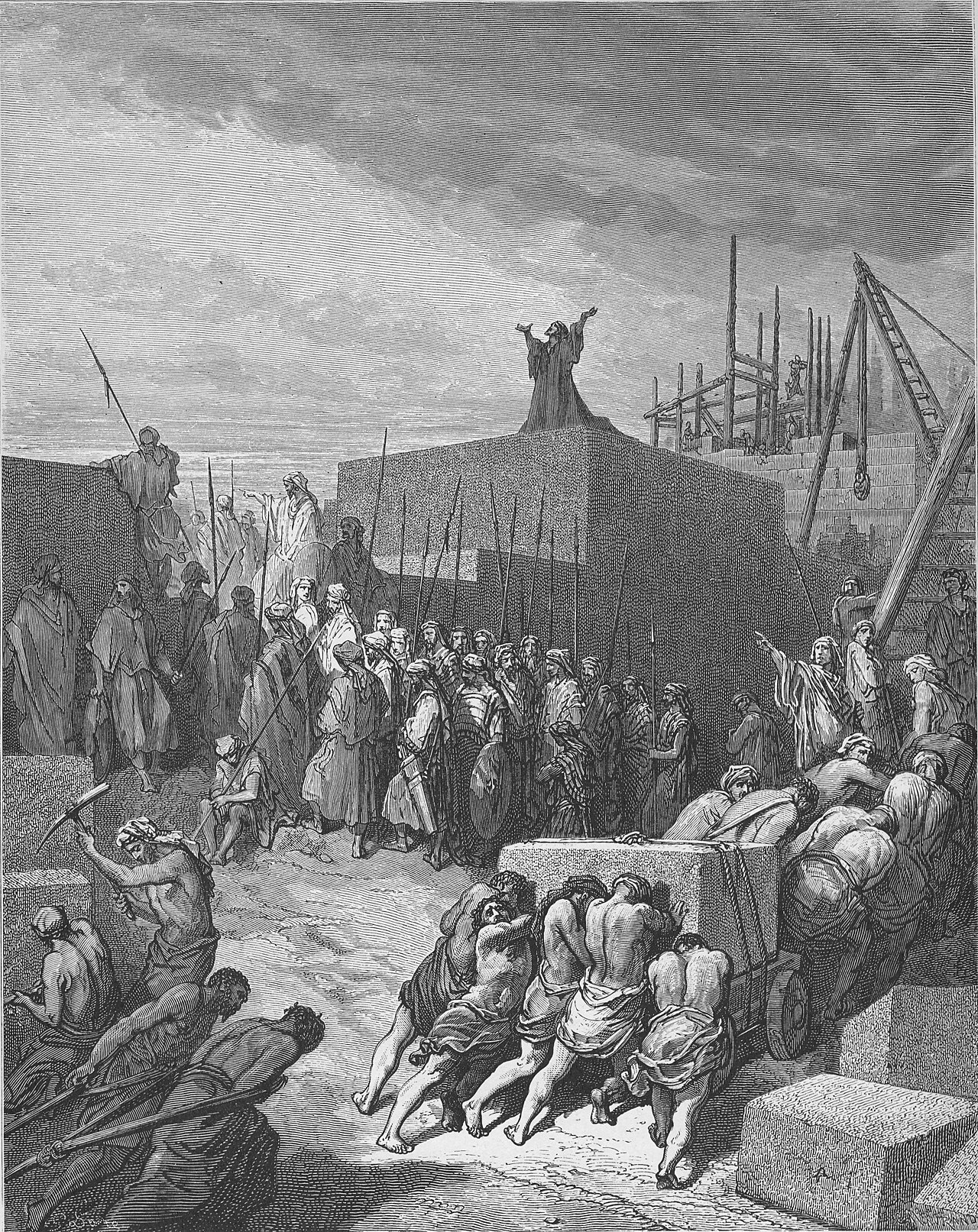
The silver is mine, and the gold is mine, saith the Lord of hosts answers any anxiety that the house cannot be worthily furnished, since its true owner already holds the world's wealth in his hand. Then the chapter's central claim: the glory of this latter house shall be greater than of the former, and in this place will I give peace. The bench reads the fulfillment on two tracks named together, the physical enlargement and adornment under Herod that made the Second Temple's courts far grander than Zerubbabel's original, and the greater claim that the Lord of the house himself once walked its courts in the person of Christ, a glory no gold ever supplied to Solomon's temple.
The record, by era
The Church Fathers4 voices
But this is not the fault of gold and silver. Let us suppose that someone of tender heart has found a treasure. The kindness of his heart works, does it not, so that hospitality is shown to strangers, the starving are fed, the naked clothed, the needy assisted, captives redeemed, churches are built, the weary are refreshed, the quarrelsome pacified, the shipwrecked set on their feet again, the sick cured—material resources distributed on earth, spiritual ones stored up in heaven? Who does all this? The good and kindhearted person. What does he do it with? Gold and silver. Whom is he serving when he does it? The one who says, "Mine is the gold and mine is the silver." Now, brothers, I think you can see what a great mistake it is, what lunacy indeed, to project onto the things which people misuse the offense of the people who misuse them. If gold and silver, after all, can be blamed simply because people warped by avarice and neglecting the commands of the Creator are carried away by an abominable kind of lust for these things that he brought into being, then let us blame every single creature of God, because, as the apostle says, some perverse people "worshiped and served the creature rather than the Creator, who is blessed forever." Let us also blame this sun, which these same Manichaeans, as we all know, not understanding that it is a creature, never cease to worship and adore as though it were the Creator—or at least some sort of part of him.
Surely the glory of the house of the New Testament is greater than that of the old because it was built of better materials, namely, those living stones that are human beings renewed by faith and grace. Yet precisely because Solomon's temple was renovated—was made new—it was a prophetic symbol of the second Testament which is called the New. Accordingly we must understand the words God spoke by Haggai's mouth, "And I will give peace in that place," as referring to the place for which the temple stood. Since the restored temple signified the church, which Christ was to build, those words can mean only "I will give peace in that place [the church] which this place [the rebuilt temple] prefigures." (All symbols seem in some way to personify the realities of which they are symbols. So, St. Paul says, "The rock was Christ," because the rock in question symbolized Christ.) Not, however, until the house of the New Testament receives its final consecration will its greater glory in relation to the house of the Old Testament be made perfectly clear. This will take place at the second coming of him whom the Hebrew text calls "the desire of all nations." Obviously his first coming was not desired of all nations, for unbelievers did not even know whom they should desire to come. In the end too, as the Septuagint puts it with equal amount of prophetic meaning, "the chosen of the Lord shall come from all nations." Then, truly, only the chosen shall come, those of whom St. Paul says, even "as he chose us in him before the foundation of the world."
Riches, gold and silver, are not the devil's as some think, for "the whole world of riches is for the faithful man, but for the unfaithful not a farthing." But nothing is more faithless than the devil. God through the prophet says plainly, "Mine is the silver, and mine is the gold." Only use it well and there is nothing blameworthy in silver; but when you abuse a good thing and are then unwilling to blame your own conduct, you impiously put the blame on the Creator. One can even be blessed by money.
(Chapter 2, Verse 1 and following) In the seventh month, on the twenty-first day of the month, the word of the Lord came by the prophet Haggai, saying: Speak now to Zerubbabel, the son of Shealtiel, governor of Judah, and to Joshua, the son of Jehozadak, the high priest, and to the remnant of the people, saying: Who among you is left who saw this temple in its former glory? And how do you see it now? In comparison with it, is this not in your eyes as nothing?
The Puritans and the Awakening1 voice
When David and his princes offered vast sums for the service of the house of God, they acknowledged, It is all thy own, and of thy own, Lord, have we given thee, 1 Chron. xxix. Therefore God needs not sacrifice, for every beast of the forest is his, Ps. l.
3 more voices on this verse
The Puritans and the Awakening2 voices
The silver is mine, and the gold is mine, saith the Lord of hosts.
In the second he assures them that though their sin, in delaying to build the temple, had retarded the prosperous progress of all their other affairs, yet now that they had set about it in good earnest he would bless them, and give them success,
The Nineteenth Century1 voice
A commentator
Jamieson, Fausset & Brown1802–1910
Commentary Critical and Explanatory on the Whole Bible (1871)
The heavenly Jerusalem shall be similarly adorned, but shall need "no temple" (Re 21:10-22). Compare 1Co 3:12, where gold and silver represent the most precious things (Zec 2:5). The inward glory of New Testament redemption far exceeds the outward glory of the Old Testament dispensation.
The words behind it
7 Hebrew wordsEvery Hebrew word of this verse in the order it stands, with what it means and the door to its own study. The last column counts the times a word stands in the whole Bible: the rarer the word, the more the places it appears belong together.
| Hebrew | Sound | Meaning | Word study | In the Bible |
|---|---|---|---|---|
| לִ֥י | li | [belongs] to me | ||
| הַכֶּ֖סֶף | hakesef | the silver | H3701 → | |
| וְלִ֣י | veli | and [belongs] to me | ||
| הַזָּהָ֑ב | hazahav | the gold | H2091 → | |
| נְאֻ֖ם | neum | [the] utterance of | H5002 → | 376 times |
| יְהוָ֥ה | yahweh | Yahweh | H3068 → | 6520 times |
| צְבָאֽוֹת׃ | tzevaot | of hosts | H6635 → | 485 times |
לִ֥י[belongs] to me
li
הַכֶּ֖סֶףthe silver
hakesefH3701 →
וְלִ֣יand [belongs] to me
veli
הַזָּהָ֑בthe gold
hazahavH2091 →
נְאֻ֖ם[the] utterance of
neumH5002 →376 times
יְהוָ֥הYahweh
yahwehH3068 →6520 times
צְבָאֽוֹת׃of hosts
tzevaotH6635 →485 times
A shaded row is a word that stands 400 times or fewer in the Bible.
The walk
8 stopsEach card is a verse this one points to, and under it the verses that one points to in turn. Where several paths arrive at the same place, that place is listed first: the text keeps returning to it.
Through
Psalms 24:1The earth is the LORD’s, and the fullness thereof, the world and all who dwell therein.
it leads to
- Psalms 89:11
The heavens are Yours, and also the earth. The earth and its fullness You founded.
- 1 Corinthians 10:26
for, “The earth is the Lord’s, and the fullness thereof.”
- 1 Chronicles 29:11
Yours, O LORD, is the greatness and the power and the glory and the splendor and the majesty, for everything in heaven and on earth belongs to You. Yours, O LORD, is the kingdom,…
- Job 41:11
Who has given to Me that I should repay him? Everything under heaven is Mine.
- Deuteronomy 10:14
Behold, to the LORD your God belong the heavens, even the highest heavens, and the earth and everything in it.
- Psalms 89:11
Through
Isaiah 60:17Instead of bronze I will bring you gold; I will bring silver in place of iron, bronze instead of wood, and iron instead of stones. I will appoint peace as your governor and righteousness…
it leads to
- Hebrews 11:40
God had planned something better for us, so that together with us they would be made perfect.
- Isaiah 30:26
The light of the moon will be as bright as the sun, and the light of the sun will be seven times brighter—like the light of seven days—on the day that the LORD binds…
- Isaiah 1:26
I will restore your judges as at first, and your counselors as at the beginning. After that you will be called the City of Righteousness, the Faithful City.”
- Hebrews 11:40
Where this verse is studied
About Haggai
This page draws on 9 works. Open the list of works
This page draws on Albert Barnes, Notes, Explanatory and Practical, on the Old and New Testaments (1832-1869); Augustine of Hippo, SERMON 50:7; Augustine of Hippo, City of God 18.48; Carl Friedrich Keil, The Twelve Minor Prophets; Cyril of Jerusalem, Catechetical Lecture 8:6; Jamieson, Fausset & Brown, Commentary Critical and Explanatory on the Whole Bible; Jerome, Commentary on Haggai; John Gill, Exposition of the Old Testament (1748-1763) and Matthew Henry, Commentary on the Whole Bible.