
Ezrachapter 1
11 verses · Ezra, by tradition · 5th century BC · History
In the first year of Cyrus king of Persia, to fulfill the word of the LORD spoken through Jeremiah, the LORD stirred the spirit of Cyrus king of Persia to send a proclamation throughout his kingdom and to put it in writing as follows:
Introduction
Ezra, by tradition, History, Ezra Overview.
Ezra was written for a small people back in their own land after seventy years in Babylon, and tradition gives it to Ezra the priest and scribe. Its first hearers knew exile, foreign kings and a ruined city at first hand. This chapter opens the book and stands where Second Chronicles ends, at the hinge between judgment and return. It is a short report built around a royal document. Listen for whose hand the writer says is moving behind the throne, and for the promise the chapter names in its first line. Read it as the first step of a long rebuilding.
Context
- Who
- Exiles who had been told seventy years and had started to wonder
- What
- A report of the decree that sent the exiles home, the families who chose to go, and the temple vessels handed back for the road home.
- Where
- The Persian court and the province of Babylon, with Jerusalem in Judah as the place they were going.
- When
- The first year of Cyrus over Babylon, which the book's own dating and the Persian records place in 538 BC with good certainty.
- Why
- To show the returned community that their release came from the LORD keeping His word through a foreign king.
Historical context
Cyrus took Babylon in October 539 BC, and within about a year he had issued the decree that opens this book: the God of heaven has charged me to build Him a house at Jerusalem; whoever is among His people, let him go up.
Show the rest of the historical context, 4 more paragraphs
That was Persian policy, not a personal conversion. Persia governed differently from Assyria and Babylon, who had ruled by mass deportation. Cyrus preferred to send peoples back to their homelands, restore their shrines, and let them worship their own gods, on the reasonable calculation that grateful provinces need fewer garrisons.
The famous physical evidence is the Cyrus Cylinder, a clay barrel inscribed in Babylonian, now in the British Museum. It describes Cyrus returning gods to their sanctuaries and people to their settlements. It does not mention Judah or Jerusalem by name, it is a Mesopotamian document about Mesopotamian shrines, but it shows the policy this decree belongs to, which is exactly why it matters.
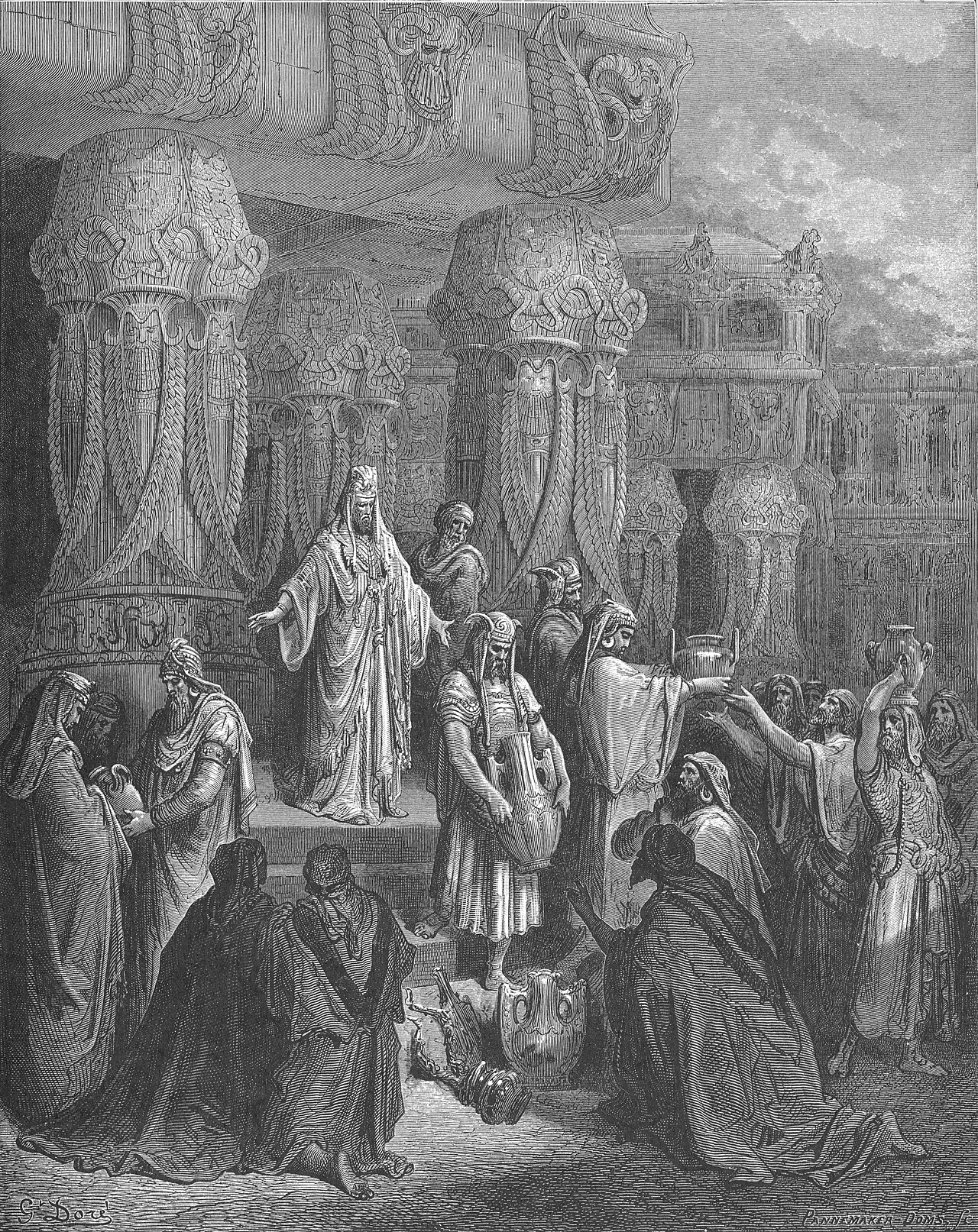
The vessels are the detail worth watching. Nebuchadnezzar had carried the temple's gold and silver articles to Babylon and put them in the house of his gods; Belshazzar had drunk from them at his last feast. Cyrus has them counted out of the treasury, 5,400 items, and handed over to a man named Sheshbazzar.
The returnees' neighbors are told to help with silver, gold, goods, and animals, which echoes the Israelites leaving Egypt with their neighbors' silver. The comparison is deliberate.
Significance
For the exile generation this was the promise landing on schedule. Jeremiah had said seventy years; Daniel had counted them; Cyrus signed the paper.
Show the rest of the significance, 1 more paragraph
The chapter's first sentence says why it happened: the LORD stirred up the spirit of Cyrus. The most powerful man on earth issues a decree, and the text credits it to God working on him, the same claim it makes about the ordinary families who decided to pack.
This chapter in Jewish lifeWhat this chapter is in Jewish life and reading.
What is done
No part of this chapter is read in the synagogue year. Probed for this lane, the site's own table in src/lib/hebraic/readings.ts printed parashot total 0 and haftarah uses total 0 for Ezra, with no festival reading. The same probe printed 54 weekly portions and 6 festival readings in the table as a whole. A congregation does not hear this chapter on a Sabbath or a feast.
The decree of Cyrus is met in the study of the Torah portions instead, and the corpus shows one join. Under the third verse, the call to go up and build, it carries Midrash Tanchuma Buber, Shemot 10:1 and Shemot Rabbah 2:2, both on the opening of Exodus.
How it is read
Rashi is the one commentator on this chapter whose English the corpus carries, quoted here from The Judaica Press complete Tanach with Rashi, translated by A. J. Rosenberg, which Sefaria reports as CC-BY. He opens by joining the book to the one before it in his reading. "This book is arranged as a continuation of the Book of Daniel, as is explained in Baba Bathra (15a)" (Rashi on Ezra 1:1:1). He takes the first word of the book as reaching back to Daniel's reckoning of Jeremiah's seventy years.
The same note works out the seventy years. Rashi counts them from the exile of Jehoiakim to the first year of Cyrus, when the return began and the foundation was laid. He then counts a second seventy from the destruction of the Temple under Zedekiah to the second year of Darius, when the building resumed: fifty-two years to Cyrus and eighteen after. He closes the reckoning on its sources. "This is proven in Seder Olam (ch. 29), in Tractate Megillah (11b) and in this book, as I explained" (Rashi on Ezra 1:1:1). The chronology is the rabbinic one of Seder Olam, and it is reported here as his reading.
At the decree itself Rashi says where Cyrus's charge came from. "He commanded me through Isaiah the prophet to build for Him the Temple in Jerusalem" (Rashi on Ezra 1:2:2). He sets beside it the two lines of Isaiah 44:28 and 45:1 that name Cyrus, the second calling him the Lord's anointed. A Christian reader will know the word anointed from its other uses, and will see here that the tradition reads it of a Persian king who fulfils a prophecy.
The gifts of the neighbours he reads plainly. The king commanded the people of each place to help those who went up, "for also among the nations there were some who contributed donations to the building of the Temple" (Rashi on Ezra 1:4:2). The neighbours gave besides what the Jews gave themselves (Rashi on Ezra 1:6:1 and 1:6:2).
At Sheshbazzar, who received the vessels, Rashi reports a saying of the Rabbis and names it as theirs. Our Rabbis said, in his report, "Sheshbazzar is identical with Daniel, and why was he called Sheshbazzar? Because he endured six troubles" (Rashi on Ezra 1:8:2). The rest of the chapter he glosses word by word. The bowls take their Hebrew name from wiping, because the priest who received the blood wiped the splashes on the rim (Rashi on Ezra 1:10:1). The total counts every vessel together, "but the important ones he counts" (Rashi on Ezra 1:11:1).
The corpus carries two further notes on this chapter without an English text, each marked linked because Sefaria holds no English version of the ref. They stand cited and unquoted at Ibn Ezra on Ezra 1:3:1 and Rashi on Ezra 1:7:2.
What the rabbis say
The corpus carries thirty-two rabbinic locators on this chapter and the text of none, so each is cited here rather than quoted. On the first verse it holds Seder Olam Rabbah 29:1, the chapter Rashi names for his reckoning.
The second verse, the words of Cyrus, draws the heaviest run in the chapter. The corpus holds Megillah 11b:5 and 12a:4 with Ein Yaakov, Megillah 1:23, and Esther Rabbah 1:5, 1:14 and Petichta 8. With them stand Midrash Lekach Tov on Esther, Introduction 3, Sifrei Aggadah on Esther, Midrash Panim Acherim, Version II 1:3, and Midrash Lekach Tov, Deuteronomy 33:12:1. It also holds Pesikta DeRav Kahana 5:9, Pesikta Rabbati 15:1, Shir HaShirim Rabbah 2:13:3, Sifrei Devarim 352:8, Vayikra Rabbah 13:5, and Yalkut Shimoni on Torah 536:2 and 957:1.
On the third verse, the call to go up, the corpus holds Megillah 12a:5, Kohelet Rabbah 10:12:1 and 10:13:1, and Pesikta Rabbati 31:1. With them stand Shemot Rabbah 2:2, Midrash Tanchuma Buber, Shemot 10:1, and a passage of Otzar Midrashim from Midrash Hashkem ('Arise Early'), at 33. On the fourth it holds Esther Rabbah, Petichta 6, and on the fifth Shir HaShirim Rabbah 5:5:1. On the sixth it holds Bereshit Rabbah 60:11, and on the ninth Jerusalem Talmud Yoma 3:8:6.
The vessels close the chapter. On the tenth verse the corpus holds Menachot 7b:21, Zevachim 25a:12 and 93b:14, and Yalkut Shimoni on Torah 469:5. What each of them teaches is a saying of the rabbis, and is reported as theirs wherever this site quotes one. The quotations wait on a fetch that carries the text.
Sources: Rashi, Rashi on Ezra 1:1:1 to 1:11:2, The Judaica Press complete Tanach with Rashi, translated by A. J. Rosenberg, reported CC-BY; Ibn Ezra, Ibn Ezra on Ezra 1:3:1, cited by ref because the corpus carries no English text; Rashi (linked), Rashi on Ezra 1:7:2, cited by ref because the corpus carries no English text; The Sefaria corpus, scripts/data/sources/sefaria/ezra/1.json, the 32 Talmud and Midrash locators of this chapter; The site's own files, src/lib/hebraic/readings.ts, probed for this book and printing parashot total 0, haftarah uses total 0 and festivalReadingForBook null.
The heads below are this chapter's scenes. The numbered points under each are its verses.
Cyrus stirred up: who is among you of all His people?
Ezra 1:1-2
the LORD stirred the spirit of Cyrus: The LORD stirred Cyrus to fulfill the word spoken through Jeremiah, the seventy years of Jeremiah 25:11-12 and 29:10. Isaiah named Cyrus more than a century before his birth (Isaiah 44:28 and 45:1). The title the God of heaven recurs through Ezra and Nehemiah more than anywhere else in Scripture.
Ezra 1:1
“Now in the first year - This is word for word with the two last verses of the preceding book; which stand here in their proper place and connection, but there are entirely destitute of chronological connection and reference. Cyrus - This prince, so eminent in antiquity, is said to have been the son of Cambyses king of Persia, and Mandane, daughter of Astyages king of the Medes; and was born about six hundred years before Christ.”
Adam Clarke · Commentary on the Bible (1810-1826)evangelical
has given me all the kingdoms of the earth: Cyrus credits the LORD with every kingdom he holds. John Gill notes that Cyrus had conquered many lands before the whole Babylonian monarchy fell into his hands. Matthew Henry reads the claim as the inheritance of Nebuchadnezzar, whose dominion, Daniel says, reached to the end of the earth.
Ezra 1:2
“Thus saith Cyrus king of Persia,.... Of whom, and this edict of his, Isaiah prophesied two hundred years before he was born, Isa 44:28 the Lord God of heaven hath given me all the kingdoms of the earth; many he had conquered before he took Babylon, and then the whole Babylonian monarchy fell into his hands.”
1 more voice on this verse
Ezra 1:2
“The Lord God of heaven - It is not unworthy of remark, that in all the books written prior to the captivity, Jehovah is called The Lord of Hosts; but in all the books written after the captivity, as 2 Chronicles, Ezra Nehemiah, and Daniel, he is styled The God of Heaven. The words however have the same meaning. All the kingdoms of the earth.”
Adam Clarke · Commentary on the Bible (1810-1826)evangelical
Ezra 1:3-4
may he go to Jerusalem in Judah: Anyone who belongs to His people may go to Jerusalem and build the house of the LORD. Those who stay are to assist the survivors with silver, gold, goods, and livestock. The decree leaves the going to each person's choice and asks those who remain to fund those who go.
Ezra 1:3
“This sounds a little vain-glorious, for there were many kingdoms of the earth which he had nothing to do with; but he means that God had given him all that was given to Nebuchadnezzar, whose dominion, Daniel says, was to the end of the earth, Dan. iv.”
Matthew Henry · Commentary on the Whole Bible (1707-1721)puritan
let every survivor, wherever he lives: The decree calls each exile a survivor and reaches him wherever he lives in the empire. Adam Clarke reads the open choice as a trial of attachment to God: the man comfortably settled in Babylon went only if he chose. Verse 6 records the order carried out.
Ezra 1:4
“Whosoever remaineth in any place - Every one was at liberty to go, but none was obliged to go. Thus their attachment to God was tried; he whose heart was right with God went; he who was comfortably settled in Babylon, might go if he chose. Those who did not go, were commanded to assist their brethren who went.”
Adam Clarke · Commentary on the Bible (1810-1826)evangelical
Those whose spirit God raised, and neighbors who strengthened their hands
Ezra 1:5-6
The family heads of Judah and Benjamin rise with the priests and Levites, everyone whose spirit God had stirred. The same stirring moved Cyrus in verse 1, so the king's decree and the exiles' readiness come from one hand. Those who remain in Babylon fund those who leave it.
Ezra 1:5
“Only a portion of the Israelites took advantage of the permission of Cyrus. Many remained in Babylon, since they were disinclined to relinquish their property. They who returned were persons whom God had especially stirred up to make sacrifices for His glory.”
1 more voice on this verse
Ezra 1:5
“The call and offer of the gospel are like Cyrus's proclamation. Deliverance is preached to the captives, Luke iv. Those that are bound under the unrighteous dominion of sin, and bound over to the righteous judgment of God, may be made free by Jesus Christ.”
Matthew Henry · Commentary on the Whole Bible (1707-1721)puritan
all their neighbors supported them: The verse counts two kinds of gift. Matthew Henry takes the freewill offerings as given by the Jews who stayed in Babylon, out of love to God and his house. He reads the silver, gold and livestock of the Babylonian neighbors as moved by a divine power on their minds.
Ezra 1:6
“The earth helped the woman. Besides what was willingly offered by the Jews themselves who staid behind, from a principle of love to God and his house, much was offered, as one may say, unwillingly by the Babylonians, who were influenced to do it by a divine power on their minds of which they themselves could give no account. How this proclamation was seconded by Cyrus himself.”
Matthew Henry · Commentary on the Whole Bible (1707-1721)puritan
The temple vessels counted out of Babylon's treasury
Ezra 1:7-8
the articles belonging to the house: Cyrus brings out the articles of the house of the LORD that Nebuchadnezzar had carried from Jerusalem. Mithredath the treasurer counts them out to Sheshbazzar, so the return begins with an inventory. The list answers 2 Kings 25:13-17, where the same articles are broken and carried out of Jerusalem.
Sheshbazzar the prince of Judah: John Wesley and Adam Clarke take Sheshbazzar, the prince of Judah, as the Chaldean name of Zerubbabel. Others, as Clarke reports, hold that he was a Persian or Chaldean whom Cyrus sent to oversee the help given to the exiles from Babylon. Clarke glosses the name as joy in affliction.
Ezra 1:8
“Sheshbazzar, the prince of Judah - This was probably the Chaldean name of him who was originally called Zerubbabel: the former signifies joy in affliction; the latter, a stranger in Babylon. The latter may be designed to refer to his captive state; the former, to the prospect of release. Some think this was quite a different person, a Persian or Chaldean, sent by Cyrus to superintend whatever officers or men Cyrus might have sent to assist the Jews on their return; and to procure them help in the Chaldean provinces, through which they might be obliged to travel.”
Adam Clarke · Commentary on the Bible (1810-1826)evangelical
1 more voice on this verse
Ezra 1:8
“Sheshbazzar - Zerubbabel; the Chaldeans called him Sheshbazzar, that is, Joy in tribulation, but among his own people he was called Zerubbabel, a stranger in Babylon. So he looked upon himself, tho' (Josephus says) he was captain of the life- guard.”
John Wesley · Explanatory Notes upon the Old Testament (1765)evangelical
Ezra 1:9-11
30 gold dishes: The inventory lists gold dishes, silver dishes, and other articles, then gives a total of 5,400 gold and silver articles. The listed numbers do not add up to that total in the Hebrew text as it stands. Sheshbazzar brings every article up with the exiles from Babylon to Jerusalem.
Ezra 1:9
“Chargers - The word in the original thus translated occurs only in this passage. Its meaning is doubtful. Some derive it from a Hebrew root, “to hollow out,” and translate “cup” or “vessel.” Knives - This is another doubtful word, only used here. The etymology points to some employment of basket-work.”
410 matching silver bowls: The inventory ends on a lump figure of other articles. Gold appears only in the dishes and bowls, thirty of each, and silver fills the rest of the named articles. Bede reads the different dishes, bowls and utensils as different persons or works among the faithful.
5,400 gold and silver articles: Albert Barnes sums the gold and silver articles of verses 9 and 10, the dishes, bowls and utensils, at 2,499. The apocryphal 1 Esdras gives an inventory totaling 5,469, and most commentators, he reports, propose to correct Ezra by it. Barnes finds those items improbable and suspects the stated total.
Ezra 1:11
“The sum of the numbers as they stand in the present Hebrew text is 2,499, instead of 5,400. In the Apocryphal Book of Esdras the sum given is 5,469, and with this sum the items in that place exactly agree (1 Esdras 2:13, 14). Most commentators propose to correct Ezra by the passage of Esdras; but the items of Esdras are improbable. Probably the sum total in the present passage has suffered corruption.”
Keep studying
Studies12
Sources for this chapter
The summary
Jamieson, Fausset & Brown, Commentary Critical and Explanatory; John Wesley, Notes on the Old Testament and Matthew Henry, Complete Commentary.
The exposition
Adam Clarke, Commentary on the Bible; Albert Barnes, Notes, Explanatory and Practical, on the Old and New Testaments; Bede, Commentary on Ezra and Nehemiah; Berean Standard Bible, Ezra 1; Jamieson Fausset and Brown, Commentary Critical and Explanatory on the Whole Bible; John Gill, Exposition of the Old Testament; John Wesley, Explanatory Notes upon the Old Testament; Keil, The Books of Ezra, Nehemiah, and Esther; Matthew Henry, Commentary on the Whole Bible and W. F. Adeney, Ezra, Nehemiah and Esther (Expositor's Bible).