
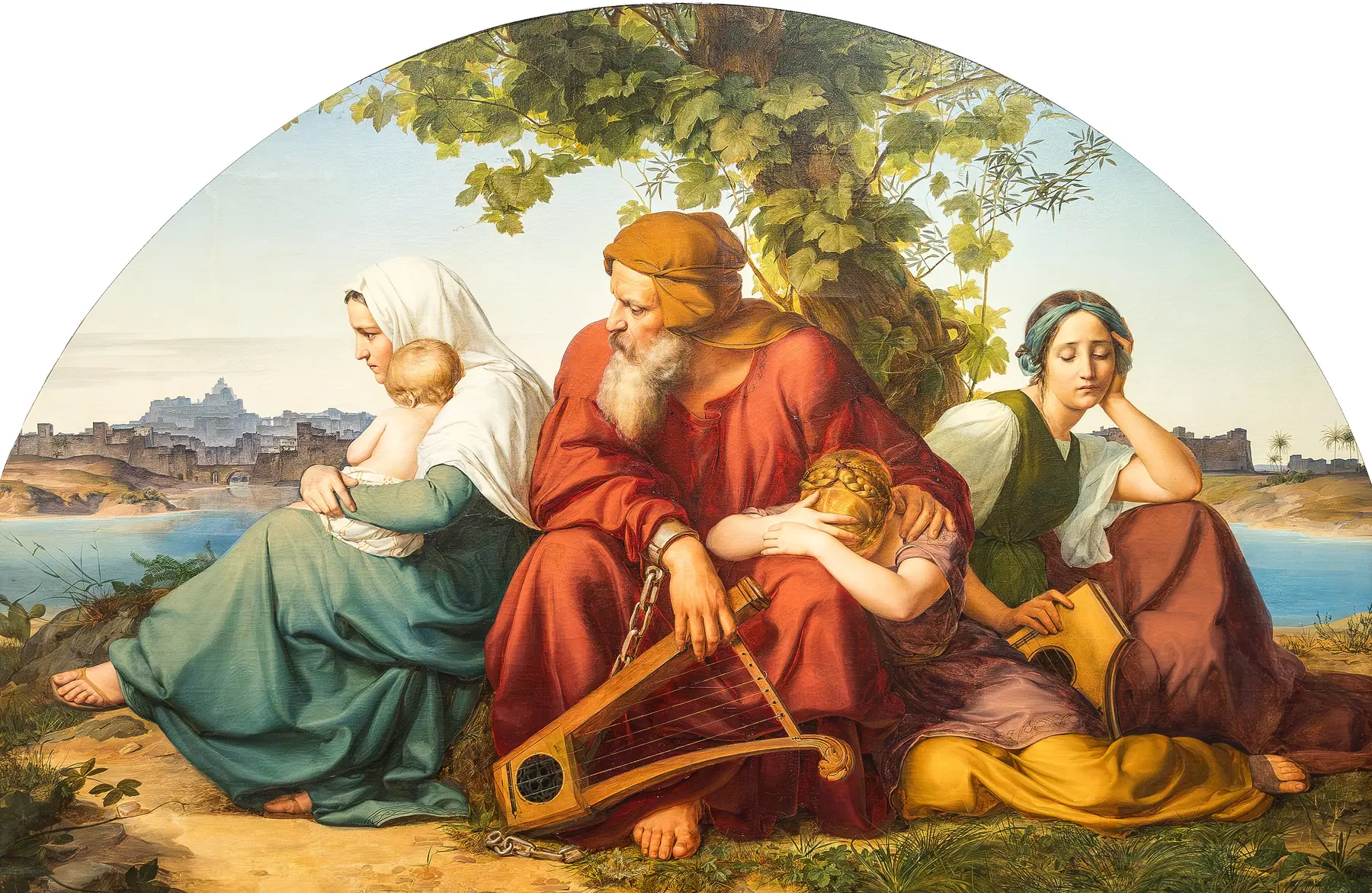
2 Kingschapter 24
20 verses · Jeremiah, by tradition · 6th century BC · History
During Jehoiakim’s reign, Nebuchadnezzar king of Babylon invaded. So Jehoiakim became his vassal for three years, until he turned and rebelled against Nebuchadnezzar.
Introduction
Jeremiah, by tradition, History, 2 Kings Overview.
This chapter was written for exiles who were among the first to be deported to Babylon, and it tells the beginning of their own story. It covers three kings in quick succession, each placed on the throne or removed by a foreign power. The compiler names the sins of Manasseh as the reason behind these events. Listen for the trades the chapter counts among the captives, and ask why an empire would want those men in particular. Notice also the new name given to the last king, and what renaming a king declared.
Context
- Who
- Judeans among the first deportation, reading their own history from exile
- What
- An account of the reigns of Jehoiakim and Jehoiachin, the first capture of Jerusalem by Nebuchadnezzar, the first deportation, and the installing of Zedekiah.
- Where
- Jerusalem under siege and stripped of its treasures, and the road to Babylon taken by the deported.
- When
- Jehoiakim about 609 to 598 BC and Jehoiachin 598 to 597 BC, with the city taken on 16 March 597 BC by the Babylonian Chronicle.
- Why
- To show the prophets' word against Judah beginning to be fulfilled, and to tie the disaster to the sins of Manasseh.
Historical context
The chapter carries three kings. Jehoiakim was Egypt's appointee, his son Jehoiachin reigned three months at eighteen, and his uncle Mattaniah was installed by Babylon under the name Zedekiah.
Show the rest of the historical context, 4 more paragraphs
The time is the decade after Carchemish, where Babylon beat Egypt in the fourth year of Jehoiakim. From that point the whole corridor from the Brook of Egypt to the Euphrates answered to Nebuchadnezzar.
The place is Jerusalem under siege and then stripped, and the road east that the deported took. The occasion is a broken oath, three times over, since a vassal king swore loyalty and then rebelled.
A first hearer knew what a deportation was for. Carrying off the commanders, the craftsmen and the metalsmiths left a country without the hands to make weapons or rebuild walls, which is why the text counts those trades. He also knew that renaming a king was a claim of ownership, the same gesture Pharaoh had made at 23:34.
The Babylonian Chronicle records Nebuchadnezzar taking the city of Judah in his seventh year, on a day that converts to 16 March 597 BC.
Significance
For the exiles this chapter explained where they were. It names their own deportation, counts them, and says plainly that it happened at the LORD's command rather than by Babylon's strength alone.
Show the rest of the significance, 1 more paragraph
It also told them that a word spoken a century earlier had landed, since Isaiah had told Hezekiah that everything in his palace would go to Babylon. And it kept their line visible, since the king carried off here is the one the last four verses of the book find at a table in Babylon.
This chapter in Jewish lifeWhat this chapter is in Jewish life and reading.
How it is read
The chapter is read as the first deportation and the paperwork around it, and the classical comment does three things with it: it settles the numbers, it says who the people taken actually were, and it reads the last king's name as a sentence passed in advance.
The numbers come first because the chapter contradicts itself. At the fourteenth verse ten thousand are carried away and at the sixteenth the figure is seven thousand with a thousand craftsmen beside them. Rashi does not smooth it over. He brings in a third figure from the prophet, the three thousand exiled in the seventh year, and reads the three together. Three thousand were of the tribe of Judah and seven thousand of Benjamin and the rest, which gives the ten thousand of the earlier verse, and he says this is what is learned in Seder Olam as well (Rashi on II Kings 24:16:1, the Metsudah Tanach series of Lakewood, N.J, CC-BY). Metzudat David does the same work on the chronology at the opening, reading the servitude as lasting three years, reading the raiding bands as armies whose hearts were stirred up to bring war against Judah, and explaining the tense of the second verse as the way of Scripture, going back to say he sent them when the events covered a longer span (Metzudat David on II Kings 24:1:1, 24:2:1 and 24:2:2, Sefaria Community Translation, CC0).
On who was taken, Rashi carries two readings and gives both. The craftsmen and the smiths are rendered by Targum Jonathan as craftsmen and the guards of the gates. But the rabbis, he says, read the two words as a figure for great scholars of the Torah. The first is used because when such a man began to speak everyone else fell silent, and the second because all sat before him and learned from him, with the Talmud at Sanhedrin 38a and Gittin 88a behind the reading (Rashi on II Kings 24:14:1). That reading changes what the verse is about, from a deportation of skilled labour to the removal of the teachers, and a Christian reader who has only met the plain sense should know the other is there. The chief men of the land are read as the men of Judah and Benjamin who were righteous, and Rashi ties them to the prophet's vision of the good figs, the exiles of Judah whom God acknowledges for good (Rashi on II Kings 24:15:1).
The end of the previous king is read from outside this book. The text says only that he slept with his fathers, and Rashi says he did not die in his bed. He was bound in chains to be taken to Babylon and died in their hands as they dragged him, which Rashi supports from the prophet's word about the burial of a donkey and from the parallel account (Rashi on II Kings 24:6:1). The Egyptian who does not come out of his land again is read as not coming out to help him (Rashi on II Kings 24:7:1). The reason is given as the defeat at Carchemish on the Euphrates in the fourth year of that reign, which Rashi takes from the book of the prophet (Rashi on II Kings 24:7:2). The young king's going out to the king of Babylon at the twelfth verse is read as a surrender rather than a sortie, that he might do with him as he wished and not for war (Rashi on II Kings 24:12:1). Metzudat David reads the siege works of the tenth and eleventh verses from the law of siege in the Torah, and explains the Hebrew word for a siege from what it does, pressing and distressing the people inside (Metzudat David on II Kings 24:10:1 and 24:11:1), and reads the stripping of the vessels as the gold being cut and peeled off them (Metzudat David on II Kings 24:13:1).
Two comments read the whole chapter as decided elsewhere. At the third verse Rashi says the calamity that came by these bands came at the LORD's own command, and the Metsudah edition's note carries Radak adding that it had been settled from the time of the reign three chapters back (Rashi on II Kings 24:3:1). At the seventeenth, the new name given to the last king is read as a warning folded into the name, that God should justify the judgment upon him if he rebelled, with the Talmud at Horiyos 11b behind it (Rashi on II Kings 24:17:1). And at the last verse Rashi reads the rebellion itself as given to him: the desire to rebel was put in him so that the exile would follow (Rashi on II Kings 24:20:1). A reader who wants the Jewish reading of why the end came will find it there, in a chain that runs from the earlier reign to the king's own name to the rebellion that ends the book.
Radak, Metzudat David and Malbim comment across this chapter at further verses, and the corpus carries those refs with the reason that Sefaria holds no English version of them, so they stand here cited and unquoted: Radak on II Kings 24:1:1, 24:3:1, 24:5:1, 24:6:1, 24:8:1 and 24:18:1; Metzudat David on II Kings 24:4:1; and Malbim on II Kings 24:19:1. Metzudat David on the fourth verse stands on the innocent blood that the LORD would not pardon, and what he makes of it waits on a fetch that carries the text.
What the rabbis say
The corpus carries forty rabbinic locators for this chapter and the text of none, so each is cited and linked here rather than quoted. Eighteen of the forty stand on the sixteenth verse, the count of the men carried away, and they are gathered in the tractates where the rabbis discuss the generation that went into exile: Ein Yaakov (Glick Edition), Gittin 9:2, Ein Yaakov (Glick Edition), Sanhedrin 4:11, Ein Yaakov, Gittin 9:2, Ein Yaakov, Sanhedrin 4:18, the Babylonian Talmud at Gittin 88a:21 and Sanhedrin 38a:5, Jerusalem Talmud Nedarim 6:8:14, Jerusalem Talmud Sanhedrin 1:2:34, Midrash Tanchuma, Tazria 9:1, Midrash Tanchuma Buber, Tazria 13:1, Midrash Tannaim on Deuteronomy 32:25:11, Ruth Rabbah (Lerner) 1:7:1, Ruth Rabbah, Petichta 7, Shir HaShirim Rabbah 8:10:1, Sifrei Devarim 321:14 and 321:15, and Vayikra Rabbah 11:7. Two of those, Sanhedrin 38a and Gittin 88a, are the places Rashi cites above for reading the craftsmen and the smiths as scholars.
Five stand on the seventeenth verse, where the king of Babylon sets up the last king and changes his name, and all five are places the rabbis treat the making of a king: Horayot 11b:18, Jerusalem Talmud Horayot 3:2:25, Jerusalem Talmud Shekalim 6:1:10, Jerusalem Talmud Sotah 8:3:7, and Keritot 5b:14.
Three stand on the fourteenth verse, on the ten thousand carried away: Esther Rabbah, Petichta 11, Midrash Tanchuma, Noach 3:10, and Otzar Midrashim, The Ten Exiles 1:9. Bamidbar Rabbah 20:20 is anchored across the whole deportation from the eighth verse to the seventeenth, with Eikhah Rabbah, Petichta 23 and Kohelet Rabbah 12:7:1 on the eighth.
The rest are single or in pairs. On the first verse, Aggadat Bereshit 64:2 and Midrash Lekach Tov on Esther, Introduction 2. On the fourth, Jerusalem Talmud Sanhedrin 10:2:13. On the fifth, Vayikra Rabbah 19:6, which is the passage the Metsudah note names for the death of the earlier king. On the seventh, Seder Olam Rabbah 24:2. On the twelfth, Seder Olam Rabbah 25:2. On the thirteenth, Midrash Tehillim 17:10. On the fifteenth, Midrash Sekhel Tov, Bereshit 32:16:5 and Tractate Soferim 7:4. On the nineteenth, Ein Yaakov (Glick Edition), Sanhedrin 11:78 and Sanhedrin 103a:6. On the twentieth, Eikhah Rabbah 2:14. What each of them teaches is a saying of the rabbis, and is reported as theirs wherever this site quotes one. The quotations wait on a fetch that carries the text.
Sources: Rashi, Rashi on II Kings 24:3:1, 24:6:1, 24:7:1, 24:7:2, 24:12:1, 24:14:1, 24:15:1, 24:16:1, 24:17:1 and 24:20:1, The Metsudah Tanach series, Lakewood, N.J, CC-BY; Metzudat David, Metzudat David on II Kings 24:1:1, 24:2:1, 24:2:2, 24:10:1, 24:11:1 and 24:13:1, Sefaria Community Translation, CC0; and on 24:4:1, cited by ref because the corpus carries no English text; Radak, Radak, the reading the Metsudah edition carries at II Kings 24:3:1, and his own refs at 24:1:1, 24:3:1, 24:5:1, 24:6:1, 24:8:1 and 24:18:1, cited by ref because the corpus carries no English text; Malbim, Malbim on II Kings 24:19:1, cited by ref because the corpus carries no English text; The Sefaria corpus, scripts/data/sources/sefaria/2-kings/24.json, the 40 Talmud and Midrash locators of this chapter.
The heads below are this chapter's scenes. The numbered points under each are its verses.
Raiding bands, and the king of Egypt came no more
2 Kings 24:1-2
Jehoiakim became his vassal for three years: s" and then "rebelled against Nebuchadnezzar". The LORD sends "Chaldean, Aramean, Moabite, and Ammonite raiders" against Judah. Henry sets them beside Deuteronomy 28:49, a nation brought from far against a people who would not keep the covenant.
2 Kings 24:1
“Nebuchadnezzar began his reign in the fourth year of Jehoiakim. In his eighth year he made him his prisoner, but restored him upon his promise of faithfulness to him. That promise he kept about three years, but then rebelled, probably in hopes of assistance from the king of Egypt.”
Matthew Henry · Commentary on the Whole Bible (1707-1721)puritan
2 more voices on this verseWhat preachers and commentators have said about this verse, in their own words.
2 Kings 24:1
Necessarily, too, the Lord gives us this admonition, to say in our prayer, "And lead us not into temptation." In this part it is shown that the adversary has no power against us, unless God has previously permitted it, in order that all our fear and devotion and obedience may be turned to God, since in temptations nothing evil is permitted, unless the power is granted by him. Scripture proves this when it says, "Nebuchadnezzar, king of Babylon, came against Jerusalem and assaulted it, and the Lord gave it into his hand."
Cyprian · written before 258 · Treatise IV. On the Lord's Prayer 25patristic
2 Kings 24:1
“In his days - i. e., 605 B.C., which was the third completed Dan 1:1, and fourth commencing Jer 25:1, year of Jehoiakim. Nebuchadnezzar - or Nebuchadrezzar, which is closer to the original, Nabu-kudurri-uzur. This name, like most Babylonian names, is made up of three elements, Nebo, the well-known god Isa 46:1, kudur, of doubtful signification (perhaps “crown” perhaps “landmark”), and uzur “protects.” Nebuchadnezzar, the son of Nabopolassar, and second monarch of the Babylonian empire, ascended the throne, 604 B.C., and reigned 43 years, dying 561 B.C.”
Moabite, and Ammonite raiders: Albert Barnes reads these raiders as troops Nebuchadnezzar sent in place of coming himself, joined by the peoples around Judah. Ezekiel 25:3 and Zephaniah 2:8 condemn Ammon and Moab for taunting Judah in its fall. Adam Clarke links the prophets' word to Huldah at 22:16.
2 Kings 24:2
“See the marginal references. Instead of coming up in person Nebuchadnezzar sent against Jehoiakim his own troops and those of the neighboring nations. The ravages of the Moabites and the Ammonites are especially alluded to in the following passages: Jer 48:26-27; Jer 49:1; Eze 25:3-6; Zep 2:8.”
1 more voice on this verse
2 Kings 24:2
“Now he came himself, and laid siege to the city. Now the word of God was fulfilled ( Deut. xxviii. 49 , &c.), The Lord shall bring a nation against thee from far, of fierce countenance, that shall first eat of the fruit of thy land and then besiege thee in all thy gates.”
Matthew Henry · Commentary on the Whole Bible (1707-1721)puritan
2 Kings 24:3-4
because of the sins of Manasseh: The narrator states that Judah's fall came "at the LORD’s command", "because of the sins of Manasseh and all that he had done". The second ground is "the innocent blood he had shed". Verse 4 closes, "the LORD was unwilling to forgive", a national judgment that outlives Josiah's reform.
2 Kings 24:3
“Surely at the commandment of the Lord came this upon Judah, to remove them out of his sight,.... It was the sure and certain decree of God they should be carried captive, and therefore he stirred up the spirit of Nebuchadnezzar, and gave him orders to go against it: for the sins of Manasseh, according to all that he did; which were still continued among the Jews, and committed by them, though repented of by Manasseh, and he returned from them.”
the innocent blood he had shed: John Gill ties this innocent blood to Manasseh at 21:16 and to its continuation in the days of Jehoiakim. Jeremiah 26:20-23 records Jehoiakim bringing the prophet Uriah back from Egypt and putting him to the sword. The blood in Jerusalem kept flowing.
2 Kings 24:4
“And also for the innocent blood that he shed, for he filled Jerusalem with innocent blood,.... See 2Ki 21:16 which cruel usage of the prophets, and servants of the Lord, was still continued; see Jer 26:21, which the Lord would not pardon; he pardoned the sins of Manasseh, who repented, but not the sins of those persons who imitated him, but repented not; or though he personally pardoned the sins of Manasseh, so that he was saved everlastingly, yet the temporal punishment of the nation for those sins, in which they were involved with him, was not averted.”
2 Kings 24:5-7
the rest of the acts of Jehoiakim: Jehoiakim "rested with his fathers," and the formula records no burial. Jeremiah had said he would be buried like a donkey, dragged off and thrown out beyond the gates. His son Jehoiachin succeeds him, though by Jeremiah 36:30 none of his line would sit long on the throne of David.
2 Kings 24:5
“Now the rest of the acts of Jehoiakim,.... In 2Ch 36:8, it is added, "his abominations, and that which was found in him": which besides his rebellion against the king of Babylon, and his shedding innocent blood, is interpreted of marks made in his body for superstitious and idolatrous purposes; so Lyra.”
2 more voices on this verse
2 Kings 24:5
“Comparing Jer 22:19; Jer 36:6, Jer 36:30; and Eze 19:8-9, it would seem that Nebuchadnezzar must in the fifth or sixth year after Jehoiakim’s revolt have determined to go in person to Riblah, to direct operations, first against Tyre and then against Jerusalem. Jehoiakim was taken prisoner, and brought in chains to Nebuchadnezzar, who at first designed to convey him to Babylon, but afterward had him taken to Jerusalem, where he was executed.”
2 Kings 24:5
“Bands - For Nebuchadnezzar's army was made up of several nations, who were willing to fight under the banner of such a puissant and victorious emperor. The sins - Properly and directly for their own sins, and occasionally for the sins of Manasseh, which had never been charged upon them, if they had not made them their own by their repetition of them.”
John Wesley · Explanatory Notes upon the Old Testament (1765)evangelical
Jehoiakim rested with his fathers: His son is also called Jeconiah and Coniah, and Albert Barnes renders all three names as forms of YHWH will establish. 2 Chronicles 36:6 has Nebuchadnezzar binding Jehoiakim in bronze shackles to take him to Babylon. John Gill holds that he died at the city gate.
2 Kings 24:6
“Jehoiachin his son - As this man reigned only three months and was a mere vassal to the Babylonians, his reign is scarcely to be reckoned; and therefore Jeremiah says of Jehoiakim, He shall have none to sit upon the throne of David, Jer 36:30, for at that time it belonged to the king of Babylon, and Jehoiachin was a mere viceroy or governor. Jehoiachin is called Jechonias in Mat 1:11.”
Adam Clarke · Commentary on the Bible (1810-1826)evangelical
ConnectionsJeremiah 22:24, Jeremiah 52:31
from the Brook of Egypt: The Brook of Egypt marks the southern border at Numbers 34:5, and Genesis 15:18 gives Abram the land from Egypt to the Euphrates River. Babylon now held the whole span. Albert Barnes dates Egypt's withdrawal from the battle of Carchemish.
2 Kings 24:7
“Neco, from the year of the battle of Carchemish, confined himself to his own country and made no efforts to recover Syria or Judaea.”
Jehoiachin surrenders; ten thousand carried to Babylon
2 Kings 24:8-9
Jehoiachin was eighteen years old: d when he became king", where 2 Chronicles 36:9 gives his age as eight. Gill and Clarke reconcile the numbers by supposing a co-regency with his father. In verse 9 "he did evil in the sight of the LORD, just as his father had done".
2 Kings 24:8
“Jehoiachin was eighteen years old - He is called Jeconiah, 1Ch 3:16, and Coniah, Jer 22:24. In 2Ch 36:9, be is said to be only eight years of age, but this must be a mistake; for we find that, having reigned only three months, he was carried captive to Babylon, and there he had wives; and it is very improbable that a child between eight and nine years of age could have wives; and of such a tender age, it can scarcely be said that, as a king, he did that which was evil in the sight of the Lord.”
Adam Clarke · Commentary on the Bible (1810-1826)evangelical
just as his father had done: Jamieson, Fausset and Brown read Ezekiel 19:5-7 as the portrait of this king, the second young lion in that lament over the princes of Judah. Matthew Henry describes a curse that passed down with the crown. He reigned three months and did evil in that time.
2 Kings 24:9
“And he did that which was evil in the sight of the Lord, according to all that his father had done. Being partner with him in his throne, he was in his sins, and continued therein, see 2Ki 23:37.”
2 Kings 24:10-12
the servants of Nebuchadnezzar king of Babylon: Jehoiachin surrenders with "his mother, his servants, his commanders, and his officials". Gill dates the capture to the eighth year of Nebuchadnezzar's reign and reckons the seventy years of captivity from this point. The whole royal household goes out together, the pattern the exile keeps to the book's last chapter.
while his servants were besieging: Jamieson, Fausset and Brown read this siege as the end of Nebuchadnezzar's patience with the kings of Judah. Jeremiah 22:24-25 had said the LORD would pull Coniah off like a signet ring and hand him over to Nebuchadnezzar king of Babylon. The king came in person to the city.
2 Kings 24:11
“And Nebuchadnezzar king of Babylon came against the city,.... He came in person, following his army: and his servants did besiege it; very closely.”
in the eighth year: Jeremiah 52:28 dates a deportation to the seventh year of Nebuchadnezzar, and Albert Barnes explains the one-year gap as two ways of counting the years. Adam Clarke reads the surrender as a bid for better terms. Jehoiachin was taken captive with his household.
2 Kings 24:12
“And Jehoiachin king of Judah went out to the king of Babylon,.... Not to fight with him, but to submit to him, and to surrender the city to him, and be at his mercy: he and his mother, and his servants, and his princes, and his officers; the royal family, courtiers, and nobles: and the king of Babylon took him in the eighth year of his reign; Of Nebuchadnezzar's reign, and which was the eighth of the first captivity, and from whence the seventy years' captivity were reckoned.”
2 Kings 24:13-14
he cut into pieces all the gold articles: "As the LORD had declared" through Isaiah to Hezekiah, Nebuchadnezzar carries off "all the treasures from the house of the LORD and the royal palace". He cuts "into pieces all the gold articles that Solomon king of Israel had made", and Barnes notes the great bronze pieces wait for 25:13-17.
2 Kings 24:13
“The church has gold, not stored up but to lay out and to spend on those who need. What necessity is there to guard what is of no good? Do we not know how much gold and silver the Assyrians took out of the temple of the Lord? Is it not much better that the priests should melt it down for the sustenance of the poor, if other supplies fail, than that of a sacrilegious enemy should carry it off and defile it? Would not the Lord say, Why did you allow so many needy to die of hunger?”
Ambrose of Milan · written before 397 · On the Duties of the Clergy 2.28.137patristic
2 more voices on this verse
2 Kings 24:13
“On the first capture of the city in the fourth (third) year of Jehoiakim Dan 1:2; 2Ch 36:7, the vessels carried off consisted of smaller and lighter articles; while now the heavier articles, as the table of showbread, the altar of incense, the ark of the covenant were stripped of their gold, which was carried away by the conquerors. Little remained more precious than brass at the time of the final capture in the reign of Zedekiah 2Ki 25:13-17.”
2 Kings 24:13
“Now the word of God by Isaiah was fulfilled ( ch. xx. 17 ), All that is in thy house shall be carried to Babylon.”
Matthew Henry · Commentary on the Whole Bible (1707-1721)puritan
Only the poorest people: Albert Barnes sets the number at no more than eleven thousand, in three classes: officials, seven thousand soldiers and a thousand craftsmen. Babylon took the men who could lead, fight or build, and left those who could do none of these. John Wesley reads all Jerusalem as its best part.
2 Kings 24:14
“All - Not simply all, but the best and most considerable part, as the following words explain it. Captives - Which are more particularly reckoned up, ver. 16, where there are seven thousand mighty men, and a thousand smiths; and those mentioned ver. 15, make up the other two thousand.”
John Wesley · Explanatory Notes upon the Old Testament (1765)evangelical
2 Kings 24:15-16
the leading men of the land: Verse 15 names "the leading men of the land", and verse 16 counts "seven thousand men of valor and a thousand craftsmen and metalsmiths". Barnes reads the two as distinct terms, one for civil rank and one for fitness in war. Ezekiel is taken in this deportation.
2 Kings 24:15
“The mighty of the land - Or “the great,” “the powerful.” The word used is quite distinct from that in 2Ki 24:14, 2Ki 24:16. It refers, not to bodily strength or fitness for war, hut to civil rank or dignity. The term would include all civil and all ecclesiastical functionaries - the nobles, courtiers, and elders of the city on the one hand, the priests, prophets (among them, Ezekiel), and Levites on the other.”
Esther 2:6 places Mordecai's family among the exiles taken with Jeconiah king of Judah, as Matthew Henry notes. The Hebrew word for the metalsmiths, masger, comes from a verb meaning to shut, and Albert Barnes renders it locksmiths. Babylon wanted men fit for battle.
2 Kings 24:16
“And of the way in which, as we said, the sin of fornication is prevented by an attack of vainglory, there is an excellent and significant figure in the book of Kings, where, when the children of Israel had been taken captive by Necho, King of Egypt, Nebuchadnezzar, King of Assyria, came up and brought them back from the borders of Egypt to their own country, not indeed meaning to restore them to their former liberty and their native land, but meaning to carry them off to his own land and to transport them to a still more distant country…”
John Cassian · written before 435 · CONFERENCE 5.12patristic
1 more voice on this verse
2 Kings 24:16
“In this captivity Ezekiel the prophet was carried away ( Ezek. i. 1, 2 ) and Mordecai, Esth. ii. This Jehoiachin was also called Jeconiah ( 1 Chron. iii.”
Matthew Henry · Commentary on the Whole Bible (1707-1721)puritan
2 Kings 24:17-18
changed his name to Zedekiah: The king of Babylon makes "Mattaniah, Jehoiachin’s uncle," king and "changed his name to Zedekiah," a vassal wearing a name his master gave him. The name means the righteousness of the LORD, as Jamieson, Fausset and Brown note. Gill notes he was not yet ten when his father Josiah died.
2 Kings 24:17
“And the king of Babylon made Mattaniah his father's brother king in his stead,.... The third son of Josiah, 1Ch 3:15. and changed his name to Zedekiah; for the same reason the king of Egypt changed the name of Eliakim, 2Ki 23:34 to signify his subjection to him; though some think it was to put him in mind of the justice of God, as the name signifies, that would overtake him, should he be treacherous to him, and rebel against him; so the Jewish Midrash.”
2 more voices on this verse
2 Kings 24:17
“But, according to the custom of conquerors, who changed the names of the great men they took captives in war, in token of their supremacy, he gave him the new name of Zedekiah--that is, "The righteous of God." This being a purely Hebrew name, it seems that he allowed the puppet king to choose his own name, which was confirmed.”
Jamieson, Fausset & Brown · Commentary Critical and Explanatory on the Whole Bible (1871)reformed
2 Kings 24:17
“Mattaniah, son of Josiah and brother of Jehoahaz, but thirteen years his junior, adopted a name significant of the blessings promised by Jeremiah to the reign of a king whose name should be “Yahweh, our righteousness” Jer 23:5-8.”
Zedekiah rebels, and Jerusalem is cast out from his presence
Hamutal daughter of Jeremiah: This Jeremiah of Libnah is a different man from the prophet of Anathoth named at Jeremiah 1:1. Libnah was a town given to the priests. Jeremiah 52:1 repeats this verse on Zedekiah's years and his mother word for word at the opening of its own account of the fall.
2 Kings 24:19-20
just as Jehoiakim had done: Verse 19 measures Zedekiah by the same standard: "Zedekiah did evil in the sight of the LORD, just as Jehoiakim had done". Verse 20 names the cause before the political fact. Only then does it add, "And Zedekiah also rebelled against the king of Babylon".
2 Kings 24:19
“He did that which was evil - The character of Zedekiah seems to have been weak rather than wicked. Consult Jer. 34; 37: His chief recorded sins were: (1) his refusal to be guided in his political conduct by Jeremiah’s counsels, while nevertheless he admitted him to be a true Yahweh-prophet; and (2) his infraction of the allegiance which he had sworn to Nebuchadnezzar.”
Zedekiah also rebelled against: Albert Barnes traces the rebellion through Jeremiah, where Hananiah promised at Jeremiah 28:3 that the temple articles would return within two years. Adam Clarke notes that Zedekiah broke an oath sworn by God, the charge of 2 Chronicles 36:13. Ezekiel 17:15 adds his appeal to Egypt.
2 Kings 24:20
“Zedekiah rebelled - This was in the eighth year of his reign: and he is strongly reproved for having violated the oath he took to the king of Babylon: see 2Ch 36:13. This was the filling up of the measure of iniquity; and now the wrath of God descends upon this devoted king, city, and people, to the uttermost. See the catastrophe in the next chapter.”
Adam Clarke · Commentary on the Bible (1810-1826)evangelical
1 more voice on this verse
2 Kings 24:20
“Came to pass - Thus the peoples sins were the true cause why God gave them wicked kings, whom he suffered to do wickedly, that they might bring the long-deserved, and threatened punishments upon themselves and their people.”
John Wesley · Explanatory Notes upon the Old Testament (1765)evangelical
How this psalm is built
The form: Three regnal notices compressed into one chapter, with the compiler's own statement of cause set between the first and the second, as John Gill, with Keil classes it.
The patterns in this chapter
| Device | What it does | Where to see it |
|---|---|---|
| He did evil, just as his father had done | Three kings are graded in this chapter and none of them is measured against the law. Jehoiachin at verse 9 is measured against Jehoiakim, and Zedekiah at verse 19 is measured against Jehoiakim again. The site's exposition note on 24:19 to 20, which cites Barnes with Wesley, records that Barnes calls Zedekiah weak rather than wicked, a king who heard Jeremiah and would not obey him. Once the standard becomes the last king rather than the covenant, the book has nothing left to say about any of them separately.Albert Barnes, Notes on the Old and New Testaments, cited by the site's exposition note on 2 Kings 24:19 to 20. | 2 Kings 24:9, 2 Kings 24:19 |
| The deportation counted twice | Verse 14 gives the first list, all the commanders and mighty men of valour, all the craftsmen and metalsmiths, ten thousand captives, with only the poorest left. Verse 16 gives a second and more exact one, seven thousand men of valour and a thousand craftsmen and metalsmiths. The site's exposition note on 24:15 to 16, which cites Barnes with Henry, reads the two as distinct terms, one for civil rank and one for fitness in war, and observes that removing the craftsmen and smiths leaves a conquered land without the hands to make weapons or rebuild walls.Albert Barnes, Notes on the Old and New Testaments, cited by the site's exposition note on 2 Kings 24:15 to 16. | 2 Kings 24:14, 2 Kings 24:15, 2 Kings 24:16 |
| Three vassals, three broken oaths | Jehoiakim serves three years and rebels at verse 1, Jehoiachin surrenders at verse 12 and is carried off, and Zedekiah is installed at verse 17 and rebels at verse 20. The site's exposition note on 24:1 to 2 names the pattern at its first turn, a vassal king who breaks his oath, and the chapter runs it twice more. Rashi, at 24:20, carries the Jewish reading of the last of the three, that the desire to rebel was given to Zedekiah so that the exile would follow.Matthew Henry, Commentary on the Whole Bible, 1710, cited by the site's exposition note on 2 Kings 24:1 to 2. | 2 Kings 24:1, 2 Kings 24:12, 2 Kings 24:20 |
| Mattaniah renamed Zedekiah | Verse 17 has Nebuchadnezzar install Josiah's remaining son and change his name, the same gesture Pharaoh Neco made at 23:34 when he renamed Eliakim. The site's exposition note on 24:17 to 18, which cites Jamieson, Fausset and Brown with Gill, records that Jamieson, Fausset and Brown, along with Wesley, read the new name, the righteousness of the LORD, as a standing warning aimed at the unfaithfulness it names. Rashi glosses it as the conqueror's own sentence, that God should justify the judgment on him if he rebels.Rashi, Rashi on II Kings 24:17:1, the Metsudah Tanach series, Lakewood, fetched from Sefaria under CC-BY. | 2 Kings 24:17, 2 Kings 23:34 |
The historical value
15 more paragraphs on the patterns
This is the chapter of the book with the most exact outside dating, and the dossier carries the tablet that supplies it. The Babylonian Chronicle ABC 5, BM 21946 in the British Museum, records Nebuchadnezzar taking the city of Judah on the second day of the month Adar in his seventh year, which the dossier converts to 16 March 597 BC, and installing a king of his own choice. The dossier calls it an independent dated confirmation of the deportation of Jehoiachin and the accession of Zedekiah in verses 10 to 17.
The Jehoiachin ration tablets carry the same king forward. The dossier records administrative tablets from the storerooms near the Ishtar Gate in Babylon, about 592 BC, excavated by Robert Koldewey's expedition and published by Ernst Weidner in 1939, listing rations of oil issued to Ya'u-kinu, king of the land of Yahudu, and to his sons. That is the man carried off at verse 15, drawing a royal allowance in the city he was carried to.
The removal of craftsmen and metalsmiths at verses 14 and 16 is a policy rather than a detail. The site's exposition note on verses 15 and 16 states what it accomplishes, a conquered land left without the hands to make weapons or rebuild its own walls.
Two prophetic books date themselves by the events of this chapter. The site's exposition note on verses 13 and 14 records that Daniel dates by the earlier captivity of his own first chapter and Ezekiel by this one, each stating it lightly as its own setting. The note on verses 15 and 16 adds that Ezekiel was among the priests and officials taken here, and that his book dates its opening vision by the years of Jehoiachin's captivity rather than by any king still reigning in Jerusalem.
The debated concept
Jehoiachin's age is the chapter's textual question. Verse 8 gives eighteen and 2 Chronicles 36:9 gives eight. The site's exposition note on verses 8 and 9, which cites Gill with Clarke, records that both read the two numbers together by supposing a co-regency, crowned young alongside his father and reckoned differently by each book's own convention, and states plainly that the text itself gives no such explanation.
The count of the deportation is the second. Verse 14 says ten thousand and verse 16 says seven thousand with a further thousand craftsmen. Rashi reconciles them from Jeremiah 52:28 and Seder Olam by taking three thousand of Judah and seven thousand of Benjamin and the other tribes. The site records the reconciliation with its holder and the figures the text itself carries.
How far the phrase at the end of verse 4 reaches is the third. The site's exposition note on verses 3 and 4 records that the clause the Berean renders the LORD was unwilling to forgive occurs nowhere else in Scripture, and that Gill reads them as a temporal judgment on the nation rather than a verdict on Manasseh's own standing, since 2 Chronicles 33 records his repentance. The dossier carries the wider question under the heading of why Manasseh's sins fell on a later generation, with the door /featured/the-exile-and-return.
Where the regnal numbers of this book come from is the standing question behind every date in the chapter, and the dossier carries it with two positions. Edwin R. Thiele, in The Mysterious Numbers of the Hebrew Kings, 1951, holds that the numbers are consistent once the ancient conventions are applied, since Judah and Israel counted regnal years from different new years, used accession and non-accession reckoning at different periods, and recorded coregencies as full reigns. Critical scholars including Julius Wellhausen and, more recently, Gershon Galil in The Chronology of the Kings of Israel and Judah, 1996, accept much of the data as ancient while holding that some figures were rounded or harmonised in transmission. The dossier records that Thiele's synchronisms are the basis for the standard dates of 931, 722 and 586 BC used across conservative and critical scholarship alike. Where the Greek figures differ from the Hebrew, the dossier's manuscripts section sends a reader first to the kaige recension, the revision of the Greek toward the proto-Masoretic Hebrew identified by Dominique Barthelemy in Les Devanciers d'Aquila, 1963, which covers all of 2 Kings.
The divine connection
The chapter states its own causation three times and each time before the political fact. Verse 2 has the raiders sent according to the word the LORD had spoken through His servants the prophets. Verse 3 says the removal happened at the LORD's command. Verse 20 says that because of the anger of the LORD all this happened, and only then reports that Zedekiah rebelled. The site's exposition note on verses 19 and 20 records Wesley's reading of the order, that the people's own sin produced the wicked king who then brought their punishment.
The oldest word in the chapter is fulfilled at verse 13. The site's exposition note on verses 13 and 14 records that the gold vessels Solomon made are cut in pieces exactly as the LORD had said, fulfilling the word given to Hezekiah through Isaiah at 20:17 about a century before, and that this first plundering strips the gold from the heavier furnishings while the ark and the great bronze pieces wait for the final capture at 25:13 to 17.
The Davidic thread is bent here rather than broken. The guide's Christ table pairs 8:19 with 25:27 to 30 and Matthew 1:11 to 12, and the man that thread runs through is the king carried off at verse 15. Rashi, at 24:15, carries a Jewish reading of the same deportation, that the dignitaries taken with him were righteous men, and that Jeremiah 24:5 speaks of them as the good figs.
How the rest of Scripture reads this chapter
Jeremiah 22:18 to 19 says of Jehoiakim that he would be buried with the burial of a donkey, dragged and thrown out beyond the gates, and the site's exposition note on verses 5 to 7 reads the chapter's silence about his burial as deliberate against it. Jeremiah 36:30 says none of his line would sit long on David's throne, and the next king reigns three months. Jeremiah 52:28 supplies the third figure Rashi uses to reconcile the counts. 2 Chronicles 36 carries the same three reigns in short. Matthew 1:11 to 12 carries Jeconiah into the genealogy of Christ.
Keep studying
Studies4
Sources for this chapter
The summary
Jamieson, Fausset & Brown, Commentary Critical and Explanatory; John Wesley, Notes on the Old Testament and Matthew Henry, Complete Commentary.
The form and classifications
John Gill, with Keil, Exposition of the Old Testament, 1748 to 1763, and The Books of the Kings, cited together by the site's exposition note on 2 Kings 24:3 to 4 and Matthew Henry, with Albert Barnes, Commentary on the Whole Bible, 1710, and Notes on the Old and New Testaments, cited together by the site's exposition note on 2 Kings 24:1 to 2.
The exposition
Adam Clarke, Commentary on the Bible; Albert Barnes; Bede, Thirty Questions on the Book of Kings; Berean Standard Bible; Jamieson, Fausset & Brown, Commentary Critical and Explanatory on the Whole Bible; Jamieson, Fausset and Brown, Commentary Critical and Explanatory on the Whole Bible; John Gill; John Wesley, Explanatory Notes upon the Old Testament; Keil, The Books of the Kings and Matthew Henry, Commentary on the Whole Bible.