
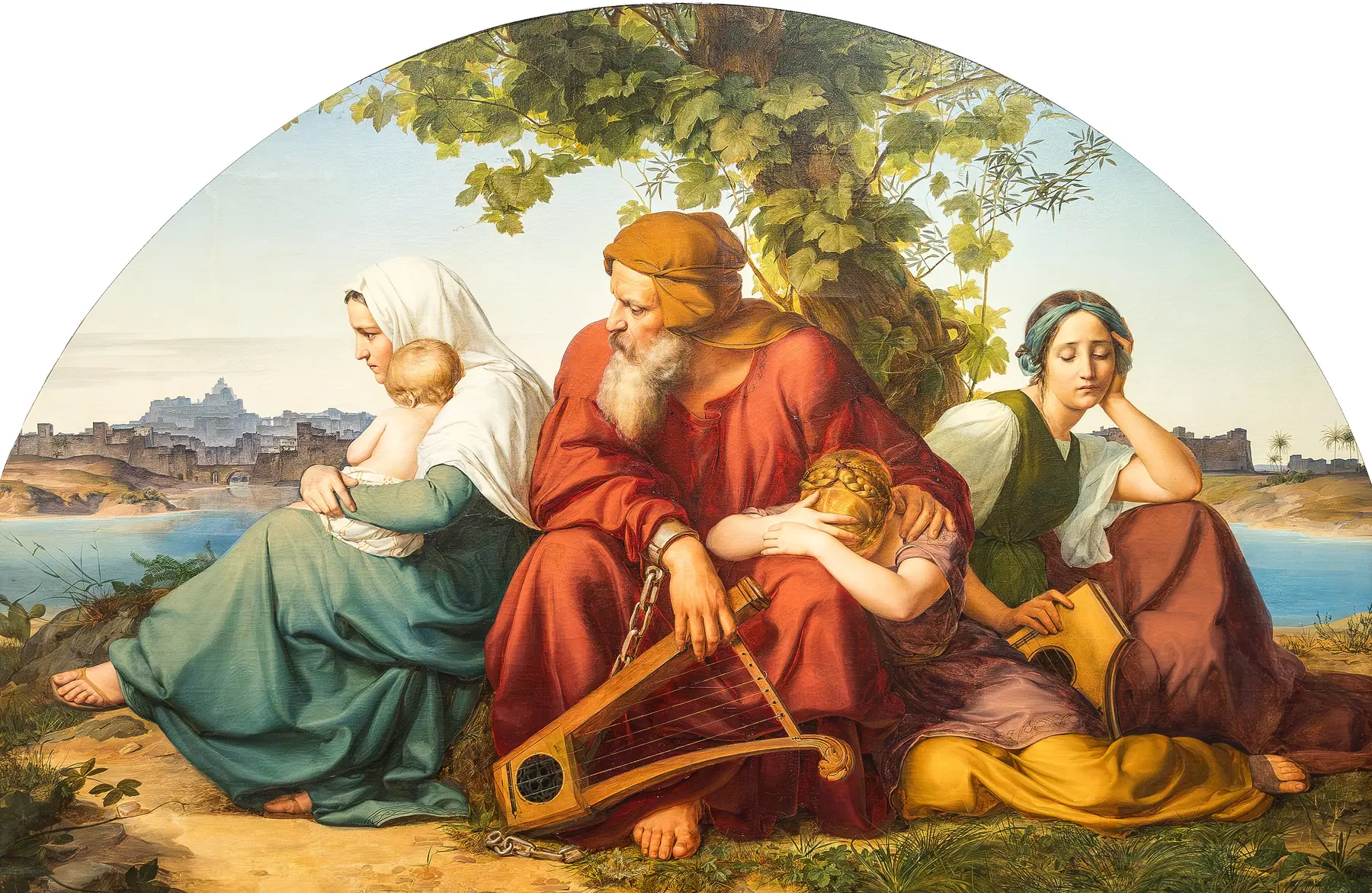
2 Kingschapter 21
26 verses · Jeremiah, by tradition · 6th century BC · History
For he rebuilt the high places that his father Hezekiah had destroyed, and he raised up altars for Baal. He made an Asherah pole, as King Ahab of Israel had done, and he worshiped and served all the host of heaven.
Introduction
Jeremiah, by tradition, History, 2 Kings Overview.
This chapter was written for exiles who traced their captivity back to one reign more than to any other. It covers the longest reign in Judah's history and a short reign after it, and it reverses nearly everything the reforming king before them had done. Its list of practices follows the law of Moses item by item. Listen for the prophets' verdict, given in the pictures of a builder and a household. Read it with 2 Chronicles 33, which tells of a captivity and a prayer this chapter leaves out.
Context
- Who
- Judeans who traced the exile back to this reign more than to any other
- What
- An account of the reigns of Manasseh and Amon, the idolatry they restored, and the prophetic sentence passed on Jerusalem.
- Where
- Jerusalem, with altars in both courts of the temple, shrines rebuilt across the hill country, and the burial garden of Uzza.
- When
- Manasseh about 697 to 642 BC and Amon about 642 to 640 BC, in the years when Assyria's power was at its height.
- Why
- To name the reign the book holds responsible for the fall of Jerusalem, and to show that the sentence was spoken long before it fell.
Historical context
The chapter belongs to two kings, Manasseh, who came to the throne at twelve and reigned fifty-five years, and his son Amon, who reigned two. The period is the height of Assyrian power, and Judah paid tribute through most of it. Assyrian records of the era name kings of Judah among the vassals who sent tribute, and the Prism of Ashurbanipal is one of them.
Show the rest of the historical context, 4 more paragraphs
The place is Jerusalem and the hill country around it. The chapter puts altars in both courtyards of the temple, an Asherah pole inside the house, shrines rebuilt across the country, and a valley outside the walls where children were burned.
The occasion is a reversal, since everything Hezekiah had pulled down went back up, and the text gives no reason beyond the deed.
A first hearer knew that the host of heaven means the sun, the moon and the constellations, a religion that came from Assyria and Babylon. He would also have heard the list at verse 6 as the practices of Deuteronomy 18:10 and 18:11 worked through in order. A burial in the garden of Uzza rather than among the kings was a public statement about a reign.
2 Chronicles 33 records a captivity in Assyria, a prayer and a return that this account leaves out entirely.
Significance
For Judah this chapter was the explanation of the exile. The sentence spoken here through unnamed prophets is quoted again after Josiah's reform and again when Babylon arrives.
Show the rest of the significance, 2 more paragraphs
It told them they were being measured by one standard, since the line that condemned Samaria was stretched over Jerusalem. The city that had survived for David's sake was held to what the north could not pass.
And it told them that blood-guilt was its own charge, standing beside the idolatry rather than inside it.
This chapter in Jewish lifeWhat this chapter is in Jewish life and reading.
How it is read
The corpus is thinner on this chapter than on any other of the twelve, and the thinness is itself worth stating. The reign the compiler blames the exile on carries only three comments with their English text. Every other classical remark on it stands in the corpus without a translation.
Of the three, one answers a question the text raises and does not settle. The verse says the LORD spoke by his servants the prophets, and names none of them. Rashi names two, Nahum and Habakkuk, and explains the silence: "because Menashe was wicked, they were not referred to with his name". That is his reading of why the books of those prophets do not date themselves by this king as other prophets date themselves by the king of their day (Rashi on II Kings 21:10:1, the Metsudah Tanach series of Lakewood, N.J, CC-BY).
The other two are explanations of images. The ears that will tingle at the news are read through a word for cymbals, and Rashi reaches for one word of Old French to fix the sense, tintiner (Rashi on II Kings 21:12:1). The measuring line and the plummet held over Jerusalem are read from the builder's yard. The plumb line is "the string to which the builders of a wall tie a lead weight to make the wall straight", so the image is a tool for testing whether what is built stands true (Rashi on II Kings 21:13:1).
Malbim, Radak and Metzudat David comment across this chapter at twenty-one places, and the corpus carries every one of those refs with the reason that Sefaria holds no English version of them, so they stand here cited and unquoted: Malbim on II Kings 21:2:1, 21:4:1, 21:7:1, 21:9:1, 21:11:1 and 21:22:1; Radak on II Kings 21:3:1, 21:6:1, 21:8:1, 21:10:1 and 21:16:1; and Metzudat David on II Kings 21:4:1, 21:5:1, 21:6:1, 21:7:1, 21:8:1, 21:9:1, 21:14:1, 21:15:1, 21:18:1 and 21:26:1. The verses a Christian reader most wants a Jewish comment on are covered by all three and translated for none of them: the sixth, where the king passes his son through the fire and deals with mediums, and the sixteenth, where he fills Jerusalem with innocent blood. What any of the three makes of either waits on a fetch that carries the text.
What the rabbis say
The corpus carries thirty-nine rabbinic locators for this chapter and the text of none, so each is cited and linked here rather than quoted. Nineteen of the thirty-nine, nearly half, stand on one verse, the sixteenth, where the king sheds innocent blood until Jerusalem is filled from one end to the other: Bamidbar Rabbah 7:10, Ein Yaakov (Glick Edition), Sanhedrin 11:81 and 11:121, Ein Yaakov (Glick Edition), Yoma 1:6, Ein Yaakov, Yoma 1:10 and 2:10, Jerusalem Talmud Sanhedrin 10:2:13, Midrash Lekach Tov, Genesis 13:12:5, Midrash Sekhel Tov, Bereshit 44:17:20, Midrash Tannaim on Deuteronomy 33:7:16, Otzar Midrashim, Baraita of Yeshua ("Salvation") 1:10, Pesikta Rabbati 4:1, the Babylonian Talmud at Sanhedrin 103b:6, Sanhedrin 109a:10, Yoma 9b:7 and Yoma 23a:13, Sifrei Bamidbar 160:14 and 161:4, Sifrei Devarim 348:9, and Yalkut Shimoni on Torah at 70:3 and 788:15. That the rabbis returned to this verse more than to any other in the chapter is a fact about the corpus and is reported as one.
The king himself carries nine at the opening: Ein Yaakov (Glick Edition), Sanhedrin 11:67 on the first verse and 11:77 across the first three, Jerusalem Talmud Sanhedrin 11:5:2, the Babylonian Talmud at Sanhedrin 101a:17 and 103a:2, Sifrei Devarim 32:18, and Yalkut Shimoni on Torah at 303:1 and 837:3, with Avot DeRabbi Natan 34:4 anchored across the whole reign from the first verse to the seventeenth.
The rest follow the text. On the second verse, Jerusalem Talmud Sanhedrin 10:2:5. On the third, where the high places are built again, Sanhedrin 102b:19. On the seventh, where the carved image is set in the house, Midrash Tanchuma, Bechukotai 3:1, Midrash Tanchuma Buber, Bechukotai 5:1, Midrash Tanchuma Buber, Appendix to Vaetchanan 2:2, and Sanhedrin 103b:8. On the twelfth, where the ears of those who hear will tingle, Aggadat Bereshit 49:4 and Mekhilta DeRabbi Yishmael, Tractate Kaspa 4:16. On the fourteenth, where the remnant of the inheritance is forsaken, Otzar Midrashim, Midrash on the Ten Kings 1:9. What each of them teaches is a saying of the rabbis, and is reported as theirs wherever this site quotes one. The quotations wait on a fetch that carries the text.
Sources: Rashi, Rashi on II Kings 21:10:1, 21:12:1 and 21:13:1, The Metsudah Tanach series, Lakewood, N.J, CC-BY; Malbim, Malbim on II Kings 21:2:1, 21:4:1, 21:7:1, 21:9:1, 21:11:1 and 21:22:1, cited by ref because the corpus carries no English text; Radak, Radak on II Kings 21:3:1, 21:6:1, 21:8:1, 21:10:1 and 21:16:1, cited by ref because the corpus carries no English text; Metzudat David, Metzudat David on II Kings 21:4:1, 21:5:1, 21:6:1, 21:7:1, 21:8:1, 21:9:1, 21:14:1, 21:15:1, 21:18:1 and 21:26:1, cited by ref because the corpus carries no English text; The Sefaria corpus, scripts/data/sources/sefaria/2-kings/21.json, the 39 Talmud and Midrash locators of this chapter.
The heads below are this chapter's scenes. The numbered points under each are its verses.
Manasseh rebuilds every high place his father broke
2 Kings 21:1-3
twelve years old when he became king: Manasseh reigns fifty-five years over a kingdom his father Hezekiah had reformed. He reverses the reform: he "rebuilt the high places that his father Hezekiah had destroyed," and he made an Asherah pole as Ahab had. He served "all the host of heaven," the star worship of Assyria and Babylon.
2 Kings 21:1
“Manasseh was twelve years old - Manasseh, therefore, was not born at the time of Hezekiah’s dangerous illness; and it is probable that Hezekiah had at that time no son to succeed him. According to Josephus, this was the principal cause of his grief. Hephzibah - Jewish tradition makes Hephzibah, Hezekiah’s wife, the daughter of Isaiah; but this is scarcely probable. She was, however, no doubt, known to the prophet, and it may well have been in special compliment to her that Isaiah introduced her name Isa 62:4 as one that Jerusalem would bear after her restoration to God’s favor.”
the abominations of the nations: Barnes holds that the boy king fell under the chief nobles of Judah, a party that had turned Joash to idols at 2 Chronicles 24:17. Deuteronomy 18:9 forbade Israel to imitate the ways of the nations in the land. Gill adds the Phoenicians of Manasseh's own day.
2 Kings 21:2
“And he did that which was evil in the sight of the Lord,.... Was guilty of idolatry: after the abomination of the Heathen, whom the Lord cast out before the children of Israel: the old Canaanites; he committed idolatry in imitation of them, and as the Phoenicians now did before the children of Israel: the old Canaanites; he committed idolatry in imitation of them, and as the Phoenicians now did.”
3 more voices on this verse
2 Kings 21:2
“After the abominations of the heathen - He exactly copied the conduct of those nations which God had cast out of that land.”
Adam Clarke · Commentary on the Bible (1810-1826)evangelical
2 Kings 21:2
“For so Manasses had perpetrated innumerable pollutions, having both stretched out his hands against the saints, and brought abominations into the temple, and filled the city with murders, and wrought many other things beyond excuse; yet nevertheless after so long and so great wickedness, he washed away from himself all these things. How and in what manner? By repentance, and consideration. For there is not, yea, there is not any sin, that doth not yield and give way to the power of repentance, or rather to the grace of Christ.”
John Chrysostom · written before 407 · Homilies on the Gospel of Matthew 22.6patristic
2 Kings 21:2
“Manasseh during his minority naturally fell under the influence of the chief Jewish nobles, with whom the pure religion of Yahweh was always unpopular (compare 2Ch 24:17-18; Jer 8:1-2). They seem to have persuaded him, not only to undo Hezekiah’s work, but to proceed to lengths in polytheism, magic, and idolatry, unknown before. The sins of Manasseh’s reign appear to have been those which filled up the measure of Judah’s iniquity, and brought down the final sentence of doom on the last remnant of the chosen people (2Ki 23:26; compare Jer 15:4).”
all the host of heaven: Barnes traces three stages: the high places Hezekiah had destroyed, then altars for Baal as under Athaliah, and then worship of the host of heaven. Deuteronomy 4:19 forbids bowing to the sun, moon and stars. Clarke names the sun and moon as chief among that host.
2 Kings 21:3
“The first step in the re-establishment of idolatry seems to have been the restoration of the high places where Yahweh was professedly worshipped 2Ki 18:22, but with idolatrous rites 1Ki 14:23. The next was to re-introduce the favorite idolatry of Israel, Baal-worship, which had formerly flourished in Judaea under Athaliah 2Ki 11:18, and Ahaz 2Ch 28:2. After this, Manasseh seems to have especially affected Sabaism, which had been previously unknown in Judaea (compare 2Ki 17:16 and note).”
2 Kings 21:4-5
Manasseh's altars stand inside the house, of which the LORD had said, "In Jerusalem I will put My Name," a promise of Deuteronomy 12. That promise is now turned against itself. The place chosen to carry the name carries altars to a rival, in the house and in both courtyards.
2 Kings 21:4
“And he built altars in the house of the Lord,.... In the holy place, as distinct from the courts in the next verse; and these were sacred to the idols of the Gentiles: of which the Lord said, in Jerusalem will I put my name; in the temple there, devoted to his service, called by his name, and where his name was called upon, see Deu 12:5 and to erect altars to idols here must be very abominable to him.”
1 more voice on this verse
2 Kings 21:4
“The “altars” of this verse seem to be the same with those of 2Ki 21:5, and consequently were not in the temple building, but in the outer and inner courts.”
In both courtyards: Solomon built two courts, the courtyard of the priests and the large court, at 2 Chronicles 4:9. Manasseh removed these altars after his repentance at 2 Chronicles 33:15. Josiah pulls down the altars of both courtyards at 2 Kings 23:12.
sacrificed his own son in the fire: Manasseh "sacrificed his own son in the fire," most read as an offering to Molech. He then practiced the arts that Deuteronomy 18:10 to 11 forbids by name, "sorcery and divination," and he consulted "mediums and spiritists". Each practice on that list carries its own prohibition in the Torah.
2 Kings 21:6
“Made his son pass through the fire - Consecrated him to Moloch. Observed times - ועונן veonen; he practiced divination by the clouds; by observing their course at particular times, their different kinds, contrary directions, etc., etc. Used enchantments - ונחש venichesh; he used incantations, spells, and charms. Dealt with familiar spirits - ועשה אוב veasah ob; he was a necromancer; was a raiser of spirits, whom he endeavored to press into his service; he had a Python.”
Adam Clarke · Commentary on the Bible (1810-1826)evangelical
2 Kings 21:7-8
out of all the tribes of Israel: Manasseh sets "the carved Asherah pole he had made" in the temple. Verse 8 ties Israel's hold on the land to a condition, "if only they are careful to do all I have commanded them." The image stands in the very house where the promise and its condition were spoken.
2 Kings 21:7
“A graven image of the grove - Rather, “the carved work of the Asherah.” This Asherah which Manasseh placed in the very temple itself, from where it was afterward taken by Josiah to be destroyed 2Ki 23:6. Such a profanation was beyond anything that had been done either by Athaliah 2Ki 11:18, or by Ahaz 2Ki 16:14-18; 2Ch 29:5-7.”
if only they are careful: JFB hear the promise of 2 Samuel 7:10, where the LORD pledged a place where Israel would be disturbed no more. Gill ties the condition to Isaiah 1:19, where eating the best of the land rests on willing obedience. Israel had already lost the land at 17:23.
2 Kings 21:8
“Neither will I make the feet of Israel move . . . out of the land which I gave their fathers--alluding to the promise (2Sa 7:10). only if they will observe, &c.--This condition was expressed from the first plantation of Israel in Canaan.”
Jamieson, Fausset & Brown · Commentary Critical and Explanatory on the Whole Bible (1871)reformed
Manasseh led them astray: The people did not listen. Manasseh led them astray, so that they "did greater evil than the nations that the LORD had destroyed before the Israelites" entered the land. The text made this comparison once at verse 2 and now extends it from the king to the whole nation.
2 Kings 21:9
“During the long reign of Manasseh idolatry in all manner of varied forms took a hold upon the Jewish people such as had never been known before. Compare Jer 7:18, Jer 7:31; Eze 23:37; Zep 1:5. The corruption of morals kept pace with the degradation of religion. Compare 2Ki 23:7; Zep 3:1-3; Jer 2:8; Jer 5:1.”
I will wipe Jerusalem as a man wipeth a dish
2 Kings 21:10-12
through His servants the prophets: Manasseh acted "more wickedly than the Amorites" and caused Judah to sin. The saying about the ears of all who hear occurs three times: over Eli's house at 1 Samuel 3:11, here, and at Jeremiah 19:3. Each time it announces judgment on a house that bore the LORD's name.
2 Kings 21:10
“And the Lord spake by his servants the prophets,.... Who prophesied in the days of Manasseh; and were, according to the Jewish chronology (f), Joel, Nahum, and Habakkuk: saying: as follows. (f) Seder Olam Rabba, c. 20. p. 55.”
1 more voice on this verse
2 Kings 21:10
“The Lord spake by - the prophets - The prophets were Hosea, Joel, Nahum, Habakkuk, and Isaiah. These five following verses contain the sum of what these prophets spoke. It is said that Isaiah not only prophesied in those days, but also that he was put to death by Manasseh, being sawn asunder by a wooden saw.”
Adam Clarke · Commentary on the Bible (1810-1826)evangelical
more wickedly than the Amorites: Gill takes the Amorites who preceded Israel as one of the seven nations of Canaan standing for all of them. Genesis 15:16 told Abram that his descendants would return when the iniquity of the Amorites was complete. Gill says Manasseh made Judah sin by edict and example.
2 Kings 21:11
“Because Manasseh king of Judah hath done these abominations,.... Before named, 2Ki 21:3, and hath done wickedly above all that the Amorites did that were before him; one of the seven nations of Canaan, a principal of them, and which is put for all the rest: and hath made Judah also to sin with his idols: the worship of them, as the Targum; which he did both by his edicts, and by his example.”
reverberate in the ears: Clarke explains the Hebrew verb, titstsalnah, from the ringing that a loud and sudden noise leaves in the ears of every hearer. Matthew Henry says the news of the calamity on Jerusalem and Judah would make a great noise in the world. Chapter 25 records it.
2 Kings 21:12
“Both his ears shall tingle - תצלנה titstsalnah; something expressive of the sound in what we call, from the same sensation, the tingling of the ears. This is the consequence of having the ears suddenly pierced with a loud and shrill noise; the ears seem to ring for some time after. The prophets spoke to them vehemently, so that the sound seemed to be continued even when they had left off speaking. This was a faithful and solemn testimony.”
Adam Clarke · Commentary on the Bible (1810-1826)evangelical
the measuring line used against Samaria: The LORD stretches over Jerusalem the standard that sent the north into exile and ended Ahab's house. The city that had outlasted every earlier wicked king for David's sake now faces the test the ten tribes failed. He will "wipe out Jerusalem as one wipes out a bowl."
2 Kings 21:13
“And I will stretch over Jerusalem the line of Samaria,.... The Targum is, the line of destruction; and the sense is, that the same measure should be measured to Jerusalem as was to Samaria; that is, the same lot and portion should befall one as the other, that is, be utterly destroyed: and the plummet of the house of Ahab; the Targum is, the weight or plummet of tribulation; signifying, that the same calamities should come upon the families of Jerusalem, and especially on the family of Manasseh as came upon the family of Ahab.”
1 more voice on this verse
2 Kings 21:13
“The line - She shall have the same measure, the same judgments which Samaria had. The line is often put for one's lot or portion, because mens portions or possessions used to be measured by lines.”
John Wesley · Explanatory Notes upon the Old Testament (1765)evangelical
2 Kings 21:14-15
forsake the remnant of My inheritance: The LORD will "forsake the remnant of My inheritance," and hand it over as "plunder and spoil" to its enemies. Verse 15 dates the provocation "from the day their fathers came out of Egypt until this day." The judgment answers the record of the whole nation.
2 Kings 21:14
“And I will forsake the remnant of mine inheritance,.... The whole land of Canaan was the Lord's inheritance; ten tribes in it were already removed, only Judah with Benjamin was left, and the Lord threatens to forsake that remnant: and deliver them into the hands of their enemies, and they shall become a prey and spoil to all their enemies; which was fulfilled in their captivity in Babylon.”
provoked Me to anger: Gill points to the golden calf of Exodus 32 as the first evil that provoked the LORD. Wesley reads the judgment as falling chiefly for the sins of Manasseh's generation, with the evil of their fathers counted in. Henry says the sons trod in their fathers' steps.
2 Kings 21:15
“Because they have done that which was evil in my sight,.... Committed idolatry: and have provoked me to anger, since the day their fathers came forth out of Egypt, even to this day; being always prone to idolatry, so provoking to God, and which they were guilty of quickly after they came out of Egypt, in the worship of the golden calf, and had ever since at times been criminal this way; and now the measure of their iniquity being almost up, would be reckoned for together.”
Manasseh shed so much innocent blood: Manasseh "filled Jerusalem from end to end" with innocent blood, beside the sin of leading Judah into idolatry. Jewish tradition, recorded by Jamieson, Fausset and Brown and by John Wesley, holds that Isaiah was sawn in two in this persecution.
2 Kings 21:16
“Moreover Manasseh shed innocent blood--Not content with the patronage and the practice of idolatrous abomination, he was a cruel persecutor of all who did not conform. The land was deluged with the blood of good men; among whom it is traditionally said Isaiah suffered a horrid death, by being sawn asunder (see on Heb 11:37).”
Jamieson, Fausset & Brown · Commentary Critical and Explanatory on the Whole Bible (1871)reformed
2 Kings 21:17-18
the rest of the acts of Manasseh: The closing formula sends the reader to the Book of the Chronicles of the Kings of Judah, and this book says no more. His captivity in Assyria, his prayer, and his return to Jerusalem to remove the altars he had built appear only in 2 Chronicles 33.
2 Kings 21:17
“Now the rest of the acts of Manasseh and all that he did,.... Both good and bad, for he repented, and was humbled, and did many good things afterwards, though not recorded in this book: and his sin that he sinned; his idolatry: are they not written in the book of the chronicles of the kings of Judah? in which were recorded the most memorable events of their reigns; and in the canonical book of Chronicles are many things concerning Manasseh, which are not written here; see 2Ch 33:11.”
1 more voice on this verse
2 Kings 21:17
“The writer of Kings relates in eighteen verses the history of 55 years, and consequently omits numerous facts of great importance in the life of Manasseh. Among the most remarkable of the facts omitted are the capture of Manasseh by the king of Assyria, his removal to Babylon, his repentance there, his restoration to his kingdom, and his religious reforms upon his return to it. These are recorded only in Chronicles (marginal reference, see the note).”
the garden of Uzza: Barnes holds the tomb of David was probably full, with Ahaz outside the royal tombs at 2 Chronicles 28:27 and Hezekiah in the upper tombs. Wesley reads the garden burial as Manasseh's own choice, a mark of his repentance. Amon lies there too, at verse 26.
2 Kings 21:18
“In the garden of his own house - It was probably a burying-place made for his own family, for Amon his son is said to be buried in the same place, 2Ki 21:26.”
Adam Clarke · Commentary on the Bible (1810-1826)evangelical
1 more voice on this verse
2 Kings 21:18
“Garden - Not in the sepulchre of the kings; probably, by his own choice and command, as a lasting testimony of his sincere repentance and abhorrence of himself for his former crime.”
John Wesley · Explanatory Notes upon the Old Testament (1765)evangelical
Amon forsakes Jehovah and is slain in his own house
2 Kings 21:19-22
Amon was twenty-two years old: Amon reigns two years and does evil "as his father Manasseh had done," the Manasseh of the years before the repentance recorded in Chronicles. He "served and worshiped the idols his father had served," and he repeats the sin and skips the repentance.
2 Kings 21:19
“He reigned two years in Jerusalem - The remark of the rabbins is not wholly without foundation, that the sons of those kings who were idolaters, and who succeeded their fathers, seldom reigned more than two years. So Nadab, the son of Jeroboam, 1Ki 15:25; Elah, the son of Baasha, 1Ki 16:8; Ahaziah, the son of Ahab, 1Ki 22:51; and Amon, the son of Manasseh, as mentioned here, 2Ki 21:19.”
Adam Clarke · Commentary on the Bible (1810-1826)evangelical
1 more voice on this verse
2 Kings 21:19
“There is no sin more grievous than idolatry, for it is an impiety against God, and yet even this sin has been forgiven, on sincere repentance. But if anyone sins in direct opposition and on purpose to try whether God will punish the wicked or not, such a one shall have no remission, although he says to himself, "All is well, and I will walk according to the customs of my evil heart." Such a one was Amon the son of Manasseh.”
Apostolic Constitutions · written before 380 · Constitutions of the Holy Apostles 2.23patristic
as his father Manasseh had done: 2 Chronicles 33:23 adds that Amon increased his guilt, where his father Manasseh had humbled himself before the LORD. Gill limits the likeness to the evil of Manasseh's early years.
2 Kings 21:20
“And he did that which was evil in the sight of the Lord,.... Committed idolatry: as his father Manasseh did: he imitated him in that, but not in his repentance and humiliation, 2Ch 33:23.”
served and worshiped the idols: Gill notes from 2 Chronicles 33:22 that Amon served the very images his father had made, which Manasseh had removed without breaking. Barnes holds that the idol party, held in check in Manasseh's last years, took charge again under Amon. Zephaniah 1:4 shows what Josiah inherited.
2 Kings 21:21
“And he walked in all the ways that his father walked in,.... In his wicked way, his idolatry, witchcraft, and murders: and served the idols that his father served, and worshipped them; Baal, Ashtoreth, and all the host of heaven, and all the carved images his father made, which it seems he only removed, but did not break in pieces, 2Ch 33:22.”
1 more voice on this verse
2 Kings 21:21
“At Manasseh’s death, the idolatrous party, held in some check during his later years 2Ch 33:15-17, recovered the entire direction of affairs, and obtained authority from Amon to make once more all the changes which Manasseh had made in the early part of his reign. Hence, we find the state of things at Josiah’s accession 2Ki 23:4-14; Zep 1:4-12; Zep 3:1-7, the exact counterpart of that which had existed under Manasseh.”
He abandoned the LORD: Gill names David and Solomon among those fathers. Huldah's word at 2 Kings 22:17 lays the same charge on the whole nation, that they forsook the LORD and burned incense to other gods. Matthew Henry reads the verse as a disowning of the covenant made with those fathers.
2 Kings 21:22
“And he forsook the Lord God of his fathers,.... Of David, Solomon, &c. and walked not in the way of the Lord; prescribed by him in his law for the worship of him.”
2 Kings 21:23-24
conspired against him and killed the king: Amon's own servants conspire against him and kill him in his palace. The people of the land kill "all those who had conspired against King Amon" and make his son Josiah king. Their act keeps the throne in David's line at the moment a palace coup might have broken it.
2 Kings 21:23
“And the servants of Amon conspired against him,.... Some of his domestic servants, and perhaps his courtiers, not on account of his idolatry, but for some ill usage of them: and slew the king in his own house: which they had an opportunity to do, being his servants.”
2 more voices on this verse
2 Kings 21:23
“This conspiracy may have been due to the popular reaction against the extreme idolatry which the young king had established.”
2 Kings 21:23
“His servants, who should have guarded him, murdered him; his own house, that should have been his castle of defence, was the place of his execution. He had profaned God's house with his idols, and now God suffered his own house to be polluted with his blood. How unrighteous soever those were that did it, God was righteous who suffered it to be done.”
Matthew Henry · Commentary on the Whole Bible (1707-1721)puritan
the people of the land: also stood behind the boy Joash at 2 Kings 11:14, and they make Jehoahaz king at 23:30. Barnes suggests the conspirators meant to set a new dynasty on the throne. Josiah was eight, as 22:1 records.
2 Kings 21:24
“The intention of the conspirators had perhaps been to declare a forfeiture of the crown by the existing line, and to place a new dynasty on the throne. This the people would not suffer. They arrested them and put them to death; and insisted on investing with the royal authority the true heir of David, the eldest son of Amon, though he was a boy only 8 years old.”
2 Kings 21:25-26
the rest of the acts of Amon: The closing formula for Amon matches every other king's. He is buried in the garden of Uzza, beside his father Manasseh, and Josiah his son reigns in his place. The chapter that opened with Judah's deepest fall closes by naming the king under whom the book records its deepest reform.
2 Kings 21:25
“Now the rest of the acts of Amon which he did, are they not written in the book of the chronicles of the kings of Judah? See Gill on 2Ki 21:17.”
his tomb in the garden: Gill notes that Amon lies in the same garden as Manasseh at verse 18, and Clarke calls it the family burial place. Josiah, who takes the throne here, fills the next two chapters. 1 Kings 13:2 had foretold him by name.
2 Kings 21:26
“The garden of Uzza - The family sepulcher or burying-place. It is said 2Ki 21:3, 2Ki 21:7, that “Manasseh made a grove; and he set a graven image of the grove,” etc. וישם את פסל האשרה אשר עשה vaiyasem eth pesel haasherah, asher asah: “And he put the graven image of Asherah, which he had made,” into the house. Asherah, which we translate grove, is undoubtedly the name of an idol; and probably of one which was carved out of wood. R. S.”
Adam Clarke · Commentary on the Bible (1810-1826)evangelical
How this psalm is built
The form: Two regnal notices carrying a prophetic indictment, the compiler's own charge sheet against the longest reign in Judah's record, as Keil, with Jamieson, Fausset and Brown classes it.
The patterns in this chapter
| Device | What it does | Where to see it |
|---|---|---|
| Every forbidden door tried in turn | Verse 6 runs the practices of Deuteronomy 18:10 to 11 through in order: a son passed through the fire, sorcery, divination, mediums and spiritists. The site's exposition note on 21:6, which cites Adam Clarke with Jamieson, Fausset and Brown, observes that every practice on that list carries its own prohibition in the Torah and that Manasseh performs all of them in sequence. Ahaz his grandfather had already made a son pass through the fire at 16:3, so the worst item on the list repeats inside one family before it becomes this king's signature.Adam Clarke, Commentary on the Bible, 1832, cited by the site's exposition note on 2 Kings 21:6. | 2 Kings 21:3, 2 Kings 21:6, 2 Kings 16:3 |
| He did evil in the sight of the LORD | The book's grading formula falls four times in these twenty-six verses, at verses 2, 6, 16 and 20, and the last of them measures Amon by his father rather than by the law. The guide's ledger gives Manasseh the book's lowest verdict word, evil: the worst, with the refs 21:2 to 9, and gives Amon a plain evil with the refs 21:19 to 22 and the note that he walked in every way of his father. The verdict scale is the guide's reading of the regnal formula rather than a phrase the text supplies.the site's own book guide for 2 Kings, src/components/book/guides/2-kings/Book2KingsGuide.tsx, the JUDAH ledger and the VERDICT_LABEL record. | 2 Kings 21:2, 2 Kings 21:6, 2 Kings 21:16, 2 Kings 21:20 |
| The measuring line of Samaria and the plumb line of the house of Ahab | Verse 13 sets two builder's instruments side by side and turns both on Jerusalem, the measuring line that condemned the north and the plumb line that ended Ahab's house. Rashi glosses the second as the string to which builders tie a lead weight to keep a wall straight. The site's exposition note on 21:13, which cites Wesley with Gill, reads the pairing as Judah measured by the standard the ten tribes could not pass, and the wiped dish turned upside down at the end of the verse as a total reversal rather than a partial judgment.Rashi, Rashi on II Kings 21:13:1, the Metsudah Tanach series, Lakewood, fetched from Sefaria under CC-BY. | 2 Kings 21:13, 2 Kings 17:18, 2 Kings 10:11 |
| News that will reverberate in the ears of all who hear it | The oracle of verses 10 to 15 is spoken by unnamed prophets and opens on a formula the older English renders as ears that tingle, and it falls three times in Scripture, over Eli's house at 1 Samuel 3:11, over Manasseh's Jerusalem here, and over the temple's ruin at Jeremiah 19:3. The site's exposition note on 21:10 to 12, which cites Gill with Clarke, records all three and observes that each announces judgment on a house that had carried the LORD's own name. Rashi names Nahum and Habakkuk as the prophets of this reign and says the text withholds their names because the king was wicked.John Gill, Exposition of the Old Testament, 1748 to 1763, cited by the site's exposition note on 2 Kings 21:10 to 12. | 2 Kings 21:10, 2 Kings 21:12, 1 Samuel 3:11 |
The historical value
12 more paragraphs on the patterns
Manasseh is a king of the Assyrian record as well as of this book. The site's own historical layer for these chapters names the Prism of Ashurbanipal among its sources for the period, and the reign falls inside the long stretch when Judah paid tribute as an Assyrian vassal. The astral worship of verse 3 and verse 5 belongs to that setting, and the chapter's own note on verses 1 to 3 names it as the religion of Assyria and Babylon rather than the older cults of Canaan.
The archaeology this book's dossier carries bears on the reigns around this one rather than on Manasseh himself. Nothing in the seven finds it lists names him. A page on this chapter says so and cites the dossier rather than reaching for a find that is not there.
The tradition about Isaiah belongs here and is carried as tradition. The site's exposition note on verse 16, which cites Jamieson, Fausset and Brown with Wesley, records that Jewish tradition holds Isaiah was sawn asunder in this persecution, and that many read that tradition as standing behind the unnamed man of Hebrews 11:37 who was sawn in two. The note states it as a tradition and as a reading of the New Testament verse, and a page keeps both words.
The debated concept
Why Manasseh's sins fell on a later generation is the question this chapter opens and chapter 24 closes, and the dossier carries it with its own door. After Josiah's reform the compiler still writes at 24:3 that judgment came because of the sins of Manasseh and all that he had done, and Judah fell a generation after the most thorough reform in its history. The dossier answers from the book's own material rather than leaving the reader to guess. Manasseh reigned fifty-five years, and the text says at 21:9 that he led the people astray so that they did greater evil than the nations the LORD had destroyed. Josiah changed the shrines. The judgment announced here in the image of a dish wiped and turned over fell on a people whose habits had been formed across two generations, and the dossier records that 2 Kings holds that corporate reality alongside the principle it quotes in full at 14:6, that each is to die for his own sin. The door is /featured/the-exile-and-return.
The second question is what to do with the two accounts of this king. Kings gives the charge and the sentence; 2 Chronicles 33:10 to 20 gives a captivity, a prayer, a return and a partial reform. The site's exposition notes on verses 17 and 18 and on verses 19 to 22 both name the difference and neither flattens it: Amon repeats the sin and skips the repentance, and the fathers whose God he forsook are the fathers Manasseh himself returned to before his death. Gill's reading of 24:4, recorded on that chapter, takes the phrase the LORD would not pardon as temporal judgment on the nation rather than a verdict on Manasseh's own standing, since Chronicles records his repentance.
The divine connection
The chapter's theology is stated in the placing of the altars. The site's exposition note on verses 4 and 5, which cites Gill with Barnes, states the contradiction and lets it stand: the altars are built in the house of the LORD itself, on the ground of which the LORD had said that in Jerusalem He would put His name. Verse 7 puts the carved Asherah in the same room where the promise of permanence was spoken to David and Solomon, and verse 8 carries the condition the promise always had, that Israel keeps the land if it keeps the whole law Moses commanded. The violation and the promise share one floor.
Verse 13 gives the measure. The city that had survived every wicked king before this one for David's sake is measured by the instrument that already condemned the north. The book is arguing, here and at chapter 17, that the exile is the covenant working rather than the covenant failing, which the guide names as the book's theological centre of gravity at 17:7 to 23.
How the rest of Scripture reads this chapter
2 Chronicles 33 is the fuller record and it carries what this chapter withholds. Jeremiah 15:4 names Manasseh as the reason Judah is given over, and Jeremiah 19:3 repeats the ears that tingle over the same city. Hebrews 11:37 names a man sawn in two among the faithful, which the commentators read against the tradition about Isaiah recorded at verse 16.
The chapter's own back-reference is 1 Samuel 3:11, where the formula of verse 12 first falls, over Eli's house. A reader who follows the phrase meets three houses that carried the name of the LORD and lost it.
Keep studying
Sources for this chapter
The summary
Jamieson, Fausset & Brown, Commentary Critical and Explanatory; John Wesley, Notes on the Old Testament and Matthew Henry, Complete Commentary.
The form and classifications
John Gill, with Adam Clarke, Exposition of the Old Testament, 1748 to 1763, and Commentary on the Bible, 1832, cited together by the site's exposition note on 2 Kings 21:25 to 26 and Keil, with Jamieson, Fausset and Brown, The Books of the Kings and Commentary Critical and Explanatory on the Whole Bible, 1871, cited together by the site's exposition note on 2 Kings 21:1 to 3.
The exposition
Adam Clarke, Commentary on the Bible; Albert Barnes; Berean Standard Bible, 2 Chronicles 4:9; 33:15; 2 Kings 23:12; Jamieson, Fausset & Brown, Commentary Critical and Explanatory on the Whole Bible; John Gill; John Wesley, Explanatory Notes upon the Old Testament; Keil, The Books of the Kings and Matthew Henry, Commentary on the Whole Bible.