
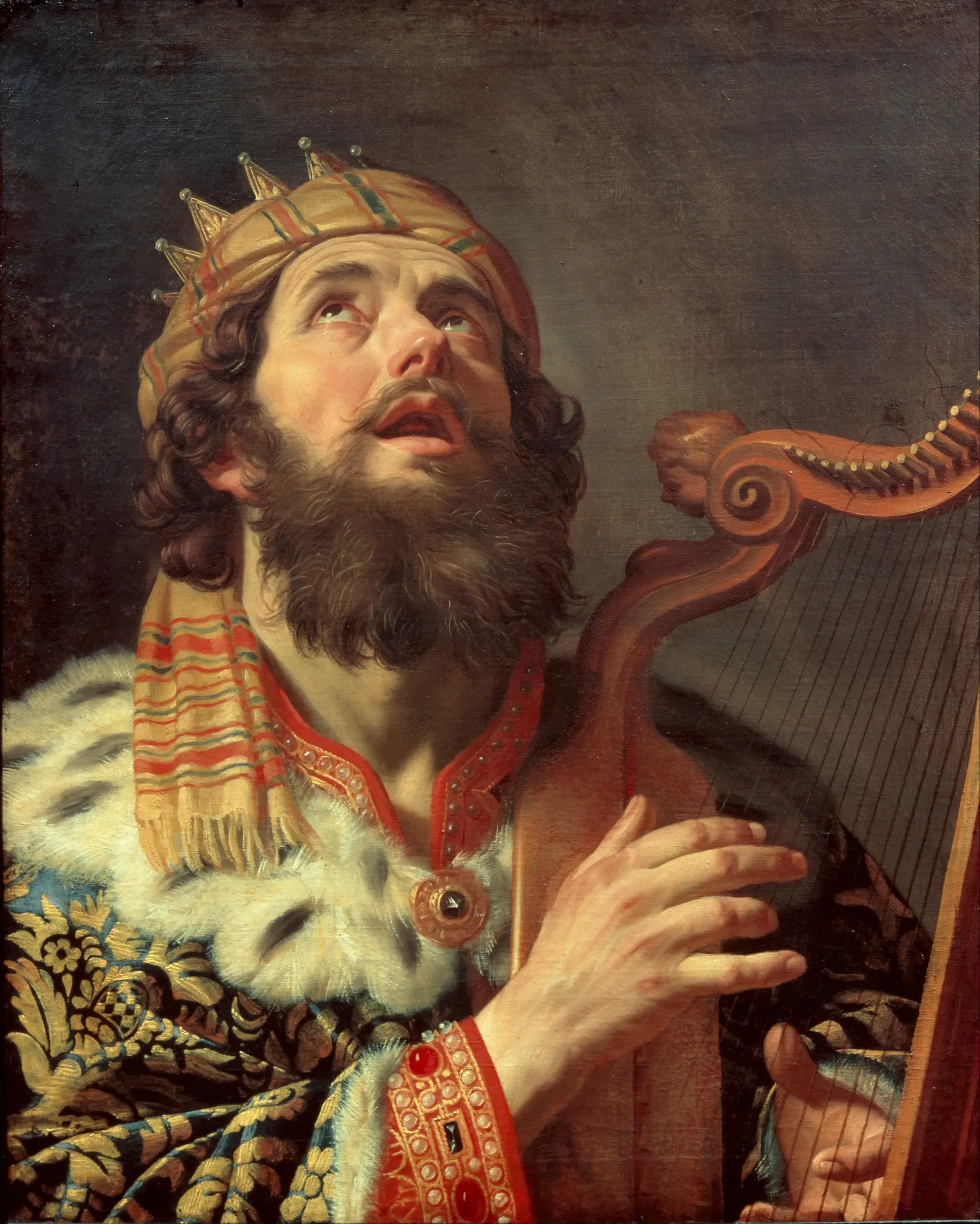
1 Chronicleschapter 15
29 verses · Ezra, by tradition · 450 to 400 BC · History
Then David said, “No one but the Levites may carry the ark of God, because the LORD has chosen them to carry the ark of the LORD and to minister before Him forever.”
Introduction
Ezra, by tradition, History, 1 Chronicles Overview.
This chapter was written for the Levites and singers of the second temple, who traced their duties to this day. It tells of David's second attempt to bring the ark to Jerusalem, three months after the first. This time the compiler lists every family that carried and every musician who played. Listen for David's own explanation of what went wrong before, and for the care taken to follow the law of Moses. The chapter also records one person in the royal family who looked on the celebration with contempt.
Context
- Who
- Levites and singers who traced their own orders of service to this day
- What
- The Levites prepared and appointed, the ark carried on their shoulders to Jerusalem with music, and Michal's contempt for David.
- Where
- From the house of Obed-edom up to the tent David pitched for the ark in Jerusalem.
- When
- About 1003 BC, three months after the first attempt recorded in 1 Chronicles 13:14.
- Why
- To show the ark brought up in the way God commanded, and to establish the Levites and singers in their duties.
Historical context
1 Chronicles names no author, and it names its own sources at 29:29, the histories of Samuel the seer, Nathan the prophet and Gad the seer. The Babylonian Talmud at tractate Bava Batra 15a assigns the book to Ezra the scribe, and C. F. Keil follows that tradition. Sara Japhet, H. G. M. Williamson and Gary Knoppers hold instead that an anonymous writer of the Persian period compiled it. The second attempt falls about 1003 BC, three months after the first, the interval 13:14 records, and runs from Obed-edom's house up to the tent David pitched in Jerusalem. A first hearer knew that purifying themselves meant washing, changing clothes and abstaining beforehand, which was a set process. He knew the poles went on the shoulders as Moses commanded, which is the point the first attempt had failed on. The music is set out like an orchestra chart, with bronze cymbals for the leaders, harps tuned one way, lyres tuned another and priests blowing trumpets by name. Two of those tuning terms have never been explained, and translators have left them as they stand. Chenaniah is set over the carrying or the song, since one Hebrew word covers the lifting of a load and the lifting of the voice, and both fit a man instructing Levites in a procession. The linen robe and ephod David wears is a priest's plain working garment, and seven bulls and seven rams were offered when God helped the carriers.
Significance
The men who led the singing in the second temple traced their assignments, their instruments and their sections to this chapter. It was their charter and it doubled as their rulebook. It also told the story of a second chance, the same king and the same ark and the same road, done this time as God said. Failure in worship was answered here by correction.
This chapter in Jewish lifeWhat this chapter is in Jewish life and reading.
What is done
The second bringing up of the ark has no place in the synagogue year. The site's own table in src/lib/hebraic/readings.ts printed parashot total 0 and haftarah uses total 0 for this book, and no festival reading.
The practice this chapter settled outlasted the ark itself, and the corpus shows where it is taught. Under the second verse, where only the Levites may carry it, it carries four locators on the song at the sea. They are Mekhilta DeRabbi Yishmael, Tractate Shirah 1:1, Mekhilta DeRabbi Shimon Ben Yochai 15:1, Midrash Tanchuma, Beshalach 10:7 and Yalkut Shimoni on Torah 241:5. Under the eleventh and thirteenth verses it carries Sifrei Bamidbar 46:1 and 46:2, Bamidbar Rabbah 12:20 and 21:12, and Midrash Tanchuma, Pinchas 8:1. Those are the places the duties of the Levites are taught in the Torah's own weeks. Under the twenty-second, the leader of the singing, it carries Arakhin 11a:16 with Ein Yaakov, Arakhin 2:7, and Arakhin is the tractate that discusses the Levites' song.
How it is read
Rashi is the one commentator on this chapter whose English the corpus carries, quoted here from The Judaica Press complete Tanach with Rashi, translated by A. J. Rosenberg, which Sefaria reports as CC-BY. He reads the chapter as the correction of chapter 13 and says so at the start. God chose the Levites to carry the ark rather than a cart, and Uzza was punished because it was put on a cart. He takes David's own words later in the chapter about the breach as a confession of that fault (Rashi on I Chronicles 15:2:1).
The manner of the carrying is given exactly. The verse says on their shoulders, and Rashi explains that the staves rested on the shoulders rather than the ark itself (Rashi on I Chronicles 15:15:1). The help given to the Levites in the twenty-sixth verse he reads as their not erring this time as they had erred when Uzza died. He notes the vowel on the Hebrew word, and reports that 2 Samuel 6:13 puts the sacrifice after six paces, from which the Rabbis derived that the ark carried itself (Rashi on I Chronicles 15:26:1). That last sentence is a saying of the Rabbis and is reported here as theirs.
The music is described as an appointed order rather than an outburst. Heman, Asaph and Ethan were set over the instruments to make a resounding voice (Rashi on I Chronicles 15:19:1). Men named as gatekeepers in one verse are moved to the singers in the next, and Rashi marks the transfer (Rashi on I Chronicles 15:18:1 and 15:20:1). The harps on the sheminith he reads as the instruments used for the psalms whose heading names the sheminith (Rashi on I Chronicles 15:21:1). Those are the two psalms he gathered at chapter 3 of this book. Chenaniah's leadership he defines in one word, the raising of the voice in song (Rashi on I Chronicles 15:22:1). David's linen robe he glosses from the Aramaic of Daniel 3:21 and from the comb of a rooster (Rashi on I Chronicles 15:27:1).
The last note in the chapter shows the book's method working on a wife of David. Michal watches from the window here and says nothing, while 2 Samuel 6:20 gives her a speech mocking the king. Rashi says the omission is deliberate, because the book is for David's honour and it was a disgrace to him that a woman said such a thing to him (Rashi on I Chronicles 15:29:1). A Christian reader who has both books open will see the tradition explaining a silence rather than denying it.
The corpus carries fourteen further notes on this chapter without an English text. Twelve are marked linked because Sefaria holds no English version of the ref, and two because the licence Sefaria reports for them, CC-BY-NC, does not permit the text to be kept. The two are Radak on I Chronicles 15:24:1 and 15:28:1, and they are cited by ref alone for that reason and never quoted. Seven of the rest stand at Metzudat David on I Chronicles 15:1:1, 15:2:1, 15:3:1, 15:5:1, 15:16:1, 15:23:1 and 15:25:1. Three stand at Malbim on I Chronicles 15:1:1, 15:11:1 and 15:17:1, and two at Radak on I Chronicles 15:12:1 and 15:13:1.
What the rabbis say
The corpus carries nineteen rabbinic locators on this chapter and the text of none, so each is cited and linked here rather than quoted. On the second verse, the choice of the Levites, it holds Mekhilta DeRabbi Yishmael, Tractate Shirah 1:1, Mekhilta DeRabbi Shimon Ben Yochai 15:1, Midrash Tanchuma, Beshalach 10:7 and Yalkut Shimoni on Torah 241:5.
The calling of the Levites carries the next run. On the eleventh verse the corpus holds Sifrei Bamidbar 46:1 and 46:2 with Bamidbar Rabbah 12:20. On the thirteenth, David's word about the breach, it holds Bamidbar Rabbah 21:12, Midrash Tanchuma, Pinchas 8:1 and Midrash Lekach Tov, Numbers 1:50:1. On the fifteenth, the carrying on the shoulders, it holds Bamidbar Rabbah 4:20.
The song and the procession carry the rest. On the twenty-second verse the corpus holds Arakhin 11a:16, Ein Yaakov, Arakhin 2:7, Midrash Tehillim 87:2 and Yalkut Shimoni on Torah 157:3. On the twenty-fifth it holds Seder Olam Rabbah 14:2 and Shir HaShirim Rabbah 1:1:6. On the twenty-sixth, the help given to the bearers, it holds Sotah 35b:3 with Ein Yaakov (Glick Edition), Sotah 7:14. That is the same page of the tractate the corpus set under the ninth verse of chapter 13. What each of them teaches is a saying of the rabbis, and is reported as theirs wherever this site quotes one. The quotations wait on a fetch that carries the text.
Sources: Rashi, Rashi on I Chronicles 15:2:1 to 15:29:1, The Judaica Press complete Tanach with Rashi, translated by A. J. Rosenberg, reported CC-BY; Metzudat David, Metzudat David on I Chronicles 15:1:1, 15:2:1, 15:3:1, 15:5:1, 15:16:1, 15:23:1 and 15:25:1, cited by ref because the corpus carries no English text; Malbim, Malbim on I Chronicles 15:1:1, 15:11:1 and 15:17:1, cited by ref because the corpus carries no English text; Radak, Radak on I Chronicles 15:12:1 and 15:13:1, cited by ref because the corpus carries no English text, and Radak on I Chronicles 15:24:1 and 15:28:1, cited by ref because the licence reported for them is CC-BY-NC; The Sefaria corpus, scripts/data/sources/sefaria/1-chronicles/15.json, the 19 Talmud and Midrash locators of this chapter; The site's own files, src/lib/hebraic/readings.ts, printing no portion, no Haftarah and no festival reading for this book.
The heads below are this chapter's scenes. The numbered points under each are its verses.
None but the Levites may carry the ark
1 Chronicles 15:1-3
pitched a tent for it: David built houses in the City of David, prepared a place for the ark and pitched a tent for it. He states the rule: No one but the Levites may carry the ark of God, because the LORD has chosen them. 2 Samuel 6 has no equivalent to verse 2.
1 Chronicles 15:1
“And pitched for it a tent - The old “tent” or “tabernacle” was still in existence at Gibeon 1Ch 16:39; 2Ch 1:3; but the ark had long been separated from it, and David probably thought that something newer and more magnificent was requisite. He therefore allowed the former tabernacle to keep its place, and had another made and erected.”
1 more voice on this verseWhat preachers and commentators have said about this verse, in their own words.
1 Chronicles 15:1
“The old tabernacle, which Moses had constructed in the wilderness and which had hitherto served the purpose of a sacred covering, was to be left at Gibeon, either because of the unwillingness of the inhabitants to part with such a venerable relic, or because there was no use for it in Jerusalem, where a more solid and sumptuous edifice was contemplated.”
Jamieson, Fausset & Brown · Commentary Critical and Explanatory on the Whole Bible (1871)reformed
Deuteronomy 10:8 set apart the tribe of Levi to carry the ark of the covenant and minister before the LORD. Henry notes that David knew this rule and still put the ark on a cart. Clarke ties the rule to the breach of 13:10.
1 Chronicles 15:2
“None ought to carry the ark - but the Levites - It was their business; and he should have thought of this sooner, and then the unfortunate breach on Uzza would have been prevented; see 1Ch 15:13.”
Adam Clarke · Commentary on the Bible (1810-1826)evangelical
1 more voice on this verse
1 Chronicles 15:2
“This rule was express, and yet David himself forgot it, and put the ark upon a cart. Note, Even those that are very knowing in the word of God, yet have it not always so ready to them as were to be wished when they have occasion to use it. Wise and good men may be guilty of an oversight, which, as soon as they are aware of, they will correct.”
Matthew Henry · Commentary on the Whole Bible (1707-1721)puritan
David assembled all Israel in: The second attempt is as public as the first in 13:5, with all Israel gathered in Jerusalem. 2 Samuel 6:12 tells only that David went to bring up the ark with rejoicing. The place prepared is the tent of verse 1.
1 Chronicles 15:3
“And David gathered all Israel together to Jerusalem,.... The chief and heads of the people: to bring up the ark of the Lord; from the house of Obededom, where it had been three months, and for the sake of which his house was blessed, and which David heard of; and this encouraged him to take this step to fetch it from thence: unto his place, which he had prepared for it; 1Ch 15:1.”
1 more voice on this verse
1 Chronicles 15:3
“All Israel - Chosen men probably, like the 30,000 of 2Sa 6:1. See 1Ch 15:25.”
1 Chronicles 15:4-10
he gathered together the descendants of Aaron: Six Levitical houses are mustered by name and number, 862 men in all, under Uriel, Asaiah, Joel, Shemaiah, Eliel and Amminadab. Kohath's line supplies four of the six heads, since the ark was a Kohathite charge under Numbers 4, while Gershom and Merari each supply one.
1 Chronicles 15:4
“And David assembled the children of Aaron, and the Levites.”
1 more voice on this verse
1 Chronicles 15:4
“The children of Aaron - i. e., the priests.”
From the Kohathites, Uriel the: Barnes notes that Gershom was the firstborn of Levi, yet the Kohathites are named first here. The Kohathites carried the ark and the holy things on their shoulders (Numbers 4:4 to 15), the task David now gives the Levites. Uriel the chief leads 120 relatives.
1 Chronicles 15:5
“The sons of Kohath - The order of the sons of Levi according to primogeniture is, Gershom, Kohath, Merari Gen 46:11; Exo 6:16. But the Kohathites, of whom came the priestly family of the Aaronites, had precedence in all respects. To them especially was committed the attendance upon the ark and the bearing of it. Of the six Levitical families mentioned 1Ch 15:5-10 one only was descended from Gershom, one from Merari, and four (Uriel, Elizaphan, Hebron, and Uzziel) from Kohath.”
from the Merarites, Asaiah the: The Merarites had carried the frames, bars and bases of the tabernacle (Numbers 4:29 to 33). Asaiah the chief appears in the line of Merari at 1 Chronicles 6:30. His 220 relatives are the largest of the six Levite companies.
from the Gershomites, Joel the: The Gershomites had carried the curtains of the tabernacle (Numbers 4:24 to 26). Joel the chief and his 130 relatives now join the Levites who bring up the ark of the LORD. A Joel appears in the same family at 1 Chronicles 23:8.
from the Elizaphanites, Shemaiah the: Elizaphan son of Uzziel was chief of the Kohathite clans in the wilderness (Numbers 3:30). He and Mishael carried the bodies of Nadab and Abihu out of the camp in Leviticus 10:4. His descendants had grown into a house of their own.
from the Hebronites, Eliel the: Hebron here is a son of Kohath (Exodus 6:18), and the Hebronites are his descendants. Four of the six houses in verses 5 to 10 descend from Kohath. The ark's wilderness bearers lead its return.
from the Uzzielites, Amminadab the: Uzziel was a son of Kohath (Exodus 6:18), and Elizaphan's house in verse 8 also comes from him. This Amminadab is a Levite, a different man from Amminadab of Judah, whose daughter married Aaron (Exodus 6:23). The six chiefs lead 862 men in all.
1 Chronicles 15:11-12
David summoned the priests Zadok and Abiathar: and the six family heads just numbered, and told them to consecrate themselves before the ark was moved. He addresses them as the heads of the Levitical families. The charge to consecrate is new to this second attempt.
1 Chronicles 15:11
“And David called for Zadok and Abiathar the priests,.... See 2Sa 8:17. and for the Levites, for Uriel, Asaiah, and Joel, Shemaiah, and Eliel, and Amminadab; the six chiefs before mentioned.”
To consecrate themselves, as Gill explains, the Levites washed and kept apart from anything unclean, as Israel did at Sinai (Exodus 19:10 to 15). The heads of the Levitical families lead their relatives in it. The first attempt had no such step.
1 Chronicles 15:12
“And he said unto them, ye are the chief of the fathers of the Levites,.... Of the families of the Levites, heads of their fathers' houses: sanctify yourselves, both ye and your brethren; respectively under each, whose numbers are before given, by washing their bodies and clothes, and abstaining from their wives: that you may bring up the ark of the Lord God of Israel unto the place that I have prepared for it; 2Sa 6:17.”
the LORD our God burst forth: It was because you Levites were not with us the first time that the LORD our God burst forth in anger against us. The commentators read the fault as the whole method, the cart and the absence of the Levites, before Uzzah put out his hand.
1 Chronicles 15:13
“For because ye did it not at the first,.... Did not sanctify themselves, as the supplement in our version directs; but rather the sense is, ye were not there at first, when the ark was brought from Kirjathjearim as far as the house of Obededom, as they should have been; they were not then employed, as was their business, and therefore the Lord our God made a breach upon us; by smiting Uzzah with death, who was no Levite, and touched the ark, which is called his "error", and for which God smote him, 2Sa 6:7 on which place Lud.”
2 more voices on this verse
1 Chronicles 15:13
“The “due order” was that the ark should be borne on the shoulders of Kohathite Levites - not that it should be placed upon a cart, drawn by oxen, and rudely shaken.”
1 Chronicles 15:13
"We did not go about our work considerately; and therefore we sped so ill." Note, It is not enough that we do that which is good, but we must do it well--not enough that we seek God in a due ordinance, but we must seek after him, in a due order.
Matthew Henry · Commentary on the Whole Bible (1707-1721)puritan
1 Chronicles 15:14-15
the priests and Levites consecrated themselves: So the priests and Levites consecrated themselves to bring up the ark of the LORD. The Levites carried the ark of God on their shoulders with the poles, as Moses had commanded in accordance with the word of the LORD. This is the rule of Numbers 4 and 7.
1 Chronicles 15:14
“So the priests and the Levites sanctified themselves,.... As they were ordered, and in the manner they should: to bring up the ark of the Lord God of Israel; for though it was chiefly the work of the Levites, yet the priests might do it, and sometimes did, see Jos 3:13.”
the Levites carried the ark: Numbers 7:9 gave the Kohathites no carts, since they carried the holy things on their shoulders. Clarke describes the poles passing through the ark's rings and resting on the bearers' shoulders (Exodus 25:14). The ox cart of 13:7 is gone.
1 Chronicles 15:15
“And the children of the Levites bare the ark of God upon their shoulders, with the staves thereon, as Moses commanded, according to the word of the Lord. Not only bare it on their shoulders, but with the staves in it, which rested on their shoulders, see Num 7:9, the reason of this command, that the ark should be carried on men's shoulders, and not in any carriage, according to Maimonides (h), was both for the honour of it, and lest its form and structure should be any ways damaged. (h) Moreh Nevochim, par. 3. c. 45. p. 479.”
2 more voices on this verse
1 Chronicles 15:15
“Upon their shoulders - That is the staves which went through the rings rested on their shoulders, but the ark itself rested on the staves like a sedan on its poles. As Moses commanded - See Num 4:5, Num 4:15.”
Adam Clarke · Commentary on the Bible (1810-1826)evangelical
1 Chronicles 15:15
“Note, Many that are very remiss in their duty, if they were but faithfully told of it, would reform and do better. The breach upon Uzza made the priests more careful to sanctify themselves, that is, to cleanse themselves from all ceremonial pollution and to compose themselves for the solemn service of God, so as to strike a reverence upon the people.”
Matthew Henry · Commentary on the Whole Bible (1707-1721)puritan
Singers, harps, and trumpets appointed
1 Chronicles 15:16-19
appoint their relatives as singers: Three are named in Psalm titles: Asaph at Psalms 50 and 73 to 83, Heman at Psalm 88 and Ethan at Psalm 89. The musicians Heman, Asaph, and Ethan were to sound the bronze cymbals, which John Gill ties to 1 Corinthians 13:1.
1 Chronicles 15:16
“David spake to the chief of the Levites to appoint . . . the singers with instruments--These eminent Levites were instructed to train the musicians and singers who were under them, for the solemn procession. The performers were ranged in three choirs or bands, and the names of the principal leaders are given (1Ch 15:17, 18, 21), with the instruments respectively used by each.”
Jamieson, Fausset & Brown · Commentary Critical and Explanatory on the Whole Bible (1871)reformed
1 more voice on this verse
1 Chronicles 15:16
“The singers - Singing had long been recognized as appropriate to religious ceremonies Exo 15:21; Jdg 5:1; 1Ch 13:8; but this is the first occasion on which we find the duty of conducting musical services expressly laid on the Levites. Henceforth, the services of the tabernacle and the temple were regularly choral, and a considerable section of the Levites was trained in musical knowledge, and set apart to conduct this portion of the national worship.”
the Levites appointed Heman son: The three chief singers come from each branch of Levi: Heman from Kohath, Asaph from Gershom and Ethan from Merari (1 Chronicles 6:33 to 47). Gill notes that Heman was a grandson of Samuel the prophet. Ethan's father is Kishi in 6:45.
1 Chronicles 15:17
“So the Levites appointed Heman the son of Joel,.... The grandson of Samuel the prophet, 1Ch 6:33. and of his brethren, Asaph the son of Berechiah; a famous singer, often mentioned in the Psalms, 1Ch 6:39. and of the sons of Merari their brethren, Ethan the son of Kushaiah; the same with the son of Kishi, 1Ch 6:44, these were the chief of the singers.”
the gatekeepers Obed-edom and Jeiel: These men form the second rank, and verses 20 and 21 assign them their instruments. The Hebrew has an extra word after Zechariah, Ben, found in neither later list, and the Berean leaves it out. Jaaziel appears in verse 20 as Aziel.
1 Chronicles 15:18
“And with them their brethren of the second degree,.... Who were next unto them, both in office and skill in singing: the fourteen following, Zechariah, Ben, and Jaaziel, and Shemiramoth, and Jehiel, and Unni, Eliab, and Benaiah, and Maaseiah, and Mattithiah, and Elipheleh, and Mikneiah, and Obededom, and Jeiel, the porters; who, when they were not employed in singing, were doorkeepers of the sanctuary; either they had been porters at the tabernacle in Gibeon, or were so after the ark was placed in the tabernacle David prepared for it.”
Heman, Asaph, and Ethan were: The bronze cymbals belong to the three chiefs, who led the whole company. Gill notes that each of the three sorts of instrument in verse 16 had its own players, and the cymbals went to these three. 1 Chronicles 16:5 again gives Asaph the cymbals.
1 Chronicles 15:19
“So the singers, Heman, Asaph, and Ethan,.... The three principal of them: these were appointed to sound with cymbals of brass; for as there were three sorts of musical instruments, 1Ch 15:16 these three chief singers had one of those instruments appropriated to them, one of which were the cymbals of brass, to which the apostle alludes, 1Co 13:1.”
1 Chronicles 15:20-21
were to play the harps according to Alamoth: Two groups of players are set according to Alamoth and according to Sheminith, technical terms whose meaning had passed out of use. Proposed readings for Alamoth include a pitch, a known tune or women's voices, and for Sheminith an eighth or an octave below.
1 Chronicles 15:20
“With psalteries on Alamoth - Some suppose that the word signifies virgins, or women singers, the persons mentioned here being appointed to accompany them with psalteries, and preside over them. The Vulgate says arcana cantabant, they sang secret things or mysteries; probably prophetic hymns.”
Adam Clarke · Commentary on the Bible (1810-1826)evangelical
to lead the music with: Barnes sets Sheminith against the Alamoth of verse 20 and reads it as the eighth, and Gill names lyres of eight strings among the meanings. Psalms 6 and 12 are also set according to Sheminith. The verb to lead the music shares its root with the choirmaster of those Psalms.
1 Chronicles 15:21
“And Mattithiah, and Elipheleh, and Mikneiah, and Obededom, and Jeiel, and Azaziah,.... These six were appointed to sound: with harps on the Sheminith to excel; which Sheminith some take to be an harp with eight strings, or the beginning of a song, or a musical tone, the bass; see the title of Psa 6:1.”
1 more voice on this verse
1 Chronicles 15:21
“Harps on the Sheminith - “Sheminith” properly means “the eighth,” and has been compared with the modern musical term “octave.” Further, “Sheminith” and “Alamoth” are regarded as contrasted, and the harps of Mattithiah and his companions are supposed to have been pitched an octave below the psalteries of Zechariah and his brethren. The word translated “to excel,” is taken as meaning “to lead,” and Mattithiah, etc., as leaders of the singers.”
Chenaniah the head Levite was: the director of the music because he was highly skilled. Some readings take the word for his office to mean the burden, so that Chenaniah directed the procession's movement. The commentators hold both readings without a settled choice between them.
1 Chronicles 15:22
“And Chenaniah chief of the Levites was for song,.... But the chief for the song were Heman, Asaph, and Ethan; rather for the burden, as the Targum; for the lifting up and bearing the ark: he instructed about the song; or about the taking up and bearing the burden, the ark; directing when to take it up, and how far to go with it, and then rest: because he was skilful; a wise and prudent man in all things, and so proper to direct in this business.”
1 more voice on this verse
1 Chronicles 15:22
“Chenaniah - he instructed about the song - This appears to have been the master singer; he gave the key and the time, for he presided במשא bemassa, in the elevation, probably meaning what is called pitching the tune, for he was skillful in music, and powerful in his voice, and well qualified to lead the band: be might have been precentor.”
Adam Clarke · Commentary on the Bible (1810-1826)evangelical
1 Chronicles 15:23-24
Berechiah and Elkanah were to be guardians: of the ark, and Obed-edom and Jehiah join them, beside seven priests who blow the trumpets. The trumpets belong to the priests, as Numbers 10 assigns them for moving the camp, apart from the Levites' harps and cymbals.
1 Chronicles 15:23
“And Berechiah, and Elkanah, were doorkeepers for the ark,.... Either while it was at Kirjathjearim, and at Obededom's house; or rather after it was put in the tabernacle David had prepared for it; though it may be best of all to understand it, that those, as it was carrying, went before it, to keep the people from pressing to it, and gazing on it.”
Shebaniah, Joshaphat, Nethanel, Amasai: Numbers 10:2 to 8 assigned the silver trumpets to the priests, the sons of Aaron. Seven priests blow them here before the ark. Gill recalls that the trumpets sounded when the camp and the ark set out in the wilderness.
1 Chronicles 15:24
“And Shebaniah, and Jehoshaphat, and Nethaneel, and Amasai, and Zechariah, and Benaiah, and Eliezer, the priests, did blow with the trumpets before the ark of God,.... With the silver trumpets; one use of which was to blow with when the camps and ark of the Lord moved, Num 10:5. and Obededom and Jehiah were doorkeepers for the ark; they went behind it, as the others before it, for the same purpose, as it was bringing up.”
The ark comes up with shouting, and Michal despises
1 Chronicles 15:25-26
the commanders of thousands went with rejoicing: Verse 26 marks the difference from chapter 13: because God helped the Levites carrying the ark, they sacrificed seven bulls and seven rams. Chronicles tells the two attempts as one story, the same men and the same ark, with the method changed.
1 Chronicles 15:25
“So David and the elders of Israel, and the captains over thousands,.... He and the principal men of the nation, and the officers of the army or militia: went to bring up the ark of the covenant of the Lord out of the house of Obededom with joy; with all demonstrations of it; for which purpose such a band of music was prepared, as before described.”
because God helped the Levites: 2 Samuel 6:13 has David sacrifice an ox and a fattened calf when the bearers had gone six steps. Chronicles gives seven bulls and seven rams and credits God's help to the Levites. Henry reads the offerings as thanks and as atonement.
1 Chronicles 15:26
“And it came to pass, when God helped the Levites that bare the ark of the covenant of the Lord,.... Not merely granted them bodily strength to carry it, which did not require a great deal; but helped them to carry it with cheerfulness, and without fear, and so as to commit no error, nor in any respect provoke his displeasure, as when it was brought before from Kirjathjearim: that they offered seven bullocks and seven rams; by way of thanksgiving, besides what David offered; and this was done by the way, see 2Sa 6:13.”
dressed in a robe of fine linen: David was dressed in a robe of fine linen, as were all the Levites as well as the singers. David also wore a linen ephod, a priestly garment on a king who held no priestly office. Chenaniah, the director of music, is dressed and numbered with the singers he leads.
1 Chronicles 15:27
“Fine linen” (byssus) is here first spoken of as used for dress. It seems to have been reserved for nobles of the highest rank Est 8:15, for kings, and for priests 2Ch 5:12. David’s robe was probably worn, like that of the high priest, immediately under the ephod, and may, like that, have reached the feet.
1 more voice on this verse
1 Chronicles 15:27
“Linen - With a linen ephod. This circumstance is repeated, because it was an unusual thing for one, who was no Levite, to wear a Levitical garment.”
John Wesley · Explanatory Notes upon the Old Testament (1765)evangelical
1 Chronicles 15:28-29
all Israel brought up the ark: Saul’s daughter Michal looked down from a window and saw King David dancing and celebrating, and she despised him in her heart. Chronicles keeps this line and drops her exchange with David from 2 Samuel 6, in a book that omits David's sin with Bathsheba.
1 Chronicles 15:28
“Thus all Israel brought up the ark of the covenant of the Lord with shouting,.... See 2Sa 6:15.”
Saul’s daughter Michal looked down: Chronicles stops at Michal's contempt, and 2 Samuel 6:20 to 23 goes on to her quarrel with David and her childlessness. Calling her Saul's daughter ties her scorn to the house the LORD set aside in 10:14. Jamieson, Fausset and Brown picture David's dancing as slow and solemn.
1 Chronicles 15:29
“David dancing and playing--His movements would be slow and solemn, suitable to the grave and solemn character of the music. Though his royal robes were laid aside, he was attired like the other officials, showing a becoming humility in the immediate presence of God.”
Jamieson, Fausset & Brown · Commentary Critical and Explanatory on the Whole Bible (1871)reformed
How this psalm is built
The form: Narrative and muster record, a corrected procession with its rosters written into it, as table classes it.
The patterns in this chapter
| Device | What it does | Where to see it |
|---|---|---|
| The second attempt answered to the first, point by point | Chapter 13 had a new cart, no recorded sanctifying and a death. This chapter has shoulders and staves, a charge to sanctify, and seven bullocks and seven rams offered when God helped the carriers. The site's published exposition reads the two chapters as one story told across two attempts, the same men and the same ark with only the method changed. It notes that no cart and no oxen appear anywhere in this telling. | 1 Chronicles 15:13, 1 Chronicles 15:15, 1 Chronicles 15:26 |
| David says the doctrine, and then says the diagnosis | Verse 2 is David's own unprompted sentence, that none ought to carry the ark of God but the Levites, whom the LORD chose to carry it and to minister to him for ever. Verses 12 and 13 are his charge to the named heads. They are to sanctify themselves, because they did it not at the first and the LORD made a breach upon them for seeking him not after the due order. Matthew Henry notes that the rule was express and that even a knowing man had let it slip.Matthew Henry, Commentary on the Whole Bible, on 1 Chronicles 15:2. | 1 Chronicles 15:2, 1 Chronicles 15:12, 1 Chronicles 15:13 |
| The rosters, mustered before the ark is touched | Verses 4 to 10 number six Levitical houses, three hundred and eighty-two men under Uriel, Asaiah, Joel, Shemaiah, Eliel and Amminadab. Verses 16 to 24 name the singers, the second degree under them, the doorkeepers and the trumpeting priests. Albert Barnes explains that the Kohathites take precedence over the elder Gershom because the priestly family of the Aaronites came of them, and the ark itself was a Kohathite charge under Numbers 4.Albert Barnes, Notes on the Old Testament, on 1 Chronicles 15:5. | 1 Chronicles 15:5, 1 Chronicles 15:16, 1 Chronicles 15:24 |
| One word for the lifting of a load and the lifting of the voice | Verse 22 sets Chenaniah over what the English renders as the song. Albert Barnes records that Hebraists are still at variance over the passage, some reading an elevation of the voice and others an elevation of the ark. Adam Clarke reads him as the master singer who pitched the tune, and John Gill takes the Targum's reading of the burden, the lifting and carrying of the ark. The site's published exposition holds both readings without a settled choice.Albert Barnes, Notes on the Old Testament, on 1 Chronicles 15:22. | 1 Chronicles 15:22 |
Alamoth and Sheminith, two terms nobody can settle
12 more paragraphs on the patterns
Verses 20 and 21 assign two groups of singers two technical terms whose precise meaning had passed out of use before the commentators wrote.
On Alamoth, Adam Clarke records the reading that the word means virgins or women singers, and gives the Vulgate beside it. Albert Barnes reads it as a tone resembling the voices of girls, and compares the female flutes of the Lydians. John Wesley states plainly that the certain signification is not now known, and says the same of Sheminith.
On Sheminith, Albert Barnes reads the word as the eighth and compares it with the modern term octave, and sets it against Alamoth as its contrast. Adam Clarke gathers the Targum for an instrument that sounded an octave, or one of eight strings, with the Syriac and the Arabic beside it. John Wesley reads the added clause about excelling as a note either on the instrument or on the elevation of the voice.
No reading commands certainty. What the roster does preserve is that David organised the choir into parts distinct enough to need names, whatever those names once meant.
Chenaniah, and what he was set over
The same uncertainty falls on verse 22. Chenaniah stands over the choir for his skill rather than his descent, and he is counted among none of the three Levitical houses named earlier in the chapter. Albert Barnes records the disagreement among Hebraists. Adam Clarke reads him as the master singer who gave the key and the time. John Gill follows the Targum's reading of the burden, so that Chenaniah directed the procession's movement as much as its music. Both readings fit a man instructing Levites in a procession, and this row keeps both.
The fine linen, and a king dressed as a Levite
Verse 27 is the first place in Scripture where fine linen is spoken of as dress. Albert Barnes records that it was later reserved for nobles of the highest rank, for kings and for priests. Adam Clarke identifies the material itself, and Jamieson, Fausset and Brown note that the later books read the same word as cotton. John Wesley marks how unusual a Levitical garment was on a man who held no Levitical office. The commentators read David's choice as a deliberate lowering of his own robes into the company of the men he was honouring.
The one line kept against David
Verse 29 keeps Michal's contempt and keeps nothing else of her story. Her exchange with David and the rest of 2 Samuel 6 are dropped. The daughter of Saul watches from a window, sees king David dancing, and despises him in her heart, and the sentence is left exactly there. The book that omits David's sin with Bathsheba and the whole Absalom rebellion still finds room for this one line against him. Jamieson, Fausset and Brown read his movements as slow and solemn, suited to the music, and note that he was dressed like the other officials rather than in his royal robes.
Where the chapter reaches into the New Testament
The three principals sound cymbals of brass, the instrument that keeps time for everything else. John Gill names this as the detail Paul draws on for the sounding brass and tinkling cymbal of 1 Corinthians 13:1. The connection is the commentator's, and the row names it as his.
Keep studying
Studies4
Places1
Sources for this chapter
The summary
Jamieson, Fausset & Brown, Commentary Critical and Explanatory; John Wesley, Notes on the Old Testament and Matthew Henry, Complete Commentary.
The form and classifications
Albert Barnes, Notes on the Old Testament, on 1 Chronicles 15:16; This site's published book guide, src/components/book/guides/1-chronicles/Book1ChroniclesGuide.tsx, the BANDS table, the band "The Ark, and the Covenant" at 13:1 to 17:27 and This site's published book sections table, src/lib/bible/book-sections.ts, the entry "1 Chronicles": "history".
The exposition
Adam Clarke, Commentary on the Bible; Albert Barnes; Berean Standard Bible; Jamieson Fausset and Brown, Commentary Critical and Explanatory on the Whole Bible; Jamieson, Fausset & Brown, Commentary Critical and Explanatory on the Whole Bible; John Gill; John Wesley, Explanatory Notes upon the Old Testament; Keil, The Books of the Chronicles and Matthew Henry, Commentary on the Whole Bible.