
Skip to content
mannafest.faith
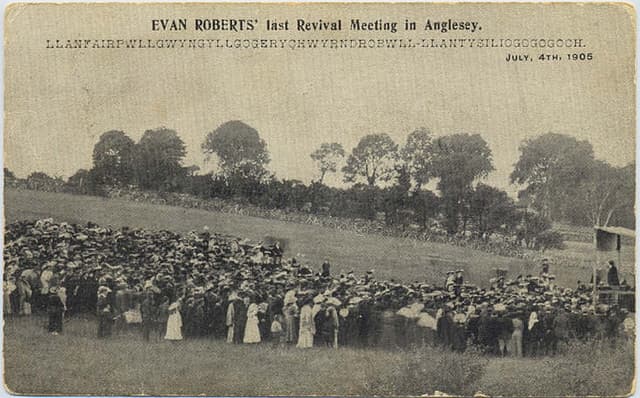
Evan Roberts's last revival meeting

Evan Roberts's last revival meeting, Anglesey, 4 July 1905, public domain

The Great Cloud of Witnesses, era 9 of 10 · Church history · Featured Study

The Revival Streams

At the opening of the twentieth century God moved again, in Welsh mining villages, in a shabby Los Angeles building, in Korea and India, and the church rediscovered the power of Pentecost.

Span
1900–1950
Boundary
The span closes at 1950, before the charismatic renewal carried the same claim into the older denominations.

In fifty years a small mission on Azusa Street grew into the fastest-spreading stream of the church.

Summary

Its claim was that Acts 2 had never stopped. Black and white met in those first rooms, when American churches did not.

  • Agnes Ozman spoke in tongues at Topeka on 1 January 1901.
  • The Welsh revival of 1904 raised hope in America.
  • The Azusa Street mission opened in April 1906 under William Seymour.
  • Its paper, The Apostolic Faith, carried the news around the world.
  • The Assemblies of God formed in 1914.

The era's own voice

Why he wrote it: Bartleman took part in the revival and promoted it. He wrote How Pentecost Came to Los Angeles in 1925, nineteen years after the meetings, from notes and memory, to defend a movement then under attack. The line is testimony from inside the revival about the revival.

What else says so: The mission's own paper, The Apostolic Faith, printed from September 1906, describes the mixed meetings in the same terms; the hostile report in the Los Angeles Daily Times of 18 April 1906 confirms, in its own language of contempt, that black and white worshippers were meeting together.

“The 'color line' was washed away in the blood.”

Frank Bartleman · Frank Bartleman, How Pentecost Came to Los Angeles: As It Was in the Beginning (1925), later reprinted as Azusa Street

The turning points

The era hangs on these moments, each with a document a reader can open.

  1. January 1, 1901Topeka, KansasIt is where the teaching that tongues accompany the baptism in the Spirit was first held as doctrine, and everything after runs through it.Charles Parham, A Voice Crying in the Wilderness, 1902
  2. November 1904The Welsh valleys burnDaily newspaper coverage recorded it as it happened, including the effects on the pits and the courts, which is rare for any revival.The Western Mail reports of 1904 and 1905, and W. T. Stead, The Revival in the West, 1905
  3. April 1906312 Azusa StreetThe mission's own paper is the primary record, and from that address the movement reached many countries inside a decade.The Apostolic Faith, Los Angeles, September 1906 to May 1908
  4. January 1907Pyongyang, the Korean PentecostIt began without reference to Los Angeles, which is the strongest evidence that the century's outpourings were not one movement spreading but several starting.The reports printed in The Korea Mission Field, 1907
  5. April 1914The Assemblies of God is formedThe streams organised, and the movement gained the structures that let it outlast the meetings.The minutes of the General Council, Hot Springs, Arkansas, April 1914

The 5 turning points of The Revival Streams, 1900–1950, in order, each with the document that records it and why it earned its place.

The story

The paper that carried the Azusa Street revival around the world was given away. The Apostolic Faith was printed in Los Angeles from September 1906, mailed free to anyone who asked, and reached tens of thousands of subscribers with no price on it anywhere.

The twentieth century opened with the church in the West feeling thin. Attendance was steady, machinery was everywhere, and preachers in both Britain and America were writing openly that something living had gone out of the meetings. In small groups on several continents, people began asking God for exactly one thing: do it again.

And afterward, I will pour out My Spirit on all people. Your sons and daughters will prophesy, your old men will dream dreams, your young men will see visions.
Joel 2:28BSB

The promise every one of these revivals reached for: God pouring out His Spirit on ordinary people, sons and daughters alike, not on a priestly few.

It came first, and hardest, in Wales. In the autumn of 1904 a twenty-six-year-old collier named Evan Roberts came home to Loughor after months of praying that had cost him his sleep. He asked if he could speak to the young people after the service; seventeen stayed. He gave them four things, confess every known sin, put away anything doubtful, obey the Spirit promptly, confess Christ publicly, and the meetings that followed ran for two years.

There was almost no preaching. The meetings ran on singing, testimony, and open prayer, often past midnight, and Roberts refused to control them because he believed the Spirit was leading. There was no advertising and no organization. The Western Mail sent reporters anyway, and the story went out by cable to the whole English-speaking world.

‘In the last days, God says, I will pour out My Spirit on all people. Your sons and daughters will prophesy, your young men will see visions, your old men will dream dreams.
Acts 2:17BSB

Peter quotes Joel on the day of Pentecost and calls it fulfilled, and the people at Azusa Street read that as a door still standing open, not a chapter closed.

The effects were public enough that the newspapers counted them. About a hundred thousand converts inside a year is the figure the press and the churches gave at the time, repeated ever since, but taken from counts, not from an audit. Papers reported taverns closing, old debts repaid, and magistrates handed white gloves for court sessions with nothing to try. The most-loved story, that the pit ponies balked underground because the miners had stopped cursing at them, belongs to the era's own testimony; it is told everywhere and documented nowhere.

What Wales did next mattered more than what Wales did. The reports crossed the ocean in newspapers and letters, and people in Los Angeles read them and started praying for the same thing. A separate stream had already opened in Topeka, Kansas, where on New Year's Day 1901 a student in Charles Parham's Bible school spoke in a language she did not know, as the participants themselves told it afterward. One of Parham's later students in Texas was William J. Seymour, the son of former slaves, blind in one eye, who had to sit in the hallway to hear the lectures because the classroom was segregated.

But you will receive power when the Holy Spirit comes upon you, and you will be My witnesses in Jerusalem, and in all Judea and Samaria, and to the ends of the earth.”
Acts 1:8BSB

Power to be witnesses to the ends of the earth, the verse behind workers leaving a Los Angeles stable for more than twenty-five nations in about two years.

Seymour came to Los Angeles in 1906 to preach and was locked out of the church that had invited him. He kept praying in a house on Bonnie Brae Street until, on April 9, the outpouring came and the front porch collapsed under the crowd. They moved into an abandoned livery stable at 312 Azusa Street, sawdust floor, planks across nail kegs for pews, and the meetings ran nearly around the clock for three years. The Los Angeles Times sent a reporter and ran it under the headline "Weird Babel of Tongues."

The thing eyewitnesses kept returning to was not the tongues. It was who was in the room. Black, white, Mexican, Chinese, rich and poor worshiped together in 1906 Los Angeles, led by a black man, in a decade when that simply did not happen. Frank Bartleman wrote that the color line was washed away in the blood. Honesty requires the rest of it: within a few years the new Pentecostal bodies organized themselves along that same color line and stayed there for most of a century. The miracle was real and the church did not keep it.

Jesus Christ is the same yesterday and today and forever.
Hebrews 13:8BSB

Jesus Christ the same yesterday, today, and forever, the plain argument the era made for expecting Him to heal and speak now, and Smith Wigglesworth's constant text.

The participants understood the tongues plainly: Acts 2 was not a closed chapter. They believed God still fills, still speaks, still heals, and that what fell on the hundred and twenty was promised to the church and not withdrawn from it. This house believes that too. What the Spirit did in a stable in Los Angeles was not a new religion; it was the church remembering the equipment it had been given.

It was never only America. In June 1905, at Pandita Ramabai's Mukti Mission in India, revival came among hundreds of famine widows and orphan girls Ramabai had rescued and taught, after she read the Welsh reports and asked her girls to pray. In January 1907 the New Year Bible meetings in Pyongyang, Korea, turned into public confession so heavy that the missionaries present admitted they were frightened, and stolen money went back to its owners. The daybreak prayer meeting born there still marks Korean churches across the world.

The era's writings, 1 to 3 of 6: each with its date and one line on what it holds.

WritingDateWhat it holds
The Apostolic Faith (Los Angeles)Sept 1906 – May 1908Azusa Street's own free paper, mailed to anyone who asked, the mission telling the world what it believed God was doing, in its own words and with its own claims.
Frank Bartleman, How Pentecost Came to Los Angeles (later Azusa Street)1925An eyewitness journalist's diary-based account of the revival, written nearly twenty years later, warm, opinionated, and the closest thing the movement has to a primary narrative.
The Welsh revival newspaper record, the Western Mail reports and W. T. Stead's The Revival in the West1904–1905Reporters, including one of Britain's most famous editors, went to the valleys night after night and wrote down what they saw, the reason the Welsh Revival is documented from outside the church as well as inside.

The cost was real too. Evan Roberts collapsed under the strain and spent most of the rest of his life out of public ministry. Azusa fractured over leadership and a stolen mailing list. Sadhu Sundar Singh, who had walked the Himalayas preaching Christ for twenty years, set out for Tibet in April 1929 and was never seen again. Revivals do not run on strong men; they run on God, and He tends to leave the strong men visibly weak so no one mistakes the source.

Under all of it ran a quieter work. Rees Howells, a Welsh miner converted in America and marked by 1904, gave himself to intercession, praying through, at cost, until he had assurance, and writing down what he had prayed. He served years in southern Africa, then in 1924 bought an estate he could not pay for and opened the Bible College of Wales at Swansea. Through Dunkirk and the Battle of Britain, he and his students prayed by name and kept the record. The whole era rests on one conviction, and it is the plainest thing in it: God still acts, and the door He opens is prayer.

The era's writings, 4 to 6 of 6: each with its date and one line on what it holds.

WritingDateWhat it holds
Norman Grubb, Rees Howells: Intercessor1952The life of the Welsh miner who treated prayer as a calling with a cost, built from Howells's own records of what he prayed and what followed.
Oswald Chambers, My Utmost for His Highest1927The era's devotional companion, assembled by his wife Biddy from her shorthand notes of his talks after his death in Egypt in 1917, one page a day, and still in print a century later.
Sadhu Sundar Singh, At the Master's Feet1922Short meditations from the Indian convert who walked the Himalayas in a saffron robe, written as if Christ were speaking, the era's clearest voice from outside the West.

Acts 1:8, Hebrews 13:8

Why these years

The span closes at 1950, before the charismatic renewal carried the same claim into the older denominations. It opens at 1900 with Topeka. The overlap with the era after it is deliberate: the persecution era begins in the 1930s, while these streams were still spreading. A witness hangs where he was formed.

What did not change

The prayer meeting did not change. Topeka, Loughor, Mukti, Los Angeles and Pyongyang all began with small groups praying for months before anything happened, and none of them began with a plan.

What the critics said about this era

The critics were loud, and some of them were right. There were counterfeits, there was manipulation, there were people who chased manifestations and neglected Scripture. Parham himself came to Azusa, denounced what he saw, and was shown the door; his later life was a scandal. Jessie Penn-Lewis, who had watched Wales up close, wrote a whole book warning about the counterfeit.

The old rule from Jonathan Edwards's day is still the right one: test everything, hold fast what is good, and do not quench the Spirit because some of the fire smoked.

What this page leaves out

This page follows the Pentecostal and revival streams to about 1950. It leaves out the charismatic renewal in the historic churches, the healing evangelists of the 1950s in any detail, and the doctrinal split over the Oneness teaching, which is named here and not argued.

What it handed the church

The movement that began in a Welsh chapel and a Los Angeles stable now counts in the hundreds of millions worldwide, and nearly every Pentecostal and charismatic body alive traces its line back through those rooms.

It gave the church back an expectation, that the gifts described in Acts and 1 Corinthians are for the present church, to be sought, tested, and used, not admired from a distance.

It put ordinary people to work: miners, laundresses, plumbers, and rescued widows preached, prayed, and planted churches without waiting for a seminary to authorize them.

It showed, for a few years in the worst decade for it, that the gospel can dissolve a racial divide in a single room, and, by losing that ground afterward, it left the church a debt it is still paying.

It recovered intercession as real labor rather than a warm-up to the sermon, and Rees Howells's college taught a generation to keep books on what they asked God for.

It handed on a discipline as well as a fire: test the spirits, keep Scripture over experience, and refuse to disown a genuine work of God because some of its people failed.

The dated line18 dated moments of the era in order, the turning points included

Every dated moment of The Revival Streams in order, 18 in all, the turning points included.

YearMomentWhat happened
Jan 1, 1901Topeka, Kansas, a student speaks in tonguesIn Charles Parham's small Bible school, a student named Agnes Ozman asked for prayer and began to speak in a language she had never learned. Everything we know about that night comes from the participants' own later accounts, written down years afterward.
Feb 1904A girl stands up in New Quay, WalesAt a young people's meeting on the Welsh coast, Florrie Evans stood and said simply that she loved the Lord Jesus with all her heart. The room broke, and the meetings that followed spread up the coast months before Evan Roberts began.
Oct 31, 1904Evan Roberts comes home to LoughorA twenty-six-year-old collier and blacksmith, home from ministry study after months of praying, asked to speak to the young people after the service. Seventeen stayed. He gave them four conditions, and the meetings did not stop for two years.
Nov 1904 – 1905The Welsh valleys burnThe Western Mail sent reporters to follow the meetings nightly, and the story went round the world by cable. About a hundred thousand converts within the year is the figure the press and the churches gave at the time, widely repeated since, but never audited.
1905The social effects the newspapers recordedPapers reported taverns closing for want of custom, old debts repaid, and magistrates handed white gloves for court sessions with no cases to try. The best-loved story, that the pit ponies balked because the miners had stopped swearing at them, is the era's own testimony and hard to document.
Jun 1905Mukti Mission, India, revival among the rescuedAt Pandita Ramabai's mission at Kedgaon, where hundreds of famine widows and orphan girls were being sheltered and taught, prayer meetings turned into weeping, confession, and reported tongues. Ramabai had asked her girls to pray for revival after reading the reports from Wales.
Apr 9, 1906Bonnie Brae Street, Los AngelesWilliam J. Seymour, locked out of the church that had invited him to preach, kept praying in a house on Bonnie Brae Street. The outpouring came, the crowd grew, and the front porch collapsed under the weight of the people.
Apr 1906312 Azusa StreetThey moved into an abandoned livery stable with sawdust on the floor and planks laid across nail kegs for pews. Meetings ran nearly around the clock for three years, with no set order, no name on the door, and no one taking up an offering by force.
Sep 1906The Apostolic Faith goes out freeThe mission began printing its own paper and mailing it to anyone who asked, at no charge. It claimed a subscription list in the tens of thousands and reported healings, tongues, and conversions in nearly every issue, the mission's own testimony about itself, and read best that way.
Jan 1907Pyongyang, the Korean PentecostAt New Year Bible study meetings in Korea, missionary confession of coldness opened a flood of public confession among the Korean believers: theft, hatred, adultery named out loud. Restitution followed, and the daybreak prayer meeting born there still marks Korean churches worldwide.
1906–1909Workers scatter from AzusaPeople came, received, and went home, to more than twenty-five nations within about two years, by the mission's own count. Parham himself came in late 1906, denounced what he saw, and was turned away; the mission's leadership and its mailing list fractured soon after.
Apr 1914The streams organize: Assemblies of GodMinisters met at Hot Springs, Arkansas, to form a fellowship for order, missions, and credentials. The new bodies mostly formed along the color line that Azusa had crossed, and the American Pentecostal movement stayed largely segregated for eighty years.
1915–1920Rees Howells in southern AfricaA Welsh miner converted in America and shaped by the 1904 revival went out to the Rusitu valley as a missionary. He prayed for the same thing he had seen at home, and by his and his colleagues' accounts revival came to the mission stations and spread through the district.
1924The Bible College of Wales opens at SwanseaHowells bought an estate he could not afford and opened a college where students were taught to pray as work. Its ledger of answered prayer, kept in his own hand, is the reason his biography exists.
Apr 1929Sadhu Sundar Singh walks toward TibetThe Indian sadhu who had preached Christ barefoot across the Himalayas for twenty years set out again for Tibet in poor health and was never seen again. No body was ever found, and no account of his end exists.
1936Wigglesworth's word to David du PlessisAs du Plessis told it for the rest of his life, the old Bradford plumber-evangelist pinned him to a wall in Johannesburg and told him a move of the Spirit would come to the historic churches, and that he would have a part in it. We have the story only from du Plessis, who lived to see something like it.
1939–1945The college prays through the warHowells and his students at Swansea gave themselves to intercession through Dunkirk, the Battle of Britain, and the years that followed, keeping records of what they prayed and when. What that prayer accomplished is God's ledger, not history's, and the college never claimed otherwise.
1946–1948The healing campaigns stirTent meetings advertising healing and the gifts spread across North America after the war, drawing enormous crowds and, before long, enormous controversy. The stream that began in a Los Angeles stable was about to enter its loudest and most tested decades.

Apr 9, 1906, Apr 1906, Sep 1906, Jan 1907, 1906–1909, Apr 1914, 1915–1920, 1924 and 4 more

Books to Read Next

How Pentecost Came to Los Angeles (also printed as Azusa Street)
Frank Bartleman

Start here. An eyewitness wrote it from his diaries, so you get the smell of the room and the man's own opinions together. Free, public domain.

The Awakening in Wales
Jessie Penn-Lewis · 1905

Written in 1905 by someone who was in the Welsh meetings and who also warned, later and hard, about counterfeits, both halves of the era in one honest voice. Free, public domain.

The Welsh Revival of 1904
Eifion Evans · 1904

The careful modern history of Wales, built from the Welsh-language sources and the press record, and the best place to see which famous stories hold up.

Rees Howells: Intercessor
Norman Grubb

The life that shows what the era meant by prayer as work, costly, specific, written down, and carried through the war years at Swansea.

The Korean Pentecost and the Sufferings Which Followed
William Newton Blair and Bruce F. Hunt

Missionaries who were in the Pyongyang meetings tell what happened and what it cost the Korean church afterward under occupation.

The Holiness-Pentecostal Tradition
Vinson Synan

The standard survey of where the whole movement came from and where its streams ran, including the racial division it fell into after Azusa.

The line through this page

The verse whose work this page shows continuing.

  1. Acts 2:17

    The verse whose work this page shows continuing.

  2. This page

    The Revival Streams

Sources

Scripture is the Berean Standard Bible.

  1. Frank Bartleman, How Pentecost Came to Los Angeles: As It Was in the Beginning (1925), primary.
  2. The Apostolic Faith (Los Angeles), Sept 1906 – May 1908, primary.
  3. Los Angeles Daily Times, "Weird Babel of Tongues," April 18, 1906, primary.
  4. "Awstin" (T. Awstin Davies), The Religious Revival in Wales, Western Mail reports, 1904–05, primary.
  5. W. T. Stead, The Revival in the West: A Narrative of Facts (1905), primary.
  6. Jessie Penn-Lewis, The Awakening in Wales (1905), primary.
  7. William Newton Blair and Bruce F. Hunt, The Korean Pentecost and the Sufferings Which Followed (1977), primary.
  8. Norman Grubb, Rees Howells: Intercessor (1952)
  9. Eifion Evans, The Welsh Revival of 1904 (cited)
  10. Vinson Synan, The Holiness-Pentecostal Tradition (1971), cited.
  11. J. Edwin Orr, The Flaming Tongue: Evangelical Awakenings, 1900– (cited)

Every cited work: the sources registry →