
Old Testament · Book 22 of 66
Song of Solomon
The Song of Solomon is a book of love poems in eight chapters, in which a bride and her beloved speak in turn. Her friends answer them, and the song ends by calling love as strong as death.
The Song of Solomon is a book of love poems in eight chapters, in which a bride and her beloved speak in turn. Her friends answer them, and the song ends by calling love as strong as death.
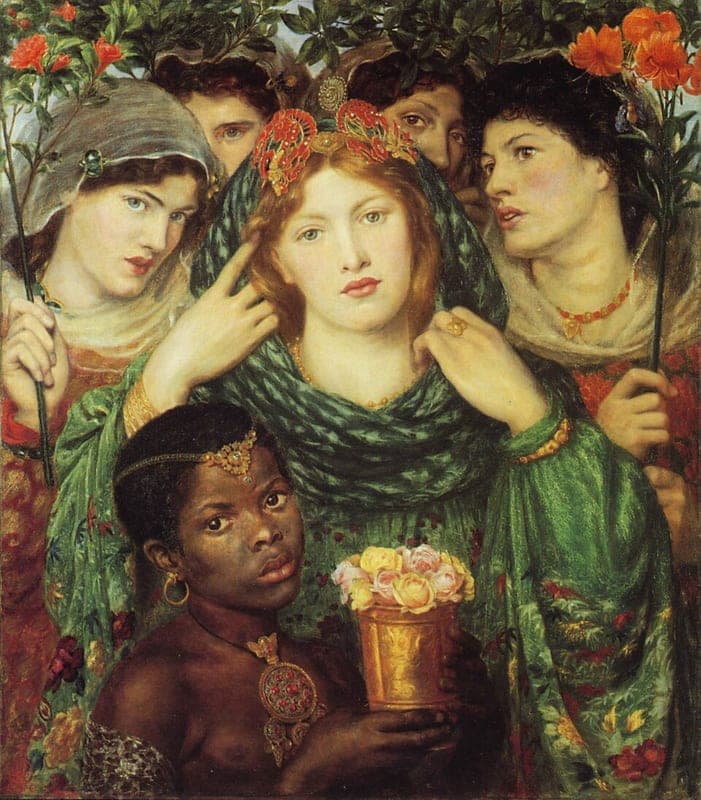
The Beloved or The Bride, Dante Gabriel Rossetti, between 1865 and 1866. Public domain.
What is the Song of Solomon about?
The Song of Songs is a book of love poems in eight chapters, spoken by a woman, the man she loves and the daughters of Jerusalem. It opens with her longing for the king and their praise of each other. Solomon's procession comes up from the wilderness, and he calls his bride a garden locked, which she opens to him. One night she is slow to open her door, he is gone, and she searches the city for him. It closes by naming love as strong as death. Its words for the two of them come three times, first at 2:16: “My beloved is mine and I am his.”
All 8 chapters
Every chapter of the book, in one grid. Each cell opens that chapter.
- The courtshipSong 1:1 to 3:5
- The weddingSong 3:6 to 5:1
- The search and the praiseSong 5:2 to 8:4
- The sealSong 8:5 to 8:14
The colour is the movement the chapter stands in, and every cell opens that chapter's Study level. Three movements begin inside a chapter: the wedding at 3:6, the search and the praise at 5:2, and the seal at 8:5, so each of those chapters takes the colour of the movement that holds most of its verses.
Who wrote it, where, when, for whom, and why?
The book names itself Solomon's Song of Songs in its first verse (1:1), and it names Solomon again at 1:5, 3:7, 3:9, 3:11, 8:11 and 8:12. First Kings says that his songs numbered a thousand and five (1 Kings 4:32). The Hebrew of the title can mean by Solomon, for Solomon or about Solomon, and the book does not say who set the poem down; the question stands under the Hard Questions. No other book of Scripture names the Song.
Solomon composed three thousand proverbs, and his songs numbered a thousand and five.
1 Kings 4:32, Berean Standard Bible.
The poem moves between Jerusalem, whose daughters it addresses (1:5), the king's chambers (1:4), the streets and squares of the city at night (3:2), and the countryside with its vineyards and fields (7:11 and 12). Its names run from Lebanon, Amana, Senir and Hermon in the north (4:8) through Gilead (4:1), Tirzah (6:4), Heshbon (7:4) and Carmel (7:5) to Sharon on the coast (2:1) and En-gedi by the Dead Sea (1:14).
The text gives no year. It sets its days by the seasons: the winter past and the rain over, the fig ripening and the vines in blossom (2:11 to 13), and the time to see whether the vines have budded (6:11, 7:12). The one day it names is Solomon's wedding day, when his mother crowned him (3:11), which places the procession in his reign.
Inside the poem the woman speaks to the daughters of Jerusalem, and they answer her twice (5:9, 6:1). The last verses call on the one who dwells in the gardens, whose companions are listening (8:13). The book names no reader outside the poem.
The Song states no purpose in so many words. What it says of love it says at 8:6 and 7: love is as strong as death, many waters cannot quench it, and all the wealth of a house cannot buy it. Three times the woman charges the daughters not to arouse love until the time is right (2:7, 3:5, 8:4).
Mighty waters cannot quench love; rivers cannot sweep it away. If a man were to give all the wealth of his house for love, his offer would be utterly scorned.
Song of Solomon 8:7, Berean Standard Bible.
The poem's world is the court and the country together: a carriage of Lebanon timber with posts of silver and a base of gold (3:9 and 10), sixty warriors with swords at their sides (3:7 and 8), and sixty queens and eighty concubines (6:8); beside them are shepherds' tents, flocks, a walnut grove and mandrakes (1:8, 6:11, 7:13). Its spices come from far off: nard, saffron, calamus, cinnamon, myrrh and aloes (4:14).
Sources. Song of Solomon 1:1, 1:4, 1:5, 1:8, 1:14, 2:1, 2:7, 2:11 to 13, 3:2, 3:5, 3:7 to 11, 4:1, 4:8, 4:14, 5:9, 6:1, 6:4, 6:8, 6:11, 7:4, 7:5, 7:11 to 13, 8:4, 8:6 and 7, 8:11 to 13; 1 Kings 4:32. Every verse is read in the Berean Standard Bible.
How is the Song arranged, and what is it for?
The four movements the poem falls into, then what it teaches and what it was given to do.
- The courtshipSong 1:1 to 3:5, 39 verses
The woman longs for the king, the two praise each other, spring calls her out, and she searches for him at night.
The turn, 2:16: The first time the two are said to belong to each other.
- The weddingSong 3:6 to 5:1, 23 verses
Solomon's procession comes up from the wilderness, he praises his bride, and the locked garden is opened.
The turn, 5:1: The garden entered and the friends told to eat and drink, the middle of the book.
- The search and the praiseSong 5:2 to 8:4, 45 verses
She is slow to open, he is gone, the watchmen beat her, and in the search each praises the other again.
The turn, 6:3: The belonging said again, turned round, once she knows where he has gone.
- The sealSong 8:5 to 8:14, 10 verses
The two come up from the wilderness together, love is named as strong as death, and she calls him once more.
The turn, 8:6: The one place the book says what love is.
The theme
The Song is about the love of one man and one woman: the longing before they are together, their delight in each other, the loss on the night she is slow to open, and a love that holds. It speaks of the body without shame and of desire as good, and it keeps the timing of love in the woman's charge to the daughters. It sings rather than argues, and its one statement about love stands at 8:6 and 7.
The purpose
Set among the books of wisdom beside Proverbs and Ecclesiastes, the Song teaches the worth of the love between a husband and a wife, the love Genesis 2:24 describes when the two become one flesh. Israel's teachers have also read it as the love of the LORD for Israel, and the church as the love of Christ for the church; the Hard Questions set out those readings with their holders.
Who speaks, verse by verse, across the eight chapters
- The bride
- The beloved
- The others
- Hatched: assigned by the editors
The movements
- The courtship, 1:1 to 3:5
- The wedding, 3:6 to 5:1
- The search and the praise, 5:2 to 8:4
- The seal, 8:5 to 8:14
The bride
The beloved
The others
Do not arouse love (2:7, 3:5, 8:4)
My beloved is mine (2:16, 6:3, 7:10)
The night search (3:1 to 3:4, 5:6 to 5:8)
Every speech in order, with its voice and how it is assigned (40)
| Verses | Voice | What is said | Assigned by |
|---|---|---|---|
| 1:2 to 1:4a | The bride | Let him kiss me | the text's grammar |
| 1:4b | The others | We will rejoice in you | the editors |
| 1:5 to 1:7 | The bride | Dark, yet lovely; where do you pasture? | the text's grammar |
| 1:8 | The beloved | Follow the tracks of the flock | the editors |
| 1:9 to 1:10 | The beloved | A mare among Pharaoh's chariots | the text's grammar |
| 1:11 | The others | We will make you ornaments | the editors |
| 1:12 to 1:14 | The bride | A sachet of myrrh | the text's grammar |
| 1:15 | The beloved | How beautiful you are | the text's grammar |
| 1:16 to 1:17 | The bride | How handsome you are | the text's grammar |
| 2:1 | The bride | A rose of Sharon | the editors |
| 2:2 | The beloved | A lily among the thorns | the text's grammar |
| 2:3 to 2:13 | The bride | The apple tree; the winter is past | the text's grammar |
| 2:14 | The beloved | My dove in the clefts of the rock | the text's grammar |
| 2:15 | The bride | Catch the little foxes | the editors |
| 2:16 to 3:5 | The bride | My beloved is mine; the first night search | the text's grammar |
| 3:6 to 3:11 | The others | Solomon's carriage comes up | the editors |
| 4:1 to 4:15 | The beloved | The first song of her beauty; the garden locked | the text's grammar |
| 4:16 | The bride | Let my beloved come into his garden | the text's grammar |
| 5:1a | The beloved | I have come to my garden | the text's grammar |
| 5:1b | The others | Eat, O friends, and drink | the editors |
| 5:2 to 5:8 | The bride | The knock, and the second night search | the text's grammar |
| 5:9 | The others | How is your beloved better? | the text's grammar |
| 5:10 to 5:16 | The bride | Her song of him | the text's grammar |
| 6:1 | The others | Where has your beloved gone? | the text's grammar |
| 6:2 to 6:3 | The bride | Gone down to his garden | the text's grammar |
| 6:4 to 6:9 | The beloved | Beautiful as Tirzah; my dove is unique | the text's grammar |
| 6:10 | The others | Who is this who shines like the dawn? | the editors |
| 6:11 to 6:12 | The bride | Down to the walnut grove | the editors |
| 6:13a | The others | Come back, O Shulammite | the text's grammar |
| 6:13b | The bride | Why do you look at the Shulammite? | the editors |
| 7:1 to 7:9a | The beloved | The song from her feet to her head | the editors |
| 7:9b to 7:13 | The bride | Let us go to the vineyards | the text's grammar |
| 8:1 to 8:4 | The bride | O that you were like a brother | the text's grammar |
| 8:5a | The others | Who is this coming up? | the editors |
| 8:5b to 8:7 | The bride | Set me as a seal over your heart | the text's grammar |
| 8:8 to 8:9 | The others | We have a little sister | the text's grammar |
| 8:10 | The bride | I am a wall | the text's grammar |
| 8:11 to 8:12 | The bride | Solomon's vineyard and my own | the editors |
| 8:13 | The beloved | Let me hear your voice | the text's grammar |
| 8:14 | The bride | Come away, my beloved | the text's grammar |
The courtship, Song 1:1 to 3:5
What the text says across these 2 chapters, and the pages they open on.
The book opens with the woman's longing for the king, whose love she calls better than wine. She tells the daughters of Jerusalem that she is dark because her brothers set her to keep the vineyards in the sun, and she asks the man where he pastures his flock. The two praise each other in turn, she a lily among thorns and he an apple tree among the trees of the forest. In chapter 2 he comes over the hills and calls her out, because the winter is past. The movement ends with her search through the city at night, the watchmen, the finding, and her first charge to the daughters (3:1 to 5).
My beloved is mine and I am his; he pastures his flock among the lilies.
- Study
Song of Solomon 1her longing, her dark skin, and praise in turnShow the summary and 4 pagesShow summary, 4 pagesHide the summary
The woman longs for the king whose love is better than wine, and she tells the daughters of Jerusalem she is dark from keeping her brothers' vineyards. The two then praise each other in turn.
- She asks where he pastures his flock and is told to follow the tracks of the flock (1:7 and 8).
- He compares her to a mare among Pharaoh's chariots (1:9).
- She calls him a sachet of myrrh and a cluster of henna from En-gedi (1:13 and 14).
On this chapter (4)
- How the Song has been read
The Jewish and Christian traditions of reading the book.
- How has the Song been read?
Answered under Where do readers disagree, lower on this page, with each reading and who holds it.
- Did Solomon write it, and when?
Answered under Where do readers disagree, lower on this page, with each reading and who holds it.
- Song of Solomon 1:2
The verse on its own page, with the commentators on it by era.
- Study
Song of Solomon 2the rose of Sharon and the call of springShow the summary and 2 pagesShow summary, 2 pagesHide the summary
She is a lily among thorns and he an apple tree among the trees of the forest, and she charges the daughters not to arouse love until the time is right. He comes over the hills and calls her out, because the winter is past.
- His banner over her is love (2:4).
- The fig ripens and the vines blossom as he calls (2:11 to 13).
- The chapter ends with the two belonging to each other (2:16).
On this chapter (2)
- Marriage and family
What Scripture teaches of marriage.
- Song of Solomon 2:16
The verse on its own page, with the commentators on it by era.
The vineyard and the garden, from her brothers' vineyard to her own
1vineyard1:6
Do not stare because I am dark, for the sun has gazed upon me. My mother’s sons were angry with me; they made me a keeper of the vineyards, but my own vineyard I have neglected.
Her own vineyard, neglected while she kept her brothers'.
2vineyard1:14
My beloved is to me a cluster of henna blossoms in the vineyards of En-gedi.
He is henna blossom in the vineyards of En-gedi.
3vineyard2:15
Catch for us the foxes—the little foxes that ruin the vineyards—for our vineyards are in bloom.
The little foxes spoil the vineyards in bloom.
4garden4:12
My sister, my bride, you are a garden locked up, a spring enclosed, a fountain sealed.
She is a garden locked, a spring enclosed.
5garden4:16
Awake, O north wind, and come, O south wind. Breathe on my garden and spread the fragrance of its spices. Let my beloved come into his garden and taste its choicest fruits.
She opens the garden to him.
6garden6:2
My beloved has gone down to his garden, to the beds of spices, to pasture his flock in the gardens and to gather lilies.
He has gone down to his garden.
7garden6:11
I went down to the walnut grove to see the blossoms of the valley, to see if the vines were budding or the pomegranates were in bloom.
Down to the walnut grove to see the vines.
8vineyard7:12
Let us go early to the vineyards to see if the vine has budded, if the blossom has opened, if the pomegranates are in bloom—there I will give you my love.
Early to the vineyards, where she gives her love.
9vineyard8:11 and 12
Solomon had a vineyard in Baal-hamon. He leased it to the tenants. For its fruit, each was to bring a thousand shekels of silver. But my own vineyard is mine to give; the thousand shekels are for you, O Solomon, and two hundred are for those who tend its fruit.
Solomon's vineyard is let out; her own is hers to give.
Characters (5)
Who the text names. A name with a page carries its door.
- The bride, the Shulammite
She speaks first and last, and most of the book is hers; called the Shulammite at 6:13.
- The beloved
The man she loves, the king who brings her to his chambers (1:4).
- The daughters of Jerusalem
The women she speaks to, and three times charges not to arouse love (2:7).
- Her brothers
Her mother's sons, who set her to keep the vineyards (1:6).
Show the next 1
- The watchmen
The city's guards she meets on her first night search (3:3).
Places (4)
Where the chapters stand.
Themes (3)
What these chapters raise, each on its own page where one stands.
- How the Song has been read
The two traditions of reading the book, Jewish and Christian.
- Marriage and family
What Scripture teaches of marriage, from Eden onward.
- Love and its time
The charge not to arouse love until the time is right (2:7, 3:5).
No New Testament passage quotes or names these chapters.
The wedding, Song 3:6 to 5:1
What the text says across these 2 chapters, and the pages they open on.
A column of smoke comes up from the wilderness: it is Solomon's carriage, guarded by sixty warriors, and he wears the crown his mother gave him on the day of his wedding (3:11). The man then praises his bride from her eyes down to her breasts (4:1 to 7), calls her to come with him from Lebanon, and names her a garden locked and a spring enclosed (4:12). She asks the north wind and the south wind to blow on her garden and bids her beloved come into it (4:16). He answers that he has come into his garden, and a voice tells the friends to eat and drink (5:1).
I have come to my garden, my sister, my bride; I have gathered my myrrh with my spice. I have eaten my honeycomb with my honey; I have drunk my wine with my milk. Eat, O friends, and drink; drink freely, O beloved.
- Study
Song of Solomon 3the night search, and Solomon's processionShow the summary and 3 pagesShow summary, 3 pagesHide the summary
At night she seeks the one she loves through the city, passes the watchmen and finds him. Then Solomon's carriage comes up from the wilderness on the day of his wedding.
- She holds him and brings him to her mother's house (3:4).
- The second charge to the daughters closes the search (3:5).
- Sixty warriors guard a carriage of Lebanon timber, silver and gold (3:7 to 10).
- Solomon wears the crown his mother gave him on his wedding day (3:11).
On this chapter (3)
- The bride and the Jewish wedding
Betrothal and wedding behind the Bible's bride.
- Did Solomon write it, and when?
Answered under Where do readers disagree, lower on this page, with each reading and who holds it.
- Song of Solomon 3:11
The verse on its own page, with the commentators on it by era.
- Study
Song of Solomon 4his song of her, and the garden lockedShow the summary and 2 pagesShow summary, 2 pagesHide the summary
He praises his bride from her eyes to her breasts and calls her to come with him from Lebanon. He names her a garden locked and a spring enclosed, and she asks him to come into his garden.
- He calls her altogether beautiful, with no flaw (4:7).
- Her garden holds pomegranates, nard, saffron, cinnamon and myrrh (4:13 and 14).
- She asks the north wind and the south wind to blow on her garden (4:16).
On this chapter (2)
- The bride and the Jewish wedding
Betrothal and wedding behind the Bible's bride.
- Song of Solomon 4:12
The verse on its own page, with the commentators on it by era.
Four songs of the body: who sings whom, and in what order
1He sings her
4:1 to 7, the singer settled by the text's grammar
From the head down (7 parts)
- 1. eyes
- 2. hair
- 3. teeth
- 4. lips
- 5. brow
- 6. neck
- 7. breasts
2She sings him
5:10 to 16, the singer settled by the text's grammar
From the head down (9 parts)
- 1. head
- 2. hair
- 3. eyes
- 4. cheeks
- 5. lips
- 6. arms
- 7. body
- 8. legs
- 9. mouth
3He sings her
6:4 to 10, the singer settled by the text's grammar
From the head down (4 parts)
- 1. eyes
- 2. hair
- 3. teeth
- 4. brow
4He sings her
7:1 to 9, the singer assigned by the editors
From the feet up (10 parts)
- 1. feet
- 2. thighs
- 3. navel
- 4. waist
- 5. breasts
- 6. neck
- 7. eyes
- 8. nose
- 9. head
- 10. hair
Characters (4)
Who the text names. A name with a page carries its door.
- Solomon
The king whose carriage and wedding crown the chapter describes (3:7 to 11).
- His mother
She crowned him on the day of his wedding (3:11).
- The sixty warriors
The mighty men of Israel around the carriage, swords at their sides (3:7 and 8).
- The friends
Told to eat and drink freely at the garden (5:1).
Places (3)
Where the chapters stand.
- The wilderness
Where the procession comes up from, like a column of smoke (3:6).
- Lebanon
Where he calls her down from, with Amana, Senir and Hermon (4:8).
- Gilead
The mountain whose goats stream down like her hair (4:1).
Themes (3)
What these chapters raise, each on its own page where one stands.
- The bride and the Jewish wedding
The customs of betrothal and wedding behind the Bible's bride.
- The garden
The bride as a garden locked and then opened (4:12 to 5:1).
- The wedding
Solomon's wedding day, the one day the book names (3:11).
No New Testament passage quotes or names these chapters. The readings below set New Testament texts beside them, and each is marked as a later Christian reading.
Where the New Testament uses these chapters (1)each marked as a quotation or an allusion, with the evidence
- Later Christian readingThe bride and her beloved, Song 4:8 to 5:1 at Ephesians 5:25 to 32. Paul speaks of Christ loving the church as a husband loves his wife and calls it a profound mystery. He does not name the Song, and the reading of the Song through his words is the church's. Held by Origen, Commentary on the Song of Songs, and Bernard of Clairvaux, Sermons on the Song of Songs.
The search and the praise, Song 5:2 to 8:4
What the text says across these 3 chapters, and the pages they open on.
She is asleep when he knocks, and she is slow to rise; when she opens the door he has gone (5:2 to 6). The watchmen beat her and take her cloak, and she charges the daughters to tell him she is sick with love. They ask what makes him better than others, and she answers with a song of him from his head to his legs (5:10 to 16). Asked where he has gone, she knows: down to his garden (6:2). He sings her twice more (6:4 to 9 and 7:1 to 9), she is called back as the Shulammite (6:13), and she invites him out to the fields and the vineyards. The movement closes with her third charge to the daughters (8:4).
I belong to my beloved and he belongs to me; he pastures his flock among the lilies.
- Study
Song of Solomon 5the garden entered, the knock, and her song of himShow the summary and 1 pageShow summary, 1 pageHide the summary
He comes into his garden, and then on another night she is slow to open when he knocks and finds him gone. The watchmen beat her, and when the daughters ask what makes him better, she sings him from head to legs.
- The friends are told to eat and drink (5:1).
- She charges the daughters to tell him she is sick with love (5:8).
- She calls him outstanding among ten thousand and altogether lovely (5:10 and 16).
On this chapter (1)
- Song of Solomon 5:16
The verse on its own page, with the commentators on it by era.
- Study
Song of Solomon 6gone to his garden; beautiful as TirzahShow the summary and 2 pagesShow summary, 2 pagesHide the summary
Asked where he has gone, she knows he has gone down to his garden, and she says again that they belong to each other. He praises her as beautiful as Tirzah and unique among sixty queens.
- The daughters offer to seek him with her (6:1).
- Lines of his first song of her return (6:5 to 7).
- The queens and concubines praise her (6:9).
- She is called back as the Shulammite (6:13).
On this chapter (2)
- Who is the Shulammite?
Answered under Where do readers disagree, lower on this page, with each reading and who holds it.
- Song of Solomon 6:3
The verse on its own page, with the commentators on it by era.
- Study
Song of Solomon 7the song from her feet up, and the vineyardsShow the summary and 2 pagesShow summary, 2 pagesHide the summary
He praises her from her feet to her head, and the king is captured in her tresses. She answers that she belongs to him and his desire is for her, and she invites him out to the fields and vineyards.
- Her stature is like a palm tree (7:7).
- The belonging refrain takes its third form (7:10).
- She has treasured up delicacies new and old for him (7:13).
On this chapter (2)
- Marriage and family
What Scripture teaches of marriage.
- Song of Solomon 7:10
The verse on its own page, with the commentators on it by era.
The two night searches, step against step
At night
The first night, 3:1: On her bed at night she seeks him.The second night, 5:2: She sleeps, and he knocks.Not found
The first night, 3:2: She goes through the city and does not find him.The second night, 5:6: She opens, he has gone; he does not answer.The watchmen
The first night, 3:3: She asks them if they have seen him.The second night, 5:7: They beat her and take her cloak.The end
The first night, 3:4: She finds him and will not let go.The second night, 5:8: She charges the daughters to tell him she is sick with love.What follows
The first night, 3:5: The charge not to arouse love.The second night, 5:9: The daughters ask what makes him better, and she sings him.
Characters (5)
Who the text names. A name with a page carries its door.
- The bride
Slow to open, beaten in the street, and the singer of 5:10 to 16.
- The beloved
Gone from the door, then found in his garden, and the singer of 6:4 to 9.
- The daughters of Jerusalem
They ask her twice about her beloved (5:9, 6:1).
- The watchmen
On the second night they beat her and take her cloak (5:7).
Show the next 1
- The queens and concubines
Sixty queens and eighty concubines who praise her (6:8 and 9).
Places (5)
Where the chapters stand.
- Tirzah
The city her beauty is compared to, beside Jerusalem (6:4).
- Mahanaim
The dance the Shulammite is watched in (6:13).
- Damascus
The city the tower of Lebanon faces, in the song of her body (7:4).
- Heshbon
Its pools are her eyes (7:4).
Show the next 1
- Carmel
The mountain her head is compared to (7:5).
Themes (3)
What these chapters raise, each on its own page where one stands.
- Desire
His desire is for me (7:10): the refrain's third form.
- The songs of the body
Four songs praise the body part by part (4:1, 5:10, 6:4, 7:1).
- Marriage and family
What Scripture teaches of marriage.
No New Testament passage quotes or names these chapters.
The seal, Song 8:5 to 14
What the text says in this chapter, and the pages it opens on.
The two come up from the wilderness together, she leaning on her beloved (8:5). She asks to be set as a seal over his heart and on his arm, and she says what love is: as strong as death, too strong for many waters to quench, and beyond any price (8:6 and 7). Her brothers ask what to do for their little sister, and she answers that she is a wall. She sets her own vineyard beside Solomon's at Baal-hamon, and the book ends with him asking to hear her voice and her call to come away (8:13 and 14).
Set me as a seal over your heart, as a seal upon your arm. For love is as strong as death, its jealousy as unrelenting as Sheol. Its sparks are fiery flames, the fiercest blaze of all.
- Study
Song of Solomon 8love as strong as death, and the last callShow the summary and 4 pagesShow summary, 4 pagesHide the summary
She asks to be set as a seal over his heart, for love is as strong as death and many waters cannot quench it. Her brothers plan for their little sister, she sets her own vineyard beside Solomon's, and the book ends with her call to come away.
- The third charge to the daughters closes the search and the praise (8:4).
- The two come up from the wilderness together (8:5).
- Solomon's vineyard at Baal-hamon is let out to tenants (8:11).
- He asks to hear her voice, and she calls him to the mountains of spices (8:13 and 14).
On this chapter (4)
- The seal
The seal in Scripture, from the signet to the Spirit.
- Does 8:6 read the flame of the LORD?
Answered under Where do readers disagree, lower on this page, with each reading and who holds it.
- Why is the Song in the canon, and what did Akiba say?
Answered under Where do readers disagree, lower on this page, with each reading and who holds it.
- Song of Solomon 8:7
The verse on its own page, with the commentators on it by era.
The book's own statement of its subject
6Set me as a seal over your heart, as a seal upon your arm. For love is as strong as death, its jealousy as unrelenting as Sheol. Its sparks are fiery flames, the fiercest blaze of all.
7Mighty waters cannot quench love; rivers cannot sweep it away. If a man were to give all the wealth of his house for love, his offer would be utterly scorned.
Song of Solomon 8:6 and 7, Berean Standard Bible
The word behind the flame
שַׁלְהֶבֶתְיָה, shalhebetyah, rendered “the fiercest blaze of all” in the Berean text. It stands only here in the Hebrew Bible. Its last syllable, yah, is the short form of the LORD's name, and it is also read as the Hebrew way of saying the greatest of its kind.
The two readings and who holds themCharacters (4)
Who the text names. A name with a page carries its door.
- The bride
She asks to be set as a seal, and speaks the book's last words (8:14).
- The little sister
The girl her brothers plan for, a wall or a door (8:8 and 9).
- Her brothers
They speak once, of their little sister (8:8 and 9).
- Solomon
His vineyard at Baal-hamon, let out to tenants (8:11 and 12).
Places (3)
Where the chapters stand.
- The wilderness
The two come up from it together (8:5).
- Baal-hamon
Where Solomon's vineyard stands (8:11).
- The mountains of spices
Where the last verse sends him (8:14).
Themes (3)
What these chapters raise, each on its own page where one stands.
- The seal
The seal in Scripture, from the signet to the Spirit.
- Love as strong as death
The book's one statement about love (8:6 and 7).
- Jealousy as unrelenting as Sheol
Love's jealousy set beside the grave (8:6).
No New Testament passage quotes or names these chapters. The readings below set New Testament texts beside them, and each is marked as a later Christian reading.
Where the New Testament uses these chapters (1)each marked as a quotation or an allusion, with the evidence
- Later Christian readingWho is this coming up from the wilderness?, Song 8:5 at Revelation 19:7. John hears that the marriage of the Lamb has come and his bride has made herself ready. The Song is not named, and the pairing is made by readers of both books. Held by Matthew Henry, Commentary on the Whole Bible, on the Song.
- Author
- Traditional: Solomon (1:1 ''the song of songs, which is Solomon's''). Critical: the ''of Solomon'' construction allows ''about Solomon'' or ''to Solomon'' and opens the authorship question. Most readings keep the Solomonic association.
- Date
- Solomonic reading: c. 965–930 BC. Critical reading: later editorial compilation.
- Audience
- The covenant community at marriage; in Jewish tradition read at Passover; in Christian tradition a devotional and (per school) allegorical anchor.
Where do readers disagree?
One list: the readings with their holders, and what the evidence does not settle.
How has the Song been read?
How the Song has been read, argued in full→- The LORD and Israel. Held by the Targum to the Song of Songs, which reads the book as Israel's history from the exodus to the Messiah, and by Rashi in his Commentary on the Song of Songs.
- Christ and the church, and the soul. Held by Origen in his Commentary on the Song of Songs, and by Bernard of Clairvaux, Sermons on the Song of Songs (1135 to 1153).
- A celebration of married love. Held by Christian D. Ginsburg, The Song of Songs (1857), and Tremper Longman III, Song of Songs (2001).
- A drama of three. Held by Heinrich Ewald, Das Hohelied Salomo's (1826), and set out at length by Ginsburg.
What the evidence does not settle: The Hebrew carries no speaker labels and the book names no key, so whether its love points beyond itself is decided by how the canon is read. Delitzsch holds that the love is real and also a pattern of God's love.
The argument in full
The LORD and Israel. The tradition that kept the book read the lover as the LORD and the woman as Israel, and Jewish practice reads the Song at Passover beside the exodus.
Christ and the church, and the soul. Scripture uses marriage for God's love of his people (Hosea 2:19 and 20; Ephesians 5:32), so the church read the bride as the church and as the believer.
A celebration of married love. The text gives no key to an allegory and reads verse by verse as the love of a man and a woman, the love Genesis 2:24 and Proverbs 5:18 and 19 call good.
A drama of three. A country shepherd is the woman's true love and Solomon a king who tries to win her for his court; 8:11 and 12 are her refusal of the king.
Did Solomon write it, and when?
- Solomon, in his reign. Held by Franz Delitzsch, Commentary on the Song of Songs and Ecclesiastes (1885), who takes the title of 1:1 as it stands.
- A collection that honours Solomon. Held by Ginsburg, and by Longman in his Song of Songs, who takes 1:1 as open.
- The language cannot date it. Held by Ian Young and Robert Rezetko, Linguistic Dating of Biblical Texts (2008).
What the evidence does not settle: The title can be read three ways, and two rare words carry most of the dating argument, so neither the writer nor the date is settled by the text.
The argument in full
Solomon, in his reign. The title names Solomon, 1 Kings 4:32 credits him with a thousand and five songs, and the royal wealth of 3:6 to 11 and the places from Lebanon to En-gedi fit his kingdom.
A collection that honours Solomon. The Hebrew of the title can mean for or about Solomon as well as by him, and Solomon appears inside the poem as its royal figure.
The language cannot date it. Two rare words, pardes, an orchard (4:13), and appiryon, a carriage (3:9), have been read as late loanwords, but early and late styles of Hebrew overlapped and trade words travel ahead of empires.
Who is the Shulammite?
- A woman of Shunem. Held by Delitzsch, who reads the name from the village of Shunem.
- A name taken from Solomon's. Held by John Gill, An Exposition of the Song of Solomon (1728), on 6:13.
- Israel called to return. Held by the Targum to the Song of Songs on 6:13, as translated by Hermann Gollancz, The Targum to the Song of Songs (1908).
What the evidence does not settle: The name stands only at 6:13 and nowhere else in Scripture, so no second use decides it. In the Hebrew Bible the verse is numbered 7:1.
The argument in full
A woman of Shunem. The name is read as the Shunammite, a woman of the village of Shunem, the home of Abishag the Shunammite who served David (1 Kings 1:3).
A name taken from Solomon's. The name is read as the feminine of Solomon's, as a wife takes her husband's name, so it pairs her with the king.
Israel called to return. The fourfold call to come back is read as the call to the assembly of Israel to return to the LORD.
Why is the Song in the canon, and what did Akiba say?
- The holy of holies. Held by Rabbi Akiba, as recorded in Mishnah Yadayim 3:5.
- Kept because it was read as a figure. Held by Origen in his Commentary on the Song of Songs, in its prologue.
- Kept as Scripture on married love. Held by Longman, in his Song of Songs, who reads the book as poetry of married love.
What the evidence does not settle: The Mishnah records Akiba's answer without the other side's reasons, and the same teacher is remembered warning against singing the Song at banquets (Tosefta Sanhedrin 12:10), so the terms of the dispute are known only in part.
The argument in full
The holy of holies. In a dispute over whether the Song defiles the hands, the sages' phrase for holy Scripture, he said that all the Writings are holy and the Song of Songs is the holy of holies.
Kept because it was read as a figure. The book was taught as the love of God for his people and kept for mature readers, and under that reading it was preserved and read.
Kept as Scripture on married love. The Song stands in the canon beside Proverbs and Genesis 2 as God's word on the love of husband and wife, with no allegory needed to earn its place.
Does 8:6 read the flame of the LORD?
- A flame of the LORD. Held by the American Standard Version (1901), Young's Literal Translation (1862) and the Darby translation (1890), which print the divine name in the verse, and by Delitzsch.
- The fiercest flame. Held by King James's translators, who print a most vehement flame in the Authorized Version (1611), and by the Berean Standard Bible, which prints the fiercest blaze of all.
What the evidence does not settle: The word stands only here in the Hebrew Bible, so no other use decides whether its ending names God or marks the superlative.
The argument in full
A flame of the LORD. The Hebrew word shalhebetyah ends in yah, the short form of the LORD's name, so the verse names him as the source of love's fire, the one place the book names God.
The fiercest flame. The ending is read as the Hebrew way of making a thing the greatest of its kind, so the verse says love's fire is the fiercest there is.
The Text and the Spade
- En-gedi (Tel Goren and the oasis, western shore of the Dead Sea)Iron Age settlement, seventh century BC and later
The oasis named at 1:14, 'a cluster of henna blossoms in the vineyards of En-gedi,' is a real place with permanent springs in otherwise waterless country, and excavation found a settled Iron Age town with installations connected to the perfume industry the site was later famous for. The verse's picture of vineyards and fragrance in the desert is geography rather than invention.
- Tirzah (Tell el-Farah North, excavated by Roland de Vaux, 1946-1960)occupied through the Iron Age; Israel's royal seat in the early ninth century BC
At 6:4 the woman is 'as beautiful, my darling, as Tirzah, as lovely as Jerusalem,' which sets her beside two named cities. Excavation confirmed Tirzah as a substantial northern city that served briefly as Israel's capital before Omri built Samaria (1 Kings 16:23-24). The name itself is built on a Hebrew root meaning to be pleasing, so the line works as both a place and a play on the word.
- The South Arabian incense routeattested archaeologically from roughly the eighth century BC onward
The spice list at 4:13-14 names frankincense, myrrh, saffron, calamus, cinnamon, and spikenard, which grew nowhere near Israel and arrived by caravan across Arabia or by sea from further east. The trade network is well attested, though scholars differ over how early it reached the volume the list assumes, and that disagreement feeds the dating question above.
The pages Song of Solomon opens on
Studies9
Books beside it5
Sources for this page
The painting in the band is The Beloved or The Bride, Dante Gabriel Rossetti, between 1865 and 1866. Public domain. The movements, the chapter entries, the figures and the Context are read off the text of the Song; the speakers are placed by the gender and number of the Hebrew forms where they settle it. The works behind the readings under Where do readers disagree are the Mishnah, tractate Yadayim; the Tosefta, tractate Sanhedrin; the Targum to the Song of Songs, as translated by Hermann Gollancz (1908); Origen, Commentary on the Song of Songs; Rashi, Commentary on the Song of Songs; Bernard of Clairvaux, Sermons on the Song of Songs (1135 to 1153); the King James Version (1611); John Gill, An Exposition of the Song of Solomon (1728); Matthew Henry, Commentary on the Whole Bible (1706); Heinrich Ewald, Das Hohelied Salomo's (1826); Christian D. Ginsburg, The Song of Songs (1857); Young's Literal Translation (1862); Franz Delitzsch, Commentary on the Song of Songs and Ecclesiastes (1885); the Darby translation (1890); the American Standard Version (1901); Tremper Longman III, Song of Songs (2001); and Ian Young and Robert Rezetko, Linguistic Dating of Biblical Texts (2008). Every verse quoted on this page is the Berean Standard Bible, read from the store.