
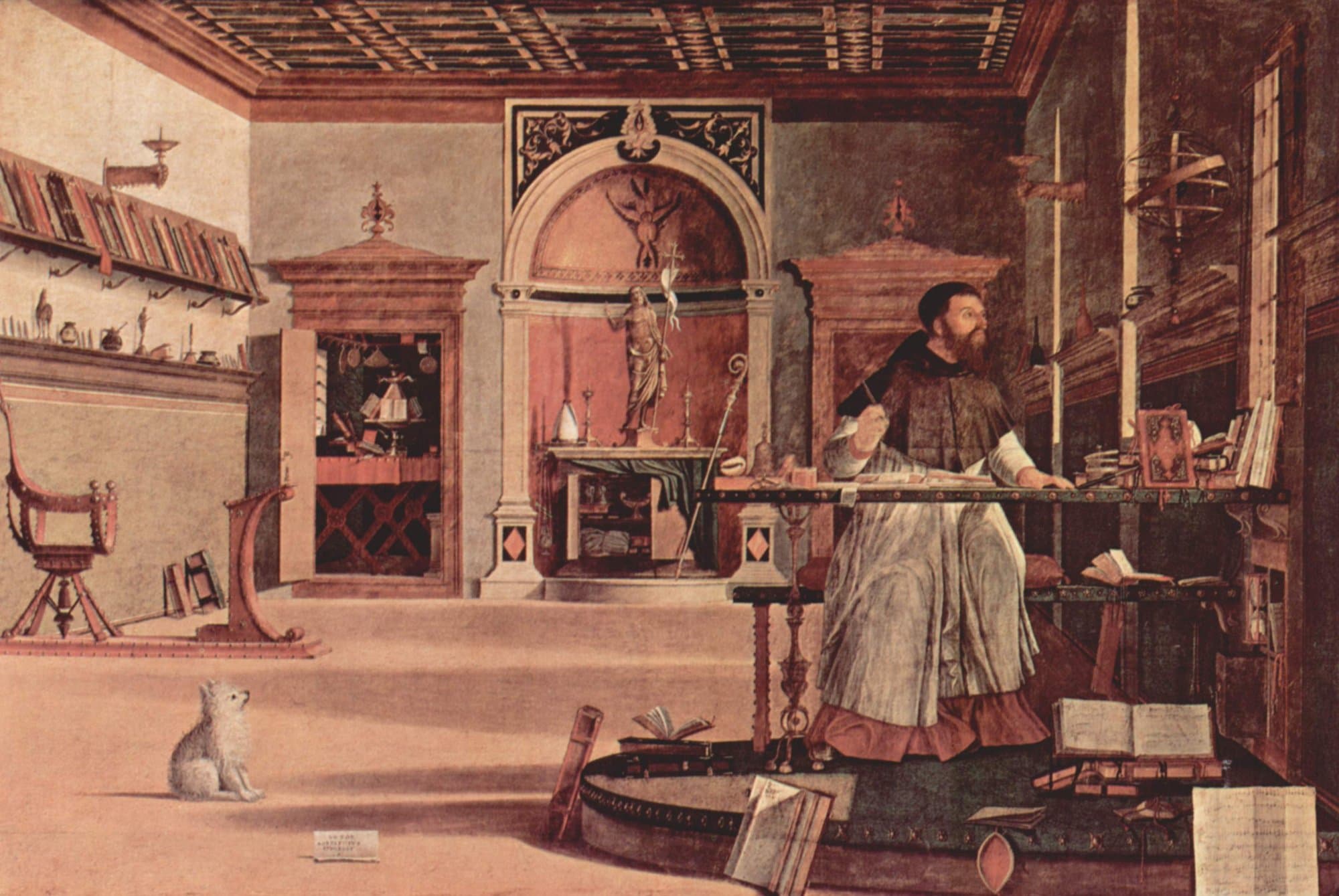
Confessions, Book 1 · Story · Purpose and Futility
Our Heart Is Restless
Augustine of Hippo opened his Confessions by telling God that He made us for Himself and that our heart is restless until it rests in Him.
Philip Schaff judged the sentence on the restless heart “the finest sentence in the whole book”.
Great is the LORD and greatly to be praised; His greatness is unsearchable.
- Where
- Carthage, Milan, Hippo
- Who
- Augustine of Hippo
- When
- 397, the year Schaff's table gives for the writing of the Confessions (probable)
Summary
Augustine told his own life to God in the Confessions, up to his conversion, his baptism and his mother's death. He traced a long search through philosophy, a sect and a career in rhetoric in Carthage, Rome and Milan, which ended when he read a single passage of the apostle Paul.
- Ten of the thirteen books tell Augustine's own life, and the last three expound Scripture from the first verse of Genesis, as he wrote in his Retractations.
- His mother Monnica prayed for him through his years among the Manichees, and she died at Ostia in the year of his baptism.
- Augustine was bishop of Hippo in North Africa from 396 until his death in 430, by the table of his life in the Nicene and Post-Nicene Fathers.
Great Art Thou, O Lord
Pusey's English and the notes of the Nicene and Post-Nicene Fathers give the opening line and its source.
Our Heart Is Restless is the story of Augustine of Hippo's search for God, as he tells it in his Confessions. It belongs to the trial of purpose and futility because Augustine spent years seeking what would give his life its point, in learning, ambition and pleasure.
Its question is what Augustine meant by the restless heart and how he came to know it. It gives the opening prayer in his own words, a timeline of his life, the search Book 3 tells, the garden at Milan in Book 8 and the account he later gave of the book.
In E. B. Pusey's translation the book begins, “Great art Thou, O Lord, and greatly to be praised; great is Thy power, and Thy wisdom infinite”. The edition of the Nicene and Post-Nicene Fathers refers that line to Psalm 145:3 and Psalm 147:5.
Great is our Lord, and mighty in power; His understanding has no limit.The verse joins God's greatness to His limitless understanding, the two things Augustine praises before he says anything of himself.
A few lines later he gives the reason man would praise God. He wrote, “Thou awakest us to delight in Thy praise; for Thou madest us for Thyself, and our heart is restless, until it repose in Thee”.
The note prints the Latin, “cor nostrum inquietum est donec requiescat in Te”. In it the restless heart and its rest make a play on words, which the note says Pusey's English misses.
From Tagaste to Hippo
The table of his life in the Nicene and Post-Nicene Fathers dates the search and the writing of the book.
Augustine wrote the Confessions about ten years after his baptism, looking back on a search of more than a decade.
- 13 November 354Augustine is born at Tagaste to Patricius and MonnicaChief Events, NPNF
- 371Patricius dies, and Augustine studies at CarthageChief Events, NPNF
- 373Cicero's Hortensius awakens a strong desire for true wisdomChief Events, NPNF; Confessions, Book 3
- 374He joins the ManicheesChief Events, NPNF
- 382He finds the Manichees in error and goes to Rome to teach rhetoricChief Events, NPNF
- 385He moves to Milan and hears AmbroseChief Events, NPNF
- 386He is converted and gives up his professionChief Events, NPNF; Confessions, Book 8
- 387Ambrose baptizes him with his son Adeodatus, and Monnica dies at OstiaChief Events, NPNF
- 389He is ordained presbyter at HippoChief Events, NPNF
- 396He succeeds Valerius as bishop of HippoChief Events, NPNF
- 397He writes the ConfessionsChief Events, NPNF
- 28 August 430He dies in the third month of the Vandals' siege of HippoChief Events, NPNF
A timeline of twelve dated events from Augustine's birth to his death, each with its date and the account it comes from.
386, 387, 389, 396, 397, 28 August 430
The Restless Search
Augustine's own words give the turn at Carthage and the years after it.
At Carthage, in his nineteenth year, Augustine read Cicero's Hortensius, “an exhortation to philosophy”. He wrote, “this book altered my affections, and turned my prayers to Thyself O Lord”.
He went on, “Every vain hope at once became worthless to me; and I longed with an incredibly burning desire for an immortality of wisdom.”
Of the Manichees he joined he wrote, “Therefore I fell among men proudly doting, exceeding carnal and prating”. The names of God and of Christ were in their mouths, he said, but only as sound, “for the heart was void of truth”.
The Garden at Milan
Augustine tells the scene with his friend Alypius beside him.
“A little garden there was to our lodging”, Augustine wrote, and there he wept under a fig tree with his friend Alypius nearby. He heard from a neighbouring house a voice, “as of boy or girl, I know not, chanting, and oft repeating, ‘Take up and read; Take up and read.’”
He took it as a command from God, returned to the volume of the apostle Paul and read the first passage his eyes fell on, the verses now numbered Romans 13:13 to 14.
Let us behave decently, as in the daytime, not in carousing and drunkenness, not in sexual immorality and debauchery, not in dissension and jealousy. Instead, clothe yourselves with the Lord Jesus Christ, and make no provision for the desires of the flesh.The command to clothe oneself with the Lord Jesus Christ is the one Augustine took as spoken to him.
“No further would I read; nor needed I”, he wrote. At the end of the sentence, he said, “all the darkness of doubt vanished away”.
His Mother
Monnica appears in the dated record and in her son's own words.
The table of his life records for 374 “His mother’s earnest prayers for him; she is assured of his recovery.”
When Augustine and Alypius went in from the garden to tell her, he wrote, “she rejoiceth: we relate in order how it took place; she leaps for joy, and triumpheth, and blesseth Thee”.
At the end of Book 9 he asked his readers to “remember Monnica Thy handmaid, with Patricius, her sometimes husband”.
Why He Wrote It
Late in life Augustine looked back on the Confessions in his Retractations.
In his Retractations, as the Nicene and Post-Nicene Fathers translate it, Augustine wrote that the thirteen books “praise the just and good God, and stimulate the heart and mind of man to approach unto Him”.
Augustine's Three Answers tells how, as a bishop, he answered a student who wanted learning for the praise it would bring.
Rest in God
Augustine's opening prayer and a catechism of 1647 both name God as the end for which man is made.
The Chief End of Man teaches the first question and answer of the Westminster Shorter Catechism.
Sources
Scripture is the Berean Standard Bible.
- Augustine, The Confessions, translated by E. B. Pusey, Books 1, 3, 8 and 9.
- Augustine, The Confessions, translated by J. G. Pilkington, Nicene and Post-Nicene Fathers, First Series, volume 1, edited by Philip Schaff (Buffalo: Christian Literature Publishing, 1887), Book 1, chapter 1, notes 121 and 124.
- Chief Events in the Life of St. Augustin, as given nearly in the Benedictine edition, the table at the head of the NPNF volume on Augustine's life and Confessions.
- Augustine, Retractations 2.6, The Opinion of St. Augustin Concerning His Confessions, translated in the same NPNF volume.
Keep Studying
Studies1
Places1
People and groups2