
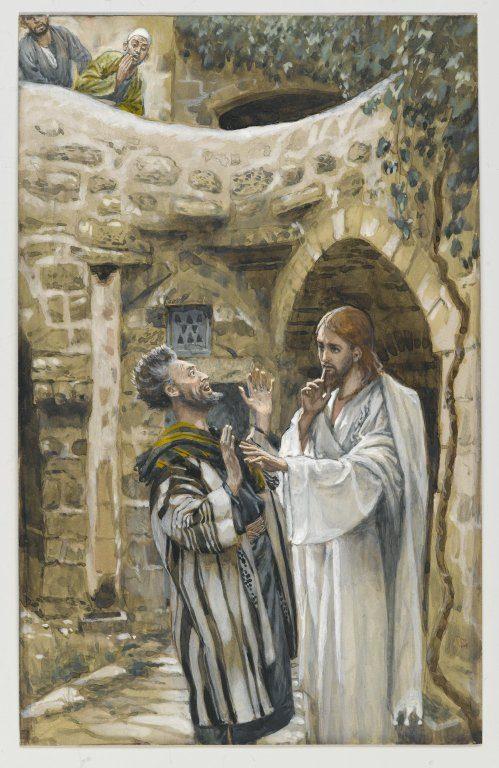
James Tissot, Jesus Heals a Mute Possessed Man, 1886 to 1894. Public domain.
Luke 11:14 to 26 · Subject · Featured Study
The Beelzebul Dispute and the Stronger Man
Luke 11:14 to 26 holds an accusation against Jesus, His answer, and a warning about a house swept and left empty.
The man Jesus healed had been mute, and Matthew adds that he was blind as well.
But if I drive out demons by the finger of God, then the kingdom of God has come upon you.
But if I drive out demons by the finger of God, then the kingdom of God has come upon you.
- Books
- Luke, Matthew, Mark
- Hold in memory
- Luke 11:23
Summary
Jesus drove a demon out of a mute man, and some in the crowd said He did it by Beelzebul. Jesus answered with a short argument and a picture of a strong man overpowered.
- Luke alone has the strong man fully armed and stripped of the armor he trusted.
- Bede and Theophylact read your sons in Luke 11:19 in two different ways.
- The finger of God is a phrase from the plagues of Egypt.
The Charge at Luke 11:15
The charge followed a healing, and others in the crowd demanded a sign from heaven (Luke 11:16).
One day Jesus was driving out a demon that was mute. And when the demon was gone, the man who had been mute spoke. The crowds were amazed, but some of them said, “It is by Beelzebul, the prince of the demons, that He drives out demons.”Luke puts the amazement of the crowds and the charge of the critics in one breath.
Matthew gives the same charge to the Pharisees (Matthew 12:24), and Mark gives it to scribes from Jerusalem (Mark 3:22).
Jamieson, Fausset and Brown observed that the bitterest enemies of Jesus could not deny that His miracles were real.
The Answer in Five Steps
Jesus answered the accusers knowing their thoughts (Luke 11:17).
Jesus moves from the folly of the charge to the coming of the kingdom and a call to choose.
- The point
- Satan would be at war with his own rule.
- The verse
- Luke 11:17 to 18
- The point
- The accusers' sons would be their judges.
- The verse
- Luke 11:19
- The point
- The power at work is God's, so His kingdom is present.
- The verse
- Luke 11:20
- The point
- The armed guard of the house has met his master.
- The verse
- Luke 11:21 to 22
- The point
- No hearer can stand between the two sides.
- The verse
- Luke 11:23
Jesus first shows that the charge cannot stand, then says what His power over demons means and calls for a choice.
The Strong Man and the Stronger
Jamieson, Fausset and Brown read the saying as a picture of Christ and Satan.
When a strong man, fully armed, guards his house, his possessions are secure. But when someone stronger attacks and overpowers him, he takes away the armor in which the man trusted, and then he divides up his plunder.Jamieson, Fausset and Brown took the strong man's house to be man, in each soul and in the race as a whole.
Matthew and Mark speak of tying up the strong man before his house is plundered (Matthew 12:29; Mark 3:27).
Theophylact explained the armor of the strong man.
“The Devil's arms are all kinds of sins, trusting in which he prevailed against men.”
Theophylact of Ohrid · Catena Aurea by Aquinas · on Luke 11:21 to 22Patristic
The Finger of God
Matthew records the Spirit of God where Luke records the finger.
“This is the finger of God,” the magicians said to Pharaoh. But Pharaoh’s heart was hardened, and he would not listen to them, just as the LORD had said.Bede read Luke 11:20 in the light of this confession by Pharaoh's magicians.
Augustine read the finger of God as the Holy Spirit, the wording of Matthew 12:28.
The Name Beelzebul
Wesley and Thomas Aquinas both tied the name to the god of Ekron.
Now Ahaziah had fallen through the lattice of his upper room in Samaria and injured himself. So he sent messengers and instructed them: “Go inquire of Baal-zebub, the god of Ekron, whether I will recover from this injury.” But the angel of the LORD said to Elijah the Tishbite, “Go up to meet the messengers of the king of Samaria and ask them, ‘Is it because there is no God in Israel that you are on your way to inquire of Baal-zebub, the god of Ekron?’Elijah's rebuke shows the name standing for a rival to the God of Israel.
John Wesley explained the meaning of the name.
“Beelzebub signifies the Lord of flies, a title which the heathens gave to Jupiter, whom they accounted the chief of their gods, and yet supposed him to be employed in driving away flies from their temple and sacrifices. The Philistines worshipped a deity under this name, as the God of Ekron: from hence the Jews took the name, and applied it to the chief of the devils.”
John Wesley · Explanatory Notes upon the New Testament · on Luke 11:15Evangelical
The Greek Words of the Dispute
Four Greek words carry the passage: the name, the dividing, the strong man and his plunder.
Βεελζεβούλ Beelzeboul, Beelzebul
7 uses in the canon
The name the accusers gave the prince of demons; Strong's glosses it dung-god.
διαμερίζω diamerizō, to divide
11 uses in the canon
To split apart, used of the kingdom and of Satan divided against themselves.
ἰσχυρός ischuros, strong
29 uses in the canon
Strong or mighty, said of the armed man and, in its comparative form, of the stronger one.
σκῦλον skulon, plunder
1 use in the canon
Spoil stripped from a beaten enemy, divided by the stronger man.
The House Swept and Left Empty
Jesus ended the dispute with a warning about a spirit that returns.
When an unclean spirit comes out of a man, it passes through arid places seeking rest and does not find it. Then it says, ‘I will return to the house I left.’ On its return, it finds the house swept clean and put in order. Then it goes and brings seven other spirits more wicked than itself, and they go in and dwell there. And the final plight of that man is worse than the first.”Cyril of Alexandria read the warning as aimed at the people who had sunk to such thoughts of Christ.
Matthew Henry (1662 to 1714)
Matthew Henry applied the picture to the heart.
“The house is swept, but it is not washed; and Christ hath said, If I wash thee not, thou hast no part with me; the house must be washed, or it is none of his. Sweeping takes off only the loose dirt, while the sin that besets the sinner, the beloved sin, is untouched.”
Matthew Henry · Commentary on the Whole Bible · on Luke 11:24 to 26Puritan
Who Are Your Sons in Luke 11:19?
Two teachers named the sons of Luke 11:19 differently.
The exorcists of IsraelBede, on Luke 11:19, in Thomas Aquinas, Catena Aurea
Bede took your sons to be the exorcists of Israel, who drove out demons by calling on God. If their work was ascribed to God, he reasoned, the same work in Jesus had the same cause.
The objection: Jesus had already given the Twelve authority over all demons (Luke 9:1), so the sons may be His own followers.
The apostlesTheophylact of Ohrid, Commentary on Luke (1107), on Luke 11:19
Theophylact read your sons as the apostles and asked by whose power they cast demons out, if not by the name of Jesus.
The objection: Acts 19:13 shows Jewish exorcists at work in the years after, so the accusers had exorcists of their own.
Hearing and Keeping the Word
A woman in the crowd blessed His mother, and Jesus answered her.
Jesus called those who hear the word of God and obey it blessed (Luke 11:28).
Sources
Scripture is the Berean Standard Bible.
- Strong's lexicon entries g954, g1266, g2478 and g4661, with their counts of uses.
- Jamieson, Fausset and Brown, Commentary Critical and Explanatory on the Whole Bible (1871), on Matthew 12:24 and Luke 11:21 to 22.
- John Wesley, Explanatory Notes upon the New Testament (1755), on Luke 11:15.
- Theophylact of Ohrid, Commentary on Luke (1107), on Luke 11:19, and on Luke 11:21 to 22 in Thomas Aquinas, Catena Aurea.
- Bede, On the Gospel of Luke (735), on Luke 11:20, and on Luke 11:19 in Thomas Aquinas, Catena Aurea.
- Augustine of Hippo, Questions on the Gospels 2.17, in Thomas Aquinas, Catena Aurea, on Luke 11:20.
- Cyril of Alexandria, on Luke 11:24 to 26, in Thomas Aquinas, Catena Aurea.
- Thomas Aquinas, Commentary on Matthew, on Matthew 12:24.
- Matthew Henry, Commentary on the Whole Bible (1710), on Luke 11:24 to 26.
Keep Studying
Read it4
Studies1
People and groups2
Subjects1
Go further8