MANNAFEST

The Twelve · Haggai

Consider Your Ways

Four oracles, one governor's obedience, and a signet restored — all inside three months and twenty-three days. A discouraged, self-focused remnant has finished paneling its own houses while the LORD's house sits a ruin; Haggai reframes an unimpressive rebuilding project as the very house where the God-given King will personally walk, and closes by re-lighting the Davidic promise, snuffed out in Jeconiah, in the person of a small-time governor named Zerubbabel.

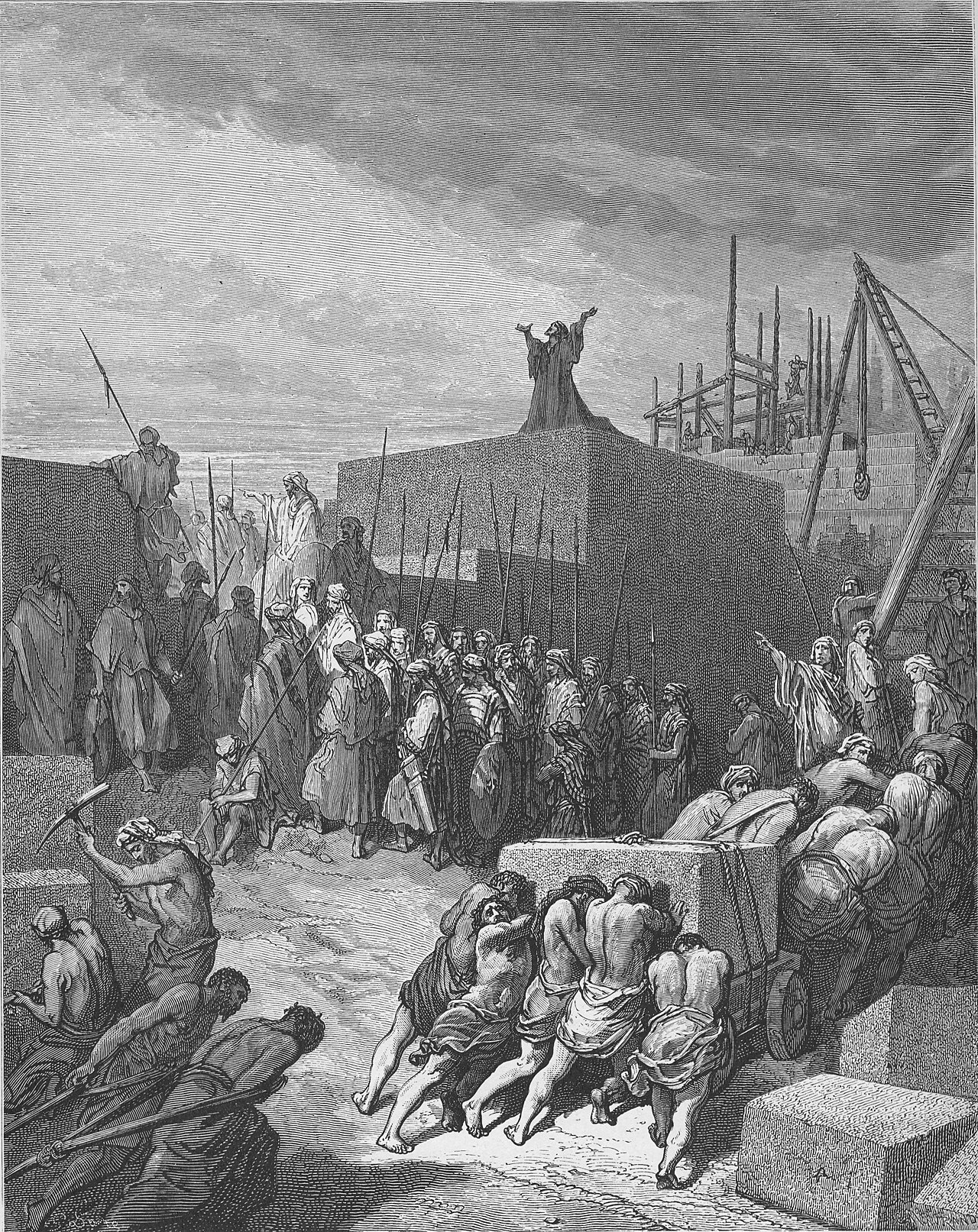
The Rebuilding of the Temple Is Begun — Gustave Doré
The stalled house restarted — consider your ways, and build — Gustave Doré, Doré’s English Bible (1866), public domain · Haggai 1:7-8

The Dated Clock

four dated oracles — every one opens with a precise regnal-year/month/day formula

Haggai reads closer to a court chronicle than to a prophet's first-person oracle-voice — reported about, dated to the day, verifiable against a documented Persian administration. The whole sequence — rebuke to signet promise — runs from the 6th month's 1st day to the 9th month's 24th day: three months and twenty-three days, about 111 days end to end. And Haggai is not working alone — Zechariah's first oracle is dated two months after Haggai's first (Zech 1:1), and Zechariah's visions go on to pair Zerubbabel and Joshua as “the two anointed ones” (Zech 4).

1
The Rebuke1:1–116th month, day 1
The Response1:12–156th month, day 24
2
The Encouragement2:1–97th month, day 21
3·4

“Consider your ways” — the covenant-curse futility (drought, wages in a bag with holes) traced to the ruined house.

Zerubbabel, Joshua, and the remnant obey; the LORD stirs their spirit; work resumes — 23 days after the rebuke.

Don't measure by the eye — the latter house's glory will outstrip the former, and the nations themselves are being shaken toward it.

Uncleanness is contagious, holiness is not — the people's work was unclean because their hearts were misplaced. “From this day will I bless you.”

The kingdoms of men are overturned, and Zerubbabel — David's line, once cursed in his grandfather Jeconiah — is named God's chosen signet.

The dates are the text's own — every oracle carries its regnal year, month, and day; only the pixel spacing between them is approximate, since the Hebrew months alternate between twenty-nine and thirty days. Note the inclusio: “consider your ways” (1:5, 7) is deliberately recalled at 2:15, 18 — the same imperative, first applied to the past, then to the future.

The Argument

the whole book in three sentences
Attribution
Haggai the prophet — no genealogy given, called only “the LORD's messenger” (1:13)
Span
2nd year of Darius I, 520 BC — three months and twenty-three days
Genre
Prophetic oracle collection, third-person narrative frame
Shape
2 chapters · 4 dated oracles · 1 refrain
Haggai 1:6

“Ye have sown much, and bring in little; ye eat, but ye have not enough; ye drink, but ye are not filled with drink; ye clothe you, but there is none warm; and he that earneth wages earneth wages to put it into a bag with holes.”

  1. 1

    Reorder your priorities — the LORD's house first, not last: the futility curse the remnant is living under traces directly to the ruined temple they have deprioritized while paneling their own houses.

  2. 2

    Don't despise this house's modest beginnings — its latter glory will outstrip the first, because the LORD is shaking the nations toward it and will fill it with his own presence.

  3. 3

    The Davidic collapse pronounced over Jeconiah is reopened in his own grandson: a small-time Persian-appointed governor named Zerubbabel becomes God's chosen signet, the first re-affirmation of the promise after the crisis.

Christ in Haggai

two rails, both load-bearing for the temple-theology chain and the messianic thread
The glory of the latter house2:6–9 → Heb 12:26–27; Luke 2:22–38; John 2:14–17

The Second Temple Haggai promises to fill with glory never outshone Solomon's in gold, cedar, or scale (Ezra 3:12 records the older generation weeping at the comparison). Its greater glory is that the incarnate LORD himself walked its courts: presented there as an infant, teaching there as a boy and a man, cleansing it twice. Hebrews 12:26–27 quotes Haggai's “shaking” directly, reading it as pointing past itself to the unshakeable kingdom Christ inaugurates.

Matthew Henry puts the whole weight on presence rather than splendor: the second house's advantage over Solomon's was never architectural — it was that the Messiah, the Son of God, stood inside it.

Paraphrased — Matthew Henry, Commentary on the Whole Bible, on Hag 2:9
The signet reversed2:23 → Jer 22:24; Matt 1:12–13; Luke 3:27

Jeremiah 22:24 pronounced Jeconiah plucked off though he “were the signet upon my right hand” — the Davidic line under judicial curse. Haggai 2:23 uses the identical word for Jeconiah's own grandson, Zerubbabel: “In that day… will I take thee, O Zerubbabel, my servant… and will make thee as a signet.” Zerubbabel himself never becomes king; the promise reads as a down payment, re-opening rather than completing the Davidic line — a line both Matthew's and Luke's genealogies carry forward toward Christ.

“But this promise has special reference to Christ, who lineally descended from Zerubbabel, and is the sole builder of the gospel-temple. Zerubbabel is here owned as God's servant, and it is an honourable mention that is hereby made of him, as Moses and David my servants.”

Matthew Henry, Commentary on the Whole Bible (1710), on Haggai 2:23

The promise outlives its own generation: two generations later, Malachi's audience is still standing in this same house, still waiting for this glory — and the cynicism that produces is the wound the last book of the Old Testament is written to answer.

The Outside Record

Ezra 5–6 narrates Haggai's own four months from the outside — as a Persian administrative file

Haggai's oracles sit at the exact center of a documented administrative sequence. Ezra 5–6 tells the same months as paperwork: a prophetic catalyst, a provincial investigation, an imperial archive search, and a royal decree that funds the finish.

  1. Ezra 5:1–2

    Haggai and Zechariah are named directly as the catalyst — “then rose up Zerubbabel… and Jeshua… and began to build.” The prophetic word has a datable administrative effect.

  2. Ezra 5:3–17

    Tattenai, the Persian governor “beyond the River,” opens a formal investigation into whether the project is legal, and files a report to Darius.

  3. Ezra 6:1–5

    Darius orders a search of the royal archives; Cyrus's original decree is found — at Ecbatana, not Babylon.

  4. Ezra 6:6–12

    Darius issues a confirming decree: leave the builders alone, and fund the work out of royal revenue.

  5. Ezra 6:15

    The house is finished in Darius's sixth year — 516 BC, roughly seventy years after the first temple's destruction in 586 BC.

That 516 BC completion date is what makes the Christ-reading of 2:9 something other than a pious leap. The house finished under Darius is the same physical institution — repaired, and later massively expanded by Herod the Great — that stood until its destruction in AD 70. One continuous Second Temple: so when Christ is presented in “Herod's temple,” teaches in it, and cleanses it, he is standing in the very house Haggai was talking about, not a different building that inherited the name.

The Behistun Inscription

Darius I is among the best-attested Persian kings outside the Bible, principally through the trilingual Behistun Inscription, which records his rise to power after the succession crisis following Cambyses II's death and the pretender Gaumata's brief usurpation. A returned-exile community hearing “I will shake all nations” (2:6–7, 21–22) in 520 BC was living through real imperial instability — offered here as background resonance a reader may find suggestive, not as an established exegetical link between the two.

The “Yehud” jar handles

Persian-period Judah — called Yehud in Aramaic administrative usage — is attested archaeologically by “Yehud” stamp impressions on storage-jar handles, corroborating a functioning provincial administration of exactly the kind Zerubbabel's title “governor of Judah” (1:1) implies. This is the general scholarly picture of the setting, not evidence for any specific event Haggai narrates.

Themes

six load-bearing lines through a two-chapter book
01

Misplaced priorities and the futility curse

Hag 1:4–11

Deuteronomic covenant-curse language (cf. Lev 26; Deut 28) applied in real time: sown much, brought in little. The diagnosis is not poverty but sequence — self first, God's house last.

02

“Consider your ways”

Hag 1:5, 7; 2:15, 18

The book's keynote refrain; the Hebrew idiom behind the ASV's wording reads “set your heart upon your ways” — the examined life applied to worship-priority, first to the past (why the harvest failed) and then to the future (what changes now).

03

The house and the glory

Hag 1:13; 2:4, 7

The temple is never a building project for its own sake — it is the place where the LORD promises to fill it with glory and to be present: “I am with you.”

04

Shaking the nations, filling the house

Hag 2:6–9

A coming cosmic upheaval results not in destruction but in contribution — “the silver is mine, and the gold is mine” — and in the arrival of what the KJV calls “the desire of all nations,” where the ASV reads “the precious things of all nations” (the book's most contested phrase — see below).

05

Contagious defilement, non-contagious holiness

Hag 2:10–19

The priests rule that holy flesh does not sanctify what it touches, but corpse-defilement does defile — applied as a diagnosis: the people's work was unclean because they were unclean in priority, not because the project was wrong.

06

The reversal of the Davidic collapse

Hag 2:20–23

A Persian-appointed provincial governor, not a king, is named “my servant,” “chosen,” and “a signet” — directly answering Jeconiah's rejection in Jer 22:24.

The Approved Voices on Haggai

the roster applied — the specific work named, so you can go to it
Matthew Henrypublic domain

Commentary on the Whole Bible, on Haggai 1–2 (CCEL)

The strongest public-domain source recovered for this book; reads “consider your ways” as serious introspection and takes both the KJV's “the desire of all nations” (2:7) and the signet promise (2:23) messianically — paraphrased and cited above, pending a verbatim reconfirmation pass.

Jamieson-Fausset-Brownpublic domain

Commentary Critical and Explanatory on the Whole Bible, on Haggai

A full verse-by-verse companion engaging the same 2:7 grammatical crux; paraphrase-and-cite only for now, pending a source reconfirmation.

Keil & Delitzschpublic domain

Commentary on the Old Testament, on Haggai

The standard technical Hebrew-grammar reference for the plural-verb/singular-noun crux at 2:7.

Calvinpublic domain

Commentaries on the Twelve Minor Prophets, on Haggai

Close covenantal exposition of the four oracles; public domain and quotable in full.

Wesleypublic domain

Explanatory Notes, on Haggai

Brief marginal-note-style commentary — the shortest way into the book's argument verse by verse.

Haggai is a narrow, under-covered book in most modern teaching catalogs relative to its size. The roster's modern voices align doctrinally with its themes, but no Haggai-specific work has yet been confirmed for any of them, so none is named here — this page cites only the public-domain companions above until a targeted sourcing pass supplies a Haggai-titled sermon, chapter, or series. Marcus Brown's own commentary leads above all; within a tier, all voices are equal.

Contested Points

presented at full strength, then MannaFest's flag

KJV “The desire of all nations shall come” vs. ASV “the precious things of all nations shall come” (2:7) — a messianic Person, or the nations' treasure?

Messianic-Person reading (older/traditional)

Reading with the KJV, Christ himself is “the desire of all nations” — long expected, universally desirable. Matthew Henry takes it straightforwardly of Christ: the one whom the nations, without knowing it, most want; the one in whom every family of the earth is blessed; the one God's people awaited wherever they were scattered (Commentary on the Whole Bible, on Hag 2:7).

Treasures-of-the-nations reading (the modern grammatical consensus)

The verb “shall come” is grammatically plural, which does not agree with the grammatically singular chemdâh if it names one Person; 2:8's “the silver is mine, and the gold is mine” reads more naturally as the nations' wealth flowing in to adorn the house.

MannaFest flag — The grammar genuinely favors the “treasures” reading; the KJV's “he shall come” tradition is a real, long-held reading with public-domain commentary behind it, not a fringe view. MannaFest presents both columns and lets 2:9's Christ-fulfillment carry the weight rather than resting everything on 2:7's disputed grammar.

Does the “latter glory” fulfillment terminate on Christ's first-century presence, or await a still-future temple?

Fulfilled in Christ's incarnate presence (this page's default)

The latter house's glory is realized when the LORD in the flesh enters it — a completed fulfillment, with Hebrews 12:26–27 confirming the shaking-language points to the unshakeable kingdom Christ brings.

Future-millennial-temple reading

A dispensational reading may extend “glory” language forward to a still-future literal temple whose glory exceeds even the incarnation-era Second Temple — the same fork the site has already worked out on Ezekiel's temple.

MannaFest flag — MannaFest does not adjudicate here; the two readings can be held together — a completed near fulfillment and a still-future consummation are not mutually exclusive. Whether Haggai 2:9 is folded into the Ezekiel fork or treated as self-contained and already fulfilled is the founder's editorial call, held open here.

The Zerubbabel/Jeconiah signet reversal — messianic re-opening, or a modest personal restoration only?

Messianic-line reading (this page's default)

The deliberate chôthām/chôthām word-pair across Jer 22:24 and Hag 2:23 signals a real theological reversal — the Davidic line's judicial curse answered in kind, in the same generation as the grandson, carried forward through both NT genealogies toward Christ.

Modest-restoration reading

Zerubbabel's promise never plays out as regained kingship in his own lifetime — he disappears from the biblical record without a throne, and the cosmic “overthrow” of 2:21–22 manifestly did not happen historically in 520 BC. On this reading the oracle is a personal covenant-favor restoration, whose messianic weight is supplied only in retrospect by the NT genealogies.

MannaFest flag — Both readings can be held together without contradiction — near-term personal restoration and long-range messianic re-opening — while stating honestly that no kingship returned to Zerubbabel in his own lifetime.

The Cast

one linked page, and the fuller cast the story needs

Also in the story, awaiting their own pages: Haggai the prophet (no genealogy given, unlike most of the Twelve — called only “the LORD's messenger,” 1:13) · Joshua (Jeshua) the son of Josedech, the high priest — Zerubbabel's constant co-leader · Darius I (Hystaspes), Persian king — every oracle is dated to his 2nd regnal year, 520 BC · Tattenai, the Persian governor “beyond the River” who investigates the resumed building (Ezra 5).

Places

Read Haggai

two chapters, four oracles

Open the Haggai reader — both chapters →

Keep studying

— more from The Prophets

Drafted from MannaFest's research brief on Haggai — Matthew Henry cited by specific work, paraphrased, with a ledger-confirmed verbatim excerpt; JFB, Keil & Delitzsch, Calvin, and Wesley named as the public-domain companions for this book, paraphrase-and-cite pending a verbatim sourcing pass. Scripture ASV. Every cited work — the sources registry →