MANNAFEST

Historical Books · Esther

Providence Wearing a Disguise

In the one book of Scripture where God’s name never appears, His hand is everywhere. A Jewish orphan becomes queen of the greatest empire on earth “for such a time as this” (4:14); a genocidal decree against her people is reversed through her risk and a cascading series of “coincidences” — until the hunters become the hunted. Esther is the Bible’s clearest demonstration that coincidence is providence wearing a disguise.

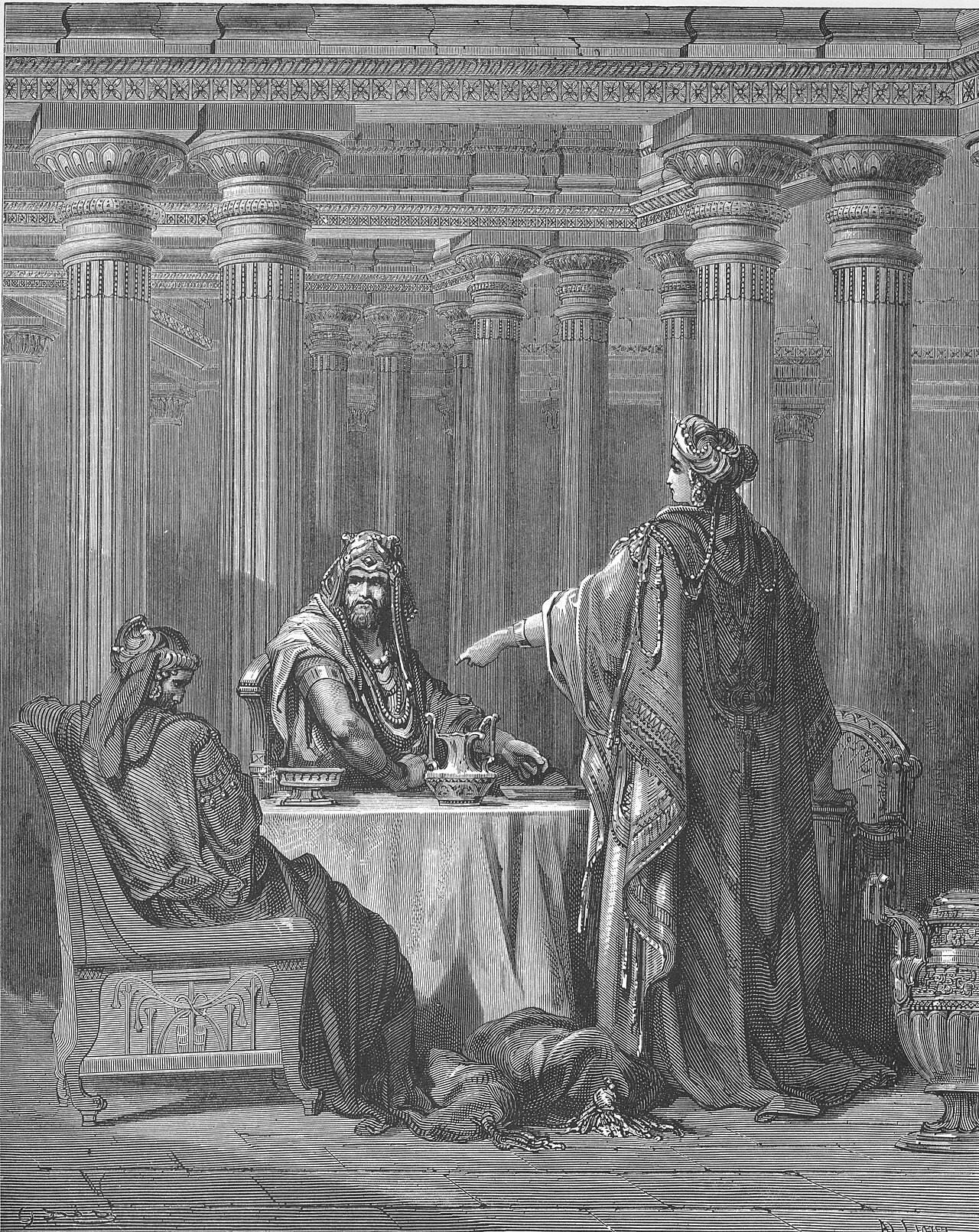
Esther Before the King — Gustave Doré
Esther before the king — the unsummoned approach, capital by law, risked for her people — Gustave Doré, Doré’s English Bible (1866), public domain · Est 5:1–2

The Reversal

ten chapters, one hinge — everything set up in the first half is turned to the contrary in the second

Esther is built as a symmetrical inversion. What Haman sets in motion in the first half of the book is undone in the second — and the single “coincidence” that pivots the whole narrative is a king’s sleepless night in chapter 6.

The Court and the VacancyThe ThreatThe TurnThe HingeThe DeliverancePurim and the Epilogue
  1. The Court and the VacancyEsther 1:1–2:20

    Vashti refuses the king's summons and is deposed; a Jewish orphan, Hadassah — Esther — is crowned queen in her place, her people concealed on Mordecai's instruction (2:10, 2:20).

  2. The ThreatEsther 2:21–3:15

    Mordecai uncovers a plot against the king's life — recorded, and left unrewarded (2:21–23). Haman rises to the king's right hand, is enraged when Mordecai will not bow, and casts the pur to fix a day for the extermination of every Jew in the empire.

  3. The TurnEsther 4:1–5:14

    Mordecai's charge — “for such a time as this” (4:14); Esther's three-day fast and her resolve, “if I perish, I perish” (4:16); her first banquet invitation to the king and Haman; Haman's gallows, built that same night for Mordecai.

  4. The HingeEsther 6:1–14

    The king cannot sleep. The court chronicles are read. Mordecai's unrewarded deed surfaces at the exact hour Haman arrives to ask for his enemy's death — the single “coincidence” that turns the whole book.

  5. The DeliveranceEsther 7:1–9:19

    Esther's accusation at the second banquet; Haman hanged on the gallows he built for Mordecai (7:10); the irrevocable counter-decree (8); the Jews' authorized self-defense and victory, empire-wide (9:1–19).

  6. Purim and the EpilogueEsther 9:20–10:3

    Mordecai and Esther write to institute Purim as a perpetual memorial (9:20–32); the book closes with Mordecai's greatness, “next unto king Ahasuerus” (10:3). Purim's institution actually falls inside chapter 9 — chapter 10 itself is only the three-verse epilogue.

The ledger — five reversals, one hinge

Rabbinic tradition names this whole pattern venahafokh hu— “it was turned to the contrary” (9:1) — and reads it not as plot device but as theological claim: the wicked’s own weapon becomes the instrument of their downfall.

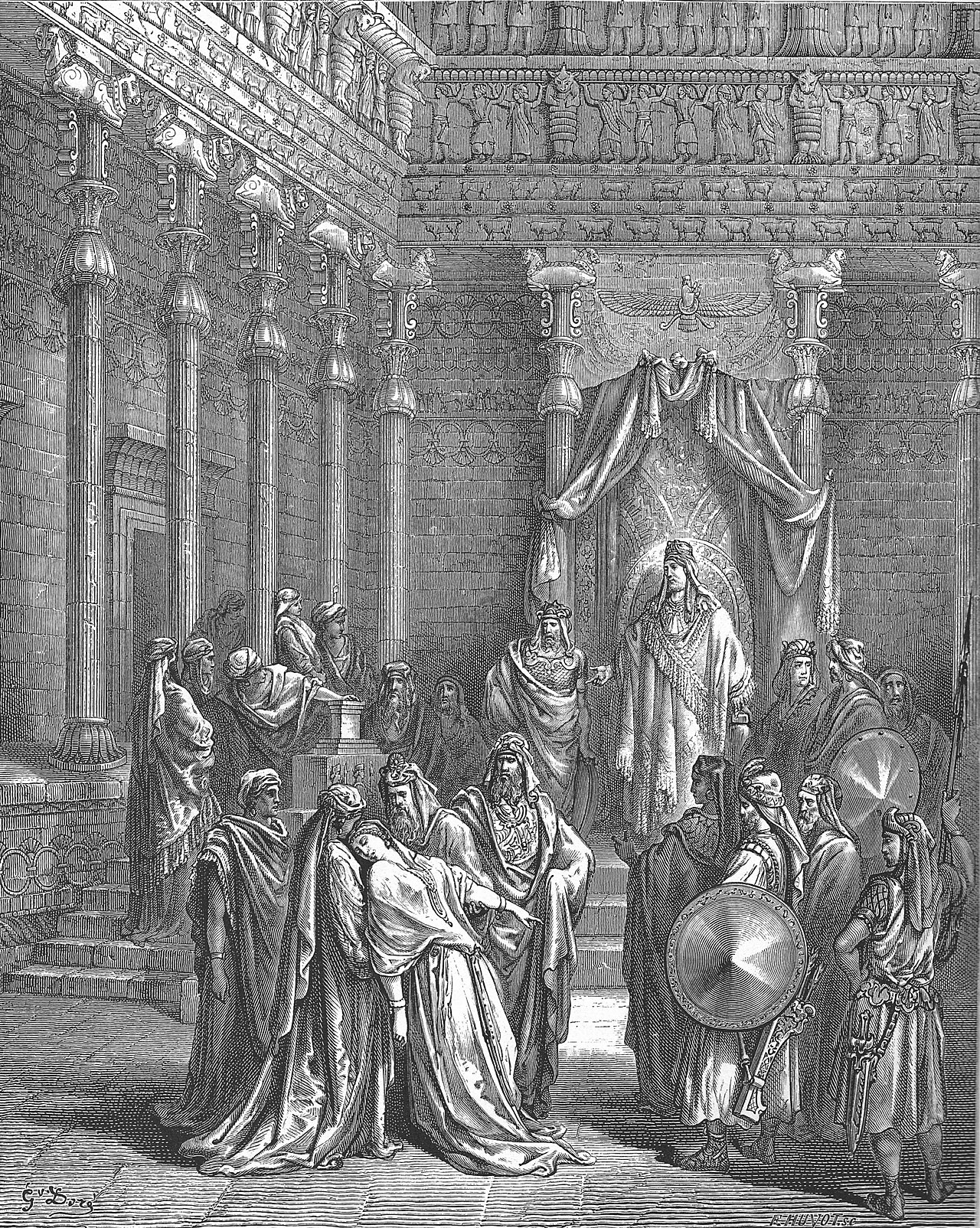
Esther Accuses Haman — Gustave Doré
Esther accuses Haman — the second banquet, and the deliverance's turning word — Gustave Doré, Doré’s English Bible (1866), public domain · Est 7:6
“How vain are all the contrivances of foolish man against the wise and omnipotent God, who hath the hearts and hands of kings and all men perfectly at his disposal, and can by such trivial accidents (as they are accounted) change their minds, and produce such terrible effects.”

John Wesley, Explanatory Notes upon the Bible(1765), on Esther 6:1 — public domain.

The Argument

the whole book in three sentences
Author
Anonymous — Jewish tradition credits the Men of the Great Synagogue
Date of events
Reign of Ahasuerus / Xerxes I, c. 483–473 BC
Genre
Historical narrative — a court deliverance tale
Shape
10 chapters · 1 hinge (ch. 6) · 1 feast instituted
  1. 1

    A Jewish orphan girl, raised by her cousin Mordecai, becomes queen of the greatest empire on earth, her identity concealed, at the very moment history will require a Jew inside the Persian court.

  2. 2

    Haman, enraged that Mordecai will not bow to him, secures a decree of annihilation against every Jew in the empire — an attempt to sever the covenant people, and with them the messianic line, root and branch.

  3. 3

    Through Esther's risk-taking intercession and a cascade of load-bearing “coincidences” hinged on a king's sleepless night, the decree is reversed, Haman is hanged on his own gallows, and Purim is instituted as the annual memorial of a deliverance God's name is never once used to explain.

Christ in Esther

no direct prophecy or type-name — the absence is itself instructive
Preservation of the seedEst 3:13 → Gen 3:15; 2 Sam 7; Matt 1

Had Haman's decree succeeded, the Jewish people — and with them the line through which Messiah would come — would have been annihilated roughly 450 years before Bethlehem. Esther is a hinge episode in the unbroken thread of Gen 3:15's protection; the book's deliverance is a precondition for the Incarnation as a matter of historical fact.

A mediator who risks her lifeEst 4:11, 16; 7:3–4 → Heb 2:14–17; Phil 2:6–8

Esther conceals, then reveals, her identity with a condemned people and stakes her own standing at mortal risk to secure their reprieve — imperfect and non-atoning, but a recognizable shadow of the pattern completed in Christ, who counted not equality with God a thing to be grasped and took on flesh and blood to redeem those under sentence.

Hidden reign, sovereign handEst 6:1 → Isa 53:2–3; Luke 24:16

The book's central technique — God unnamed but everywhere active — anticipates the “hidden Messiah” motif of the incarnation itself: “no beauty that we should desire him”; the Emmaus road, where “their eyes were holden.” God's greatest deliverances often come wrapped in ordinary, even secular-seeming, providence.

Esther is never directly quoted in the New Testament — one of a small number of OT books with no NT citation. The book's canonicity was among the more disputed in both Jewish and Christian tradition precisely because of the absence of God's name.

The Providence Hidden study →

Themes

six load-bearing lines through the book
01

Hidden providence, not absent God

Esther 2:21–23; 6:1; 6:4–5

God is never named, yet every “coincidence” is load-bearing — the king's sleepless night, the timing of Haman's arrival, Mordecai's unrewarded loyalty held in reserve for precisely this moment. The narrative shows sovereignty by refusing to say it.

02

“For such a time as this”

Esther 4:14

Mordecai's charge asserts, without naming God, that Esther's position is providentially assigned — and pairs it with confidence that deliverance would come even without her. Sovereignty and human responsibility, held together without resolving into either.

03

The seed under assault

Esther 3:13; cf. Ex 1; 2 Ki 11; Matt 2

Haman's decree aims at every Jew, young and old, in one day — an attempt to sever the covenant line itself. The pattern recurs across redemptive history: Pharaoh's infanticide, Athaliah's purge, Herod's slaughter — each thwarted by providence.

04

Risk and intercession

Esther 4:11, 16

Esther's approach to the king unsummoned — capital by law — and her “if I perish, I perish” models costly intercessory courage, situated in the corporate humility of a three-day fast that, like everything else in the book, is never explicitly directed to God.

05

Reversal — venahafokh hu

Esther 9:1

“It was turned to the contrary.” Every element of Haman's plot inverts onto himself — his gallows, his day, his house, his honor. Not mere plot device but theological claim: the wicked's own weapon becomes the instrument of their downfall.

06

The humbled proud, the exalted humble

Esther chs. 1–2 and 6–8

Mordecai the overlooked gatekeeper rises; Haman the exalted vizier falls — the pattern enacted twice, first in Vashti and Esther, then in Haman and Mordecai. A Luke 1:52 pattern, centuries before Luke.

The Approved Voices on Esther

the roster applied — the specific work named where one is confirmed
R. C. Sproulcite-only ≤50w

Chosen by God (1986)

“If there is one single molecule in this universe running around loose, totally free of God's sovereignty, then we have no guarantee that a single promise of God will ever be fulfilled” — the roster's load-bearing articulation of sovereignty, directly applicable to Esther's hidden-providence theme.

Chuck Misslercite-only ≤50w

no confirmed Esther-specific title for this pass (khouse.org series unverified)

Marcus Brown's formative teacher. His integrated-design and typological-hidden-sovereignty lens is the natural fit for Esther's “coincidence is providence” theme; carried here as thematic emphasis, not as an asserted title.

Matthew Henrypublic domain

An Exposition of the Old and New Testament, on Esther

Characteristically devotional-practical: providence at work in “common” events, God working behind the curtain of a book that never names Him. Exact wording not yet pulled for this pass.

Jamieson, Fausset & Brownpublic domain

A Commentary, Critical and Explanatory, on the Whole Bible, on Esther

Robert Jamieson covered Genesis through Esther in the OT — a direct, confirmed, full-text-available source; the first stop for the verse-by-verse workbench pass on this book.

Keil & Delitzschpublic domain

Commentary on the Old Testament (Esther volume — exact edition ⚠verify)

The standard conservative German-critical treatment, strong on Persian-court historical background; specific volume/page not independently confirmed in this pass.

Charles Spurgeonpublic domain

no confirmed sermon specific to Esther for this pass

Preached comparatively rarely and briefly on Esther directly relative to his volume on other OT books. Where a specific MTP sermon is confirmed, it may be quoted in full per PD status.

A real gap, honestly named: this pass confirmed relatively few direct roster-voice quotes specific to Esther. Sproul's sovereignty quote is confirmed; Missler's thematic fit is confirmed but his exact Esther series title is not; Henry, JFB, and K&D are confirmed to cover the book but their exact wording is not yet pulled. Marcus Brown's own commentary leads above all; within a tier, all voices are equal.

Contested Points

presented at full strength, then MannaFest's flag

The absence of God's name

Deliberate theology of hidden providence

The author writes with extreme narrative control elsewhere — dates, officials, court customs precisely named. The omission of God's name across ten chapters cannot be accidental; it enacts Deut 31:17–18 (“I will hide my face”) and models providence for readers, like the book's diaspora audience, in a world without visible miracle or prophetic voice.

The minority / critical concern

The silence may reflect a genuinely more secular or nationalistic work; the book's canonicity was contested partly for this reason — it is absent from the Dead Sea Scrolls fragments found so far, and Luther himself expressed reservations about it.

MannaFest flag — The hidden-Name reading is theological, not accidental — the book is Scripture precisely because its restraint teaches a truth explicit theophany books cannot: God is sovereign even, especially, when He is not named, seen, or invoked.

Historicity, and the Greek Additions to Esther

For historicity

The book's precision about Persian court customs — the 127 provinces, the postal system, the irrevocability of Persian law — matches independently-attested Achaemenid administrative practice, and Xerxes' reign chronology fits Herodotus's independently-dated account with unusual precision for a “mere story.” ⚠verify: no extra-biblical source names Esther or Mordecai directly; the case is circumstantial-but-strong, not a named external attestation.

The skeptical reading

The absence of named extra-biblical attestation, the large casualty figures (9:16), and the story's tight narrative symmetry lead some critical scholars to read Esther as historical fiction rather than strict chronicle.

MannaFest flag — Historically grounded narrative in the Hebrew canon only. The Greek Additions to Esther — six passages in the LXX/Vulgate adding explicit prayers and God-language, absent from the Hebrew text — are a labeled Apocrypha study resource illustrating early reception history, never presented as Scripture on this site.

The violence of chapter 9

Licensed self-defense

The Jews' military action is defensive combat against those already legally licensed to attack them, since Persian law could not be revoked, only countered (8:8). The text is explicit that the Jews took no plunder (9:10, 15, 16) — evidence read as marking the action defensive and judicial, not conquest.

The harder critical reading

The scale — roughly 75,000 killed empire-wide (9:16), plus Haman's ten sons hanged post-mortem (9:13–14) — reads as troubling by modern sensibility, and the text records no reluctance or mourning accompanying it, unlike other OT war narratives.

MannaFest flag — The covenant-preservation / self-defense reading is textually best-supported — licensed self-defense against a dated genocidal decree, not conquest — while Esther's own request to extend the fighting a second day and hang Haman's sons' bodies (9:13) is the harder edge of the text, named rather than softened away.

The Cast

six people and the city where it all happens
Esther / HadassahOrphaned Jewish girl, cousin and ward of Mordecai, made queen of Persia; per rabbinic tradition, one of the book's co-authors (9:29).MordecaiEsther's guardian, a Benjamite of the line of Kish (2:5); a court gatekeeper who rises to become second only to the king (10:3).
Haman the AgagiteThe villain (3:1). His epithet links him, by rabbinic and much conservative-Christian tradition, to Agag, king of the Amalekites — ⚠verify, traditional but not textually certain.
Ahasuerus (Xerxes I)King of Persia, ruling India to Ethiopia over 127 provinces (1:1); vacillating and pleasure-loving, manipulated first by Haman, then by Esther.
VashtiThe deposed queen (ch. 1), whose removal creates the vacancy Esther fills — a minor but structurally essential figure.
ZereshHaman's wife, whose counsel to build the gallows (5:14) becomes the instrument of his own death, and who prophesies his fall (6:13).

The place

Drafted from MannaFest's research brief on Esther — public-domain commentators (Henry, JFB, Keil & Delitzsch) paraphrased, with ledger-confirmed verbatim excerpts, and cited by specific work, moderns cite-only per the founder's approved-voices roster. Scripture ASV. Every cited work — the sources registry →