
2 Samuel 2:16
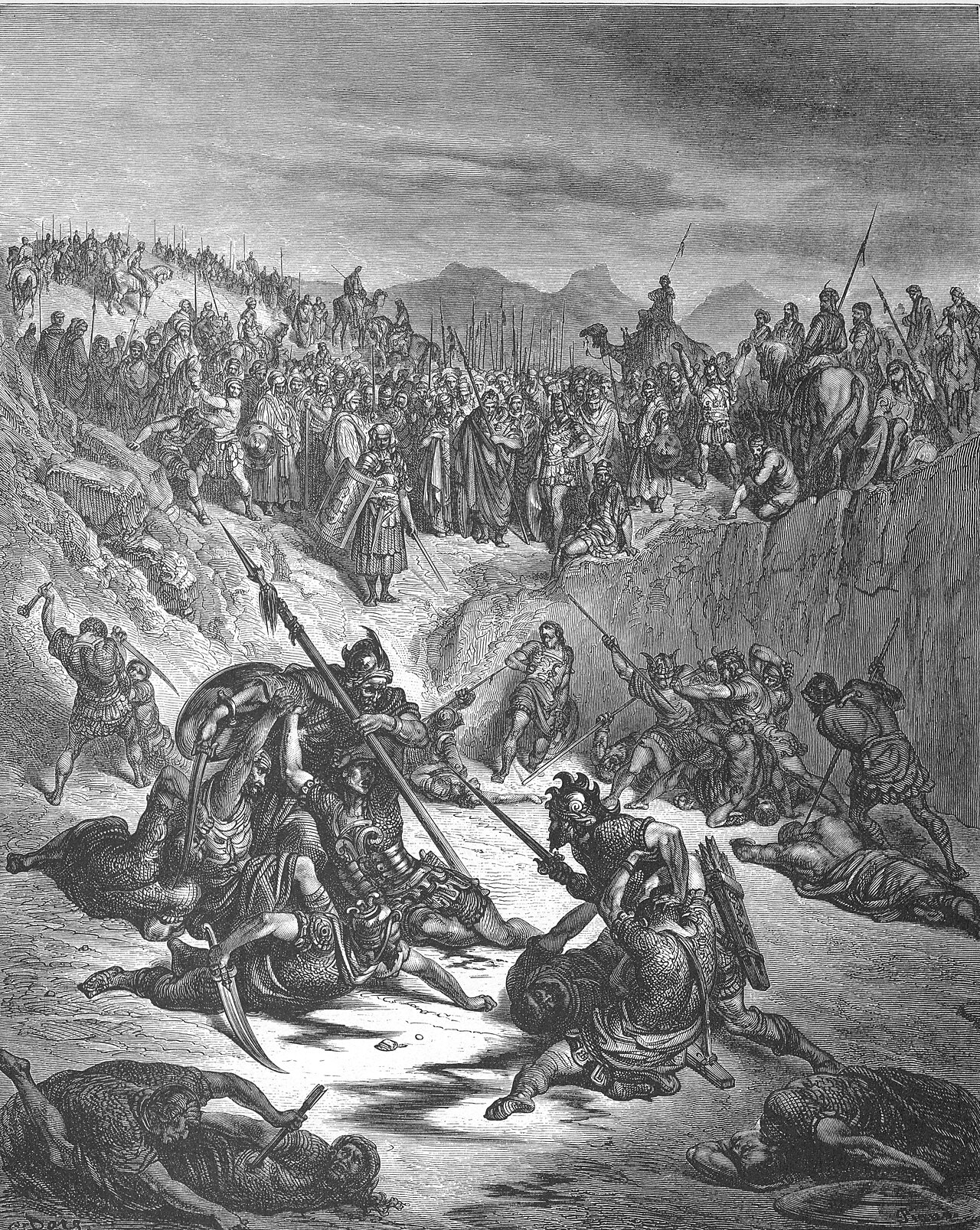
in 2 Samuel 2Then each man grabbed his opponent by the head and thrust his sword into his opponent’s side, and they all fell together. So this place, which is in Gibeon, is called Helkath-hazzurim.
BSB
The same verse in ASV and KJV ▾
ASV
And they caught every one his fellow by the head, and thrust his sword in his fellow’s side; so they fell down together: wherefore that place was called Helkath-hazzurim, which is in Gibeon.
KJV
And they caught every one his fellow by the head, and thrust his sword in his fellow’s side; so they fell down together: wherefore that place was called Helkath–hazzurim, which is in Gibeon.
⋯
This verse in 2 Samuel 2
Commentary
7 notes on this verseCaught every one his fellow by the head - Probably by the beard, if these persons were not too young to have one, or by the hair of the head. Alexander ordered all the Macedonians to shave their beards; and being asked by Parmenio why they should do so, answered, “Dost thou not know that in battle there is no better hold than the beard?” Helkath-hazzurim - “The portion of the mighty;” or, “The inheritance of those who were slain,” according to the Targum.
This site's exposition
Let the young men now arise, and play before us
on 2 Samuel 2:14-16
Abner proposes that the young men arise and play before them, and Joab agrees, but the game is twelve against twelve with swords, and every pair falls together, each man's blade in his fellow's side. The place is named Helkath-hazzurim from what happened there, a field remembered by its dead rather than by any victor. What began as a contest between champions ends as mutual slaughter with no survivor on either side of the pairs.
The record, by era
The Puritans and the Awakening3 voices
By the head - By the hair of the head, which after their manner was of a considerable length. Helkath-kazzurim - Or, the field of rock; that is, of men who stood like rocks unmovable, each one dying upon the spot where he fought.
Yet the stout-hearted were spoiled, and slept their sleep, Ps. lxxvi. Poor honour for men to purchase at so vast an expense! Those that lose their lives for Christ shall find them.
And they caught everyone his fellow by the head,....
The Nineteenth Century2 voices
A commentator
Jamieson, Fausset & Brown1802–1910
Commentary Critical and Explanatory on the Whole Bible (1871)
proposed
Abner the son of Ner, captain of Saul's host took Ish-bosheth--Here was the establishment of a rival kingdom, which, however, would probably have had no existence but for Abner. Ish-bosheth--or "Esh-baal" (1Ch 8:33;
quarantine:debris (2026-07-29) — unbalanced-parens
A commentator
Albert Barnes1798–1870
Notes, Explanatory and Practical, on the Old and New Testaments (1832-1869)
proposed
Compare Livy’s history of the battle between the Horatii and Curiatii. This combat, like that, may have been proposed as a means of avoiding the effusion of blood of two nations united by consanguinity, and having a common powerful enemy in the Philistines. Helkath-hazzurim - i. e. “the part, field, or plat Gen 23:19 of the sharp edges or blades.” This seems, on the whole, the best explanation of this rather obscure name.
How the passage was read
What the Jewish commentators add
The Plain of Swords. Yonasan translates the plain of Killing on account of the swords just like you say [in Scriptures] (Tehilim, 44) 2 Rashi is showing how the word צוּר, sharpness, is used in reference to a sword. "You also turned back the sharpness of his sword."
This section is reception history: how the passage was read and kept in the Jewish tradition. Where a reading parts from an essential of the Christian faith, the section says so at that point.
Texts and citation data: Sefaria; each excerpt follows its version’s licence. 7 further sources are cited on this chapter that carry no English text this site may quote or only restate the verse.
The words behind it
16 Hebrew wordsEvery Hebrew word of this verse in the order it stands, with what it means and the door to its own study. The last column counts the times a word stands in the whole Bible: the rarer the word, the more the places it appears belong together.
| Hebrew | Sound | Meaning | Word study | In the Bible |
|---|---|---|---|---|
| וַֽיַּחֲזִ֜קוּ | vaiyachaziku | and they took hold | H2388 → | 291 times |
| אִ֣ישׁ׀ | ʾish | each | H376 → | 1663 times |
| בְּרֹ֣אשׁ | berosh | on [the] head of | H7218 → | 599 times |
| רֵעֵ֗הוּ | reehu | neighbor his | H7453 → | 188 times |
| וְחַרְבּוֹ֙ | vecharbo | and sword his | H2719 → | 413 times |
| בְּצַ֣ד | betzad | [was] in [the] side of | H6654 → | |
| רֵעֵ֔הוּ | reehu | neighbor his | H7453 → | 188 times |
| וַֽיִּפְּל֖וּ | vaiyipelu | and they fell | H5307 → | 435 times |
| יַחְדָּ֑ו | yachdav | together | H3162 → | 141 times |
| וַיִּקְרָא֙ | vaiyikra' | and someone called | H7121 → | 733 times |
| לַמָּק֣וֹם | lamakom | <to> the place | H4725 → | 401 times |
| הַה֔וּא | hahu' | <the> that | H1931 → | 1879 times |
| חֶלְקַ֥ת | chelkat | Helkath | H2521 → | |
| הַצֻּרִ֖ים | hatzurim | Hazzurim | H2521 → | |
| אֲשֶׁ֥ר | ʾasher | which | H834 → | 5497 times |
| בְּגִבְעֽוֹן׃ | begivon | [is] in Gibeon | H1391 → | 38 times |
וַֽיַּחֲזִ֜קוּand they took hold
vaiyachazikuH2388 →291 times
אִ֣ישׁ׀each
ʾishH376 →1663 times
בְּרֹ֣אשׁon [the] head of
beroshH7218 →599 times
רֵעֵ֗הוּneighbor his
reehuH7453 →188 times
וְחַרְבּוֹ֙and sword his
vecharboH2719 →413 times
בְּצַ֣ד[was] in [the] side of
betzadH6654 →
רֵעֵ֔הוּneighbor his
reehuH7453 →188 times
וַֽיִּפְּל֖וּand they fell
vaiyipeluH5307 →435 times
יַחְדָּ֑וtogether
yachdavH3162 →141 times
וַיִּקְרָא֙and someone called
vaiyikra'H7121 →733 times
לַמָּק֣וֹם<to> the place
lamakomH4725 →401 times
הַה֔וּא<the> that
hahu'H1931 →1879 times
חֶלְקַ֥תHelkath
chelkatH2521 →
הַצֻּרִ֖יםHazzurim
hatzurimH2521 →
אֲשֶׁ֥רwhich
ʾasherH834 →5497 times
בְּגִבְעֽוֹן׃[is] in Gibeon
begivonH1391 →38 times
A shaded row is a word that stands 400 times or fewer in the Bible.
About 2 Samuel
This page draws on Adam Clarke, Commentary on the Bible; Albert Barnes, Notes, Explanatory and Practical, on the Old and New Testaments (1832-1869); Jamieson, Fausset & Brown, Commentary Critical and Explanatory on the Whole Bible; John Gill, Exposition of the Old Testament; John Gill, Exposition of the Old Testament (1748-1763); John Wesley, Explanatory Notes upon the Old Testament and Matthew Henry, Commentary on the Whole Bible.