
Psalm 9
20 verses · Acrostic psalm of thanksgiving
The wicked will return to Sheol— all the nations who forget God.
Introduction
David, the Acrostic of Thanksgiving, Book 1: The book of David, Poetry, Psalms Overview.
David wrote this as thanks after God had given him victory over hostile nations. In Hebrew it is the first half of an alphabet poem that Psalm 10 completes, and the old Greek Bible counts the two as one psalm. That joins a song of public thanks to a complaint about private wrong. Listen for the praise that is given in the city gates, for the names given to God as judge and refuge, and for the poor whom God remembers. Read it with the psalm after it.
Context
- Who
- Israelites celebrating a national deliverance and the ruin of enemy towns
- Where
- Jerusalem after a campaign, with the thanksgiving given publicly in the city gates
- When
- The reign of David, after a victory over hostile nations. c. 1010 to 970 BC on the superscription, which Young's Literal Translation renders To the Overseer, On the Death of Labben, a Psalm of David; the phrase stands nowhere else and most likely names a tune whose melody is lost
Historical context
Psalms 9 and 10 walk the Hebrew alphabet together, a letter to each new section. The old Greek version counted the two as one psalm, which is why Greek and Hebrew numbering differ from this point on. An alphabetic pattern served memory and made a claim of completeness, the subject covered from the first letter to the last. The gates of Daughter Zion at verse 14 were the public square of the town, where court sat, deals were witnessed and crowds gathered. Praise given in the gates was given where the whole town did its business. A defeated town could be burned, its walls pulled down and its name struck from the records, which is the ruin of verse 6. The title at verse 12, the Avenger of bloodshed, belongs to Israel's law of blood, and the psalm gives that office to God Himself.
Significance
The hinge of the psalm is that the God who wrecks the cities of an enemy is the refuge of the oppressed and a stronghold in times of trouble. To a small kingdom on a large map those were one subject. The last plea asks that the nations know they are men, which was the correction Israel prayed for in a world where kings were called sons of gods.
This chapter in Jewish lifeWhat this chapter is in Jewish life and reading.
How it is read
Two words in this heading have no agreed meaning, and the corpus preserves a long argument over them. Radak, quoted here from the Finch translation of 1919, which is public domain, lists the readings in order. Most interpreters took the words as the death of an enemy of Israel named Labben. Some read the name as an inversion of Nabal, and Radak rejects that. The psalm speaks of a man who did evil to Israel, "while Nabal did no harm to anyone, but simply was avaricious". Others read the word as the champion, which points to Goliath. Radak's own father read it of a Temple singer named Ben, whose name stands in the record of the singers. Radak's verdict is that the psalm may be interpreted with reference to Goliath the Philistine (Radak on Psalms 9:1:1).
Rashi, quoted from the Judaica Press Tanach with Rashi, walks the same ground and comes out somewhere else. He rejects the reading of Absalom on a point of spelling, and the reading of Nabal because the name is nowhere in the psalm. He reports that the Pesikta takes the chapter of Amalek and Esau. Then he gives his own reading, which is about the age to come rather than the age past. The song is "for the future, when the childhood and the youth of Israel will be brightened; their righteousness will be revealed and their salvation will draw near" (Rashi on Psalms 9:1:1). He takes the wonders of the second verse the same way, as "the final redemption, which is equal to all the miracles" (Rashi on Psalms 9:2:1).
That division runs through the whole chapter, and it is the thing to carry away. Radak reads a psalm about a battle already fought. He has David giving thanks with his whole heart because the death of Goliath "was a great deliverance to David and to Israel" (Radak on Psalms 9:2:1). He grounds the gladness of the third verse in the trust David brought to the fight, "though I was a youth and he a man of war" (Radak on Psalms 9:3:1). He reads the turning back of the fourth verse against the record of the Philistines fleeing when their champion fell (Radak on Psalms 9:4:1). Rashi reads a psalm about a judgment still to come, in exile, with Israel crushed and waiting. He glosses the grace of the fourteenth verse in two words, "now in exile" (Rashi on Psalms 9:14:1). He takes the fortress of the tenth verse as a future provision for Israel (Rashi on Psalms 9:10:1).
Rashi's note on the eighth verse carries one of the traditional insights this card exists to show a Christian reader. He reads the spelling of the psalm against the spelling of an earlier oath, where the throne is written short and the divine Name is written half. His reading is that the Name and the throne are both incomplete while Amalek stands, and that here "the Name shall be complete and the throne shall be complete" (Rashi on Psalms 9:8:1). At the ninth verse he adds a rabbinic picture of God's mercy in judgment, that he judged the nations at night, "when they would sleep and commit no sins" (Rashi on Psalms 9:9:1). At the eighteenth verse he carries a saying of two named rabbis on the wicked returning to Sheol. Rabbi Nehemiah set out a rule of Hebrew grammar. Rabbi Abba bar Zavda answered the objection by reading the verse of "the lowest level of Sheol", to which the wicked return after judgment (Rashi on Psalms 9:18:1). This psalm and the next form one alphabetic acrostic, and the site treats that shape at /featured/the-acrostic-psalms.
What the rabbis say
The corpus carries forty locators on this psalm and the text of none, so each is cited and linked here rather than quoted. Three are Talmudic, all in the Jerusalem Talmud. They stand at Rosh Hashanah 1:3:2 on the ninth verse, Rosh Hashanah 4:7:5 on the thirteenth, and Berakhot 2:4:10 later in the chapter.
Midrash Tehillim carries fourteen and follows the psalm almost verse by verse. They stand at 9:1, 9:2 and 7:14 on the heading, 9:4 on the second verse, 9:5 on the third, and 9:6 on the fourth. They continue at 82:3 on the eighth verse, 9:12 on the tenth, 9:13 on the eleventh, and 9:15 on the fourteenth. Four more stand at 9:16 on the sixteenth verse, 13:2 and 9:19 on the nineteenth, and 9:20 on the twentieth.
Midrash Lekach Tov carries five, reaching in from Genesis, Exodus, Lamentations and Ruth. They stand at Genesis 4:1:3 on the third verse, Exodus 23:5:1 with Lamentations 3:59:1 and Ruth 2:1:1 on the fifth, Genesis 1:1:33 on the fifteenth, and Lamentations 1:6:1 on the fourteenth. On the sixth verse the corpus carries Midrash Tanchuma, Ki Teitzei 9:1 with the same passage in the Buber recension, and Midrash Sekhel Tov on Genesis 37:10:2. On the seventeenth and eighteenth it carries Aggadat Bereshit 78:1 and 35:1, Bamidbar Rabbah 13:4 and Bereshit Rabbah 50:3. Four entries of Ein Yaakov stand on the seventh and twenty-first verses, at Horayot 3:6 and Sotah 9:19 in the Glick Edition, and at Horayot 3:17 and Sotah 9:20. What each of them teaches is a saying of the rabbis, and is reported as theirs wherever this site quotes one. The quotations wait on a fetch that carries the text.
Sources: Rashi, Rashi on Psalms 9:1:1 to 9:21:1, the Judaica Press complete Tanach with Rashi, translated by A. J. Rosenberg; Radak, Radak on Psalms 9:1:1 to 9:15:1, R. David Kimhi on the first book of Psalms, translated by R. G. Finch, London, 1919; MannaFest, the acrostic psalms, at /featured/the-acrostic-psalms; The Sefaria corpus, scripts/data/sources/sefaria/psalms/9.json, the 3 Talmud and 37 Midrash locators of this chapter.
Psalms 9:1-2
with all my heart: The psalm opens in praise, before it asks God for anything. Thanks with all my heart is paired with an account of all God's wonders, sung to the name of the Most High. The petition waits until verse 13.
Psalms 9:1
“Joy and praise are properly expressed by singing psalms. When God has shown himself to be above the proud enemies of the church we must take occasion thence to give glory to him as the Most High. The triumphs of the Redeemer ought to be the triumphs of the redeemed; see Rev. xii.”
Matthew Henry · Commentary on the Whole Bible (1707-1721)puritan
I will be glad and rejoice in You: Verses 1 and 2 hold four lines, give thanks, recount, be glad and sing praise, and in Hebrew each opens with aleph. Franz Delitzsch counted Psalms 9 and 10 as one alphabetic psalm. Most High renders Elyon, the name of God at Genesis 14:18.
Psalms 9:2
“Gladness and joy are the appropriate spirit in which to praise the goodness of the Lord. Birds extol the Creator in notes of overflowing joy, the cattle low forth his praise with tumult of happiness, and the fish leap up in his worship with excess of delight. Moloch may be worshipped with shrieks of pain, and Juggernaut may be honoured by dying groans and inhuman yells, but he whose name is Love is best pleased with the holy mirth, and sanctified gladness of his people.”
Charles Spurgeon · The Treasury of David, Vol. 1 (1869)Particular Baptist
Psalms 9:3-6
When my enemies retreat: The praise rests on something that happened. Enemies retreated and fell before God, and God upheld the singer's just cause from a throne where He judges righteously. From verse 5 the same judgment falls on nations, their name erased and their cities uprooted until the memory of them is gone.
Psalms 9:3
“When mine enemies are turned back,.... As the Philistines were, when Goliath their champion was dead; and as the men that came to apprehend Christ, David's antitype, went backwards and fell to the ground, through the superior power of Christ; and as sin, Satan, and the world, and at last antichrist, are made to retreat from the Lord's people, who are more than conquerors over them through Christ that has loved them.”
2 more voices on this verse
Psalms 9:3
“When mine enemies are turned back - Who these enemies were, the psalmist does not say. It is clear, however, as was remarked in the introduction, that the psalm was composed: (a) in view of a victory which had been achieved over some formidable enemies; and (b) in view of some dangers still impending from a similar source. The literal meaning of the passage here is, “In the turning of my enemies back;” that is, in their retreat, defeat, overthrow.”
Psalms 9:3
These things, he said, I will assuredly do "when my enemies are turned back." But who is such an enemy unless it is death, the enemy of life about which it is said, "You knew the enemy death will be destroyed." Destruction will be Death's end when he is turned back. But "back" where, unless the return into the pristine condition when he did not exist? "For God did not make death, but through the envy of the devil, death entered into the world."
Eusebius of Caesarea · written before 339 · Commentary on Psalms 9:3-4patristic
You have upheld my just cause: In Hebrew the just cause is two legal words, mishpat and din, the judgment and the plea of a man at law. The picture is a court in which God sits as judge and rules for the one wronged. Psalm 140:12 pairs the same two words.
Psalms 9:4
“God sits in the throne of judgment. To him it belongs to decide controversies, to determine appeals, to avenge the injured, and to punish the injurious; for he has said, Vengeance is mine. We are sure that the judgment of God is according to truth and that with him there is no unrighteousness.”
Matthew Henry · Commentary on the Whole Bible (1707-1721)puritan
1 more voice on this verse
Psalms 9:4
“For thou hast maintained my right and my cause - My righteous cause; that is, when he was unequally attacked. When his enemies came upon him in an unprovoked and cruel manner, God had interposed and had defended his cause. This shows that the psalmist refers to something that had occurred in the past; also that he regarded his cause as right - for the interposition of God in his behalf had confirmed him in this belief.”
You have rebuked the nations: Rebuked renders ga'ar, the word used when God rebuked the Red Sea at Psalm 106:9. The verse opens with gimel, the third letter of the acrostic. The erased name of the wicked stands against the name of the Most High praised in verse 2.
Psalms 9:5
“God rebukes before he destroys, but when he once comes to blows with the wicked he ceases not until he has dashed them in pieces so small that their very name is forgotten, and like a noisome snuff their remembrance is put out for ever and ever. How often the word "thou" occurs in this and the former verse, to show us that the grateful strain mounts up directly to the Lord as doth the smoke from the altar when the air is still.”
Charles Spurgeon · The Treasury of David, Vol. 1 (1869)Particular Baptist
2 more voices on this verse
Psalms 9:5
“The expression "you have rebuked" indicates correction: "You have blotted out his name." God blotted out the name Abram, making it Abraham, and Sarai, calling her Sarah, and Simon, naming him Peter.”
Origen of Alexandria · written before 253 · Selections from the Psalms 9:6patristic
Psalms 9:5
“Thou hast rebuked the heathen - Not the pagan in general, or the nations at large, but those who are particularly referred to in this psalm - those who are described as the enemies of the writer and of God. On the word rendered “heathen” here - גוים gôyim - see the notes at Psa 2:1. The word rebuke here does not mean, as it does usually with us, to chide with words, but it means that he had done this by deeds; that is, by overcoming or vanquishing them.”
the very memory of them has vanished: Eternal ruin is the enemy's end, and the Hebrew line closes on an emphatic pronoun, their memory, they themselves. Exodus 17:14 pronounces the same sentence on Amalek, whose memory was to be blotted out. Here the sentence has come to pass.
Psalms 9:6
“Destructions are come to a perpetual end - Rather, “The enemy is desolated for ever; for thou hast destroyed their cities, and their memory is perished with them.” Multitudes of the cities of the Canaanites have perished so utterly that neither name nor vestige remains of them.”
Adam Clarke · Commentary on the Bible (1810-1826)evangelical
2 more voices on this verse
Psalms 9:6
“The malicious and vexatious neighbours of Israel, as the Philistines, Moabites, Ammonites, Edomites, and Syrians, had made incursions upon them (when there was no king in Israel to fight their battles), had destroyed their cities and done what they could to make their memorial perish with them.”
Matthew Henry · Commentary on the Whole Bible (1707-1721)puritan
Psalms 9:6
“Here the Psalmist exults over the fallen foe. He bends as it were, over his prostrate form, and insults his once vaunted strength. He plucks the boaster's song out of his mouth, and sings it for him in derision. After this fashion doth our Glorious Redeemer ask of death, "Where is thy sting?" and of the grave, "Where is thy victory?" The spoiler is spoiled, and he who made captive is led into captivity himself. Let the daughters of Jerusalem go forth to meet their King, and praise him with timbrel and harp.”
Charles Spurgeon · The Treasury of David, Vol. 1 (1869)Particular Baptist
Psalms 9:7-8
the LORD abides forever: Against the erased names and uprooted cities of verse 6 stands a throne that does not fall. The LORD abides forever and has established that throne for judgment, judging the world with justice and governing the people with equity. Equity means one measure for every people.
Psalms 9:7
“The enduring existence and unchanging dominion of our Jehovah, are the firm foundations of our joy. The enemy and his destructions shall come to a perpetual end, but God and his throne shall endure for ever. The eternity of divine sovereignty yields unfailing consolation. By the throne being prepared for judgment, are we not to understand the swiftness of divine justice. In heaven's court suitors are not worn out with long delays. Term-time lasts all the year round in the court of King's Bench above.”
Charles Spurgeon · The Treasury of David, Vol. 1 (1869)Particular Baptist
1 more voice on this verse
Psalms 9:7
“But the Lord shall endure for ever,.... When antichrist is entirely ruined, his cities destroyed, and the memorial of them perished, then "shall the Lord sit for ever" (g), as the words may be rendered; that is, as a Jewish writer (h) paraphrases them, in rest and quiet. The words may be expressive of the unchangeableness and eternity and power of God; the Chaldee paraphrase of them is, מימרא דיי, "the Word of the Lord is for ever; his habitation is in the highest heavens".”
He judges the world with justice: Here the world is tevel, the inhabited earth. Psalms 96:13 and 98:9 repeat the line almost word for word, as the LORD comes to judge. Paul echoes it at Acts 17:31, where God has set a day to judge the world by the Man He has appointed.
Psalms 9:8
“Whatever earthly courts may do, heaven's throne ministers judgment in uprightness. Partiality and respect of persons are things unknown in the dealings of the Holy One of Israel. How the prospect of appearing before the impartial tribunal of the Great King should act as a check to us when tempted to sin, and as a comfort when we are slandered or oppressed.”
Charles Spurgeon · The Treasury of David, Vol. 1 (1869)Particular Baptist
Psalms 9:9-10
a refuge for the oppressed: The judge of the nations is the refuge of the oppressed. A stronghold is a high place out of an enemy's reach, and that is what the LORD is in times of trouble. Trust comes from knowing His name, and He has not forsaken those who seek Him.
Psalms 9:9
“He who gives no quarter to the wicked in the day of judgment, is the defence and refuge of his saints in the day of trouble. There are many forms of oppression; both from man and from Satan oppression comes to us; and for all its forms, a refuge is provided in the Lord Jehovah. There were cities of refuge under the law, God is our refuge-city under the gospel. As the ships when vexed with tempest make for harbour, so do the oppressed hasten to the wings of a just and gracious God.”
Charles Spurgeon · The Treasury of David, Vol. 1 (1869)Particular Baptist
1 more voice on this verse
Psalms 9:9
“It is the lot of God's people to be oppressed in this world and to have troublous times appointed to them. Perhaps God may not immediately appear for them as their deliverer and avenger; but, in the midst of their distresses, they may by faith flee to him as their refuge and may depend upon his power and promise for their safety, so that no real hurt shall be done them.”
Matthew Henry · Commentary on the Whole Bible (1707-1721)puritan
Those who know Your name trust in You: To know the name is to know the LORD as He has shown Himself, as at Exodus 34:5 to 7, where He proclaims His name. Seek renders darash. Verse 12 uses the same verb of God, the Avenger who requires an account of blood.
Psalms 9:10
“They that know thy name - Who have an experimental acquaintance with thy mercy, will put their trust in thee, from the conviction that thou never hast forsaken, and never wilt forsake, them that trust in thee.”
Adam Clarke · Commentary on the Bible (1810-1826)evangelical
2 more voices on this verse
Psalms 9:10
“Thy name - Thy infinite power and wisdom, and faithfulness and goodness. The name of God is frequently put for God. Put their trust - The experience of thy faithfulness to thy people in all ages, is a just ground for their confidence.”
John Wesley · Explanatory Notes upon the Old Testament (1765)evangelical
Psalms 9:10
“Ignorance is worst when it amounts to ignorance of God, and knowledge is best when it exercises itself upon the name of God. This most excellent knowledge leads to the most excellent grace of faith. O, to learn more of the attributes and character of God. Unbelief, that hooting nightbird, cannot live in the light of divine knowledge, it flies before the sun of God's great and gracious name. If we read this verse literally, there is, no doubt, a glorious fulness of assurance in the names of God.”
Charles Spurgeon · The Treasury of David, Vol. 1 (1869)Particular Baptist
Psalms 9:11-12
who dwells in Zion: The praise goes public here, sung to the LORD who dwells in Zion and proclaimed among the nations. Verse 12 gives the ground: the Avenger of bloodshed remembers, the God who requires an account for blood that has been shed.
Psalms 9:11
“As the special residence of his glory is in heaven, so the special residence of his grace is in his church, of which Zion was a type. There he meets his people with his promises and graces, and there he expects they should meet him with their praises and services.”
Matthew Henry · Commentary on the Whole Bible (1707-1721)puritan
the Avenger of bloodshed remembers: At Genesis 9:5 God says He will demand an accounting for the blood of man, with the same verb darash. Remembers answers the wicked man's boast at Psalm 10:11 that God has forgotten. The acrostic sets the two claims side by side.
Psalms 9:12
“Blood - The bloodshed of his innocent and holy ones: which though he may not seem to regard for a season, yet he will certainly call the authors of it to a severe account.”
John Wesley · Explanatory Notes upon the Old Testament (1765)evangelical
3 more voices on this verse
Psalms 9:12
“When he maketh inquisition for blood - This not only applies to the Canaanites, Moabites, Ammonites, and Philistines, who shed the blood of God’s people unjustly, but to all the nations of the earth who, to enlarge their territory, increase their wealth, or extend their commerce, have made destructive wars. For the blood which such nations have shed, their blood shall be shed.”
Adam Clarke · Commentary on the Bible (1810-1826)evangelical
Psalms 9:12
“When God comes to make inquisition for blood by his judgments on earth, before he comes to do it by the judgment of the great day, he remembers them, remembers every drop of the innocent blood which they have shed, and will return it sevenfold upon the head of the blood-thirsty; he will give them blood to drink, for they are worthy.”
Matthew Henry · Commentary on the Whole Bible (1707-1721)puritan
Psalms 9:12
“When an inquest is held concerning the blood of the oppressed, the martyred saints will have the first remembrance; he will avenge his own elect. Those saints who are living shall also be heard; they shall be exonerated from blame, and kept from destruction, even when the Lord's most terrible work is going on; the man with the inkhorn by his side shall mark them all for safety, before the slaughtermen are permitted to smite the Lord's enemies.”
Charles Spurgeon · The Treasury of David, Vol. 1 (1869)Particular Baptist
Psalms 9:13-14
Lift me up from the gates of death: The prayer turns personal, asking the LORD for mercy under enemies who afflict him. He asks to be lifted from the gates of death so he may declare God's praises within the gates of Daughter Zion. One gate is exchanged for the other.
Psalms 9:13
“Have mercy upon me, O Lord - The cry for mercy implies that though God had interposed and granted them surprising deliverances, yet he was still surrounded by enemies, and was still in trouble. See introduction to the psalm, 2, 3. He had been delivered from many troubles, but there were many still pressing upon him, and he now calls on God to interpose further in his behalf, and to grant him entire deliverance from all his sorrows and dangers.”
1 more voice on this verse
Psalms 9:13
“Memories of the past and confidences concerning the future conducted the man of God to the mercy seat to plead for the needs of the present. Between praising and praying he divided all his time. How could he have spent it more profitably? His first prayer is one suitable for all persons and occasions, it breathes a humble spirit, indicates self-knowledge, appeals to the proper attributes, and to the fitting person. Have mercy upon me, O Lord.”
Charles Spurgeon · The Treasury of David, Vol. 1 (1869)Particular Baptist
within the gates of Daughter Zion: Daughter Zion names the city and its people as one person, as at Isaiah 1:8 and Zechariah 9:9. Salvation renders yeshuah, deliverance brought by God. Praise declared at the city gate is the vow that the prayer of verse 13 makes.
Psalms 9:14
“Of - Of the people who live or meet together in Zion. For cities are as it were mothers to their people, and the people are commonly called their daughters. So the names of the daughters of Egypt, Jer. xlvi, 11, and of Edom, Lam. iv, 21, 22, and of Tyre, chap. xlv, 12, are put for the people of those places.”
John Wesley · Explanatory Notes upon the Old Testament (1765)evangelical
2 more voices on this verse
Psalms 9:14
“That I may show forth all thy praise - That I may praise time in the land of the living; that I may finish the work of praise by rendering to thee all that is due. The idea is, that the dead could not praise God, or that his praise could be uttered only by the living; and he calls on God, therefore, to interpose and save him, that he might yet worship and praise him on the earth.”
Psalms 9:14
“We must not overlook David's object in desiring mercy, it is God's glory: "that I may show forth all thy praise." Saints are not so selfish as to look only to self; they desire mercy's diamond that they may let others see it flash and sparkle, and may admire Him who gives such priceless gems to his beloved.”
Charles Spurgeon · The Treasury of David, Vol. 1 (1869)Particular Baptist
Psalms 9:15-16
fallen into a pit: The trap springs on the man who set it. The nations fall into a pit of their own making, their feet caught in the net they hid. The wicked are snared by what their hands made, so the LORD is known by that justice.
Psalms 9:15
“The heathen - Hebrew, “The nations;” that is, the idolatrous people that were arrayed against him. See the notes at Psa 9:5. Are sunk down - That is, referring to those who had been overcome, as mentioned in Psa 9:5; or to those who still encompassed him, in respect to whom he was so certain that they would be overcome that he could speak of it as a thing already accomplished.”
1 more voice on this verse
Psalms 9:15
“This is very applicable to the kingdom of the Messiah, the enemies of which have been in part destroyed already, and shall be yet more and more till they all be made his footstool, which we are to assure ourselves of, that God may have the glory and we may take the comfort.”
Matthew Henry · Commentary on the Whole Bible (1707-1721)puritan
The LORD is known by the justice He brings: Higgaion and Selah close the line on the wicked. Higgaion may mean a meditation or the sound of a harp, as at Psalm 92:3, set after the justice by which the LORD is known. The meaning of Selah is uncertain, and a pause is the usual reading.
Psalms 9:16
“The Lord is known by the judgment - It is not every casualty that can properly be called a judgment of God. Judgment is his strange work; but when he executes it, his mind is plainly to be seen. There are no natural causes to which such calamities can be legally attributed. The wicked is snared in the work of his own hands - There is nothing that a wicked man does that is not against his own interest.”
Adam Clarke · Commentary on the Bible (1810-1826)evangelical
3 more voices on this verse
Psalms 9:16
“Higgaion - This is either a musical term, or a note of attention, intimating that the matter deserves deep meditation, or consideration, as the word signifies.”
John Wesley · Explanatory Notes upon the Old Testament (1765)evangelical
Psalms 9:16
“Though Selah occurs seventy-three times, this is the only case in which Higgaion is found. In the view which is given here of the retribution on the wicked as an instance of God's wise and holy ordering, we may well pause in adoring wonder and faith.”
Jamieson, Fausset & Brown · Commentary Critical and Explanatory on the Whole Bible (1871)reformed
Psalms 9:16
“Jehovah is known by the judgment which he executeth; his holiness and abhorrence of sin is thus displayed. A ruler who winked at evil would soon be known by all his subjects to be evil himself, and he, on the other hand, who is severely just in judgment reveals his own nature thereby. So long as our God is God, he will not, he cannot spare the guilty; except through that one glorious way in which he is just, and yet the justifier of him that believeth in Jesus.”
Charles Spurgeon · The Treasury of David, Vol. 1 (1869)Particular Baptist
Psalms 9:17-18
The wicked will return to Sheol—: The wicked return to Sheol, and the nations who forget God go with them. Forgetting God is the mark the verse puts on them. Verse 18 sets a needy people God remembers against them, and a hope that holds.
Psalms 9:17
When, by faith and knowledge, the Lord's people have embraced true life, they surely receive the joy of heaven. The wicked, however, since they do not care about the Lord's life, are rightly deprived of its blessings. For "let the wicked be taken away so that he shall not see the glory of the Lord." In the end they, like everyone else, shall hear the universal proclamation of the promise, "Awake, sleeper, and rise up from the dead." They shall rise and knock on the doors of heaven, saying, "Open to us."
Athanasius of Alexandria · written before 373 · Festal Letters 7:2patristic
1 more voice on this verse
Psalms 9:17
“The wicked - All the wicked; all who come properly under the denomination of wicked persons. Doubtless the writer had particularly in his eye the enemies with whom he was contending, and in reference to whom the psalm wits composed; and he meant to say that they would be certainly punished. But what was true in regard to them, was true of all others of similar character, and the statement is therefore made in a universal form - all the wicked. Shall be turned - Shall turn back, or be turned from their present course.”
the needy will not always be forgotten: Forgotten renders shakach, the verb used in verse 17 of the nations who forget God. In Hebrew the second line has no negative of its own. The not of the first line carries over to the hope of the oppressed.
Psalms 9:18
“Mercy is as ready to her work as ever justice can be. Needy souls fear that they are forgotten; well, if it be so, let them rejoice that they shall not alway be so. Satan tells poor tremblers that their hope shall perish, but they have here the divine assurance that their expectation shall not perish for ever.”
Charles Spurgeon · The Treasury of David, Vol. 1 (1869)Particular Baptist
1 more voice on this verse
Psalms 9:18
“The needy shall not alway be forgotten - The needy, and the poor, whose expectation is from the Lord, are never forgotten, though sometimes their deliverance is delayed for the greater confusion of their enemies, the greater manifestation of God’s mercy, and the greater benefit to themselves.”
Adam Clarke · Commentary on the Bible (1810-1826)evangelical
Psalms 9:19-20
do not let man prevail: The psalm closes with a request, that God rise up. Man is to be kept from prevailing, the nations judged in God's own presence, and terror laid on them. What the nations are to learn is that they are but men.
Psalms 9:19
“Arise, O Lord - See the notes at Psa 3:7. Let not man prevail - Against thee and thy cause. The war waged against the psalmist he regarded as waged against God, and he calls upon him, therefore, to interpose and vindicate his own cause. The word rendered “prevail” is be strong; that is, let not man seem to be stronger than thou art, or let, him not succeed in his efforts in opposing thy cause.”
2 more voices on this verse
Psalms 9:19
"Lord, reckon with them: Let the heathen be judges in thy sight, that is, let them be plainly called to an account for all the dishonour done to thee and the mischief done to thy people." Impenitent sinners will be punished in God's sight; and, when their day of grace is over, the bowels even of infinite mercy will not relent towards them, Rev. xiv.
Matthew Henry · Commentary on the Whole Bible (1707-1721)puritan
Psalms 9:19
“Prayers are the believer's weapons of war. When the battle is too hard for us, we call in our great ally, who, as it were, lies in ambush until faith gives the signal by crying out, "Arise, O Lord." Although our cause be all but lost, it shall be soon won again, if the Almighty doth but bestir himself. He will not suffer man to prevail over God, but with swift judgments will confound their gloryings.”
Charles Spurgeon · The Treasury of David, Vol. 1 (1869)Particular Baptist
let the nations know they are but men: Men renders enosh, the word for frail man at Psalm 8:4. The nations learn by terror what verse 19 asked, that man should not prevail, and verse 19 uses the same word enosh for man. Selah follows, usually read as a pause.
Psalms 9:20
“Put them in fear - שיתה יהוה מורה להם shithah Yehovah morah lahem, “O Lord, place a teacher among them,” that they may know they also are accountable creatures, grow wise unto salvation, and be prepared for a state of blessedness. Several MSS. read מורא morre, fear; but teacher or legislator is the reading of all the versions except the Chaldee. Coverdale has hit the sense, translating thus: O Lorde, set a Scholemaster over them; and the old Psalter, Sett Lorb a brynger of Law abouen tham.”
Adam Clarke · Commentary on the Bible (1810-1826)evangelical
2 more voices on this verse
Psalms 9:20
“He urges God by his tolerance and the strength of his mercy and patience that he grant a time of trials of long duration to the people harassing him. Before he had prayed that the nations be judged in the sight of God; now he asks that a lawgiver be appointed for the nations before the future judgment, so that they might learn they are people and not brute animals, for the law was hardly given to brutish animals.”
Eusebius of Caesarea · written before 339 · Commentary on Psalms 9:20, 21patristic
Psalms 9:20
“One would think that men would not grow so vain as to deny themselves to be but men, but it appears to be a lesson which only a divine schoolmaster can teach to some proud spirits. Crowns leave their wearers but men, degrees of eminent learning make their owners not more than men, valour and conquest cannot elevate beyond the dead level of "but men;" and all the wealth of Croesus, the wisdom of Solon, the power of Alexander, the eloquence of Demosthenes, if added together, would leave the possessor but a man.”
Charles Spurgeon · The Treasury of David, Vol. 1 (1869)Particular Baptist
How this psalm is built
The form: A thanksgiving that opens in praise and holds its petition back until verse 13, as Spurgeon classes it.
The patterns in this chapter
| Device | What it does | Where to see it |
|---|---|---|
| The alphabet begun and left unfinished | The psalm walks the Hebrew alphabet from its first verse, and it walks only part of the way. Counted over the store's own tagged Hebrew, eleven of the twenty-two letters open a line of this chapter, the Yod line stands under a one-letter prefix, and the rest are gaps. This site's published structure of the Psalter reads the scheme as one acrostic broken across two psalms, Psalm 9 and Psalm 10, which is why the Greek and Latin traditions count the two as one. An alphabetic pattern served memory and made a claim of completeness, the subject covered from the first letter to the last.This site's published structure of the Psalter, src/components/book/dossier-content/psalms-structure.ts, the key psalms table. | Psalm 9:1, Psalm 9:19, Psalm 9:20 |
| Higgaion Selah, the only one in the book | Verse 16 closes with two words rather than one. Jamieson, Fausset and Brown note that Selah stands seventy-three times in the Psalter and that this is the only place Higgaion is found with it. John Wesley takes Higgaion for a musical term or a note of attention, marking matter that deserves deep consideration, and the matter it marks is that the wicked are ensnared by the work of their own hands.Jamieson, Fausset and Brown, Commentary Critical and Explanatory on the Whole Bible, 1871, on Psalm 9:16. | Psalm 9:16 |
| The erased name against the throne that stands | Verses 5 and 6 pile up what is gone, the name erased forever, the cities uprooted, the very memory vanished, and verse 7 answers with what remains, the LORD abiding forever with His throne established for judgment. Charles Spurgeon reads the enduring dominion as the firm foundation of the psalm's joy, set against destructions that come to an end.Charles Spurgeon, The Treasury of David, Vol. 1, 1869, on Psalm 9:7. | Psalm 9:6, Psalm 9:7 |
| One gate exchanged for another | Verse 13 asks to be lifted up from the gates of death and verse 14 says why, so that within the gates of Daughter Zion the psalmist may declare God's praises. The same word stands at both ends of the request. Charles Spurgeon marks the object of the asking, that mercy is wanted for the sake of the praise that follows it.Charles Spurgeon, The Treasury of David, Vol. 1, 1869, on Psalm 9:14. | Psalm 9:13, Psalm 9:14 |
The pattern of the trap
7 more paragraphs on the patterns
The trap that catches its maker stands three times in these psalms. Psalm 7:15 digs a pit and falls into it, Psalm 9:15 has the nations fall into a pit of their making with their feet caught in their own net, and Psalm 10:2 asks that the wicked be caught in the schemes they devise. Verse 16 states the rule behind all three, that the LORD is known by the justice He brings.
Where the words come from
The psalm's title for God at verse 12, the Avenger of bloodshed, ties it to the law of the shed blood in Genesis 9:5 and to the cry of the martyrs at Revelation 6:10. Charles Spurgeon reads the inquest as one where the martyred saints have the first remembrance, and Matthew Henry reads it as an inquisition made on earth before the judgment of the great day.
Where it sits in the Psalter
Inside the Psalter, Psalm 9 and Psalm 10 are one movement with two moods. The first thanks God for judgment that has come, the second asks why God stands far off while it has not, and the alphabet carries the reader from one to the other without a break.
The debated concept: who verse 17 speaks of
Verse 17 sends the wicked to Sheol, with all the nations that forget God, and readers differ over its reach. Albert Barnes holds that the writer had the enemies of his own contention particularly in view, and applies the sentence to all who come properly under the name of wicked persons (Notes, Explanatory and Practical, on the Old and New Testaments, 1832 to 1869). Matthew Henry reads it of whole nations rather than of individuals alone, since forgetfulness of God is the cause of all the wickedness of the wicked and there are multitudes who live without God in the world (Commentary on the Whole Bible, 1710). Athanasius of Alexandria reads the verse of the two ends, the Lord's people receiving the joy of heaven by faith and knowledge, and the wicked deprived of a life they did not care for (Festal Letters 7.2, 373). The psalm states the sentence and leaves the timing of it to the psalms that follow.
Key words
The words this chapter repeats, each one a lemma of the store’s tagged Hebrew however the chapter inflects it, with the verses it stands in. The grammar words are struck out, and the eight terms the psalm says the word of God by stand in the figure above the patterns rather than here. Every row opens that word’s own page.
| Word | Said | No.Strong’s | Meaning | Where it stands |
|---|---|---|---|---|
| מִשְׂגָּב | misgâb | H4869 | high refuge | 9 |
| נֶצַח | netsach | H5331 | perpetuity | 6, 18 |
| זָמַר | zâmar | H2167 | to sing | 2, 11 |
| אָבַד | ʼâbad | H6 | to perish | 3, 5, 6, 18 |
| סֶלָה | çelâh | H5542 | Selah | 16, 20 |
| גּוֹי | gôwy | H1471 | nation | 5, 15, 17, 19, 20 |
Show the next 11 words
| Word | Said | No.Strong’s | Meaning | Where it stands |
|---|---|---|---|---|
| שָׁפַט | shâphaṭ | H8199 | to judge | 4, 8, 19 |
| רָשָׁע | râshâʻ | H7563 | wicked | 5, 16, 17 |
| כִּסֵּא | kiççêʼ | H3678 | throne | 4, 7 |
| סָפַר | çâphar | H5608 | to recount | 1, 14 |
| דָּרַשׁ | dârash | H1875 | to seek | 10, 12 |
| אֹיֵב | ʼôyêb | H341 | enemy | 3, 6 |
| יְהֹוָה | Yᵉhôvâh | H3068 | LORD | 1, 7, 9, 10, 11, 13 and 3 more |
| שֵׁם | shêm | H8034 | name | 2, 5, 10 |
| יָדַע | yâdaʻ | H3045 | to know | 10, 16, 20 |
| יָשַׁב | yâshab | H3427 | to dwell | 4, 7, 11 |
| עָשָׂה | ʻâsâh | H6213 | to make | 4, 15, 16 |
Keep studying
Studies1
Places1
Words12
Sources for this chapter
The summary
Jamieson, Fausset & Brown, Commentary Critical and Explanatory; John Calvin, Commentaries; John Wesley, Notes on the Old Testament and Matthew Henry, Complete Commentary.
The form and classifications
Charles Spurgeon, The Treasury of David, Vol. 1, 1869, on Psalm 9:13; Matthew Henry, Commentary on the Whole Bible, 1710, on Psalm 9:1 and Thomas Aquinas, Exposition on the Psalms of David, 1274, on Psalm 9:7.
The exposition
Albert Barnes, Notes on the Book of Psalms; Charles Spurgeon, The Treasury of David; Franz Delitzsch, Biblical Commentary on the Psalms; John Calvin, Commentary on the Book of Psalms; John Gill, Exposition of the Old Testament and Matthew Henry, Commentary on the Whole Bible.
The painting
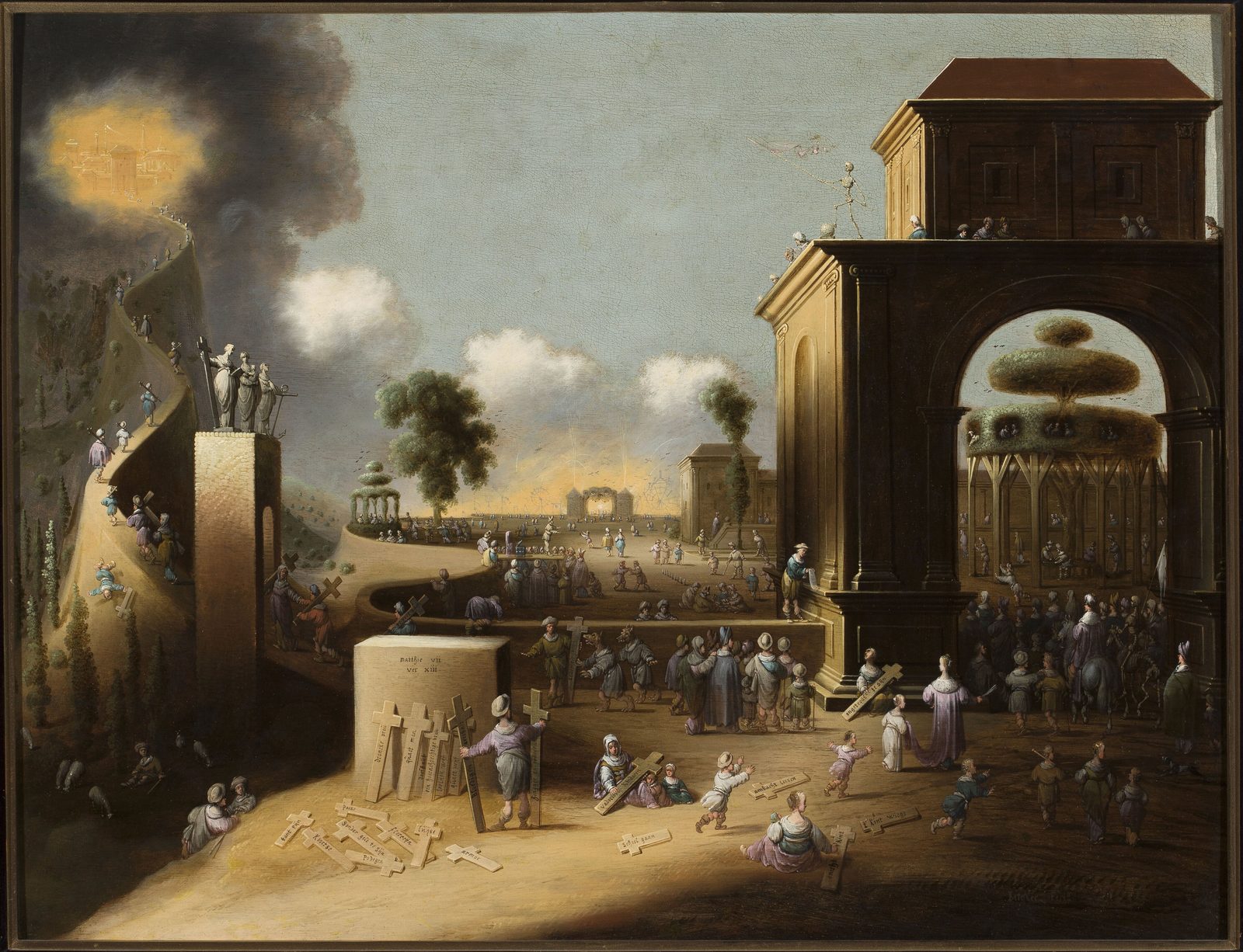
Narrow Road of Virtue and Wide Road of Sin. Jan Micker, not stated on the file page. National Museum in Warsaw. Public domain.