
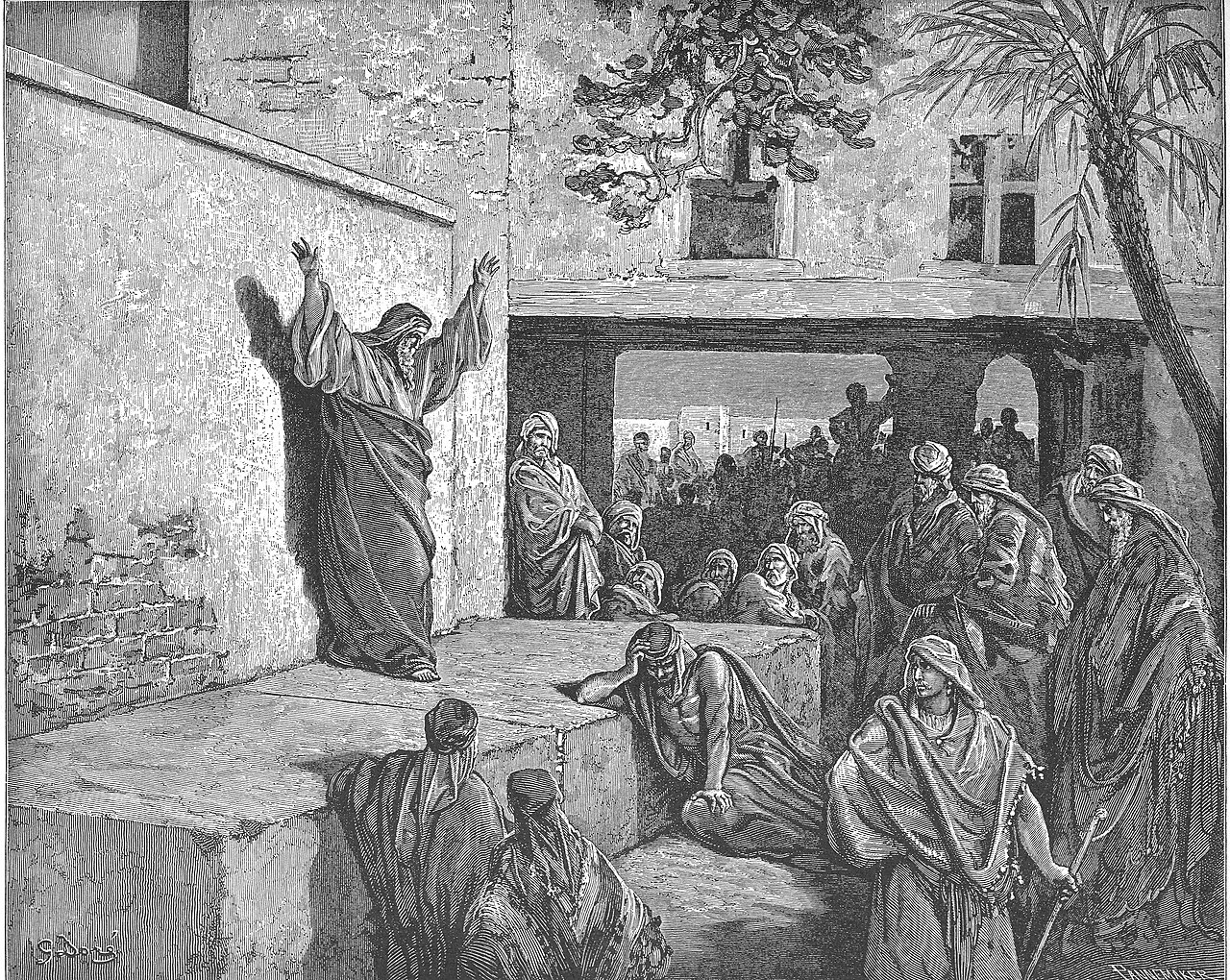
Micahchapter 6
16 verses · Micah · 750 to 686 BC · The Twelve
He has shown you, O man, what is good. And what does the LORD require of you but to act justly, to love mercy, and to walk humbly with your God?
Introduction
Micah, The Twelve, Micah Overview.
This chapter opens the third section of Micah's book, and it is set as a trial. The people who first heard it knew how a case was argued at the city gate, with witnesses called and the accused given a chance to answer. They also knew the story of their own nation from Egypt to the promised land. Listen for who brings the charge and who is called as witness. Listen for the worshipper's questions and the plain answer that follows. Then listen for the charge moving from the temple to the market.
Context
- Who
- Worshippers who wanted to know the price of being right with God
- What
- The LORD's lawsuit against His people, the question of what He requires with its answer of justice, mercy and humility, and the sentence on the city's dishonest trade.
- Where
- Jerusalem, the city of verse 9, pictured as a court with the mountains and the foundations of the earth as witnesses.
- When
- Micah's ministry under Jotham, Ahaz and Hezekiah, about 750 to 686 BC; the chapter gives no date of its own.
- Why
- To call Israel back to the covenant by reminding it of God's saving acts, and to show that God asks for a just and humble life above costly offerings.
Historical context
The mountains and the foundations of the earth are called as jury because they were there for the whole history under review. This is a formal covenant lawsuit, a form Israel's prophets used repeatedly, and it opens the way a legal complaint opens: God asks what he has done to weary his people.
Show the rest of the historical context, 3 more paragraphs
The evidence he cites is a walking tour. Egypt, Moses and Aaron and Miriam, Balak of Moab hiring Balaam to curse Israel and failing, and then the stretch from Shittim, the last camp east of the Jordan, to Gilgal, the first camp inside the land. It is the crossing itself, the moment the promise became ground under their feet.
The escalating offers in the middle are a bidding war: burnt offerings, calves a year old, thousands of rams, ten thousand rivers of oil, and finally the firstborn son. Child sacrifice was not a hypothetical horror in that region; it was practised by Israel's neighbours and, in Judah's worst periods, by Judeans in the valley outside Jerusalem. The bidder is offering the most extreme thing the surrounding cultures had on the price list.
The chapter then drops to a merchant's bag. Wicked scales and a bag of deceitful weights are the same fraud Amos named, one set of stones for buying and a lighter set for selling. The statutes of Omri and the works of Ahab are named as the pattern being followed, which was a deep insult in Judah, since those were northern kings.
Significance
The answer to the bidding war is the most quoted sentence in the book: he has shown you, O man, what is good, to do justice, to love mercy, and to walk humbly with your God. None of the three can be bought, and all three cost more than ten thousand rivers of oil.
Show the rest of the significance, 1 more paragraph
The curses that follow are the covenant curses in domestic form: you will eat and not be satisfied, sow and not reap, tread olives but not anoint yourself with oil, tread grapes but not drink the wine. Hearers who lived by those exact processes knew precisely what a life that shape would feel like.
This chapter in Jewish lifeWhat this chapter is in Jewish life and reading.
What is done
This chapter is read aloud in the synagogue once a year. The site's table in src/lib/hebraic/readings.ts records Micah 5:6 to 6:8 as the Haftarah of Balak, the portion of Numbers 22:2 to 25:9. The probe printed that reading for both the Ashkenazi and the Sephardi rite. The reading closes at the eighth verse of this chapter, the verse on what the Lord requires.
The join between the Haftarah and the portion stands in the fifth verse, which recalls Balak and Balaam by name. Rashi's note on that verse quotes Balaam's own words from Numbers 23:8, which fall inside the portion of Balak (Rashi on Micah 6:5:1).
How it is read
Rashi is the one commentator on this chapter whose English the corpus carries, quoted here from The Judaica Press complete Tanach with Rashi, translated by A. J. Rosenberg, which Sefaria reports as CC-BY.
He reads the mountains and hills called as witnesses as the fathers and mothers of Israel: the mountains are "with the Patriarchs." and the hills are "the Matriarchs." (Rashi on Micah 6:1:1 and 6:1:2). The Lord's question is a call to remember: "Put your heart to recognizing what benefit I have done for you." (Rashi on Micah 6:3:1). He adds that "I did not weary you with much worship or with large sacrifices." (Rashi on Micah 6:4:1). At Moses, Aaron and Miriam he reports Jonathan's paraphrase: "Moses to teach the transmission of the laws, Aaron to atone for the people, and Miriam to instruct the women." (Rashi on Micah 6:4:2).
At Balaam's answer he gives the reason God was not angry in those days, citing Berachot 4a (Rashi on Micah 6:5:1). The road from Shittim to Gilgal is read as a record of mercy. Israel sinned at Shittim, and the Lord still brought them to Gilgal and conquered the land before them (Rashi on Micah 6:5:2). The firstborn of the seventh verse is offered "as a sacrifice for my transgression." (Rashi on Micah 6:7:2).
The eighth verse carries two notes. "The Holy One, blessed be He, has told you what is good for you to do." (Rashi on Micah 6:8:1). On walking humbly he gives Jonathan's rendering, "Walk discreetly in the fear of your God." He then gives a second reading from the Pesikta. A man who shames another must make peace before those who saw it, but God asks only that a man's return to Him be between the two of them (Rashi on Micah 6:8:2).
The voice calling to the city is the voice of the prophets, "calling them [the people] to repentance." (Rashi on Micah 6:9:1). The statutes of Omri are the ways of Omri and Ahab, which Rashi calls the evil kings of Israel (Rashi on Micah 6:16:1).
The corpus carries 6 further notes on this chapter without an English text, each marked linked because Sefaria holds no English version of the ref. They stand cited and unquoted at Ibn Ezra on Micah 6:2:1, 6:6:1 and 6:12:1 and Radak on Micah 6:2:1, 6:11:1 and 6:15:1.
What the rabbis say
The corpus carries 40 rabbinic locators on the verses of this chapter, 4 in the Talmud and 36 in the Midrash. It carries the text of none, so each is cited by ref here and never quoted or paraphrased. The verse numbers are the Hebrew ones the corpus prints.
On verse 1 it holds Bereshit Rabbah 84:10, Midrash Sekhel Tov, Bereshit 24:61:3, Midrash Sekhel Tov, Bereshit 37:36:12 and Ruth Rabbah (Lerner) 1:8:4. On verse 2 it holds Aggadat Bereshit 25:2, Aggadat Bereshit 56:1, Bamidbar Rabbah 10:1 and Bereshit Rabbah 50:11. On verse 3 it holds Bamidbar Rabbah 20:5, Midrash Lekach Tov, Numbers 23:8:1, Midrash Lekach Tov, Numbers 5:31:1 and Midrash Sekhel Tov, Bereshit 49:27:50. On verse 4 it holds Bamidbar Rabbah 1:2, Bamidbar Rabbah 13:20, Midrash Aggadah, Exodus 27:1:5 and Midrash Aggadah, Numbers 20:2:1. On verse 5 it holds Avodah Zarah 4b:4, Berakhot 7a:11, Bereshit Rabbah 41:3 and Eikhah Rabbah 1:38.
On verse 6 it holds Bereshit Rabbah 55:5, Midrash Tanchuma Buber, Bechukotai 8:1 and Midrash Tanchuma, Bechukotai 6:1. On verse 7 it holds Midrash Aggadah, Leviticus 27:2:4, Midrash Aggadah, Leviticus 6:2:1, Midrash Aggadah, Numbers 23:4:2 and Midrash Tanchuma Buber, Tzav 1:1. On verse 8 it holds Bamidbar Rabbah 1:3, Ein Yaakov (Glick Edition), Makkot 3:7, Ein Yaakov (Glick Edition), Sukkah 4:6 and Ein Yaakov, Makkot 3:10. On verse 9 it holds Avot DeRabbi Natan 34:7, Eikhah Rabbah, Petichta 25 and Ein Yaakov (Glick Edition), Rosh Hashanah 4:2. On verse 11 it holds Midrash Shmuel 28:4, Midrash Tanchuma Buber, Ki Teitzei 8:1 and Midrash Tanchuma, Ki Teitzei 8:1.
On verse 14 it holds Avot DeRabbi Natan, Recension B 41:1, Sifrei Devarim 40:10 and Sifrei Devarim 40:11.
What each of them teaches is a saying of the rabbis, and is reported as theirs wherever this site quotes one. The quotations wait on a fetch that carries the text.
Sources: Rashi, Rashi on Micah 6:1:1 to 6:16:1, The Judaica Press complete Tanach with Rashi, translated by A. J. Rosenberg, reported CC-BY; Ibn Ezra, Ibn Ezra on Micah 6:2:1, 6:6:1 and 6:12:1, cited by ref because the corpus carries no English text; Radak, Radak on Micah 6:2:1, 6:11:1 and 6:15:1, cited by ref because the corpus carries no English text; The Sefaria corpus, scripts/data/sources/sefaria/micah/6.json, the 40 Talmud and Midrash locators on the verses of this chapter; The site's own files, src/lib/hebraic/readings.ts, probed for Micah 6 with parashotForChapter, haftarahUsesForChapter and festivalReadingForBook.
The heads below are this chapter's scenes. The numbered points under each are its verses.
Plead before the mountains: what have I done to you?
Micah 6:1-2
The Lord summons Israel to court: "Arise, plead your case before the mountains". The mountains hear the case, as heaven and earth are called in Deuteronomy 32:1 and Isaiah 1:2 to witness the covenant. The case is "against His people", and the mountains sit as the jury.
enduring foundations of the earth: The chapter opens as a lawsuit, and the mountains and the foundations of the earth are called as witnesses. They have stood through the whole history between God and Israel. The Lord of all stoops to argue His case before His own people.
Micah 6:3-5
The Lord opens by asking, "what have I done to you". His evidence is His own care, for "I brought you up from the land of Egypt" and "I sent Moses before you". Verse 5 recalls Balak's hire of Balaam in Numbers 22 to 24, the curse turned to blessing.
I brought you up from the land of Egypt: God answers His own question by listing what He has done. He brought them out of slavery, redeemed them, and gave them Moses, Aaron and Miriam to lead them. The list is the evidence of His goodness, and it leaves them nothing to answer.
from Shittim to Gilgal: Balak hired Balaam to curse Israel, and Balaam could only bless, as Numbers 22 to 24 records. Shittim was the last camp east of the Jordan, where Israel sinned at Peor, and Gilgal the first camp inside the land. The road between them shows the LORD's faithfulness.
What the LORD requires: do justly, love mercy, walk humbly
Micah 6:6-7
With what shall I come before the LORD: The worshiper's offers climb from "burnt offerings, with year-old calves" to "thousands of rams". The last is "Shall I present my firstborn for my transgression", the child sacrifice the king of Moab made in 2 Kings 3:27. The questions set up the answer of verse 8.
Shall I present my firstborn: The questions climb from year-old calves to thousands of rams, rivers of oil and a firstborn child. The king of Moab did that in 2 Kings 3:27. The worshipper imagines that God can be paid, and each offer grows larger and more absurd.
He has shown you, O man, what is good: The answer to verses 6 and 7 comes in one sentence: "to act justly, to love mercy, and to walk humbly with your God". Justice governs dealings with others, mercy renders the Hebrew chesed, covenant loyalty, and the humble walk is the bond with God beneath both.
Micah 6:8
“You ask what you should offer: offer yourself. For what else does the Lord seek of you but you? Because of all earthly creatures he has made nothing better than you, he seeks yourself from yourself, because you have lost yourself.”
Augustine of Hippo · written before 430 · SERMON 48:2patristic
Wicked balances and the statutes of Omri
Micah 6:9-12
The voice of the LORD calls out to the city: The Lord calls to the city to "Heed the rod and the One who ordained it". The charge is fraud in trade, "dishonest scales", and "bags of false weights", against the law's standard in Leviticus 19:35-36 and Deuteronomy 25:13-15. The wealthy are "full of violence", and the residents "speak lies".
the short ephah: The ephah was the standard measure of grain. A merchant who made it short cheated every buyer while claiming full measure. God asks whether He can forget treasure gathered this way, and He calls the measure accursed, as Proverbs 11:1 calls false scales an abomination.
dishonest scales: Weights were carried in a bag and set against goods on the balance, and Deuteronomy 25:13 forbids keeping two kinds. A trader with false weights cheated the poor quietly. God will not count such a man pure, whatever devotion he shows.
full of violence: The rich of the city gained their wealth by violence, and its people speak lies. These are the people verse 8 told to act justly and love mercy. Their tongues deceive in their own mouths.
Micah 6:13-16
Therefore I am striking you severely: The sentence follows the futility curses of Deuteronomy 28:38-40: "You will eat but not be satisfied", "You will sow but not reap". The source is named: "You have kept the statutes of Omri and all the practices of Ahab’s house", the northern dynasty of 1 Kings 16:25-33.
eat but not be satisfied: The punishment follows the covenant curses of Leviticus 26:26. Food will be eaten and will not nourish. What they store up will be lost, and the match between sin and loss shows the hand of God.
sow but not reap: Sowing, pressing olives and treading grapes were the work of the whole farming year. Each labour will be done and its fruit lost. Deuteronomy 28:38 to 40 names the same three losses among the curses of the covenant.
the statutes of Omri: Omri built Samaria, and Ahab his son set up the worship of Baal there, as 1 Kings 16 records. The city had kept their practices as though they were law. Its end will be the same desolation and scorn.
How this psalm is built
The form: A trial in which judgment is given against Israel for injustice and ingratitude toward God, followed by the terms of reconciliation, as Henry classes it.
The patterns in this chapter
| Device | What it does | Where to see it |
|---|---|---|
| The witnesses called | Verses 1 and 2 call the mountains, the hills and the enduring foundations of the earth to hear the LORD's case, as a court calls its witnesses. Jamieson, Fausset and Brown stress how far the Lord of all stoops to prove the equity of His dealings to His people. Matthew Henry reads the whole as a trial in which Israel is convicted.Jamieson, Fausset & Brown, Commentary Critical and Explanatory on the Whole Bible, 1871, on Micah 6:2. | Micah 6:1, Micah 6:2, Micah 6:3 |
| The offers that climb | Verses 6 and 7 ask four questions, each larger than the last: burnt offerings and year-old calves, thousands of rams, ten thousand rivers of oil, and a firstborn child. Adam Clarke notes that the first might be found with difficulty and the rest are impossible, and that conscience says none of them will do. Verse 8 answers all four with three plain duties.Adam Clarke, Commentary on the Bible, 1831, on Micah 6:7. | Micah 6:6, Micah 6:7, Micah 6:8 |
How this chapter is built
1 more paragraph on the patterns
The chapter opens the third section of the book with the same call to hear that opened the first two, at 1:2 and 3:1. Verses 1 to 5 are the LORD's case, argued before the mountains as witnesses, with His saving acts as the evidence. Verses 6 and 7 are the worshipper's questions, and verse 8 is the answer. Verses 9 to 16 turn to the city's market and pass sentence in the terms of the covenant curses, eating without being satisfied and sowing without reaping.
Keep studying
Studies13
Words12
Subjects1
Sources for this chapter
The summary
Jamieson, Fausset & Brown, Commentary Critical and Explanatory; John Calvin, Commentaries; John Wesley, Notes on the Old Testament and Matthew Henry, Complete Commentary.
The form and classifications
Matthew Henry, Commentary on the Whole Bible, 1710, on Micah 6:5.
The exposition
Adam Clarke, Commentary on the Bible; Albert Barnes; Carl Friedrich Keil, The Twelve Minor Prophets; Edward Bouverie Pusey, The Minor Prophets: A Commentary; Jamieson, Fausset & Brown, Commentary Critical and Explanatory on the Whole Bible; Jamieson, Fausset and Brown, Commentary Critical and Explanatory on the Whole Bible; John Gill, Exposition of the Old Testament; John Wesley, Explanatory Notes upon the Old Testament and Matthew Henry, Commentary on the Whole Bible.