
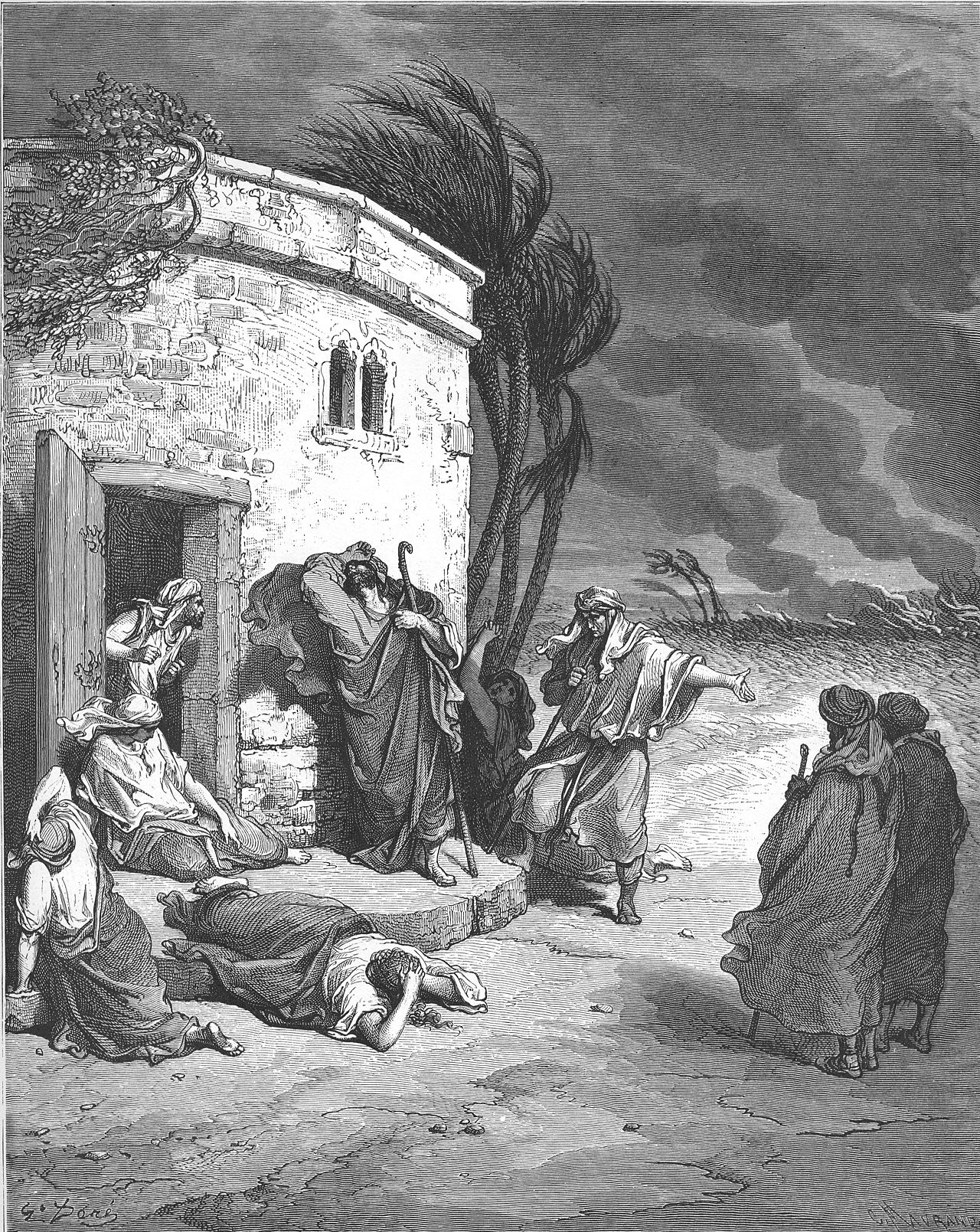
Jobchapter 31
40 verses · unknown · 10th century BC · Wisdom and poetry
“I have made a covenant with my eyes. How then could I gaze with desire at a virgin?
Introduction
unknown, Wisdom and poetry, Job Overview.
This chapter closes the words of Job, and its last line marks the close. It is written as an oath of clearing, a legal act of the ancient world for a case that no witness could settle. The accused swore that if he had done a wrong, a named penalty should fall on him, and he left the matter with God. Its first hearers knew that such an oath invited God to enforce it. Listen for the pattern of if and then, and for how many parts of a life the oath covers. It ends with a demand for a written charge.
Context
- Who
- Hearers who understood that a self-curse invited God to enforce it
- What
- Job's formal oath of innocence, a series of self-curses covering every area in which a man could be charged.
- Where
- The ash heap, with Job speaking as a defendant before God as his judge.
- When
- The book sets Job in the age of the patriarchs, commonly placed about 2000 to 1800 BC, and it gives no date.
- Why
- To close his case by swearing before God that he is clear of the crimes his friends named, and to ask for a written charge.
Historical context
This chapter is a legal instrument, not a list of good intentions. Job swears a series of conditional self-curses in a fixed form: if I have done this, then let that happen to me. In the ancient world an oath of clearing was a recognised way to end a case where no witnesses could settle it, the accused swore, calling down destruction on himself if he lied, and the matter was left with God.
Show the rest of the historical context, 3 more paragraphs
The catalogue covers every area a man could be charged in. A covenant with his eyes, so as not to look on a young woman. Honest scales, 'let me be weighed in an even balance', which mattered because trade ran on a beam scale and a merchant's own stone weights, and short weights were the classic quiet fraud. No lying in wait at his neighbour's door. Justice for his manservant and maidservant when they brought a complaint against him, on the ground that the same God formed them both in the womb.
Then the social duties: not withholding what the poor desired, not eating his morsel alone while the fatherless went without, not seeing anyone perish for want of clothing when his sheep had wool. Not lifting his hand against the fatherless because he had backing in the court at the gate. Not making gold his confidence. Not rejoicing at an enemy's ruin or wishing him dead. Keeping his door open to the traveller, since a stranger with nowhere to sleep was in real danger at night.
Two entries are worth pausing over. Secret idolatry is described by its gesture, beholding the sun when it shone or the moon walking in brightness, and the heart being enticed so that the mouth kissed the hand. Kissing the hand toward a heavenly body is an act of worship attested in Mesopotamian ritual texts, and Job calls it an iniquity for the judges, meaning a crime a court should punish. And at the very end he curses his own fields: if my land cry against me, or I have eaten its fruit without paying, let thistles grow instead of wheat and weeds instead of barley. His closing demand is that his accuser write out the indictment, 'oh that mine adversary had written a book', and he signs his defence with his mark.
Significance
The words of Job are ended here, and they end with a man laying his whole life open under oath and daring heaven to find the flaw. He is not claiming sinlessness; he is denying the specific crimes his friends invented.
Show the rest of the significance, 1 more paragraph
For the first hearers this chapter also functioned as a moral standard in its own right, the fullest picture in the Old Testament of what a godly man with power and money owes to the people beneath him.
This chapter in Jewish lifeWhat this chapter is in Jewish life and reading.
What is done
This chapter has no place in the synagogue year. The site's own table in src/lib/hebraic/readings.ts printed parashot total 0 and haftarah uses total 0 for the book of Job, and no festival reading.
The corpus joins it to the study of the Torah portions through the Midrash arranged by them. Under the thirty-fifth verse it carries Midrash Tanchuma Buber, Vaetchanan 5:2. Under the thirty-fifth verse it carries Midrash Tanchuma, Vaetchanan 5:1. Under the thirty-eighth verse it carries Midrash Tanchuma Buber, Re'eh 13:1. Under the thirty-eighth verse it carries Midrash Tanchuma, Re'eh 15:1.
How it is read
Rashi and Malbim are the two commentators on this chapter whose English the corpus carries. Rashi is quoted from The Judaica Press complete Tanach with Rashi, translated by A. J. Rosenberg, which Sefaria reports as CC-BY. Malbim is quoted from Malbim's Job, trans. Jeremy I. Pfeffer. Ktav, 2003, which Sefaria reports as CC-BY. Job is still the speaker, and Rashi reads the chapter as his account of the sins he kept from. Job made a covenant with his eyes to keep from gazing upon a married woman (Rashi on Job 31:1:1).
Job then asks why God recompensed him so. Misfortune is for the unjust, who deserve it, and Job does not (Rashi on Job 31:2:1, Rashi on Job 31:3:1). God may count his steps and see whether he walked with falsehood (Rashi on Job 31:4:1). Rashi writes each clause as a condition and its penalty. If Job did this, he would deserve the curse to come upon him (Rashi on Job 31:7:1).
At the ninth verse, if Job lurked at his neighbour's doorway for his wife, God should requite him (Rashi on Job 31:9:1). At the tenth Rashi reports that the Sages explained the grinding as an expression of sexual intercourse, as in Judges 16:21 (Rashi on Job 31:10:1). Job feared that sin as an iniquity fit for the judgment of suffering (Rashi on Job 31:11:1). It is a fire that uproots all his grain, and so he held back from it (Rashi on Job 31:12:1).
Malbim reads the next verses as Job's conduct toward those beneath him. "Job was a considerate master who recognized the rights of his slaves" (Malbim on Job 31:13:1). Had he done otherwise, he could not have faced God if God answered his suit. Rashi reads the fourteenth verse as Job's own question, what he would answer God when He visits (Rashi on Job 31:14:1). One Creator formed Job in his mother's womb and the servant in his (Rashi on Job 31:15:1). Malbim adds that Job had been a merciful judge (Malbim on Job 31:21:1).
The other notes gloss single words and thoughts. Failure of the eyes at the sixteenth verse is desire that goes unfulfilled (Rashi on Job 31:16:1). From his youth the uprightness of his heart taught Job as a father raises a child (Rashi on Job 31:18:1). The fear of the twenty-third verse is the misfortune God brought on the wicked, which kept Job from doing the same (Rashi on Job 31:23:1). The Hebrew for hope in the twenty-fourth verse Rashi derives from the flanks, where the kidneys lie, because the kidneys give counsel (Rashi on Job 31:24:1).
The corpus carries four further notes on this chapter without an English text, each marked linked because Sefaria holds no English version of the ref. They stand cited by ref and unquoted. Four stand at Metzudat David on Job 31:6:1, 31:17:1, 31:19:1 and 31:20:1.
What the rabbis say
The corpus carries forty rabbinic locators on this chapter and the text of none, so each is cited and linked here rather than quoted. On the first verse it holds Avot DeRabbi Natan 2:5, Avot DeRabbi Natan, Recension B 2:1 and Bava Batra 16a:15. On the second verse it holds Tractate Kallah Rabbati 5:1. On the sixth verse it holds Midrash Lekach Tov on Esther 3:7:22 and Otzar Midrashim, Midrashim on Megilat Esther, Midrash on the Book of Esther 5. It also holds Sifrei Aggadah on Esther, Midrash Abba Guryon 3:10.
On the tenth verse it holds Bamidbar Rabbah 9:24 and Bereshit Rabbah 48:17. On the twelfth verse it holds Pirkei DeRabbi Eliezer 12:9 and Yalkut Shimoni on Torah 24:2. On the thirteenth verse it holds Bereshit Rabbah 48:3 and Midrash Sekhel Tov, Bereshit 44:18:4. On the fourteenth verse it holds Otzar Midrashim, Pesikta, Pesikta Chadata 49 and Shemot Rabbah 17:4. On the fifteenth verse it holds Jerusalem Talmud Bava Kamma 8:4:2 and Jerusalem Talmud Ketubot 5:5:4. On the sixteenth verse it holds Vayikra Rabbah 17:4. On the seventeenth verse it holds Avot DeRabbi Natan 7:1 and Bereshit Rabbah 30:8.
On the eighteenth verse it holds Midrash Tehillim 139:3. On the nineteenth verse it holds Midrash Lekach Tov, Genesis 26:5:8. On the twentieth verse it holds Bekhorot 17a:6 and Chullin 137a:10. On the twenty-first verse it holds Avot DeRabbi Natan, Recension B 14:2. On the twenty-fifth verse it holds Midrash Sekhel Tov, Bereshit 35:16:2 and Midrash Sekhel Tov, Bereshit 48:7:1. On the twenty-sixth verse it holds Midrash Lekach Tov, Deuteronomy 17:3:1 and Midrash Lekach Tov, Genesis 2:12:10. On the twenty-ninth verse it holds Midrash Tehillim 7:18. On the thirty-first verse it holds Midrash Sekhel Tov, Bereshit 34:30:6.
On the thirty-second verse it holds Aggadat Bereshit 56:1 and Jerusalem Talmud Sanhedrin 10:2:26. On the thirty-fourth verse it holds Midrash Lekach Tov, Deuteronomy 7:21:1 and Pesikta DeRav Kahana 7:10. On the thirty-fifth verse it holds Midrash Tanchuma Buber, Vaetchanan 5:2 and Midrash Tanchuma, Vaetchanan 5:1. On the thirty-eighth verse it holds Midrash Tanchuma Buber, Re'eh 13:1 and Midrash Tanchuma, Re'eh 15:1. On the fortieth verse it holds Shir HaShirim Rabbah 1:1:6. What each of them teaches is a saying of the rabbis, and is reported as theirs wherever this site quotes one. The quotations wait on a fetch that carries the text.
Sources: Rashi, Rashi on Job 31:1:1 to 31:24:1, The Judaica Press complete Tanach with Rashi, translated by A. J. Rosenberg, reported CC-BY; Malbim, Malbim on Job 31:13:1 to 31:21:1, Malbim's Job, trans. Jeremy I. Pfeffer. Ktav, 2003, reported CC-BY; Metzudat David, Metzudat David on Job 31:6:1, 31:17:1, 31:19:1 and 31:20:1, cited by ref because the corpus carries no English text; The Sefaria corpus, scripts/data/sources/sefaria/job/31.json, the 40 Talmud and Midrash locators of this chapter; The site's own files, src/lib/hebraic/readings.ts, printing no portion, no Haftarah and no festival reading for this book.
The heads below are this chapter's scenes. The numbered points under each are its verses.
Job: I Made a Covenant With Mine Eyes
Job 31:1-3
“I have made a covenant with my eyes” opens Job's defense, which Henry reads as a discipline over the sense most apt to lead astray. Gill notes that Job argues from “the allotment of God from above” to what God will therefore require.
Job 31:1
“I made a covenant with mine eyes - The first virtue of his private life to which Job refers is chastity. Such was his sense of the importance of this, and of the danger to which man was exposed, that he had solemnly resolved not to think upon a young female. The phrase here, “I made a covenant with mine eyes,” is poetical, meaning that he solemnly resolved. A covenant is of a sacred and binding nature; and the strength of his resolution was as great as if he had made a solemn compact.”
the allotment of God from above: Jamieson, Fausset and Brown tie the question to the covenant of Job 31:1. Had his eyes led him to desire, what allotment of God could he expect from above? Henry answers that impurity leaves no heritage with the Almighty.
Job 31:2
“For what portion would God have in me from above, and what inheritance would the Almighty have from on high? As though he said in plain words; 'If I defile, my mind in thought, I can never be the 'inheritance' of Him, Who is the Author of purity.' For the rest are no good things at all, if to the eyes of the secret Judge they be not approved by the testimony of chastity.”
Gregory the Dialogist · written before 604 · Morals on the Book of Job, Book XXIpatristic
calamity to the workers of iniquity?: Henry reports a reading of disaster as alienation. Sin sets the mind at a distance from God, as Ephesians 4:18 and 19 describe, and the unjust stay at that distance forever. Barnes hears Job admitting he could expect the same calamity had he broken his covenant.
Job 31:3
“Is there not alienation (so some read it) to the workers of iniquity? This is the sinfulness of the sin that it alienates the mind from God ( Eph. iv. 18, 19 ), and this is the punishment of the sinners that they shall be eternally set at a distance from him, Rev. xxii.”
Matthew Henry · Commentary on the Whole Bible (1707-1721)puritan
1 more voice on this verse
Job 31:3
“Is not destruction to the wicked? - That is, Job says that he was well aware that destruction would overtake the wicked, and that if he had given indulgence to impure desires he could have looked for nothing else. Well knowing this, he says, he had guarded himself in the most careful manner from sin, and had labored with the greatest assiduity to keep his eyes and his heart pure. And a strange punishment - - ונכר weneker. The word used here, means literally strangeness - a strange thing, something with which we were unacquainted.”
Job 31:4-6
Does He not see my ways: With “Does He not see my ways and count my every step”, Job names the audience of every clause. “let God weigh me with honest scales” asks for the trial by scale. Delitzsch reads the scales as courtroom language, Job offering himself to be tried beyond asserting his innocence.
Job 31:4
“Doth he not see my ways? - This either means that God was a witness of all that he did - his thoughts, words, and deeds, and would punish him if he had given indulgence to improper feelings and thoughts; or that since God saw all his thoughts, he could boldly appeal to him as a witness of his innocence in this matter, and in proof that his life and heart were pure. Rosenmuller adopts the latter interpretation; Herder seems to incline to the former.”
If I have walked in falsehood: Barnes reads falsehood as the older word vanity, made plain by the parallel with deceit. Aquinas names the form of the whole chapter. Each if binds the speaker to a penalty should his words prove false.
Job 31:5
“If I have walked in vanity, or if my foot hath hasted to deceit, let Him weigh me in an even balance, and let God know mine integrity. 'God to know' is said for His making us to know by a customary mode of our speech, who speak of 'a happy day,' by which it happens that we are made happy. For hence it is the Lord saith to Abraham, Now I know that thou fearest God.”
Gregory the Dialogist · written before 604 · Morals on the Book of Job, Book XXIpatristic
1 more voice on this verse
Job 31:5
“If I have walked with vanity - This is the second specification in regard to his private deportment. He says that his life had been sincere, upright, honest. The word vanity here is equivalent to falsehood, for so the parallelism demands, and so the word (שׁוא shâv') is often used; Psa 12:3; Psa 41:7; Exo 23:1; Deu 5:20; compare Isa, Deu 1:13. The meaning of Job here is, that he had been true and honest.”
weigh me with honest scales: Clarke gives integrity as tummathi, a whole and blameless life. Chrysostom says Job's life had the exactness of the arm of a balance. He appeals to the testimony of God, who knows every detail, over any mortal witness.
Job 31:7-8
If my steps have turned from the path: Job extends the covenant of verse 1 to the whole body. The curse form Job uses throughout the chapter follows, calling down on himself the kind of loss he has already suffered.
Job 31:7
“In every particular action and affair we must closely tie ourselves up to the rules of righteousness. (4.) His heart did not walk after his eyes, that is, he did not covet what he saw that was another's, nor wish it his own. Covetousness is called the lust of the eye, 1 John ii.”
Matthew Henry · Commentary on the Whole Bible (1707-1721)puritan
may another eat what I have sown: Aquinas finds the penalty fitted to the fault. A man who takes what belongs to another should see another eat what he has sown. Barnes calls the wording a common expression, and Clarke takes the curse to reach both his goods and his family.
Job 31:8
“Let me sow, and let another eat - Let me be plagued both in my circumstances and in my family. My offspring be rooted out - It has already appeared probable that all Job’s children were not destroyed in the fall of the house mentioned Job 1:18, Job 1:19.”
Adam Clarke · Commentary on the Bible (1810-1826)evangelical
Job 31:9-10
my heart has been enticed: “If my heart has been enticed by my neighbor’s wife” names adultery specifically. Gill reads the grinding as the labor of a captive or slave, the fullest domestic humiliation Job can name. Clarke notes that the oath's severity matches the gravity the crime carries under the law Job cites.
Job 31:9
“If mine heart has been deceived by a woman, or if I have laid wait at my neighbour's door. Though it sometimes happens that the sin of fornication is not at all different from the guilt of adultery, seeing that Truth saith; Whoso looketh on a woman to lust after her, hath already committed adultery with her in his heart.”
Gregory the Dialogist · written before 604 · Morals on the Book of Job, Book XXIpatristic
1 more voice on this verse
Job 31:9
“If mine heart have been deceived by a woman - If I have been enticed by her beauty. The word rendered “deceived” פתה pâthâh means to open, to expand. It is then applied to that which is open or ingenuous; to that which is unsuspicious - like a youth; and thence is used in the sense of being deceived, or enticed; Deu 11:16; Exo 22:16; Pro 1:10; Pro 16:29. The word “woman” here probably means a married woman, and stands opposed to “virgin” in ver.”
may my own wife grind grain: The wife who must grind grain for another is a slave at the handmill, Clarke says, and the Syriac and Arabic versions read it so. Henry compares 2 Samuel 12:11. There the sin of the husband was answered through his wife.
Job 31:10
“Let my wife grind unto another - Let her work at the handmill, grinding corn; which was the severe work of the meanest slave. In this sense the passage is understood both by the Syriac and Arabic. See Exo 11:5 (note), and Isa 47:2 (note); and see at the end of the chapter, Isa 31:8 (note). And let others bow down upon her - Let her be in such a state as to have no command of her own person; her owner disposing of her person as he pleases.”
Adam Clarke · Commentary on the Bible (1810-1826)evangelical
1 more voice on this verse
Job 31:10
“Let her be a slave (so some), a harlot, so others. God often punishes the sins of one with the sin of another, the adultery of the husband with the adultery of the wife, as in David's case ( 2 Sam. xii. 11 ), which does not in the least excuse the treachery of the adulterous wife; but, how unrighteous soever she is, God is righteous.”
Matthew Henry · Commentary on the Whole Bible (1707-1721)puritan
Job 31:11-12
a heinous crime: “For it is a fire that burns down to Abaddon; it would root out my entire harvest” completes the figure begun in verse 8. Delitzsch reads the fire as the image Proverbs uses for the ruin of adultery, a sin that burns through all a household has built.
Job 31:11
“For this is an heinous crime - This expresses Job’s sense of the enormity of such an offence. He felt that there was no palliation for it; he would in no way, and on no pretence, attempt to vindicate it. An iniquity to be punished by the judges - A crime for the judges to determine on and decide. The sins which Job had specified before this, were those of the heart; but here he refers to a crime against society - an offence which deserved the interposition of the magistrate.”
1 more voice on this verse
Job 31:11
“In the earliest times punished with death (Ge 38:24). So in later times (De 22:22). Heretofore he had spoken only of sins against conscience; now, one against the community, needing the cognizance of the judge.”
Jamieson, Fausset & Brown · Commentary Critical and Explanatory on the Whole Bible (1871)reformed
a fire that burns down to Abaddon: Older versions read Abaddon as destruction, a fire that burns to the lowest depths in Henry. Aquinas reads the harvest it would root out as a man's inheritance. The sin burns up his goods and leaves his sons uncertain.
Job 31:12
“Lust is a fire in the soul: those that indulge it are said to burn. It consumes all that is good there (the convictions, the comforts), and lays the conscience waste. It kindles the fire of God's wrath, which, if not extinguished by the blood of Christ, will burn to the lowest hell.”
Matthew Henry · Commentary on the Whole Bible (1707-1721)puritan
Job: If I Despised the Cause of My Servant
Job 31:13-15
the cause of my manservant: “If I have rejected the cause of my manservant or maidservant” turns the oath to Job's servants, whom the ancient world rarely allowed to complain. He asks whether the same One did not form us in the womb, which Henry reads as the ground of the servant's claim.
Job 31:13
“If I despised to submit to judgment with my man-servant or with my maid-servant, when they contended with me. For he who did not refuse to be 'judged with menservants and maid-servants,' clearly shews that against no fellow-creature was he at any time swoln with pride in himself. But herein it is interesting to remark with what circumspection the holy man preserved his life in all respects. For not far above he said, The young men saw me, and hid themselves: and the aged arose and stood up. The princes refrained talking, and laid their hand on their mouth.”
Gregory the Dialogist · written before 604 · Morals on the Book of Job, Book XXIpatristic
when God rises to judge?: Barnes pictures God rising to pronounce sentence. The master who rejected a servant's complaint would then have to answer the One who made them both. Aquinas adds that such a man would find no helper at that judgment.
Job 31:14
“For what shall I do, when God riseth up to judge; and when He seeketh, what shall I answer Him? He who thinks on the Judge to come, is unceasingly day by day preparing the cases of his accounts for the better: he who views the Eternal Lord with trembling of heart, is forced to abate the rights of temporal lordship over those under him. For he considers well that it is nothing that he is set above others in time, when for the rendering account he is beneath Him, Who exercises dominion without end.”
Gregory the Dialogist · written before 604 · Morals on the Book of Job, Book XXIpatristic
1 more voice on this verse
Job 31:14
“What then shall I do when God riseth up? - That is, when he rises up to pronounce sentence upon people, or to execute impartial justice. Job admits that if he had done injustice to a servant, he would have reason to dread the divine indignation, and that he could have no excuse. “I tremble,” said President Jefferson, speaking of slavery in the United States “when I remember that God is just!” Notes on Virginia. And when he visiteth - When he comes to inspect human conduct.”
the same One form us: Barnes calls this a very advanced view. He who made Job in the womb also made his manservant and maidservant, one Creator and one nature. Jamieson, Fausset and Brown set the verse against every claim that a slave is born inferior.
Job 31:15
“Did not He Who made me in the womb make him? And did not One make us in the womb? To persons possessed of power, the equality of creation kept in the thoughts is great goodness of humility. For all of us men are equal by nature, but it has been added by a distributive arrangement, that we should appear as set over particular persons. So then if we keep down from the imagination that thing which has accrued temporarily, we find out the sooner that which we are naturally.”
Gregory the Dialogist · written before 604 · Morals on the Book of Job, Book XXIpatristic
2 more voices on this verse
Job 31:15
“Did not he that made me in the womb make him? - Had we not one and the same Creator, and have we not consequently the same nature? We may observe in regard to this sentiment, (1.) That it indicates a very advanced state of view in regard to man. The attempt has been always made by those who wish to tyrannize over others, or who aim to make slaves of others, to show that they are of a different race, and that in the design for which they were made, they are wholly inferior.”
Job 31:15
“Slaveholders try to defend themselves by maintaining the original inferiority of the slave. Eph 6:9 make the common origin of masters and servants the argument for brotherly love being shown by the former to the latter.”
Jamieson, Fausset & Brown · Commentary Critical and Explanatory on the Whole Bible (1871)reformed
Job 31:16-18
If I have denied the desires of the poor: “If I have denied the desires of the poor or allowed the widow’s eyes to fail” turns the rescues in chapter 29 into oath form. It was a lifelong practice, and Gill reads the verse as evidence that Job raised orphans in his own household from his earliest years.
Job 31:16
“If I have withheld the poor from their desire,.... Their reasonable desires, and which it was in his power to grant; as when they desired a piece of bread, being hungry, or clothes to cover them, being naked; but not unreasonable desires, seeking and asking great things for themselves, or unlimited and unbounded ones, such as the two sons of Zebedee desired of Christ, Mar 10:35; or have caused the eyes of the widow to fail; through long waiting for, and expecting help and succour from him, and at last disappointed.”
2 more voices on this verse
Job 31:16
“If I have withheld the poor from their desire - Job now turns to another class of virtues, regarded also as of great importance in the patriarchal ages, kindness to the poor and the afflicted; to the fatherless and the widow. He appeals to his former life on this subject; affirms that he had a good conscience in the recollection of his dealings with them, and impliedly declares that it could not have been for any deficiency in the exercise of these virtues that his calamities had come upon him.”
Job 31:16
“If a poor person begged a kindness of his, he was ready to gratify him; if he could but perceive by the widow's mournful craving look that she expected an alms from him, though she had not confidence enough to ask it, he had compassion enough to give it, and never caused the eyes of the widow to fail.”
Matthew Henry · Commentary on the Whole Bible (1707-1721)puritan
eaten my morsel alone: Barnes reads my morsel alone as even the smallest portion, still shared with others. Clarke adds that friends and strangers were welcome at supper. The fatherless, the poor and the widow of Job 31:16 had their fill at that table.
Job 31:17
“Or have eaten my morsel alone, and the fatherless hath not eaten thereof. That is to say, reckoning that he prejudiced his pitifulness, if he ate alone what the Lord of all created in common. Which same fellowship of intercourse should be carried on within the domestic walls with those persons, by whom the rewards of eternal retribution may be promoted. Whence the holy man describes himself as having had not any indifferent person, but, for eating, the 'fatherless' as his companions.”
Gregory the Dialogist · written before 604 · Morals on the Book of Job, Book XXIpatristic
1 more voice on this verse
Job 31:17
“Or have eaten my morsel myself alone - If I have not imparted what I had though ever so small, to others. This was in accordance with the Oriental laws of hospitality. It is regarded as a fixed law among the Arabians, that the guest shall always be helped first, and to that which is best; and no matter how needy the family may be, or how much distressed with hunger, the settled laws of hospitality demand that the stranger-guest shall have the first and best portion.”
I reared him as would a father: Clarke calls this a very difficult verse. Heath reads him as an orphan boy reared with Job, and the one guided from her mother's womb as an orphan girl. Henry adds that Job gave the fatherless education along with their keep.
Job 31:18
“This is a very difficult verse, and is variously translated. Take the following instances: - For from his youth he (the male orphan) was brought up with me as a father. Yea, I have guided her (the female orphan) from her mother’s womb - Heath.”
Adam Clarke · Commentary on the Bible (1810-1826)evangelical
2 more voices on this verse
Job 31:18
“He was a father to the fatherless, took care of orphans, brought them up with him under his own eye, and gave them, not only maintenance, but education. He was a guide to the widow, who had lost the guide of her youth; he advised her in her affairs, took cognizance of them, and undertook the management of them.”
Matthew Henry · Commentary on the Whole Bible (1707-1721)puritan
Job 31:18
“Parenthetical: asserting that he did the contrary to the things in Job 31:16, 17. he--the orphan. guided her--namely, the widow, by advice and protection. On this and "a father," see Job 29:16.”
Jamieson, Fausset & Brown · Commentary Critical and Explanatory on the Whole Bible (1871)reformed
Job 31:19-20
seen one perish for lack of clothing: If I have “seen one perish for lack of clothing, or a needy man without a cloak” names exposure to cold. If “his heart has not blessed me for warming him with the fleece of my sheep” pictures the man's gratitude. Delitzsch reads the blessing as the man's own thanks.
Job 31:19
“If I have seen any perish for want of clothing,.... A man may be in such poor circumstances as to want proper clothing to cover his naked body with, and preserve it from the inclemencies of the weather, and for want of it be ready to perish or die with cold.”
2 more voices on this verse
Job 31:19
“If I have seen any perish ... - He turns to another virtue of the same general class - that of providing for the poor. The meaning is clear, that he had always assisted the poor and needy.”
Job 31:19
“If I despised any passing by, because he had no covering, and a poor man without clothing, if his loins have not blessed me, and if he were not warmed with the fleece of my sheep. Because he did not despise the poor, he displayed the virtue of humility; and because he covered him, of pitifulness. For these two virtues ought to be so linked together, as to be even supported by reciprocal practice; that so neither humility, when it reverences a fellow-creature, should abandon the grace of free giving, nor pity, when it gives, be made to swell high.”
Gregory the Dialogist · written before 604 · Morals on the Book of Job, Book XXIpatristic
the fleece of my sheep: Where the Berean has his heart, older versions read his loins. Clarke calls it a delicate touch. The needy man without a cloak in Job 31:19 finds warmth in the fleece, and his body blesses the one who clothed him.
Job 31:20
“If his loins have not blessed me - This is a very delicate touch: the part that was cold and shivering is now covered with warm woollen. It feels the comfort; and by a fine prosopopoeia, is represented as blessing him who furnished the clothing.”
Adam Clarke · Commentary on the Bible (1810-1826)evangelical
Job 31:21-23
lifted up my hand against the fatherless: The oath names the temptation of a powerful man at the gate of 29:7. The curse “then may my arm fall from my shoulder” fits the fault. “For calamity from God terrifies me” names the fear, which Henry reads as the root of his ethics, reverence for God before reputation.
Job 31:21
“If I have lifted up my hand against the fatherless, even when I saw myself uppermost in the gate. It was the custom with those of old that the elders should sit at the gate to make out by judicial trial the quarrels of persons at strife, in order that the city, in which it was befitting that they should dwell in concord, they should never enter at variance. And hence the Lord saith by the Prophet, Establish judgment in the gate.”
Gregory the Dialogist · written before 604 · Morals on the Book of Job, Book XXIpatristic
1 more voice on this verse
Job 31:21
“If I have lifted up my hand against the fatherless - That is, if I have taken advantage of my rank, influence, and power, to oppress and injure him. When I saw my help in the gate - The gate of a city was a place of concourse; a place where debates were held, and where justice was administered. Job speaks here of that part of his life when he was clothed with authority as a magistrate, or when he had power and influence as a public man.”
may my arm fall from my shoulder: Henry calls the curse just. It matches the hand lifted against the fatherless in Job 31:21, and Henry recalls how God withered the arm Jeroboam stretched out against a prophet. Barnes hears in the strong language a clear conscience.
Job 31:22
“Let mine arm fall - Mr. Good, as a medical man, is at home in the translation of this verse: - “May my shoulder-bone be shivered at the blade, And mine arm be broken off at the socket.” Let judgment fall particularly on those parts which have either done wrong, or refused to do right when in their power.”
Adam Clarke · Commentary on the Bible (1810-1826)evangelical
2 more voices on this verse
Job 31:22
“And he intimates that it is a righteous thing with God to break the arm that is lifted up against the fatherless, as he withered Jeroboam's arm that was stretched out against a prophet.”
Matthew Henry · Commentary on the Whole Bible (1707-1721)puritan
Job 31:22
“Job alludes to Eliphaz' charge (Job 22:9). The first "arm" is rather the shoulder. The second "arm" is the forearm. from the bone--literally, "a reed"; hence the upper arm, above the elbow.”
Jamieson, Fausset & Brown · Commentary Critical and Explanatory on the Whole Bible (1871)reformed
His splendor I cannot overpower: Calamity from God terrified Job more than the judgment of men, which he could have escaped, say Jamieson, Fausset and Brown. Bonaventure joins the splendor of God's power with the severity of His vengeance. That joining is the ground of fear.
Job 31:23
“For destruction from God was a terror to me - The destruction which God would bring upon one who was guilty of the crime here specified, awed and restrained me. He was deterred from this crime of oppressing the fatherless by the fear of God. He could have escaped the judgment of people. He had power and influence enough not to dread the penalty of human law.”
1 more voice on this verse
Job 31:23
“For--that is, the reason why Job guarded against such sins. Fear of God, though he could escape man's judgment (Ge 39:9). UMBREIT more spiritedly translates, Yea, destruction and terror from God might have befallen me (had I done so): mere fear not being the motive. highness--majestic might. endure--I could have availed nothing against it.”
Jamieson, Fausset & Brown · Commentary Critical and Explanatory on the Whole Bible (1871)reformed
Job: If I Made Gold My Hope: Let Thistles Grow for Wheat
Job 31:24-25
If I have put my trust in gold: “If I have put my trust in gold or called pure gold my security” denies trust moved from God onto wealth. The next line denies pride of increase as well. Gill reads the pair as covering both inward reliance on riches and outward delight in having them.
Job 31:24
“If I have made gold my hope - That is, if I have put my trust in gold rather than in God; if I have fixed my affections with idolatrous attachment on riches rather than on my Maker. Job here introduces another class of sins, and says that his conscience did not charge him with guilt in respect to them. He had before spoken mainly of social duties, and of his manner of life toward the poor, the needy, the widow, and the orphan.”
rejoiced in my great wealth: Barnes reads the joy as trust, a heart resting on great wealth. Henry draws the lesson. The less pleasure a man takes in what his hand has gained, the less pain he feels when it is gone.
Job 31:25
“If I have rejoiced because my wealth was great - That is, if I have rejoiced as if I might now confide in it, or put my trust in it. He had not found his principal joy in his property, nor had he attempted to find in that the happiness which he ought to seek in God. And because mine hand had gotten much - Margin, found. Prof. Lee translates this, “When as a mighty man my hand prevailed.” But the usual interpretation is given in our translation, and this accords better with the connection.”
Job 31:26-28
I have beheld the sun in its radiance: Job's oath about “the sun in its radiance or the moon moving in splendor” names the oldest idolatry, which Deuteronomy 4:19 and 17:3 condemn. The gesture in which “my hand threw a kiss from my mouth” is private homage, which Delitzsch reads as the ritual the Hebrew names.
Job 31:26
“If I saw the sun when it shined, or the moon walking in brightness, and my heart hath secretly rejoiced, and I have kissed my hand with my mouth; which is an exceeding iniquity, and denial against the Most High God. There is no doubt that both these two luminaries, which are commissioned to ministrations for man, are called 'the hosts of heaven.' Into the worshipping whereof we know that numbers have fallen, as Scripture is witness; as where it is written, And worshipped all the host of heaven.”
Gregory the Dialogist · written before 604 · Morals on the Book of Job, Book XXIIpatristic
2 more voices on this verse
Job 31:26
“I - This place speaks of the worship of the host of heaven, and especially of the sun and moon, the most eminent and glorious of that number, which was the most ancient kind of idolatry, and most frequent in the eastern countries. Shined - In its full strength and glory. Kissed - In token of worship, whereof this was a sign.”
John Wesley · Explanatory Notes upon the Old Testament (1765)evangelical
Job 31:26
“The Hebrew here for "sun" is light. Probably light was worshipped as the emanation from God, before its embodiments, the sun, &c. This worship prevailed in Chaldea; wherefore Job's exemption from the idolatry of his neighbors was the more exemplary.”
Jamieson, Fausset & Brown · Commentary Critical and Explanatory on the Whole Bible (1871)reformed
threw a kiss from my mouth: Barnes notes that the Hebrew has the hand kissing the mouth, a gesture of worship toward the sun and moon of Job 31:26. Ishodad of Merv compares the kiss people give their hands for those dear to them. The heart secretly enticed is drawn to idolatry.
I would have denied God on high: Barnes links an iniquity to be judged back to Job 31:11. Among the Hebrews, he adds, idolatry was punished by stoning, at Deuteronomy 17:2 to 7. Clarke says worship of the sun and moon would deny the God who made them.
Job 31:28
“Which is the chiefest iniquity, and denial against the Most High God. For it is clear that he does deny Him, when setting at nought His grace, he claims to himself the powers of good practice. Which too is rightly called as well 'the chiefest iniquity' because every act of sin which is from infirmity destroyeth not hope, seeing that it asks forgiveness from the Judge Above. But presuming on our own goodness is so much the worse in desperateness, the further it is removed from humility.”
Gregory the Dialogist · written before 604 · Morals on the Book of Job, Book XXIIpatristic
1 more voice on this verse
Job 31:28
“For I should have denied the God that is above - Had I paid Divine adoration to them, I should have thereby denied the God that made them.”
Adam Clarke · Commentary on the Bible (1810-1826)evangelical
Job 31:29-30
If I have rejoiced in my enemy’s ruin: “If I have rejoiced in my enemy’s ruin, or exulted when evil befell him” denies an enemy's downfall as any occasion for Job's own joy. Henry notes that this standard exceeds even the law's own toleration of satisfaction at a wrongdoer's fall.
Job 31:29
“If I rejoiced at the destruction of him that hated me, or lifted up myself when evil found me. That we are disciples of Almighty God, the keeping of charity is the only proof. For it is hence that Truth saith by Itself, By this shall all men know that ye are My Disciples, if ye have love one toward another. Which same love, if it really fills our heart, is wont to be exhibited in two ways; viz. if we at once love our friends in God, and our enemies for God.”
Gregory the Dialogist · written before 604 · Morals on the Book of Job, Book XXIIpatristic
1 more voice on this verse
Job 31:29
“If I rejoiced at the destruction of him that hated me - Job here introduces another class of offences, of which he says he was innocent. The subject referred to is the proper treatment of those who injure us. In respect to this, he says that he was entirely conscious of freedom from exultation when calamity came upon a foe, and that he had never even wished him evil in his heart. The word “destruction” here, means calamity, disappointment, or affliction of any kind. It had never been pleasant to him to see one who hated him suffer.”
asking for his life with a curse—: Barnes gives the Hebrew for mouth as palate, the organ of the voice, and compares Proverbs 8:7. Henry sets the verse beside Psalm 39:1. Job guarded his tongue even against an enemy.
Job 31:30
“Neither have I suffered my mouth to sin by wishing a curse to his soul. For he would sin, if he were to desire that to be done by God, which he himself either could not at all be able to do, or if he could it would not be in any wise right. For they who assail an enemy with curses, what other thing do they wish God to do in his case, but what they are either unable or ashamed to do themselves?”
Gregory the Dialogist · written before 604 · Morals on the Book of Job, Book XXIIpatristic
1 more voice on this verse
Job 31:30
“He never wished a curse to his soul (curses to the soul are the worst of curses), never desired his death; he knew that, if he did, it would turn into sin to him. He was careful not to offend with his tongue ( Ps. xxxix. 1 ), would not suffer his mouth to sin, and therefore durst not imprecate any evil, no, not to his worst enemy.”
Matthew Henry · Commentary on the Whole Bible (1707-1721)puritan
Job 31:31-32
the men of my house have not said: Job appeals to “the men of my house” as witnesses to his table. He kept the law of hospitality, since “no stranger had to lodge on the street, for my door has been open to the traveler”. Delitzsch reads the open door as a claim any traveler could have confirmed.
Job 31:31
“If the men of my tabernacle said not, O that we had of his flesh, that we might be satisfied! [MYSTICAL INTERPRETATION] Which same sentence may also be taken in mystery of the voice of our Redeemer. For 'the men of his tabernacle' longed to be 'satisfied by his flesh,' i.e. whether the Jews in persecuting or the Gentiles in believing.”
Gregory the Dialogist · written before 604 · Morals on the Book of Job, Book XXIIpatristic
1 more voice on this verse
Job 31:31
“If the men of my tabernacle - The men of my tent; or those who dwell with me. The reference is doubtless to those who were in his employ, and who, being constantly with him, had an opportunity to observe his manner of life. On this verse there has been a great variety of exposition, and interpreters are by no means agreed as to its meaning.”
open to the traveler—: Barnes reads this verse as proof of Job 31:31, where no one in the house lacked his fill. Clarke separates two guests. The stranger was wholly unknown, and the traveler was passing through on his way elsewhere.
Job 31:32
“The stranger did not lodge in the street - My kindness did not extend merely to my family, domestics, and friends; the stranger - he who was to me perfectly unknown, and the traveler - he who was on his journey to some other district, found my doors ever open to receive them, and were refreshed with my bed and my board.”
Adam Clarke · Commentary on the Bible (1810-1826)evangelical
1 more voice on this verse
Job 31:32
“The stranger did not lodge in the street; but my door was open to the traveller. Whereas, Paul being witness, charity is described as patient and kind, by patience it bears with composure the ill turns of others, by kindness it also renders with mercifulness its own good ones. Whence blessed Job at once patiently bore those of his own household cursing him, and received to him kindly the travellers and strangers, to the first affording examples of morals, the other meeting with the succour of external things.”
Gregory the Dialogist · written before 604 · Morals on the Book of Job, Book XXIIpatristic
Job 31:33-34
I have covered my transgressions like Adam: The oath “if I have covered my transgressions like Adam by hiding my guilt in my heart” names Adam as the pattern of concealed sin. Henry takes this rare reference back to Genesis 3 by name as proof that Job knew the Genesis account as shared history.
Job 31:33
“If I covered my transgressions as Adam - That is, if I have attempted to hide or conceal them; if, conscious of guilt, I have endeavored to cloak my sins, and to appear righteous. There has been great variety of opinion about the meaning of this expression. The margin reads it, “After the manner of men.” Luther, renders it, “Have I covered my wickedness as a man” - Habe ich meine Schalkheit wie ein Menseh gedecht.”
1 more voice on this verse
Job 31:33
“So he might easily know of the fall, through the two links which connect Adam and Abraham (about Job's time), namely, Methuselah and Shem. Adam is representative of fallen man's propensity to concealment (Pr 28:13). It was from God that Job did not "hide his iniquity in his bosom," as on the contrary it was from God that "Adam" hid in his lurking-place.”
Jamieson, Fausset & Brown · Commentary Critical and Explanatory on the Whole Bible (1871)reformed
the contempt of the clans: Clarke reads the verse in the court. The crowds and the clans never frightened Job out of a just decision. Jamieson, Fausset and Brown see a just retribution in the fear itself, the man who hides sin from God exposed before men.
Job 31:34
“Did I fear a great multitude - Was I ever prevented by the voice of the many from decreeing and executing what was right? When many families or tribes espoused a particular cause, which I found, on examination, to be wrong, did they put me in fear, so as to prevent me from doing justice to the weak and friendless? Or, in any of these cases, was I ever, through fear, self-seeking, or favor, prevented from declaring my mind, or constrained to keep my house, lest I should be obliged to give judgment against my conscience?”
Adam Clarke · Commentary on the Bible (1810-1826)evangelical
1 more voice on this verse
Job 31:34
“A just retribution that he who hides his sin from God, should have it exposed before man (2Sa 12:12). But Job had not been so exposed, but on the contrary was esteemed in the assemblies of the "tribes"--("families"); a proof, he implies, that God does not hold him guilty of hiding sin (Job 24:16, contrast with Job 29:21-25).”
Jamieson, Fausset & Brown · Commentary Critical and Explanatory on the Whole Bible (1871)reformed
Job 31:35-37
(Oh, that I had one to hear me!: “Oh, that I had one to hear me” renews the plea for an arbiter in chapter 9 and a witness in heaven in chapter 16. He would “give account of all my steps” and “approach Him like a prince”, which Delitzsch reads as confident rather than defiant.
Job 31:35
“Who would give me a helper that the Almighty might hear my desire. The holy man after he related so many high achievements of the virtues in him, knowing well that he cannot attain to the things on high by his own deserts, seeks for a helper. And whom verily does he fix his eye on but the Only-begotten Son of God, Who whereas He took upon Him human nature travailing in this mortal state, did give help?”
Gregory the Dialogist · written before 604 · Morals on the Book of Job, Book XXIIpatristic
3 more voices on this verse
Job 31:35
"Behold my sign," that is, my mark of subscription to the statements just given in my defense: the mark of signature was originally a cross; and hence the letter Tau or T. Translate, also "Oh, that the Almighty," &c. He marks "God" as the "One" meant in the first clause. adversary--that is, he who contends with me, refers also to God.
Jamieson, Fausset & Brown · Commentary Critical and Explanatory on the Whole Bible (1871)reformed
Job 31:35
“Had written - Had given me his charge written in a book or paper, as the manner was in judicial proceedings. This shews that Job did not live, before letters were in use.”
John Wesley · Explanatory Notes upon the Old Testament (1765)evangelical
Job 31:35
“But an upright heart does particularly desire to be determined in every thing by the judgment of God, which we are sure is according to the truth. It was holy David's prayer, Search me, O God! and know my heart; and it was blessed Paul's comfort, He that judgeth me is the Lord.”
Matthew Henry · Commentary on the Whole Bible (1707-1721)puritan
wear it like a crown: Clarke pictures an accused man carrying on his shoulder a board with the charge fixed to it. Barnes takes it as the indictment of Job 31:35. Job is so sure of its verdict that he would wear it like a crown.
Job 31:36
“That I might bear it upon my shoulder, and put it round me like a crown. To 'bear the book upon the shoulder,' is by practising to carry out Holy Scripture. And observe how orderly it is described both first as being 'carried on the shoulder,' and afterwards 'put round' him 'as a crown;' because, that is to say, the precepts of Sacred Revelation, if they be now borne in practice, afterwards set forth for us the crown of victory in the recompensing.”
Gregory the Dialogist · written before 604 · Morals on the Book of Job, Book XXIIpatristic
1 more voice on this verse
Job 31:36
“Surely I would take it upon my shoulder - I would be contented to stand before the bar as a criminal, bearing upon my shoulder the board to which the accusation is affixed. In a book of Chinese punishments now before me, containing drawings representing various criminals brought to trial, in trial, and after trial, charged with different offenses; in almost all of them a board appears, on which the accusation or crime of which they are accused, or for which they suffer, is fairly written.”
Adam Clarke · Commentary on the Bible (1810-1826)evangelical
approach Him like a prince.)—: Barnes hears the language of a trial, with all his steps as the whole course of his life. Clarke lists every office Job had held, civil, military and domestic, open to search. The bracket then closes the aside begun at Job 31:35.
Job 31:37
“A good conscience imparts a princely dignity before man and free assurance in approaching God. This can be realized, not in Job's way (Job 42:5, 6); but only through Jesus Christ (Heb 10:22).”
Jamieson, Fausset & Brown · Commentary Critical and Explanatory on the Whole Bible (1871)reformed
1 more voice on this verse
Job 31:37
“He will give them a narrative of his conversation, what would make against him as well as what would make for him, and let them make what use they pleased of it; and so confident he is of his integrity that as a prince to be crowned, rather than a prisoner to be tried, he would go near to him, both to his accuser to hear his charge and to his judge to hear his doom.”
Matthew Henry · Commentary on the Whole Bible (1707-1721)puritan
Job 31:38-40
my land cries out against me: The oath “if my land cries out against me” calls the soil as a witness, the figure Gill reads with Genesis 4:10. “let briers grow instead of wheat” calls down the curse of Genesis 3:18. “Thus conclude the words of Job” marks, as Henry notes, that the defense is finished.
Job 31:38
“Let us hear what is said in the voice of blessed Job: If my land cries out against me, and its furrows weep together with it, if I have eaten its fruits without payment. For the land cries out against its possessor when the Church justly murmurs against its pastor. Its furrows also weep if the hearts of hearers, which have been plowed by the preceding fathers with the voice of preaching and the vigor of rebuke, see something to mourn in the life of their pastor.”
Gregory the Dialogist · written before 604 · Forty Gospel Homilies, Homily 17patristic
1 more voice on this verse
Job 31:38
“If my land cry - The most careless reader may see that the introduction of this and the two following verses here, disturbs the connection, and that they are most evidently out of their place. Job seems here to refer to that law, Lev 25:1-7, by which the Israelites were obliged to give the land rest every seventh year, that the soil might not be too much exhausted by perpetual cultivation, especially in a country which afforded so few advantages to improve the arable ground by manure.”
Adam Clarke · Commentary on the Bible (1810-1826)evangelical
devoured its produce without payment: Barnes gives the Hebrew for produce as strength, the yield of a strong soil. Gill reads without payment as without silver, the money of that age. Aquinas takes the tenants as workers denied their wages.
Job 31:39
“If I have eaten the fruits thereof without money, or have afflicted the soul of the tillers thereof. [ALLEGORICAL INTERPRETATION] For to 'eat the fruit of the land without money' is to receive indeed our charges from the Church, but not to yield to that Church the price of preaching. Of which same preaching it is said by the voice of the Creator, Thou oughtest therefore to have put my money to the exchangers, and then at my coming I should have received mine own with usury.”
Gregory the Dialogist · written before 604 · Morals on the Book of Job, Book XXIIpatristic
2 more voices on this verse
Job 31:39
“If I have eaten the fruits thereof without money,.... Or, "the strength thereof without silver" (b); see Gen 4:12, silver being the money chiefly in use in those times.”
Job 31:39
“If I have eaten the fruits thereof - Margin, strength. The strength of the earth is that which the earth produces or which is the result of its strength. We speak now of a “strong soil “ - meaning that it is capable of bearing much. Without money - Hebrew “without silver “ - silver being the principal circulating medium in early times. The meaning here is, “without paying for it;” either without having paid for the land, or for the labor. “Or have caused the owners thereof.” Margin, the soul of the owners thereof to expire, or breathe out.”
briers grow instead of wheat: Clarke traces the Hebrew for briers to a root meaning to catch like a hook, some kind of hooked thorn. Henry sets the worst of weeds against the best of grains. Land gained unjustly yields its owner no comfort.
Job 31:40
“Let thistles grow instead of wheat - What the word חוח choach means, which we translate thistles, we cannot tell: but as חח chach seems to mean to hold, catch as a hook, to hitch, it must signify some kind of hooked thorn, like the brier; and this is possibly its meaning. And cockle - באשה bashah, some fetid plant, from באש baash, to stink.”
Adam Clarke · Commentary on the Bible (1810-1826)evangelical
1 more voice on this verse
Job 31:40
“At Job 31:37 would be the regular conclusion in strict art. But Job 31:38-40 are naturally added by one whose mind in agitation recurs to its sense of innocence, even after it has come to the usual stopping point; this takes away the appearance of rhetorical artifice. Hence the transposition by EICHORN of Job 31:38-40 to follow Job 31:25 is quite unwarranted.”
Jamieson, Fausset & Brown · Commentary Critical and Explanatory on the Whole Bible (1871)reformed
How this psalm is built
The form: An execratory oath, in which a man binds himself to a punishment if what he says is untrue, as Aquinas classes it.
The patterns in this chapter
| Device | What it does | Where to see it |
|---|---|---|
| If I have, then may | The word if opens a charge in seventeen verses of the chapter, counted in the Berean text in the store. They are verses 5, 7, 9, 13, 16, 17, 19, 20, 21, 24, 25, 26, 29, 31, 33, 38 and 39. The penalty follows at verses 8, 10, 22 and 40, and each is fitted to its wrong. A harvest is eaten by another, a wife given to another, an arm torn from its socket and a field left to briers. Albert Barnes reads each of those lines as the curse Job calls down on himself if he is guilty.Albert Barnes, Notes, Explanatory and Practical, on the Old and New Testaments (1832-1869), on Job 31:8. | Job 31:5, Job 31:8, Job 31:10, Job 31:22, Job 31:40 |
How this chapter is built
1 more paragraph on the patterns
The chapter is Job's last speech, and it is built as one long oath. Each section names a wrong, from a lustful look and a false weight to a servant refused a hearing and an orphan left hungry. Later sections name trust in gold, worship of the sun and moon, and a field taken without pay. Where a penalty is spoken it is fitted to the wrong. Job signs the whole at verse 35 and asks for his accuser's written charge, and the line that ends verse 40 closes the words of Job. Albert Barnes, in his Notes on Job 31:38, reports that many have thought verses 38 to 40 were moved from an earlier place by copyists, since they follow the signature.
Keep studying
Studies6
People and groups1
Sources for this chapter
The summary
Jamieson, Fausset & Brown, Commentary Critical and Explanatory; John Wesley, Notes on the Old Testament and Matthew Henry, Complete Commentary.
The form and classifications
Thomas Aquinas, Commentary on Job, on Job 31:5.
The exposition
Adam Clarke, Commentary on the Bible; Albert Barnes, Notes, Explanatory and Practical, on the Old and New Testaments (1832-1869); Bonaventure, Collationes de Septem Donis, Collation 2; Franz Delitzsch, Biblical Commentary on the Book of Job; Ishodad of Merv, COMMENTARY ON JOB 31:27; Jamieson, Fausset & Brown, Commentary Critical and Explanatory on the Whole Bible; John Chrysostom, COMMENTARY ON JOB 31:6A-7; John Gill; Matthew Henry, Commentary on the Whole Bible and Thomas Aquinas, Commentary on Job.