
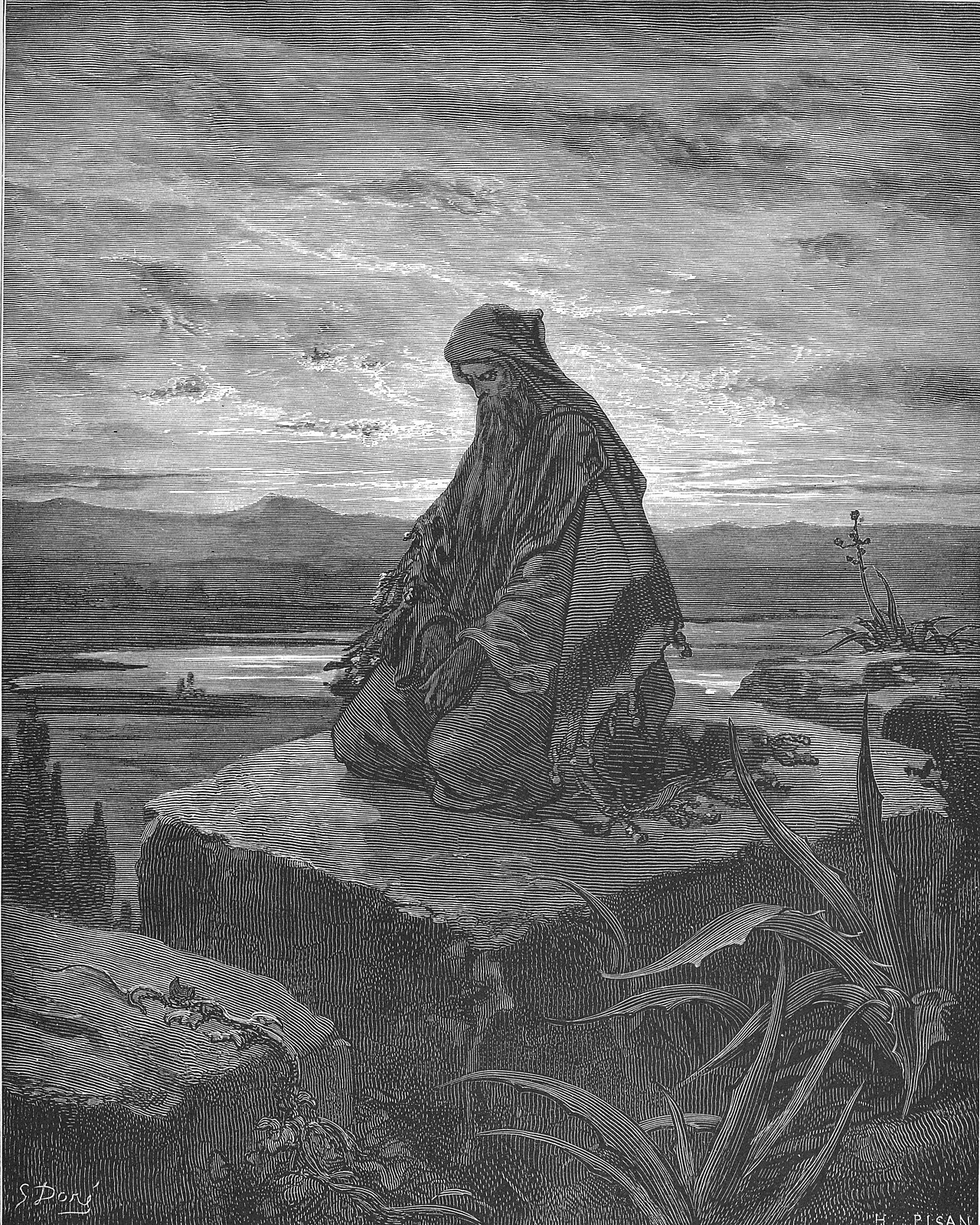
Isaiahchapter 5
30 verses · Isaiah · 8th century BC · The Prophets
For the vineyard of the LORD of Hosts is the house of Israel, and the men of Judah are the plant of His delight. He looked for justice, but saw bloodshed; for righteousness, but heard a cry of distress.
Introduction
Isaiah, The Prophets, Isaiah Overview.
Isaiah spoke this chapter to a festival crowd in Jerusalem in years when great estates were swallowing the family farms. Its first hearers knew vineyard work well, since the hills around them were terraced and cut with wine presses. It opens as a song for a friend and then becomes a verdict, followed by a series of woes. Listen for the moment the song stops being about a vineyard. Count the woes and notice what each one names. Mark the stretched out hand at the close, because the book will return to it. The chapter shows how God weighs a people by the fruit they bear.
Context
- Who
- Landowners, judges, and the wine-drinking class of the capital
- What
- A song of a vineyard that yields only sour grapes, applied to Israel and Judah, followed by six woes and a summons of a distant nation.
- Where
- Jerusalem and the land of Judah, among its vineyards, estates and courts.
- When
- The years of Uzziah and Jotham, about 740 to 730 BC, with the foreign army of the close answering to Assyria.
- Why
- To bring the hearers to condemn the vineyard and then show them it was their own nation, guilty of injustice, greed and pride.
Historical context
Every step of the vineyard song is real work. A Judean hillside had to be cleared of stones, and the stones went into terrace walls that held the soil. A hedge of thorn or a low stone wall kept out foxes and wild pigs. A tower of piled stone gave the watchman a view and a place to sleep at harvest. And the press was cut straight down into the bedrock: a shallow treading floor with a channel running to a lower catch basin. Hundreds of these rock-cut presses are still visible in the Judean hills. Anyone listening had worked in one.
Show the rest of the historical context, 3 more paragraphs
The first woe names the crime the whole book keeps circling. Joining house to house and field to field means buying up the neighbors, usually through debt, until one family owns the valley. Israel's law tied every family to an inherited plot that was not supposed to be sold off permanently, so consolidating land was not shrewd business; it was the dismantling of the nation's design.
The judgment is delivered in dry measurements, which is how a farmer feels a disaster. Ten acres of vineyard will make one bath of wine, about six gallons, a laughable yield. A homer of seed will return an ephah, one tenth of what was sown. You would eat less than you planted.
The chapter closes with the sound of the Assyrian army before anyone in Judah had met it: arrows sharpened, bows strung, horse hooves like flint, chariot wheels like a whirlwind, and not one man in the ranks stumbling or loosening his belt. Assyrian reliefs show exactly that army. God says he will whistle for them the way a beekeeper whistles up a swarm.
Significance
The crowd was set up. A love song about a vineyard invites you to take the owner's side, and the audience would have been nodding along and condemning the useless vines, until the last verse names the vineyard as the house of Israel.
Show the rest of the significance, 1 more paragraph
The punchline turns on a pair of words that nearly rhyme in Hebrew: he looked for justice, and got bloodshed; for righteousness, and got a cry. One syllable apart, and a whole nation's difference.
This chapter in Jewish lifeWhat this chapter is in Jewish life and reading.
What is done
No part of this chapter is read in the synagogue. Probed for this lane, the site's own table in src/lib/hebraic/readings.ts printed parashot 0 and haftarah uses 0 for Isaiah 5, and no festival reading for the book. Across chapters 1 to 22 of Isaiah the same probe found a Haftarah only in chapters 1, 6, 7 and 9.
How it is read
Rashi is the main commentator on this chapter in the corpus, quoted here from The Judaica Press complete Tanach with Rashi, translated by A. J. Rosenberg, which Sefaria reports as CC-BY. Ibn Ezra is quoted from the Commentary of Ibn Ezra on Isaiah, translated by M. Friedlander in 1873, which Sefaria reports as Public Domain.
The song of the vineyard is read as the prophet singing on God's behalf, "for my beloved and in his place and as his messenger" (Rashi on Isaiah 5:1:1). The vineyard is Israel. "To this vineyard are you compared, O House of Israel" (Rashi on Isaiah 5:7:1). Ibn Ezra reads the fourth verse as God asking "What good thing is left to be done for the vineyard that I have not yet done?" (Ibn Ezra on Isaiah 5:4:1).
Rashi sets the six woes of the chapter against the Psalms. There are twenty-two instances of "fortunate" in the Book of Psalms for those who keep the Torah, and Isaiah answers with twenty-two woes (Rashi on Isaiah 5:8:1). The punishment is read as measure for measure: those who opened their mouths to swallow food and drink are met by the nether world that opens to swallow them (Rashi on Isaiah 5:14:1).
The cords of the eighteenth verse are the evil inclination, drawn in little by little, "at first with ropes of nothingness, like the thread of a spider web" (Rashi on Isaiah 5:18:1). On calling evil good Rashi reads the twentieth verse as praise of idolatry and contempt for the worship of the Holy One (Rashi on Isaiah 5:20:1).
What the rabbis say
The corpus carries 40 rabbinic locators on the verses of this chapter, 6 in the Talmud and 34 in the Midrash. It carries the text of none, so each is cited by ref here and never quoted or paraphrased. The verse numbers are the Hebrew ones the corpus prints.
On verse 1 it holds Avot DeRabbi Natan, Recension B 43:20 and Eikhah Rabbah 2:6. On verse 2 it holds Bereshit Rabbah 19:12 and Jerusalem Talmud Rosh Hashanah 2:3:2. On verse 3 it holds Aggadat Bereshit 2:2 and Midrash Tanchuma Buber, Appendix to Sh'lach 15:5. On verse 4 it holds Bamidbar Rabbah 16:24 and Midrash Tanchuma Buber, Appendix to Sh'lach 3:1. On verse 5 it holds Jerusalem Talmud Bava Kamma 1:1:2 and Mekhilta DeRabbi Shimon Ben Yochai 22:4.
On verse 6 it holds Bereshit Rabbah 21:8 and Bereshit Rabbati, Parashat Vayechi 57. On verse 7 it holds Aggadat Bereshit 34:1 and Bereshit Rabbati, Parashat Vayeshev 36. On verse 8 it holds Bereshit Rabbah 68:13 and Eikhah Rabbah, Petichta 22. On verse 9 it holds Berakhot 58b:4 and Ein Yaakov (Glick Edition), Berakhot 9:10. On verse 11 it holds Bereshit Rabbah 36:4 and Ein Yaakov (Glick Edition), Shabbat 16:19.
On verse 12 it holds Ein Yaakov (Glick Edition), Shabbat 7:3 and Ein Yaakov, Shabbat 7:5. On verse 13 it holds Bamidbar Rabbah 3:6 and Ein Yaakov (Glick Edition), Sanhedrin 11:14. On verse 14 it holds Aggadat Bereshit 20:3 and Bereshit Rabbati, Parashat Vayishlach 20. On verse 15 it holds Midrash Tehillim 8:6. On verse 16 it holds Berakhot 12b:3 and Bereshit Rabbati, Parashat Vayetze 34.
On verse 17 it holds Eikhah Rabbah 1:33. On verse 18 it holds Berakhot 24b:20. On verse 19 it holds Aggadat Bereshit 20:2. On verse 20 it holds Ein Yaakov (Glick Edition), Sotah 7:35. On verse 21 it holds Bereshit Rabbati, Parashat Toldot 10.
On verse 22 it holds Bamidbar Rabbah 10:8. On verse 23 it holds Bereshit Rabbah 65:5. On verse 24 it holds Bamidbar Rabbah 7:5. On verse 25 it holds Midrash Sekhel Tov, Shemot 7:5:2. On verse 28 it holds Midrash Lekach Tov on Lamentations 1:6:1.
On verse 30 it holds Midrash Sekhel Tov, Bereshit 19:23:4.
What each of them teaches is a saying of the rabbis, and is reported as theirs wherever this site quotes one. The quotations wait on a fetch that carries the text.
Sources: Rashi, Rashi on Isaiah 5:1:1 to 5:24:1, The Judaica Press complete Tanach with Rashi, translated by A. J. Rosenberg, reported CC-BY; Ibn Ezra, Ibn Ezra on Isaiah 5:3:1 to 5:21:1, Commentary of Ibn Ezra on Isaiah - trans. by M. Friedlander, 1873, reported Public Domain; The Sefaria corpus, scripts/data/sources/sefaria/isaiah/5.json, the 40 Talmud and Midrash locators on the verses of this chapter; The site's own files, src/lib/hebraic/readings.ts, probed for Isaiah 5: parashot 0, haftarah uses 0, and no festival reading for the book.
The heads below are this chapter's scenes. The numbered points under each are its verses.
The Song of the Vineyard That Yielded Wild Grapes
Isaiah 5:1-2
I will sing for my beloved: The vineyard song opens as a love song for a friend. The owner waited for good grapes and the vineyard gave sour fruit, and every act of care named makes that failure worse. The song lays out this care as evidence before verse 3 asks for a verdict.
Isaiah 5:1
“Now will I sing - This is an indication that what follows is poetic, or is adapted to be sung or chanted. To my well-beloved - The word used here - ידיד yedı̂yd - is a term of endearment. It properly denotes a friend; a favorite; one greatly beloved. It is applied to saints as being the beloved, or the favorites of God, in Psa 127:2; Deu 33:12. In this place, it is evidently applied to Yahweh, the God of the Jewish people.”
1 more voice on this verseWhat preachers and commentators have said about this verse, in their own words.
Isaiah 5:1
“WE recognize at once that Jesus is here. Who but He can be meant by, "My Well-Beloved"? Here is a word of possession and a word of affection—He is mine, and my Well-Beloved. He is loveliness, itself, the most loving and lovable of beings—and we personally love Him with all our heart, mind, soul and strength—He is ours, our Beloved, our Well-Beloved! We can say no less.”
Charles Spurgeon · written before 1892 · The Metropolitan Tabernacle Pulpit, Sermon No. 3319: “The Well-beloved's Vineyard” (lightly modernized text, CCEL edition)Particular Baptist
planted the finest vines: Clarke notes that clearing the stones was ordinary good husbandry, so each task here is one a real vinedresser did. Jerome's text keeps the Hebrew name of the vine, Sorec. A watchtower and a winepress were built for a harvest, and verse 7 names the sour fruit as bloodshed.
Isaiah 5:3-4
The song turns from story to trial, as the LORD asks Jerusalem and Judah to "judge between Me and My vineyard" in their own case. The question "What more could I have done for My vineyard" is the argument. The parable Jesus told at Matthew 21:33 takes up this setup.
What more could I have done for My vineyard: The owner asks the judges what he left undone. Barnes lists what God had given Judah: His choice of them, His law, His prophets and teachers, and His defense. Aquinas sets the question beside Micah 6:3, where the LORD asks His people what He has done to them.
Isaiah 5:4
“God has done all that could be done for the salvation of sinners, consistently with His justice and goodness. The God of nature is, as it were, amazed at the unnatural fruit of so well-cared a vineyard.”
Jamieson, Fausset & Brown · Commentary Critical and Explanatory on the Whole Bible (1871)reformed
Isaiah 5:5-7
Now I will tell you: The sentence follows the trial: the hedge taken away. Verse 7 gives the song its own interpretation, "the vineyard of the LORD of Hosts is the house of Israel." The closing line turns on Hebrew words that nearly rhyme with opposite meanings, a wordplay Delitzsch and Barnes both set out.
Isaiah 5:5
“Go to - The Hebrew word here is one that is commonly rendered, ‘I pray you,’ and is used “to call the attention to” what is said. It is the word from which we have derived the adverb “now,” נא nā'. I will take away the hedge - A “hedge” is a fence of thorns, made by suffering thorn-bushes to grow so thick that nothing can pass through them.”
1 more voice on this verse
Isaiah 5:5
"That which completes its woe is that the dews of heaven shall be withheld; he that has the key of the clouds will command them that they rain no rain upon it, and that alone is sufficient to run it into a desert." Note, God in a way of righteous judgment, denies his grace to those that have long received it in vain.
Matthew Henry · Commentary on the Whole Bible (1707-1721)puritan
I will command the clouds: Here the parable slips. No farmer can command the clouds that rain shall fall, so Barnes takes the Owner of the vineyard to be the LORD of Hosts. Jerome took the clouds as the prophets, whose word Israel would lose.
Isaiah 5:6
“See then how very bad sinning is, that they may be delivered to Satan, who holds captive the souls of those forsaken by God—though God does not forsake without cause or judgment those whom he has abandoned. For when he sends the rain for the vineyard and the vineyard bears thorns instead of grapes, what else will God do except order the clouds not to sprinkle rain on the vineyard?”
Origen of Alexandria · written before 253 · Homilies on Jeremiah 1:4patristic
1 more voice on this verse
Isaiah 5:6
“There shall come up briers and thorns “The thorn shall spring up in it” - One MS. has בשמיר beshamir. The true reading seems to be בו שמור bo shamir, which is confirmed by the Septuagint, Syriac, and Vulgate.”
Adam Clarke · Commentary on the Bible (1810-1826)evangelical
He looked for justice, but saw bloodshed: The verse ends on a play of Hebrew sounds. Justice is mishpat and bloodshed is mispach, and righteousness is tsedakah and a cry is tseakah. Clarke and Jamieson, Fausset and Brown mark the pairs, where a change of sound turns the fruit the owner wanted into the fruit he found.
Isaiah 5:7
“The play upon words is striking in the Hebrew, He looked for mishpat, but behold mispat ("bloodshed"); for tsedaqua, but behold tseaqua (the cry that attends anarchy, covetousness, and dissipation, Isa 5:8, 11, 12; compare the cry of the rabble by which justice was overborne in the case of Jesus Christ, Mt 27:23, 24).”
Jamieson, Fausset & Brown · Commentary Critical and Explanatory on the Whole Bible (1871)reformed
Woe to Those Who Join House to House
Isaiah 5:8-10
Woe to you who add: The first woe falls on the wealthy who add house to house, a sin the older commentators read against the land laws. The answer comes from the LORD of Hosts Himself. Ten acres yield one bath of wine, and a homer of seed yields an ephah, a tenth.
Isaiah 5:8
“The jubilee restoration of possessions was intended as a guard against avarice. till there be no place--left for any one else. that they may be--rather, and ye be. the earth--the land.”
Jamieson, Fausset & Brown · Commentary Critical and Explanatory on the Whole Bible (1871)reformed
2 more voices on this verse
Isaiah 5:8
“Not that it is a sin for those who have a house and a field, of they have wherewithal, to purchase another; but 1. Their fault is, (1.) That they are inordinate in their desires to enrich themselves, and make it their whole care and business to raise an estate, as if they had nothing to mind, nothing to seek, nothing to do, in this world, but that.”
Matthew Henry · Commentary on the Whole Bible (1707-1721)puritan
Isaiah 5:8
“Wo unto them that - lay field to field “You who lay field unto field” - Read תקריבו takribu, in the second person; to answer to the verb following. So Vulgate.”
Adam Clarke · Commentary on the Bible (1810-1826)evangelical
I heard the LORD of Hosts declare: The Hebrew puts these words in the prophet's ears, and Barnes takes it that the LORD of Hosts spoke the sentence to Isaiah. Clarke compares 22:14. The desolate houses answer the woe of 5:8 on those who add house to house.
Isaiah 5:9
“In mine ears - This probably refers to the prophet. As if he had said, ‘God has revealed it to me,’ or ‘God has said in my ears,’ i. e, to me. The Septuagint reads it, ‘These things are heard in the ears of the Lord of hosts,’ that is, the wishes” of the man of avarice. The Chaldee, ‘The prophet said, In my ears I have heard; a decree has gone from the Lord of hosts,’ etc. Many houses shall be desolate - Referring to the calamities that should come upon the nation for its crimes.”
ten acres of vineyard: Wesley reckons a bath at about eight gallons, so each acre yields less than one. An ephah is a tenth of a homer. Barnes reads the failed harvest as the reason the great houses of verse 9 stand empty.
Isaiah 5:10
“The bath contained about eight gallons. Thus an acre did not yield one gallon. An ephah - Which was of the same quantity with the bath, only the bath was the measure of liquid things, the ephah of dry things; and a ephah was the tenth part of an homer.”
John Wesley · Explanatory Notes upon the Old Testament (1765)evangelical
1 more voice on this verse
Isaiah 5:10
“Yea, ten acres - In this verse a reason is rendered why the houses mentioned in the previous verse should become desolate. The reason is, that the land would become sterile and barren, as a divine judgment for their oppression. To what particular time the prophet refers, here, is not apparent. It is certain, however, that the land of Canaan was frequently given up to sterility. The withholding of the early and latter rains, or the neglect of cultivation from any cause, would produce this.”
Isaiah 5:11-14
Woe to those who rise early: The second woe turns to drinking, men who rise early for strong drink and linger until wine inflames them. The charge falls on the blindness drink produces, a people entertained past noticing their own coming exile. Sheol "opens wide its enormous jaws," and down go the nobles and revelers.
Isaiah 5:11
“As Christ pronounces a woe against those that are rich, so also against those that laugh now and are full ( Luke vi. 24, 25 ), and fare sumptuously, Luke xvi. Who the sinners are against whom this woe is denounced.”
Matthew Henry · Commentary on the Whole Bible (1707-1721)puritan
They disregard the actions of the LORD: The feast has music for every hour and no thought for what God is doing. Wesley reads the work of His hands as the judgments already falling on Judah and those still threatened. Verse 13 names the result as exile for lack of understanding.
Isaiah 5:12
“The harp - They give up themselves wholly to luxury. The work - What God hath lately done, and is yet doing, and about to do among them; his grievous judgments, partly inflicted, and partly threatened, which required another course of life.”
John Wesley · Explanatory Notes upon the Old Testament (1765)evangelical
My people will go into exile: The Hebrew verb is past, and Gill and Barnes take it as the prophet seeing the exile as done. The feasters of 5:12 are the dignitaries now starving. Clarke joins the wine of those feasts to this hunger and thirst.
Isaiah 5:13
“Therefore my people are gone into captivity,.... Or rather, as Kimchi explains it, "shall go into captivity"; the past for the future; for this cannot be understood even of the captivity of the ten tribes, for they were not carried captive until the sixth year of Hezekiah's reign, 2Ki 17:6 whereas this prophecy was delivered out many years before, even in the time of Uzziah, as is manifest from the following chapter, Isa 6:1 and much less it cannot design the captivity of Judah, but respects the captivity by the Romans, in future time.”
1 more voice on this verse
Isaiah 5:13
“Therefore my people are gone - This is evidently used with reference to the “future.” The prophet described events as “passing before his eyes” as a vision (note, Isa 1:1); and he here seems to “see” the people going into captivity, and describes it as an event actually occurring. Into captivity - Referring, doubtless, to the captivity at Babylon. Because they have no knowledge - Because they do not choose to retain the knowledge of God.”
Sheol enlarges its throat: Sheol is the Hebrew name for the place of the dead, which Barnes sets beside the Greek Hades. Its throat opens wide for the revelers who drank wine at their feasts in 5:11 and 12. Numbers 16:30 tells of the ground opening its mouth.
Isaiah 5:14
“Therefore hell - The word transated “hell,” שׁאול she'ôl, has not the same meaning that we now attach to that word; its usual signification, among the Hebrews, was “the lower world, the region of departed spirits.” It corresponded to the Greek ἅδης Hadēs, “hades,” or place of the dead.”
1 more voice on this verse
Isaiah 5:14
“Greek, hades; "the unseen world of spirits." Not here, "the place of torment." Poetically, it is represented as enlarging itself immensely, in order to receive the countless hosts of Jews, which should perish (Nu 16:30). their--that is, of the Jewish people. he that rejoiceth--the drunken reveller in Jerusalem.”
Jamieson, Fausset & Brown · Commentary Critical and Explanatory on the Whole Bible (1871)reformed
Isaiah 5:15-17
So mankind will be brought low: The leveling touches every rank, mankind brought low and the arrogant lowering their eyes, while "the LORD of Hosts will be exalted by His justice." Lambs grazing "in the ruins of the wealthy" picture the land gone back to pasture, the reverse of the tended vineyard that opened the chapter.
Isaiah 5:15
“And the mean man ... the mighty man - The expressions here mean that “all” ranks would be subdued and punished; see the note at Isa 2:9. The eyes of the lofty ... - see Isa 2:11, note; Isa 2:17, note. Shall be exalted in judgment - In his justice; he shall so manifest his justice as to be exalted in the view of tbe people. Shall be sanctified - Shall be “regarded” as holy. He shall so manifest his righteousness in his dealings, that it shall be seen and felt that he is a holy God.”
the holy God will show Himself holy in righteousness: Mankind is brought low in verse 15 and the LORD is exalted here, by the same judgment. Wesley reads it as God shown to be holy by His righteous judgments. Isaiah hears the seraphim cry that holiness in 6:3.
Isaiah 5:16
“God shall be "exalted" in man's view, because of His manifestation of His "justice" in punishing the guilty. sanctified--regarded as holy by reason of His "righteous" dealings.”
Jamieson, Fausset & Brown · Commentary Critical and Explanatory on the Whole Bible (1871)reformed
1 more voice on this verse
Isaiah 5:16
“Exalted - By the execution of this just judgment. Sanctified - Shall appear to be an holy God, by his righteous judgments.”
John Wesley · Explanatory Notes upon the Old Testament (1765)evangelical
strangers will feed in the ruins of the wealthy: The verse is taken two ways. Wesley saw the poor, left in the land when the wealthy went into exile, grazing lambs in their ruins. Jamieson, Fausset and Brown took the strangers as the Gentiles, and Clarke gives the Septuagint reading of lambs for strangers.
Isaiah 5:17
“Then shall the lambs feed - This verse is very variously interpreted. Most of the Hebrew commentators have followed the Chaldee interpretation, and have regarded it as desired to console the pious part of the people with the assurance of protection in the general calamity. The Chaldee is, ‘Then the just shall feed, as it is said, to them; and they shall be multiplied, and shall possess the property of the inpious.’ By this interpretation, “lambs” are supposed, as is frequently the case in the Scriptures, to represent the people of God.”
2 more voices on this verse
Isaiah 5:17
“Then - When God shall have finished that work of judgment. The lambs - The poor and harmless people, who shall be left in the land when the rich are carried into captivity. Manner - Or, by their fold, as this word is manifestly used, Micah ii, 12, the only place of scripture, except this, in which this word is found.”
John Wesley · Explanatory Notes upon the Old Testament (1765)evangelical
Isaiah 5:17
“THE sense of this passage may be that Judea would be so desolated that it would become rather a wild wilderness pasture for flocks than an inhabited country. But that is not the meaning which the old readers of the Bible were accustomed to give to it. The Hebrew commentators considered "the lambs" to mean the house of Israel and regarded this as a promise that in all times of distress and affliction, God's flock would still be fed—there would still be a people kept alive and these should still meet with suitable support.”
Charles Spurgeon · written before 1892 · The Metropolitan Tabernacle Pulpit, Sermon No. 3199: “How the Lambs Feed” (lightly modernized text, CCEL edition)Particular Baptist
Woe to Those Who Call Evil Good
Isaiah 5:18-19
Woe to those who draw iniquity: The third woe pictures sin as a load, wrongdoing so practiced it no longer feels like effort. The mockers say "Let Him hurry and hasten His work." Their taunt names "the Holy One of Israel," the title behind the cry of the seraphim at 6:3.
Isaiah 5:18
“For the righteous Lord will cut in sunder the cords of the wicked, Ps. cxxix. They are by long custom and confirmed habits so hardened in sin that they cannot get clear of it. Those that sin through infirmity are drawn away by sin; those that sin presumptuously draw iniquity to them, in spite of the oppositions of Providence and the checks of conscience.”
Matthew Henry · Commentary on the Whole Bible (1707-1721)puritan
1 more voice on this verse
Isaiah 5:18
“With a cart-rope “As a long cable” - The Septuagint, Aquila, Sym., and Theod., for בחבלי bechabley, read כחבלי kechahley, ὡς σχοινιῳ, or σχοινιοις; and the Septuagint, instead of שוא shau, read some other word signifying long; ὡς σχοινιῳ μακρῳ; and so likewise the Syriac, אריכא arecha. Houbigant conjectures that the word which the Septuagint had in their copies was שרוע sarua, which is used Lev 21:18, Lev 22:23, for something in an animal body superfluous, lengthened beyond its natural measure.”
Adam Clarke · Commentary on the Bible (1810-1826)evangelical
The scoffers of 5:18 dare the Holy One of Israel to hurry His work, and Barnes takes their words as defiance. Henry sets them beside the mockers of 2 Peter 3:4. The LORD answers in 5:26, where the nations come speedily and swiftly.
Isaiah 5:19
“Let him - God, in whose name thou and other prophets are always threatening us. This was the plain language of their actions; they lived as if they were of this opinion.”
John Wesley · Explanatory Notes upon the Old Testament (1765)evangelical
Isaiah 5:20-21
Woe to those who call evil: The fourth woe falls on those who "call evil good and good evil," turning darkness to light and bitter to sweet. The fifth woe follows, on those "wise in their own eyes," and sets that self-made wisdom beside the reversal of good and evil.
Isaiah 5:20
“Woe unto them that call evil good, and good evil,.... That call evil actions good, and good actions evil; that excuse the one, and reproach the other; or that call evil men good, and good men evil; to which the Targum agrees.”
1 more voice on this verse
Isaiah 5:20
“Fourth Woe--against those who confound the distinctions of right and wrong (compare Ro 1:28), "reprobate," Greek, "undiscriminating: the moral perception darkened." bitter . . . sweet--sin is bitter (Jer 2:19; Heb 12:15); though it seem sweet for a time (Pr 9:17, 18). Religion is sweet (Ps 119:103).”
Jamieson, Fausset & Brown · Commentary Critical and Explanatory on the Whole Bible (1871)reformed
wise in their own eyes: This woe follows 5:20, and Gill joins them: those wise in their own eyes are the men who call evil good. Barnes sets it beside Proverbs 3:7. Romans 12:16 gives the same warning.
Isaiah 5:21
“Woe unto therm that are wise in their own eyes,.... And yet betray such stupidity and sottishness, as to call things by their wrong names; and make such a perverse judgment of them, as before described. This is a true description of the Scribes and Pharisees in Christ's time; who said, "dost thou teach us? are we blind also?" Joh 9:34. and prudent in their own sight; being wise above what was written; leaving the word of God, and following the traditions of the elders.”
1 more voice on this verse
Isaiah 5:21
“Wo unto them that are wise ... - This is the fifth crime specified. It refers to those who are inflated with a false opinion of their own knowledge, and who are, therefore, self-confident and vain. This is expressly forbidden; Pro 3:7: ‘Be not wise in thine own eyes;’ compare Pro 26:12. In their own eyes - In their own opinion, or estimation. And prudent - Knowing; self-conceited. This was, doubtless, one characteristic of the times of Isaiah.”
Isaiah 5:22-24
Woe to those who are heroes: The sixth woe returns to drink, paired with a courtroom sin, as the "heroes in drinking wine" also "acquit the guilty for a bribe." Verse 24 gathers the six woes into one verdict. The reason closes the series: they "have rejected the instruction of the LORD of Hosts."
Isaiah 5:22
Mighty to drink wine - “They show not,” says Kimchi, “their strength in combating their enemies, but in drunkenness and debauchery.”
Adam Clarke · Commentary on the Bible (1810-1826)evangelical
1 more voice on this verse
Isaiah 5:22
“The two verses are closely joined [MAURER]. mingle strong drink--not with water, but spices to make it intoxicating (Pr 9:2, 5; So 8:2). take away the righteousness--set aside the just claims of those having a righteous cause.”
Jamieson, Fausset & Brown · Commentary Critical and Explanatory on the Whole Bible (1871)reformed
who acquit the guilty for a bribe: The drinkers of verse 22 sit as judges, and Barnes reads the verse as a charge against the magistrates. Jerome counts it among the sour grapes of the vineyard in verse 4. Exodus 23:8 had forbidden the bribe that blinds the clear-sighted.
Isaiah 5:23
“They justify the wicked for reward, and find some pretence or other to clear him from his guilt and shelter him from punishment; and they condemn the innocent, and take away their righteousness from them, that is, overrule their pleas, deprive them of the means of clearing up their innocency, and give judgment against them.”
Matthew Henry · Commentary on the Whole Bible (1707-1721)puritan
1 more voice on this verse
Isaiah 5:23
“Which justify - This refers, doubtless, to magistrates. They gave unjust decisions. For reward - For bribes. And take away the righteousness - That is, they do not decide the cause in favor of those who have just claims, but are determined by a bribe; see the note at Isa 1:23. It is remarkable, that this is introduced in immediate connection with their being mighty to mingle strong drink.”
Therefore, as a tongue of fire: The Hebrew calls the flame a tongue of fire, a figure Clarke and Gill both take from its shape. The roots decay and the blossoms blow away like dust, the picture of a tree past recovery. The cause stands last, in the rejected instruction of the LORD of Hosts.
Isaiah 5:24
“Therefore as the fire devoureth the stubble,.... Or "tongue of fire" (h); meaning the flame, the same as in the next clause; because it is in the form of a tongue; see Act 2:3, and the flame consumeth the chaff; which is done easily, speedily, and entirely; the metaphors denote that their destruction would be easy, swift, sudden, irresistible, and irrecoverable.”
2 more voices on this verse
Isaiah 5:24
“The flame “The tongue of fire” - “The flame, because it is in the shape of a tongue; and so it is called metaphorically.” Sal. ben Melec. The metaphor is so exceedingly obvious, as well as beautiful, that one may wonder that it has not been more frequently used. Virgil very elegantly intimates, rather than expresses, the image; - Ecce levis summo de vertice visus Iuli Fundere lumen apex; tactuque innoxia molli Lambere flamma comas, et circum tempora pasci. Aen.”
Adam Clarke · Commentary on the Bible (1810-1826)evangelical
Isaiah 5:24
“Rottenness - They shall be like a tree which not only withers in its branches, but dies and rots at the roots, therefore is past recovery. Dust - Shall be resolved into dust, and yield no fruit.”
John Wesley · Explanatory Notes upon the Old Testament (1765)evangelical
Therefore the anger of the LORD: The judgment has already begun, with the hand of the LORD raised. The verse closes on a refrain, "His anger is not turned away; His hand is still upraised." The refrain binds this chapter to the judgments ahead, each recurrence saying the hand has not yet been withdrawn.
Isaiah 5:25
“Therefore is the anger of the Lord kindled - The Lord is “enraged,” or is angry. Similar expressions often occur; Num 11:33; 2Ki 23:26; Deu 11:17; Psa 56:1-13:40; Job 19:11; Psa 2:12. The “cause” of his anger was the crimes which are specified in this chapter. And he hath stretched forth his hand - To stretch forth the hand may be an action expressive of protection, invitation, or punishment. Here it is the latter; compare Isa 14:27. And hath smitten them - Punished them. To what this refers particularly is not clear.”
A Whistle for a Nation from Far Away
Isaiah 5:26-30
He lifts a banner for: The chapter names the instrument of judgment without naming a nation, a banner lifted for "the distant nations." The older commentators read the sharpened arrows as the Assyrian army, named only in later chapters. The chapter that opened with a love song for a vineyard ends in "darkness and distress."
Isaiah 5:26
“The ulterior fulfilment took place in the siege under Roman Titus. Compare "end of the earth" (De 28:49, &c.). So the pronoun is singular in the Hebrew, for "them," "their," "whose" (him, his, &c.), Isa 5:26-29; referring to some particular nation and person [HORSLEY].”
Jamieson, Fausset & Brown · Commentary Critical and Explanatory on the Whole Bible (1871)reformed
2 more voices on this verse
Isaiah 5:26
“An ensign - To call them together for his service. From far - To the Chaldeans; for even Babylon is called a far country, chap. xxxix, 3. And he saith nations, because the Chaldean army was made up of several nations.”
John Wesley · Explanatory Notes upon the Old Testament (1765)evangelical
Isaiah 5:26
“He will - hiss “He will hist” - “The metaphor is taken from the practice of those that keep bees, who draw them out of their hives into the fields, and lead them back again, συρισμασι, by a hiss or a whistle.” - Cyril, on this place; and to the same purpose Theodoret, ib.”
Adam Clarke · Commentary on the Bible (1810-1826)evangelical
No belt is loose: The nations the LORD whistles for in 5:26 come with no man weary. Clarke takes the lines as a picture of courage in the march. Jerome says the army comes at the will of the LORD.
Isaiah 5:27
“Nor sleep - They shall all be watchful and diligent to take all opportunities of executing my judgments. Nor latchet - I will take all impediments out of their way.”
John Wesley · Explanatory Notes upon the Old Testament (1765)evangelical
The hooves of their horses are like flint: Iron horseshoes were unknown to the ancients, Clarke says, so the hooves themselves had to be hard as flint. Wesley takes the flint as horses the rough way cannot break. Their bows are strung before they come.
Isaiah 5:28
“Their horses’ hoofs shall be counted like flint “The hoofs of their horses shall be counted as adamant” - The shoeing of horses with iron plates nailed to the hoof is quite a modern practice, and was unknown to the ancients, as appears from the silence of the Greek and Roman writers, especially those that treat of horse medicine, who could not have passed over a matter so obvious and of such importance that now the whole science takes its name from it, being called by us farriery.”
Adam Clarke · Commentary on the Bible (1810-1826)evangelical
1 more voice on this verse
Isaiah 5:28
“Bent - Who are every way furnished and ready for my work, waiting only for my command. Flint - Because they shall not be broken or battered by the length or stonyness and ruggedness of the way.”
John Wesley · Explanatory Notes upon the Old Testament (1765)evangelical
Their roaring is like that of a lion: Barnes hears the battle cry an army raised as it closed with its enemy. A lion that seizes its prey and carries it off leaves nothing to rescue. Verse 30 turns the roar into the roaring of the sea.
even the light will be obscured by clouds: Henry reads two looks here, one at the land and one at the sky, and both find darkness. Wesley notes that men in distress look up to the heavens and find no light there. Isaiah 8:22 ends with the same pair, distress and darkness.
Isaiah 5:30
“First, Look round to the earth, to the land, to that land that used to be the land of light and the joy of the whole earth, and behold darkness and sorrow, all frightful, all mournful, nothing hopeful. Secondly, Look up to heaven, and there the light is darkened, where one would expect to have found it. If the light is darkened in the heavens, how great is that darkness!”
Matthew Henry · Commentary on the Whole Bible (1707-1721)puritan
1 more voice on this verse
Isaiah 5:30
“If one look unto the land, etc. “And these shall look to the heaven upward, and down to the earth” - ונבט לארץ venibbat laarets. Και εμβλεψονται εις την γην.”
Adam Clarke · Commentary on the Bible (1810-1826)evangelical
Keep studying
People and groups1
Places1
Sources for this chapter
The summary
Jamieson, Fausset & Brown, Commentary Critical and Explanatory; John Calvin, Commentaries; John Wesley, Notes on the Old Testament and Matthew Henry, Complete Commentary.
The exposition
Adam Clarke, Commentary on the Bible; Albert Barnes; Franz Delitzsch, Biblical Commentary on the Prophecies of Isaiah; Jamieson, Fausset & Brown, Commentary Critical and Explanatory on the Whole Bible; Jerome; John Calvin, Commentary on the Book of the Prophet Isaiah; John Gill; John Wesley, Explanatory Notes upon the Old Testament; Matthew Henry, Commentary on the Whole Bible and Thomas Aquinas, Commentary on Isaiah.