
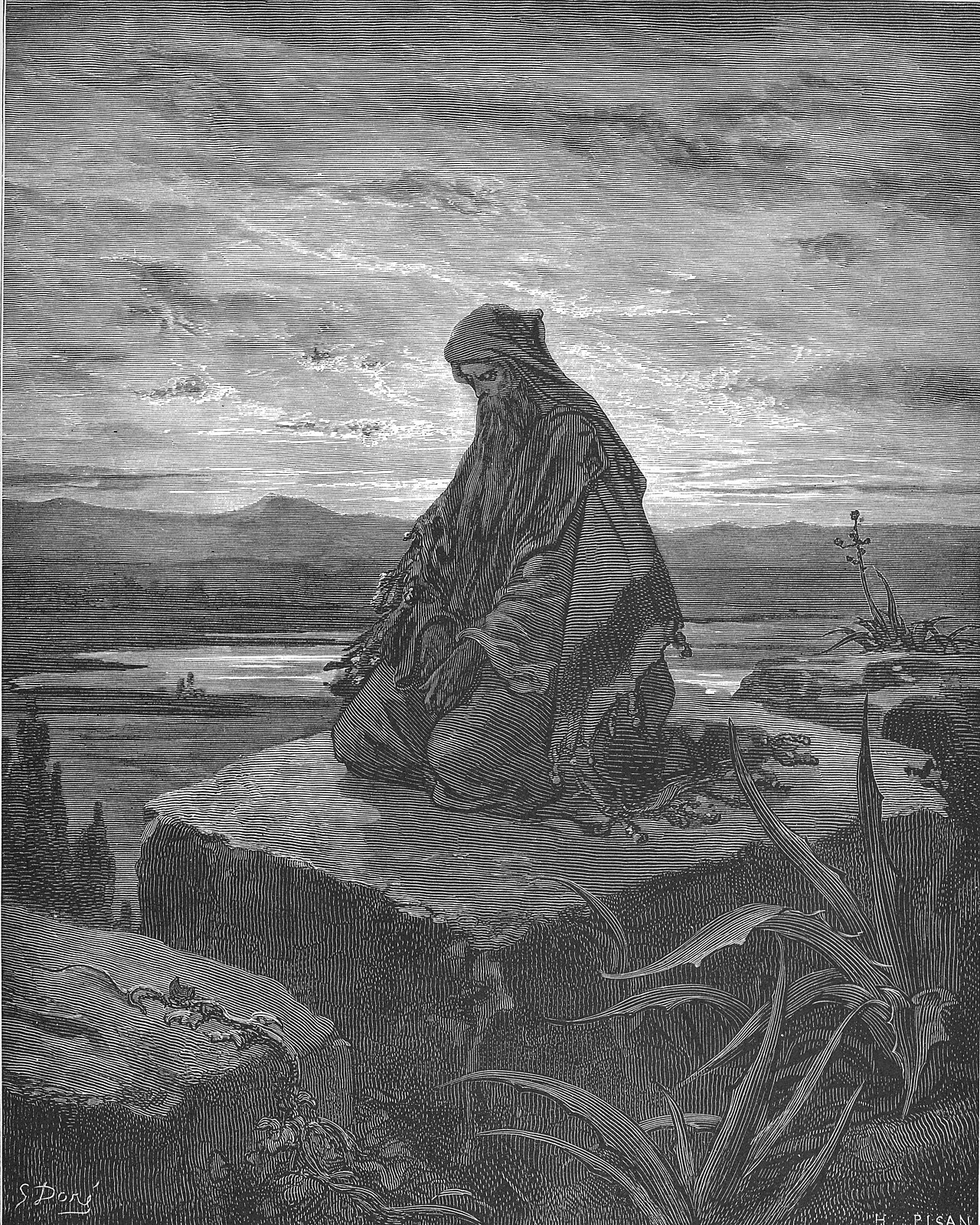
Isaiahchapter 23
18 verses · Isaiah · 8th century BC · The Prophets
He said, “You shall rejoice no more, O oppressed Virgin Daughter of Sidon. Get up and cross over to Cyprus—even there you will find no rest.”
Introduction
Isaiah, The Prophets, Isaiah Overview.
The last of Isaiah's oracles against the nations concerns Tyre, the Phoenician port that ran the shipping trade of the Mediterranean. Judeans bought its goods and knew its sailors, and many counted its wealth as a kind of safety. The chapter is written as a call to mourn, sent from port to port along the trade routes. Listen for the question of who planned Tyre's fall and the answer given. It ends with a period of seventy years and a surprising use for the city's profits.
Context
- Who
- Judeans who bought Phoenician goods and knew Phoenician sailors
- What
- An oracle on the fall of Tyre and Sidon, the trading cities of Phoenicia, and on Tyre's return to trade after seventy years.
- Where
- Tyre and Sidon on the Phoenician coast, with Cyprus, Egypt and Tarshish along the shipping lanes.
- When
- Most likely between about 715 and 701 BC, with a period of seventy years set before Tyre's return.
- Why
- To show that the LORD of Hosts humbles the pride of wealth, and that the richest trading city on earth stands under His rule.
Historical context
Tyre was a Phoenician port built partly on an island just off the coast, with a mainland town opposite, and it ran the Mediterranean. Its merchants shipped Lebanese cedar, worked metal, and above all purple cloth, a dye squeezed a drop at a time from the murex sea snail, so costly that it became the color of royalty everywhere. Mounds of crushed murex shells still mark the old dye works. Tyre planted colonies as far west as Cyprus, North Africa, and Spain.
Show the rest of the historical context, 4 more paragraphs
The news reaches the fleet before it reaches home. Ships of Tarshish, the big long-haul freighters, named for their westernmost run, hear the report at Cyprus on the way back and find they have no harbor to enter. That is how word traveled: from port to port, ahead of the ship.
The chapter calls Tyre the city whose merchants are princes and whose traders are the honored of the earth, and that was simply true. Phoenician trading houses had the wealth of kingdoms and none of the burden of armies. Isaiah says the LORD of hosts planned this to stain the pride of all glory and bring into contempt all the honored of the earth.
Then a seventy-year gap, described as the days of one king, a lifetime, the span of a single reign. Tyre paid tribute to Assyria, later held out against Nebuchadnezzar for thirteen years, and finally fell to Alexander in 332 BC, who took the island by building a causeway out to it from the rubble of the mainland city.
The image for the comeback is deliberately crude: an old prostitute taking up her harp and walking the city to be remembered. Trade resumes; the character does not change. But the last line does something unexpected, her profit will be set apart for the LORD, to feed and clothe those who live before him.
Significance
Judah's hearers watched the richest trading city on earth put in the same list as Moab and Damascus. Money is not a country's immunity.
Show the rest of the significance, 1 more paragraph
And with Tyre, the roll call of the nations closes. Every power a Judean could name, north, south, coast, and desert, has now been weighed. The next four chapters widen the frame to the whole earth.
This chapter in Jewish lifeWhat this chapter is in Jewish life and reading.
What is done
No part of this chapter is read aloud in the synagogue. The site's own table in src/lib/hebraic/readings.ts printed parashot 0 and haftarah uses 0 for Isaiah 23, and no festival reading for the book. The table records Isaiah only as a source of Haftarot, and none of the Haftarot it records reaches this chapter.
The chapter is met instead in the study of the weekly portions, and the corpus names the doors. Under the fifth verse it carries Midrash Tanchuma Buber, Bo 6:1, Midrash Tanchuma Buber, Vaera 15:1, Midrash Tanchuma, Bo 4:4 and Midrash Tanchuma, Vaera 13:4. Under the eighth verse it carries Midrash Tanchuma Buber, Masei 7:1. Under the eighteenth verse it carries Midrash Tanchuma Buber, Balak 23:2, Midrash Tanchuma Buber, Beshalach 14:3 and Midrash Tanchuma Buber, Toldot 24:2. Each of those locators is named for the Torah portion whose study it belongs to.
How it is read
Rashi is quoted here from The Judaica Press complete Tanach with Rashi, translated by A. J. Rosenberg, which Sefaria reports as CC-BY, and Ibn Ezra from the Commentary of Ibn Ezra on Isaiah translated by M. Friedlander in 1873, which Sefaria reports as public domain. Rashi reads the oracle as a lament over a trading city. Tarshish, he says, "is the name of the sea", and its ships grew rich carrying goods to Tyre (Rashi on Isaiah 23:1:1). Egypt's harvest was the revenue of Tyre, and when Tyre falls Zidon falls with it, since the two stood a day apart (Rashi on Isaiah 23:2:1 and 23:3:2). Ibn Ezra glosses the inhabitants of the isle as the inhabitants of Tyre (Ibn Ezra on Isaiah 23:2:1).
At the fourth verse Rashi gives the plain reading first, through the Aramaic of Jonathan, and then the reading of the Sages in the Aggadah. There the sea itself rebukes Zidon. The sea has no children to lose and still keeps the boundary of sand its Maker set, so Zidon, who has much to lose, should be the more ashamed (Rashi on Isaiah 23:4:2). The report of the fifth verse he reads as the report of the ten plagues and of Egypt drowned in the sea (Rashi on Isaiah 23:5:1).
Two notes carry a verdict. The land of the Chaldees "was not to be a people", and Rashi rests the reading on Tractate Sukkah 52b (Rashi on Isaiah 23:13:1). Tyre forgotten he reads as a harlot whose lovers have forgotten her, for want of merchants (Rashi on Isaiah 23:15:1). At the words holy to the Lord in the last verse he reads of the end: "The righteous are destined to plunder her when the king Messiah comes" (Rashi on Isaiah 23:18:1).
What the rabbis say
The corpus carries forty rabbinic locators on this chapter and the text of none, so each is cited by ref here and none is quoted or paraphrased. On the second verse it holds Sifrei Bamidbar 58:2 and Yalkut Shimoni on Torah 718:1. On the fourth verse it holds Midrash Tehillim 114:4, Pesikta Rabbati 22:1 and Sifrei Bamidbar 42:4. On the fifth verse it holds Midrash Lekach Tov, Exodus 10:24:1, Midrash Sekhel Tov, Shemot 15:14:2, Midrash Sekhel Tov, Shemot 15:21:20, Midrash Tanchuma Buber, Bo 6:1 and Midrash Tanchuma Buber, Vaera 15:1. The same verse also carries Midrash Tanchuma, Bo 4:4 and Midrash Tanchuma, Vaera 13:4. On the seventh verse it holds Bereshit Rabbah 61:7. On the eighth verse it holds Bamidbar Rabbah 23:10, Bava Batra 75a:5, Bereshit Rabbah 85:4, Ein Yaakov, Bava Batra 5:17, Ein Yaakov, Pesakhim 3:6 and Midrash Sekhel Tov, Bereshit 38:2:2. The same verse also carries Midrash Tanchuma Buber, Masei 7:1.
On the ninth verse it holds Ein Yaakov (Glick Edition), Sotah 1:45. On the eleventh verse it holds Midrash Sekhel Tov, Shemot 15:12:1 and Midrash Sekhel Tov, Shemot 7:5:2. On the thirteenth verse it holds Ein Yaakov, Sukkah 5:13, Jerusalem Talmud Taanit 3:4:5, Midrash Lekach Tov on Lamentations 3:14:1, Midrash Lekach Tov, Deuteronomy 32:21:1 and Midrash Mishlei 30:7. The same verse also carries Otzar Midrashim, Chuppah of Eliyahu, Chuppat Eliyahu Rabbah 189 and Pesikta DeRav Kahana 14:3. On the fifteenth verse it holds Ein Yaakov (Glick Edition), Sanhedrin 11:53 and Sanhedrin 99a:2. On the eighteenth verse it holds Bamidbar Rabbah 20:20, Ein Yaakov (Glick Edition), Pesakhim 10:19, Ein Yaakov, Pesakhim 10:29, Kohelet Rabbah 1:7:9, Midrash Tanchuma Buber, Balak 23:2 and Midrash Tanchuma Buber, Beshalach 14:3. The same verse also carries Midrash Tanchuma Buber, Toldot 24:2.
The corpus files one further locator under a verse number this chapter does not reach. The site's table in src/data/bible/chapter-verse-counts.json counts the chapter at 18 verses in the Berean Standard Bible. The corpus files Midrash Lekach Tov, Exodus 19:18:4 at the number 29. It is cited as the corpus files it, and the anchor is left for a check against the source. What each of them teaches is a saying of the rabbis, and it is reported as theirs wherever this site quotes one. The quotations wait on a fetch that carries the text.
Sources: Rashi, Rashi on Isaiah 23:1:1 to 23:18:1, The Judaica Press complete Tanach with Rashi, translated by A. J. Rosenberg, reported CC-BY; Ibn Ezra, Ibn Ezra on Isaiah 23:2:1 to 23:14:1, Commentary of Ibn Ezra on Isaiah, translated by M. Friedlander, 1873, reported public domain; The Sefaria corpus, scripts/data/sources/sefaria/isaiah/23.json, the 40 Talmud and Midrash locators of this chapter; The site's own files, src/lib/hebraic/readings.ts, printing no portion, no Haftarah and no festival reading for this chapter, and src/data/bible/chapter-verse-counts.json for the verse count.
The heads below are this chapter's scenes. The numbered points under each are its verses.
Howl, Ships of Tarshish: Tyre Is Laid Waste
Isaiah 23:1-5
the burden against Tyre: The last burden falls on Tyre, and the "ships of Tarshish" wail, for Tyre is "without house or harbor". Barnes and Delitzsch map the trade: "the harvest of the Nile was the revenue of Tyre". The sea itself speaks as a bereaved mother: "I have not been in labor".
Isaiah 23:1
“The burden of Tyre - (see the note at Isa 13:1) Howl - This is a highly poetic description of the destruction that was coming on Tyre. The ships of Tarshish traded there; and the prophet now addresses the ships, and calls upon them to lament because the commerce by which they had been enriched was to be destroyed, and they were to be thrown out of employ. Ye ships of Tarshish - (see the note at Isa 2:16).”
1 more voice on this verseWhat preachers and commentators have said about this verse, in their own words.
Isaiah 23:1
“Tyre was, according to this prophecy, destroyed; first by Nebuchadnezzar, and afterwards by Alexander the great. And tho' this prophecy seemed directly to respect the former destruction, yet it seems to have some reference to the latter also; only it is intimated, that after seventy years, Tyre should recover some former power and glory, before her second and final destruction.”
John Wesley · Explanatory Notes upon the Old Testament (1765)evangelical
Be silent, O dwellers of the coastland: The coastland is Tyre, a city on an island in the sea until Alexander joined it to the land in 332 BC, as Wesley notes. Its merchants and traders are told to be silent. Grief replaces the noise of the harbor.
Isaiah 23:2
“Be still - Hebrew. be silent, boast no more of thy wealth and power. The isle - Of Tyre, which was an island, 'till Alexander joined it to the continent. The title of islands is often given by the Hebrew to places bordering upon the sea.”
John Wesley · Explanatory Notes upon the Old Testament (1765)evangelical
2 more voices on this verse
Isaiah 23:2
“Be still “Be silent” - Silence is a mark of grief and consternation. See Isa 47:5. Jeremiah has finely expressed this image: - “The elders of the daughter of Zion sit on the ground, they are silent: They have cast up dust on their heads, they have girded themselves with sackcloth. The virgins of Jerusalem hang down their heads to the ground.” Lam 2:10.”
Adam Clarke · Commentary on the Bible (1810-1826)evangelical
Isaiah 23:2
“Zidon--of which Tyre was a colony, planted when Zidon was conquered by the Philistines of Ascalon. Zidon means a "fishing station"; this was its beginning. replenished--with wealth and an industrious population (Eze 27:3, 8, 23).”
Jamieson, Fausset & Brown · Commentary Critical and Explanatory on the Whole Bible (1871)reformed
the grain of Shihor: Shihor is a name for the Nile, and Clarke and Jamieson, Fausset and Brown trace it to a word for dark, after the black silt. Egypt grew the grain and Tyre carried and sold it. The ruin of the carrier would reach the grower.
Isaiah 23:3
“And by great waters - That is, by the abundant-waters, or the overflowing of the Nile. Tyre was the mart to which the superabundant productions of Egypt were borne (see Ezek. 27) The seed of Sihor - There can be no doubt that by ‘Sihor’ here is meant the river Nile in Egypt (see Jos 13:3; 1Ch 13:5; Jer 2:18). The word שׁחר shichor is derived from שׁחר shachar, “to be black” Job 30:30, and is given to the Nile from its color when it brings down the slime or mud by which Egypt is rendered so fertile.”
Be ashamed, O Sidon: Sidon was the older city, and Tyre began as its colony, so verse 12 calls Tyre the Virgin Daughter of Sidon. Barnes reads the call to shame as a mother told to mourn her daughter. The disgrace spreads along the whole Phoenician coast.
When the report reaches Egypt: Egypt sold its harvest through Tyre, so the news hurts its trade first. Henry and Jerome both add a second fear: a strong neighbor taken by siege warns Egypt that its own turn is near. Chapters 19 and 20 had already spoken that turn.
Isaiah 23:5
“As, &c.--rather, "When the report (shall reach) the people of Egypt, they shall be sorely pained at the report concerning Tyre" (namely, its overthrow). So JEROME, "When the Egyptians shall hear that so powerful a neighboring nation has been destroyed, they must know their own end is near" [LOWTH, &c.].”
Jamieson, Fausset & Brown · Commentary Critical and Explanatory on the Whole Bible (1871)reformed
1 more voice on this verse
Isaiah 23:5
“As at the report concerning Egypt - According to our translation, this verse would seem to mean that the Sidonians and other nations had been pained or grieved at the report of the calamities that had come upon Egypt, and that they would be similarly affected at the report concerning Tyre. In accordance with this, some (as Jarchi) have understood it of the plagues of Egypt, and suppose that the prophet means to say, that as the nations were astonished at that, so they would be at the report of the calamities that would come upon Tyre.”
Isaiah 23:6-9
Cross over to Tarshish: Tyre is the "jubilant city, whose origin is from antiquity", whose "traders are princes" and whose merchants "are renowned on the earth". The oracle asks, "Who planned this", and answers, "The LORD of Hosts planned it, to defile all its glorious beauty, to disgrace all the renowned".
Isaiah 23:6
“Pass ye over - That is, ye inhabitants of tyre. This is an address to Tyre, in view of her approaching destruction; and is designed to signify that when the city was destroyed, its inhabitants would flee to its colonies, and seek refuge and safety there. As Tarshish was one of its principal colonies, and as the ships employed by Tyre would naturally sail to Tarshish, the inhabitants are represented as fleeing there on the attack of Nebucbadnezzar.”
Is this your jubilant city: Tyre's age was its boast. Jamieson, Fausset and Brown record that its priests in the time of Herodotus claimed the city was 2,300 years old. Henry reads that pride as false security, as if a city standing time out of mind must stand without end.
Isaiah 23:7
“Is this your joyous city - Is this the city that was just now so full of happiness, of revelry, of business, of gaiety, of rejoicing? (see the note at Isa 22:2) Whose antiquity is of ancient days - Strabo (xvi. 756) says, ‘After Sidon, Tyre, a splendid and most ancient city, is to be compared in greatness, beauty, and antiquity, with Sidon.’ Curtius (Hist. Alex. iv. 4) says, ‘The city was taken, distinguished both by its antiquity, and its great variety of fortune.’ Arrian (ii.”
1 more voice on this verse
Isaiah 23:7
“Is this silent ruin all that is left of your once joyous city (Isa 23:12)? antiquity--The Tyrian priests boasted in HERODOTUS' time that their city had already existed 2300 years: an exaggeration, but still implying that it was ancient even then. her own feet--walking on foot as captives to an enemy's land.”
Jamieson, Fausset & Brown · Commentary Critical and Explanatory on the Whole Bible (1871)reformed
the bestower of crowns: Tyre bestowed crowns through colonies that became kingdoms of their own, among them Carthage and Citium in Cyprus, as Jamieson, Fausset and Brown list them. Henry notes that her merchants lived like princes. The Hebrew word for merchants is Canaanites.
Isaiah 23:8
“Who--answered in Isa 23:9, "The Lord of hosts." crowning--crown-giving; that is, the city from which dependent kingdoms had arisen, as Tartessus in Spain, Citium in Cyprus, and Carthage in Africa (Eze 27:33). traffickers--literally, "Canaanites," who were famed for commerce (compare Ho 12:7, Margin).”
Jamieson, Fausset & Brown · Commentary Critical and Explanatory on the Whole Bible (1871)reformed
1 more voice on this verse
Isaiah 23:8
“Who hath taken this counsel? - To whom is this to be traced? Is this the work of man, or is it the plan of God? - questions which would naturally arise at the contemplation of the ruin of a city so ancient and so magnificent. The object of this question is to trace it all to God; and this perhaps indicates the scope of the prophecy - to show that God reigns, and does all his pleasure ever cities and kingdoms.”
The LORD of Hosts planned it: The LORD of Hosts planned the fall before any army is named, and Barnes traces the ruin to God whatever nation carries it out. Pride in glorious beauty is the target. The day of the LORD in 2:12 is set against the same pride.
Isaiah 23:9
“The Lord of hosts hath purposed it - (see the note at Isa 1:9). It is not by human counsel that it has been done. Whoever is the instrument, yet the overthrow of wicked, proud, and vicious cities and nations is to be traced to the God who rules in the empires and kingdoms of the earth (see the notes at Isa 10:5-7).”
Seventy Years, and Tyre's Hire Made Holy to the LORD
Isaiah 23:10-14
Cultivate your land like the Nile: "The LORD has stretched out His hand over the sea", so the God of Israel commands the element Tyre thought she owned. Verse 13 sets "the land of the Chaldeans" before Tyre as a warning. The section closes as the oracle opened, "Wail, O ships of Tarshish".
Isaiah 23:10
“O daughter of Tarshish - Tyre is called the daughter of Tarshish; perhaps because, Tyre being ruined, Tarshish was become the superior city, and might be considered as the metropolis of the Tyrian people; or rather because of the close connection and perpetual intercourse between them, according to that latitude of signification in which the Hebrews use the words son and daughter to express any sort of conjunction and dependence whatever.”
Adam Clarke · Commentary on the Bible (1810-1826)evangelical
1 more voice on this verse
Isaiah 23:10
“Rather, Tarshish, or Tartessus and its inhabitants, as the phrase usually means: they had been kept in hard bondage, working in silver and lead mines near Tarshish, by the parent city (Eze 26:17): but now "the bond of restraint" (for so "strength," Margin, "girdle," that is, bond, Ps 2:3, ought to be translated) is removed, since Tyre is no more.”
Jamieson, Fausset & Brown · Commentary Critical and Explanatory on the Whole Bible (1871)reformed
The LORD has stretched out His hand over the sea: Henry hears in the stretched out hand the power that divided the Red Sea. The kingdoms tremble at it. Canaan here means the coast of Tyre and Sidon, and Jamieson, Fausset and Brown note that its cities called their land Canaan on their coins.
Isaiah 23:11
“He stretched out his hand - That is, Yahweh (see Isa 23:9). To stretch out the hand is indicative of punishment (see the notes at Isa 5:25; Isa 9:12), and means that God has resolved to inflict exemplary punishment on Tyre and its dependent colonies. Over the sea - That is, over the sea coast of Phenicia; or over the cities that were built on the coast. This alludes to the fact that Nebuchadnezzar would lay siege to these cities, and would ravage the maritime coast of Phenicia.”
O oppressed Virgin Daughter of Sidon: A virgin city was one never taken by an enemy, and Wesley and Jamieson, Fausset and Brown read the title that way. The word oppressed says the city is about to be taken. Its people will flee to Cyprus and find no rest there.
Isaiah 23:12
“And he said - God said Isa 23:9. Thou shalt no more rejoice - The sense is, that Tyre was soon to be destroyed. It does not mean that it should never afterward exult or rejoice, for the prophet says Isa 23:17, that after its destruction it would be restored, and again be filled with exultation and joy. O thou oppressed Virgin - Lowth renders this, ‘O thou deflowered virgin,’ expressing the sense of the word המעשׁקה hame‛ushâqâh. O daughter of Zidon - Isa 23:4. “Pass over to Chittim” (see the note at Isa 23:1).”
The land of the Chaldeans is set before Tyre as a warning, a people the Assyrians once brought to ruin. Clarke finds the verse obscure. Nebuchadnezzar of Babylon later laid siege to Tyre for thirteen years.
Isaiah 23:13
“But most of the people had been transferred only a little before the time of this prophecy from their original seats in the north to Mesopotamia, and soon afterwards to South Babylonia. "Founded it," means "assigned it (the land) to them who had (heretofore) dwelt in the wilderness" as a permanent settlement (so in Ps 104:8) [MAURER].”
Jamieson, Fausset & Brown · Commentary Critical and Explanatory on the Whole Bible (1871)reformed
1 more voice on this verse
Isaiah 23:13
“Babel was built by the Assyrians for those that dwelt in the wilderness. It may be rendered for the ships (the Assyrians founded it for ships and shipmen that traffic upon those vast rivers Tigris and Euphrates to the Persian and Indian seas), for men of the desert, for Babylon is called the desert of the sea, ch. xxi. Thus Tyrus was built upon the sea for the like purpose.”
Matthew Henry · Commentary on the Whole Bible (1707-1721)puritan
Wail, O ships of Tarshish: The destroyed harbor is Tyre, where the ships of Tarshish lay safe and sold their goods, as Gill explains. Jerome and Ambrose quote the line with Carthage for Tarshish, from the old Greek. The ships wail for their home port.
Isaiah 23:14
"Howl," he says—he repeats it—"O you ships of Carthage, for your strength is laid waste. And it shall come to pass in that day, Tyre shall be abandoned;" and below, "but after seventy years, Tyre shall be as the song of a harlot." Behold what words the prophet employs, and how he does not avoid the baseness of words of this kind. We ourselves sometimes avoid them, not because our tongue is more chaste than theirs, but our authority inferior.
Ambrose of Milan · written before 397 · On Elijah and Fasting 20.73-74patristic
1 more voice on this verse
Isaiah 23:14
“Howl, ye shops - The Prophet Ezekiel hath enlarged upon this part of the same subject with great force and elegance: - “Thus saith the Lord Jehovah concerning Tyre: - At the sound of thy fall, at the cry of the wounded, At the great slaughter in the midst of thee, shall not the islands tremble? And shall not all the princes of the sea descend from their thrones, And lay aside their robes, and strip off their embroidered garments?”
Adam Clarke · Commentary on the Bible (1810-1826)evangelical
Isaiah 23:15-18
"Tyre will be forgotten for seventy years", the span Jeremiah fixes for Babylon. The harlot's song is sung again, and she returns "to all the kingdoms". Her "profits and wages will be set apart", which Henry and Delitzsch set beside the wealth of the nations in chapter 60.
Isaiah 23:15
“Tyre shall be forgotten - Shall cease to be a place of importance in commerce; shall be unheard of in those distant places to which ships formerly sailed. Seventy years, according to the days of one king - ‘That is, of one kingdom (see Dan 7:17; Dan 8:20).’ (Lowth) The word ‘king’ may denote dynasty, or kingdom. The duration of the Babylonian monarchy was properly but seventy years. Nebuchadnezzar began his conquest in the first year of his reign, and from thence to the taking of Babylon by Cyrus was seventy years.”
1 more voice on this verse
Isaiah 23:15
“Tyre was taken by Nebuchadnezzar, Jer. xxvii, 3, 8 Ezek xxvi, 7, a little after the taking of Jerusalem and was restored by the favour of the Persian monarchs after the return of the Jews. One king - One royal race of Nebuchadnezzar, including his son, and his son's son, in whom his family and kingdom were to expire.”
John Wesley · Explanatory Notes upon the Old Testament (1765)evangelical
The harlot takes up her harp, and Barnes cites the Roman writer Donatus, who counted the harp girl among the harlots of the city. Wesley gives the reason for the figure: Tyre drew merchants to her by every art. Her song invites trade back.
Isaiah 23:16
“Take an harp - This is a continuation of the figure commenced in the previous verse, a direct command to Tyre as an harlot, to go about the city with the usual expressions of rejoicing. Thus Donatus, in Terent. Eunuch., iii. 2, 4, says: ‘Fidicinam esse meretricum est;’ And thus Horace: ‘Nec meretrix tibicina, cujus Ad strepitum salias.’ 1 Epis. xiv. 25. Thou harlot that hast been forgotten - For seventy years thou hast lain unknown, desolate, ruined.”
the LORD will restore Tyre: The LORD restores Tyre after seventy years, and the city returns at once to its old hire. Clarke records that Tyre recovered its wealth after Nebuchadnezzar's siege and again after Alexander's. Aphrahat saw the rich city of his day.
Isaiah 23:17
“Her hire - The Hebrew word properly signifies, the hire of an harlot. Fornication - Shall trade promiscuously with people of all nations, as harlots entertain all comers.”
John Wesley · Explanatory Notes upon the Old Testament (1765)evangelical
Yet her profits and wages will be set apart to the LORD: Her profits and wages pass to the people who live before the LORD, and Wesley reads this as the conversion of Tyre. Acts 21:4 finds disciples living at Tyre, and Paul stayed with them seven days. The profit feeds and clothes others.
Isaiah 23:18
“And her merchandise - The prophecy here does not mean that this would take place immediately after her rebuilding, but that subsequent to the seventy years of desolation this would occur. Shall be holiness to the Lord - This undoubtedly means, that at some future period, after the rebuilding of Tyre, the true religion would prevail there, and her wealth would be devoted to his service. That the true religion prevailed at Tyre subsequently to its restoration and rebuilding there can be no doubt. The Christian religion was early established at Tyre.”
1 more voice on this verse
Isaiah 23:18
“Holiness - This is a prophecy concerning the conversion of the Tyrians to the true religion. Laid up - Either out of covetousness, or for their pride and luxury, as they formerly did; but now they shall freely lay it out upon pious and charitable uses.”
John Wesley · Explanatory Notes upon the Old Testament (1765)evangelical
Keep studying
Sources for this chapter
The summary
Jamieson, Fausset & Brown, Commentary Critical and Explanatory; John Calvin, Commentaries; John Wesley, Notes on the Old Testament and Matthew Henry, Complete Commentary.
The exposition
Adam Clarke, Commentary on the Bible; Albert Barnes; Ambrose of Milan, On Elijah and Fasting 20.73-74; Aphrahat the Persian Sage, DEMONSTRATION 21:6; Franz Delitzsch, Biblical Commentary on the Prophecies of Isaiah; Jamieson, Fausset & Brown, Commentary Critical and Explanatory on the Whole Bible; Jerome, Commentary on Isaiah; John Gill; John Wesley, Explanatory Notes upon the Old Testament and Matthew Henry, Commentary on the Whole Bible.