
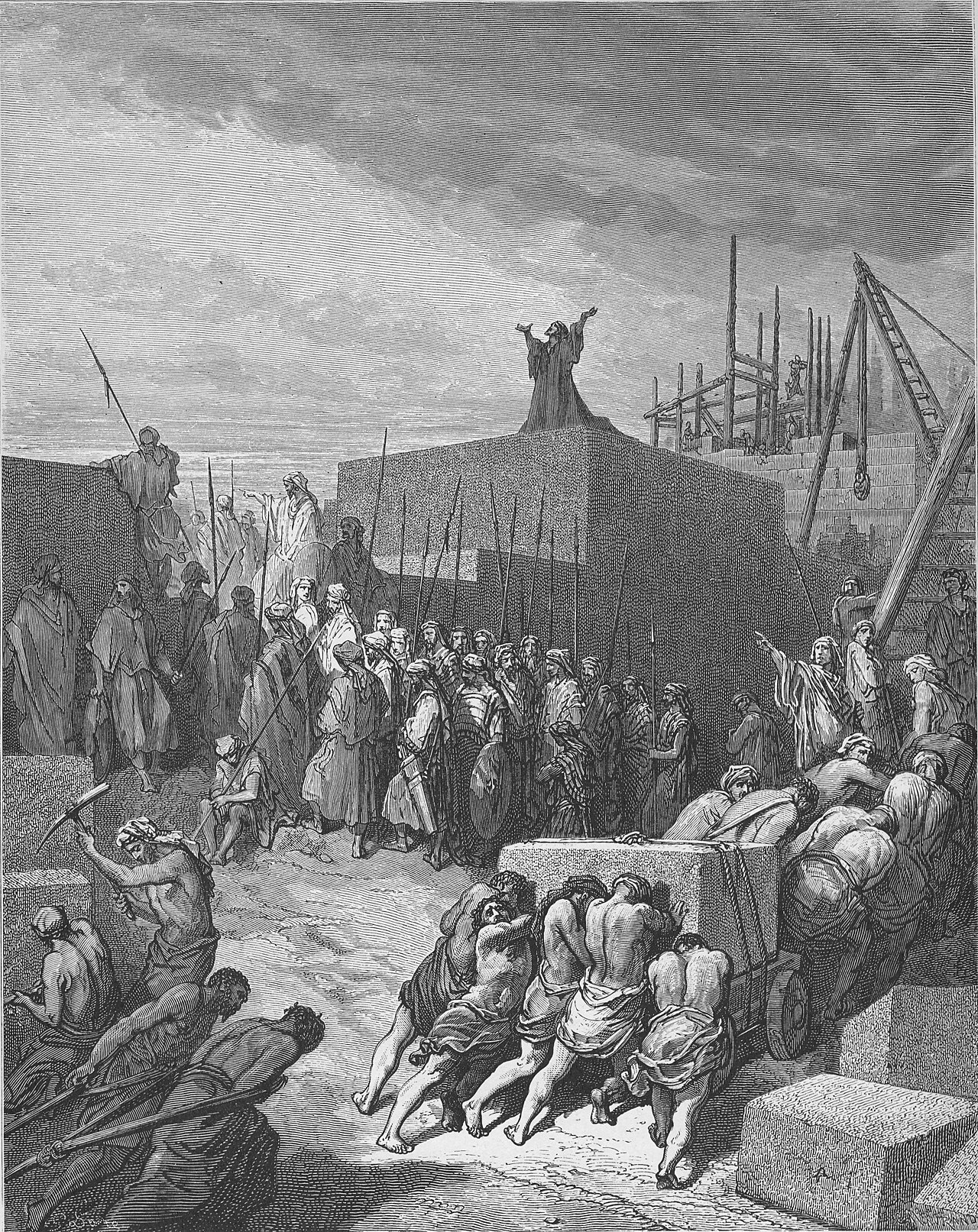
Haggaichapter 1
15 verses · Haggai · 520 BC · The Twelve
In the second year of the reign of Darius, on the first day of the sixth month, the word of the LORD came through Haggai the prophet to Zerubbabel son of Shealtiel, governor of Judah, and to Joshua son of Jehozadak, the high priest, stating
Introduction
Haggai, The Twelve, Haggai Overview.
Haggai spoke these words in Jerusalem to families who had come home from Babylon almost twenty years before. They had houses, fields and a governor again, but the house of God was still a bare foundation. The chapter is a prophet's sermon followed by a short report of what came of it, and both parts carry their dates. Listen for the question the LORD keeps pressing on His hearers, and for the ordinary losses of farm and household that He claims as His own doing. It is one of the few places in the prophets where the hearers are recorded as doing what they were told.
Context
- Who
- Returned exiles who had rebuilt their own houses and left God's in ruins
- What
- A dated message from the LORD through Haggai calling the returned exiles to rebuild the temple, followed by the report of their obedience.
- Where
- Jerusalem and the farmland of Judah, a small province of the Persian Empire, at the ruined site of the temple.
- When
- The sixth month of the second year of Darius I, late summer of 520 BC; the date is stated in the text and is secure.
- Why
- To move a people who had put their own houses before the LORD's house to take up the work again, and to explain their poor harvests.
Historical context
The first group came home under Cyrus's decree in 538 BC, rebuilt the altar, and laid the temple foundation around 536 BC. Then local opposition and official complaints froze the project, and it stayed frozen for about sixteen years. People got on with their lives.
Show the rest of the historical context, 4 more paragraphs
The dates in this book are given by the Persian regnal calendar, which lets us convert them to the modern calendar within a day. The second year of Darius I was 520 BC. Darius had come to the throne in a violent succession crisis in 522 BC and spent his first years putting down revolts across the empire, a fact he advertised on a huge trilingual inscription cut into a cliff at Behistun.
Haggai's charge is specific: "Is it time for you, O ye, to dwell in your cieled houses, and this house lie waste?" Paneled or roofed houses were finished construction, the kind you build when you intend to stay. The temple, meanwhile, was a foundation with weeds on it.
The economic diagnosis follows: you have sown much and bring in little, you eat but are not filled, you earn wages to put into a bag with holes. A drought had been called on the land, the grain, the new wine, the oil, and the labor of their hands.
The response is what makes this book remarkable. Twenty-three days later, the whole community, governor, high priest, and people, went to work. Almost no prophet in the Old Testament gets obeyed that fast.
Significance
This spoke to a community that had lost its nerve rather than its faith. Nobody in Jerusalem had renounced God. They had simply concluded that the time had not come, and quietly reorganized their lives around that conclusion.
Show the rest of the significance, 1 more paragraph
The promise given when they moved is five words long: "I am with you, saith the LORD." No timeline, no funding, no guarantee against the neighbors. That was enough to restart the work.
This chapter in Jewish lifeWhat this chapter is in Jewish life and reading.
What is done
No part of this chapter is read in the synagogue year. Probed for this lane, the site's own table in src/lib/hebraic/readings.ts printed parashot total 0 and haftarah uses total 0 for Haggai, with no festival reading. The same probe printed 54 weekly portions and 6 festival readings in the table as a whole. A congregation does not hear this chapter on a Sabbath or a feast.
The practice the chapter itself turns on is the Temple service that had stopped, and Rashi names the offerings. The small harvest of the sixth verse came "because of the iniquity of the cessation of [the offerings of] the first fruits" (Rashi on Haggai 1:6:1). The hunger that was never satisfied came "because of the iniquity of the cessation of the meal-offerings" (Rashi on Haggai 1:6:2).
The corpus sets the chapter beside the Torah portions under three verses. Under the sixth it carries Midrash Tanchuma Buber, Kedoshim 7:1. Under the tenth it carries Midrash Tanchuma, Bechukotai 2:1 with Midrash Tanchuma Buber, Bechukotai 3:1. Under the thirteenth it carries Midrash Tanchuma, Sh'lach 1:1.
How it is read
Rashi is the one commentator on this chapter whose English the corpus carries, quoted here from The Judaica Press complete Tanach with Rashi, translated by A. J. Rosenberg, which Sefaria reports as CC-BY. He opens by setting the prophecy in its years. The Darius of the first verse is "Darius king of Persia, who succeeded Ahasuerus" (Rashi on Haggai 1:1:1), and Rashi reports from Midrash Leviticus Rabbah 13:4 that he was Esther's son. Under Cyrus, Zerubbabel and Joshua the priest went up from Babylon and began the building, and the adversaries of Judah and Benjamin wrote to the king and had it stopped. By Rashi's count it stood stopped "for the three years that Cyrus reigned, the fourteen years of Ahasuerus, and the first year of Darius his son" (Rashi on Haggai 1:1:1). In the second year of Darius the word came to Haggai to urge them to build again and not to fear. The chronology is the rabbinic one, and it is reported here as his reading.
At the second verse, where the people say the time has not come, Rashi works out which seventy years they were waiting on. The first return marked seventy years from the rise of the kingdom of Babylon. The building of the House was counted from the destruction of Jerusalem, eighteen years later, and he cites Megillah 11b for the count. He closes the note in five words: "Now, the eighteen years are complete" (Rashi on Haggai 1:2:1).
At the fourth verse he reads the words as a question, marked by the vowel under the first letter (Rashi on Haggai 1:4:1). The panelled houses are "covered with boards of cedar", and he gives the rendering he credits to Jonathan: "Is such a way proper for you, that you sit in the houses that are covered with boards of cedar, and this Temple is destroyed?" (Rashi on Haggai 1:4:2).
At the fifth verse he reads "your ways" as "Your affairs", and he gives the reason the work of their hands failed. "All this is because of the desolation of My house" (Rashi on Haggai 1:5:1). They expected much from the field and brought in little (Rashi on Haggai 1:9:1). What the Lord blew away he glosses as "a plague of decay and worms" (Rashi on Haggai 1:9:2), and the heavens held back their dew "Because of your sins" (Rashi on Haggai 1:10:1).
At the eighth verse Rashi reads a letter the Masoretic text leaves out. The word for "I will be honored" lacks a final he, a letter whose value is five, and he reads the gap as the five things of the First Temple that the Second lacked: "1) the Holy Ark, 2) the Urim and Tummim, 3) the fire that descended from heaven, 4) the Shechinah, and 5) the Holy Spirit" (Rashi on Haggai 1:8:1). He takes the list from Tractate Yoma 21b, and the corpus carries Ein Yaakov, Yoma 1:31 under the same verse.
The chapter closes on the people's answer. Haggai spoke "In the messengership of the Omnipresent" (Rashi on Haggai 1:13:1). Rashi dates the start of the work: "They commenced cutting stones and sawing trees in the sixth month, on the twenty fourth of the month" (Rashi on Haggai 1:14:1). In the same note he dates the next word to Haggai to the twenty-first day of the seventh month, which opens the second chapter.
The corpus carries eleven further notes on this chapter without an English text, each marked linked because Sefaria holds no English version of the ref. Seven stand cited and unquoted at Ibn Ezra on Haggai 1:1:1, 1:2:1, 1:3:1, 1:5:1, 1:7:1, 1:12:1 and 1:15:1. Three stand at Radak on Haggai 1:3:1, 1:7:1 and 1:8:1, and one at Rashi on Haggai 1:11:1.
What the rabbis say
The corpus carries forty rabbinic locators on this chapter and the text of none, so each is cited here rather than quoted. The first verse, the date in the second year of Darius, draws the reckoning of the kings' years. The corpus holds Jerusalem Talmud Rosh Hashanah 1:1:2 and 1:1:3, and the Introductions to Tractates of the Mishnah, Rosh HaShanah 43, from the Introductions to Tanaitic Literature. With them stand Aggadat Bereshit 68:1 and 68:2 and Mekhilta DeRabbi Shimon Ben Yochai 19:1.
The sixth verse, the harvest that came to little, draws six locators. The corpus holds Avot DeRabbi Natan, Recension B 42:8, Midrash Aggadah at Deuteronomy 3:23:9 and Leviticus 19:23:1, and Midrash Lekach Tov, Exodus 29:2:2. With them stand Midrash Mishlei 23:1 and Midrash Tanchuma Buber, Kedoshim 7:1.
The eighth verse, the command to build, draws six more. The corpus holds Ein Yaakov, Yoma 1:31 and Ein Yaakov (Glick Edition), Yoma 1:25, with Jerusalem Talmud Horayot 3:2:26, Makkot 2:6:12 and Taanit 2:1:7. It also holds a passage of Otzar Midrashim from the Chuppah of Eliyahu, at Chuppat Eliyahu Rabbah 182.
On the ninth verse the corpus holds Avot DeRabbi Natan 4:4, Midrash Tannaim on Deuteronomy 11:12:18, Pesikta DeRav Kahana 16:9 and Sifrei Devarim 40:11, with a passage of Otzar Midrashim from the Baraita of Rabbi Pinchas Ben Yair, at 1:33. On the tenth it holds Avot DeRabbi Natan, Recension B 41:1 with the two Tanchuma locators on Bechukotai named above. On the eleventh, the drought, it holds Avot DeRabbi Natan, Recension B 5:3 and Pesikta Rabbati 29:1 and 29:27. On the twelfth it holds Midrash Tehillim 7:8.
The thirteenth verse, the Lord's messenger, draws five locators. The corpus holds Bereshit Rabbah 68:12, Midrash Lekach Tov, Leviticus 1:1:1, Midrash Tanchuma, Sh'lach 1:1 and Midrash Tehillim 103:13. With them stands Tractate Derekh Eretz Zuta, Section on Peace 18. On the fifteenth verse, the date the work began, it holds Rosh Hashanah 3b:1 and 3b:7, Mekhilta DeRabbi Yishmael, Tractate Bachodesh 1:4, and Midrash Sekhel Tov, Shemot 19:1:1. The corpus also holds Yalkut Shimoni on Torah 16:1 under an anchor it prints as Haggai 1:23, past the fifteen verses its commentary entries reach, and it is listed here as the corpus gives it. What each of them teaches is a saying of the rabbis, and is reported as theirs wherever this site quotes one. The quotations wait on a fetch that carries the text.
Sources: Rashi, Rashi on Haggai 1:1:1 to 1:14:1, The Judaica Press complete Tanach with Rashi, translated by A. J. Rosenberg, reported CC-BY; Ibn Ezra, Ibn Ezra on Haggai 1:1:1, 1:2:1, 1:3:1, 1:5:1, 1:7:1, 1:12:1 and 1:15:1, cited by ref because the corpus carries no English text; Radak, Radak on Haggai 1:3:1, 1:7:1 and 1:8:1, cited by ref because the corpus carries no English text; Rashi (linked), Rashi on Haggai 1:11:1, cited by ref because the corpus carries no English text; The Sefaria corpus, scripts/data/sources/sefaria/haggai/1.json, the 40 Talmud and Midrash locators of this chapter; The site's own files, src/lib/hebraic/readings.ts, probed for this book and printing parashot total 0, haftarah uses total 0 and festivalReadingForBook null.
The heads below are this chapter's scenes. The numbered points under each are its verses.
You live in paneled houses while my house lies waste
Haggai 1:1-3
the reign of Darius: The word is dated to the first day of the sixth month, in the second year of Darius, and goes to Zerubbabel and Joshua. Verse 2 quotes the people in their own words: “The time has not yet come to rebuild the house of the LORD”.
Haggai 1:1
“In the state; that was Zerubbabel, the son of Shealtiel, of the house of David, who was commander-in-chief of the Jews, in their return out of captivity. In the church; and that was Joshua the son of Josedech, who was now high priest.”
Matthew Henry · Commentary on the Whole Bible (1707-1721)puritan
2 more voices on this verseWhat preachers and commentators have said about this verse, in their own words.
Haggai 1:1
“In the second year of Darius - , i. e., Hystaspis. The very first word of prophecy after the captivity betokens that they were restored, not yet as before, yet so, as to be hereafter, more than before. The earthly type, by God’s appointment, was fading away, that the heavenly truth might dawn. The earthly king was withdrawn, to make way for the heavenly.”
Haggai 1:1
“Hence it was that his brother being slain by the consent of the nobles, the kingdom came to Darius. He, then, as we may learn from histories, was the third king of the Persians.”
John Calvin · Commentaries (1554)reformed
The people's objection is about timing. Adam Clarke reports that they thought the seventy years of Jeremiah had not yet run out. Jerome observes that the words are given to the people, and Zerubbabel and Joshua are not named as saying them.
Haggai 1:2
“The time is not come - They thought that the seventy years spoken of by Jeremiah were not yet completed, and it would be useless to attempt to rebuild until that period had arrived. But Abp. Usher has shown that from the commencement of the last siege of Jerusalem unto this time, precisely sixty-nine years had been completed.”
Adam Clarke · Commentary on the Bible (1810-1826)evangelical
1 more voice on this verse
Haggai 1:2
"God," say they, "hath interposed many difficulties to punish our rash haste" [CALVIN]. Smerdis' interdict was no longer in force, now that Darius the rightful king was on the throne; therefore they had no real excuse for not beginning at once to build. AUBERLEN denies that by "Artaxerxes" in Ezr 4:7-22 is meant Smerdis.
Jamieson, Fausset & Brown · Commentary Critical and Explanatory on the Whole Bible (1871)reformed
Then the word of the LORD came through Haggai the prophet: The word of verse 1 went to the two leaders. John Gill reads this second word as sent to the people themselves, to answer the excuse they had given. Albert Barnes notes how often Haggai marks his words as the LORD's own.
Haggai 1:3
“And the word of the Lord came - o “Before, he prophesied nothing, but only recited the saying of the people; now he refutes it in his prophecy, and repeats, again and again, that he says this not of himself, but from the mind and mouth of God.” It is characteristic of Haggai to inculcate thus frequently, that his words are not his own, but the words of God.”
The LORD answers by asking whether it is “a time for you yourselves to live in your paneled houses, while this house lies in ruins”. The King James reads cieled houses, walls finished with costly woodwork. The people had found the time and the means for their own homes.
Haggai 1:4
“Is it time for you - If the time be not come to rebuild the temple, it cannot be come for you to build yourselves comfortable houses: but ye are rebuilding your houses; why then do ye not rebuild the house of the Lord? The foundation of the temple had been laid fourteen years before, and some considerable progress made in the building; and it had been lying waste in that unfinished state to the present time.”
Adam Clarke · Commentary on the Bible (1810-1826)evangelical
2 more voices on this verse
Haggai 1:4
"It is high time," says one, "that my house were wainscoted." "It is high time," says another, "that mine were painted." And God's house, all this time, lies waste, and nothing is done at it.
Matthew Henry · Commentary on the Whole Bible (1707-1721)puritan
Haggai 1:4
“Is it time--It is not time (Hag 1:2), ye say, to build Jehovah's house; yet how is it that ye make it a fit time not only to build, but to "dwell" at ease in your own houses? you, O ye--rather, for "you, you"; the repetition marking the shameful contrast between their concern for themselves, and their unconcern for God [MAURER].”
Jamieson, Fausset & Brown · Commentary Critical and Explanatory on the Whole Bible (1871)reformed
Haggai 1:5-6
The LORD calls the people to “Consider carefully your ways”, which in Hebrew is to set the heart on them, the first of two calls. Verse 6 shows why: planting, eating, drinking and clothing alike come to little, and wages go “into a bag pierced through.”
Haggai 1:5
“And now, thus saith the Lord of hosts; “Consider,” (literally “set your heart upon) your ways,” what they had been doing, what they were doing, and what those doings had led to, and would lead to. This is ever present to the mind of the prophets, as speaking God’s words, that our acts are not only “ways” in which we go, each day of life being a continuance of the day before; but that they are ways which lead, somewhere in God’s Providence and His justice; to some end of the “way,” good or bad.”
1 more voice on this verse
Haggai 1:5
“Consider your ways--literally, "Set your heart" on your ways. The plural implies, Consider both what ye have done (actively, La 3:40) and what ye have suffered (passively) [JEROME]. Ponder earnestly whether ye have gained by seeking self at the sacrifice of God.”
Jamieson, Fausset & Brown · Commentary Critical and Explanatory on the Whole Bible (1871)reformed
You have planted much but harvested little: You planted, eat, drink, put on clothes and earn wages, and each labor comes to little. Adam Clarke counts five proverbs in these lines. Matthew Henry observes that the people felt the drought and never asked why it came.
Haggai 1:6
“Ye have sown much - God will not bless you in any labor of your hands, unless you rebuild his temple and restore his worship. This verse contains a series of proverbs, no less than five in the compass of a few lines.”
Adam Clarke · Commentary on the Bible (1810-1826)evangelical
1 more voice on this verse
Haggai 1:6
“They were sensible of the smart of the judgment, and every one complained of the unseasonable weather, the great losses they sustained in their corn and cattle, and the decay of trade; but they were not sensible of the cause of the judgment, and the ground of God's controversy with them.”
Matthew Henry · Commentary on the Whole Bible (1707-1721)puritan
Consider your ways: you sowed much and brought in little
Haggai 1:7-9
The call to “Consider carefully your ways” comes a second time: “Go up into the hills, bring down lumber, and build the house”. Verse 9 names the losses of verse 6 as the act of the LORD: “what you brought home, I blew away”.
Haggai 1:7
“Thus saith the Lord of hosts, Consider your ways. What they have been; what has been the consequence of them; and to what the above things are to be ascribed. This exhortation is repeated, to impress it the more upon their minds; and to denote the importance of it, and the necessity of such a conduct; See Gill on Hag 1:5.”
Go up into the hills, bring down lumber: Lumber lay near at hand in the hills. Adam Clarke recalls cedar had come from Lebanon for the first attempt, as Ezra 3:7 records, and the labor was nearly lost in the delay. Matthew Henry reads the promise as the LORD glorified in His house once it is built.
Haggai 1:8
“Go up to the mountain, and bring wood - Go to Lebanon, and get timber. In the second year of the return from the captivity, they had procured cedar trees from Lebanon, and brought them to Joppa, and had hired masons and carpenters from the Tyrians and Sidonians; but that labor had been nearly lost by the long suspension of the building. Ezr 3:7.”
Adam Clarke · Commentary on the Bible (1810-1826)evangelical
1 more voice on this verse
Haggai 1:8
“Stones also were doubtless needed. That the old walls were not standing, as the Hebrew interpreters quoted by JEROME state, or the new walls partly built, appears from Hag 2:18, where express mention is made of laying the foundations.”
Jamieson, Fausset & Brown · Commentary Critical and Explanatory on the Whole Bible (1871)reformed
You expected much, but behold, it amounted to little: The LORD asks why, and gives the answer Himself. Albert Barnes reads what was brought home and blown away as chaff before the wind. Matthew Henry calls the house in ruins the quarrel the LORD had with His people, the cause of every loss the chapter lists.
Haggai 1:9
“Ye looked - , literally “a looking;” as though he said, it has all been one looking, “for much,” for increase, the result of all sowing, in the way of nature: “and behold it came to little,” i. e., less than was sown; as Isaiah denounced to them of old by God’s word, Isa 5:10. “the seed of a homer shall yield an ephah,” i. e., one tenth of what was sown. “And ye brought it home, and I blew upon it,” so as to disperse it, as, not the wheat, but the chaff is blown before the wind.”
2 more voices on this verse
Haggai 1:9
“Observe wherefore God thus contended with them, and stopped the current of the favours promised them at their return ( Joel ii. 24 ); they provoked him to do it: It is because of my house that is waste. This is the quarrel God has with them.”
Matthew Henry · Commentary on the Whole Bible (1707-1721)puritan
Haggai 1:9
“Ye looked for much--literally, "looked" so as to turn your eyes "to much." The Hebrew infinitive here expresses continued looking. Ye hoped to have your store made "much" by neglecting the temple.”
Jamieson, Fausset & Brown · Commentary Critical and Explanatory on the Whole Bible (1871)reformed
Haggai 1:10-11
the heavens have withheld their dew: The drought is total: “the heavens have withheld their dew and the earth has withheld its crops”. Verse 11 extends it to “all the labor of your hands”. Deuteronomy 28:22 to 24 lists drought among the covenant curses, and Haggai sets this drought “on account of you”.
Haggai 1:10
“Therefore the heaven over you is stayed from dew - It appears from the following verse that God had sent a drought upon the land, which threatened them with scarcity and famine.”
Adam Clarke · Commentary on the Bible (1810-1826)evangelical
1 more voice on this verse
Haggai 1:10
“Therefore, for you, - on your account; (As in Ps. 44:43.) for your sins, (Jon.) He points out the moral cause of the drought, whereas men think of this or that cause of the variations of the seasons, and we, e. g., take into our mouths Scriptural words, as “murrain of cattle,” and the like, and think of nothing less than why it was sent, or who sent it. Haggai directs the mind to the higher Cause, that as they withheld their service from God, so, on their account and by His will, His creatures withheld their service from them.”
I have summoned a drought: The drought comes when it is summoned. Matthew Henry notes that the mountains were the pasture grounds and dried first. Jerome records that the Hebrew letters can be read as drought or as sword, and that the Greek translators chose sword.
Haggai 1:11
“It is called and introduced living speech of God, and effective, and sharp above every two-edged sword (Heb. IV), so that the neglectful soul (which is interpreted as a dry land, and desires to dwell more in hollows than to build the house of God) may be struck by its blade, and whatever fruits it thinks it has, may be scattered. The sword is also brought against the mountains that exalt themselves against the knowledge of God, and against the wheat, and wine, and oil, with which they deceive the people who have been deceived by the assemblies of heretics...”
Jerome · written before 420 · Commentary on Haggai 1:11patristic
2 more voices on this verse
Haggai 1:11
“This drought God called for, and it came at the call; as the winds and the waves, so the rays of the sun, obey him. It was universal, and the ill effects of it were general; it was a drought upon the mountains, which, lying high, were first affected with it. The mountains were their pasture-grounds, and used to be covered over with flocks, but now there was no grass for them.”
Matthew Henry · Commentary on the Whole Bible (1707-1721)puritan
Haggai 1:11
“And I called for a drought upon the land - God called to the people and they would not hear. It is His ever-repeated complaint to them. “I called unto you, and ye would not hear.” He called to His inanimate creatures to punish them, and “they” obeyed. So Elisha tells the woman, whose son he had restored to life, 2Ki 8:1. “The Lord hath called to the famine, and it shall also come to the land seven years.” And upon men, - in that the drought was oppressive to man.”
The people obeyed and the LORD stirred up their spirit
Haggai 1:12-13
obeyed the voice of the LORD: Zerubbabel, Joshua and “all the remnant of the people” obeyed the voice of the LORD. The answer comes at once in the shortest word of assurance in the book: “I am with you”. Haggai carries the title “the messenger of the LORD” because he delivered “the message of the LORD”.
Haggai 1:12
“But as it is not till Hag 1:14 after Haggai's second message (Hag 1:13) that the people actually obeyed, MAURER translates here, "hearkened to the voice of the Lord," and instead of "as," "because the Lord had sent him." However, English Version rightly represents their purpose of obedience as obedience in God's eyes already, though not carried into effect till Hag 1:14.”
Jamieson, Fausset & Brown · Commentary Critical and Explanatory on the Whole Bible (1871)reformed
1 more voice on this verse
Haggai 1:12
“It is sometimes so; when good preaching is most scarce it does most good, whereas the manna that is rained in plenty is loathed as light bread. And, because they so readily received this prophet, God, within a month or two after, raised them up another, Zech. i.”
Matthew Henry · Commentary on the Whole Bible (1707-1721)puritan
The whole message of this verse is four words in English. Jamieson, Fausset and Brown note that God's presence includes every other blessing. Albert Barnes points out that only Haggai and Malachi use the title messenger of the LORD for a prophet.
Haggai 1:13
“And Haggai, the Lord’s messenger - Malachi, whose own name was framed to express that he was “the Lord’s messenger,” and Haggai alone use the title, as the title of a prophet; perhaps as forerunners of the great prophet whom Malachi announced. Malachi also speaks of the priest, as Mal 2:7 “the messenger of the Lord of hosts,” and prophesies of John Baptist as Mal 3:1 “the messenger” of the Lord, who should go before His face.”
1 more voice on this verse
Haggai 1:13
“He hastens as it were to forget their former unfaithfulness, and to assure them, when obedient, that He both is and will be with them: Hebrew, "I with you!" God's presence is the best of blessings, for it includes all others. This is the sure guarantee of their success no matter how many their foes might be (Ro 8:31).”
Jamieson, Fausset & Brown · Commentary Critical and Explanatory on the Whole Bible (1871)reformed
Haggai 1:14-15
the LORD stirred the spirit: The chapter closes on the source of that obedience: “the LORD stirred the spirit” of Zerubbabel, of Joshua and of all the remnant. Ezra 1:1 and 1:5 use the same words of Cyrus and of the families whose spirit God had stirred to return.
Haggai 1:14
“Every good impulse and revival of religion is the direct work of God by His Spirit. came and did work--collected the wood and stones and other materials (compare Hag 1:8) for the work. Not actually built or "laid the (secondary) foundations" of the temple, for this was not done till three months after, namely, the twenty-fourth day of the ninth month (Hag 2:18) [GROTIUS].”
Jamieson, Fausset & Brown · Commentary Critical and Explanatory on the Whole Bible (1871)reformed
1 more voice on this verse
Haggai 1:14
“The Lord of hosts - By which name he delights to be known among the returned captives; and it was a name best suited to their present state, compassed on all hands with enemies.”
John Wesley · Explanatory Notes upon the Old Testament (1765)evangelical
on the twenty-fourth day of the sixth month: The day and the month close the report that began at verse 1. Albert Barnes counts twenty-three days between the word of the LORD and the start of the work on the house. Matthew Henry says those who have lost time should make haste.
Haggai 1:15
“In the four and twentieth day of the month - The interval of twenty-three days must have been spent in preparation, since the message came on the first of the month, and the obedience was immediate.”
1 more voice on this verse
Haggai 1:15
“Note, Those that have lost time have need to redeem time; and the longer we have loitered in that which is good the more haste we should make when we are convinced of our folly. How God met them in a way of mercy.”
Matthew Henry · Commentary on the Whole Bible (1707-1721)puritan
How this psalm is built
The form: A sermon that quotes the people's own saying and then answers it from the mouth of God, as Barnes classes it.
The patterns in this chapter
| Device | What it does | Where to see it |
|---|---|---|
| Consider carefully your ways, said twice | The same command opens verse 5 and verse 7. The first time it leads into the list of losses, and the second time it leads into the order to build. Albert Barnes gives the Hebrew as set your heart upon your ways, and reads a way as a road that leads somewhere in God's providence. Chapter 2 takes the command up again at verses 15 and 18.Albert Barnes, Notes on the Old Testament, on Haggai 1:5. | Haggai 1:5, Haggai 1:7, Haggai 2:15, Haggai 2:18 |
| Five sayings of wasted work | Verse 6 sets five short sayings side by side, on sowing, eating, drinking, clothing and wages, and each one ends in too little. Adam Clarke counts them as five proverbs in a few lines. The same kind of loss stands among the covenant warnings at Deuteronomy 28:38 to 40.Adam Clarke, Commentary on the Bible, on Haggai 1:6. | Haggai 1:6 |
| The two dates that frame the chapter | The chapter opens on the first day of the sixth month and closes on the twenty-fourth day of the same month. Albert Barnes counts the twenty-three days between them and reads them as the time the people spent in preparation after they obeyed.Albert Barnes, Notes on the Old Testament, on Haggai 1:15. | Haggai 1:1, Haggai 1:15 |
The structure
3 more paragraphs on the patterns
The chapter has two parts. Verses 1 to 11 are the message. It quotes the people's saying at verse 2 and answers it with a question, two calls to consider their ways, a command to build and a list of losses. Verses 12 to 15 are the report, in which the leaders and the remnant obey, the LORD promises His presence and stirs their spirit, and the work begins. A date stands at each end.
Where it stands in the book
This is the first of the four dated messages of Haggai. The second, at 2:1 to 9, answers the grief of the old men over the smaller house, and the last two, at 2:10 to 23, come on one day three months later. Zechariah began to preach two months after this chapter, at Zechariah 1:1.
Keep studying
Studies7
People and groups4
Sources for this chapter
The summary
Jamieson, Fausset & Brown, Commentary Critical and Explanatory; John Calvin, Commentaries; John Wesley, Notes on the Old Testament and Matthew Henry, Complete Commentary.
The form and classifications
Albert Barnes, Notes on the Old Testament, on Haggai 1:3 and John Gill, Exposition of the Old Testament, on Haggai 1:3.
The exposition
Adam Clarke, Commentary on the Bible; Albert Barnes, Notes on the Old Testament; Carl Friedrich Keil, The Twelve Minor Prophets; Jamieson, Fausset & Brown, Commentary Critical and Explanatory on the Whole Bible; Jerome, Commentary on Haggai; John Gill, Exposition of the Old Testament; John Wesley, Explanatory Notes upon the Old Testament and Matthew Henry, Commentary on the Whole Bible.