
Ezrachapter 3
13 verses · Ezra, by tradition · 5th century BC · History
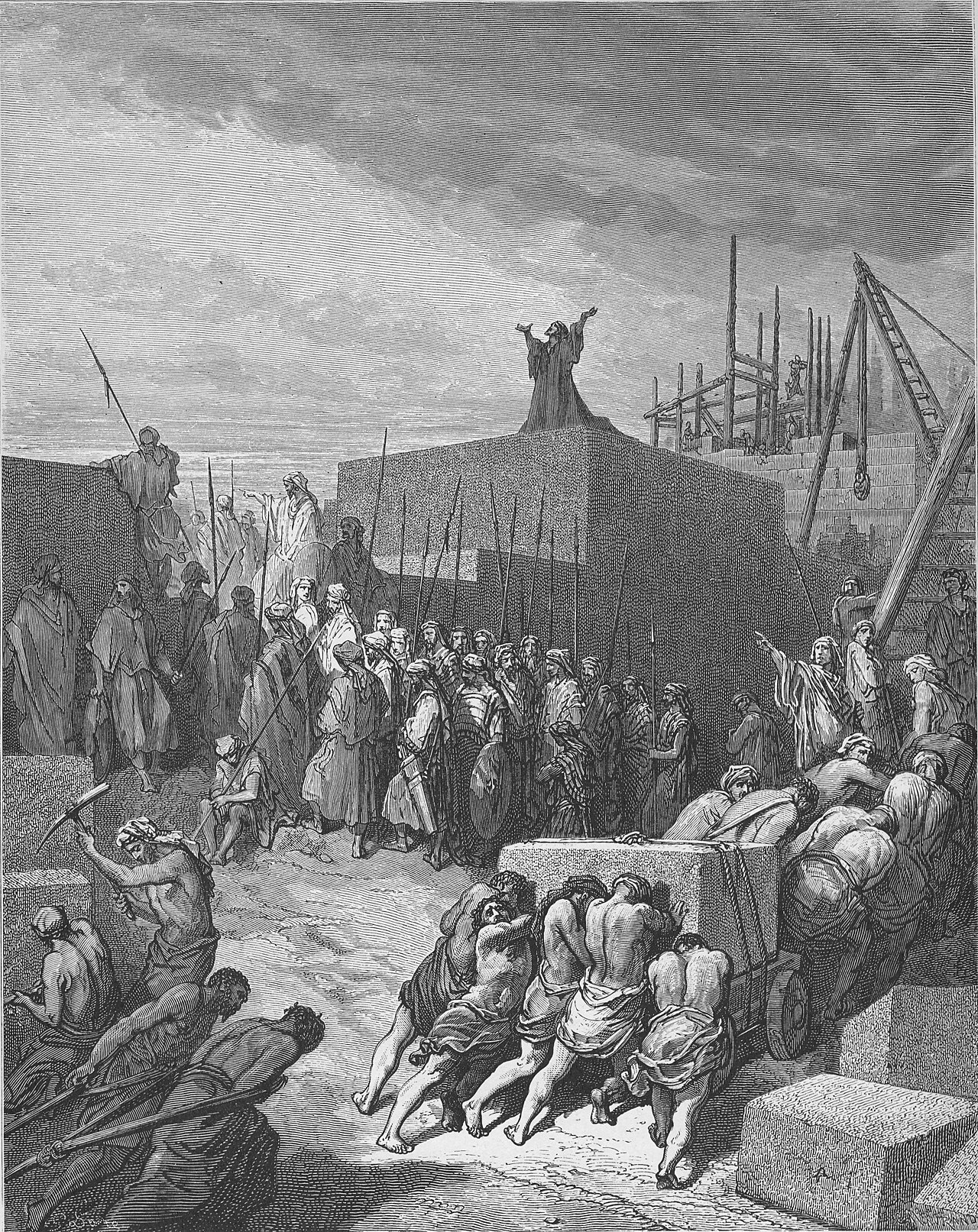
But many of the older priests, Levites, and family heads who had seen the first temple wept loudly when they saw the foundation of this temple. Still, many others shouted joyfully.
Introduction
Ezra, by tradition, History, Ezra Overview.
This chapter was written for the families who had come back to a burned city and a bare temple platform. Tradition gives the book to Ezra. Its first hearers knew the stories of Solomon's temple from their grandparents and could see what was left of it. The chapter moves from the first months home to the first stone of the new house. Listen for what the people build first, and for how closely they follow the pattern set down by Moses and David. Notice how the chapter ends, with two sounds that cannot be told apart. Read it as worship resumed before safety.
Context
- Who
- People standing on a site their grandparents had described to them
- What
- An account of the altar set up, the feasts and offerings restored, and the foundation of the second temple laid with praise and weeping.
- Where
- Jerusalem, on the ruined temple platform, with cedar brought by sea from Lebanon to Joppa.
- When
- The seventh month of the first year home, about 537 BC, for the altar, and the second month of the following year for the foundation.
- Why
- To show that the returned people put the worship of the LORD first, and to record honestly how the old and the young felt about the new beginning.
Historical context
The first thing they build is not the temple. It is the altar, set on its base in the seventh month, and the reason given is fear: "fear was upon them because of the people of those countries." They were a small unarmed group on land other people had been using for fifty years.
Show the rest of the historical context, 4 more paragraphs
The seventh month held the Feast of Tabernacles, and they kept it immediately, booths, and the daily burnt offerings by number as written. Sacrifice restarted before there was any building to house it.
The next spring they laid the foundation, and the logistics look exactly like the first temple's. Money went to masons and carpenters, and food, drink, and oil went to the men of Sidon and Tyre to float cedar down the coast from Lebanon to Joppa, the same arrangement Solomon made with Tyre, now authorized by a grant from Cyrus.
The dedication of the foundation was done with the old liturgy: priests in their vestments with trumpets, Levites with cymbals, singing responsively "for he is good, for his mercy endureth for ever unto Israel."
And then the scene that everyone remembers. Old men who had seen the first house wept aloud, while others shouted for joy, and the noise mixed so completely that no one could tell the weeping from the shouting, and the sound was heard far off.
Significance
The mixed noise is the honest sound of a partial restoration. The people who could remember Solomon's temple knew exactly what had been lost, and no foundation laid by a few thousand returnees was going to match it.
Show the rest of the significance, 1 more paragraph
But the altar came first, before the walls, before the safety, before the funding. Worship resumed on a fire-blackened platform in a hostile neighborhood, and that decision set the direction for everything after.
This chapter in Jewish lifeWhat this chapter is in Jewish life and reading.
What is done
This chapter is not read in the synagogue year. The site's own table in src/lib/hebraic/readings.ts printed parashot total 0 and haftarah uses total 0 for Ezra, and no festival reading.
The chapter itself records the first feast kept at the rebuilt altar, and Rashi names it. The seventh month "is the month of Tishri" (Rashi on Ezra 3:1:2). The offerings of the fourth verse are "the sacrifices of the Festivals in their number, according to their ordinance" (Rashi on Ezra 3:4:1). After Succoth the daily offerings went on morning and evening (Rashi on Ezra 3:5:1), and at the beginning of each month the offerings of the New Moon (Rashi on Ezra 3:5:2). The corpus sets Tractate Soferim 7:1 under the third verse, and Midrash Tanchuma Buber, Bereshit 13:1 beside it.
How it is read
Rashi is the one commentator on this chapter whose English the corpus carries, quoted here from The Judaica Press complete Tanach with Rashi, translated by A. J. Rosenberg, which Sefaria reports as CC-BY. He reads the altar as a public act meant to be seen. They built it "in order that the peoples hear and understand the matter, that they did it with the sanction of the king" (Rashi on Ezra 3:3:1). His reason is the fear named in the verse, that the peoples of the land would taunt and slander them to the king.
The work on the Temple he dates and places. The second month is Iyar (Rashi on Ezra 3:8:1). The Zidonians and Tyrians were the artisans who built the Temple (Rashi on Ezra 3:7:1), and what was brought came by way of the sea to Jaffa (Rashi on Ezra 3:7:2). Jeshua and the Levites stood and sang together around those laying the foundation (Rashi on Ezra 3:9:1), and the priests stood in their garments with trumpets (Rashi on Ezra 3:10:2). The word for their singing he reads as raising the voice in song, and he compares Miriam at the sea in Exodus 15:21 (Rashi on Ezra 3:11:1).
The end of the chapter is read through memory. Those who saw the building wept "because they remembered the large building of the First Temple" (Rashi on Ezra 3:12:2). The two sounds could not be told apart, "for the rejoicing people were shouting with a great shout, and the voice of weeping was heard farther and farther away" (Rashi on Ezra 3:13:1). Two of his notes are grammar alone, on the verb for laying the foundation and its noun (Rashi on Ezra 3:10:1 and 3:12:1).
The corpus carries five further notes on this chapter without an English text, each marked linked because Sefaria holds no English version of the ref. They stand cited and unquoted at Ibn Ezra on Ezra 3:2:1, 3:4:1 and 3:9:1, and at Metzudat David on Ezra 3:2:1 and 3:6:1.
What the rabbis say
The corpus carries twenty-two rabbinic locators on this chapter and the text of none, so each is cited here rather than quoted. On the first verse, the gathering in the seventh month, it holds Seder Olam Rabbah 29:1 and Yalkut Shimoni on Torah 752:9. On the third, the altar on its bases, it holds Zevachim 62a:2, Esther Rabbah 4:2, Mekhilta DeRabbi Shimon Ben Yochai 20:21, Midrash Tanchuma Buber, Bereshit 13:1 and Tractate Soferim 7:1.
The beginning of the building draws the next run. On the eighth verse the corpus holds Chullin 24b:6, Jerusalem Talmud Sukkah 3:12:2, Bamidbar Rabbah 6:2 and Aggadat Bereshit 45:1. On the ninth it holds Arakhin 13b:9 and Midrash Lekach Tov, Numbers 4:23:1. On the tenth it holds Midrash Tehillim 147:2 and an entry of Introductions to Tanaitic Literature, Introduction to Halakhic Midrashim, Sifrei Numbers 288. On the eleventh it holds Midrash Mishlei 31:5.
The weeping and the shout carry the rest. On the twelfth verse the corpus holds Horayot 6a:8, Temurah 15b:7, Midrash Tehillim 137:1 and Pesikta Rabbati 35:1. On the thirteenth it holds Horayot 6a:9 and Temurah 15b:8. What each of them teaches is a saying of the rabbis, and is reported as theirs wherever this site quotes one. The quotations wait on a fetch that carries the text.
Sources: Rashi, Rashi on Ezra 3:1:1 to 3:13:1, The Judaica Press complete Tanach with Rashi, translated by A. J. Rosenberg, reported CC-BY; Ibn Ezra, Ibn Ezra on Ezra 3:2:1, 3:4:1 and 3:9:1, cited by ref because the corpus carries no English text; Metzudat David, Metzudat David on Ezra 3:2:1 and 3:6:1, cited by ref because the corpus carries no English text; The Sefaria corpus, scripts/data/sources/sefaria/ezra/3.json, the 22 Talmud and Midrash locators of this chapter; The site's own files, src/lib/hebraic/readings.ts, probed for this book and printing parashot total 0, haftarah uses total 0 and festivalReadingForBook null.
The heads below are this chapter's scenes. The numbered points under each are its verses.
The altar set on its bases while the foundation was still unlaid
Ezra 3:1-2
the people assembled as one man: By the seventh month, the month of the Feast of Trumpets, the returned exiles assemble in Jerusalem before any stone of the temple is laid. Jeshua the priest and Zerubbabel the governor build the altar and offer burnt offerings on it, as it is written in the Law of Moses.
Ezra 3:1
“The seventh month - i. e., the month Tisri (nearly our September), the most sacred month in the Jewish year Exo 23:16; Lev. 23:24-41.”
Jeshua son of Jozadak: Adam Clarke traces Jeshua son of Jozadak to Seraiah, the high priest Nebuchadnezzar put to death at 2 Kings 25:18 and 21. Jeshua was his grandson and the first high priest after the captivity. The priestly line resumes where the exile cut it.
Ezra 3:2
“Or rather let them learn of you, who are so well instructed in such histories, how that Jeshua the son of Josedek the priest, and his brother, and Zerubbabel the wise, the son of Salathiel, and Ezra the priest and scribe of the law, as the temple was being built after the captivity, the feast of tabernacles being at hand (which was a great feast and time of assembly and prayer in Israel), gathered the people together with one accord in the great court within the first gate, which is toward the east, and prepared the altar to God, and…”
Athanasius of Alexandria · written before 373 · Defense Before Constantius 18patristic
2 more voices on this verse
Ezra 3:2
“Jeshua the son of Jozadak - He was grandson of Seraiah the high priest, who was put to death by Nebuchadnezzar, 2Ki 25:18, 2Ki 25:21. This Jeshua or Joshua was the first high priest after the captivity.”
Adam Clarke · Commentary on the Bible (1810-1826)evangelical
Ezra 3:2
“Altar - Which was of more present necessity than the temple, both to make atonement to God for all their sins, and to obtain God's assistance for the building of the temple, and to strengthen their own hearts and hands in that great work.”
John Wesley · Explanatory Notes upon the Old Testament (1765)evangelical
set up the altar on its foundation: They set up the altar on its foundation, the old base found again under the rubble, even though they feared the people of the land. The morning and evening burnt offerings, silent through the exile, resume as the first daily practice of the restored community.
Ezra 3:3
“Upon his bases - They restored the old altar of burnt-offerings, which stood directly in front of the temple-porch, upon the old foundation. This became apparent on the clearing away of the ruins, and on a careful examination of the site.”
1 more voice on this verse
Ezra 3:3
“Abraham, wherever he came, built an altar; and wherever we come, though we may perhaps want the benefit of the candlestick of preaching, and the showbread of the eucharist, yet, if we bring not the sacrifices of prayer and praise, we are wanting in our duty, for we have an altar that sanctifies the gift ever ready.”
Matthew Henry · Commentary on the Whole Bible (1707-1721)puritan
Ezra 3:4-6
celebrated the Feast of Tabernacles: They keep the Feast of Tabernacles as it is written. Verse 6 carries the point of the chapter: offerings begin on the first day of the seventh month, although the foundation had not been laid. The altar and the feasts run a full season ahead of any wall.
Ezra 3:4
“They kept also the feast of tabernacles, as it is written,.... According to the rules prescribed for the observation of it in Lev 23:34 this began on the fifteenth day of the seventh month: and offered the daily burnt offerings by number, according to the custom, as the duty of every day required; for on all the eight days of the feast there was a certain number of sacrifices fixed for every day; and exactly according to the law concerning them did they offer them at this time; see Num 29:12.”
1 more voice on this verse
Ezra 3:4
“Of the services of this feast, which continued seven days and had peculiar sacrifices appointed, it is said that they did as the duty of every day required (see Num. xxix. 13, 17 , &c.), Verbum die in die suo--the word, or matter, of the day in its day (so it is in the original)--a phrase that has become proverbial with those that have used themselves to scripture-language.”
Matthew Henry · Commentary on the Whole Bible (1707-1721)puritan
all the freewill offerings brought to the LORD: The freewill offerings stand beside the offerings the law set. Matthew Henry notes that the law required much and the people brought more. They had little wealth, he writes, and much zeal.
Ezra 3:5
“The law required much, but they brought more; for, though they had little wealth to support the expense of their sacrifices, they had much zeal, and, we may suppose, spared at their own tables that they might plentifully supply God's altar. Happy are those that bring with them out of the furnace of affliction such a holy heat as this.”
Matthew Henry · Commentary on the Whole Bible (1707-1721)puritan
On the first day of the seventh month: The seventh month is Tisri, close to September, which Albert Barnes calls the most sacred month of the Jewish year. John Gill dates the Feast of Tabernacles from the fifteenth day of that month, by Leviticus 23:34. The offerings of this verse began two weeks before the feast.
Ezra 3:6
“Burnt-offerings - And the other sacrifices which were to be offered with them upon that day, being the feast of trumpets. Burnt-offerings are often put for all sacrifices.”
John Wesley · Explanatory Notes upon the Old Testament (1765)evangelical
Cedar from Lebanon and workmen set to the task
cedar logs from Lebanon to Joppa: They give food, drink and oil to the people of Sidon and Tyre to bring cedar logs from Lebanon to Joppa by sea. These are the route and the partners Solomon used for the first temple. This time the timber comes by the authority of Cyrus king of Persia.
Ezra 3:7
“According to the grant - i. e., in accordance with the permission granted them by Cyrus to rebuild their temple Ezr 1:1-4.”
Ezra 3:8-9
Levites twenty years of age or older: The leaders appoint Levites twenty years of age or older to supervise the work. That is the age David set in 1 Chronicles 23:24 and 27, lower than the thirty years of Numbers 4. A Levite named Jeshua, a different man from Jeshua son of Jozadak, supervises with Kadmiel.
Ezra 3:8
“When Jerusalem was demolished by Nebuchadnezzar, the kingdom was destroyed, and no longer were there hereditary successions to the sovereignty as formerly; at that time, moreover, being out of power, the posterity of David were living in captivity. But, when the followers of Salathiel and Zerubbabel returned, they led the people more democratically, transferring the rule henceforth to the priesthood because of the intermingling of the priestly and royal tribes.”
Basil of Caesarea · written before 379 · LETTER 236.2patristic
1 more voice on this verse
Ezra 3:8
“In the second year - The previous time had been employed in clearing the ground, felling timber, hewing stones, and transporting them to the place, and making other necessary preparations for the commencement of the building.”
Adam Clarke · Commentary on the Bible (1810-1826)evangelical
(descendants of Yehudah): The descendants of Yehudah are a Levite family, which John Gill identifies with the Hodaviah of the register at 2:40. Albert Barnes reads the Hebrew behind joined together as emphatic, they stood up as one man. Gill notes two sons of Henadad named again at Nehemiah 3:18.
Ezra 3:9
“Then stood Jeshua, with his sons,.... Not Jeshua the high priest before mentioned, but Jeshua the Levite, Ezr 2:40, and his brethren, Kadmiel and his sons, the sons of Judah, together; the same with Hodaviah, Ezr 2:40 to set forward the workmen in the house of God; to give them orders to begin and lay the foundation, and hasten and animate them to it: the sons of Henadad, with their sons and their brethren the Levites: two of this man's sons are mentioned in Neh 3:18.”
1 more voice on this verse
Ezra 3:9
Jeshua - See the marginal reference. Not the high priest, but the head of one of the two Levitical houses which had returned. Together - The Hebrew phrase is very emphatic - “they stood up as one man.”
Shouting and weeping mingled till no one could tell them apart
Ezra 3:10-11
as David king of Israel had prescribed: When the foundation is laid, the priests take their trumpets and the Levites their cymbals. They sing responsively, "For He is good; for His loving devotion to Israel endures forever", the refrain of 1 Chronicles 16:34. The song David's Levites sang now marks a foundation laid under Persian rule.
Ezra 3:10
“They set the priests - Or, according to another reading, “The priests stood.” The Levites the sons of Asaph - i. e., “such of the Levites as were descendants of Asaph.” It would seem as if no descendants of Heman or Jeduthun had returned.”
Then all the people gave a great shout: The great shout of praise goes up over a laid foundation only. Matthew Henry writes that to hungry souls, after long desolation, even this foundation of the house seemed great, as life from the dead. He calls for thanksgiving at the beginnings of mercy.
Ezra 3:11
“To them even this foundation seemed great, and was as life from the dead; to their hungry souls even this was sweet. They shouted, so that the noise was heard afar off. Note, We ought to be thankful for the beginnings of mercy, though we have not yet come to the perfection of it; and the foundations of a temple, after long desolations, cannot but be fountains of joy to every faithful Israelite.”
Matthew Henry · Commentary on the Whole Bible (1707-1721)puritan
1 more voice on this verse
Ezra 3:11
“Sung - That everlasting hymn, which will never be out of date, and to which our tongue should never be out of tune, the burden of Psalm 1xxxvi, 1-26. Whatever our condition is, let it be owned, that God is good, and whatever fails, that his mercy fails not.”
John Wesley · Explanatory Notes upon the Old Testament (1765)evangelical
Ezra 3:12-13
who had seen the first temple: Many of the older priests and family heads had seen the first temple, and they weep loudly at this foundation while others shout for joy. Haggai later speaks to these same old men, asking who among them saw this house in its first glory.
Ezra 3:12
“Wept with a loud voice - They saw that the glory had departed from Israel; in their circumstances it was impossible to build such a house as the first temple was; and had this been even possible, still it would have been greatly inferior, because it wanted the ark of the covenant, the heavenly fire, the mercy-seat, the heavenly manna, Aaron’s rod that budded, the Divine shechinah, the spirit of prophecy, and most probably the Urim and Thummim.”
Adam Clarke · Commentary on the Bible (1810-1826)evangelical
2 more voices on this verse
Ezra 3:12
“These lamented the disproportion between this temple and the former. And, (1.) There was some reason for it; and if they turned their tears into the right channel, and bewailed the sin that was the cause of this melancholy change, they did well. Sin sullies the glory of any church or people, and, when they find themselves diminished and brought low, that must bear the blame.”
Matthew Henry · Commentary on the Whole Bible (1707-1721)puritan
Ezra 3:12
“Perhaps, however, the chief cause of grief was that the second temple would be destitute of those things which formed the great and distinguishing glory of the first; namely, the ark, the shekinah, the Urim and Thummim, &c. Not that this second temple was not a very grand and beautiful structure.”
Jamieson, Fausset & Brown · Commentary Critical and Explanatory on the Whole Bible (1871)reformed
could not distinguish the shouts of joy: John Wesley reads the people's mingled shouts of joy and weeping as a picture of this world. In heaven all are singing, and in hell all are wailing. On earth the two sounds mix, as they did at this foundation.
Ezra 3:13
“Could not discern - The mixture of sorrow and joy here, is a representation of this world. In heaven all are singing and none sighing; in hell all are wailing, and none rejoicing: but here on earth we can scarce discern the shouts of joy from the noise of the weeping, let us learn to rejoice with them that rejoice, and weep with them that weep.”
John Wesley · Explanatory Notes upon the Old Testament (1765)evangelical
Keep studying
Studies6
People and groups4
Sources for this chapter
The summary
Jamieson, Fausset & Brown, Commentary Critical and Explanatory; John Wesley, Notes on the Old Testament and Matthew Henry, Complete Commentary.
The exposition
Adam Clarke, Commentary on the Bible; Albert Barnes, Notes, Explanatory and Practical, on the Old and New Testaments; Berean Standard Bible, Ezra 3; Jamieson Fausset and Brown, Commentary Critical and Explanatory on the Whole Bible; John Gill, Exposition of the Old Testament; John Wesley, Explanatory Notes upon the Old Testament; Keil, The Books of Ezra, Nehemiah, and Esther and Matthew Henry, Commentary on the Whole Bible.