
Ezrachapter 1
11 verses · KJVEzra book hub →
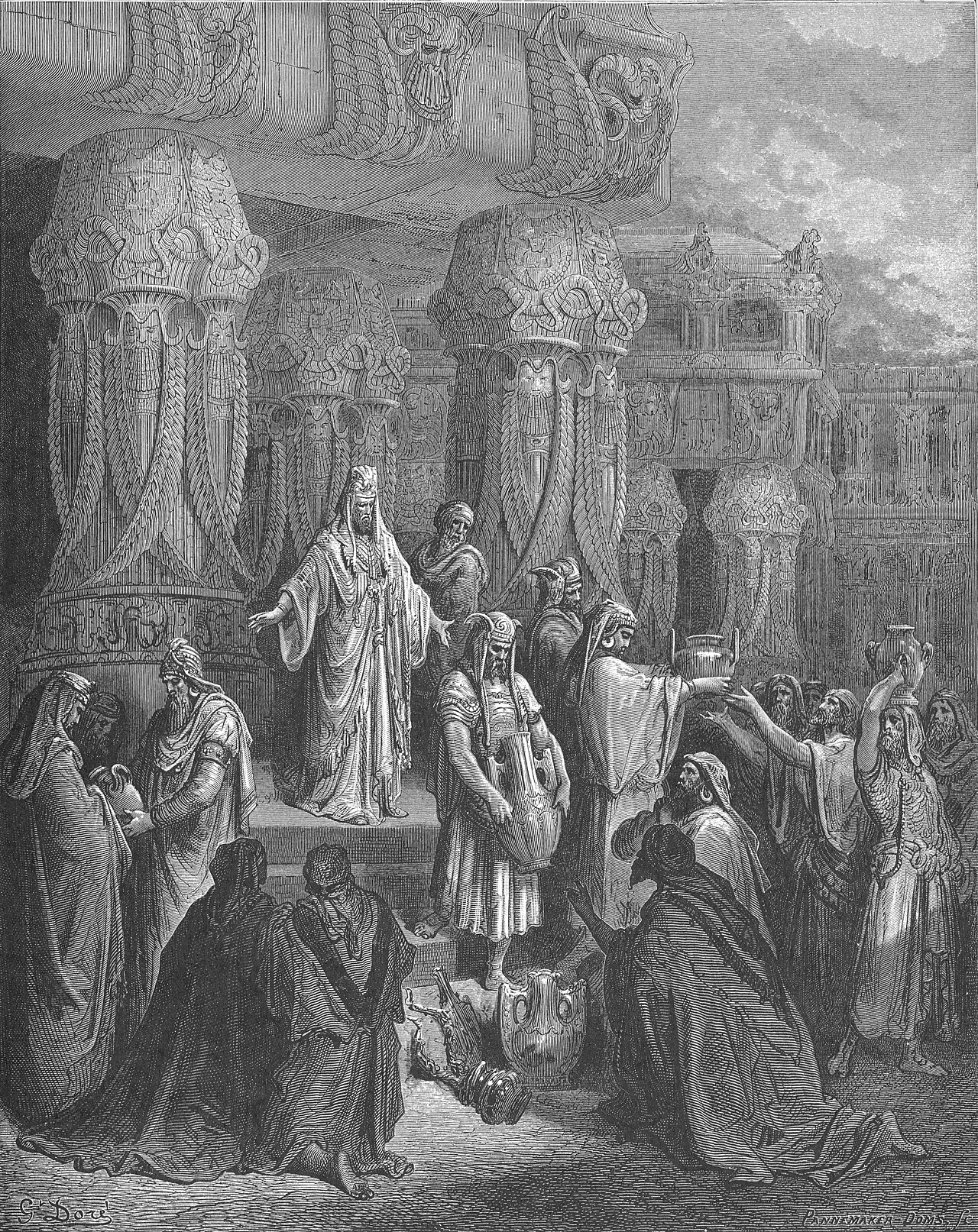
Cyrus Restores the Vessels of the Temple, Gustave Doré, Doré's English Bible (1866), public domain
Key verse
Now in the first year of Cyrus king of Persia, that the word of the Lord by the mouth of Jeremiah might be fulfilled, the Lord stirred up the spirit of Cyrus king of Persia, that he made a proclamation throughout all his kingdom, and put it also in writing, saying,
It stands in Cyrus stirred up: who is among you of all His people?, verses 1 to 4.
The chapter
Chapter summary
The exile ends by decree. In the first year of Cyrus king of Persia, that the word of Jeremiah might be accomplished, 'Jehovah stirred up the spirit of Cyrus,' who proclaimed through all his realm: Jehovah, the God of heaven, hath charged me to build him a house in Jerusalem: 'whosoever there is among you of all his people, his God be with him, and let him go up.' The heads of fathers' houses in Judah and Benjamin rose, their spirits stirred by God, and their neighbors strengthened their hands with silver, gold, and goods. Cyrus brought out the temple vessels Nebuchadnezzar had carried away: 5,400 counted into the hand of Sheshbazzar.
Context
History · Ezra · Ezra overview
Where the chapter sits
Ezra 1 falls in First return under Zerubbabel (chapters 1–6). Cyrus's decree (538 BC); the altar restored; temple foundation laid amid weeping and shouting; Samaritan opposition; Haggai and Zechariah's prodding; the temple finished in 515 BC.
Cyrus's decree. ‘The LORD God of heaven hath given me all the kingdoms of the earth’; the return authorized.
After it: Ezra's return and covenant reform, chapters 7–10.
The whole shape of Ezra→The world behind this chapter
Ezra 1The history
Cyrus took Babylon in October 539 BC, and within about a year he had issued the decree that opens this book: the God of heaven has charged me to build Him a house at Jerusalem; whoever is among His people, let him go up.
That was Persian policy, not a personal conversion. Persia governed differently from Assyria and Babylon, who had ruled by mass deportation. Cyrus preferred to send peoples back to their homelands, restore their shrines, and let them worship their own gods, on the reasonable calculation that grateful provinces need fewer garrisons.
The rest of the history, and what it meant to them
The famous physical evidence is the Cyrus Cylinder, a clay barrel inscribed in Babylonian, now in the British Museum. It describes Cyrus returning gods to their sanctuaries and people to their settlements. It does not mention Judah or Jerusalem by name, it is a Mesopotamian document about Mesopotamian shrines, but it shows the policy this decree belongs to, which is exactly why it matters.
The vessels are the detail worth watching. Nebuchadnezzar had carried the temple's gold and silver articles to Babylon and put them in the house of his gods; Belshazzar had drunk from them at his last feast. Cyrus has them counted out of the treasury, 5,400 items, and handed over to a man named Sheshbazzar.
The returnees' neighbors are told to help with silver, gold, goods, and animals, which echoes the Israelites leaving Egypt with their neighbors' silver. The comparison is deliberate.
What it meant to them
For the exile generation this was the promise landing on schedule. Jeremiah had said seventy years; Daniel had counted them; Cyrus signed the paper.
The chapter's first sentence says why it happened: the LORD stirred up the spirit of Cyrus. The most powerful man on earth issues a decree, and the text credits it to God working on him, the same claim it makes about the ordinary families who decided to pack.
Sources cited
- Edwin Yamauchi, Persia and the Bible
- K. A. Kitchen, On the Reliability of the Old Testament
- Josephus, Antiquities of the Jews (Whiston translation)
The structure of this chapter
The heads below are this chapter's scenes. The numbered points under each are its verses.
A. Cyrus stirred up: who is among you of all His people?
1. (vv. 1-2)
Ezra 1:1
“Now in the first year - This is word for word with the two last verses of the preceding book; which stand here in their proper place and connection, but there are entirely destitute of chronological connection and reference.”
Read the whole quotation
Cyrus - This prince, so eminent in antiquity, is said to have been the son of Cambyses king of Persia, and Mandane, daughter of Astyages king of the Medes; and was born about six hundred years before Christ.
Adam Clarke· Commentary on the Bible (1810-1826)· Ezra 1:1evangelical
Ezra 1:2
“Thus saith Cyrus king of Persia,.... Of whom, and this edict of his, Isaiah prophesied two hundred years before he was born, Isa 44:28 the Lord God of heaven hath given me all the kingdoms of the earth; many he had conquered before he took Babylon, and then the whole Babylonian monarchy fell into his hands.”
John Gill· Exposition of the Old Testament (1748-1763)· Ezra 1:2reformed
Ezra 1:2, 1 more voice
Ezra 1:2
“The Lord God of heaven - It is not unworthy of remark, that in all the books written prior to the captivity, Jehovah is called The Lord of Hosts; but in all the books written after the captivity, as 2 Chronicles, Ezra Nehemiah, and Daniel, he is styled The God of Heaven. The words however have the same meaning.”
Read the whole quotation
All the kingdoms of the earth.
Adam Clarke· Commentary on the Bible (1810-1826)· Ezra 1:2evangelical
a.stirred up the spirit of Cyrus: The book opens by repeating the last two verses of 2 Chronicles almost word for word, the canon's own splice: Chronicles ends with the summons and Ezra begins the same sentence again, one story handed from one scroll to the next. The Lord stirs up the spirit of Cyrus so that the word of the Lord by the mouth of Jeremiah is fulfilled, the seventy years of Jer 25:11-12 and 29:10 counted out to the year. Isaiah had named Cyrus by name more than a century before his birth, Isa 44:28 and 45:1, one of only two men in the Old Testament named in prophecy ahead of their lives, the other being Josiah at 1 Ki 13:2. Cyrus's own decree calls the God of Israel the God of heaven, the court title of the Persian era that recurs through these two books far more than anywhere else in Scripture.
2. (vv. 3-4)
Ezra 1:3
“This sounds a little vain-glorious, for there were many kingdoms of the earth which he had nothing to do with; but he means that God had given him all that was given to Nebuchadnezzar, whose dominion, Daniel says, was to the end of the earth, Dan. iv.”
Matthew Henry· Commentary on the Whole Bible (1707-1721)· Ezra 1:3puritan
Ezra 1:4
“Whosoever remaineth in any place - Every one was at liberty to go, but none was obliged to go. Thus their attachment to God was tried; he whose heart was right with God went; he who was comfortably settled in Babylon, might go if he chose. Those who did not go, were commanded to assist their brethren who went.”
Adam Clarke· Commentary on the Bible (1810-1826)· Ezra 1:4evangelical
a.let him go up to Jerusalem: Cyrus's proclamation turns from praise to summons: whoever among the Lord's people wishes may go up to Jerusalem and build the house of the Lord God of Israel, and his God be with him. Those who stay behind are given a role of their own, to help their neighbors who go with silver, gold, goods and beasts, besides whatever is freely offered for the house of God. The command falls on conscience rather than compulsion, for Cyrus commands no one, he only opens the road and asks the ones who remain to fund the ones who take it.
B. Those whose spirit God raised, and neighbors who strengthened their handsvv. 5-6
a.whose spirit God had raised: The chief fathers of Judah and Benjamin rise, with the priests and Levites and all whose spirit God had raised, the same stirring that moved Cyrus in verse one now moving the remnant. The king's decree and the exile's will act by one hand, an empire's word and a captive people's readiness meeting in a single sentence. Their neighbors who stay behind strengthen their hands with vessels of silver and gold, goods and beasts and precious things, besides all that was willingly offered, so those who remain in Babylon fund those who leave it.
Ezra 1:5
“Only a portion of the Israelites took advantage of the permission of Cyrus. Many remained in Babylon, since they were disinclined to relinquish their property. They who returned were persons whom God had especially stirred up to make sacrifices for His glory.”
Albert Barnes· Notes, Explanatory and Practical, on the Old and New Testaments (1832-1869)· Ezra 1:5evangelical
Ezra 1:5, 1 more voice
Ezra 1:5
“The call and offer of the gospel are like Cyrus's proclamation. Deliverance is preached to the captives, Luke iv. Those that are bound under the unrighteous dominion of sin, and bound over to the righteous judgment of God, may be made free by Jesus Christ.”
Matthew Henry· Commentary on the Whole Bible (1707-1721)· Ezra 1:5puritan
Ezra 1:6
“The earth helped the woman. Besides what was willingly offered by the Jews themselves who staid behind, from a principle of love to God and his house, much was offered, as one may say, unwillingly by the Babylonians, who were influenced to do it by a divine power on their minds of which they themselves could give no account.”
Read the whole quotation
How this proclamation was seconded by Cyrus himself.
Matthew Henry· Commentary on the Whole Bible (1707-1721)· Ezra 1:6puritan
C. The temple vessels counted out of Babylon's treasury
1. (vv. 7-8)
Ezra 1:7
“King Cyrus also brought forth the vessels of the temple of the Lord, etc. Nebuchadnezzar took the vessels of the Lord from Jerusalem, as any unclean spirit, snatching certain of the faithful from the Church, deprives them of the joy of internal peace. Moreover, he …”
Bede· written before 735· Commentary on Ezra and Nehemiah· Ezra 1:7patristic
Ezra 1:7, 1 more voice
Ezra 1:7
“Cyrus . . . brought forth the vessels of the house of the Lord--Though it is said (2Ki 24:13) that these were cut in pieces, that would not be done to the large and magnificent vases; and, if they had been divided, the parts could be reunited.”
Read the whole quotation
But it may be doubted whether the Hebrew word rendered cut in pieces, does not signify merely cut off, that is, from further use in the temple.
Jamieson, Fausset & Brown· Commentary Critical and Explanatory on the Whole Bible (1871)· Ezra 1:7reformed
Ezra 1:8
“Sheshbazzar, the prince of Judah - This was probably the Chaldean name of him who was originally called Zerubbabel: the former signifies joy in affliction; the latter, a stranger in Babylon. The latter may be designed to refer to his captive state; the former, to the prospect of release.”
Read the whole quotation
Some think this was quite a different person, a Persian or Chaldean, sent by Cyrus to superintend whatever officers or men Cyrus might have sent to assist the Jews on their return; and to procure them help in the Chaldean provinces, through which they might be obliged to travel.
Adam Clarke· Commentary on the Bible (1810-1826)· Ezra 1:8evangelical
Ezra 1:8, 1 more voice
Ezra 1:8
“Sheshbazzar - Zerubbabel; the Chaldeans called him Sheshbazzar, that is, Joy in tribulation, but among his own people he was called Zerubbabel, a stranger in Babylon. So he looked upon himself, tho' (Josephus says) he was captain of the life- guard.”
John Wesley· Explanatory Notes upon the Old Testament (1765)· Ezra 1:8evangelical
a.the vessels of the house of the Lord: Cyrus brings out the vessels of the house of the Lord that Nebuchadnezzar had carried off and set in the house of his own gods, the temple vessels that survived seventy years in pagan storage. Mithredath the treasurer hands them over by count to Sheshbazzar, the prince of Judah, so the return begins with an inventory rather than a sermon. The list answers the list at 2 Ki 25:13-17, where the same vessels are catalogued going out of Jerusalem broken and carried away; here they are catalogued coming home.
2. (vv. 9-11)
Ezra 1:9
“And this is their number: thirty golden bowls, etc. Different types of vessels signify different persons or operations of the faithful. Finally, we read in the Apocalypse that the twenty-four elders had golden bowls full of incense (Rev. 5); and the Scripture explains: These are …”
Bede· written before 735· Commentary on Ezra and Nehemiah· Ezra 1:9patristic
Ezra 1:9, 1 more voice
Ezra 1:9
“Chargers - The word in the original thus translated occurs only in this passage. Its meaning is doubtful. Some derive it from a Hebrew root, “to hollow out,” and translate “cup” or “vessel.” Knives - This is another doubtful word, only used here. The etymology points to some employment of basket-work.”
Albert Barnes· Notes, Explanatory and Practical, on the Old and New Testaments (1832-1869)· Ezra 1:9evangelical
Ezra 1:10
“Thirty basins of gold,....”
John Gill· Exposition of the Old Testament (1748-1763)· Ezra 1:10reformed
Ezra 1:11
“Sasabasar took everything, etc. Because surely none of those who are predestined to life can perish forever; but all who belong to the Lord, although they may seem to be led into Babylon, that is, the confusion of sins, for a time, are brought back …”
Bede· written before 735· Commentary on Ezra and Nehemiah· Ezra 1:11patristic
Ezra 1:11, 1 more voice
Ezra 1:11
“The sum of the numbers as they stand in the present Hebrew text is 2,499, instead of 5,400. In the Apocryphal Book of Esdras the sum given is 5,469, and with this sum the items in that place exactly agree (1 Esdras 2:13, 14).”
Read the whole quotation
Most commentators propose to correct Ezra by the passage of Esdras; but the items of Esdras are improbable. Probably the sum total in the present passage has suffered corruption.
Albert Barnes· Notes, Explanatory and Practical, on the Old and New Testaments (1832-1869)· Ezra 1:11evangelical
a.thirty chargers of gold: The inventory itemizes gold chargers, silver chargers, knives, basons and other vessels before the record totals five thousand four hundred pieces of gold and silver in all. The individual numbers listed do not sum to the stated total in the Hebrew text as it stands, a detail the commentators note without pretending to settle it. Sheshbazzar brings up every vessel with the exiles who come from Babylon to Jerusalem, the chapter closing where it began, a king's decree turned into a counted, carried, delivered inheritance.
This page carries no textual note on Ezra 1. Where this site has examined a place the manuscripts differ, the examination is in the manuscripts room. Every place this site examines →
This page draws on 10 works. Open the list of works
This page draws on Adam Clarke; Albert Barnes, Notes, Explanatory and Practical, on the Old and New Testaments (1832-1869); Bede, Commentary on Ezra and Nehemiah; Jamieson Fausset and Brown, Commentary Critical and Explanatory on the Whole Bible; Jamieson, Fausset & Brown, Commentary Critical and Explanatory on the Whole Bible (1871); John Gill; John Wesley, Explanatory Notes upon the Old Testament (1765); Keil, The Books of Ezra, Nehemiah, and Esther; Matthew Henry and W. F. Adeney, Ezra, Nehemiah and Esther (Expositor's Bible).
Keep studying
On this page
Studies7
On this book