
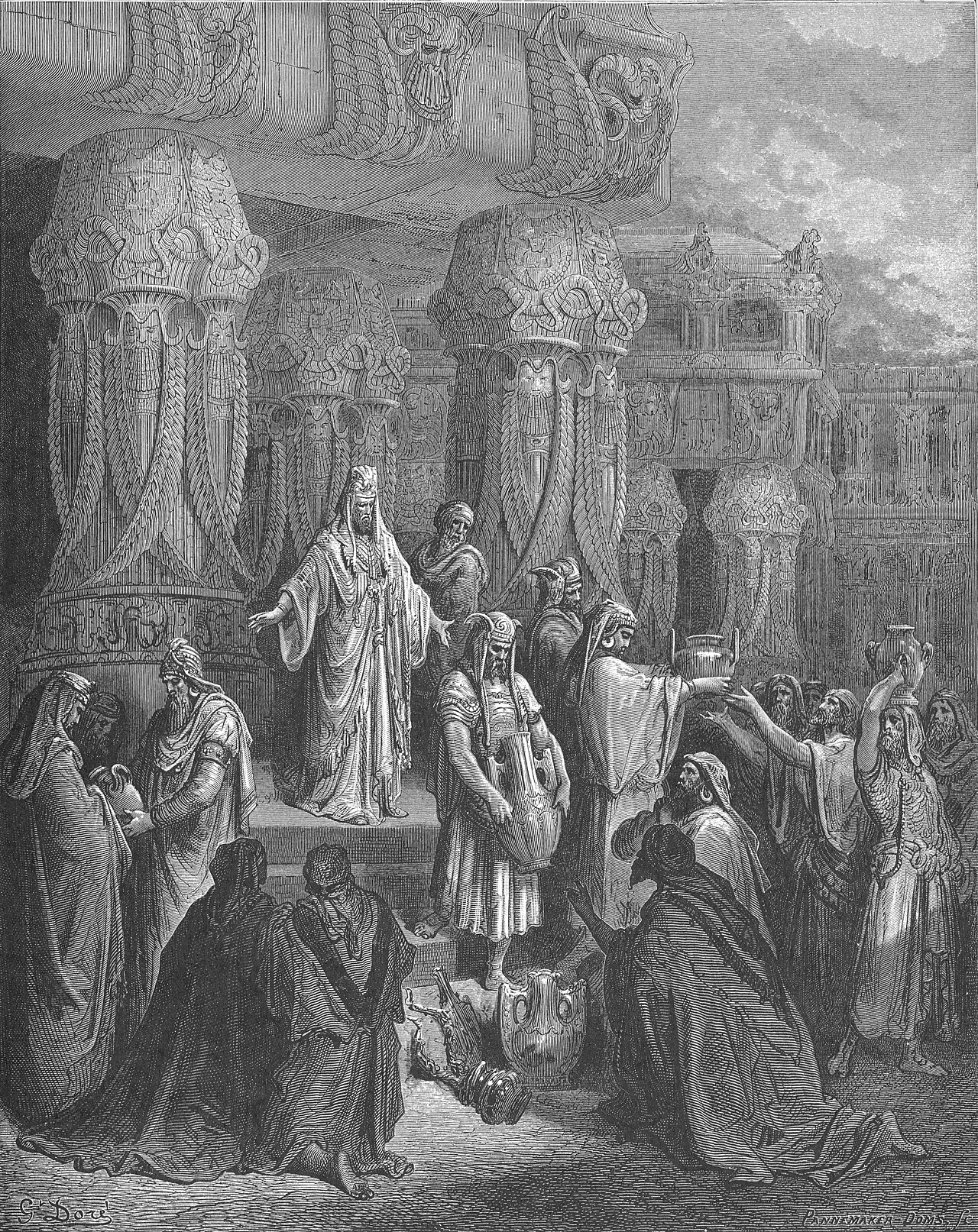
Ezrachapter 10
44 verses · Ezra, by tradition · 5th century BC · History
Whoever failed to appear within three days would forfeit all his property, according to the counsel of the leaders and elders, and would himself be expelled from the assembly of the exiles.
Introduction
Ezra, by tradition, History, Ezra Overview.
This chapter was written for families who faced the hardest decision in the book. Tradition gives the book to Ezra, and this closing chapter moves from his voice to an account of the whole assembly. Its first hearers knew the names on the list at its end, some of them from their own households. The chapter shows a people choosing to keep its covenant identity at a real cost. Listen for how the assembly speaks, for the weather it sits in, and for the few who opposed the plan. Notice how plainly the book ends. Read it as a hard reform recorded without softening.
Context
- Who
- Families facing the hardest decision in the book
- What
- An account of the covenant to put away foreign wives, the assembly in the rain, the months of hearings and the list of men found to have married foreign women.
- Where
- The open square before the house of God in Jerusalem, and the towns of Judah where the cases were heard.
- When
- The twentieth day of the ninth month of 458 BC, in the winter rains, with the hearings running to the first day of the first month of the next year.
- Why
- To record how the returned community acted to remain the people of the covenant, and to set down the names and the cost honestly.
Historical context
The whole community is summoned to Jerusalem on three days' notice, with property forfeiture for anyone who does not come. They sit in the street before the house of God, trembling, the text says, "for this matter, and for the great rain."
Show the rest of the historical context, 5 more paragraphs
That detail is exact. The ninth month is roughly December, the heart of Jerusalem's rainy season, when cold rain comes in off the Mediterranean and the hill country turns miserable. A large crowd sitting in the open in that weather could not sit long, and they say so: the people are many and it is a time of much rain, and we are not able to stand outside.
So they propose a process instead of a mass decision, appointed rulers, each town's cases heard with its elders and judges, working through the winter. It took about three months.
The list at the end is short relative to the population: a little over a hundred men, including seventeen priests. Whatever else this was, it was not a purge of the whole community.
The chapter is genuinely painful, and honest readers have always felt it. Wives and children were sent away. The text records that it happened and does not soften it, and it also records one dissenting voice, some men stood against the plan.
Nehemiah, arriving thirteen years later, would face the same problem again and handle it differently, confronting individuals rather than running a province-wide review.
Significance
For the returnees the question underneath the whole procedure was whether this small community was going to survive as the people of the covenant or dissolve into the landscape within a generation.
Show the rest of the significance, 1 more paragraph
The book ends without a tidy resolution, just a list of names and a bare note about the children. It is a record of a community trying, at real cost and imperfectly, to keep its identity in a corner of an empire that had no reason to care whether it did.
This chapter in Jewish lifeWhat this chapter is in Jewish life and reading.
What is done
The last chapter of Ezra is not read in the synagogue year. The site's own table in src/lib/hebraic/readings.ts printed parashot total 0 and haftarah uses total 0 for Ezra, and no festival reading.
The chapter records an assembly in the ninth month in the rainy season, and Rashi names the month and the word for what was asked of the people. The ninth month "is the month of Kislev" (Rashi on Ezra 10:9:1). The word in the eleventh verse means "confession" (Rashi on Ezra 10:11:1). The corpus sets the chapter beside the Torah portions at four places. It carries Midrash Tanchuma, Chukat 6:1 under the third verse and Midrash Tanchuma, Vayakhel 10:4 under the ninth. It carries Midrash Tanchuma Buber, Vayakhel 11:1 under the fifteenth and Midrash Tanchuma, Tzav 7:1 under the nineteenth.
How it is read
Rashi is the one commentator on this chapter whose English the corpus carries, quoted here from The Judaica Press complete Tanach with Rashi, translated by A. J. Rosenberg, which Sefaria reports as CC-BY. His notes on this chapter are short, and most are glosses. The counsel of the Lord in the third verse is "the counsel and the will of the Holy One, blessed be He" (Rashi on Ezra 10:3:1). The proclamation is "a voice, an announcement" (Rashi on Ezra 10:7:1). The three days are "at the end of three days" (Rashi on Ezra 10:8:1). Rashi glosses the rainy season "for the rains are falling upon us" (Rashi on Ezra 10:13:1).
The men of the fifteenth verse stood up "to argue concerning this matter" (Rashi on Ezra 10:15:1). The pledge of the nineteenth verse he reads as counsel given, citing Joab's advice in 2 Samuel 14:19 (Rashi on Ezra 10:19:1). The list that follows he divides by office: those of the sons of Immer onward are priests until the Levites begin (Rashi on Ezra 10:20:1).
The outcome he states twice without comment. They completed "the rectification of the matter of the men who had brought in heathen wives, for they cast them out" (Rashi on Ezra 10:17:1). At the last verse he reads the children as sent out with their mothers: "They cast out all of them, both the wives and the children." (Rashi on Ezra 10:44:1). That is Rashi's reading of the verse, and it is reported as his.
The corpus carries eight further notes on this chapter without an English text, each marked linked because Sefaria holds no English version of the ref. Six stand cited and unquoted at Metzudat David on Ezra 10:5:1, 10:10:1, 10:12:1, 10:18:1, 10:23:1 and 10:30:1, and two at Malbim on Ezra 10:6:1 and 10:34:1.
What the rabbis say
The corpus carries thirty-eight rabbinic locators on this chapter and the text of none, so each is cited here rather than quoted. On the first verse, the weeping, it holds Midrash Shmuel 4:2 and Mishnat Rabbi Eliezer 12:18. On the second it holds Megillah 15a:6, Ein Yaakov, Sanhedrin 1:19, Ein Yaakov (Glick Edition), Sanhedrin 1:16, and Yalkut Shimoni on Torah 261:5.
The third verse, the counsel of the Lord, draws a long run. The corpus holds Jerusalem Talmud Kiddushin 3:12:13 and Yevamot 2:6:5, Bamidbar Rabbah 19:3, Bereshit Rabbah 7:2 and Kohelet Rabbah 7:23:4. With them stand Midrash Tanchuma, Chukat 6:1, Midrash Tanchuma Buber, Chukat 15:4, Pesikta DeRav Kahana 4:3 and Pesikta Rabbati 14:1.
The eighth verse, the three days, carries the heaviest Talmudic weight in the chapter. The corpus holds Moed Katan 16a:9, Gittin 36b:3 and Yevamot 89b:11, with Jerusalem Talmud Moed Katan 3:1:8, Nedarim 1:1:11, Peah 5:1:3 and Shekalim 1:2:3. With them stand Ein Yaakov, Moed Katan 3:3 and Yevamot 10:1, Ein Yaakov (Glick Edition), Yevamot 10:1, Midrash Lekach Tov, Deuteronomy 29:20:1 and Yalkut Shimoni on Torah 897:9.
The assembly and the lists carry the rest. On the ninth verse the corpus holds Midrash Tanchuma, Vayakhel 10:4, and on the tenth Midrash Tannaim on Deuteronomy 5:15:7. On the thirteenth it holds Mekhilta DeRabbi Shimon Ben Yochai 35:2. On the fifteenth it holds Shemot Rabbah 50:5 and Midrash Tanchuma Buber, Vayakhel 11:1, and on the sixteenth Esther Rabbah 7:11. On the eighteenth it holds Sanhedrin 11a:5. On the nineteenth, the pledge, it holds Keritot 11a:9, Midrash Aggadah, Leviticus 7:12:2, Midrash Tanchuma, Tzav 7:1 and Midrash Tanchuma Buber, Tzav 9:1. What each of them teaches is a saying of the rabbis, and is reported as theirs wherever this site quotes one. The quotations wait on a fetch that carries the text.
Sources: Rashi, Rashi on Ezra 10:1:1 to 10:44:1, The Judaica Press complete Tanach with Rashi, translated by A. J. Rosenberg, reported CC-BY; Metzudat David, Metzudat David on Ezra 10:5:1, 10:10:1, 10:12:1, 10:18:1, 10:23:1 and 10:30:1, cited by ref because the corpus carries no English text; Malbim, Malbim on Ezra 10:6:1 and 10:34:1, cited by ref because the corpus carries no English text; The Sefaria corpus, scripts/data/sources/sefaria/ezra/10.json, the 38 Talmud and Midrash locators of this chapter; The site's own files, src/lib/hebraic/readings.ts, probed for this book and printing parashot total 0, haftarah uses total 0 and festivalReadingForBook null.
The heads below are this chapter's scenes. The numbered points under each are its verses.
Shecaniah: there is yet hope in Israel concerning this thing
Ezra 10:1-3
falling facedown before the house of God: Shecaniah son of Jehiel speaks first, and his own name is absent from the list, though he says "We have been unfaithful to our God". He proposes a covenant to send away the foreign wives and their children according to the Law and says "there is hope for Israel".
Ezra 10:1
“Before the house of God - i. e., in front of the temple, praying toward it 1Ki 8:30, 1Ki 8:35; Dan 6:10, and thus in the sight of all the people who happened at the time to be in the great court.”
Shecaniah son of Jehiel, an Elamite: Bede reports from Josephus that Shecaniah was the first of the Jerusalemites, and that he confessed the people's sin as one who shared in it. He belongs to the house of Elam. That house has six men in the list at verse 26.
Ezra 10:2
“Shechaniah the son of Jehiel - He speaks here in the name of the people, not acknowledging himself culpable, for he is not in the following list. It is in the same form of speech with that in James, Jas 3:9. With the tongue curse we men. He seems to have been a chief man among the people; and Ezra, at present, stood in need of his influence and support.”
Adam Clarke · Commentary on the Bible (1810-1826)evangelical
Let it be done according to the Law: Albert Barnes reads according to the Law as a formal certificate of divorce for each wife, which left her free to marry another husband. Matthew Henry holds that such marriages are sinful and yet valid. He judges that Shecaniah's counsel does not hold for his own day.
Ezra 10:3
“Let it be done according to the law - i. e., let a formal “bill of divorcement” be given to each foreign wife, whereby she will be restored to the condition of an unmarried woman, and be free to marry another husband (see Deu 24:1-2). The facility of divorce among the Jews is well-known. According to many of the rabbis, a bill of divorcement might he given by the husband for the most trivial cause.”
1 more voice on this verse
Ezra 10:3
“What has been unjustly got cannot be justly kept, but must be restored; but, as to the case of being unequally yoked with unbelievers, Shechaniah's counsel, which he was then so clear in, will not hold now; such marriages, it is certain, are sinful, and ought not to be made, but they are not null.”
Matthew Henry · Commentary on the Whole Bible (1707-1721)puritan
Ezra 10:4-6
this matter is your responsibility: Shecaniah's speech ends with a charge to Ezra: get up, "this matter is your responsibility, and we will support you." In chapter 9 Ezra confessed alone, and here support is pledged before he acts. He makes the leading priests, the Levites and all Israel take an oath.
Ezra 10:4
“Arise; for this matter belongeth unto thee - By the decree of Artaxerxes, he was authorized to do everything that the law of God required: see Ezr 7:23-28. And all officers were commanded to be aiding and assisting; hence Shechaniah says, We are with you.”
Adam Clarke · Commentary on the Bible (1810-1826)evangelical
made the leading priests, Levites, and all Israel: Adam Clarke traces Ezra's authority here to the decree of Artaxerxes in Ezra 7, which let him do whatever the law of God required. The oath runs from priests to Levites to all Israel. The list of verses 18 to 43 names the guilty in that same order.
the chamber of Jehohanan son of Eliashib: Adam Clarke names Eliashib as high priest and thinks Jehohanan is his grandson, the Jonathan of Nehemiah, son of Joiada. Some, he notes, make Jehohanan and Joiada one man. Bede traces the high priests from Jeshua son of Jozadak through Joachim to Eliashib.
Ezra 10:6
“Johanan the son of Eliashib - Eliashib was high priest, and was succeeded in that office by his son Joiada, Neh 12:10. Probably Johanan here is the same as Jonathan in Nehemiah, who was the son of Joiada, and grandson of Eliashib. Some suppose that Johanan and Joiada were two names for the same person.”
Adam Clarke · Commentary on the Bible (1810-1826)evangelical
Ezra 10:7-9
a proclamation was issued throughout Judah and Jerusalem: The proclamation carries a deadline. Anyone who fails to gather at Jerusalem within three days forfeits all his property and is expelled from the assembly of the exiles. The men of Judah and Benjamin come, and the narrator names the date, the twentieth day of the ninth month.
would forfeit all his property: Adam Clarke follows the Septuagint, which reads the forfeited property as devoted to a holy use. In that reading the property went to the house of God. Clarke reads the man expelled from the assembly of the exiles as excommunicated from the church of God and exiled from Israel.
Ezra 10:8
“All his substance should be forfeited - To the use of the temple. So the Septuagint understood the place: Αναθεματισθησεται πασα ἡ ὑπαρξις αυτου, “All his substance shall be devoted to a holy use.” Himself separated - Excommunicated from the Church of God, and exiled from Israel.”
Adam Clarke · Commentary on the Bible (1810-1826)evangelical
Trembling in the rain, and a matter too great for one day
on the twentieth day of the ninth month: Albert Barnes sets the ninth month four months after Ezra's arrival at Jerusalem, dated at Ezra 7:9. Barnes reads the square as the temple's broad court. Bede takes the naming of Judah and Benjamin as a sign that the guilty belonged to the first migration.
Ezra 10:9
“It was the ninth month - Or, our December, a time when rain fails heavily in Palestine: four months, therefore, after Ezra’s arrival in Jerusalem (compare Ezr 7:9). The street - Rather, “the court,” the “broad,” “spacious, place” (compare the 2Ch 29:4 note).”
Ezra 10:10-12
Ezra the priest stood up: Ezra's speech has three sentences. The people have been unfaithful, they must make confession to the LORD and do His will, and they must separate themselves from their foreign wives. The whole assembly answers in a loud voice, "Truly we must do as you say", before the details are settled.
Ezra 10:10
“Assuredly also, when (the apostle) rules that marriage should be "only in the Lord," (1 Cor. 7:39) that no Christian should intermarry with a heathen, he maintains a law of the Creator, who everywhere prohibits marriage with strangers.”
Tertullian · written before 220 · Against Marcion Book Vpatristic
Separate yourselves from the people of the land: Tertullian reads Paul's rule at 1 Corinthians 7:39, that a Christian marry only in the Lord, as a law of the Creator. In his reading the Creator forbids marrying foreign women everywhere.
Ezra 10:11
“Now therefore make confession to the Lord God of your fathers,.... Of their sin, and express their detestation of it, and repentance for it: and do his pleasure; obey his will, and particularly in this case: and separate yourselves from the people of the land; the Canaanites, &c. have no fellowship with them, make no covenants, contracts, and alliances with them for the future: and from the strange wives; they had taken; put them away.”
1 more voice on this verse
Ezra 10:11
“Make confession - Acknowledge your sins before God, with deep compunction of heart, and the fullest resolution to forsake them.”
Adam Clarke · Commentary on the Bible (1810-1826)evangelical
Adam Clarke follows the assembly's answer through to verse 44, where some foreign wives had children. He calls it a great hardship on the women and children. By Jewish law such marriages were void, Clarke says, yet the foreign women had not known it, and he calls their case deplorable.
Ezra 10:12
“It was agreed that this affair should be carried on, not in a popular assembly, nor that they should think to go through with it all on a sudden, but that a court of delegates should be appointed to receive complaints and to hear and determine upon them. It could not be done at this time, for it was not put into a method, nor could the people stand out because of the rain.”
Matthew Henry · Commentary on the Whole Bible (1707-1721)puritan
1 more voice on this verse
Ezra 10:12
“As thou hast said, so must we do - They all resolved to do what Ezra then commanded, they did put away their wives, even those by whom they had children; Ezr 10:44: this was a great hardship on the women and children. Though by the Jewish laws such marriages were null and void, yet as the women they had taken did not know these laws, their case was deplorable.”
Adam Clarke · Commentary on the Bible (1810-1826)evangelical
Ezra 10:13-15
it is the rainy season: The crowd's objection slows what the vow had promised. Their remedy becomes the method: leaders represent the assembly, and each case comes with its town's elders and judges. The Berean reads Jonathan and Jahzeiah as opponents, and some commentators take them as officers appointed to the work.
Ezra 10:13
“But the people are many,.... Who have been guilty of this evil: and it is a time of much rain, and we are not able to stand without: in the street, because of the rain: neither is this a work of one day or two; to inquire into this affair, who they are that have taken strange wives, and to persuade or oblige them to put them away: for we are many that have transgressed in this thing; in marrying strange wives.”
until the fierce anger of our God: Matthew Henry calls this plan a court of delegates, set up to receive complaints and to hear and determine each case. The people close on the fierce anger of God. Ezra had asked at 9:14 whether God would become so angry as to leave no remnant.
Ezra 10:14
“If, in this method, a thorough reformation be made, the fierce wrath of God will be turned from us, which, we are sensible, is ready to break forth against us for this transgression." Ezra was willing that his zeal should be guided by the people's prudence, and put the matter into this method; he was not ashamed to own that the advice came from them, any more than he was to comply with it.”
Matthew Henry · Commentary on the Whole Bible (1707-1721)puritan
opposed this plan.): Albert Barnes notes that some render the clause as Jonathan and Jahzeiah opposed this, the reading the Berean follows. Four men are named against the plan. Barnes calls the opposition useless, and in verse 16 the exiles did as proposed.
Ezra 10:15
“Some translate it: “Nevertheless, Jonathan the son of Asahel and Jahaziah the son of Tikvah opposed this.” The opposition was useless Ezr 10:16.”
Ezra 10:16-17
On the first day of the tenth month: The investigation runs three months, from the first day of the tenth month to the first day of the first month. Ezra selects family heads, each identified by name, to represent their families. This is the same ancestral method that shaped the registers of Ezra 2.
Ezra 10:16
“It was happy for them that they had such a man as Ezra to head them; they could not have done it well without his direction, yet he would not do it without their concurrence.”
Matthew Henry · Commentary on the Whole Bible (1707-1721)puritan
by the first day of the first month: John Gill counts three months for the investigation, from the tenth month to the first, and Albert Barnes a full two. Barnes lists the work. The family heads of verse 16 had to confirm that each wife was foreign and write each certificate of divorce.
Ezra 10:17
“And they made an end with all the men that had taken strange wives,.... Finished their inquiry and examination of them: by the first day of the first month; the month Nisan, answering to part of March and April; so that they were three months about this work.”
1 more voice on this verse
Ezra 10:17
“The business occupied the commission full two months. In some cases, it may be presumed, they had to summon persons before them who did not wish to part with their foreign wives; in all, they had to assure themselves that the wives were foreign; finally, they had in every case where they decreed a divorce to make out the “writing of divorcement” Ezr 10:3.”
The names of the men who had taken foreign wives
Ezra 10:18-22
Among the descendants of the priests: The list opens among the priests with the descendants of the high priest Jeshua, so even the household nearest the altar is on it. Maaseiah, Eliezer, Jarib and Gedaliah pledge to send their wives away, and for their guilt they present a ram as a guilt offering.
Ezra 10:18
“Compare with the list in Ezra 2. Ezr 10:19 They gave their hands - i. e., “solemnly pledged themselves” (compare the marginal references). Ezr 10:44 The guilty persons, it would seem, were 113 in number. They comprised 4 members of the high priest’s family, 13 other priests, 10 Levites, and 86 lay Israelites belonging to at least 10 distinct families. The fact noted in the second clause of the verse must have increased the difficulity of Ezra’s task.”
They pledged to send their wives away: Albert Barnes counts these four as the high priest's family, and he reads the pledge as giving their hands, a solemn promise. Aben Ezra, as John Gill reports him, finds no rule that made a guilt offering the penalty for such marriages. He supposes the leaders advised it.
Ezra 10:19
“And they gave their hands that they would put away their wives,.... They proposed to do it, and actually did it: and being guilty; of which they were fully convinced: they offered a ram of the flock for their trespass; to make atonement for it, and thereby set an example to others to do the like. Aben Ezra observes, that we do not find that the trespass offering was a mulct to such who married strange wives, and conjectures, that it was the advice of the chief men to do it.”
From the descendants of Immer: Immer is one of the four priestly houses John Gill finds in the first return, with 1,052 men at Ezra 2:37. The other three are Jedaiah, Pashhur and Harim. Immer's two names are the fewest of any priestly house here.
From the descendants of Harim: Harim is a priestly house of the first return, counted at 1,017 men in Ezra 2:39. Albert Barnes counts 13 priests in this list beyond the high priest's family. Harim gives five of them.
From the descendants of Pashhur: Pashhur was the largest of the four priestly houses of the first return, with 1,247 men at Ezra 2:38. Its six names are the most of any priestly house here. A Maaseiah stands in each priestly house of verses 19, 21 and 22.
Ezra 10:23-24
Among the Levites: The roll moves from priests to Levites, singers and porters. Only a handful of names appear in each order, six Levites, one singer, three porters, against the much longer priestly and lay lists. The proportion is itself a kind of witness: the failure ran widest among the laity.
From the gatekeepers: The first return had brought 128 singers of Asaph's line and 139 gatekeepers, by Ezra 2:41 and 42. Shallum's house leads the gatekeepers there. Albert Barnes counts ten Levites in the whole list, so he reckons this singer and these gatekeepers with the six Levites of verse 23.
Ezra 10:25-43
among the other Israelites: The heading "among the other Israelites" opens the longest stretch of the chapter, nineteen verses of names. Ten or more houses of ordinary Israelites are named, which shows how far the failure had spread. By verse 17 the cases were already dealt with, so the list records finished discipline.
Ezra 10:25
“Moreover of Israel - That is, as Calmet observes, simple Israelites, to distinguish them from the priests, Levites, and singers, mentioned in Ezr 10:18, Ezr 10:23, Ezr 10:24.”
Adam Clarke · Commentary on the Bible (1810-1826)evangelical
From the descendants of Elam: A Jehiel stands among these men of Elam, and Shecaniah of verse 2 is a son of Jehiel, an Elamite. Elam had sent 1,254 men in the first return, by Ezra 2:7. Jeshaiah brought 70 more with Ezra at 8:7.
From the descendants of Zattu: Zattu had sent 945 men in the first return, by Ezra 2:8, and 300 more with Ezra at 8:5. The name Mattaniah occurs in four houses of this list, at verses 26, 27, 30 and 37. Jeremoth occurs in three.
From the descendants of Bebai: Bebai had sent 623 men in the first return, by Ezra 2:11, and 28 more with Ezra at 8:11. Its four names are the fewest of any lay house here.
From the descendants of Bani: Bani had sent 642 men in the first return, by Ezra 2:10, and 160 more with Ezra at 8:10. A Meshullam is named here. The name also stands at verse 15, among the men who stood against the plan.
From the descendants of Pahath-moab: Pahath-moab had sent 2,812 men in the first return, by Ezra 2:6, and 200 more with Ezra at 8:4. Binnui here is one man of that house. A house of the same name follows at verse 38.
From the descendants of Harim: This is the lay house of Harim, counted at 320 in the first return by Ezra 2:32. The priests of Harim in verse 21 belong to a second house of that name. Its eight names follow in verse 32.
Eliezer, Isshijah, Malchijah, Shemaiah: These eight belong to the lay house of Harim headed in verse 31. A Shemaiah stands in both houses of Harim, the priests of verse 21 and the laymen here. Malchijah and Malluch also recur, at verses 25 and 29.
From the descendants of Hashum: Hashum had sent 223 men in the first return, by Ezra 2:19. Ezra's roll in chapter 8 leaves it out. Six lay houses of this list, Parosh, Elam, Zattu, Bebai, Bani and Pahath-moab, do appear in that roll.
From the descendants of Bani: The descendants of Bani head a second group here. The other Israelites of verses 25 to 43 come under eleven headings, and Bani has two of them. Albert Barnes counts at least ten distinct families.
Maadai, Amram, Uel, Benaiah: These six names open the second group of Bani, headed at verse 34. Benaiah stands in four lay houses of this list, at verses 25, 30, 35 and 43. Only Mattaniah occurs as often.
Vaniah, Meremoth, Eliashib: The name Eliashib occurs four times in this chapter, at verses 6, 24, 27 and 36. Here it names a layman of Bani. Meremoth also shares his name with the priest who received the treasure at 8:33.
Mattaniah, Mattenai, and Jaasu: Bani's second group closes here at twelve names. Only Binnui's group, of thirteen, runs longer in the lay list. Mattaniah and Mattenai stand side by side, and a Mattenai also stands first in the house of Hashum at verse 33.
From the descendants of Binnui: Binnui heads the largest group in the whole list, thirteen names in verses 39 to 42. At 8:33 a Noadiah son of Binnui stands among the Levites who received the treasure. This Binnui is a lay house.
Shimei, Shelemiah, Nathan, Adaiah: Shimei, first in Binnui's group, is also the name of a Levite at verse 23 and of a man of Hashum at verse 33. Adaiah recurs from the house of Bani at verse 29.
Machnadebai, Shashai, Sharai: The two registers may join the houses of Binnui and Bani. Ezra 2:10 lists the descendants of Bani with 642, and Nehemiah 7:15 gives the descendants of Binnui with 648 in the same place. Machnadebai, Shashai and Sharai occur in no other verse of Ezra.
Azarel, Shelemiah, Shemariah: Shelemiah is named here a second time, after verse 39. Parosh shows the same at verse 25, where Malchijah is named twice. Shemariah also stands in the lay house of Harim at verse 32.
Shallum, Amariah, and Joseph: A Shallum also stands among the gatekeepers at verse 24. Shallum and Amariah are both names in Ezra's own line of descent, at Ezra 7:2 and 3. Binnui's thirteen names end with this verse.
And from the descendants of Nebo: The descendants of Nebo numbered 52 in Ezra 2:29. Albert Barnes and John Gill both count about 113 men who had married foreign women, and the names in this list come to 111. Matthew Henry notes that the same unfaithfulness returns in Nehemiah 13.
some of them had children by these wives: The book ends without a scene, on a sentence about consequence: all these men had married foreign women, and some of them had children. The narrative breaks off in the middle of the register. The ending matches the book's opening, which had picked up mid-sentence from the close of Chronicles.
Ezra 10:44
“All these had taken strange wives,.... In all about one hundred and thirteen: and some of them had wives by whom they had children; and yet they put them away, which made it the more difficult for them to do; and those that had none, it is thought to be a mark of God's displeasure at such marriages.”
1 more voice on this verse
Ezra 10:44
“One would think this grievance was now thoroughly redressed, yet we meet with it again ( Neh. xiii. 11 ), for such corruptions are easily and insensibly brought in, but not without great difficulty purged out again. The best reformers can but do their endeavour, but, when the Redeemer himself shall come to Sion, he shall effectually turn away ungodliness from Jacob.”
Matthew Henry · Commentary on the Whole Bible (1707-1721)puritan
How this psalm is built
The patterns in this chapter
How this chapter is built
1 more paragraph on the patterns
Verses 1 to 17 tell the covenant, the assembly and the hearings, and verses 18 to 44 are a register of the men who had married foreign women. The register runs in order of standing: the priests first in verses 18 to 22, then the Levites, a singer and the gatekeepers in verses 23 and 24, and then the other Israelites by family in verses 25 to 43. Verse 44 closes the list and the book.
Keep studying
Studies2
Places1
Sources for this chapter
The summary
Jamieson, Fausset & Brown, Commentary Critical and Explanatory; John Wesley, Notes on the Old Testament and Matthew Henry, Complete Commentary.
The exposition
Adam Clarke, Commentary on the Bible; Albert Barnes, Notes, Explanatory and Practical, on the Old and New Testaments (1832-1869); Bede, Commentary on Ezra and Nehemiah; Berean Standard Bible; Jamieson Fausset and Brown, Commentary Critical and Explanatory on the Whole Bible; John Gill; John Wesley, Explanatory Notes upon the Old Testament; Keil, The Books of Ezra, Nehemiah, and Esther; Matthew Henry, Commentary on the Whole Bible; Tertullian, Against Marcion Book V and W. F. Adeney, Ezra, Nehemiah and Esther (Expositor's Bible).