
2 Kingschapter 1
18 verses · Jeremiah, by tradition · 6th century BC · History
Key verse
Then Moab rebelled against Israel after the death of Ahab.
It stands in Is it because there is no God in Israel?, verses 1 to 8.
The chapter
Chapter summary
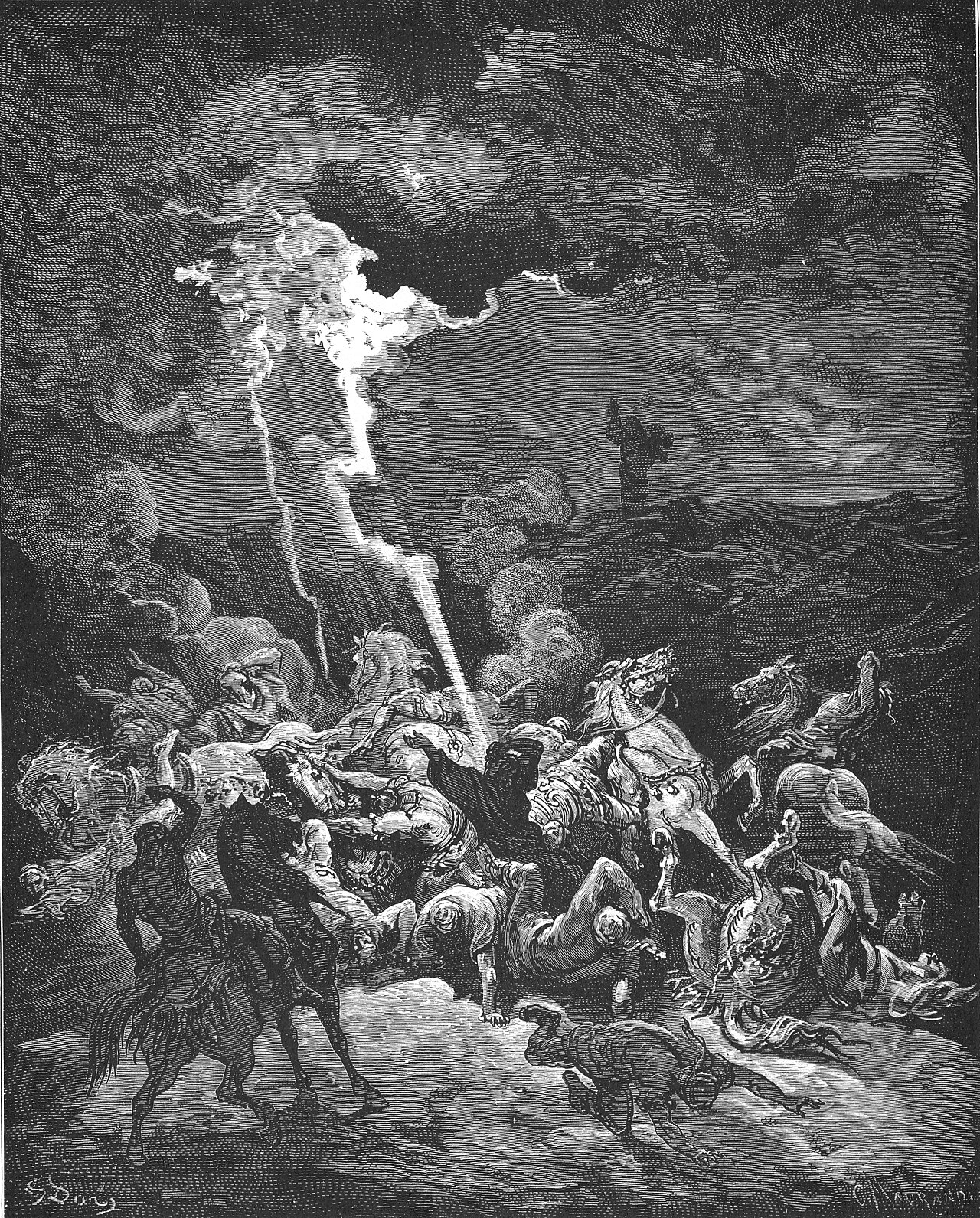
Ahaziah falls through the lattice of his upper chamber and sends to inquire of Baal-zebub, the god of Ekron, whether he will recover. Elijah meets the messengers on the road with the question that frames the whole book: 'Is it because there is no God in Israel, that ye go to inquire of Baal-zebub, the god of Ekron?' The king recognizes the hairy man with the leathern girdle and sends captains of fifty to fetch him; twice fire comes down, and the third captain kneels and begs and is spared. Elijah goes down and repeats the sentence in person, and Ahaziah dies. James and John will ask for this same fire, and be rebuked (Luke 9).
Context
History · Jeremiah · 2 Kings overview
The world of this chapter
- Who
- Israelites whose king sent to a foreign shrine before he sent to his own God
- Where
- The palace at Samaria, the road to Philistine Ekron, and a hilltop outside the city
- When
- The short reign of Ahaziah of Israel. 853 to 852 BC, on Thiele's chronology
Historical context
The book does not name its compiler. Jewish tradition at b. Bava Batra 15a assigns it to Jeremiah, 1 and 2 Kings stood as one scroll until the Greek translation divided them, and the critical reading follows Martin Noth in placing a single exilic compiler behind Joshua through Kings. Both readings agree that the final form is exilic, and the dates across these rows follow Edwin R. Thiele's synchronisms as close approximations rather than fixed points.
Ahaziah son of Ahab reigned about two years over Israel from Samaria, and the compiler's verdict on him is evil in the LORD's sight. The accident that opens the chapter is domestic and plausible, since upper rooms had window openings closed with a wooden lattice, cross-slats that let air and light through while keeping out sun and eyes, and a man leaning on one could go straight through it into the courtyard below.
Ekron was one of the five Philistine cities, about forty miles southwest, and it had a well-known oracle shrine; a royal inscription found there in 1996 names five of its rulers and its patron goddess. Sending envoys across a border to consult another nation's god about your recovery was a public statement that your own God either could not or would not answer, which is the charge Elijah brings. The name the text uses, Baal-zebub, means lord of the flies, and it is almost certainly a deliberate Israelite twisting of Baal-zebul, Baal the prince, a title known from Canaanite texts.
Elijah is identified by his clothing before anyone gives his name, a hairy garment with a leather belt, which was a prophet's recognized dress and is the description John the Baptist wears centuries later. The captains of fifty who come for him are the ordinary unit commanders of a standing army, and their errand is a legal one, since a king's messengers carried the king's own authority, so the third captain's decision to climb the hill and beg rather than command is a man choosing whose authority is higher.
Significance
The question in the middle of the chapter is the whole point: is it because there is no God in Israel that you go to inquire of Baal-zebub? It is asked twice.
The first hearers were people who had a shrine in walking distance for every need. The chapter says the issue is which God you turn to first when you are frightened, rather than whether an answer comes at all.
Where the chapter sits
2 Kings 1 falls in Elijah's ascension; Elisha's ministry (chapters 1–13). Elijah taken up by whirlwind; double portion; widow's oil; the Shunammite's son raised; Naaman healed; siege of Samaria broken; Elisha dies and his bones raise a man.
After it: Northern kingdom's fall, chapters 14–17.
The whole shape of 2 Kings→The structure of this chapter
The heads below are this chapter's scenes. The numbered points under each are its verses.
Is it because there is no God in Israel?
Moab rebelled against Israel: Moab had been tributary to Israel since David subdued it, and the text marks Ahab's death as the moment the vassal state judges the throne weak enough to break free. The rebellion is left as a bare notice here and does not return to the story until 2 Kings 3, when Israel and Judah march against it together. The Septuagint divides Samuel and Kings into four books of Kingdoms and cuts the seam inside Ahaziah's short reign, a reminder that this chapter break belongs to later editors and not to the original scroll.
2 Kings 1:1
“The Moabites, who had once lorded over Israel Jdg 3:12-14, were reduced to subjection by David, and treated with extreme severity (marginal reference). In the time of Ahab they were dependent on the kingdom of Israel, to which it has been generally supposed that they fell at the separation of Israel from Judah.”
1 more voice on this verseWhat preachers and commentators have said about this verse, in their own words.
2 Kings 1:1
“But they took advantage of the death of Ahab to shake off the yoke (see on 2Ki 3:6). The casualty that befell Ahaziah [2Ki 1:2] prevented his taking active measures for suppressing this revolt, which was accomplished as a providential judgment on the house of Ahab for all these crimes. AHAZIAH'S JUDGMENT BY ELIJAH.”
Jamieson, Fausset & Brown· Commentary Critical and Explanatory on the Whole Bible (1871)reformed
fell down through a lattice: A lattice gives way under a king's weight and turns an ordinary accident into a test of where a monarch turns in a crisis. Ahaziah sends past the God of Israel to Baal-zebub, the fly-god of the Philistine city Ekron, asking only whether he will live and never asking what he owes. The name travels forward into the Gospels as Beelzebub, the prince of devils at Matt 12:24, so the god Ahaziah consults here is the same figure Jesus is later accused of serving.
2 Kings 1:2
“Fell down through a lattice - Perhaps either through the flat root of his house, or over or through the balustrades with which the roof was surrounded. Go, inquire of Baal-zebub - Literally, the fly-god, or master of flies. The Septuagint has βααλ μυιαν, Baal the fly. He was the tutelary god of Ekron, and probably was used at first as a kind of telesm, to drive away flies. He became afterwards a very respectable devil, and was supposed to have great power and influence.”
Adam Clarke· Commentary on the Bible (1810-1826)evangelical
1 more voice on this verse
2 Kings 1:2
“This latter supposition is most probably the true one, as Ahaziah did not fall either into the street or the court, but "in his upper chamber." inquire of Baalzebub--Anxious to learn whether he should recover from the effects of this severe fall, he sent to consult Baalzebub, that is, the god of flies, who was considered the patron deity of medicine.”
Jamieson, Fausset & Brown· Commentary Critical and Explanatory on the Whole Bible (1871)reformed
there is not a God in Israel: The angel meets Elijah before the messengers ever reach Ekron and hands him a question rather than an order, whether there is no God in Israel that the king must send abroad to a foreign idol. The same question falls two more times before the chapter closes, once repeated by the returning messengers and once delivered by Elijah in person, so the reader hears it three separate times. Elijah does not chase the men down to argue the point. He meets them, speaks the sentence, and departs, and that one sentence becomes the king's death warrant.
2 Kings 1:3
“This consultation of an idol, being a breach of the fundamental law of the kingdom (Ex 20:3; De 5:7), was a daring and deliberate rejection of the national religion. The Lord, in making this announcement of his death, designed that he should see in that event a judgment for his idolatry.”
Jamieson, Fausset & Brown· Commentary Critical and Explanatory on the Whole Bible (1871)reformed
2 Kings 1:4
“But shalt surely die - The true God tells you this; he in whose hands are both life and death, who can kill and make alive. Baal-zebub can do nothing; God has determined that your master shall die.”
Adam Clarke· Commentary on the Bible (1810-1826)evangelical
Why are ye now turned back?: The messengers turn back so quickly that Ahaziah can tell at once something has stopped them, since a round trip to Ekron could not have been made in so little time. They repeat the prophet's sentence to the king word for word, the second time the chapter puts that same accusing question in someone's mouth, though they can describe only his bearing and not yet his name. Ahaziah hears his own fate from his own servants before he ever stands before the man who sent it.
2 Kings 1:5
“And when the messengers turned back unto him,.... To Ahaziah king of Israel, as they did as soon as Elijah was gone from them; concluding from his habit, his gravity, and the authority with which he spoke, that he was a prophet of the Lord, and especially from his knowledge of them, and of what they were sent about: he said unto them, why are ye now turned back? for, by the time they had been gone, he knew they could never have been at Ekron and returned.”
2 Kings 1:6
“And they said unto him, there came a man up to meet us, and said unto us, go, turn again unto the king that sent you,.... King Ahaziah: and say unto him; and then they repeated all that is said by the angel to Elijah, and he had delivered to them, 2Ki 1:3 and which was a sufficient reason for their turning back, since they got a full answer from a man of God, of what they were to inquire of at Ekron; which was, whether the king would recover of this disease or not.”
What manner of man was he: Ahaziah asks not for a name but for a description, and the answer he gets, a hairy man girt with a girdle of leather, is enough on its own. It is Elijah the Tishbite. Matthew 3:4 dresses John the Baptist in the same garment, camel's hair and a leather girdle, and Malachi 4:5 had already promised that Elijah would come before the day of the Lord, so the uniform becomes a sign later readers are meant to recognize. The prophets of this period commonly wore rough garments of skin, which the servants' description assumes rather than explains.
2 Kings 1:7
“He that was a thorn in Ahab's eyes will be so in the eyes of his son while he treads in the steps of his father's wickedness; and he is ready to cry out, as his father did, Hast thou found me, O my enemy? Let sinners consider that the word which took hold of their fathers is still as quick and powerful as ever.”
Matthew Henry· Commentary on the Whole Bible (1707-1721)puritan
2 Kings 1:8
“He was a hairy man - That is, he wore a rough garment, either made of camels’ hair, as his successor John Baptist’s was, or he wore a skin dressed with the hair on. Some think that the meaning is, he had very long hair and a long beard. The ancient prophets all wore rough garments, or upper coats made of the skins of beasts: They wandered about in sheep-skins and goat-skins, says the apostle, Heb 11:37.”
Adam Clarke· Commentary on the Bible (1810-1826)evangelical
1 more voice on this verse
2 Kings 1:8
“The Dervishes and Bedouins are attired in this wild, uncouth manner, while their hair flows loose on the head, their shaggy cloak is thrown over their shoulders and tied in front on the breast, naked, except at the waist, round which is a skin girdle--a broad, rough leathern belt.”
Jamieson, Fausset & Brown· Commentary Critical and Explanatory on the Whole Bible (1871)reformed
Two captains consumed; a third one kneels
a captain of fifty with his fifty: The first captain arrives with fifty men and a command dressed as courtesy, thou man of God, the king hath said, come down, though Adam Clarke and others read plain hostility under the polite title, since a squad of fifty was not sent to deliver a mere invitation. Elijah answers with a test in the same shape Carmel already proved, if I be a man of God, then let fire come down from heaven, and the fire falls exactly as asked, consuming the captain and all fifty with him. The prophet supplies no fire of his own. He only states the terms, and heaven answers them.
2 Kings 1:9
“A captain of fifty with his fifty - It is impossible that such a man as Ahaziah, in such circumstances, could have had any friendly designs in sending a captain and fifty soldiers for the prophet; and the manner in which they are treated shows plainly that they went with a hostile intent. And he spake unto him, Thou man of God - Thou prophet of the Most High.”
Adam Clarke· Commentary on the Bible (1810-1826)evangelical
2 Kings 1:10
“And there came down fire - Some have blamed the prophet for destroying these men, by bringing down fire from heaven upon them. But they do not consider that it was no more possible for Elijah to bring down fire from heaven, than for them to do it. God alone could send the fire; and as he is just and good, he would not have destroyed these men had there not been a sufficient cause to justify the act.”
Adam Clarke· Commentary on the Bible (1810-1826)evangelical
1 more voice on this verse
2 Kings 1:10
“Concerning the work of my hands, command you me, Isa. xiv. What an interest heaven had in the prophets! God was always ready to plead their cause, and avenge the injuries done to them; kings shall still be rebuked for their sakes, and charged to do his prophets no harm; one Elijah is more to God than 10,000 captains and their fifties.”
Matthew Henry· Commentary on the Whole Bible (1707-1721)puritan
another captain of fifty with his fifty: A second captain comes with the same fifty men and a sharper order, come down quickly, mocking the first captain's fate rather than heeding its warning. Elijah gives the identical answer and the identical fire falls, so the chapter repeats itself almost word for word to show that the king's second attempt changes nothing about the outcome. John Gill notes that Ahaziah, unmoved by the first judgment, simply sends another company to the same end.
2 Kings 1:11
“Again also he sent unto him another captain of fifty with his fifty,.... The king, not being at all terrified with the awful judgment upon the former, sends another: and he answered and said unto him, O man of God, thus hath the king said, come down quickly; he flouts the prophet in the same manner as the former, and in the king's name commands him to come down, and that immediately; which the king added to his orders, or he himself, signifying he would not be trifled with, if he did not come down directly, he would force him.”
1 more voice on this verse
2 Kings 1:11
“Elijah relents not, but calls for another flash of lightning, which instantly lays this captain and his fifty dead upon the spot. Those that will sin like others must expect to suffer like them; The third captain humbled himself and cast himself upon the mercy of God and Elijah.”
Matthew Henry· Commentary on the Whole Bible (1707-1721)puritan
2 Kings 1:12
“And Elijah answered and said unto them,.... The same as he had to the first captain, and made the same request of fire from heaven; which accordingly came down, and destroyed this captain and his fifty also.”
fell on his knees before Elijah: The third captain breaks the pattern before he speaks a word. He falls on his knees before Elijah and begs for his life and the lives of his fifty men, naming the two companies already burned as the reason for his fear. Luke 9:54 shows James and John asking Jesus whether he should call down fire even as Elijah did, citing this very scene, and Jesus refuses the request rather than repeating it, a difference the Gospel itself marks. The third captain's humility succeeds where two companies' defiance failed, and his plea is the last word before the angel intervenes.
2 Kings 1:14
“Behold, there came fire down from heaven and burnt up the two captains of the former fifties with their fifties,.... He owns the facts, and ascribes the death of them to the true cause, and appears to have an awful sense of the judgment of God on them, fearing the same would befall him and his: therefore let my life now be precious in thy sight; by sparing it, what is precious and valuable being spared.”
2 Kings 1:15-16
Go down with him: be not afraid: The angel who first sent Elijah to intercept the messengers now sends him a second time, go down with him, be not afraid of him, so the same voice that opened the confrontation also closes it. Elijah stands before Ahaziah in person and speaks the accusing question a third time, is it not because there is no God in Israel to enquire of his word, completing the pattern that opened at verse 3. Matthew Henry notes that no one in the king's court dares lay a hand on the prophet even standing inside the palace, and he leaves as safely as he came.
2 Kings 1:15
“And the angel of the Lord said - Go down with him - This is an additional proof that Elijah was then acting under particular inspirations: he had neither will nor design of his own. He waited to know the counsel, declare the will, and obey the command, of his God.”
Adam Clarke· Commentary on the Bible (1810-1826)evangelical
Thou shalt not come down from that bed
2 Kings 1:16
“So thunder-struck is Ahaziah with this message, when it comes from the prophet's own mouth, that neither he nor any of those about him durst offer him any violence, nor so much as give him an affront; but out of that den of lions he comes unhurt, like Daniel. Who can harm those whom God will shelter? Lastly, The prediction is accomplished in a few days.”
Matthew Henry· Commentary on the Whole Bible (1707-1721)puritan
according to the word of the Lord: Ahaziah dies exactly as the word declared, and because he leaves no son the throne passes to his brother Jehoram, keeping Ahab's line on the northern throne rather than closing it outright. The verse synchronizes his accession with the second year of a different Jehoram reigning in Judah at the same time, a coincidence of names between the two royal houses that Albert Barnes reads as one of the Old Testament's undesigned agreements between separate records. The closing formula, pointing past the text to the book of the chronicles of the kings of Israel, is the standard notice this book gives at the end of nearly every reign.
2 Kings 1:17
“In the second year from that time, when Jehoram was thus made vice-king in his father's stead; this Jehoram, Ahab's son, began to reign: and in the fifth year of the reign of this Jehoram son of Ahab, which was about the twenty- fourth year of Jehoshaphat's reign, Jehoram son of Jehoshaphat was made king of Judah, together with his father.”
John Wesley· Explanatory Notes upon the Old Testament (1765)evangelical
1 more voice on this verse
2 Kings 1:17
“The similarity of names in the two royal houses of Israel and Judah at this time, and at no other, seems to be the consequence of the close ties which united the two reigning families, and is well noted among the “undesigned coincidences” of the Old Testament. The accession of the Israelite Jehoram (Ahab’s brother) took place, according to 2Ki 3:1, in the eighteenth year of Jehoshaphat.”
2 Kings 1:18
“Now the rest of the acts of Ahaziah which he did,.... During his two years' reign, which yet were imperfect, and his acts must be but few: are they not written in the book of the chronicles of the kings of Israel? in which were written his father Ahab's also, and his predecessors', see 1Ki 22:39.”
Keep studying
On this page
Studies3
Sources for this chapter
The summary
Jamieson, Fausset & Brown, Commentary Critical and Explanatory; John Wesley, Notes on the Old Testament and Matthew Henry, Complete Commentary.
The exposition
Adam Clarke, Commentary on the Bible; Albert Barnes, Notes on the Old Testament; Jamieson Fausset and Brown, Commentary Critical and Explanatory on the Whole Bible; John Gill, Exposition of the Old Testament; John Wesley, Explanatory Notes upon the Old Testament; Keil, The Books of the Kings and Matthew Henry, Commentary on the Whole Bible.