
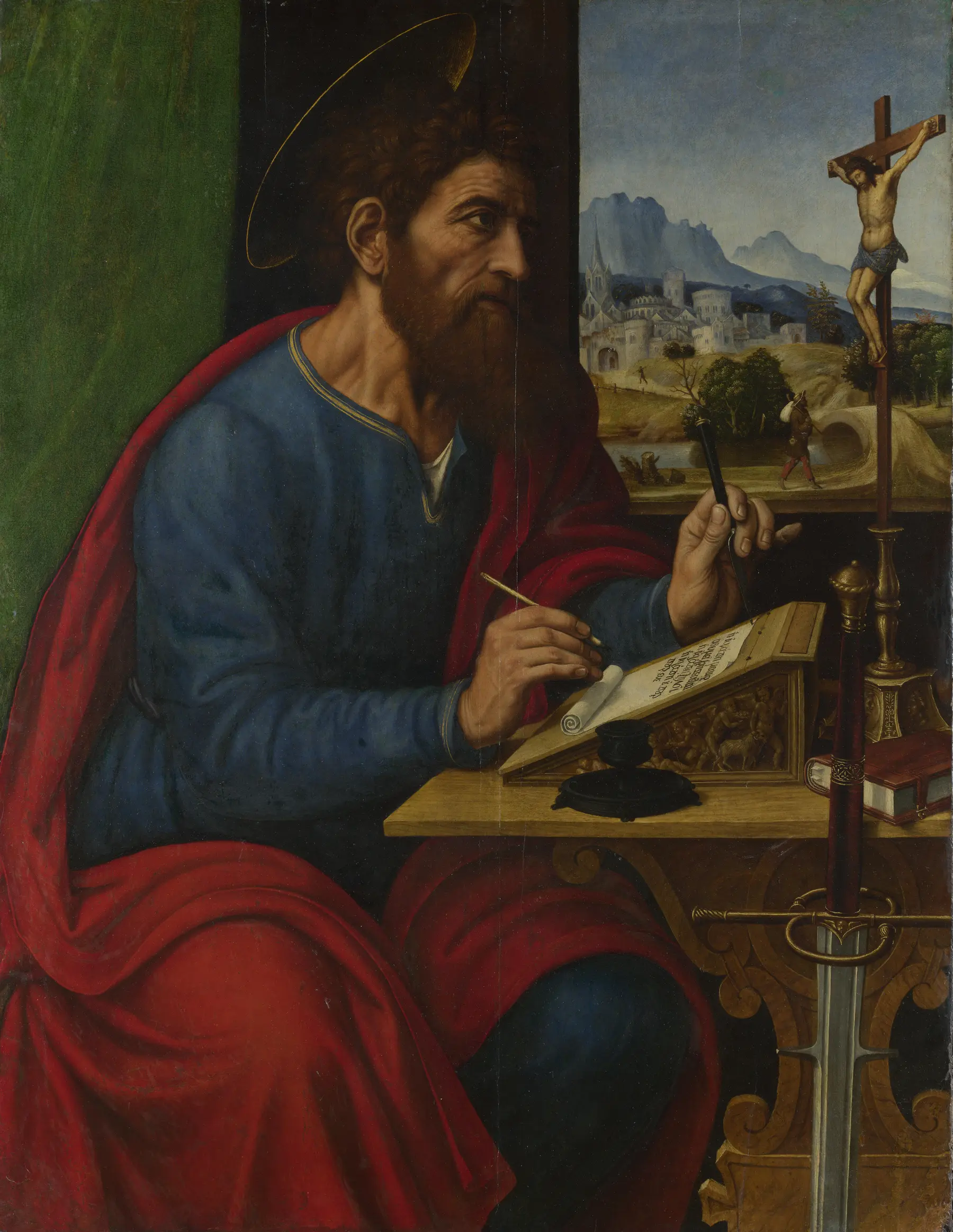
1 Timothychapter 6
21 verses · Paul, by tradition · AD 63 to 65 · Paul's letters
Instruct those who are rich in the present age not to be conceited and not to put their hope in the uncertainty of wealth, but in God, who richly provides all things for us to enjoy.
Introduction
Paul, by tradition, Paul's letters, 1 Timothy Overview.
Paul closes the letter with charges on slaves and masters, on money and on the teachers who had made religion a trade. The first hearers included many slaves and a few wealthy householders, all meeting in the same rooms. Ephesus was rich, and its great temple also served as a bank for the region. The chapter speaks to both ends of that congregation and to Timothy between them. Listen for the contrast between gain and contentment, and for the words aimed at the rich. Listen also for the praise of God that rises in the middle of the charge. Read it as the letter's last word on what to want.
Context
- Who
- A church holding both slaves and wealthy householders in the same room
- What
- The close of the letter, with instructions for slaves, a warning against teachers who used godliness for gain, a charge to Timothy, and a word to the rich.
- Where
- The church at Ephesus, a wealthy port city in the province of Asia.
- When
- About AD 62 to 64, after Paul's first imprisonment in Rome.
- Why
- To expose teachers who treated religion as a business, to teach contentment, and to charge Timothy to keep the faith entrusted to him until Christ appears.
Historical context
Slavery ran the ancient economy, and a great many believers were slaves. A Christian slave with a Christian master faced a strange new question: does calling him brother in the meeting change how I serve him on Monday? The chapter's answer aims at the slave's own honor rather than at the institution.
Show the rest of the historical context, 3 more paragraphs
Ephesus was rich, and its wealth was visible. The temple of Artemis functioned as a deposit bank for the province, and men made fortunes off the pilgrim trade in silver shrines, the very trade that started the riot in Acts 19.
The teachers being described made money by teaching. A traveling lecturer who gathered followers and gifts was a normal career, so the warning about men who think godliness is a means of gain describes a real business model, not a caricature.
'We brought nothing into the world' would have sounded familiar; the sentiment appears in Greek and Jewish writing alike. What follows it is not familiar: instruction to the rich not to abandon their money but to be rich in good works and generous, storing up a foundation for the future.
Significance
For the poor and enslaved majority, the chapter refuses to tell them that faith is a route to comfort. Contentment with food and covering is set out as gain, and the men promising more are named as frauds.
Show the rest of the significance, 1 more paragraph
For the wealthy few, it refuses the other error too. They are not told to leave, but to set their hope somewhere other than a fortune that cannot be relied on.
The heads below are this chapter's scenes. The numbered points under each are its verses.
Godliness With Contentment Is Great Gain
1 Timothy 6:1-2
under the yoke: The word to those under the yoke of slavery regulates a standing institution, so that God’s name and our teaching will not be discredited. Believing masters are to be served all the more, and the word brothers plants the gospel's seed against the institution, as Philemon shows it growing.
1 Timothy 6:1
“Let as many servants - On the word here rendered “servants” - δοῦλοι douloi - see the notes on Eph 6:5. The word is that which was commonly applied to a slave, but it is so extensive in its signification as to be applicable to any species of servitude, whether voluntary or involuntary. If slavery existed in Ephesus at the time when this Epistle was written, it would be applicable to slaves; if any other kind of servitude existed, the word would be equally applicable to that.”
believing masters: Clarke notes that a slave might think a believing master his equal and so owe him less respect. Paul reverses the logic. Both master and slave belong to Christ.
1 Timothy 6:2
“And they that have believing masters - Who have been lately converted as well as themselves. Let them not despise them - Supposing themselves to be their equals, because they are their brethren in Christ; and grounding their opinion on this, that in him there is neither male nor female, bond nor free; for, although all are equal as to their spiritual privileges and state, yet there still continues in the order of God’s providence a great disparity of their station: the master must ever be in this sense superior to the servant.”
Adam Clarke · Commentary on the Bible (1810-1826)evangelical
1 more voice on this verse
1 Timothy 6:2
“And they that have believing masters,.... That believe in one God, in opposition to the Gentiles, that held many gods, and in Jesus Christ, in distinction from the Jews; who believed in him with the heart, and professed him with their mouths, and held the mystery of faith in a pure conscience. What is said before, is said to servants that had unbelieving masters; who would be ready to blaspheme, should they act amiss.”
1 Timothy 6:3-5
disagrees with the sound words of our Lord Jesus Christ: The other teacher is diagnosed as sick. Against the sound words of our Lord Jesus Christ, hugiainousi logois, healthy words, he has an unhealthy interest in controversies and semantics. The root disease comes last, since they regard godliness as a means of gain.
1 Timothy 6:3
“Observe, We are not required to consent to any words as wholesome words except the words of our Lord Jesus Christ; but to those we must give our unfeigned assent and consent, and to the doctrine which is according to godliness. Observe, The doctrine of our Lord Jesus is a doctrine according to godliness; it has a direct tendency to make people godly.”
Matthew Henry · Commentary on the Whole Bible (1707-1721)puritan
3 more voices on this verse
1 Timothy 6:3
“If any man teach otherwise - Any otherwise than that respect should be shown to masters; and that a more cheerful and ready service should be rendered because they were Christians. It is evidently implied here that some might be disposed to inculcate such views of religion as would produce discontent and a spirit of insubordination among those who were held to servitude. Who they were is not known, nor is it known what arguments they would employ to do it.”
1 Timothy 6:3
“I might be thought to have laid down this position to remedy distrust in my case, or from a desire of entering on the contest in some other way, were there not reasons on my side, especially this, that our faith owes deference to the apostle, who forbids us to enter on "questions," or to lend our ears to new-fangled statements, or to consort with a heretic "after the first and second admonition," not, (be it observed, ) after discussion.”
Tertullian · written before 220 · The Prescription Against Hereticspatristic
1 Timothy 6:3
“If any teach otherwise - Than strict practical holiness in all Its branches. And consent not to sound words - Literally, healthful words; words that have no taint of falsehood, or tendency to encourage sin. And the doctrine which is after godliness - Exquisitely contrived to answer all the ends, and secure every interest, of real piety.”
John Wesley · Explanatory Notes upon the New Testament (1755)evangelical
an unhealthy interest in controversies: Jamieson, Fausset and Brown note that the word for conceited means wrapped in smoke. The word for unhealthy means sick, the opposite of the healthy teaching of verse 3.
1 Timothy 6:4
“He is proud--literally, "wrapt in smoke"; filled with the fumes of self-conceit (1Ti 3:6) while "knowing nothing," namely, of the doctrine which is according to godliness (1Ti 6:3), though arrogating pre-eminent knowledge (1Ti 1:7). doting about--literally, "sick about"; the opposite of "wholesome" (1Ti 6:3).”
Jamieson, Fausset & Brown · Commentary Critical and Explanatory on the Whole Bible (1871)reformed
2 more voices on this verse
1 Timothy 6:4
“True knowledge, then, consists in the understanding of Christ, which Paul terms the wisdom of God hidden in a mystery, which "the natural man receiveth not," the doctrine of the cross; of which if any man "taste," he will not accede to the disputations and quibbles of proud and puffed-up men, who go into matters of which they have no perception. For the truth is unsophisticated; and "the word is nigh thee, in thy mouth and in thy heart," as the same apostle declares, being easy of comprehension to those who are obedient.”
Irenaeus · written before 202 · Fragments from the Lost Writings of Irenaeuspatristic
1 Timothy 6:4
“He is proud - Τετυφωται· He is blown up, or inflated with a vain opinion of his own knowledge; whereas his knowledge is foolishness, for he knows nothing. Doting about questions - He is sick, distempered, about these questions relative to the Mosaic law and the traditions of the elders; for it is most evident that the apostle has the Judaizing teachers in view, who were ever, in questions of theology, straining out a gnat, and swallowing a camel.”
Adam Clarke · Commentary on the Bible (1810-1826)evangelical
godliness as a means of gain: Jamieson, Fausset and Brown note that the oldest manuscripts read constant friction, endless collisions between men of corrupt mind. Wesley names their error as treating religion as a way of getting money. He called it more common than people suppose.
1 Timothy 6:5
“Perverse disputings - Margin, “gallings one of another.” In regard to the correct reading of this passage, see Bib. Repository, vol. iii. pp. 61, 62. The word which is here used in the Received Text - παραδιατρίβη paradiatribē - occurs nowhere else in the New Testament. It properly means “mis-employment;” then “idle occupation.” (Robinson’s Lexicon) The verb from which this is derived means to “rub in pieces, to wear away;” and hence the word here used refers to what was a mere “wearing away” of time. The idea is that of employments that merely consumed time without any advantage.”
2 more voices on this verse
1 Timothy 6:5
“Supposing that gain is godliness - Thinking the best religion is the getting of money: a far more common case than is usually supposed.”
John Wesley · Explanatory Notes upon the New Testament (1755)evangelical
1 Timothy 6:5
“It is of all of us … that the apostle speaks. Christ is a pauper, let us blush with shame. Christ is lowly, let us be made lowly. Christ was crucified. He did not rule. He was crucified in order to rule. He conquered the world, not in pride but in humility. He destroyed the devil, not by derisive laughter but by weeping; he did not scourge but was scourged. He received a blow but did not give blows. Let us, therefore, imitate our Lord.”
Jerome · written before 420 · Homilies on Mark 83patristic
1 Timothy 6:6-8
godliness with contentment: The counterfeit is answered by inversion: godliness with contentment is great gain, autarkeia, the sufficiency Paul claimed at Philippians 4:11. The arithmetic is Job's: we brought nothing into the world, so we cannot carry anything out of it. The floor is food and clothing.
1 Timothy 6:6
“But godliness with contentment is great gain. By "godliness" is not meant any particular grace, but all the graces of the Spirit of God; as faith, hope, love, fear, &c. the whole of internal religion, as it shows itself in outward worship, and in all acts of holiness of life and conversation; and which the doctrine that is according to godliness teaches and engages to; and this is gain, very great gain indeed.”
3 more voices on this verse
1 Timothy 6:6
“Not merely contentment is great gain (a sentiment of the heathen CICERO [Paradox 6], "the greatest and surest riches"), but "piety with contentment"; for piety not only feels no need of what it has not, but also has that which exalts it above what it has not [WIESINGER]. The Greek for contentment is translated "sufficiency" (2Co 9:8).”
Jamieson, Fausset & Brown · Commentary Critical and Explanatory on the Whole Bible (1871)reformed
1 Timothy 6:6
“But godliness with content - The inseparable companion of true, vital religion. Is great gain - Brings unspeakable profit in time, as well as eternity.”
John Wesley · Explanatory Notes upon the New Testament (1755)evangelical
1 Timothy 6:6
“Some account Christianity an advantageous profession for this world. In the sense they mean this is false; yet it is undoubtedly true that, though Christianity is the worst trade, it is the best calling in the world.”
Matthew Henry · Commentary on the Whole Bible (1707-1721)puritan
we brought nothing into the world: Barnes hears Job 1:21 behind the verse, naked I came and naked I will return. Matthew Henry draws the lesson for contentment. Since we came with nothing, all we have since is a gift of providence, and nothing is owed to us.
1 Timothy 6:7
“For we brought nothing into this world ... - A sentiment very similar to this occurs in Job 1:21 - and it would seem probable that the apostle had that passage in his eye; see the notes on that passage. Numerous expressions of this kind occur in the classic writers; see Wetstein, in loc., and Pricaeus, in loc. in the Critici Sacri. Of the truth of what is here said, there can be nothing more obvious. It is apparent to all.”
1 more voice on this verse
1 Timothy 6:7
“This is a reason why we should be content with a little. [1.] Because we can challenge nothing as a debt that is due to us, for we came naked into the world. Whatever we have had since, we are obliged to the providence of God for it; but he that gave may take what and when he pleases.”
Matthew Henry · Commentary on the Whole Bible (1707-1721)puritan
food and clothing: Clarke notes that Paul counts food and covering a competency, the enough of verse 6. Matthew Henry recalls Agur's prayer in Proverbs 30, which asked for neither poverty nor riches.
1 Timothy 6:8
“Having food and raiment, let us be therewith content - Αρκεσθησομεθα· Let us consider this a competency. And it is evident that the apostle considers this a competency, and by these words explains what he said 1Ti 6:6. The word ακεπασματα, which we translate raiment, signifies covering in general; and here means house or lodging, as well as clothing.”
Adam Clarke · Commentary on the Bible (1810-1826)evangelical
1 more voice on this verse
1 Timothy 6:8
“If nature should be content with a little, grace should be content with less; though we have not dainty food, though we have not costly raiment, if we have but food and raiment convenient for us we ought to be content. This was Agur's prayer: Give me neither poverty nor riches; feed me with food convenient for me, Prov. xxx.”
Matthew Henry · Commentary on the Whole Bible (1707-1721)puritan
1 Timothy 6:9-10
Those who want to be rich: The warning targets the will, people who want to be rich, whose desires plunge them into ruin and destruction, a sinking figure. Verse 10 calls the love of money the root of all kinds of evil. By craving it, some have pierced themselves with many sorrows, self-inflicted wounds.
1 Timothy 6:9
“The falling into it is what we are to pray against, "Lead us not into temptation" (Jas 1:14); such a one is already in a sinful state, even before any overt act of sin. The Greek for "temptation" and "gain" contains a play on sounds--porasmus, peirasmus. snare--a further step downwards (1Ti 3:7).”
Jamieson, Fausset & Brown · Commentary Critical and Explanatory on the Whole Bible (1871)reformed
2 more voices on this verse
1 Timothy 6:9
“But how can they follow Christ, who are held back by the chain of their wealth? Or how can they seek heaven, and climb to sublime and lofty heights, who are weighed down by earthly desires? They think that they possess, when they are rather possessed; as slaves of their profit, and not lords with respect to their own money, but rather the bond-slaves of their money.”
Cyprian · written before 258 · Treatise III. On the Lapsed.patristic
1 Timothy 6:9
“It is not said, those that are rich, but those that will be rich, that is, that place their happiness in worldly wealth, that covet it inordinately, and are eager and violent in the pursuit of it.”
Matthew Henry · Commentary on the Whole Bible (1707-1721)puritan
the root of all kinds of evil: Wesley notes that the verb for wandered means to miss the mark. Such people aimed at something other than faith, and the root is the love of money.
1 Timothy 6:10
For the love of money is the root of all evil; which while some coveted after, they have made shipwreck from the faith, and have pierced themselves through with many sorrows.". For covetousness is a root of all evils, which some desiring, have made shipwreck from the faith, and pierced themselves through with many sorrows.". For the root of all evils is covetousness, which some coveting, have made shipwreck from the faith, and have plunged themselves in many sorrows."
Cyprian · written before 258 · Treatise IV On the Lord's Prayerpatristic
4 more voices on this verse
1 Timothy 6:10
“What sins will not men be drawn to by the love of money? Particularly this was at the bottom of the apostasy of many from the faith of Christ; while they coveted money, they erred from the faith, they quitted their Christianity, and pierced themselves through with many sorrows.”
Matthew Henry · Commentary on the Whole Bible (1707-1721)puritan
1 Timothy 6:10
“The love of money is the root of all evil - Perhaps it would be better to translate παντων των κακων, of all these evils; i.e. the evils enumerated above; for it cannot be true that the love of money is the root of all evil, it certainly was not the root whence the transgression of Adam sprang, but it is the root whence all the evils mentioned in the preceding verse spring.”
Adam Clarke · Commentary on the Bible (1810-1826)evangelical
1 Timothy 6:10
“Therefore the man of good counsel says, "I have learned in whatever state I am to be content." For he knew that the root of all evils is the love of money. Therefore he was content with what he had, without seeking for what was another's. Sufficient for me, he says, is what I have. Whether I have little or much, to me it is much.”
Ambrose of Milan · written before 397 · On the Duties of the Clergy 2.17.89patristic
1 Timothy 6:10
“Is the root - The parent of all manner of evils. Which some coveting have erred - Literally, missed the mark. They aimed not at faith, but at something else.”
John Wesley · Explanatory Notes upon the New Testament (1755)evangelical
Flee, Follow, Fight: Keep the Charge Till He Appears
1 Timothy 6:11-12
O man of God: is the Old Testament's title for prophets, laid on Timothy with two verbs, flee from these things and pursue righteousness. Fight the good fight of the faith is the arena's word, agonizou. His good confession before many witnesses is read of his baptism or ordination.
1 Timothy 6:11
“But thou, O man of God, flee these things - These allurements of wealth, and these sad consequences which the love of gold produces. And follow after righteousness, ... - Make these the grand object of your pursuit. On the virtues here enumerated, see the notes on Gal 5:22-23.”
2 more voices on this verse
1 Timothy 6:11
“Follow after righteousness - The whole image of God; though sometimes this word is used, not in the general, but in the particular, acceptation, meaning only that single branch of it which is termed justice. Faith - Which is also taken here in the general and full sense; namely, a divine, supernatural sight of God, chiefly in respect of his mercy in Christ.”
John Wesley · Explanatory Notes upon the New Testament (1755)evangelical
1 Timothy 6:11
“But thou, O man of God,.... Not only by creation, as every man is; nor merely by special grace, as everyone is, that is chosen of God, redeemed by Christ, and regenerated and sanctified by the Spirit; but by his peculiar office, as an evangelist and minister of the word, being qualified for, and devoted to, and employed in the service of God.”
Fight the good fight of the faith: Jamieson, Fausset and Brown note that the word for fight comes from the athletic contests and set it against the quarrels of verse 4. Wesley suggests the good confession was made at Timothy's baptism. Spurgeon calls it a fight fought for the faith and by faith.
1 Timothy 6:12
“Fight the good fight of faith - Not about words. Lay hold on eternal life - Just before thee. Thou hast confessed the good confession - Perhaps at his baptism: so likewise, ver. 13; but with a remarkable variation of the expression.”
John Wesley · Explanatory Notes upon the New Testament (1755)evangelical
4 more voices on this verse
1 Timothy 6:12
“Fight the good fight of faith - “Agonize the good agony.” Thou hast a contest to sustain in which thy honor, thy life, thy soul, are at stake. Live the Gospel, and defend the cause of God. Unmask hypocrites, expel the profligate, purge and build up the Church, live in the spirit of thy religion, and give thyself wholly to this work. Lay hold on eternal life - All this is in allusion to the exercises in the public Grecian games: Fight, conquer, and seize upon the prize; carry off the crown of eternal life!”
Adam Clarke · Commentary on the Bible (1810-1826)evangelical
1 Timothy 6:12
“In another place the apostle says, "And all those who will live godly lives in Christ Jesus will suffer persecution." Then, to help prevent people from renouncing godliness when they are persecuted, he urges them to cling to the faith. "You, therefore, continue in the things you have learned and been assured of." Just as brothers become strongly knit together when one helps another, so faith and godliness, coming from the same family, cohere together. A person who gives his attention to one of the two is strengthened by the other.”
Athanasius of Alexandria · written before 373 · Festal Letters 9patristic
1 Timothy 6:12
“We fight the good fight by firm faith in the Lord our God—"This is the victory that overcomes the world, even your faith." That fight is the fight of faith, fought for the faith and by the faith. The article should be inserted and then the words are—"Fight the good fight of the faith." "Contend earnestly for the faith once delivered to the saints." "Hold fast the form of sound words." It is worth fighting for, even if we come to resistance unto blood!”
1 Timothy 6:12
“Fight the good fight--BIRKS thinks this Epistle was written from Corinth, where contests in the national games recurred at stated seasons, which will account for the allusion here as in 1Co 9:24-26. Contrast "strifes of words" (1Ti 6:4).”
Jamieson, Fausset & Brown · Commentary Critical and Explanatory on the Whole Bible (1871)reformed
1 Timothy 6:13-16
before Pontius Pilate: The charge is given before God and Christ Jesus, who made the good confession before Pontius Pilate at the trial of John 18 and 19. It holds until the appearance of our Lord Jesus Christ, the timing kept in the Father's hand as at Acts 1:7.
1 Timothy 6:13
“What is this deposit? Is it so secret as to be supposed to characterize a new doctrine? or is it a part of that charge of which he says, "This charge I commit unto thee, son Timothy? " and also of that precept of which he says, "I charge thee in the sight of God, who quickeneth all things, and before Jesus Christ who witnessed a good confession under Pontius Pilate, that thou keep this commandment? " Now, what is (this) commandment and what is (this) charge?”
Tertullian · written before 220 · The Prescription Against Hereticspatristic
2 more voices on this verse
1 Timothy 6:13
“I give thee charge in the sight God - see the notes on 1Ti 5:21. Who quickeneth all things - Who gives life to all; notes on Eph 2:1. It is not quite clear why the apostle refers to this attribute of God as enforcing the charge which he here makes.”
1 Timothy 6:13
“I give thee charge in the sight of God,.... Who is omniscient and omnipotent: who quickeneth all things; all creatures, for all animate creatures have their life, motion, and bring in him; and who quickeneth all his people, at first conversion, when dead in sin, and afterwards when dull and lifeless; and who will quicken the dead at the last day. This seems to be mentioned to strengthen Timothy against the fears of death, that should he die in fighting the Lord's battles, he was able to raise him from the dead, and would do it.”
1 Timothy 6:14
“That thou keep this commandment without spot - Two things are mentioned here: 1. That the commandment itself - the whole doctrine of Christ, should be kept entire. 2. That his life should be agreeable to that doctrine. Keep it without spot - let there be no blot on the sacred book; add nothing to it; take nothing from it; change nothing in it. Deliver down to thy successors the truth as thou hast had it from God himself. Unrebukable - Let there be nothing in thy conduct or spirit contrary to this truth.”
Adam Clarke · Commentary on the Bible (1810-1826)evangelical
1 Timothy 6:15
“Which in his times he shall show - Which God will reveal at such times as he shall deem best. It is implied here that the time is unknown to people; see the notes on Act 1:7. Who is the blessed and only Potentate - God, who is the ruler over all. The word used here - δυνάστης dunastēs - means one who is “mighty” Luk 1:22, then a prince or ruler; compare Act 8:27. It is applied here to God as the mighty ruler over the universe.”
He alone is immortal: Gill notes that angels and human souls are immortal only as God gives it, while He alone has life in Himself. Ambrose answers those who used this verse against Christ's deity. The Son has life in Himself by nature, as John 5:26 says.
1 Timothy 6:16
“Who only hath immortality - All beings that are not eternal must be mutable; but there can be only one eternal Being, that is God; and he only can have immortality. Dwelling in the light which no man can approach unto - All this is said by the apostle in three words φως οικων απροσιτον, inhabiting unapproachable light. Such is the excessive glory of God, that neither angel nor man can approach it. It is indeed equally unapproachable to all created beings.”
Adam Clarke · Commentary on the Bible (1810-1826)evangelical
3 more voices on this verse
1 Timothy 6:16
“How could the Son not have immortality who has life in himself? He has it in his nature. He has it in his essential Being. God has it not as a temporal grace but owing to his eternal Godhead. He has it not by way of a gift as a servant but by peculiar right of his generation, as the coeternal Son. He has life in the same way that the Father has life.”
Ambrose of Milan · written before 397 · Exposition of the Christian Faith 5.2.35patristic
1 Timothy 6:16
“Who only hath immortality,.... Angels are immortal, and so are the souls of men, and so will be the bodies of men after the resurrection; but then neither of these have immortality of themselves, they have it from God; who only has it, of himself, originally, essentially, and inderivatively.”
1 Timothy 6:16
“The term used in the New Testament for "immortal," which does not occur, is "incorruptible." "Immortality" is found in 1Co 15:53, 54. dwelling in the light which no man can approach unto--After life comes mention of light, as in Joh 1:4. That light is unapproachable to creatures, except in so far as they are admitted by Him, and as He goes forth to them [BENGEL].”
Jamieson, Fausset & Brown · Commentary Critical and Explanatory on the Whole Bible (1871)reformed
Tell the Rich to Hope in God, and Guard the Deposit
those who are rich in the present age: The rich are not to put their hope in the uncertainty of wealth, but in God, who richly provides all things for us to enjoy. The verse blesses enjoyment while it breaks trust in wealth.
1 Timothy 6:17
“Charge them that are rich in this world, that they be not high-minded - One of the evils to which they are particularly exposed. The idea is, that they should not value themselves on account of their wealth, or look down with pride and arrogance on their inferiors. They should not suppose that they are any better people or any nearer heaven, because they are wealthy. Property really makes no distinction in the great things that pertain to character and salvation, It does not necessarily make one wise, or learned, or great, or good.”
2 more voices on this verse
1 Timothy 6:17
“Not to think better of themselves for their money, or anything it can purchase. Neither to trust in uncertain riches - Which they may lose in an hour; either for happiness or defense. But in the living God - All the rest is dead clay.”
John Wesley · Explanatory Notes upon the New Testament (1755)evangelical
1 Timothy 6:17
“Riches are understood in a threefold way in holy Scripture—that is, as bad, good and indifferent.… The indifferent are those which can be either good or bad, since they can tend either way depending on the desire and the character of those who use them.”
John Cassian · written before 435 · CONFERENCES 1.9.1, 3; 10.1patristic
1 Timothy 6:18
“That they do good - That they relieve the wants of their fellow creatures, according to the abundance which God has given them. The highest luxury a human being can enjoy on this side of the grave. Rich in good works - That their good works may be as abundant as their riches. Ready to distribute - Ευμεταδοτους ειναι· That they give nothing through partiality or favor, but be guided in their distribution by the necessities of the objects presented to them; and that they confine not their charity at home, but scatter it abroad.”
Adam Clarke · Commentary on the Bible (1810-1826)evangelical
1 more voice on this verse
1 Timothy 6:18
“Let those who wish Christ to spare them, have mercy on the poor; let them give freely to feed the wretched, who desire to attain to the society of the blessed. Let no man consider his fellow vile, nor despise in any one that nature which the Creator of the world made His own. For who that labours can deny that Christ claims that labour as done unto Himself? Your fellow-slave is helped thereby, but it is the Lord who will repay.”
Leo the Great · written before 461 · SERMONS 9.2patristic
1 Timothy 6:19
“Treasuring up for themselves a good foundation - Of an abundant reward, by the free mercy of God. That they may lay hold on eternal life - This cannot be done by alms-deeds; yet they "come up for a memorial before God," Acts x, 4. And the lack even of this may be the cause why God will withhold grace and salvation from us.”
John Wesley · Explanatory Notes upon the New Testament (1755)evangelical
2 more voices on this verse
1 Timothy 6:19
“Laying up in store for themselves ... - The meaning of this verse is, that they were to make such a use of their property that it would contribute to their eternal welfare. It might be the means of exalted happiness and honor in heaven, if they would so use it as not to interfere with religion in the soul, and so as to do the most good possible. See the sentiment in this verse explained at length in the notes on Luk 16:9.”
1 Timothy 6:19
“Laying up in store for themselves..... Laying up a treasure in heaven, which will be for themselves to enjoy to all eternity; whereas what they lay up here is for others, for their children or friends, and sometimes for strangers, and they know not who, whether for a wise man or a fool, yea, even for enemies: so it is said of King Munbaz, when he dispersed his father's treasures to the poor, his brethren and friends came about him, complaining of it; to whom he said (w). "my fathers treasured up below, I treasure up above.”
1 Timothy 6:20-21
O Timothy, guard what has been entrusted to you: The letter ends where it began, with the deposit. What has been entrusted to you is the paratheke, a banking word for goods left in safekeeping.
1 Timothy 6:20
“O Timothy, keep that which is committed to thy trust - This is another repetition of the apostolic charge. (See 1Ti 1:5, 1Ti 1:18, 1Ti 1:19; 1Ti 4:6, 1Ti 4:7,1Ti 4:14, 1Ti 4:15, 1Ti 4:16; 1Ti 5:21; 1Ti 6:13.) Carefully preserve that doctrine which I have delivered to thee. Nothing can be more solemn and affectionate than this charge. Avoiding profane and vain babblings - See on 1Ti 1:4 (note), and 1Ti 4:7 (note) And oppositions of science falsely so called - Και αντιθεσεις της ψευδωνυμου γνωσεως· And oppositions of knowledge falsely so named.”
Adam Clarke · Commentary on the Bible (1810-1826)evangelical
2 more voices on this verse
1 Timothy 6:20
“Keep that which is committed to thy trust - The charge I have given thee, chap. i, 18. Avoid profane empty babblings - How weary of controversy was this acute disputant!”
John Wesley · Explanatory Notes upon the New Testament (1755)evangelical
1 Timothy 6:20
“Keep that which is committed to thy trust,.... That is, the Gospel, see 1Ti 1:11 which is a rich treasure put into earthen vessels, and ought to be kept pure and uncorrupt, and faithfully dispensed, and diligently preserved, that so it may be continued genuine and sincere, and not be either adulterated and depraved, or be taken away by false teachers.”
swerved away from the faith: The letter ends as it began at 1:6, with teachers who missed the mark. Barnes reads the false knowledge of verse 20 as a philosophy that drew professing believers away.
1 Timothy 6:21
“Which some professing - Evidently some who professed to be true Christians. They were attracted by false philosophy, and soon, as a consequence, were led to deny the doctrines of Christianity. This result has not been uncommon in the world. Have erred concerning the faith - see notes on 1Ti 1:6-7; 1Ti 6:10. Grace be with thee - see the notes, Rom 1:7. On the subscription at the close of this Epistle, see Intro., Section 2. It is, like the other subscriptions at the close of the epistles, of no authority.”
How this psalm is built
The form: The letter's closing charges, with a doxology at verses 15 and 16 and a return at verses 20 and 21 to the charge that opened the letter, as 21 classes it.
The patterns in this chapter
| Device | What it does | Where to see it |
|---|---|---|
| The charge at the letter's close | The letter ends where it began. Paul charges Timothy at 1:3 and 1:18, and at 6:20 he charges him to guard what was entrusted to him, with a last warning against false knowledge. The site's published exposition of verses 20 and 21 reads the close as the return of the opening.This site's published exposition of 1 Timothy 6:20 to 21, The exposition_notes row on 1 Timothy 6:20 to 21, citing J. B. Lightfoot, Notes on the Epistles of St Paul, and Adam Clarke, Commentary on the Bible. | 1 Timothy 1:3, 1 Timothy 1:18, 1 Timothy 6:20 |
| The doxology | Verses 15 and 16 break into praise of God as the blessed and only Sovereign, King of kings and Lord of lords, who alone is immortal and dwells in unapproachable light. The site's published exposition of verses 13 to 16 reads it as part of the charge given before God and Christ.This site's published exposition of 1 Timothy 6:13 to 16, The exposition_notes row on 1 Timothy 6:13 to 16, citing Jamieson, Fausset and Brown, Commentary Critical and Explanatory on the Whole Bible, and John Gill, Exposition of the New Testament. | 1 Timothy 6:15, 1 Timothy 6:16 |
How this chapter is built
1 more paragraph on the patterns
Verses 1 and 2 address slaves. Verses 3 to 10 expose teachers who treat godliness as gain and set contentment against the love of money. Verses 11 to 16 charge Timothy as a man of God and rise into praise. Verses 17 to 19 turn to the rich, and verses 20 and 21 close the letter with the charge it opened with.
Keep studying
Studies11
People and groups1
Sources for this chapter
The summary
Jamieson, Fausset & Brown, Commentary Critical and Explanatory; John Calvin, Commentaries; John Wesley, Explanatory Notes Upon the New Testament and Matthew Henry, Complete Commentary.
The form and classifications
This site's published exposition of 1 Timothy 6:20 to 21, The exposition_notes row on 1 Timothy 6:20 to 21, citing J. B. Lightfoot, Notes on the Epistles of St Paul, and Adam Clarke, Commentary on the Bible.
The exposition
Adam Clarke, Commentary on the Bible; Albert Barnes; Ambrose of Milan; Charles Spurgeon, The Metropolitan Tabernacle Pulpit, Sermon No. 1946: “Eternal Life Within Present Grasp” (lightly modernized text, CCEL edition); Irenaeus, Fragments from the Lost Writings of Irenaeus; J. B. Lightfoot, Notes on the Epistles of St Paul; Jamieson, Fausset & Brown, Commentary Critical and Explanatory on the Whole Bible; John Gill; John Wesley, Explanatory Notes upon the New Testament and Matthew Henry, Commentary on the Whole Bible.