
1 Timothy 6:20
in 1 Timothy 6O Timothy, guard what has been entrusted to you. Avoid irreverent, empty chatter and the opposing arguments of so-called “knowledge,”
BSB
The same verse in ASV and KJV ▾
ASV
O Timothy, guard that which is committed unto thee, turning away from the profane babblings and oppositions of the knowledge which is falsely so called;
KJV
O Timothy, keep that which is committed to thy trust, avoiding profane and vain babblings, and oppositions of science falsely so called:
⋯
This verse in 1 Timothy 6
Commentary
30 notes on this verseKeep that which is committed to thy trust,.... That is, the Gospel, see 1Ti 1:11 which is a rich treasure put into earthen vessels, and ought to be kept pure and uncorrupt, and faithfully dispensed, and diligently preserved, that so it may be continued genuine and sincere, and not be either adulterated and depraved, or be taken away by false teachers.
This site's exposition
O Timothy, guard what has been entrusted to you
on 1 Timothy 6:20-21
The letter ends where it began, with the deposit. What has been entrusted to you is the paratheke, a banking word for goods left in safekeeping.
The record, by era
The Church Fathers5 voices
O Timothy, guard what has been delivered to you, avoiding profane and vain babblings and oppositions of falsely called knowledge, which some professing have strayed concerning the faith. Grace be with you. Amen. guard what has been delivered to you. Paul says the commandment of …
A commentator
Hippolytus of RomeHippolytus Refutation of All Heresies Book IX · Written before 235.
proposed
A lengthened conflict, then, having been maintained concerning all heresies by us who, at all events, have not left any unrefuted, the greatest struggle now remains behind, viz., to furnish an account and refutation of those heresies that have sprung up in our own day, by which certain ignorant and presumptuous men have attempted to scatter abroad the Church, and have introduced the greatest confusion among all the faithful throughout the entire world. For it seems expedient that we, making an onslaught upon the opinion which constitutes the prime source of (contemporaneous) evils, should prove what are the originating principles of this (opinion), in order that its offshoots, becoming a matter of general notoriety, may be made the object of universal scorn.
Did all those who have been mentioned, with whom you have been proved to coincide in expression, know, or not know, the truth? If they knew it, then the descent of the Saviour into this world was superfluous. For why [in that case] did He descend? Was it that He might bring that truth which was [already] known to the knowledge of those who knew it?
They also have an image of Simon fashioned after the likeness of Jupiter, and another of Helena in the shape of Minerva; and these they worship. In fine, they have a name derived from Simon, the author of these most impious doctrines, being called Simonians; and from them "knowledge, falsely so called," received its beginning, as one may learn even from their own assertions.
In the first book, which immediately precedes this, exposing "knowledge falsely so called," I showed thee, my very dear friend, that the whole system devised, in many and opposite ways, by those who are of the school of Valentinus, was false and baseless. I also set forth the tenets of their predecessors, proving that they not only differed among themselves, but had long previously swerved from the truth itself.
23 more voices on this verse
The Church Fathers16 voices
What is "the deposit" that each one of the faithful receives? For my part I think that we receive our soul itself and the body as a deposit from God. And do you want to see another greater "deposit" that you received from God? God entrusted "his own image and likeness" to your own soul. That deposit, therefore, must be restored by you just as intact as it was received by you. For if you are merciful, "as your Father in heaven is merciful," the image of God is in you and you preserve the "deposit" intact. If you are perfect, "as your Father in heaven is perfect," the deposit of God's image remains in you. In like manner, in all other things, if you are pious, if you are just, if you are holy, if you are "pure in heart," and if all things which are present in God through nature remain in you by imitation, "the deposit" of the divine image is safe within you.
To go into the way of the Gentiles is to adopt some Gentile teaching which is foreign to the "Israel of God" and to walk according to it. And to enter a city of the Samaritans is to be engaged in some knowledge falsely so-called of those who claim to devote themselves to the words of the law or the prophets or the Gospels or the apostles.
Celsus also says that "they were of one mind," not seeing even here that from the outset there were disagreements among the believers about the interpretation of the books regarded as divine.… In the epistles of Paul, who was contemporary with those who had seen Jesus, there are some statements to be found which concern certain disputes about the resurrection, and about the view that it had already occurred, and about the question whether the day of the Lord was already present or not. Moreover, the words "Turning away from the profane babblings and oppositions of the knowledge falsely so-called, which some have professed and made shipwreck concerning the faith" show that from the beginning there were certain varieties of interpretation.
Besides this, the same man [Hegesippus], when relating the events of these times, adds that until then the church had remained a pure and undefiled virgin, since those who attempted to corrupt the sound rule of the Savior's preaching, if any did exist, until then lurked somewhere in obscure darkness. But when the sacred band of the apostles had received an end of life in various ways, and the generation of those who were deemed worthy to hear the divine wisdom with their own ears had passed away, then the league of godless error took its beginnings because of the deceit of heretical teachers who, since none of the apostles still remained, attempted henceforth barefacedly to proclaim in opposition to the preaching of truth "the knowledge falsely so-called."
But here is, as we have said, the same madness, in their allowing indeed that the apostles were ignorant of nothing, and preached not any (doctrines) which contradicted one another, but at the same time insisting that they did not reveal all to all men, for that they proclaimed some openly and to all the world, whilst they disclosed others (only) in secret and to a few, because Paul addressed even this expression to Timothy: "O Timothy, guard that which is entrusted to thee; " and again: "That good thing which was committed unto thee keep.
What is meant by "the deposit"? That which is committed to you, not that which is invented by you. That which you have received, not that which you have devised. A thing not of wit but of learning; not of private assumption but of public tradition; a thing brought to you, not brought forth by you; wherein you must not be an author but a keeper; not a leader but a follower. Keep the deposit.
Make strong in your hearts, my brothers, this faith in the Trinity, believing in one God the Father Almighty and in his Son, Jesus Christ our Lord, and in the Holy Spirit, the true light and sanctifier of souls, who is the pledge of our …
The apostle labors, and, although he has lived blameless, according to the justice that is from the law, he counts everything as worthless for Christ, that he may be found in Christ, not having his own justice which is from the law but that which is from the faith of Christ, from God.… Therefore, we are saved, not by the power of the free will but by the mercy of God. And, lest you think that the truth of faith can be subverted by vain argumentations which raise questions in the minds of the hearers, the same apostle writes to Timothy, "O Timothy, guard the trust and keep free from profane novelties in speech and the contradictions of so-called knowledge, which some have promised and have fallen away from the faith." For the goodness and mercy of our Savior have saved us, not by reason of good works that we did ourselves but according to his mercy, in order that, justified by his grace, we may be heirs in the hope of life everlasting.
But we must proceed to attack our opponents, in the endeavor to confute those "oppositions" advanced against us which are derived from "knowledge falsely so-called." It is not permissible, they assert, for the Holy Spirit to be ranked with the Father and the Son, on account of the difference of his nature and the inferiority of his dignity. Against them it is right to reply in the words of the apostles, "We ought to obey God rather than men.
"Avoiding," he says, "profane novelties of words." Are there really people who can listen to such adjurations and then remain in such hardened and shameless stubbornness, such stony impudence, such adamant consistency, as not to yield to the mighty weight of these divine words and …
What does "avoiding" mean? "If anyone comes to you and does not bring this doctrine." Of course, this means the catholic and universal doctrine, which remains one and the same through all successive ages in the uncorrupted tradition of truth and which will remain so …
The psalmist also declares that this is the sequence we must follow. He says, "Blessed are those who are unsullied upon their journey, who walk in the law of the Lord. Blessed are those who pay heed to his witness." … In this way he shows clearly that no one can manage to engage in the correct scrutiny of God's Word unless in his daily life he proceeds unstained along the road of Christ. Therefore those whom you have mentioned cannot possess this knowledge if they are unclean. What they have is a false so-called lore, the kind about which the apostle has this to say, "O Timothy, guard what has been given to you. In all that you say avoid profane novelties and the claims of a falsely named knowledge."
"O Timothy, keep that which is committed to thy trust." Let it not suffer diminution. It is not thy own. Thou art intrusted with the property of another, do not lessen it. "Avoiding profane and vain babblings, and oppositions of science falsely so called." Well did he thus call it. For where there is not faith, there is not knowledge; when anything springs from our reasonings, it is not knowledge. Or perhaps he says this, because some then assumed the name of Gnostics, as knowing more than others.
I have many other testimonies from holy Scripture to the fact that the kingdom of Christ endures throughout all ages. But I will content myself with what I have said, because the day wears on. And do you, my hearers, worship him alone as king, and flee every misguided heresy.… Flee the false Christ, and look for the true. You have been taught the way to be among those on his right hand at the judgment. Retain "that which is committed to you" concerning Christ, and be adorned with good works. So you will stand with a good courage before the Judge and thereafter inherit the kingdom of heaven.
Nothing that was proclaimed before many witnesses could be kept secret. Nor can they [the Gnostic heretics] interpret as evidence of some hidden gospel Paul's desire that Timothy should entrust "these things to faithful men, fit to teach others." "These things" meant the things of which he was then writing. To refer to things hidden in their minds he would have said "those," as of something absent, not "these."
As, then, philosophy has been brought into evil repute by pride and self-conceit, so also ghosts by false ghosts called by the same name; of which the apostle writing says, "O Timothy, keep that which is committed to thy trust, avoiding the profane and vain babblings and oppositions of science (gnosis) falsely so called; which some professing, have erred concerning the faith." Convicted by this utterance, the heretics reject the Epistles to Timothy. Well, then, if the Lord is the truth, and wisdom, and power of God, as in truth He is, it is shown that the real Gnostic is he that knows Him, and His Father by Him. For his sentiments are the same with him who said, "The lips of the righteous know high things."
The Medieval Church2 voices
Keep all that I have commanded you, for these are the commandments of the Lord; take nothing away from them. Namely, impure and filthy ones. Consequently, there exists empty talk that is not foul. Saint John Chrysostom understands by this word novelties of teaching – …
Then when he says, O Timothy, he instructs Timothy: first, that he guard the good; second, that he avoid evil, at avoiding the profane novelties. He says, therefore: O Timothy, keep that which is committed to your trust. To man's care is committed every good …
The Puritans and the Awakening2 voices
Keep that which is committed to thy trust - The charge I have given thee, chap. i, 18. Avoid profane empty babblings - How weary of controversy was this acute disputant!
They must think themselves the more obliged to serve them because the faith and love that bespeak men Christians oblige them to do good; and that is all wherein their service consists. Observe, It is a great encouragement to us in doing our duty to our relations if we have reason to think they are faithful and beloved, and partakers of the benefit, that is, of the benefit of Christianity.
The Nineteenth Century2 voices
O Timothy, keep that which is committed to thy trust - This is another repetition of the apostolic charge. (See 1Ti 1:5, 1Ti 1:18, 1Ti 1:19; 1Ti 4:6, 1Ti 4:7,1Ti 4:14, 1Ti 4:15, 1Ti 4:16; 1Ti 5:21; 1Ti 6:13.) Carefully preserve that doctrine which I have delivered to thee. Nothing can be more solemn and affectionate than this charge. Avoiding profane and vain babblings - See on 1Ti 1:4 (note), and 1Ti 4:7 (note) And oppositions of science falsely so called - Και αντιθεσεις της ψευδωνυμου γνωσεως· And oppositions of knowledge falsely so named.
A commentator
Albert Barnes1798–1870
Notes, Explanatory and Practical, on the Old and New Testaments (1832-1869)
proposed
Keep that which is committed to thy trust - All that is entrusted to you, and to which reference has been particularly made in this Epistle. The honor of the gospel, and the interests of religion, had been specially committed to him; and he was sacredly to guard this holy trust, and not suffer it to be wrested from him. Avoiding profane and vain babblings - Greek, “Profane, empty words.” The reference is to such controversies and doctrines as tended only to produce strife, and were not adapted to promote the edification of the church; see the notes on 1Ti 1:4; 1Ti 4:7. And oppositions of science falsely so called - Religion has nothing to fear from true science, and the minister of the gospel is not exhorted to dread that. Real science, in all its advances, contributes to the support of religion; and just in proportion as that is promoted will it be found to sustain the Bible, and to confirm the claims of religion to the faith of mankind. See this illustrated at length in Wiseman’s Lectures on the connection between science and religion. It is only false or pretended science that religion has to dread, and which the friend of Christianity is to avoid. The meaning here is, that Timothy was to avoid everything which falsely laid claim to being “knowledge” or “science.” There was much of this in the world at the time the apostle wrote; and this, more perhaps than anything else, has tended to corrupt true religion since.
Modern Voices1 voice
To mix science up with philosophy is only to produce a philosophy that has lost all its ideal value and a science that has lost all its practical value. I want my private physician to tell me whether this or that food will kill me. …
The words behind it
14 Greek wordsEvery Greek word of this verse in the order it stands, with what it means and the door to its own study. The last column counts the times a word stands in the whole Bible: the rarer the word, the more the places it appears belong together.
| Greek | Sound | Meaning | Word study | In the Bible |
|---|---|---|---|---|
| Ὦ | o | O | G5599 → | |
| Τιμόθεε, | timothee | Timothy, | G5095 → | 24 times |
| τὴν | ten | the | G3588 → | 19766 times |
| παραθήκην | paratheken | deposit committed [to you] | G3866 → | |
| φύλαξον | phulaxon | do guard | G5442 → | |
| ἐκτρεπόμενος | ektrepomenos | avoiding | G1624 → | 5 times |
| τὰς | tas | the | G3588 → | 19766 times |
| βεβήλους | bebelous | profane | G952 → | 5 times |
| κενοφωνίας | kenophonias | empty babblings | G2757 → | |
| καὶ | kai | and | G2532 → | 9120 times |
| ἀντιθέσεις | antitheseis | opposing arguments | G477 → | |
| τῆς | tes | <the> | G3588 → | 19766 times |
| ψευδωνύμου | pseudonumou | falsely called | G5581 → | |
| γνώσεως, | gnoseos | knowledge, | G1108 → |
ὮO
Τιμόθεε,Timothy,
timotheeG5095 →24 times
τὴνthe
tenG3588 →19766 times
παραθήκηνdeposit committed [to you]
parathekenG3866 →
φύλαξονdo guard
phulaxonG5442 →
ἐκτρεπόμενοςavoiding
ektrepomenosG1624 →5 times
τὰςthe
tasG3588 →19766 times
βεβήλουςprofane
bebelousG952 →5 times
κενοφωνίαςempty babblings
kenophoniasG2757 →
καὶand
kaiG2532 →9120 times
ἀντιθέσειςopposing arguments
antitheseisG477 →
τῆς<the>
tesG3588 →19766 times
ψευδωνύμουfalsely called
pseudonumouG5581 →
γνώσεως,knowledge,
gnoseosG1108 →
A shaded row is a word that stands 400 times or fewer in the Bible.
The walk
8 stopsEach card is a verse this one points to, and under it the verses that one points to in turn. Where several paths arrive at the same place, that place is listed first: the text keeps returning to it.
Through
Colossians 2:8See to it that no one takes you captive through philosophy and empty deception, which are based on human tradition and the spiritual forces of the world rather than on Christ.
it leads to
- Ephesians 5:6
Let no one deceive you with empty words, for because of such things the wrath of God is coming on the sons of disobedience.
- Matthew 7:15
Beware of false prophets. They come to you in sheep’s clothing, but inwardly they are ravenous wolves.
- Galatians 4:9
But now that you know God, or rather are known by God, how is it that you are turning back to those weak and worthless principles? Do you wish to be enslaved by them…
- 1 Corinthians 3:18–19
Let no one deceive himself. If any of you thinks he is wise in this age, he should become a fool, so that he may become wise.
- Romans 1:21–22
For although they knew God, they neither glorified Him as God nor gave thanks to Him, but they became futile in their thinking and darkened in their foolish hearts.
- Ephesians 5:6
Through
2 Timothy 2:16But avoid irreverent, empty chatter, which will only lead to more ungodliness,
it leads to
- Titus 3:9
But avoid foolish controversies, genealogies, arguments, and quarrels about the law, because these things are pointless and worthless.
- Titus 3:9
Through
Colossians 2:18Do not let anyone who delights in false humility and the worship of angels disqualify you with speculation about what he has seen. Such a person is puffed up without basis by his unspiritual…
it leads to
- Colossians 2:8
See to it that no one takes you captive through philosophy and empty deception, which are based on human tradition and the spiritual forces of the world rather than on Christ.
- 1 John 4:1–2
Beloved, do not believe every spirit, but test the spirits to see whether they are from God. For many false prophets have gone out into the world.
- Colossians 2:8
Where this verse is studied
On this page
Studies5
About 1 Timothy
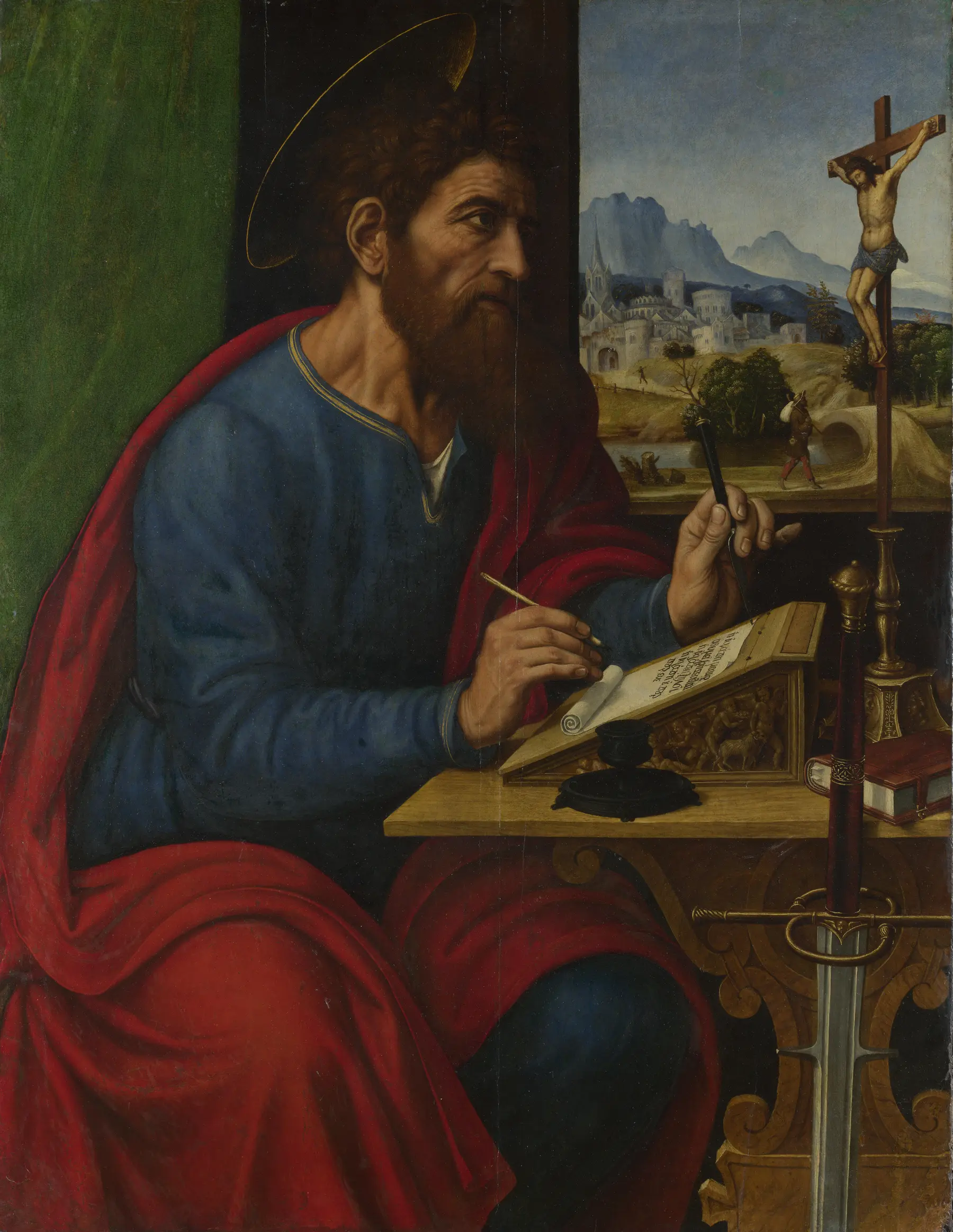
Who and where
1 name in this verse with a page on the site.
This page draws on 29 works. Open the list of works
This page draws on Adam Clarke, Commentary on the Bible; Albert Barnes, Notes, Explanatory and Practical, on the Old and New Testaments (1832-1869); Basil of Caesarea, OF THE HOLY SPIRIT 9.23-10.24; Clement of Alexandria, The Stromata Book 2; Cyril of Jerusalem, Catechetical Lecture 15:33; Eusebius of Caesarea, ECCLESIASTICAL HISTORY 3.32; GK Chesterton, All Things Considered, Science and Religion (1908); Hippolytus of Rome, Hippolytus Refutation of All Heresies Book IX; Irenaeus, Against Heresies Book II; Irenaeus, Against Heresies Book I; J. B. Lightfoot, Notes on the Epistles of St Paul; Jerome, Against the Pelagians 2.10; John Cassian, CONFERENCES 14.16; John Chrysostom, Homily on 1 Timothy 18; John Gill, Exposition of the New Testament (1746-1748); John Wesley, Explanatory Notes upon the New Testament; Leo the Great, SERMONS 85.3; Matthew Henry, Commentary on the Whole Bible; Nicetas of Remesiana, EXPLANATION OF THE CREED 8; Oecumenius, COMMENTARY ON 1 TIMOTHY; Origen of Alexandria, HOMILIES ON LEVITICUS 4.3; Origen of Alexandria, Commentary on John 13.343; Origen of Alexandria, AGAINST CELSUS 3.11; Tertullian, The Prescription Against Heretics; Tertullian, PRESCRIPTIONS AGAINST HERETICS 25; Theophylact of Ohrid, Commentary on 1 Timothy; Thomas Aquinas, Commentary on 1 Timothy; Vincent of Lérins, COMMONITORIES 21 and Vincent of Lérins, COMMONITORIES 24.