
1 Samuelchapter 6
21 verses · BSB1 Samuel book hub →
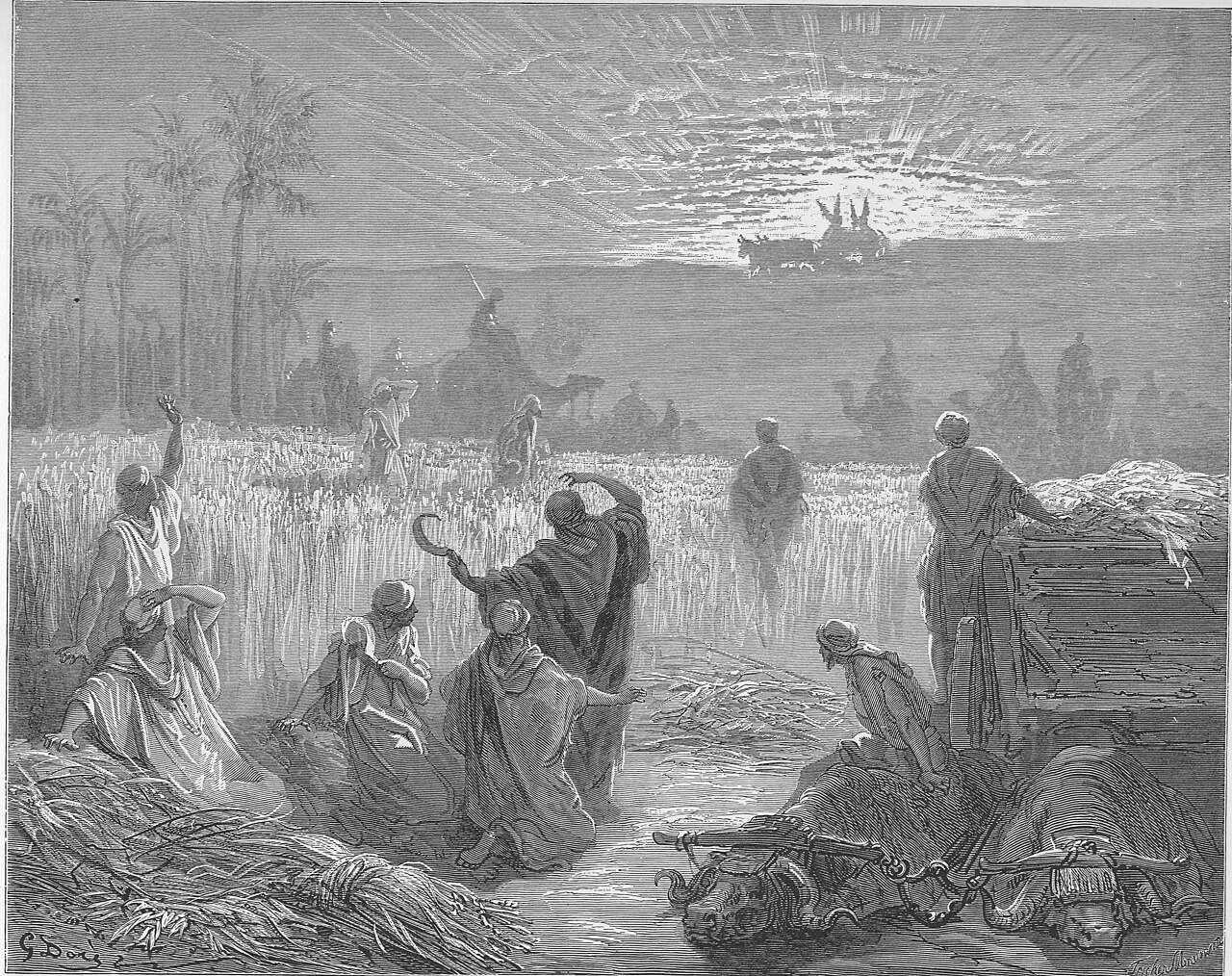
The Ark Is Returned to Beth-shemesh, Gustave Doré, Doré's English Bible (1866), public domain
Key verse
but keep watching it. If it goes up the road to its homeland, toward Beth-shemesh, it is the LORD who has brought on us this great disaster. But if it does not, then we will know that it was not His hand that punished us and that it happened by chance.”
It stands in scene A of the chapter, verses 1 to 9.
The chapter
Chapter summary
After seven months the priests advise returning the ark with a trespass-offering of five golden tumors and five golden mice, one per Philistine lord, warning against hardening the heart as Pharaoh hardened his. They devise a test: yoke two milch kine that never bore a yoke, shut up their calves, and watch. The cows go straight up the road to Beth-shemesh, lowing as they go, turning neither to the right hand nor to the left. Judah's harvesters rejoice and offer them. Then men of Beth-shemesh look into the ark and are struck, and they too ask: 'Who is able to stand before Jehovah, this holy God?'
Context
History · Samuel, Nathan, Gad · 1 Samuel overview
Where the chapter sits
1 Samuel 6 falls in Samuel's rise (chapters 1–7). Hannah's prayer; Samuel's call (‘Speak, for thy servant heareth’); Eli's house judged; the ark captured and returned; Samuel judges all Israel at Mizpah.
After it: The demand for a king, chapters 8.
The whole shape of 1 Samuel→The world behind this chapter
1 Samuel 6The history
The Philistine priests and diviners design a controlled experiment, and it is a good one. Take a new cart never used for common work, yoke two milk cows that have never been yoked, shut their calves up at home, and let them go. Every instinct in a nursing cow says turn back to the calf; no untrained animal walks a straight road under a strange yoke. If they go up to Beth-shemesh anyway, this was God's hand and not chance.
The rest of the history, and what it meant to them
The gold sent with it is a guilt offering in the shape of the affliction, five golden tumors and five golden mice, one for each ruling city. Making a model of the plague and sending it away with the offended power is sympathetic magic, a common practice in the region, and the Philistines are using their own religion as best they know how. The advice they give each other is telling: do not harden your hearts as Egypt and Pharaoh did. Israel's exodus was still a live story among the nations four hundred years later.
Beth-shemesh was a Levitical town on the Judah side of the valley, which is why Levites are on hand to lift the ark down. The people are in the middle of wheat harvest, early summer, everyone in the fields, when they look up and see the cart coming.
Then the joy turns. Men of Beth-shemesh look into the ark, and many die. The Law was explicit that even the Levites who carried the holy things must not look at them, on pain of death. The chapter ends with a question that is really a complaint: who is able to stand before the LORD, this holy God?, and they pass the ark on to Kiriath-jearim rather than keep it.
What it meant to them
The first hearers had just watched God defend himself among the Philistines without a single Israelite lifting a finger. Now they watch him refuse to be handled casually by his own people either.
That is the balance the chapter strikes. The ark comes home on its own, driven by nothing but the hand of God, and it is not tame when it arrives.
Sources cited
- Roland de Vaux, Ancient Israel: Its Life and Institutions
- John H. Walton, Victor H. Matthews, and Mark W. Chavalas, The IVP Bible Background Commentary: Old Testament
A. A new cart, two milch kine, and golden tumors
1. (vv. 1-3)
a.The ark spends seven months among the Philistines before their priests and diviners are asked what to do with it, and the answer they give quotes Israel's own theology back at them: send a trespass offering, for the hand of the God of Israel is not removed without cause. This stretch belongs to the larger arc that opens at Shiloh's fall in chapter four and does not close until David brings the ark up to Zion in 2 Samuel six. The priests never name the Lord; they only fear him.
1 Samuel 6:1, 1 voiceWhat preachers and commentators have said about these verses, in their own words.
1 Samuel 6:1
“And the ark of the Lord was in the country of the Philistines seven months. Or "in the field" (c) of the Philistines; hence Procopius Gazaeus observes, that none of the cities daring to receive the ark, they left it without under the open air, so thinking they should be delivered from their calamity.”
1 Samuel 6:2, 3 voices
1 Samuel 6:2
“The diviners - קסמים kosemim, from קסם kasam, to presage or prognosticate. See Deu 18:10. In what their pretended art consisted, we know not.”
Adam Clarke· Commentary on the Bible (1810-1826)evangelical
1 Samuel 6:2
“2, 3. the Philistines called for the priests and the diviners--The designed restoration of the ark was not, it seems, universally approved of, and many doubts were expressed whether the prevailing pestilence was really a judgment of Heaven.”
Jamieson, Fausset & Brown· Commentary Critical and Explanatory on the Whole Bible (1871)reformed
1 Samuel 6:2
“They were supposed to be best acquainted both with the rules of wisdom and with the rites of worship and atonement. And the Israelites being their neighbours, and famed above all people for the institutions of their religion, they had no doubt the curiosity to acquaint themselves with their laws and usages; and therefore it was proper to ask them, What shall we do to the ark of Jehovah?”
Matthew Henry· Commentary on the Whole Bible (1707-1721)puritan
1 Samuel 6:3, 2 voices
1 Samuel 6:3
“Send it not empty - See the marginal references. The pagan idea of appeasing the gods with gifts, and the scriptural idea of expressing penitence, allegiance, or love to God, by gifts and offerings to His glory and to the comfort of our fellow worshippers, coincide in the practical result.”
1 Samuel 6:3
“But those who by wilful sin have imprisoned the truth in unrighteousness, as the Philistines did the ark ( Rom. i. 18 ), may conclude that there is no making their peace with him whom they have thus injured but by a sin-offering; and we know but one that can take away sin.”
Matthew Henry· Commentary on the Whole Bible (1707-1721)puritan
2. (vv. 4-6)
a.The Philistines answer with images of the two plagues that struck them, one gold figure of each for every lord, a votive practice common among the nations of the ancient world. Their own priests then reach for the one precedent that fits, asking why Israel's neighbors should harden their hearts as the Egyptians and Pharaoh once did, a comparison that only makes sense if the exodus story had already reached Philistine ears. Wesley reads the choice of gold as testimony rather than defiance, an offering meant to gain favor rather than mock the God who sent the plague.
1 Samuel 6:4, 3 voices
1 Samuel 6:4
“Five golden emerods, and five golden mice - One for each satrapy. The emerods had afflicted their bodies; the mice had marred their land. Both, they considered, as sent by God; and, making an image of each, and sending them as a trespass-offering, they acknowledged this. See at the end.”
Adam Clarke· Commentary on the Bible (1810-1826)evangelical
1 Samuel 6:4
“Five golden emerods--Votive or thank offerings were commonly made by the heathen in prayer for, or gratitude after, deliverance from lingering or dangerous disorders, in the form of metallic (generally silver) models or images of the diseased parts of the body.”
Jamieson, Fausset & Brown· Commentary Critical and Explanatory on the Whole Bible (1871)reformed
1 Samuel 6:4
“Emerods - Figures representing the disease. These they offered not in contempt of God, for they fought to gain his favour hereby; but in testimony of their humiliation, that by leaving this monument of their own shame and misery, they might obtain pity from God.”
John Wesley· Explanatory Notes upon the Old Testament (1765)evangelical
1 Samuel 6:5, 3 voices
1 Samuel 6:5
“He will lighten his hand from off you - The whole land was afflicted; the ground was marred by the mice; the common people and the lords afflicted by the haemorrhoids, and their gods broken in pieces.”
Adam Clarke· Commentary on the Bible (1810-1826)evangelical
1 Samuel 6:5
“Give glory - The glory of his power in conquering you, who seemed to have conquered him; of his justice in punishing you, and of his goodness if he relieve you.”
John Wesley· Explanatory Notes upon the Old Testament (1765)evangelical
1 Samuel 6:5
“Note, Sinners lengthen out their own miseries by obstinately refusing to part with their sins. Egypt's plagues would have been fewer than ten if Pharaoh's heart had not been hardened not to let the people go. But at length it is determined that the ark must be sent back; there is no remedy, they are undone if they detain it.”
Matthew Henry· Commentary on the Whole Bible (1707-1721)puritan
1 Samuel 6:6, 2 voices
1 Samuel 6:6
“Wherefore, &c. - They express themselves thus, either because some opposed the sending home the ark, though most had consented to it; or because they thought they would hardly send it away in the manner prescribed, by giving glory to God, and taking shame to themselves.”
John Wesley· Explanatory Notes upon the Old Testament (1765)evangelical
1 Samuel 6:6
“It seems they were well acquainted with the Mosaic history, and could cite precedents out of it. This good use we should make of the remaining records of God's judgments upon obstinate sinners, we should by them be warned not to harden our hearts as they did. It is much cheaper to learn by other people's experience than by our own.”
Matthew Henry· Commentary on the Whole Bible (1707-1721)puritan
3. (vv. 7-9)
a.A new cart with two milch kine that have never worn a yoke is the priests' test, and the same two words return in Scripture only twice more, both times for David's own first attempt to bring the ark up in 2 Samuel six, verse three. The choice is not reverence but a controlled trial: cows fresh from calving would by every natural instinct turn back for their young rather than hold a strange road alone. Numbers four and seven had assigned the ark to Kohathite shoulders and forbidden the touch that later killed Uzzah, and the men who devise this cart do not know it; David will copy their expedient before he learns the same lesson.
1 Samuel 6:7, 2 voices
1 Samuel 6:7
“A new cart ... kine on which there hath come no yoke - This was so ordered in reverence to the ark, and was a right and true feeling. See Mar 11:2; Mat 27:60. For the supposed special virtue of new things, see Jdg 16:7, Jdg 16:11.”
1 Samuel 6:7
“Milch kine, &c. - In respect to the ark; and for the better discovery, because such untamed heifers are apt to wander, and keep no certain and constant paths, as oxen accustomed to the yoke do, and therefore were most unlikely to keep the direct road to Israel's land.”
John Wesley· Explanatory Notes upon the Old Testament (1765)evangelical
1 Samuel 6:8, 1 voice
1 Samuel 6:8
“The jewels of gold - The word קלי keley, which our translators so often render jewels, signifies vessels, implements, ornaments, etc. A jewel of gold has an odd sound to those who always attach the idea of a precious stone to the term.”
Adam Clarke· Commentary on the Bible (1810-1826)evangelical
1 Samuel 6:9, 3 voices
1 Samuel 6:9
“Bethshemesh was the first Israelite town they would come to, being on the border of Judah. (See the marginal reference.)”
1 Samuel 6:9-12
“Beth-shemesh--that is, "house of the sun," now Ain Shems [ROBINSON], a city of priests in Judah, in the southeast border of Dan, lying in a beautiful and extensive valley.”
Jamieson, Fausset & Brown· Commentary Critical and Explanatory on the Whole Bible (1871)reformed
1 Samuel 6:9
“His own coast - Or Border, that is, the way that leadeth to his coast, or border, namely, the country to which it belongs. Then he, &c. - Which they might well conclude, if such heifers should against their common use, and natural instinct, go into a strange path, and regularly and constantly proceed in it, without any man's conduct.”
John Wesley· Explanatory Notes upon the Old Testament (1765)evangelical
B. The cows go straight to Beth-shemesh, lowing
1. (vv. 10-12)
a.The Philistines carry out the test exactly as their priests prescribed: two milch kine tied to the cart, their calves shut up at home, the ark and its coffer of golden images laid on top. Gill notes that Philistine workmen do the lifting here and are not struck down for touching it as Uzzah later was, because the law's prohibition bound Israel and not the nations who framed this trial. Once loosed, the kine ignore their calves' cries and hold a straight road to Beth-shemesh without turning aside, and the five lords who follow behind read that unnatural obedience as their own answer.
1 Samuel 6:10, 2 voices
1 Samuel 6:10-14
“You are aware, then, that when the ark of the testimony was seized by the enemies of Ashdod, and a terrible and incurable malady had broken out among them, they resolved to place it on a cart to which they yoked cows that had recently calved, for the purpose of ascertaining by trial whether or not they had been plagued by God's power on account of the ark, and if God wished it to be taken back to the place from which it had been carried away.”
Justin Martyr· written before 165· Dialogue with Trypho, Chapter CXXXIIpatristic
1 Samuel 6:10-11
“Thus the ark that was carried into the land of the Philistines, a trophy of their victory, carried back with it trophies of its own, and lasting monuments of the disgrace of the Philistines. Note, God will be no loser in his glory, at last, by the successes of the church's enemies against his ark, but will get himself honour from those that seek to do dishonour to him.”
Matthew Henry· Commentary on the Whole Bible (1707-1721)puritan
1 Samuel 6:11, 1 voice
1 Samuel 6:11
“And they laid the ark of the Lord upon the cart,.... Perhaps the same men that made the cart; however they were the Philistines, yet were not punished for touching it, as Uzzah was, though an Israelite, 2Sa 6:6. and the coffer with the mice of gold, and the images of their emerods; which coffer was placed in a purse or bag hung at the side of the ark, with the golden mice and emerods in it.”
1 Samuel 6:12, 3 voices
1 Samuel 6:12
“Lowing as they went - Calling for their calves. To the right hand or to the left - Some think they were placed where two roads met; one going to Ekron, the other to Beth-shemesh. It is possible that they were put in such circumstances as these for the greater certainty of the affair: to have turned from their own homes, from their calves and known pasture, and to have taken the road to a strange country, must argue supernatural influence.”
Adam Clarke· Commentary on the Bible (1810-1826)evangelical
1 Samuel 6:12
“Loving - Testifying at once both their natural and vehement inclination to their calves, and the supernatural power which over-ruled them to a contrary course. The lords went - To prevent all imposture, and to get assurance of the truth of the event. All which circumstances tended to the greater illustration of God's glory.”
John Wesley· Explanatory Notes upon the Old Testament (1765)evangelical
1 Samuel 6:12
“They went on lowing for their young ones, by which it appeared that they had not forgotten them, but that nature was sensible of the grievance of going from them; the power of the God of nature therefore appeared so much the greater, in overruling one of the strongest instincts of nature.”
Matthew Henry· Commentary on the Whole Bible (1707-1721)puritan
2. (vv. 13-14)
a.Beth-shemesh, a city given to the priests in Joshua twenty-one, is also the first Israelite town on the road out of Philistine territory, so the ark's return finds working reapers rather than idle watchers. The cart stops of itself at a great stone in Joshua's field, and the men break the wood for fuel and offer the kine as a burnt offering, a departure from the law's ordinary altar that Henry reads as fitting for an extraordinary day, since Shiloh itself lay empty. Nothing in the men's welcome yet hints at the judgment that falls at verse nineteen.
1 Samuel 6:13, 1 voice
1 Samuel 6:13
“Some observe that the returning ark found the men of Beth-shemesh, not idling or sporting in the streets of the city, but busy, reaping their corn in their fields, and well employed. Thus the tidings of the birth of Christ were brought to the shepherds when they were keeping their flock by night.”
Matthew Henry· Commentary on the Whole Bible (1707-1721)puritan
1 Samuel 6:14, 3 voices
1 Samuel 6:14
“22. If Bethshemesh is interpreted as "house of the sun," the house of the sun is the heavenly city. Here Joshua the Bethshemite signifies the Redeemer of the human race not so much by type as by his very name and dignity. For Joshua is called "savior" in our language. And the Lord says of himself: "The Son of man came to seek and to save that which was lost" (Luke 19:10). Hence it is also that Joseph is promised in a dream through the angel: "He shall save his people from their sins" (Matt. 1:21).”
Gregory the Dialogist· written before 604· Commentary on 1 Kings, Book 3, Chapter 4patristic
1 Samuel 6:14
“And the cart came into the field of Joshua, a Bethshemite,.... In that part of the valley where they were reaping wheat which belonged to him, whom we nowhere else read; whether a priest or Levite, which is not improbable, since this was a city of the Levites, or a common Israelite, is not certain: and stood there where there was a great stone; afterwards called the great stone of Abel, 1Sa 6:”
1 Samuel 6:14
“They clave the wood of the cart - Both the cart and the cattle having been thus employed, could no longer be devoted to any secular services; therefore the cattle were sacrificed, and the cart was broken up for fuel to consume the sacrifice.”
Adam Clarke· Commentary on the Bible (1810-1826)evangelical
3. (vv. 15-16)
a.Levites took down the ark: Levites, not the Philistine drivers, are the ones who lift the ark and its coffer of gold down from the cart, since Beth-shemesh is a Levitical city and its own men can do lawfully what the Philistines never could. The five lords watch the whole scene, the burnt offerings, the sacrifices, the joy of the town, before they turn back to Ekron the same day, twelve miles behind them. Their errand is finished: they came to see whether the plague had truly been the hand of Israel's God, and they leave having seen it.
1 Samuel 6:15, 2 voices
1 Samuel 6:15
“The word “Levites” here probably means priests Exo 4:14, sons of Levi, since Bethshemesh was one of the cities of the priests Jos 21:13-16. The burnt offering of the kine was not in any sense the offering of the men of Bethshemesh, but rather of the Philistine lords to whom the cart and the kine belonged. But the Bethshemites themselves, in token of their gratitude for such a signal mercy, now offered both burnt offerings and sacrifices, probably peace offerings, and doubtless feasted together with great joy and gladness (see 1Ki 8:62-66; Ezr 6:16-17).”
1 Samuel 6:15
“And, the case being extraordinary, the law for offering at the altar in the court of the tabernacle was dispensed with, and the more easily because Shiloh was now dismantled; God himself had forsaken it, and the ark, which was its chief glory, they had with them here.”
Matthew Henry· Commentary on the Whole Bible (1707-1721)puritan
1 Samuel 6:16, 1 voice
1 Samuel 6:16
“And when the five lords of the Philistines had seen it,.... Observed all that was done, how the kine performed their journey, drew the cart in which the ark was straight to Bethshemesh, stopped in a field near it, where it was received joyfully by the people, and sacrifices offered on account of it: they returned to Ekron the same day; as they might very well, since it was but twelve miles from Bethshemesh.”
4. (vv. 17-18)
a.The five images are counted out by city, Ashdod, Gaza, Ashkelon, Gath and Ekron, the same five lords named through the Philistine story down to Goliath's own city among them. The golden mice are then counted by every fenced city and open village the plague had reached, a scale of damage the emerods alone did not show. The narrator adds that the great stone still stood in Joshua's field when he wrote, an eyewitness marker of the kind Samuel's book plants at several turns.
1 Samuel 6:17, 1 voice
1 Samuel 6:17
“And these are the golden emerods, which the Philistines returned for a trespass offering unto the Lord,.... Along with the ark: for Ashdod one, for Gaza one, for Ashkelon, one, for Gath one, for Ekron one; which were the five principalities of the Philistines that belonged to the five lords before mentioned; and each of these were at the expense of a golden emerod, and sent it along with the ark to make atonement for the offence they had been guilty of in taking and detaining it.”
1 Samuel 6:18, 2 voices
1 Samuel 6:18
“Abel - This is mentioned as the utmost border of the Philistines territory, to which the plague of mice extended. And this place is here called Abel, by anticipation from the great mourning mentioned in the following verse. It is desirable, to see the ark in its habitation, in all the circumstances of solemnity.”
John Wesley· Explanatory Notes upon the Old Testament (1765)evangelical
1 Samuel 6:18
“Their proposal to offer a trespass-offering for their offence was conformable enough to divine revelation at that time; but to send such things as these for trespass-offerings was very foreign, and showed them grossly ignorant of the methods of reconciliation appointed by the law of Moses; for there it appears all along that it is blood, and not gold, that makes atonement for the soul.”
Matthew Henry· Commentary on the Whole Bible (1707-1721)puritan
C. Who is able to stand before this holy God?
1. (v. 19)
a.The number of the dead is a real textual question rather than a settled one. Some Hebrew manuscripts and Josephus give seventy alone without the fifty thousand, and Barnes reads the larger figure as a scribal note that crept in from the margin. Jamieson, Fausset and Brown instead keep the received Hebrew text and read the toll at roughly a twentieth part of the town, citing Josephus's own count of seventy out of fourteen hundred. What the text does not leave open is the ground of the judgment: the men looked into the ark that only priests were permitted to handle, and the town's grief in the same verse answers its own earlier joy.
1 Samuel 6:19, 3 voices
1 Samuel 6:19
“Fifty thousand and three score and ten - Read “three” score and “ten”, omitting “fifty thousand”, which appears to have crept into the text from the margin. It is not improbable that in their festive rejoicing priests, Levites, and people may have fallen into intemperance, and hence, into presumptuous irreverence (compare Lev 10:1, Lev 10:9). God had just vindicated His own honor against the Philistines; it must now be seen that He would be sanctified in them that come near Him Lev 10:”
1 Samuel 6:19
“God, instead of decimating, according to an ancient usage, slew only a twentieth part; that is, according to JOSEPHUS, seventy out of fourteen hundred (see Nu 4:18-22).”
Jamieson, Fausset & Brown· Commentary Critical and Explanatory on the Whole Bible (1871)reformed
1 Samuel 6:19
“Be not deceived, God is not mocked. Those that will not fear his goodness, and reverently use the tokens of his grace, shall be made to feel his justice, and sink under the tokens of his displeasure. Those that pry into what is forbidden, and come too near to holy fire, will find it is at their peril.”
Matthew Henry· Commentary on the Whole Bible (1707-1721)puritan
2. (vv. 20-21)
a.The men of Beth-shemesh answer their own judgment with a question the whole book has been building toward, who is able to stand before a holy God, and their next act is to send the ark away rather than examine what brought the judgment on themselves. Kirjath-jearim receives the summons and the ark comes to rest there for the years that follow, the next station on the road that runs from Shiloh's fall in chapter four to David's dance before it in 2 Samuel six. Clarke reads the men's question as blame thrown on the ark's severity rather than on their own trespass, the same instinct that first sent it away from Ashdod.
1 Samuel 6:20, 3 voices
1 Samuel 6:20
“Who is able to stand - Why this exclamation? They knew that God had forbidden any to touch his ark but the priests and Levites; but they endeavored to throw that blame on God, as a Being hard to be pleased, which belonged solely to themselves.”
Adam Clarke· Commentary on the Bible (1810-1826)evangelical
1 Samuel 6:20
“But thus, when the word of God works with terror on sinners' consciences, they, instead of taking the blame and shame to themselves, quarrel with the word, and put it from them, Jer. vi.”
Matthew Henry· Commentary on the Whole Bible (1707-1721)puritan
1 Samuel 6:20
“This they infer from that tremendous judgment, "Who is able to stand before the God of the ark?" To stand before God to worship him (blessed be his name) is not impossible; we are through Christ invited, encouraged, and enabled to do it, but to stand before God to contend with him we are not able.”
Matthew Henry· Commentary on the Whole Bible (1707-1721)puritan
1 Samuel 6:21, 2 voices
1 Samuel 6:21
“Kirjath-jearim - See Jos 9:17 note. It has been thought that there was a high place at Kirjath-jearim (the hill, 1Sa 7:1), the remnant of its old pagan sanctity when it was called Kirjath-Baal, “the city of Baal” (see Jos 18:14; 2Sa 6:2); and that for this reason it was selected as a proper place to send the ark to.”
1 Samuel 6:21
“It lay in the way from Beth-shemesh to Shiloh, so that when they sent to them to fetch it, we may suppose, they intended that the elders of Shiloh should fetch it thence, but God intended otherwise. Thus was it sent from town to town, and no care taken of it by the public, a sign that there was no king in Israel.”
Matthew Henry· Commentary on the Whole Bible (1707-1721)puritan
The text of this chapter
This page carries no textual note on 1 Samuel 6. Where this site has examined a place the manuscripts differ, the examination is in the manuscripts room. Every place this site examines →
This page draws on 9 works. Open for the list.
This page draws on Adam Clarke; Albert Barnes; Gregory the Dialogist, Commentary on 1 Kings, Book 3, Chapter 4; Jamieson Fausset and Brown, Commentary Critical and Explanatory on the Whole Bible; Jamieson, Fausset & Brown, Commentary Critical and Explanatory on the Whole Bible (1871); John Gill; John Wesley; Justin Martyr, Dialogue with Trypho, Chapter CXXXII and Matthew Henry.
Keep studying
On this page