
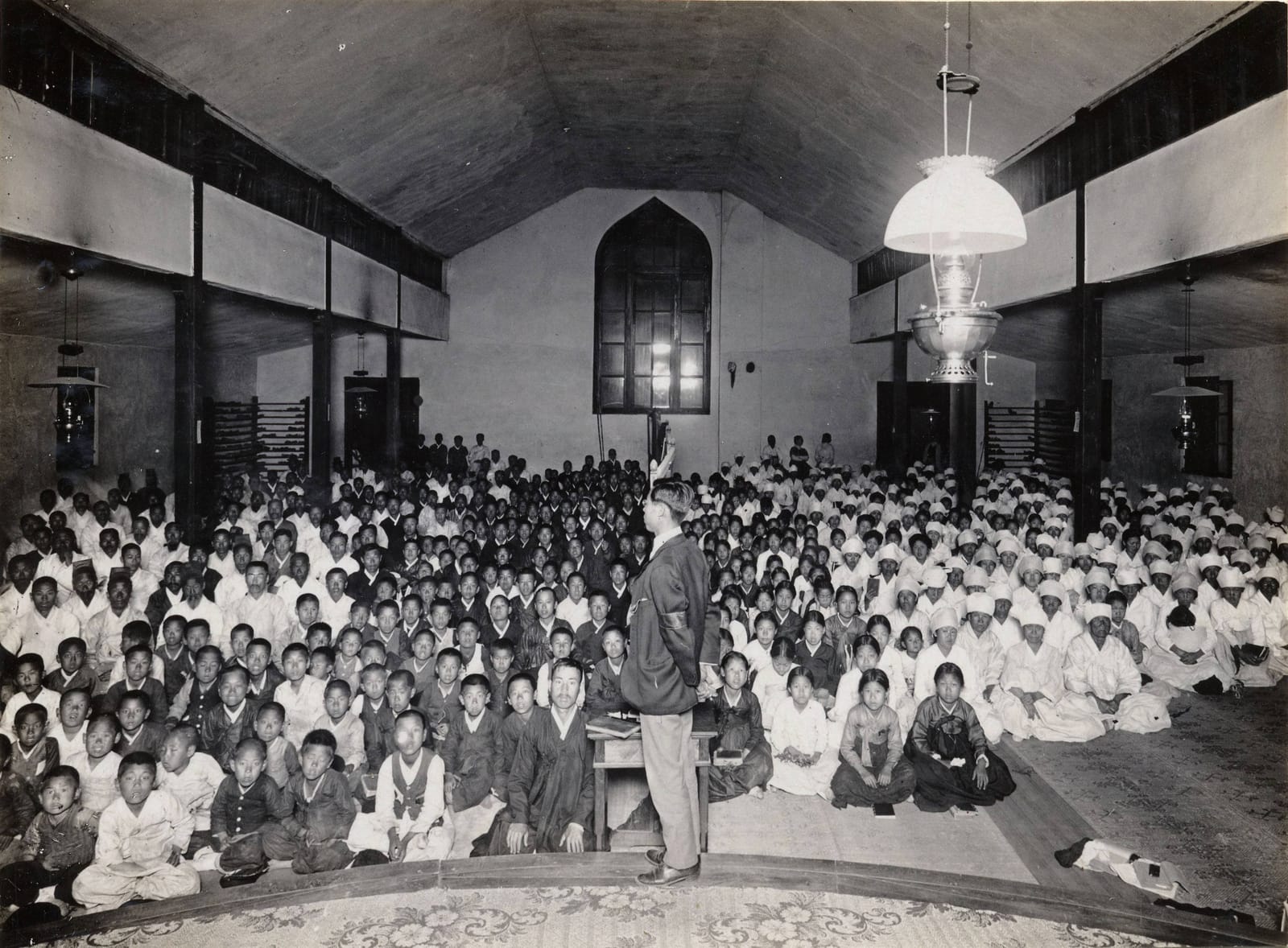
Prayer meeting, Pyeng Yang, 1908 to 1922. Public domain.
The revivals of 1904 to 1911 · Subject · Featured Study
The Fire That Went Around the World
Ten revivals on five continents in eight years, and the links between them that the records of the time name.
The Methodist board in 1909 found scarcely a feature of the meetings at Valparaíso that could not be matched in its own revivals in India, Korea and China.
And afterward, I will pour out My Spirit on all people. Your sons and daughters will prophesy, your old men will dream dreams, your young men will see visions.
Summary
Between 1904 and 1911 revivals broke out on five continents. They came in Wales, India, Los Angeles, Korea, Manchuria, Britain, South Africa, Chile and Brazil. The missionaries who wrote them up named some of the links between them. Those links stand here beside the dates.
- News of Wales stirred prayer in the Khasi Hills and at Mukti in 1905.
- In September 1906 a visitor told the Christians at Pyongyang of the revival in India.
- In February 1908 Jonathan Goforth told the churches of Manchuria of the revival in Korea.
- Willis Hoover led more than half of his members at Valparaíso into a new church.
The Promise of the Spirit for All People
Joel's promise, Peter's reading of it and the Lord's word on witness to the ends of the earth.
Joel promised the Spirit on all people, and Peter said at Pentecost that the promise had come. The Lord had sent His witnesses to the ends of the earth, and Habakkuk had prayed for revival in his own years.
The promise and its reach
‘In the last days, God says, I will pour out My Spirit on all people. Your sons and daughters will prophesy, your young men will see visions, your old men will dream dreams.
Peter reads Joel's promise at Pentecost as fulfilled in the last days.
Acts 2:17BSB
But you will receive power when the Holy Spirit comes upon you, and you will be My witnesses in Jerusalem, and in all Judea and Samaria, and to the ends of the earth.”
The Lord sends His witnesses, with the Spirit's power, to the ends of the earth.
Acts 1:8BSB
The prayer for revival
O LORD, I have heard the report of You; I stand in awe, O LORD, of Your deeds. Revive them in these years; make them known in these years. In Your wrath, remember mercy!
Habakkuk asks the Lord to revive His work in his own years.
Habakkuk 3:2BSB
So he said to me, “This is the word of the LORD to Zerubbabel: Not by might nor by power, but by My Spirit, says the LORD of Hosts.
The Lord tells Zerubbabel that His work is done by His Spirit and not by might.
Habakkuk 3:2, Zechariah 4:6
The Revivals in Order, 1904 to 1911
Ten revivals in eight years, from New Quay to Belém.
Ten revivals began within eight years, from New Quay in February 1904 to Belém in June 1911.
- Wales, at New Quay and then LoughorFebruary and November 1904The Welsh Revival, page 70
- The Khasi and Jaintia Hills, India5 March 1905Revival in India, page 30
- Mukti, near Poona, India29 and 30 June 1905Revival in India, page 44
- Los Angeles, at Bonnie Brae and Azusa Street9 April 1906How Pentecost Came to Los Angeles, page 44
- Pyongyang, Korea6 January 1907The Korea Pentecost, page 44
- Sunderland, England1907The Pentecostals, page 184
- Mukden, ManchuriaFebruary 1908The Revival in Manchuria, page 9
- South Africa1908The Pentecostals, page 120
- Valparaíso, ChileEarly 1909Annual Report of the Board of Foreign Missions, 1909, pages 5 to 6
- Belém, Brazil18 June 1911História das Assembléias de Deus no Brasil
A timeline of the revivals, each row with the work that fixes its date.
Mukden, Manchuria, South Africa, Valparaíso, Chile, Belém, Brazil
Each revival has its own page, and the era of the Revival Streams holds the years around them.
The Links the Records Name
Missionaries in India, Korea and Manchuria wrote down how news of one revival reached the next.
Seven links between the revivals are named in the records.
| The link | Who states it | What the record says |
|---|---|---|
| Wales to the Khasi Hills | Helen Dyer, 1907 | News of Wales stirred prayer through the Khasi and Jaintia Hills, and Christians in Wales prayed for the Khasi |
| Wales and the Khasi Hills to Mukti | Dyer, 1907 | Ramabai told her pupils of Wales in January 1905 and rejoiced that the revival had reached the Khasi Hills |
| India to Pyongyang | William Blair, 1910 | Howard Agnew Johnson told the Korean Christians of the blessings in India in September 1906 |
| Korea to Manchuria | James Webster, 1910 | Goforth had visited Korea the autumn before and told the Mukden church of its revival |
| Mukti to Valparaíso | Willis Hoover, 1922 | A booklet from Mukti reached Hoover in 1907, before word from friends in Chicago, as the Chile page reads his account |
| Oslo to Sunderland | Walter Hollenweger, 1972 | Alexander Boddy was drawn into the movement in 1907 at Oslo by T. B. Barratt |
| Zion to South Africa | Hollenweger, 1972 | Pentecostal missionaries came to the Zion church in South Africa in 1908, John G. Lake among them, a former elder of Dowie's church in Zion |
What the Records Leave Open
The Methodist reports and the Sunderland record leave two questions open.
Neither of the board's reports names Mukti. That link rests on Hoover's own account of 1922, which the Chile page reads in a reprint.
No record of the time read here gives the month of the Sunderland meetings of 1907. Barratt's book of 1909 says only that Boddy's daughters received their Pentecost at the vicarage.
One Fountain or a Web
The records of the field trace the revivals to one another, and some revivals were told from Azusa Street.
Dyer thought it fitting that the revival of Wales should be reproduced in the Khasi Hills, which she called the Welsh corner of the Indian mission field.
At Mukti, Ramabai called for volunteers to pray daily for revival in India, and seventy came forward. By June the praying band numbered 550, meeting twice a day, Dyer writes.
George Heber Jones and W. Arthur Noble, writing for the Methodist board in 1910, set the revivals of Wales and Korea side by side as works of the same years. They do not call one the cause of the other.
Walter Sloan, who signed the introduction to Webster's book, called a visit of two Manchurian workers to Korea late in 1907 an important link between the two revivals.
At Valparaíso Willis Hoover reported that members of his church had arranged whole nights of prayer early in the year.
Gunnar Vingren and Daniel Berg landed at Belém on 19 November 1910, by Emilio Conde's history.
In Their Own Words
Helen S. Dyer
Revival in India: Years of the Right Hand of the Most High, page 30
Dyer saw the revival spread through expectation and prayer.
“Then almost simultaneously it broke out elsewhere without any apparent connection, save that of expectation, preparedness, and fellowship in prayer.”
Evangelical
About this saying1 paragraph
Dyer wrote this in 1907 of the revivals in India after those of the Khasi Hills and Mukti.
Helen S. Dyer
Revival in India: Years of the Right Hand of the Most High, page 44
Dyer told the evening the Spirit fell at Mukti.
“The next evening, June 30, while Pandita Ramabai was expounding John viii. in the daily prayer meeting in her usual quiet way, the Holy Spirit descended with power, and all the girls began to pray aloud so that she had to cease talking.”
Evangelical
About this saying1 paragraph
Dyer printed this account of the second evening at Mukti two years after it, in 1907.
William Newton Blair
The Korea Pentecost and Other Experiences on the Mission Field, page 43
Blair named the news from India.
“Dr. Johnson told the Korean Christians about the blessings received in India and left a hunger in many hearts for similar manifestations of God's grace among us.”
Presbyterian missionary
About this saying1 paragraph
Blair wrote this of a visit to Pyongyang in September 1906, four months before the revival in the Central Church.
Books to Read Next
The Welsh Revival
W. T. Stead · 1905
Stead reports the revival in Wales while it was still running.
Free at the Internet ArchiveRevival in India
Helen S. Dyer · 1907
Dyer gathers the missionaries' reports from the Khasi Hills, Mukti and the rest of India.
Free at the Internet ArchiveThe Korea Pentecost
William Newton Blair · 1910
Blair tells the Pyongyang meetings as one of the missionaries who led them.
Free at the Internet ArchiveThe Revival in Manchuria
James Webster · 1910
Webster tells the Mukden meetings of 1908 and Goforth's report of Korea.
Free at the Internet ArchiveWhat the Revivals Handed On
The revivals of these years left churches on five continents that looked back to one another. Their missionaries wrote down the news that passed between them, and those records show a web of prayer and report.
Sources
Scripture is the Berean Standard Bible.
- The Holy Bible, Berean Standard Bible (read 2026)
- W. T. Stead, The Welsh Revival (Boston: Pilgrim Press, 1905), page 70.
- Helen S. Dyer, Revival in India: Years of the Right Hand of the Most High (1907), pages 30 to 31 and 43 to 44.
- Frank Bartleman, How Pentecost Came to Los Angeles: As It Was in the Beginning (Los Angeles: F. Bartleman, 1925), page 44.
- William Newton Blair, The Korea Pentecost and Other Experiences on the Mission Field (New York: Board of Foreign Missions of the Presbyterian Church in the U.S.A., about 1910), pages 43 and 44.
- George Heber Jones and W. Arthur Noble, The Korean Revival (New York: Board of Foreign Missions of the Methodist Episcopal Church, 1910), page 5.
- James Webster, The Revival in Manchuria (London: Morgan and Scott, 1910), pages 9 to 10, with the introduction signed by Walter B. Sloan.
- Annual Report of the Board of Foreign Missions of the Methodist Episcopal Church for the year 1909, the survey of the fields, pages 5 to 6.
- Annual Report of the Board of Foreign Missions of the Methodist Episcopal Church for the year 1910, page 39.
- T. B. Barratt, In the Days of the Latter Rain (London: Simpkin, Marshall, 1909), page 184.
- Walter J. Hollenweger, The Pentecostals (Minneapolis: Augsburg, 1972; German edition 1969), pages 120 and 184.
- Emilio Conde, História das Assembléias de Deus no Brasil (Rio de Janeiro, 1960), in a retyped edition whose page markers are not the printed pages.
Keep Studying
Church history14